

Chapter 1: The Elegant Facade of Grief
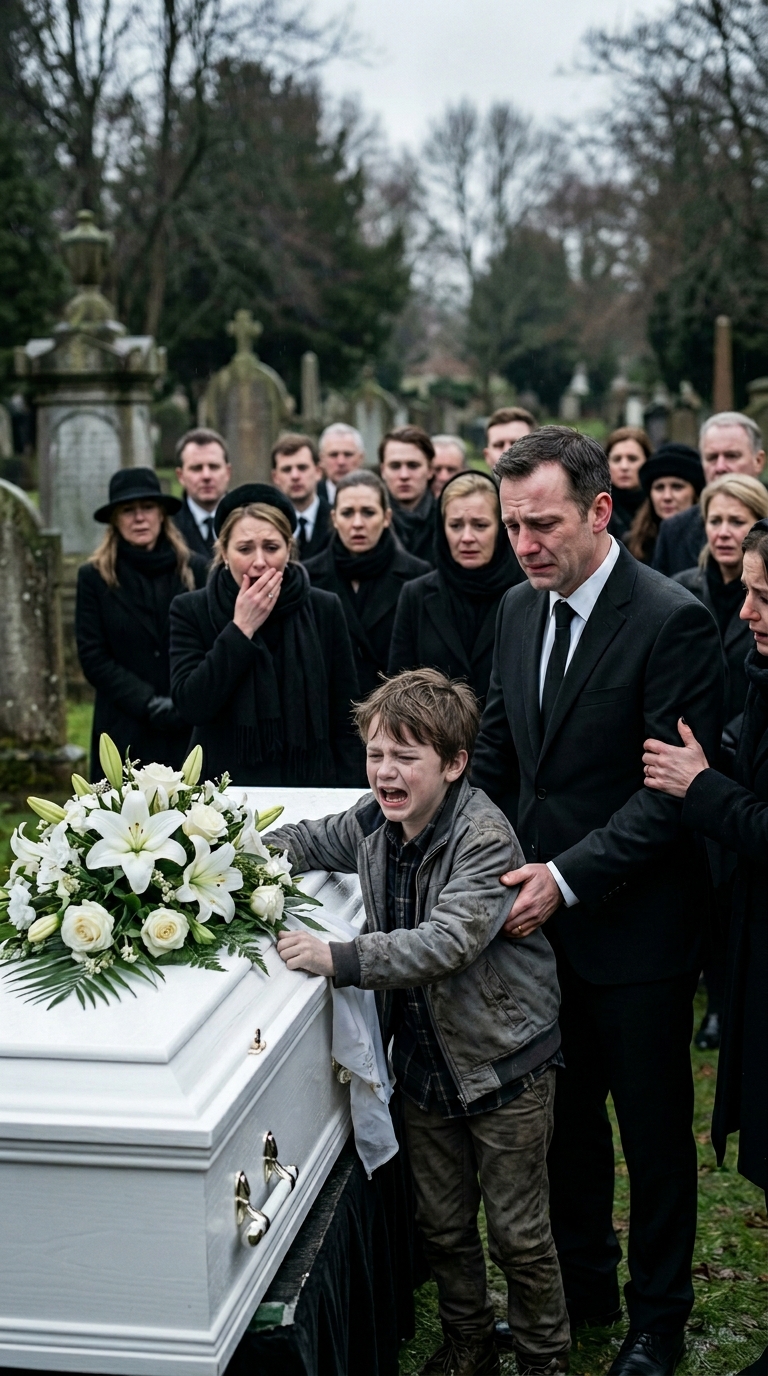
The memorial garden was a place designed to soften the edges of death. Pale stone paths wound gracefully between carefully trimmed evergreen trees, their branches whispering in the faint breeze. White lilies and roses lined the walkways like silent sentinels, their petals catching the harsh afternoon sunlight that filtered through a cloudless sky. Rows of mourners in crisp black attire stood solemnly, their faces a mosaic of practiced sorrow. Everything was orderly, measured, and controlled—a deliberate attempt to contain the chaos of loss.
At the center of it all rested a silver coffin, its polished surface reflecting soft flashes of light back into the crowd. Inside lay Emily Hayes, twenty-two years old, dressed in a simple white gown that seemed to glow against the dark lining. Her hands were folded neatly over her chest, her face peaceful—too peaceful, many whispered. The kind of stillness that made some guests shift uncomfortably, as if the scene was too perfect, too final.
Michael Hayes stood at the front, a tall man of forty-eight, his black suit impeccably tailored yet somehow hanging heavy on his frame. His black tie was knotted with precision, but his eyes were vacant, hollowed out by three relentless days of disbelief. Three days since the phone call from the hospital. Three days since he had identified her body in the cold morgue, the fluorescent lights buzzing overhead like angry insects. Three days since signing the papers that made it official.
My daughter is gone.
The words had become a mantra, repeated in the quiet hours of the night when sleep evaded him. Emily had always been his light—vibrant, independent, with a laugh that could fill a room and a stubborn streak that reminded him of her late mother. The car accident had come without warning: a late-night drive home from her shift at the hospital where she worked as a nurse. The reports said it was instantaneous. Michael had clung to that detail like a lifeline, but now, standing here, it felt like a lie.
People approached him one by one—neighbors, colleagues, distant relatives—offering condolences in hushed tones, wrapping him in awkward hugs, reciting prepared sentences about time healing wounds. He nodded mechanically, his responses empty. The pastor, an older man with a gentle voice, stepped forward and lowered his head.
“We return what was borrowed from us—”
Chapter 2: The Unexpected Interruption
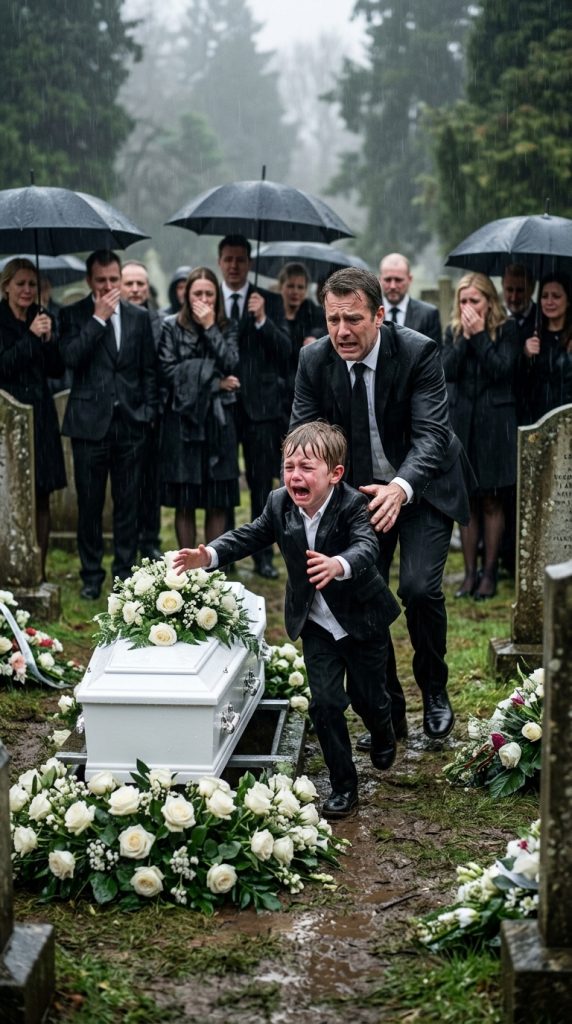
Then came the movement—fast, small, and utterly out of place. A child pushed through the crowd, weaving between legs and black-clad figures with surprising determination. Guests turned immediately, murmurs rippling through the gathering. An eight-year-old boy in a slightly oversized black suit, his curly brown hair tousled, his round face streaked with tears. He was too young for this scene, too full of raw urgency to be ignored.
Before security or any adult could react, he reached the coffin. His small hands gripped the side with surprising strength, and he looked directly at Michael.
“Wait, please!” the boy shouted, his voice cracking with emotion.
The entire memorial froze. The pastor’s words died in his throat. The wind itself seemed to hold its breath.
“She’s not dead!” the boy cried out.
Gasps echoed across the garden. Some guests exchanged shocked glances, others clutched their programs tighter. A woman in the back row let out a soft sob of disbelief.
Michael slowly lifted his head, his gaze locking onto the child. For a moment, grief had rendered language meaningless. Then understanding crashed over him like a wave, hardening his features. He stepped forward, the crowd parting instinctively around him.
“This is a funeral,” Michael said, his voice low and controlled, which only made the warning more menacing. “Get him out of here.”
But nobody moved. The boy stood his ground, tears spilling anew down his cheeks. His breathing was ragged, but his eyes burned with fierce determination.
“You’re lying,” Michael said, though something in his tone wavered.
The boy shook his head hard. “I’m not!” He glanced once at the coffin, then back at Michael. His small frame trembled, but he pressed on. “Her name is Emily. She has a scar on her wrist—shaped like a half moon.”
Michael blinked once, the world tilting slightly beneath his feet. Very few people knew about that scar. Emily had gotten it at six years old, during a family picnic when she’d fallen on broken glass from a dropped bottle. Eight stitches in the emergency room, and afterward, she had avoided sleeveless tops, always self-conscious about the faint crescent mark. It had been covered for the viewing. No public mention. No obituary. Nothing.
The boy noticed the shift in Michael’s posture—the subtle change in his shoulders, the flicker in his eyes. Hope sparked in the child’s expression for the first time.
Chapter 3: Whispers from Beyond
“I know because I saw it,” the boy continued, his voice smaller now but steady. He stepped closer, undeterred by the growing tension.
Michael’s jaw tightened. “Who told you that?” he demanded, his voice dropping dangerously.
The boy frowned, confusion crossing his tear-streaked face. “Nobody.”
Michael advanced another step, towering over the child. “Who brought you here? Who told you?”
The crowd stirred uneasily. A few hands reached out toward Michael, but he shrugged them off. The boy flinched but held his position.
“She told me,” he whispered.
Michael stared. “What?”
The child pointed toward the coffin. “She did.”
The garden descended into absolute silence. Even the distant hum of traffic from the city beyond the walls seemed to fade.
“Two days ago,” the boy—whose name, someone in the crowd later recalled, was Noah—continued, as if he had replayed this moment in his mind all night. “She was sitting on a bench near the old playground by the river. She was wearing white. She looked cold, like she hadn’t slept. She asked me if I knew where her dad was.”
Michael’s breathing grew shallow. His face emptied of color.
Noah swallowed hard. “She said she couldn’t go home. That they already buried her.”
A woman in the crowd covered her mouth, stifling a cry. Others whispered among themselves, the air thick with disbelief and dawning horror.
“She told me to remember the scar,” Noah added quietly. “If you open it… you’ll see.”
The pastor murmured Michael’s name softly, but it went unheard. Michael’s eyes drifted slowly to the coffin, lingering on the folded hands hidden beneath the white fabric.
Noah’s voice trembled but did not falter. “She said she was scared. She said she woke up.”
Chapter 4: The Weight of Doubt
The revelation hung in the air like smoke. Michael’s mind raced through memories: Emily’s laugh, her late-night texts checking on him after her mother’s death five years earlier, the way she had thrown herself into nursing to help others after her own brushes with fragility. The accident report had been thorough—head trauma, no pulse at the scene. Yet here stood this boy, knowing details no stranger could.
How had Noah even found the funeral? Perhaps he had followed the procession from the church, drawn by some inexplicable pull. Or maybe, as Michael would later wonder in sleepless nights, fate had orchestrated this impossible encounter. The boy spoke with the innocent certainty of a child who had no reason to lie, no agenda beyond delivering a message he barely understood.
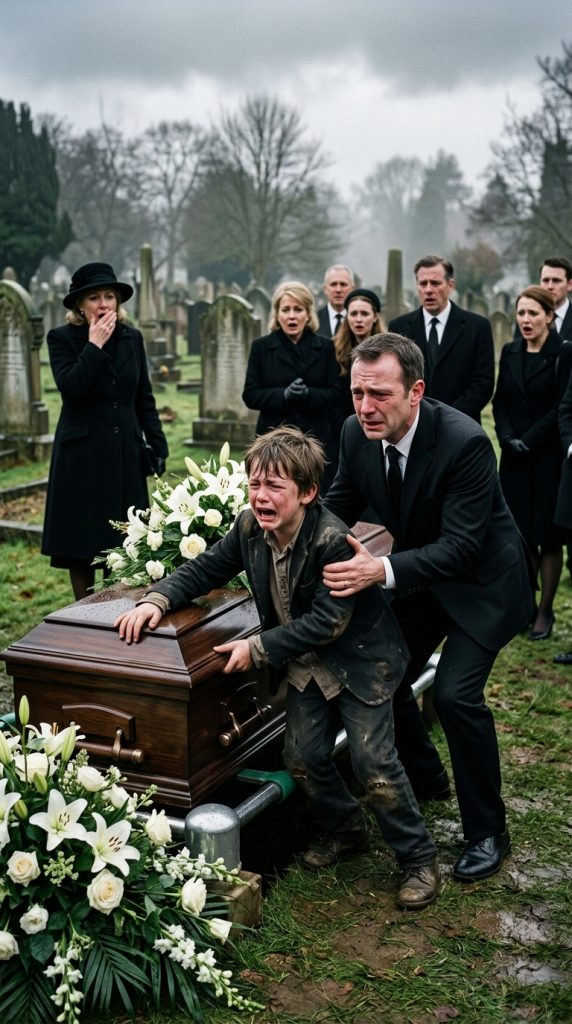
Michael’s hands shook as he approached the coffin. The crowd held its collective breath. Doubts flooded him—medical miracles, comas mistaken for death, the rare cases of catalepsy or Lazarus syndrome he had read about in frantic online searches during those three dark days. What if the doctors had been wrong? What if the identification, blurred by shock and tears, had been a terrible mistake?
He reached out, fingers brushing the cool silver lid. Noah watched with wide eyes, hope and fear mingling on his young face. In that moment, the elegant facade of the memorial garden cracked wide open, revealing the raw, unpredictable heart of human desperation.
Subtle details from Emily’s life flashed through Michael’s mind: her favorite white sundress, the one she wore on summer evenings; the way she volunteered at the children’s hospital, reading stories to kids like Noah; the quiet strength she had inherited from him. If there was even a sliver of possibility…
Chapter 5: Awakening
A groundskeeper was summoned, and with trembling hands, the lid was slowly lifted under the watchful eyes of the stunned gathering. Gasps turned to cries as the truth unfolded. Emily’s chest rose and fell—shallow, weak, but undeniably alive. Her eyes fluttered open moments later, confusion and terror giving way to recognition as she focused on her father’s face.
The scar on her wrist, revealed as her sleeve shifted, gleamed faintly under the sunlight like a crescent moon witness.
Paramedics, already on standby from the initial chaos, rushed in. Emily had been in a deep, medically induced coma-like state following the accident—misdiagnosed in the chaos of the ER. She had awakened disoriented in the morgue area two days prior, escaped in a haze, and wandered until she encountered Noah. Terrified and weak, she had begged the boy to find her father, sharing the scar as proof.
In the weeks that followed, recovery was slow and miraculous. Hospital rooms filled with tests, reunions, and tears. Michael never left her side, vowing to cherish every moment. Noah became a frequent visitor, the boy who had bridged life and death with nothing but courage and truth.
Final: The Boy Who Defied Death
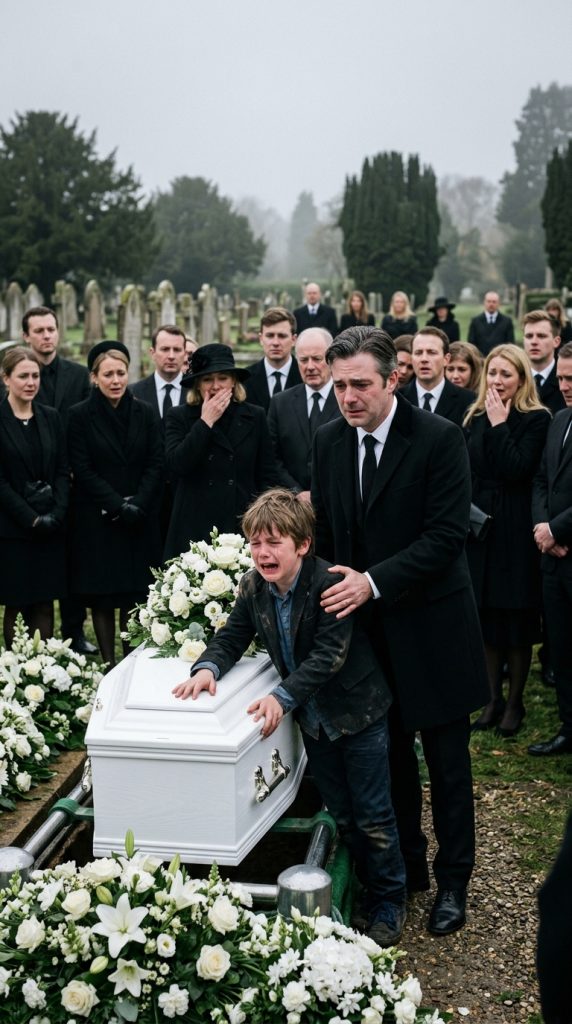
Michael once believed funerals were endings. But that day in the memorial garden taught him otherwise. Love, in its purest form, listens—even to the smallest voice in the crowd. Noah’s interruption wasn’t just a disruption; it was salvation.
Under the same golden afternoon light, now tinged with hope, Emily sat on a bench with her father and the curly-haired boy who had saved her. Her hand rested gently on Noah’s shoulder.
“Thank you,” she whispered.
The garden, once a place of elegant grief, bloomed anew with possibility. Life, it turned out, could push through even the heaviest lids of silver and sorrow.
