

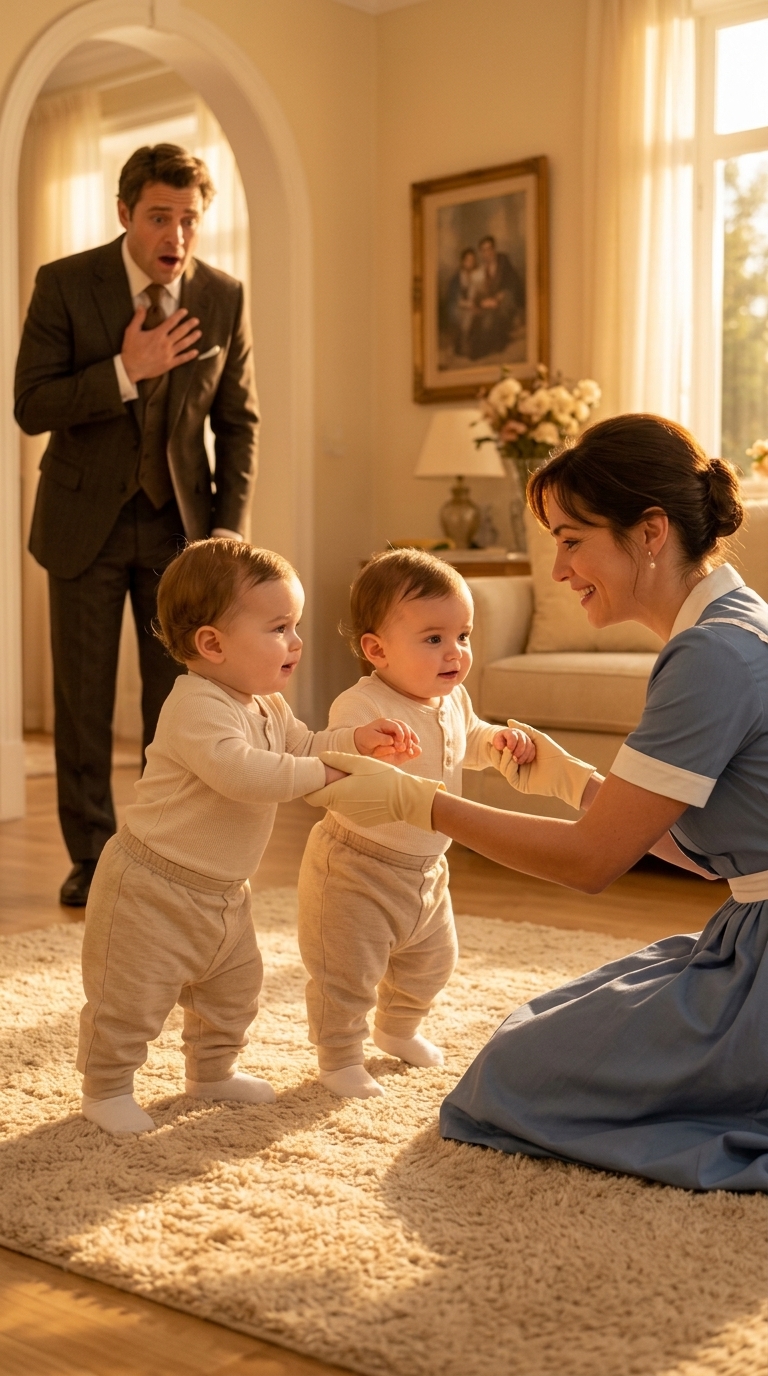
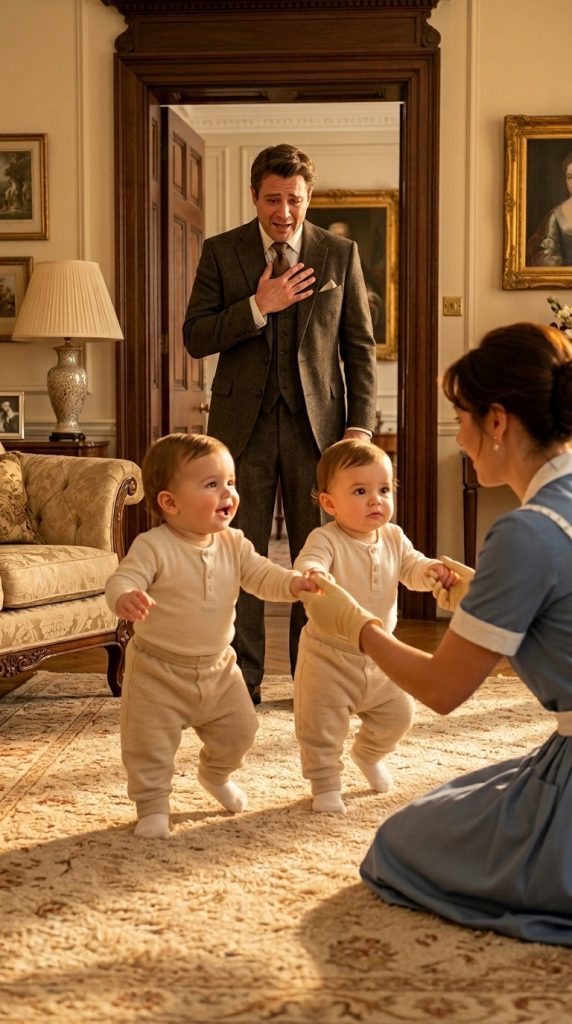
The millionaire had learned to control everything: markets, negotiations, people’s expectations. But as he stood frozen at the edge of the room, bathed in warm afternoon light, he realized there were moments no amount of power could command.
In front of him, the twins stood side by side, their small legs trembling with effort and excitement.
Their fingers were wrapped tightly around the hands of the young maid, who knelt slightly to meet them at eye level. She wore a simple blue dress with white collars, yellow gloves loosely fitted around her wrists, her blonde hair slipping from a loose bun as sunlight poured through the tall nursery windows.
“You can do it,” she whispered. “I’m right here.”
Not pulling.
Not pushing.
Only trusting.
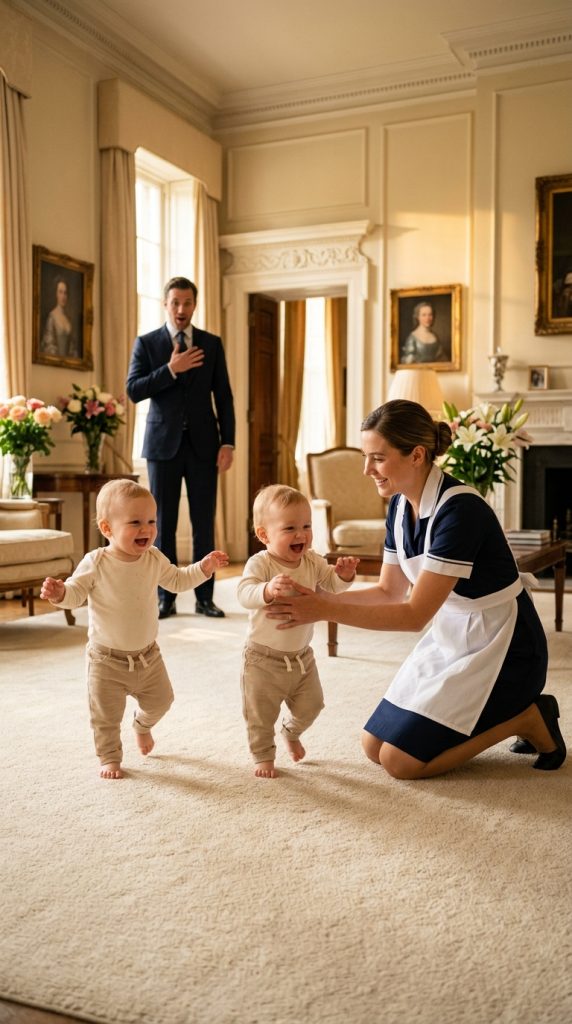
The twins laughed, that breathless little sound babies make when fear and joy feel exactly the same. Oliver, the braver one, leaned forward first. His tiny foot pressed into the soft cream rug. His brother Noah watched him with wide blue eyes, then copied him, wobbling so fiercely the maid nearly laughed through her own tears.
“That’s it,” she murmured. “One more. Come on, my little stars.”
The millionaire’s hand tightened around the doorframe.
Adrian Vale had faced collapsing companies without blinking. He had sat across from men who wanted to ruin him and made them shake his hand instead. He had buried his wife in a black suit that fit too perfectly and learned, afterward, how to speak in meetings while something inside him screamed.
But this—
This broke him.
Oliver let go.
For half a second, no one breathed.
Then Noah let go too.
Two tiny bodies stood alone in a room full of gold light, arms stretched wide, faces bright with disbelief, as if they had just discovered the world would hold them.
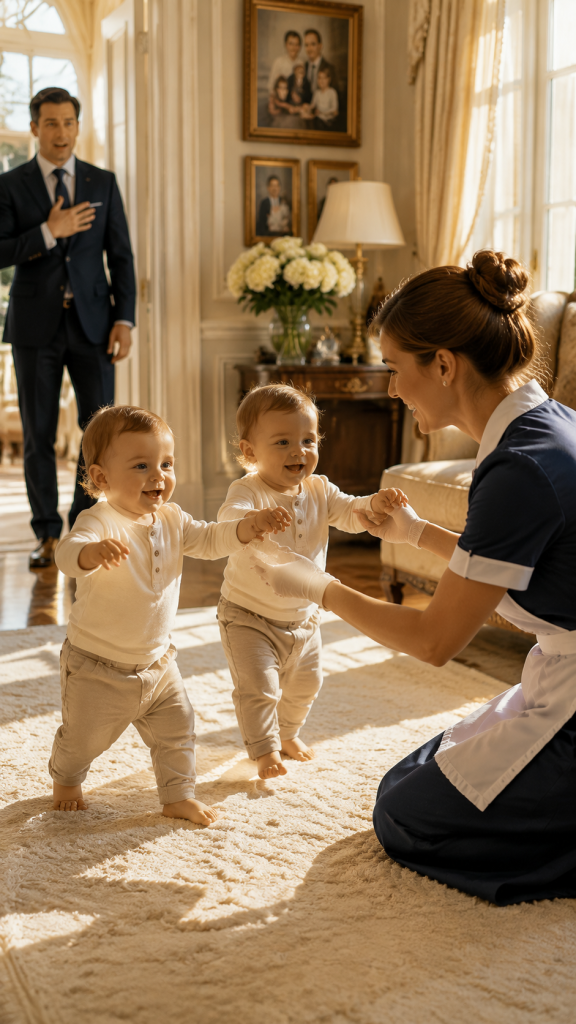
Adrian stopped breathing.
The maid looked up.
Her name was Elena.
She had been in his house for six months, quiet as morning, gentle as rain, hired first because the twins had rejected every nanny, every specialist, every woman with certificates framed in polished folders. They cried until they vomited. They scratched at their cribs. They reached toward empty spaces and made sounds that tore through Adrian’s chest because they sounded too much like questions.
Then Elena arrived wearing that plain blue uniform and holding no impressive résumé, only a handwritten letter from the old housekeeper and a voice so calm even grief seemed to lower itself when she spoke.
The first night, Noah slept against her shoulder.
The second night, Oliver did.
By the end of the week, Adrian had stopped pretending not to listen outside the nursery door.
Now Elena smiled at him, eyes shining, and nodded gently, as if she were inviting him into his own life.
“Come here,” she whispered.
Adrian shook his head once. Not because he didn’t want to.
Because he was afraid.
The twins saw him.
“Da!” Oliver squealed.
Noah bounced on his little feet, lost balance, and plopped onto the rug. For one terrible heartbeat, Adrian expected tears.
Instead, Noah laughed.
Elena laughed too, warm and low, and helped him back up.
“Go on,” she said softly. “Show your papa.”
Papa.
The word struck him harder than any accusation ever had.
He had fed them. Paid for them. Protected them from the sharp corners of the world. But had he been their father?
Or only the man who owned the house where their mother used to sing?
Adrian stepped forward.
One step.
Then another.
Oliver took three tiny, drunken steps toward him, cheeks flushed, mouth open in triumph. Noah followed, slower, one hand reaching for air.
Adrian dropped to his knees.
His expensive trousers pressed into the rug. His watch dug into his wrist. None of it mattered.
His sons fell into him.
Not gracefully. Not gently.
They crashed into his chest with all the force of two small miracles.
Adrian wrapped his arms around them and made a sound he did not recognize. It came from somewhere old and wounded, somewhere he had locked away the night his wife, Clara, died.
Elena turned her face toward the window.
But he saw her wipe her cheek.
That evening, the house felt different.
Not healed.
Not yet.
But awake.
The twins ate with mashed carrots on their cheeks and triumph in their eyes. Elena sat beside them, coaxing spoonfuls between giggles, while Adrian remained at the end of the table, watching the way she knew which child needed patience and which needed distraction.
“You should eat,” she said without looking at him.
“I am.”
“You’ve moved peas around your plate for twelve minutes, Mr. Vale.”
He stared at her.
No one in that house corrected him. No one teased him. No one saw him closely enough to notice anything except his authority.
Elena lifted one eyebrow.
Adrian picked up his fork.
A small smile touched her mouth.
And for one dangerous second, warmth moved through him so suddenly he almost hated it.
Because warmth asked for things.
It asked you to stay.
After dinner, he found her in the nursery folding tiny pajamas from the laundry basket. The twins were asleep, curled toward each other in their crib like two halves of the same secret.
“You were good with them today,” he said.
Elena kept folding.
“They were good with themselves.”
“I mean it.”
“I know.” Her voice softened. “But children don’t become brave because adults clap. They become brave when someone lets them be scared without being ashamed.”
Adrian looked at the crib.
Clara had said something like that once.
He swallowed.
“My wife made me promise they would grow up knowing love.”
Elena’s hands stilled.
“I remember.”
The room changed.
Adrian turned slowly.
“What did you say?”
Elena looked down at the tiny blue shirt in her hands. For the first time since he had met her, she seemed not calm but careful.
“I said I’m sure she did.”
“No.” His voice lowered. “You said, ‘I remember.’”
The silence stretched thin.
Outside, wind moved through the trees. The nursery mobile turned above the crib, little wooden moons circling in the dim light.
Elena folded the shirt once.
Twice.
Too neatly.
Then she set it down.
“I knew your wife,” she said.
Adrian’s pulse struck hard.
“How?”
Elena did not answer immediately. Her eyes went to the twins, then to the white rocking chair in the corner, the one no one used because Clara had died in it three weeks after giving birth, not suddenly, not dramatically, but quietly, while the nurse was downstairs and Adrian was in a meeting he still replayed in his nightmares.
“She used to come to the community clinic where I volunteered,” Elena said. “Before the boys were born.”
“My wife had private doctors.”
“Yes.” Elena’s voice trembled. “For her body.”
Adrian felt something cold enter him.
“What does that mean?”
Elena looked at him then, and there was no accusation in her face.
That made it worse.
“She was lonely,” she said. “Not neglected. Not abandoned. Just… lonely in the way people can be when everyone thinks their life is too beautiful to hurt.”
Adrian stepped back.
His first instinct was anger. Not at her. At the sentence. At the possibility that Clara had carried pain into places where strangers had held it better than he had.
“She never told me.”
“Maybe she tried.”
The words were soft.
They landed like a blade.
Adrian left the nursery without speaking.
That night, he did not sleep.
He went into Clara’s room.
Not the bedroom they had shared. That had been emptied of her scent by expensive cleaners and grief disguised as efficiency. This was the small sitting room she had loved, with pale curtains and shelves of books she arranged by color instead of author because she said life had enough systems.
Adrian had not opened the lower drawer of her desk since the funeral.
His hand shook when he did.
Inside were letters.
Dozens of them.
Some sealed.
Some unfinished.
Some addressed to him.
He sat down.
The first began with his name.
Adrian,
If I say I’m afraid, you try to fix the fear. I love that about you. I hate that about you. Some things do not need a solution. Some things need a witness.
He stopped.
His breath came unevenly.
He read another.
Today the babies kicked when you walked into the room. You were on the phone, angry about Singapore, but they knew your voice. I wanted to tell you. Then you looked so tired, and I swallowed it.
Another.
I met a girl at the clinic today. Elena. She listens like she’s holding a candle in both hands.
Adrian pressed the letter to his mouth.
Elena.
The name blurred.
He read until dawn.
By morning, the world had rearranged itself.
Elena found him in the sitting room just after six, still in yesterday’s shirt, surrounded by Clara’s handwriting.
She stopped at the doorway.
“You read them,” she said.
He nodded.
“Why didn’t you tell me?”
“Because she asked me not to.”
His eyes lifted.
“She knew I would hire you?”
Elena came inside slowly.
“She hoped.” A sad smile touched her face. “She said you would need someone you couldn’t intimidate.”
A laugh broke out of him, sharp and painful.
Then he covered his face.
Elena did not come closer. She did not comfort him too soon. She let him fall apart with dignity.
That was when Adrian understood why his sons trusted her.
She did not steal pain from people.
She stayed beside it.
Days passed.
Something fragile began to grow in the house.
Adrian came home earlier. At first, only by twenty minutes. Then an hour. Then one afternoon he canceled a dinner with investors because Noah had a fever and Oliver refused to sleep unless Adrian hummed the wrong lullaby badly enough to make Elena laugh from the hallway.
The staff noticed.
The twins noticed.
Elena pretended not to.
Spring softened into early summer. The gardens bloomed in reckless colors. The boys learned to walk properly, then run badly. They chased sunlight across polished floors and left fingerprints on glass doors that housekeepers no longer dared erase too quickly because Adrian smiled whenever he saw them.
One evening, Elena was in the garden with the twins, kneeling among crushed petals and toy trucks. Adrian watched from the terrace.
His mother stood beside him.
Vivian Vale had arrived without warning that morning, wearing pearls and judgment.
“She’s too familiar,” Vivian said.
Adrian did not look at her.
“She loves them.”
“She is paid to care for them.”
“There’s a difference.”
Vivian’s mouth tightened.
“You’re grieving. That makes men sentimental and careless.”
Adrian turned.
“And what did it make you?”
Her eyes sharpened.
“I beg your pardon?”
“When Clara died,” he said quietly. “You told me to remove her things before the boys formed attachments to ghosts.”
“I was protecting you.”
“No,” Adrian said. “You were protecting the family image from emotion.”
Vivian’s face hardened.
Below them, Elena lifted Noah into the air. His laughter spilled across the garden.
Vivian watched her.
Then she said the sentence that changed everything.
“You should be careful with that girl. Women like her study houses like ours from the servants’ entrance.”
Adrian’s voice went cold.
“Leave.”
His mother blinked.
“What?”
“Not tomorrow. Not after tea. Now.”
Vivian stared at him, stunned not by the order but by the fact that he meant it.
That evening, Elena found him in the library.
“You shouldn’t have done that because of me,” she said.
“I didn’t.”
She looked at him.
“I did it because of what I used to allow.”
Her expression softened.
He wanted to cross the room.
He did not.
Instead, he said, “Clara trusted you.”
Elena’s eyes filled.
“Yes.”
“So do I.”
That was all.
But it felt like more.
Summer came warm and golden.
The twins began calling Elena “Lena.” Then, one sleepy evening, Oliver called her “Mama” by mistake.
The room froze.
Elena’s face went white.
Adrian, sitting on the floor with a wooden train in his hand, felt the word tear through the air.
Noah repeated it, delighted by the sound.
“Mama.”
Elena stood too quickly.
“I’m sorry,” she whispered.
She left the nursery.
Adrian found her in the laundry room, one hand pressed to her mouth, shoulders shaking silently.
“They don’t understand,” she said before he could speak. “They’re little. They just—”
“I know.”
“I would never try to take her place.”
“I know.”
She turned to him, tears bright and angry now.
“No, you don’t. People always think care wants ownership. It doesn’t. Sometimes care is just care because there was a child crying and someone had arms.”
Adrian looked at her for a long moment.
Then he said, “Who held you?”
Elena went still.
The question seemed to reach a locked door inside her.
“No one important,” she said.
“That sounds like a lie.”
She laughed once, bitterly.
“My mother cleaned offices at night. My father left before I could remember his voice. I learned early that needing too much made people tired.”
Adrian stepped closer.
“You don’t tire me.”
Her eyes lifted.
The air between them changed again.
Not with passion.
With recognition.
Two wounded people standing in a room that smelled of soap and warm cotton, realizing they had been speaking the same language in different accents.
He did not touch her.
But he wanted to.
A week later, Adrian asked Elena to join them for dinner as a guest.
She refused.
He asked again.
She refused more softly.
The third time, she said, “People will talk.”
“People talk because silence gives them room.”
She smiled despite herself.
“You always sound like you’re closing a deal.”
“I’m very bad at this.”
“At what?”
“At asking someone to stay at the table because the house feels wrong when they don’t.”
Elena looked away.
But that night, she sat beside him.
The twins banged spoons like royalty.
Adrian watched Elena laugh with carrots on her sleeve and thought, with a sudden terror so pure it almost stopped his heart:
I am happy.
That was when the letter arrived.
It came in a cream envelope, hand-delivered, no return address.
Adrian opened it in his office after breakfast.
Inside was a copy of a birth certificate.
Elena Maris Whitmore.
Mother: Clara Evelyn Whitmore.
Father: Unknown.
Adrian stared at it.
The room tilted.
His assistant’s voice became distant through the intercom. Somewhere downstairs, one of the twins laughed.
He read the name again.
Clara Evelyn Whitmore.
Clara’s maiden name.
His wife.
Elena was twenty-four.
Clara had been forty-one when she died.
Impossible.
Unless.
Unless Clara had had a child at seventeen.
A child before Adrian.
A child she had never told him about.
A child who now lived in his house, loved his sons, carried his wife’s eyes, and had said in the nursery:
I remember.
Adrian found Elena in the garden.
She was sitting beneath the old magnolia, the twins asleep in a stroller beside her, one hand resting lightly over Noah’s blanket.
She saw his face and knew.
The color drained from her.
“Who sent it?” she asked.
“You tell me.”
Her mouth trembled.
“I don’t know.”
“Is it true?”
She closed her eyes.
The silence was answer enough.
Adrian felt something inside him fracture—not cleanly, but with splinters.
“Clara had a daughter.”
Elena nodded.
“And you came here as my maid.”
“I came because she asked me to.”
“When?”
Elena’s voice broke.
“Before she died.”
Adrian stepped back.
“Why didn’t she tell me?”
“She wanted to.”
“Don’t defend her.”
“I’m not.” Elena stood now, pale but steady. “She was ashamed. She was seventeen. Her parents sent her away. She gave birth in another state. The adoption was sealed. She spent years looking for me quietly, and when she found me, she didn’t know how to tell you that the perfect wife you married had a wound older than your love.”
Adrian’s throat tightened.
“She should have trusted me.”
“Yes,” Elena whispered. “She should have.”
That honesty hurt more than any excuse.
“She found you?”
“Three years ago. We met at the clinic. At first she came as a volunteer donor. Then as a friend. Then one day she cried so hard she couldn’t speak, and I knew before she said it.”
Elena looked toward the twins.
“She wanted to bring me into the family slowly. Then she got pregnant. Then she got sick. Then everything became fear.”
Adrian’s voice was barely audible.
“And the boys?”
Elena’s eyes filled.
“They’re my brothers.”
The word moved through the garden like a bell.
Brothers.
Not sons to her.
Not charges.
Brothers.
All those months—her patience, her grief when they called her Mama, the way she looked at Clara’s rocking chair, the way she knew lullabies no one had taught her.
She had not entered his house to replace Clara.
She had entered it because Clara had left behind three children, and only one of them was old enough to keep a promise.
Adrian sat down on the stone bench because his legs would no longer hold him.
Elena stood before him, crying silently.
“She wrote me a letter,” Elena said. “She said if anything happened to her, I should come. Not as family. Not at first. She said you would be angry. She said grief makes proud men cruel without meaning to.”
Adrian flinched.
“She said to love the boys where she couldn’t.”
Elena wiped her face with the back of her hand.
“I didn’t want your money. I didn’t want this house. I wanted five minutes with her where no one was dying.”
Adrian covered his mouth.
For a moment, there was only wind.
Then Noah stirred in the stroller. His sleepy face crumpled.
Elena moved instinctively.
So did Adrian.
They both reached him at the same time.
Their hands touched over the blanket.
Neither pulled away.
Noah blinked up at them, then smiled.
“Lena,” he murmured.
Elena laughed through tears.
Adrian looked at her—really looked.
Not maid.
Not stranger.
Not threat.
Clara’s daughter.
His sons’ sister.
The missing piece of a woman he had loved and never fully known.
“I’m sorry,” Adrian said.
Elena shook her head.
“You didn’t know.”
“I should have known she was hurting.”
“We all should know more than we do.”
That sentence stayed with him.
The scandal broke two days later.
Vivian, of course.
She had sent the certificate first, then leaked the story when Adrian did not cast Elena out. Headlines appeared with polished cruelty: Secret Daughter Living as Maid in Billionaire’s Home. Questions followed. Cameras gathered at the gate. Reporters shouted Elena’s name as if it belonged to them.
Adrian stood in the foyer, watching Elena hold herself together while the twins clung to her skirt, frightened by the noise outside.
“I’ll leave,” she said.
“No.”
“They’ll hurt the boys.”
“They’ll hurt them more if I teach them love is something to hide.”
He called a press conference.
Elena begged him not to.
He did it anyway.
Not in a hotel ballroom.
Not behind lawyers.
On the front steps of the house, with sunlight behind him and the noise of cameras cracking like ice.
Vivian stood at the edge of the crowd, perfectly dressed, perfectly certain she had won.
Adrian looked into the cameras.
“My late wife had a daughter before we met,” he said. “Her name is Elena. She is not a scandal. She is not a servant girl with ambition. She is my wife’s child, my sons’ sister, and from this day forward, she is under my protection—not because she is weak, but because this family has hidden enough truth in the name of pride.”
A murmur moved through the reporters.
Vivian’s face went rigid.
Adrian continued.
“Clara spent her life carrying shame that never belonged to her. I will not let that shame be inherited.”
Behind him, the door opened.
Elena stood there, holding one twin on each hip.
She had not planned to come out.
But she did.
The cameras turned.
Oliver reached for Adrian.
Noah pressed his cheek into Elena’s shoulder.
And in front of the whole world, Adrian took Oliver into his arms and stepped beside her.
Not as a savior.
As family.
Vivian left before the questions began.
Months later, the house no longer felt like a museum of grief.
