

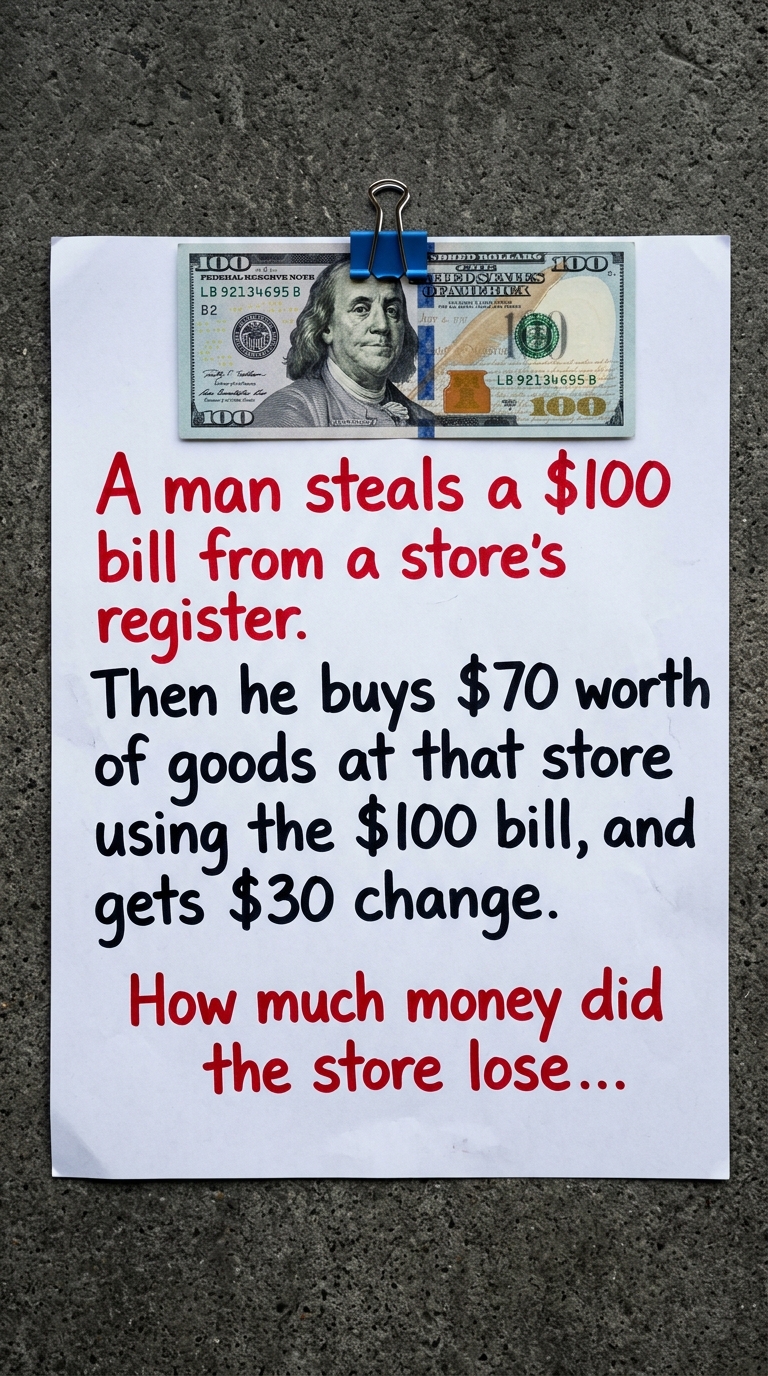
So, what was the actual loss for the store?
Take a moment to think it through. Most people completely miss the point of this puzzle because they separate the theft and the purchase into two unrelated events, when in fact everything comes down to tracking the same flow of money. The correct answer is simple: the store lost exactly $100.
This becomes clear when broken down step by step.
At first, the store has both its cash and its merchandise. Then a customer steals $100 from the register. At that moment, the store has clearly suffered a $100 loss.
But many people overcomplicate things from here. The thief later returns and uses that same stolen $100 bill to buy $70 worth of goods. Some assume the store loses both the cash and the products, but accounting doesn’t work that way. Once the transaction happens, that $100 bill goes back into the register. The store has effectively recovered its cash.
Breaking it down:
Step 1: The Theft
The thief takes $100. The store’s loss is $100. Simple enough.
Step 2: The Purchase
The thief returns and buys $70 worth of goods using the same $100 bill. The cashier accepts it without knowing its origin.
After the transaction, the $100 is back in the register. However, the store has now given away:
$70 worth of merchandise
$30 in cash as change
So the thief walks away with $70 in goods and $30 in cash, totaling $100.
In the end, the store’s real loss is $70 in inventory plus $30 in cash, which equals $100. There is no double counting, because the same $100 bill cannot be counted twice. The stolen money is returned to the register during the purchase, so the only actual loss is what left the store: goods and change.
The confusion happens because people mentally separate the theft from the sale, even though both involve the same $100 bill. That leads them to add losses incorrectly.
That’s why many people get it wrong at first. It’s not really a math problem—it’s a reasoning trick. The mind treats it as two losses instead of one continuous flow of value.
Once you see it clearly, it becomes obvious: the store lost exactly $100.
Did you get the right answer on your first try?
