

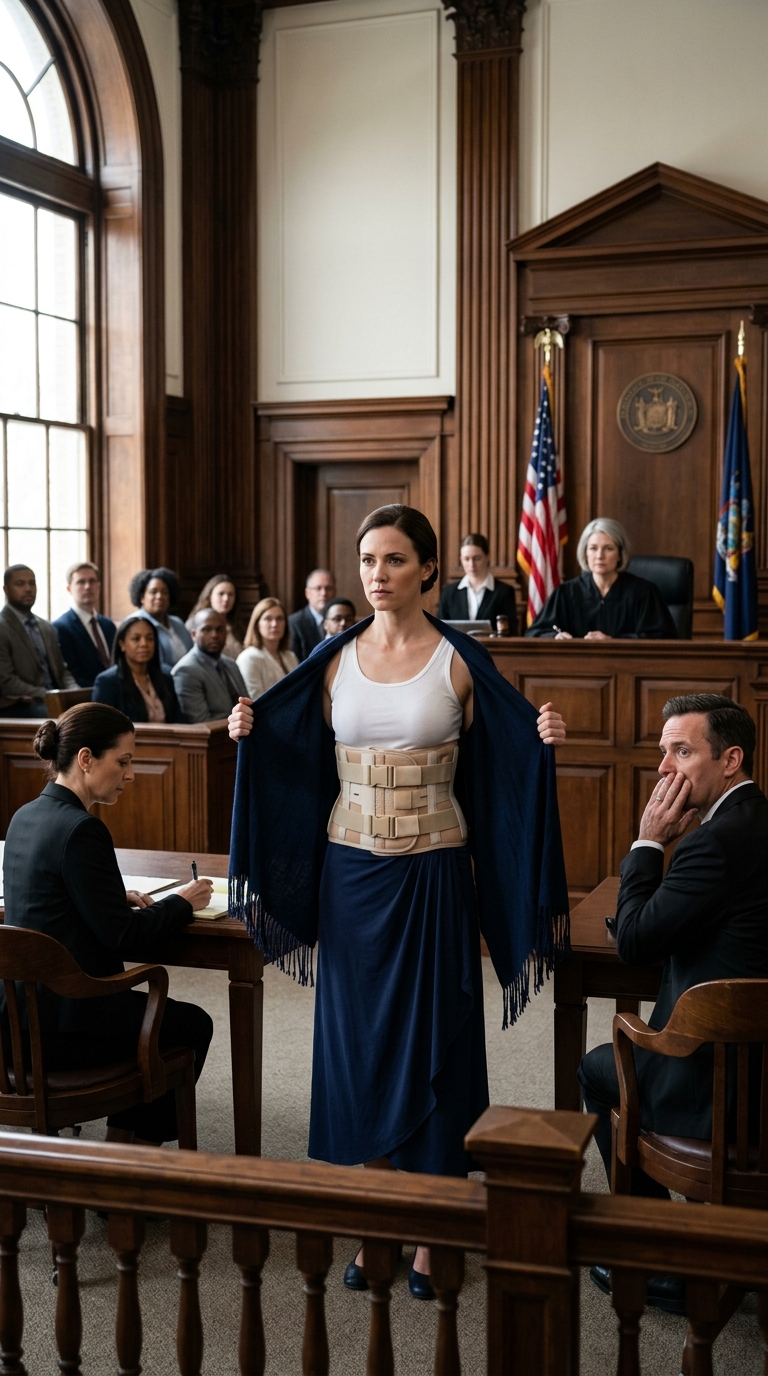
The sound of the zipper sliced through the courtroom as though time itself had frozen.
Lucía slowly removed the outer layer of her dress and neatly placed it over the back of her chair.
There was nothing dramatic or seductive about the way she moved.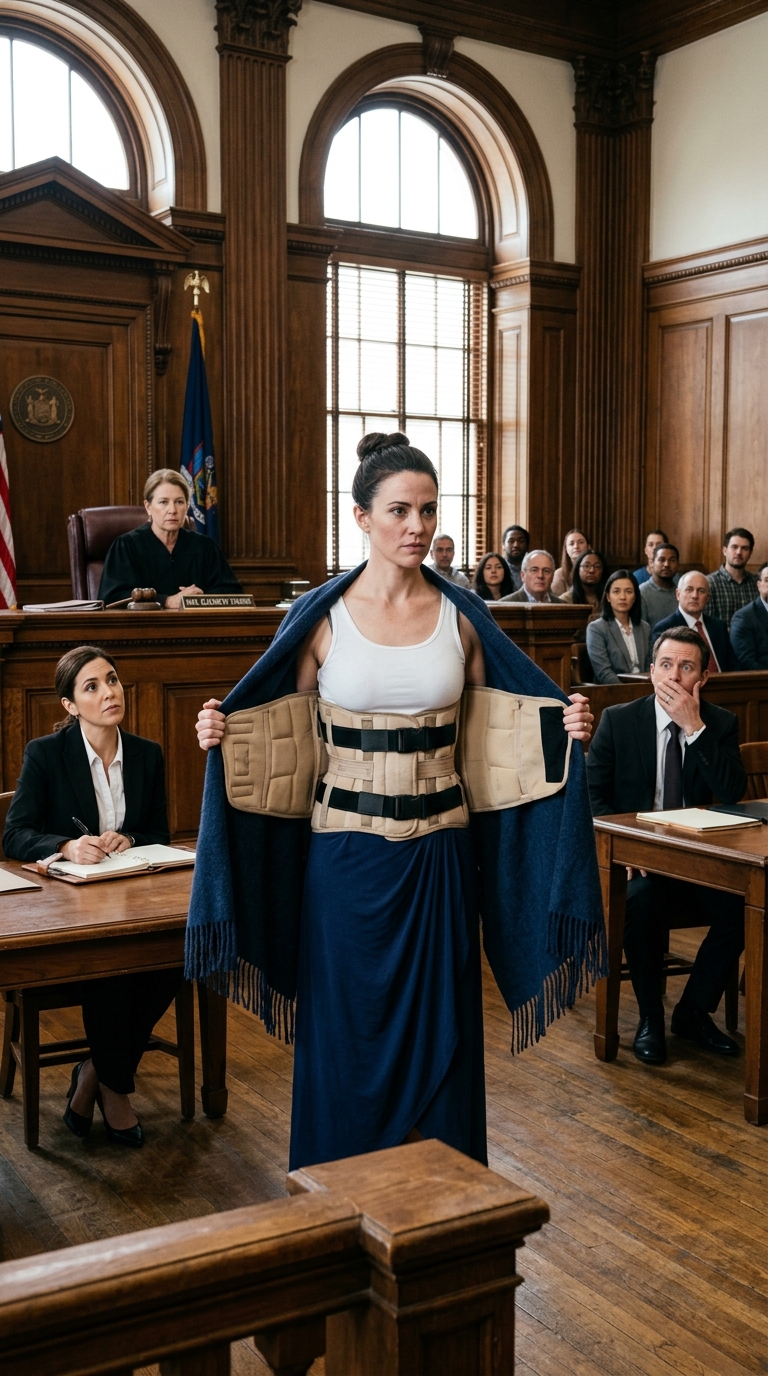
Beneath it, she wore a fitted medical compression garment and a rigid orthopedic brace wrapped around her torso from ribs to waist. Even through the fabric, the damage underneath was impossible to hide.
From her collarbone down to her hip, her skin carried severe scars—some pale and thin, others thick and raised.
These were not marks left by a simple accident. They were surgical scars, evidence of metal implants, and reminders of years of unbearable suffering.
For the first time, Alejandro couldn’t look at her.
Lucía presented medical evaluations confirming serious long-term injuries that directly contradicted his claim that she had merely “fallen.”
She explained that five years earlier, despite her fragile physical condition, Alejandro forced her to keep working during a critical period at the hacienda.
When she told him she could not continue, he insulted her and pressured her into obedience.
According to her testimony, during a violent argument, he shoved her, causing the devastating injuries. Afterward, he ordered her to lie about what had really happened. Alejandro denied everything in court, but the judge immediately cut him off.
A former foreman from the estate testified that he had seen Lucía injured and overheard Alejandro instructing staff to cover up the incident.
He also confirmed repeated patterns of labor exploitation and illegal financial practices within the business.
The defense submitted financial records exposing a years-long scheme in which Alejandro secretly redirected funds belonging to Lucía and hid income through shell companies while she was recovering from her injuries.
What unfolded in court revealed a disturbing history of abuse, manipulation, and financial fraud concealed beneath the image of a successful empire.
Lucía stood firmly before the judge and stated clearly that Alejandro’s success had been built on her labor, sacrifice, and silence.
Additional evidence followed: a notebook containing eleven years of financial records, emails, and forensic reports proving systematic embezzlement and concealed assets. It was also revealed that Alejandro had used shared funds for personal luxury purchases and intended to leave Lucía with nothing after the divorce.
Some of the messages even exposed his plan to destroy her reputation and discredit her health condition.
Ximena, their daughter, testified about the emotional abuse she had witnessed and how her father’s treatment of her mother changed drastically after the accident.
Her testimony confirmed years of psychological and domestic violence.
The trial ended with a ruling in Lucía’s favor: a 50% division of all marital assets, full financial compensation, frozen accounts under Alejandro’s name, and a criminal investigation into fraud and abuse.
Outside the courthouse, Lucía and Ximena embraced for the first time in years without fear standing between them. It wasn’t the end of the pain—but it was the beginning of freedom.
That night, inside a small apartment in Guadalajara, Lucía opened the window while Ximena quietly asked whether she was truly okay.
“I’m not whole,” Lucía admitted softly, “but I am free. And that is enough.”
Ximena confessed that she had once resented her mother, but now understood she had stayed to protect her.
Lucía, in turn, admitted her own mistake—teaching that love meant tolerating humiliation.
Time passed.
Lucía never portrayed herself as a victim. She closed that chapter completely, regained her assets, and co-founded a consulting firm with a close friend to help rescue struggling businesses.
Her experience surviving chaos became her greatest strength, and her success grew rapidly.
Years later, she crossed paths with Alejandro again inside a notary office.
He couldn’t meet her gaze.
Lucía signed the final paperwork and calmly told him she had never been his burden—she had been the foundation beneath everything he built.
As she walked away, she finally understood something important:
Some people mistake kindness for weakness.
And real life begins the moment you stop apologizing for your truth.
She got into the car beside Ximena, and they drove away—this time, the silence no longer hurt.
It was freedom.
