

Part 1
The girl was being searched for as if she were stolen cattle, and the only paper she clutched tightly to her chest said that her life belonged to another man.
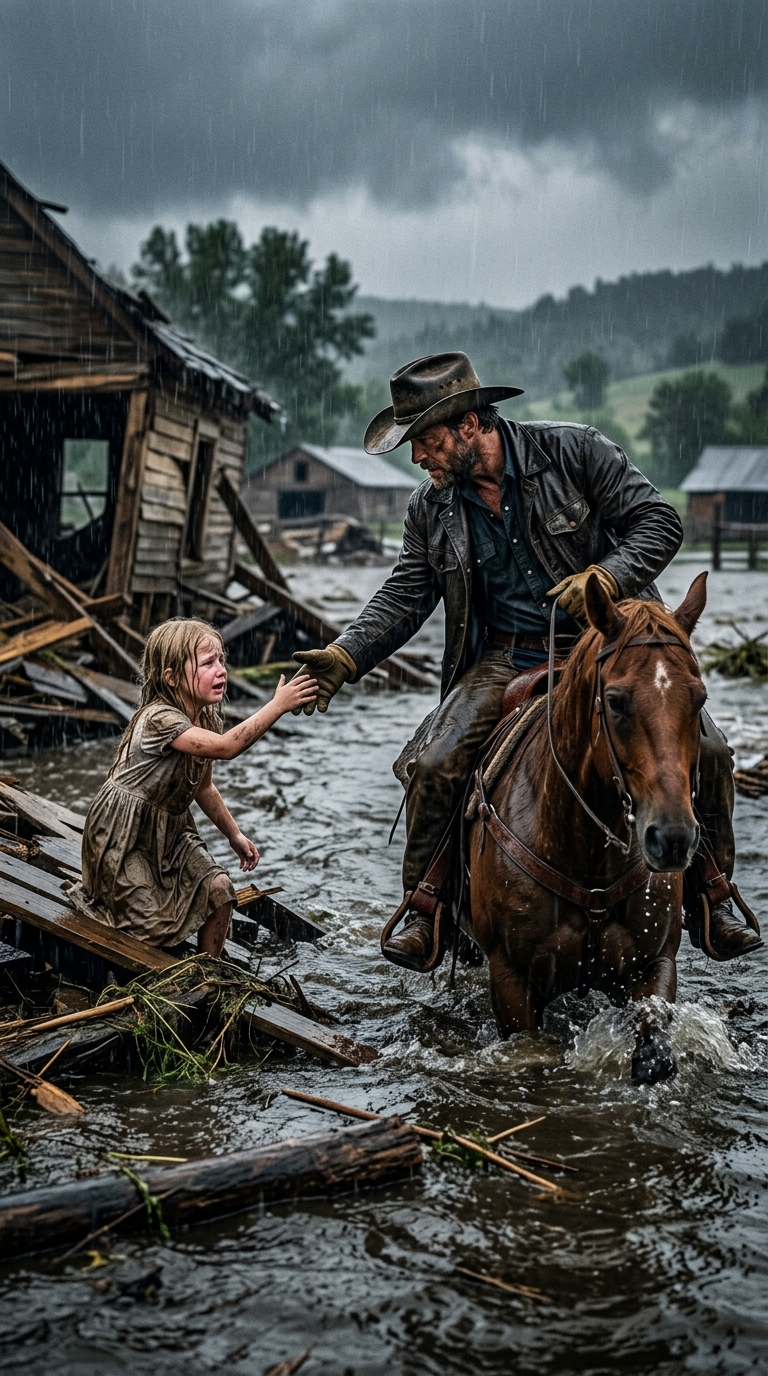
The storm was falling with such rage over the Sierra de Durango that the lightning split the sky like machete blows. Julián Mercado was riding his mare Mora, with his hat soaked down to his eyes and his rifle tied to the saddle, when he heard a cry from beneath the old wooden bridge.
At first he thought it was the water hitting the rocks. Then he heard it again.
It wasn’t an animal. It was a girl.
Julián dismounted from the mare and aimed toward the shadow moving among the broken planks. The stream was swollen, dragging branches, mud, and pieces of fence. Then he saw bare feet sunk in the water, a torn dress clinging to her body, and black eyes filled with terror.
“Don’t sell me again, sir… please.”
Julián’s hand loosened. He slowly lowered the rifle.
“I didn’t come to sell you, child. I don’t even know who you are.”
The girl clutched the wet paper even tighter.
“Everyone says that.”
She must have been 12 years old, perhaps younger. She was skinny as a dry stick, with hair plastered to her face and an open wound on her lip. The bridge creaked above her. A log crashed against the pillars and everything shook.
“Get out of there,” Julián said. “That bridge won’t hold.”
“I’d rather drown.”
The sentence came out so calmly that it chilled Julián’s blood more than the rain.
“No child should ever say that.”
“I’m not a child. I’m property.”
Julián felt something old, buried in his chest since the war, awaken with fury.
“No one is property in Mexico.”
She let out a dry, painful laugh.
“Then tell that to Don Severo Landa. Tell it to the judge. Tell it to the commissioner who signed this.”
She showed him the paper. The ink had run, but words like “apprenticeship,” “custody,” and “service” were still visible. Julián didn’t need to read any more. He had heard rumors in the towns: orphans handed over to haciendas, children sent to brickyards, girls disappearing behind contracts that no one read to them.
“What’s your name?”
The girl hesitated.
“Inés Robles.”
The bridge creaked again. The water was already up to her calves.
“Inés, I’m going to come closer. Not to grab you. To get you out of there before the stream carries you away.”
“If you take another step, I’ll bite you.”
“Then bite me, but I’m not going to let you die.”
Julián moved forward.
The girl came out like a cornered cat. She lunged at him with nails, teeth, and desperation. She bit his hand so hard she broke the skin. Julián didn’t scream. He only held her when the mud gave way under his boots and they both fell into the water.
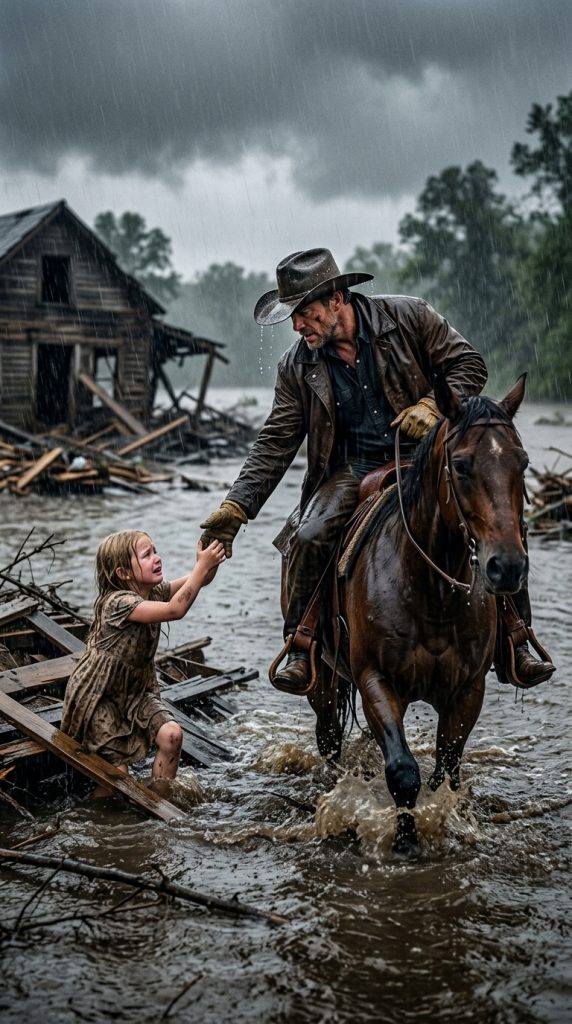
The stream swallowed them.
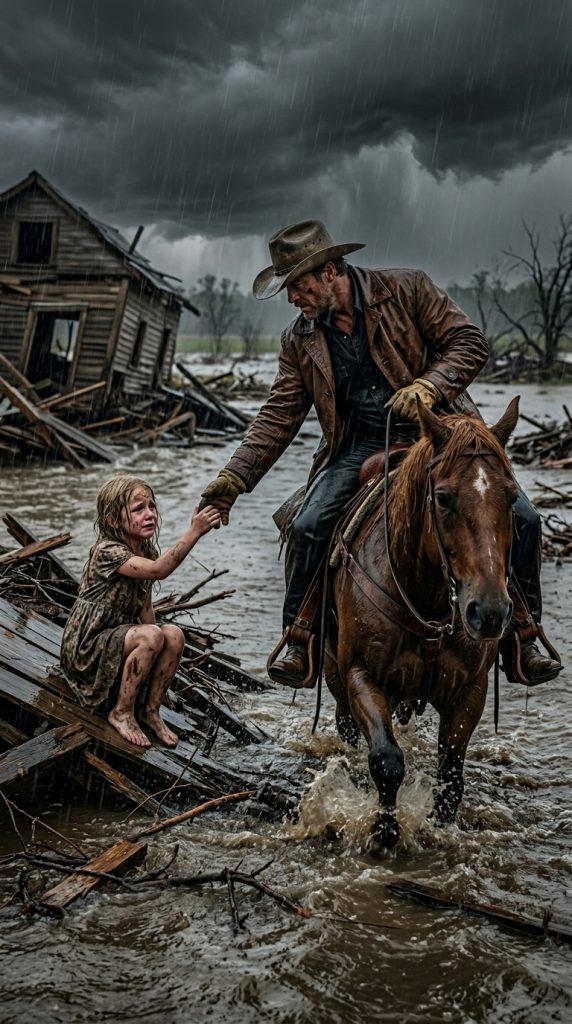
The mare whinnied from the bank. Julián felt rocks hitting his ribs, water rushing into his nose, Inés’s hand slipping between his fingers. He caught her by the dress, then by the arm. She kicked, cried, hit him, but he didn’t let go.
When he finally managed to drag her to some roots, they both lay there, spitting out mud.
“Let me go… let me go…”
“I’ll let you go if you promise not to go back into the water.”
“I don’t promise anything to any man.”
“Fine.”
Julián let her go.
She crawled away from him. Her dress slipped off her shoulder and then Julián saw her back.
Whip marks.
Some old and white. Others purple. Others still fresh.
Julián clenched his jaw until his teeth hurt. For years he had sworn never to kill anyone again. That night, looking at a girl’s back in the rain, he came close to breaking his oath.
“I have a house two leagues from here,” he said. “There’s a fire, bread, and a blanket. You go inside. I’ll stay outside on the porch until you tell me I can come in.”
“Lies.”
“You don’t have to believe me. You just have to choose between coming with me or staying here until the water kills you.”
Inés looked at the bridge. Part of it collapsed with a crash. The stream carried away the planks as if they were toys.
Trembling, she walked toward the mare.
“Don’t put me up there by force.”
“I won’t.”
She tried to mount by herself, but her legs wouldn’t respond. Julián waited.
“Can I help you?”
She closed her eyes.
“Yes.”
He lifted her carefully. She weighed less than a sack of corn.
They arrived at the adobe house almost at midnight. Julián opened the door, lit a candle, and pointed inside.
“The bread is on the table. The blanket is on the cot. The firewood is next to the stove. I’ll stay out here.”
“All night?”
“All night.”
Inés entered without taking her eyes off him, as if expecting him to pounce on her at any moment. She took the knife from the table before closing the door.
Julián sat on the porch, with the rifle across his knees, staring into the darkness.
An hour passed. Then another. The rain grew softer.
“Mr. Mercado,” she called from inside.
“I’m here.”
“He’s going to come.”
Julián didn’t move.
“Don Severo?”
“He always comes. And he brings papers. And men. And the commissioner if necessary.”
Julián looked toward the black road, where the storm had erased all traces.
“Then he’ll have to go through me.”
The door opened just a crack. Inés appeared wrapped in the blanket, knife in hand and eyes full of fear.
“You shouldn’t have said that.”
“Why?”
“Because now he’s going to come for you too.”
Julián gripped the rifle tighter.
“Let him come.”
Part 2
At dawn, Inés wasn’t crying, and that worried Julián more than her tears. He left eggs with chili and beans on the step without going inside. She took a long time to open the door, but when she came out, the plate was empty and her eyes looked less dead.
“I have a brother,” she said suddenly. “His name is Mateo. He’s 9 years old. They sent him to a brickyard in Nombre de Dios. He cries when it thunders.”
Julián felt what little air was left in the morning leave him.
“We’re going to get him out, but not alone.”
“You said the papers don’t rule over people.”
“And I still say that. But a girl and a man with one rifle can’t bring down an entire network. We’ll go to Doña Clara, the storekeeper.”
Inés stiffened.
“The lady from the green store?”
“The same one.”
“Once she said ‘I’m sorry, my child’ when they threw a cup at me. No one had ever said sorry to me.”
When he heard that, Julián went to get some boots he kept in a trunk. They had belonged to his dead sister—small, worn, but sturdy.
Inés looked at them as if they were a miracle.
“They feel… like I’m someone,” she whispered.
In the afternoon they entered the town from the back. Doña Clara, a widow with white hair and hands stained with ink, turned pale when she saw the girl. She closed the store, drew the curtains, and hid them in the book room.
“There’s a reward for her,” she said. “$50. Signed by the commissioner.”
“The commissioner is involved,” Julián murmured.
Clara pulled a thick notebook from under the floor.
“43 names. Orphans, children of dead peons, kids handed over as apprentices. Don Severo Landa signs the contracts, the commissioner seals them, and the haciendas pay per head.”
Inés touched the page where her name was. Then she found another. Mateo Robles. Her voice broke.
“He’s alive.”
“As far as I know, yes,” Clara said. “But we need to take this notebook to the capital. We need a judge that Severo can’t buy.”
Julián took a copy wrapped in oiled cloth.
“I’ll go.”
“With her,” Inés corrected. “I’m not separating from it.”
Clara washed her face, combed her hair, and gave her a blue dress. Inés looked like a different person, but when a shadow crossed the window, she shrank back like before.
Three riders passed in front of the store. One wore a black jacket, a thin mustache, and a calm smile.
Inés stopped breathing.
It was Don Severo.
He didn’t enter right away. First he looked toward the street where they had left the mare. Then he smiled as if he already knew everything.
Julián took Inés out the back door and hid her behind a barn. From the alley he saw Severo enter the store. The man bought sugar, paid with clean coins, and spoke to Clara as if he were a gentleman.
When he left, he said loudly so everyone could hear:
“It would be a shame if a widow lost what she has cared for over 22 years for protecting someone else’s trash.”
That night, Clara didn’t tremble. She rang the church bell. The town awoke with rifles, lamps, and fear. In front of everyone, she opened the notebook.
“43 children,” she shouted. “And this girl is one of them. If we stay silent today, tomorrow our own children will have a price too.”
Then a boy came running from the road.
“Don Severo has grabbed Don Julián! They’re taking him to his own house!”
Inés let out a breath as if her heart had been torn out.
Clara closed the notebook, pulled a revolver from her apron, and said:
“Then tonight we’re not hiding anymore.”
Part 3
When the neighbors arrived at Julián’s house, the lamp was still lit and the door was open. Inside, Julián was tied to a chair, his mouth split and his shirt stained with blood. Don Severo Landa walked around him like a rancher inspecting livestock.
“Where is the girl?” he asked calmly.
“Far from you.”
One of his men punched Julián in the stomach. He doubled over but didn’t scream.
“You don’t understand, Mercado. That orphan has a contract. She eats because I allow it. She breathes because I signed for it.”
Julián lifted his head.
“Then sign your own sentence too.”
Outside, the first hoofbeat was heard. Then another. Then many. Severo looked toward the window just as Don Asa, an old ex-rural, entered pointing a shotgun at him. Behind him came the blacksmith, the teacher, three peasants, Father Bell, two women with lamps, and Doña Clara with the notebook against her chest.
Inés entered last, trembling but standing tall.
“I am Abigail… no,” she corrected, swallowing. “I am Inés Robles. I am no one’s property.”
The room fell silent. Don Severo smiled still, though for the first time his eyes didn’t smile.
“These people don’t know what they’re doing. The commissioner will come.”
“He’s already here,” said Clara.
At the door appeared Commissioner Dávila, disheveled, with his belt poorly buckled and a pale face. But when he saw the entire town inside the house, he didn’t dare draw his weapon. Don Asa took the pistol from him.
“Today you’re not signing anything, compadre.”
Clara opened the notebook on the table. She read the names. Dead children. Lost children. Children seen in brickyards, ranches, workshops, and kitchens. Each name fell like a tolling bell. Some women began to cry. A man in the back removed his hat when he heard his nephew’s name. Father Bell looked at the commissioner with shame and rage.
“This is going to the capital tomorrow,” Clara said. “And if anyone touches this store, this house, or this girl, there will be 20 more copies circulating before dawn.”
It was a lie. There were only three. But Severo didn’t know that.
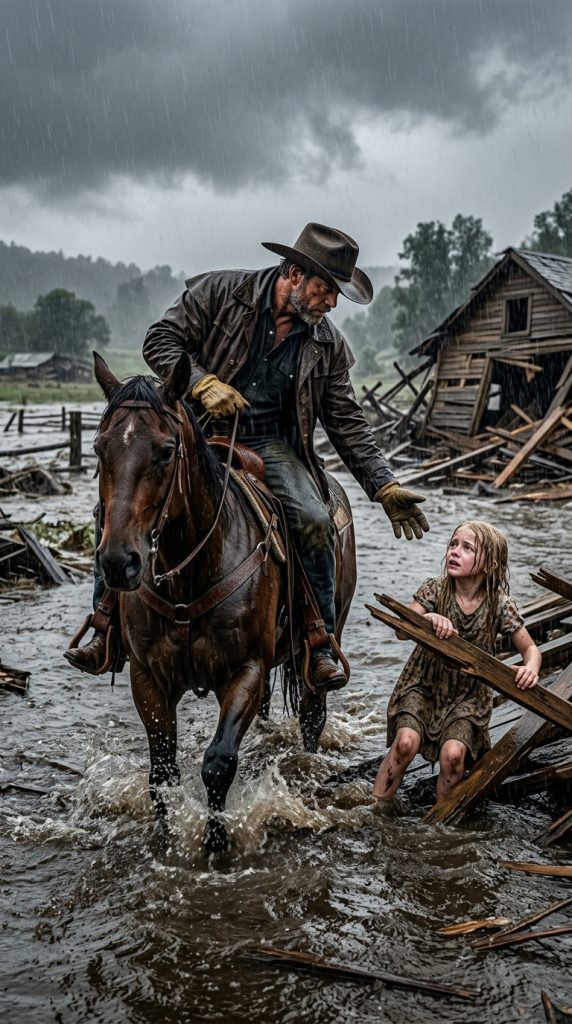
For the first time, the boss lowered his gaze. He tried to walk toward the door, but Inés stood in front of him. She was small, skinny, wearing borrowed boots and with trembling hands. Even so, she didn’t move.
“My brother Mateo,” she said. “Where is he?”
Severo didn’t answer. Julián, still tied up, spoke in a hoarse voice.
“Answer her.”
Don Asa cocked the shotgun. The commissioner broke before Severo did.
“At the San Miguel brickyard… with eight others.”
They left before dawn. No one waited for permission. The neighbors rode to the brickyard with torches. They broke the lock on the shed where the children slept on sacks of ash. Mateo was in a corner, hugging his knees, covered in red dust.
When he saw Inés, it took him a moment to recognize her. Then he ran to her crying.
“I thought you were dead.”
“I came for you,” she said, holding him so tightly it seemed she wanted to fuse him to her chest forever. “I told you I would come back.”
At dawn, nine children left the brickyard. That same day, others were taken from the Crowder ranch and the Hensen house.
The notebook traveled to the capital with Father Bell, Clara, and Don Asa. Julián went too, with his hand bandaged and Inés’s bite now turned into a scar.
Don Severo and the commissioner were tried. The contracts were burned in the square, in front of everyone. Inés held Mateo’s hand while the pages burned.
When the paper with her name turned to ash, she didn’t smile. She just breathed deeply, as if only then had she learned to do so without permission.
Months later, in the adobe house, Julián fixed the roof and built two small beds next to the kitchen. Inés still didn’t trust easily, and Mateo still woke up when it thundered. But every night there was bread, fire, and a door that no one locked.
Sometimes Inés would go out to the porch and find Julián sitting with his unloaded rifle across his knees, looking at the road.
“You don’t have to stay outside anymore,” she would tell him.
He always answered the same: “I know. But I like you to know that I’m here.”
And she, who had once believed she was property, would sit beside him in silence, with the boots of a dead girl on her feet and a new life beginning under the vast sky of Mexico.
