

The corridor of St. Aurora Medical Center—the most elite and costly hospital in the city—carried the scent of polished floors and restrained panic.
In a place where wealth usually purchased miracles, William Harrington’s fortune meant nothing. Seventeen leading specialists, flown in from Europe and Asia, stood in clusters whispering over charts and glowing monitors, their confidence cracking.
Inside the ICU room, surrounded by the steady beeping of machines, lay William’s ten-year-old son, his life fading hour by hour.
The boy’s skin had taken on a gray tint. His lips were dry and split. Each breath came as a wet, scraping struggle. Every test—blood panels, MRIs, scans—returned “normal.” Yet he was dying.
At the far end of the hallway sat someone no one noticed. Sofia Morales, eight years old, in a faded school uniform, waited quietly for her mother, Marisol Morales, who mopped the marble floors with her head down, invisible among the powerful.
Sofia wasn’t a doctor. She didn’t understand oxygen saturation or autoimmune disorders. But she carried something the specialists didn’t: memory.
Six months earlier, her father had died in a public hospital. The doctors had called it a respiratory infection. Sofia had watched him clutch his throat, gasping, while a strange sweet-rotting smell filled their tiny bedroom.
No one believed her when she said she saw something move deep inside his mouth.
Now, through the ICU glass, she saw the same signs. The boy’s hand drifted to his throat even in unconsciousness.
His color matched her father’s. And when the door opened briefly, she smelled it again—faint, sickly sweet, like damp soil and spoiled meat.
“Mom,” Sofia whispered, tugging Marisol’s sleeve. “He has what Dad had.”
Marisol stiffened. “Sofia, don’t say that. These people are important. We can’t cause trouble.”
“He keeps touching his throat. Dad did that too. He said it itched inside.”
“Enough,” her mother said under her breath. “If I lose this job, we don’t eat. Sit down.”
Sofia obeyed, but she didn’t look away.
Inside the room, alarms began to quicken. Doctors rushed in. William Harrington—the most powerful man in the pharmaceutical industry—collapsed into a chair, weeping in helpless fury.
Sofia felt a cold certainty. Soon the boy would convulse. They would try to intubate him, but the tube wouldn’t pass. He would suffocate—just like her father.
Her hands trembled. She was small. Poor. Invisible. But she was the only one who recognized the pattern.
Before fear could stop her, she stepped past the security line while nurses hurried by. The ICU door stood slightly open as Dr. Bradley shouted orders in the hall.
Sofia slipped inside.
The machines were loud; the air was icy. Up close, the boy looked fragile. She climbed onto a stool and scanned the instrument tray. Her fingers closed around a pair of long stainless-steel forceps.
“I’m sorry,” she whispered. “You have to hold on.”
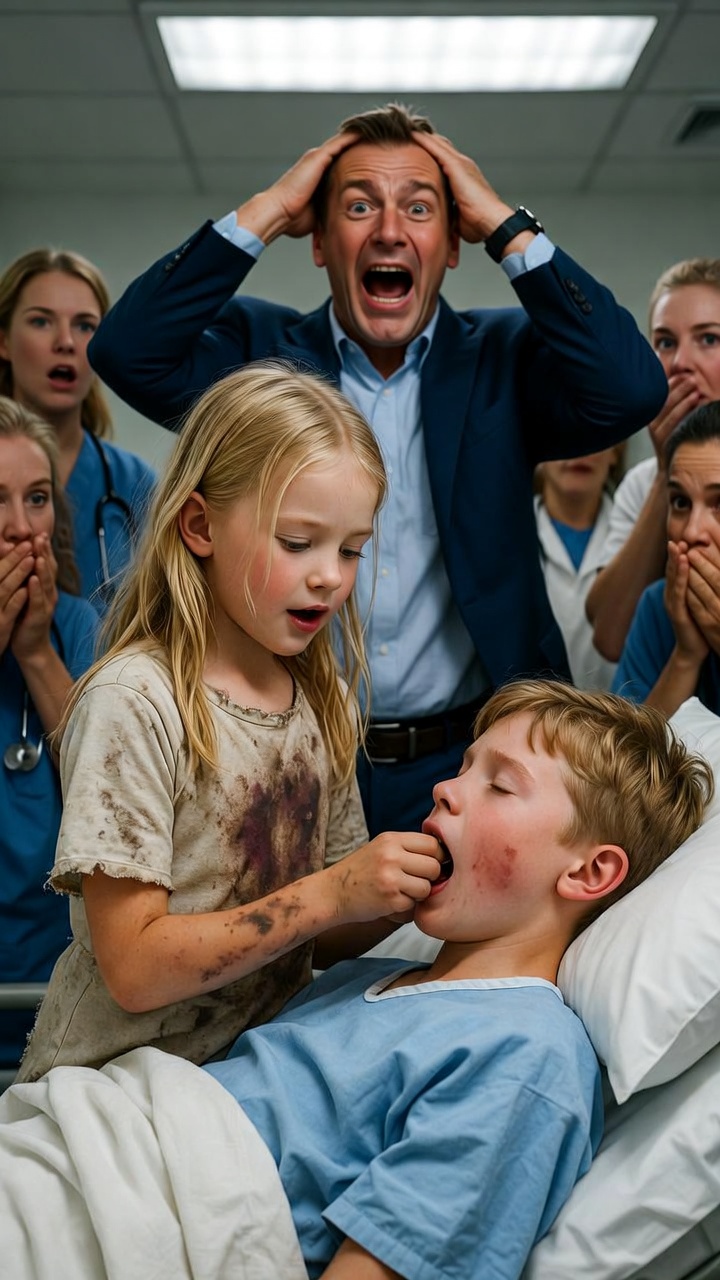
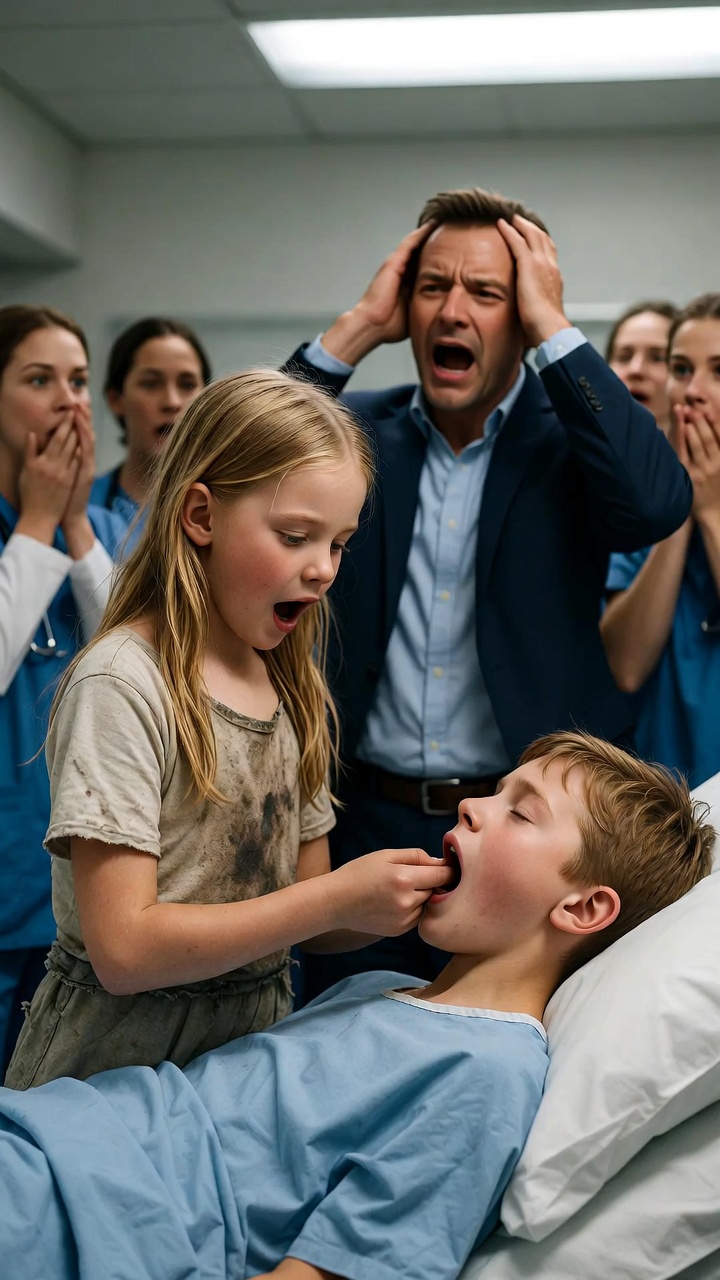
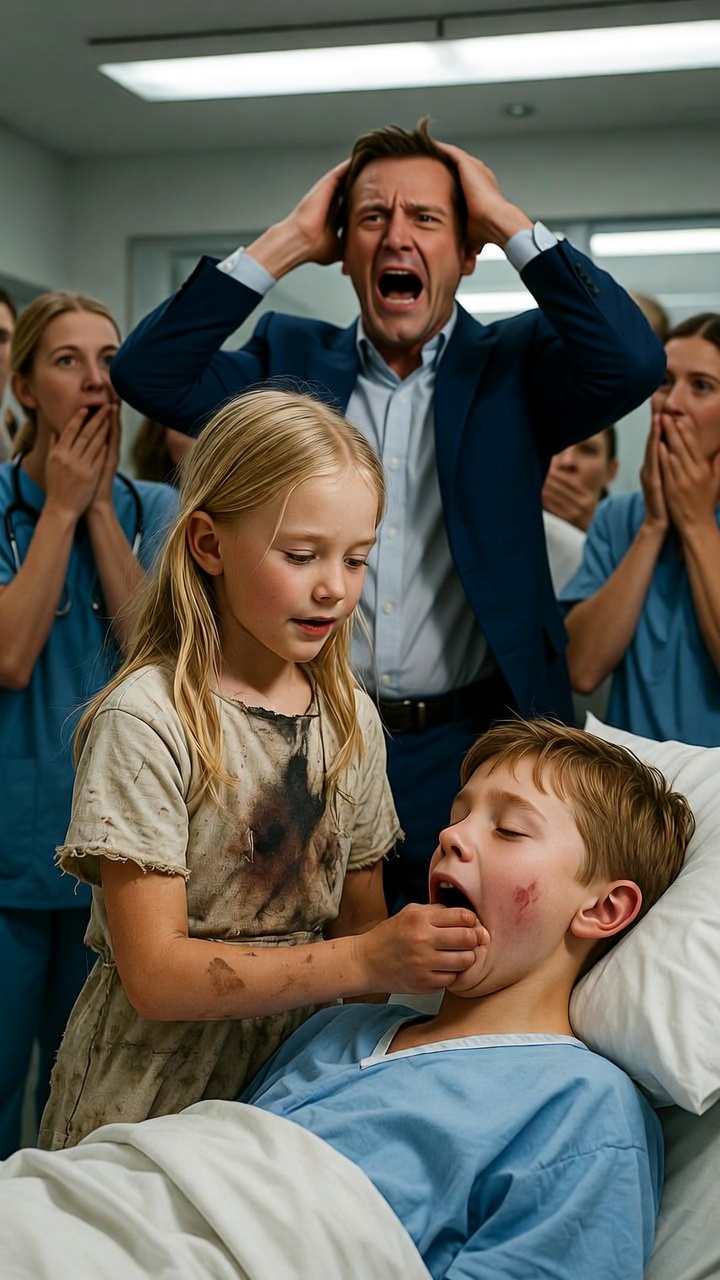
With gentle fingers, she opened his mouth. His throat was red and swollen. At first, nothing. But Sofia knew it hid when the light hit it.
She picked up an otoscope and angled the beam deeper.
“Come out,” she murmured.
The boy coughed faintly.
There—a ripple near the entrance of the esophagus. Not mucus. Not tissue. Something alive.
Sofia inserted the forceps carefully. The metal touched his throat and alarms spiked.
“What are you doing?!” a nurse screamed from the doorway.
“Security!”
Footsteps thundered down the hall, but Sofia didn’t stop. She clamped down and pulled. Resistance. It clung stubbornly.
“I’ve got you,” she thought, and yanked with every ounce of grief she carried.
A guard grabbed her arm, dragging her backward. She fell—but kept hold.
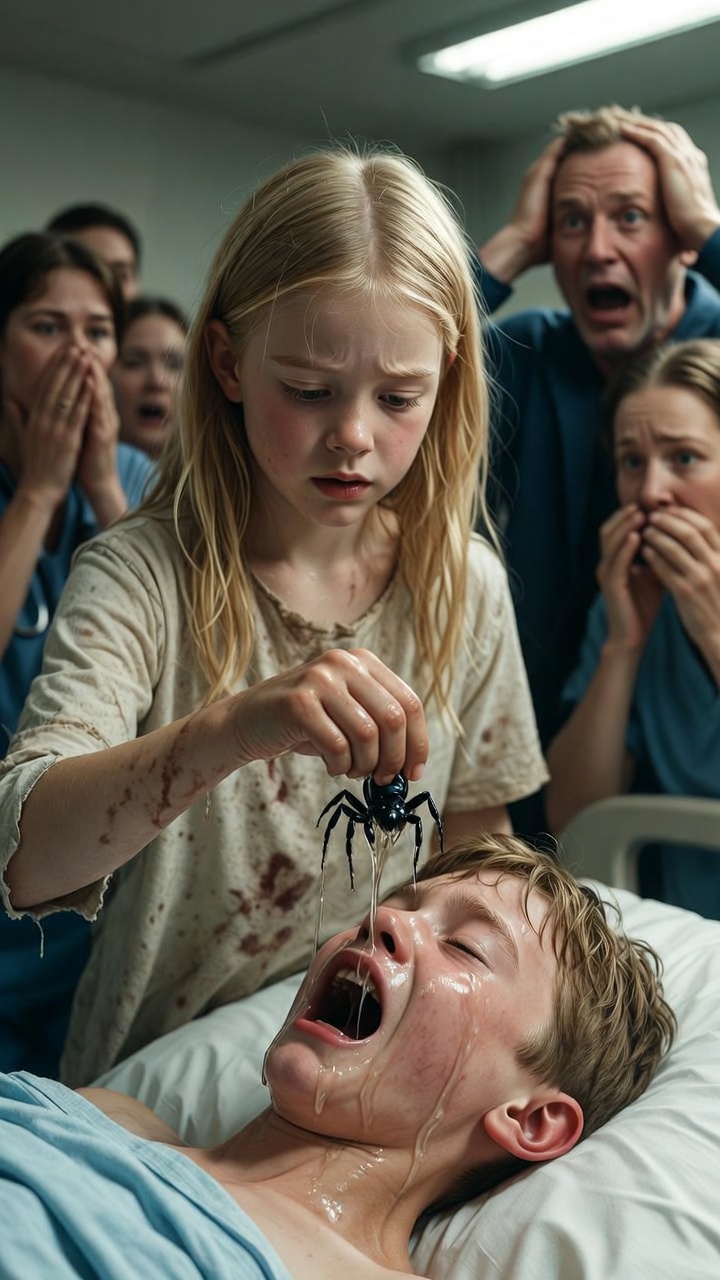
Dangling from the forceps, writhing under the sterile lights, was a long reddish centipede, slick with blood and mucus, dozens of legs twisting wildly.
The nurse screamed.
On the bed, the boy gasped—one deep, clear breath. The rasping vanished. Oxygen levels climbed rapidly.
Dr. Bradley rushed in and froze at the sight. “My God…”
Sofia stood, rubbing her arm. “It was eating his air,” she said shakily. “Like it ate my dad’s.”
Dr. Bradley carefully placed the creature into a specimen jar. He examined its body, noting unnatural markings.
“This resembles Scolopendra gigantea,” he muttered, “but altered. This isn’t an illness. It’s engineered.”
The truth spread quickly. William Harrington’s son hadn’t been sick. He had been attacked.
When William saw his son breathing normally, he sobbed. When he saw the jar, his grief hardened into fury. That species didn’t belong in this region. Someone had put it there.
The hospital locked down. Security footage was reviewed. Sofia mentioned a “doctor” who smelled strongly of mint.
Hours later she pointed at the screen. “That one.”
A man in a white coat entered during a shift change. The ID badge was fake. Police identified him as Adrian Cross, a former business partner of William Harrington who had lost everything in a lawsuit and sworn revenge. He had spent years studying exotic insects and venoms abroad.
Cross had bred parasites genetically modified to grow slowly, blending with human tissue and escaping detection. They needed a chemical activator to continue developing. Without it, they would die.
Police suspected he would return that night to administer it.
They staged a trap. The boy was moved. A dummy lay under the sheets.
At 3 a.m., the door opened. A figure slipped inside with a syringe. As he leaned over the bed, lights blazed on.
“Police! Don’t move!”
Cross tried to flee but was tackled. In his briefcase were more jars and a list of names—children of board members he blamed for his ruin.
During interrogation, he confessed chilling details. Months earlier he had tested his creation on a random patient at a public hospital.
That patient had been Sofia’s father.
Days later, St. Aurora was calm again—but changed. William Harrington held a private ceremony in the lobby. No media spectacle, only staff, police, and Sofia’s family.
The powerful executive knelt before Sofia and Marisol.
“There’s no payment equal to what you’ve done,” he said, voice breaking. “You saved my son. And you helped bring justice for your father.”
Sofia, small in her simple dress, answered softly, “I just wanted someone to listen. Adults think kids don’t understand. But we see things you forget to look for.”
Dr. Bradley lowered his eyes. It was the most humbling lesson of his career.
That day, William announced the creation of the Daniel Morales Foundation, named for Sofia’s father. It would fund research into rare diseases and parasites—and provide full scholarships for underprivileged students pursuing medicine.
“Sofia,” William said, “when you’re ready, your education is secured. If you choose medicine, we’ll support you to the best school in the country.”
Marisol wept with relief. But for Sofia, the most important moment came later.
A month afterward, she returned to the hospital as an honored guest. William’s son, now healthy and flushed with color, sat upright playing on a tablet.
When he saw her, he smiled. “You’re the girl who saved me.”
“Yes.”
“Thank you. My dad says you’re a hero. I think you’re braver than Batman.”
Sofia laughed softly. For the first time in months, the heaviness in her chest eased. She felt certain her father would be proud.
His death had not been meaningless. It had exposed a monster and saved another life.
Sometimes the truth isn’t hidden in machines or expensive expertise. Sometimes it lives in the eyes of someone who remembers—and in the courage to speak when no one else will.
As Sofia stepped outside into the sunlight, she lifted her face to the sky. The world was still complicated. But she knew one thing for certain:
She would never be invisible again.
