

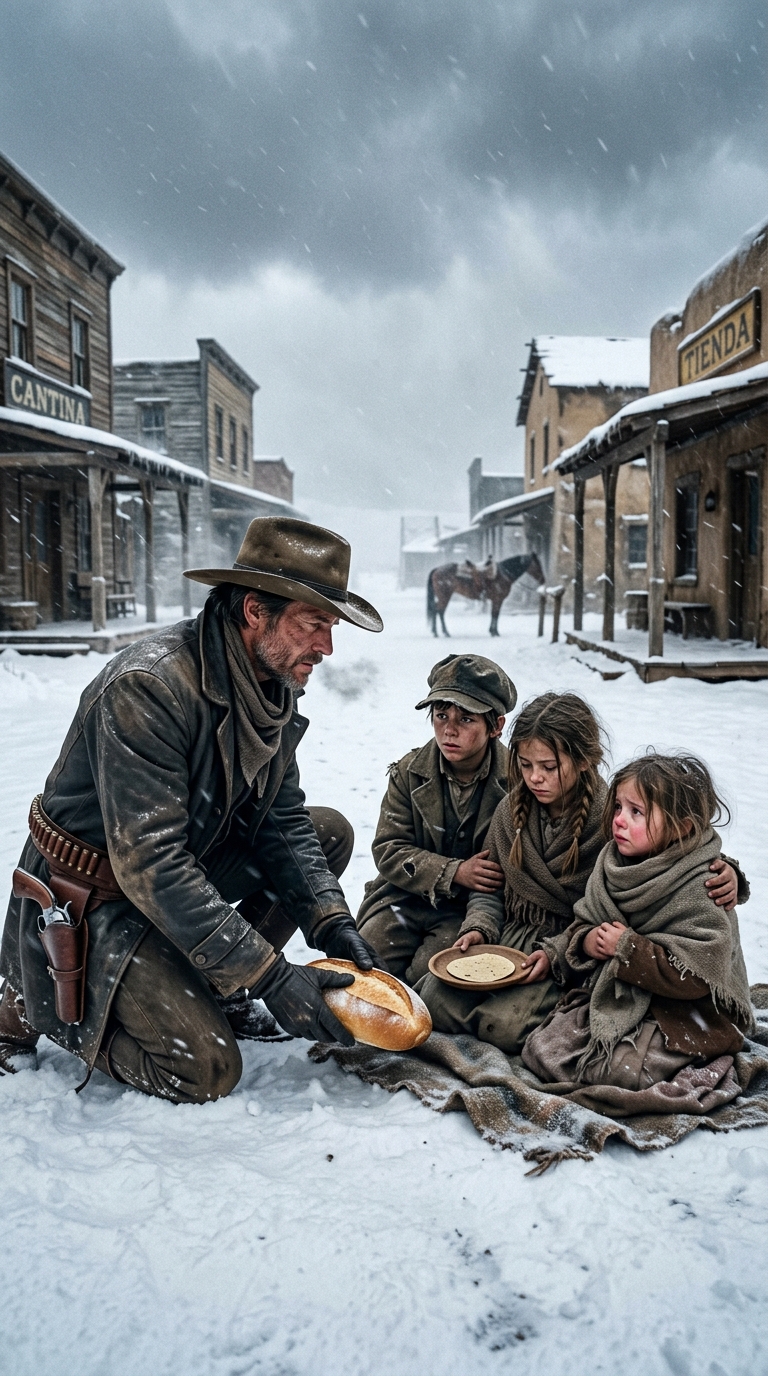
The three children were sharing a single hard tortilla behind a closed store, and the cowboy who saw them knew that if he kept going, he would carry that guilt to his grave.
The wind descended from the sierra like a furious animal, dragging icy dust through the streets of San Miguel del Viento, a forgotten town between Chihuahua and Durango where winter seemed to arrive before mercy. The wooden doors slammed against their frames, the lanterns trembled, and the snow mixed with dry earth, forming a gray crust over the adobe roofs.
Nicolás Arriaga entered the town on a dapple-gray horse named Relámpago. He wore his hat pulled down to his eyebrows, his coat stiffened by frost, and a leather pouch with barely a few coins. He was not a man who stayed. For nine years he had gone from ranch to ranch, driving cattle, repairing fences, sleeping wherever they let him, and leaving before anyone asked too many questions.
That afternoon, he was only looking for coffee, dry beans, salted meat, and perhaps some work to get through the winter.
He tied Relámpago in front of Don Celestino’s general store. The thin man with the white mustache looked at him the way people look at strangers: with curiosity and distrust.
“Are you looking for something in particular?”
“Work, if there is any.”
Don Celestino let out a bitter laugh.
“This year there isn’t even enough for the locals. The frosts killed the crops, the ranchers sold at a loss, and the miners left for the south. If you have a good horse, keep riding.”
Nicolás bought a piece of jerky, ground coffee, and one wheat bread wrapped in paper. As he left, the wind nearly snatched his hat. He was about to put the bread in his saddlebag when he saw movement across the street.
There were three children.
They were sitting against the wall of an abandoned house, huddled against the cold. The oldest, about nine years old, wore an oversized torn sack. The middle girl was around eight, with undone braids and a serious look. The smallest was no more than five; she had a red nose, chapped lips, and her hands hidden under her armpits.
They weren’t playing.
They weren’t begging.
They were just waiting.
Nicolás stood still as the boy pulled a hard tortilla from under his coat, barely bigger than his palm. He looked at it as if counting coins. He broke it in two. Then he broke off a smaller piece.
The middle girl pushed her share toward him.
“You eat more, Andrés.”
The boy shook his head.
“First Rosita.”
The little girl received the smallest piece with both hands, as if it were a communion wafer. She bit into it slowly, trying to make it last. The other girl broke her portion again and gave half to her brother.
Nicolás felt something old tighten in his chest.
He had seen hunger before. He had seen strong men cry in front of dead cattle and women boil water with salt to fool their children. But these three children weren’t crying. They had learned something worse: how to manage misery.
Nicolás looked at the bread he had just bought.
He could have gotten on his horse.
He could have continued south.
He could have told himself it wasn’t his business.
But his boots did not move.
He crossed the street slowly. The boy saw him coming and immediately stood up, positioning himself in front of the girls.
“Don’t come any closer,” he said, trying to make his voice sound tough.
Nicolás stopped three paces away.
“I’m not looking for trouble.”
The boy clenched his fists.
“We don’t have anything.”
“I already saw that.”
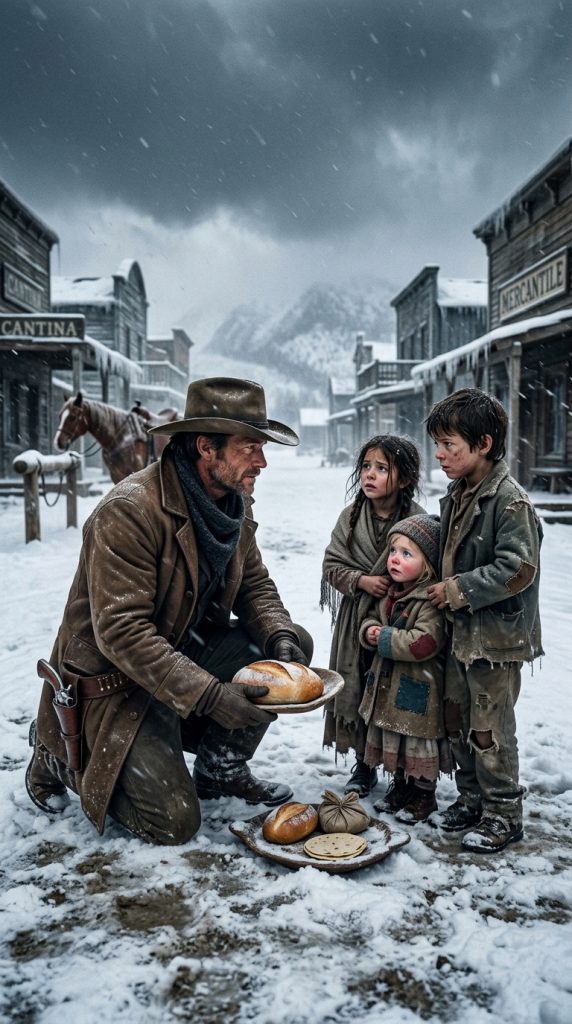
He took out the bread wrapped in paper. The three children tensed, as if expecting a blow. Nicolás placed it on the dirty snow, between them and himself.
“I bought extra.”
The boy didn’t move.
“Why?”
“Because you’ll make better use of it.”
The middle girl looked at the boy.
“Andrés…”
He hesitated, then took the bread with painful caution. The first thing he did was break it. He gave the larger half to the girls.
“For Lucía and Rosita.”
The little girl smiled faintly, with crumbs already stuck to her lips before she had even tasted the first bite.
Nicolás crouched down so he wouldn’t seem so tall.
“What are your names?”
The girl answered first.
“I’m Lucía. He is Andrés. She is Rosita.”
“Nice to meet you.”
Andrés kept his guard up.
“Are you just passing through?”
Nicolás looked at the empty street.
“I was.”
The answer seemed to worry the boy.
“We don’t need anything else.”
“I didn’t ask that.”
Silence slipped between them along with the wind.
Nicolás observed their torn boots, their thin coats, and the way Lucía covered Rosita with one arm while still eating.
“Where are your parents?”
The question extinguished the little warmth the bread had brought.
Lucía lowered her gaze.
Andrés answered:
“My dad died on the train tracks.”
“An accident?”
“That’s what they said.”
He said it like someone repeating a lie heard too many times.
“And your mother?”
Andrés swallowed.
“She’s sick.”
Nicolás looked at the abandoned house behind them. It had windows boarded up with planks, a collapsed wall, and no sign of smoke coming from the chimney.
“In there?”
Lucía nodded.
“We made a fire, but it went out. We went out to look for food.”
“How long has she been sick?”
“A few days,” said Andrés.
Lucía corrected him quietly:
“Almost a month.”
Nicolás felt the cold in a different way.
“Has the doctor seen her?”
“Once,” said Lucía. “He said without medicine and without heat there wasn’t much he could do.”
Rosita, who had finished her piece of bread, looked at Nicolás with enormous eyes.
“My mom didn’t wake up today.”
The wind slammed the boards of the house as if wanting to answer for everyone.
Nicolás stood up slowly.
“I’m going to see her.”
Andrés stepped forward.
“You don’t have to.”
“No. But someone should.”
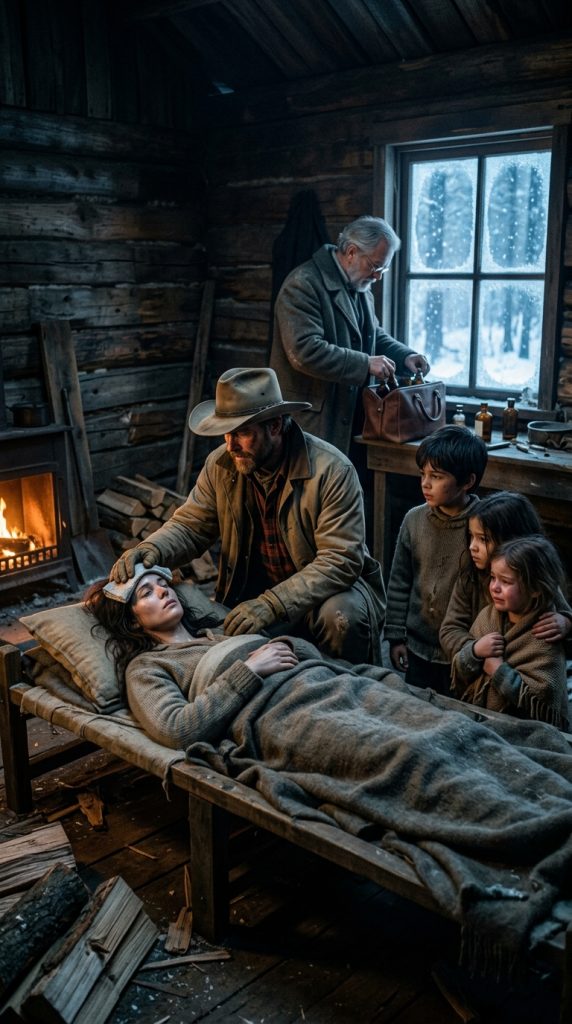
He entered the house with the children behind him. The interior smelled of old smoke, dampness, and fever. They had placed stones in the center to make a hearth, but only cold ashes remained. In a corner, behind a blanket hung with rope, there was a narrow cot.
The woman lying there looked more dead than alive.
She was young, perhaps not even thirty, but the illness had sunken her face. Her dark hair was stuck to her forehead, her lips were dry, and her breathing was so weak that Nicolás had to lean in to hear it.
He placed the back of his hand on her forehead.
It was burning.
“She’s alive,” he said.
Lucía let out a breath as if she had been holding it since dawn.
“Mom,” whispered Rosita, climbing onto the edge of the cot.
The woman did not respond.
Nicolás saw an empty jug, a thin blanket, a bag with a handful of flour, and nothing else. The children had tried to save her with water, fire, and hunger. And the whole town had left them alone.
“What is your mom’s name?”
“Elena,” said Lucía. “Elena Montiel.”
Nicolás stood motionless.
Montiel.
“Was your father named Rafael Montiel?”
Andrés looked at him in surprise.
“Yes. Did you know him?”
Nicolás did not answer immediately.
The name opened a door that had been closed for years.
He saw again a swollen river in the rainy season, a wooden bridge breaking under a cart, horses screaming, brown water swallowing everything. He saw his own hands slipping on a rock. He saw the world turn dark.
And then a rope.
A man throwing himself into the river.
Rafael Montiel had dragged him to the shore when Nicolás could no longer fight the current. Afterward, soaked and trembling, Rafael had simply told him:
“Someday when you see someone sinking, don’t ask if it’s worth helping. Pull the rope.”
Nicolás looked at the three children.
Rafael was dead.
But his family was sinking.
“Where does the doctor live?” he asked.
Andrés pointed toward the northern end of the town.
“White house, red roof. But he won’t come back.”
Nicolás took his hat.
“We’ll see about that.”
He walked through the snow to Doctor Efraín Salcedo’s house. He knocked hard. The doctor opened the door with a tired expression, wrapped in a thick vest.
“What do you want?”
“There’s a woman dying in the abandoned house. Elena Montiel.”
The doctor sighed.
“I already saw her.”
“She’s worse.”
“I don’t have resources to waste on hopeless cases.”
Nicolás took a step forward.
“Hopeless or without money?”
The doctor hardened his gaze.
“You’re a stranger. You don’t understand how winter works around here.”
“I understand that a woman is still breathing and three children are sharing bread on the street.”
“I have patients who can actually survive.”
The phrase fell like a stone.
Nicolás looked at him for a long time.
“The husband of that woman saved my life.”
The doctor blinked.
“Rafael?”
“He pulled me out of a river when everyone had given me up for dead. So if you have medicine for the fever, blankets, and something to heat that house, you’re going to bring it right now.”
“You can’t force me.”
Nicolás lowered his voice.
“No. But tomorrow the whole town will know that the doctor of San Miguel let the widow of Rafael Montiel die because she couldn’t pay him.”
The doctor clenched his jaw.
Shame, sometimes, did what compassion did not dare.
“Wait here.”
He returned with a medical bag, two wool blankets, and a box of vials.
The storm had worsened when they returned. Inside the house, Andrés was trying to light the fire again with clumsy hands. Nicolás knelt beside him.
“Not like that. First air. Then kindling. Then wood.”
“I know how to do it,” the boy muttered.
“I know. But you’re tired.”
That was enough for Andrés to lower his gaze.
The doctor examined Elena, gave her medicine drop by drop, and ordered warm water. Nicolás went out four times to look for broken boards, branches, and pieces of fence to feed the fire. The wind cut his face. The snow burned his hands. But every time he returned, Rosita lifted her head to make sure he had brought wood.
“Don’t let it go out,” she told him.
“It won’t go out.”
The night was long.
Elena delirious near midnight. She called for Rafael. Then for her children. Lucía covered her mouth to keep from crying. Andrés stood rigidly beside the cot, as if his will alone could hold his mother in this world.
Around three in the morning, the doctor stared at Elena’s pulse.
Nicolás approached.
“Tell the truth.”
“The fever is rising.”
Lucía closed her eyes.
Rosita began to tremble.
Andrés punched the wall.
“She’s not going to die!”
Nicolás took the boy by the shoulders.
“Listen to me. Your father told me that when someone is sinking, you pull the rope. Tonight we’re all pulling. You too. But you can’t break before dawn.”
Andrés breathed with difficulty.
“I’m the oldest.”
“And you’re also a child.”
The phrase disarmed him.
For the first time, Andrés cried.
Not much.
Just enough to remember that he still could.
Nicolás hugged him without asking permission. At first the boy stayed stiff. Then he clung to his coat with desperate strength.
The doctor observed the scene from the cot and lowered his gaze.
Before dawn, something changed.
Elena stopped trembling.
Her breathing became less ragged.
The doctor touched her forehead and remained silent for a few seconds.
“It’s going down.”
Lucía lifted her head.
“What?”
“The fever. It’s going down.”
Rosita woke up suddenly.
“Mom?”
Elena barely opened her eyes. She seemed to be looking from very far away.
“My children…”
Lucía released a cry she had held back for weeks. Rosita climbed onto the cot. Andrés didn’t move, as if afraid that happiness could also break.
Nicolás put a hand on his back.
“You won the fight.”
The boy looked at his mother and then at the fire.
“It didn’t go out.”
“No.”
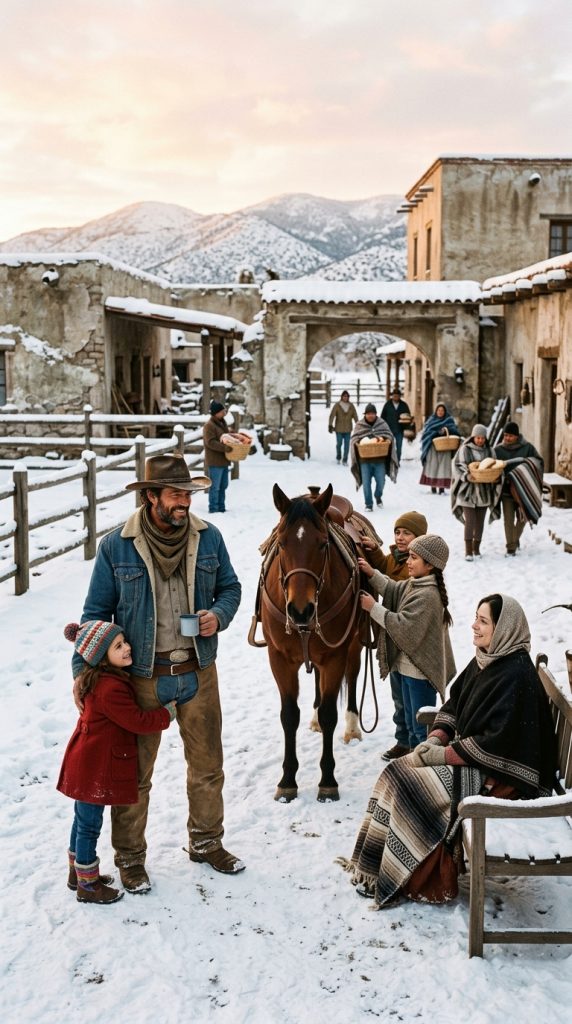
By mid-morning, the storm had left the town covered in white. The news spread faster than the wind: the Montiel widow was still alive, the children had survived the night, and the stranger cowboy had forced the doctor to return.
People started to arrive.
First Doña Jacinta with chicken broth.
Then a baker with six loaves of bread.
Then a carpenter with dry wood.
Even Don Celestino showed up with flour and beans.
Nicolás watched from the doorway. He said nothing. He knew many came out of guilt, others out of shame, and a few out of genuine kindness. But for Elena and her children, the reason mattered less than the warmth finally entering the house.
Rancher Esteban Larios offered a room in his hacienda until spring.
“The old granary is empty. It has a roof, a chimney, and beds. The children can stay. When the lady gets better, we’ll find fair work.”
Elena, still weak, tried to sit up.
“I have no way to pay.”
Esteban removed his hat.
“Rafael Montiel fixed my cart when my wife was about to give birth. He never charged me. It’s about time someone paid something back.”
Nicolás looked at the doctor.
Doctor Salcedo did not meet his gaze, but left more medicine on the table.
“I’ll come back tomorrow.”
Andrés approached Nicolás when everyone was talking.
“Are you leaving too?”
Nicolás looked toward the street. For years, his life had been about moving on. Not staying where someone might need him. Not sleeping two nights under the same roof if he could avoid it.
But that morning, the open road no longer seemed like freedom. It seemed empty.
“Don Esteban’s hacienda might need a cowboy for the winter.”
Andrés’s eyes sparkled.
“Does that mean you’re staying?”
“For now.”
Rosita ran and hugged his leg.
“You brought the bread.”
Nicolás let out a hoarse laugh.
“You reminded me what to do with it.”
Weeks later, Elena was able to get up. She was still thin, but her eyes had regained their light. At the hacienda, Lucía helped in the kitchen, Andrés learned to care for horses, and Rosita chased chickens with a seriousness that made everyone laugh.
One afternoon, Elena found Nicolás repairing a fence.
“My children talk about you as if you came from heaven.”
“I came from the general store.”
She smiled.
“Rafael used to say you had the face of a man who needed a second chance.”
Nicolás stopped working.
“Did he talk about me?”
“Many times. He said he saved a stubborn cowboy who didn’t know how to ask for help.”
Nicolás looked toward the corrals, where Andrés was holding Relámpago’s reins with pride.
“I suppose he was right.”
Elena approached slowly.
“Thank you for not riding past.”
He took time to respond.
“Your husband left me a debt.”
“No. He left you a lesson.”
The winter passed.
In spring, San Miguel del Viento no longer seemed so dead. The forge was lit again. The store opened more often. And in front of the old abandoned house, where three children had once shared a tortilla, they placed a wooden table for travelers without food.
The sign said:
Take if you are hungry. Leave if you can.
Nicolás helped carve it.
Andrés hammered the first nail.
Lucía arranged the breads wrapped in cloth.
Rosita placed a round, warm tortilla on top.
Years later, when people asked why a wandering cowboy stayed forever in such a harsh town, Nicolás would point to that table.
“Because once I saw three children divide hunger into equal pieces,” he would say, “and I understood that God doesn’t always send answers. Sometimes He sends an old debt, a storm, and a loaf of bread.”
And on cold afternoons, when Elena came out to the porch and watched her children run among the corrals, Nicolás remembered Rafael Montiel by the river.
“Pull the rope,” he had told him.
Nicolás pulled it.
And in doing so, he discovered that he had not only saved a family.
He had also saved himself.
