

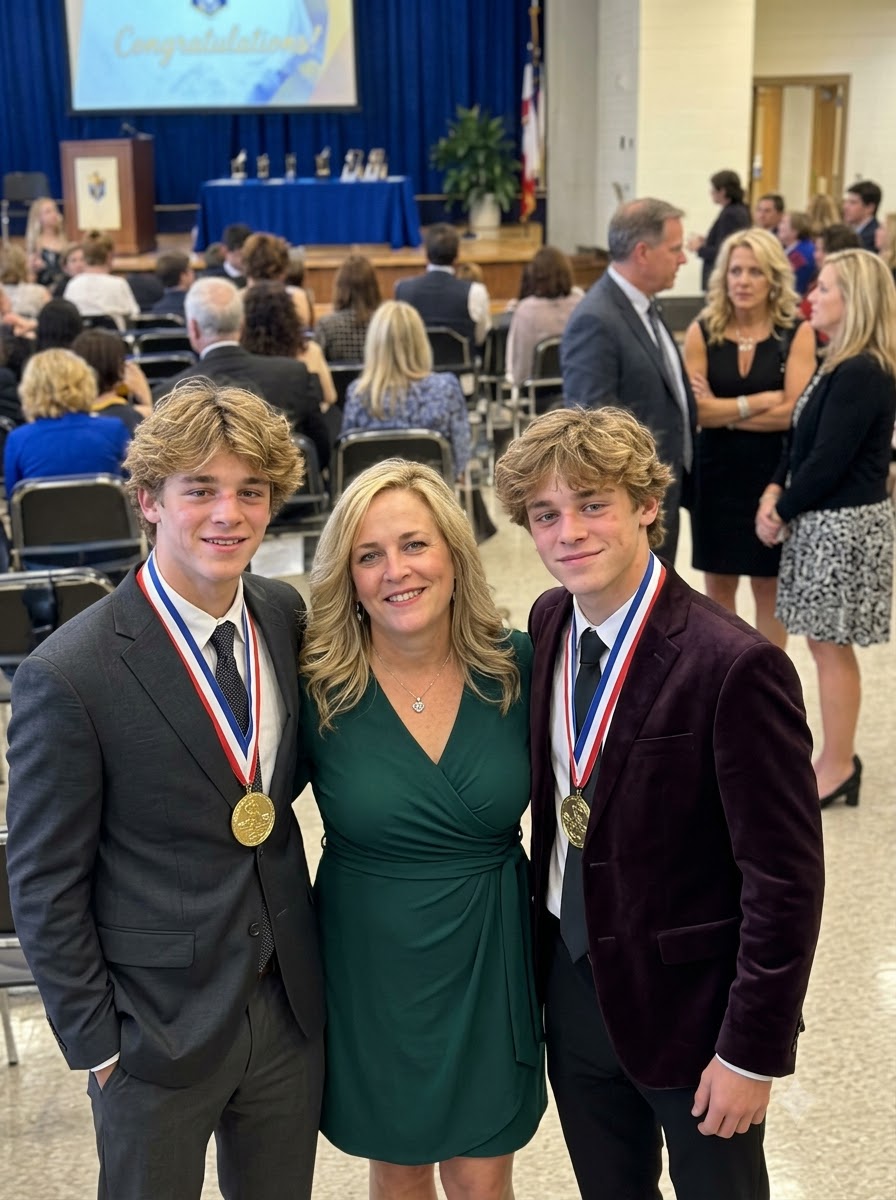
By the time the announcer invited Eli and Owen to come forward, the auditorium was no longer looking at them as two reserved boys wearing ordinary jackets.
I watched my sons make their way toward the stage while the enormous scoreboard shone behind them. Eli had earned first place in the advanced science division. Owen had achieved the top score in mathematics. Their results had been close enough that the judges spent almost twenty minutes double-checking the final standings before making them official.
Two first-place victories.
Two gold medals.
All morning, I had deliberately avoided looking toward the section where Daniel, Vanessa, and Mason were seated.
This time, I looked.
Daniel no longer appeared angry.
He looked completely stunned.
Vanessa sat perfectly motionless beside him.
And Mason, who had spent most of the morning absorbed in his own competition materials, now leaned forward with his attention locked on my sons.
The first medal was placed around Eli’s neck.
The second was placed around Owen’s.
Applause swept through the auditorium, and I rose along with everyone else. I didn’t shout. I didn’t throw my hands into the air. I simply kept clapping until my palms hurt because I understood exactly what those medals represented.
They represented all the years Daniel had never witnessed.
The kitchen table buried beneath practice worksheets. The science equipment that gradually consumed our laundry room. The Saturdays when I drove two hours to free workshops because private tutoring was beyond our budget. The evenings Owen became frustrated enough to consider quitting. The mornings Eli climbed out of bed before sunrise because he wanted one more hour to work on an experiment before school.
Daniel saw two gold medals.
I saw thirteen years.
When the boys stepped down from the stage, neither of them looked in his direction.
They walked directly toward me.
Owen was grinning so widely that he somehow looked younger than he had earlier that morning. Eli managed to stay composed for approximately three seconds before wrapping his arms around me.
“We did it,” he whispered.
“You did,” I told him.
Over Eli’s shoulder, I watched Daniel rise from his seat.
For one unreasonable second, I assumed he might be leaving.
Instead, he began walking toward us.
Vanessa reached for his sleeve, but Daniel pulled away without even glancing at her.
Mason trailed several steps behind him.
Daniel stopped directly in front of the boys and stared at the medals resting against their shirts.
Then, perhaps for the first time in years, he truly looked at their faces.
I watched understanding slowly settle over him.
Not recognition of their identities. I had already explained that.
Recognition of everything he had missed.
“You won both divisions?” he asked.
Eli glanced toward Owen. “Separate divisions.”
“Science and math,” Owen added.
Daniel nodded several times, almost as though he had just received information his mind needed extra time to absorb.
“That’s… impressive.”
Neither boy responded.
Daniel turned his attention toward me. “Why didn’t you tell me they were competing at this level?”
I nearly laughed at the question.
Not because anything about it was amusing.
Because it was so unmistakably Daniel.
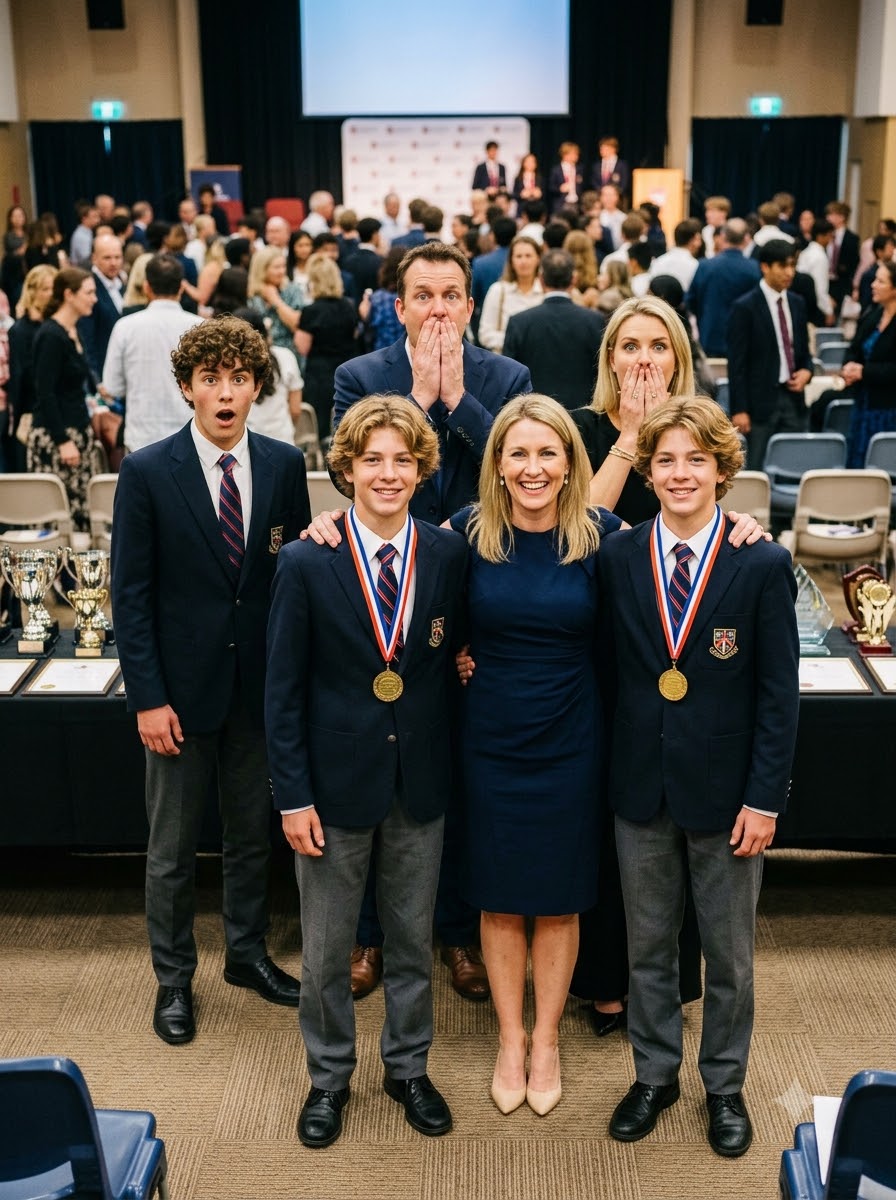
For thirteen years, he had created an enormous empty distance between himself and his sons, and now he was asking why I hadn’t provided him with directions across it.
“You didn’t know what school they attended until this morning,” I said quietly. “When exactly was I supposed to start sending you competition schedules?”
His expression tightened.
“Claire, that’s not fair.”
Something shifted in Eli’s face when he heard those words.
I felt him move slightly beside me, but he remained quiet.
Before I could respond, Mason stepped closer.
His attention wasn’t on Daniel.
He was staring at Eli’s badge.
“Wait,” he said. “You’re Eli Mercer?”
Eli looked startled. “Yeah.”
Mason turned toward Owen. “And you’re Owen Mercer?”
Owen nodded.
For the first time that entire day, Mason laughed, but there was nothing cruel about the sound.
“I knew those names sounded familiar.”
Daniel frowned. “From where?”
Mason looked at his father as though the answer should have been obvious.
“The state rankings. Their team has been ahead of ours in the online challenge series almost all year.”
Vanessa finally walked over to join us.
“Mason,” she said softly.
But Mason continued.
“Eli had that environmental model that got featured in the student research showcase, right?”
Eli nodded again, clearly uncomfortable with suddenly becoming the center of attention.
“And Owen solved the final proof problem at regionals,” Mason said. “Our coach showed us his solution.”
Daniel’s expression changed again.
That morning, he had looked straight past my sons because they wore simple jackets and attended a school whose name meant nothing to him.
Yet his other son had known their names before their own father did.
Vanessa crossed her arms. “There are a lot of different rankings.”
Mason looked directly at her. “Mom, it’s the same circuit.”
It was the only time he corrected her all day.
Vanessa didn’t argue again.
A competition volunteer walked over carrying a clipboard and mistakenly assumed Daniel belonged with our group.
“Families of the medalists can gather near the photo wall after lunch,” she said brightly.
Daniel straightened almost instinctively.
I noticed.
So did Eli.
The volunteer continued walking before anyone had the chance to correct her.
For several seconds, nobody spoke.
Then Daniel cleared his throat.
“What school are you two at now?”
The boys told him.
He asked who their teachers were.
They supplied the names.
He asked how many years they had been competing.
“A few years,” Owen said.
On the surface, it was an entirely ordinary conversation.
There was no dramatic explosion. Nobody shouted.
Daniel simply stood in a university hallway gathering basic information about his own sons while strangers passed around us carrying backpacks and competition programs.
Somehow, that felt worse than the confrontation outside.
Every answer revealed another detail he should already have known.
Eventually, Daniel said, “I’m glad you’re doing so well.”
Eli met his eyes.
“Okay.”
Daniel visibly flinched.
Not because Eli had said anything disrespectful.
Because he hadn’t.
There was no anger in my son’s tone. No accusation.
Only the careful courtesy someone uses when speaking to an adult they hardly know.
Mason tapped his pencil once against his leg before sliding it into his pocket.
Vanessa suggested that they go find something for lunch.
Daniel stayed where he was.
“Could I talk to them for a minute?” he asked me.
The question caught me off guard.
What surprised me even more was that he had actually asked rather than simply assuming he had the right.
I looked toward Eli and Owen.
“That’s their decision.”
Daniel’s jaw tightened slightly, but he turned toward the boys.
“Would you mind?”
Owen looked at his brother.
Eli shrugged. “We can talk here.”
Daniel obviously wanted the conversation to be private.
The boys weren’t offering privacy.
So the five of us remained beside the university hallway while Vanessa and Mason stood several feet away.
Daniel chose his words carefully.
“I know I haven’t been around as much as I should have been.”
Owen’s eyebrows lifted slightly.
As much as I should have been.
Thirteen years reduced to an issue of scheduling.
Daniel noticed his reaction.
“I made mistakes,” he corrected himself. “A lot happened between your mother and me. You were young. Things were complicated.”
I remained silent.
I wanted to interrupt.
But the conversation no longer belonged to me.
Eli asked the question instead.
“Were our birthdays complicated?”
Daniel opened his mouth.
Nothing came out.
“Our concerts?” Eli continued. “Were those complicated too?”
“Eli,” I said quietly.
He turned toward me, and I realized he wasn’t becoming emotional or losing control.
He was completely calm.
He had simply stopped protecting Daniel from what was obvious.
Daniel rubbed the back of his neck.
“I should have done better.”
“Yes,” Owen said.
One word.
No cruelty.
No speech.
Daniel almost appeared relieved to hear something he could simply agree with.
“I want to do better now.”
That was when Owen looked toward me.
For years, I had wondered what I would do if this exact moment ever arrived.
Would I encourage them? Shield them? Tell Daniel that he had forfeited the right to ask?
But my sons were no longer little boys.
So I gave them the only answer that felt truthful.
“You don’t have to decide anything today.”
Daniel’s expression hardened.
“I’m their father, Claire.”
There it was.
Not an apology.
A claim.
Eli heard it too.
“You didn’t know who we were this morning,” he said.
Daniel fell silent.
Behind him, Mason’s expression changed.
His eyes moved from Daniel to Eli and then toward Owen.
“They really are my brothers?” he asked.
Daniel turned sharply.
Vanessa closed her eyes for one brief second.
That told me everything.
Mason had never known.
Daniel said, “Mason, this isn’t the place.”
“You never told me.”
“We’ll talk later.”
“You told me you and Claire hadn’t spoken in years. You never said you had two sons.”
The hallway suddenly seemed much smaller.
For the first time that day, Daniel wasn’t confronting a past he could dismiss as an issue between former spouses.
He was confronting a consequence inside the family he had created afterward.
Vanessa moved slightly between them.
“Mason, your father and I were going to explain when you were older.”
Mason stared at her.
“I’m competing for college scholarships today. How much older was I supposed to get?”
Daniel lowered his voice. “Enough.”
Mason stepped backward.
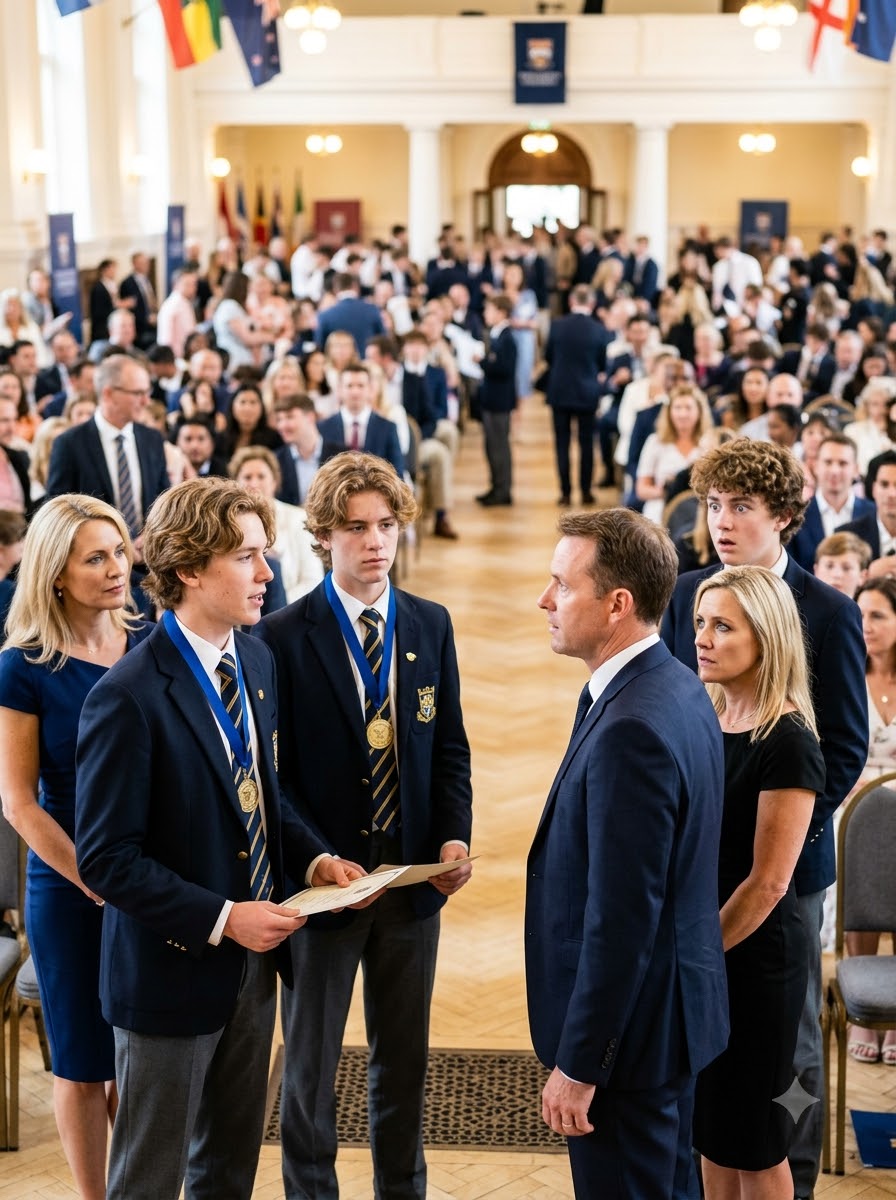
There was nothing theatrical about it.
He simply looked once more at Eli and Owen, shook his head, and said, “Good job on the medals.”
Then he walked toward the cafeteria.
Vanessa followed him.
Daniel stood watching them leave.
For one brief moment, I almost felt sorry for him.
Almost.
Then he turned toward me.
“You could have handled this differently.”
The old instinct inside me recognized the maneuver immediately.
Whenever Daniel lost control over what was happening, he searched for somebody else to carry the responsibility.
“Handled what differently?” I asked.
“This. Them. Mason finding out like that.”
“I didn’t tell Mason anything.”
“You brought the boys here knowing we’d be here.”
I stared directly at him.
“Daniel, this is a statewide academic competition. Their qualification scores brought them here. Not you.”
His cheeks darkened.
“You know what I mean.”
“No. I really don’t.”
His voice climbed just enough that a couple passing beside us turned their heads.
“You’ve had thirteen years to make me the villain to them.”
That was the exact moment he destroyed whatever small opportunity remained to make the conversation about repairing anything.
I said nothing.
There was no need.
Owen answered instead.
“Mom didn’t make you anything.”
Daniel looked toward him.
Owen stood with both hands resting quietly at his sides, the new gold medal reflecting the overhead lights.
“She never told us to hate you,” he continued. “She actually used to say we’d understand more when we were older.”
A sudden flicker of hope softened Daniel’s face.
It survived for barely a second.
“We got older,” Owen said. “We understood that you weren’t there.”
Daniel looked as though the ground beneath him had shifted.
Then Eli spoke.
“We knew your name. We knew where you lived. Mom never hid you from us. There just wasn’t much else to know.”
Nobody spoke after that.
Several minutes later, an announcement instructed the finalists to return to the auditorium for the closing team challenge.
The boys turned toward the entrance.
Daniel stepped forward.
“Can I watch?”
Eli glanced toward Owen.
Owen looked at me.
Then Eli answered, “It’s a public auditorium.”
It wasn’t forgiveness.
But neither was it punishment.
Daniel went back to his seat.
Eventually Mason returned with Vanessa and sat on her opposite side, away from his father.
The final challenge wasn’t based on individual results.
Each team received a complicated problem involving logic, engineering, and data analysis, followed by twenty minutes to develop and present its solution.
Eli and Owen usually competed on different sub-teams, but that afternoon their coach assigned them separate responsibilities within the same final presentation.
I watched Owen manage the mathematical model while Eli defended the practical design.
Their teammates completed everything around them.
No one tried to dominate.
No one needed to.
Their public school team finished first overall.
Mason’s school placed third.
When the final rankings appeared, Mason began applauding before either of his parents.
Daniel joined him one second later.
Vanessa applauded too.
For a while, I believed that would be the end of everything.
The ceremony continued.
Coaches thanked the volunteers. Students exchanged pins and posed for photographs. Parents crowded the aisles.
The tension that had accumulated throughout the day gradually dissolved into ordinary noise.
Daniel stayed near the back.
He didn’t come toward us again.
I was grateful.
Then the announcer requested that the individual gold medalists and their coaches return to the front for the official photographs.
Eli and Owen walked down with their team coach, Dr. Ramirez, a patient man who had spent two years demanding more from them than they believed they were capable of giving.
The photographer arranged the students first.
Then she invited the parents or guardians who had supported the medalists to step forward for one final photograph.
For a moment, I remained where I was.
I had never enjoyed being photographed.
Owen noticed me immediately.
“Mom!”
He waved me toward them.
Eli pointed at the empty space separating the two of them.
“Get up here.”
I started toward the aisle.
At exactly the same moment, Daniel rose from his seat.
He moved one step forward.
Then stopped.
Nobody had told him he wasn’t allowed to join them.
Nobody needed to.
He looked toward the boys.
Their eyes were on me.
That was the consequence he finally appeared to understand.
Fatherhood wasn’t a title he could suddenly reclaim because a microphone had announced his sons’ names.
It was thirteen years made from ordinary days.
And he had missed them.
I reached the front.
Eli pulled me into the space between himself and Owen.
Dr. Ramirez stood on Owen’s other side.
Their medals rested against their shirts while the state team trophy sat on a nearby table.
The photographer asked us to move closer together.
Owen wrapped an arm around my shoulders.
Eli did the same.
From the rear of the auditorium, Daniel watched us.
Then Mason began walking down the aisle.
For one second, I wondered whether Daniel had sent him.
He hadn’t.
Mason stopped a respectful distance away and looked toward the twins.
“Could I get your contact info later?” he asked. “For the summer invitational. Our coach is putting together a mixed team.”
Owen smiled. “Sure.”
Eli nodded.
It was uncomfortable.
But it was genuine.
Three boys connected by a truth none of them had chosen.
Daniel had spent years avoiding one family while carefully controlling what another family knew.
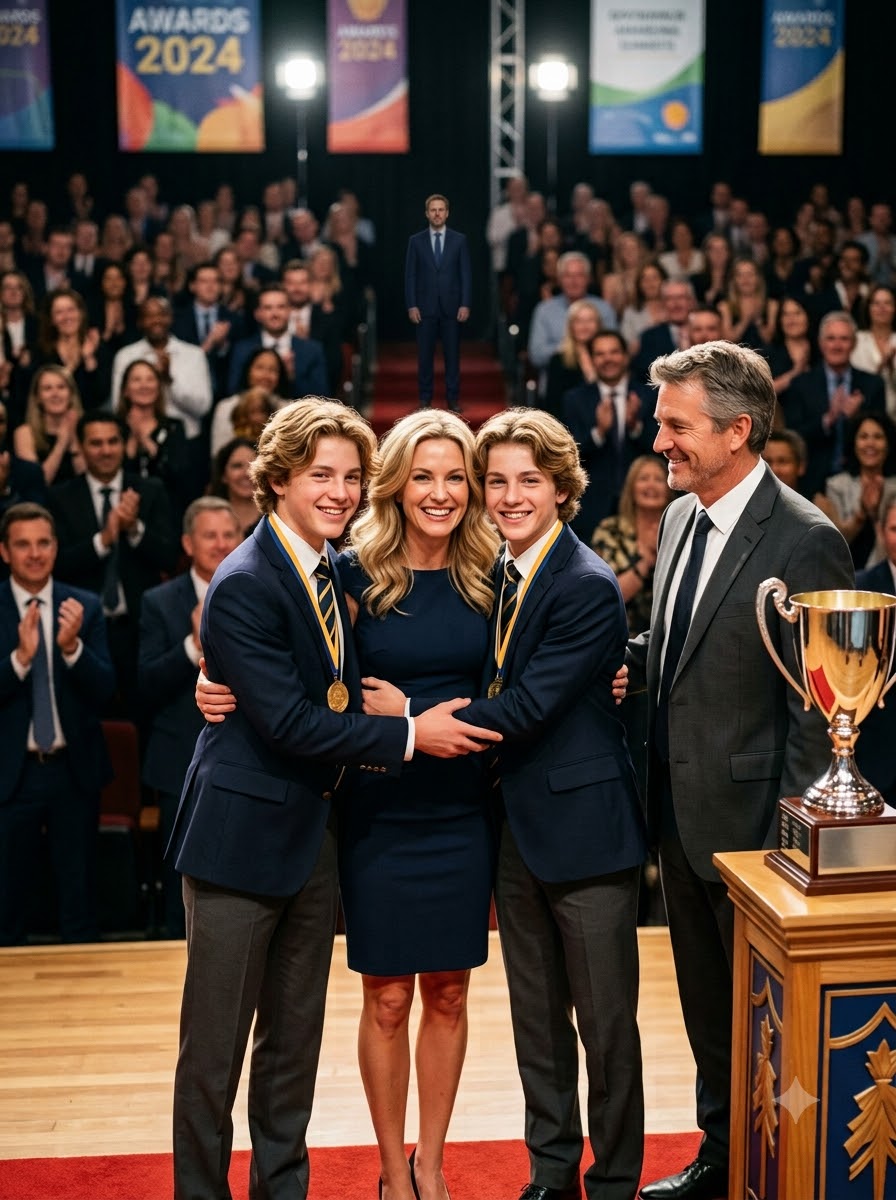
In less than a single day, those boys had started confronting the truth with more honesty than he ever had.
After the photographs were finished, Daniel approached me one final time outside the auditorium.
His anger had disappeared.
So had the confidence he’d possessed that morning when he demanded to know how I dared appear there.
“Claire,” he said, “I don’t know how to fix this.”
I believed him.
That didn’t make teaching him my responsibility.
“Start by not making them responsible for making you feel better,” I said.
He looked through the glass doors toward Eli and Owen.
“Do you think they’ll ever give me a chance?”
“Maybe. Maybe not.”
He looked at me helplessly.
I continued, “But if you only show up because they’re winning, they’ll know. If you want a relationship with them, you’ll have to show up when nobody is handing them medals.”
Daniel dropped his gaze.
For once, he had no argument.
I left him there and returned inside.
The boys were waiting beside the registration tables where our entire day had begun.
That morning, Daniel had looked at their ordinary jackets and badges and assumed they were unimportant.
He had looked at me and assumed my presence somehow revolved around him.
Now Owen was carrying both his own medal and the team trophy because Eli had stopped to help a younger competitor locate a missing backpack.
When Eli came back, he handed me his medal for a moment while he zipped his jacket.
The ribbon still held the warmth of his neck.
Thirteen years earlier, Daniel had walked away believing he was leaving me behind with two children and a difficult future.
He had misunderstood what he was abandoning.
He had left behind birthdays he could never recover.
Questions he had never heard.
Tiny victories that eventually grew into much larger ones.
Two boys who developed discipline, humor, loyalty, and ambition without ever waiting for his approval.
And that afternoon, when both of them walked onto a stage and accepted gold medals, Daniel finally understood the part that hurt the most.
They hadn’t spent thirteen years waiting for him to become their father.
They had spent those thirteen years becoming themselves.
Owen handed me my bag and gestured toward the exit.
“Ready, Mom?”
I looked across the auditorium one final time.
Daniel remained near the back, watching the three boys talking together.
Then I turned away.
“Yes,” I said. “Let’s go home.”
That morning, Daniel had demanded to know how I dared come there.
By evening, the answer was shining in gold around my sons’ necks.
I had never come for him.
I had come for my children.
