

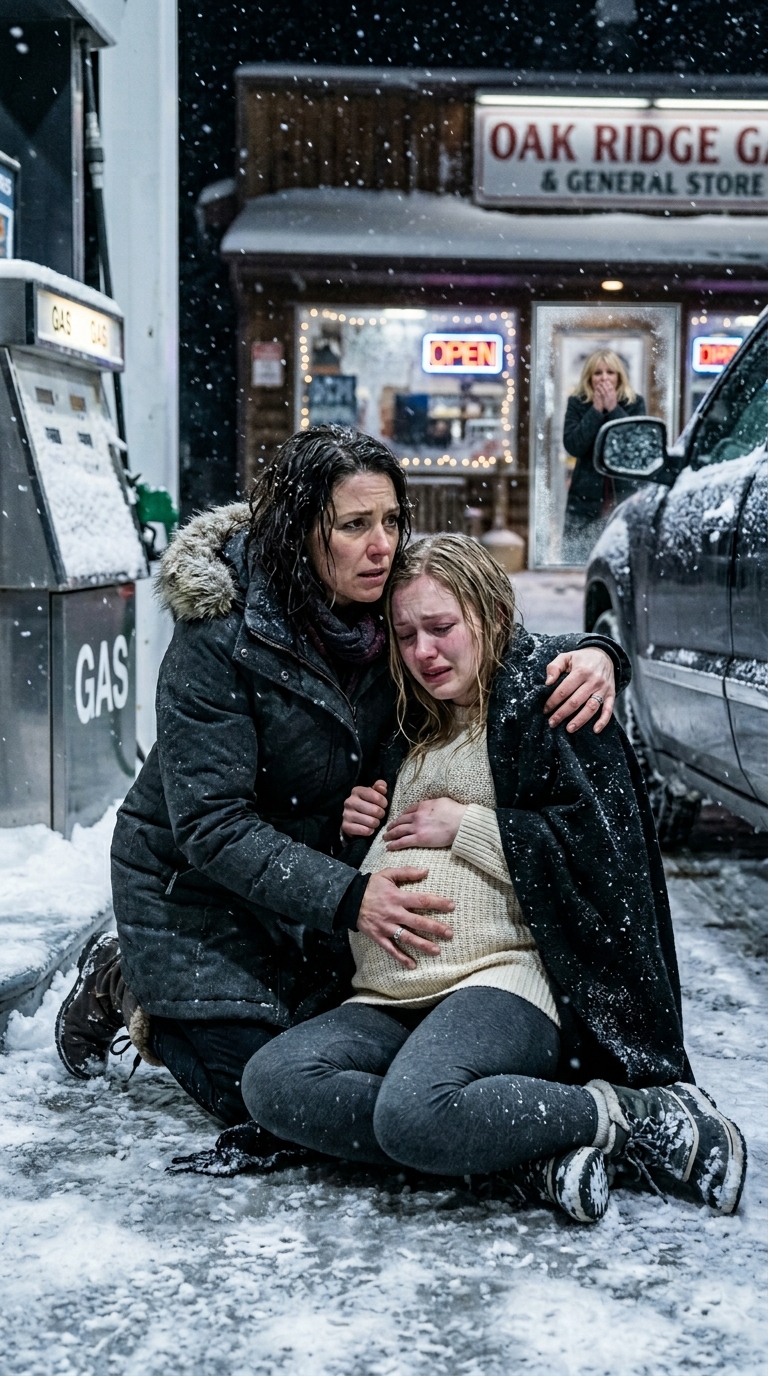
The night I found my sister, the snow was falling so hard it looked like the mountain was trying to bury her alive.
Lena was curled beside a gas station ice machine on Route 19, one hand locked over her swollen belly, the other tucked uselessly under her chest as if she could somehow protect herself from minus twelve-degree cold. Her blonde hair was stiff with frost. One shoe was missing. Her lips were blue.
And for one terrible second, I thought I was too late.
“Lena.”
My voice came out strangled. I dropped to my knees in the slush so fast the cold shot through my jeans like knives. Her eyes fluttered open slowly, glazed and unfocused.
“Mara?” she whispered.
I shrugged off my coat and wrapped it around her. Her body was trembling so violently I could feel it through my arms. Inside the gas station, a clerk with tired eyes and a gray sweater stood frozen behind the glass, staring at us in horror.
“What happened?” I asked, fighting to keep my voice steady.
Lena swallowed. The motion looked painful. “They said I was too sensitive.”
I went cold.
“Who said that?”
Her gaze drifted toward the dark highway. Snow whipped across the road, already filling the tire tracks that had left her there. “Daniel’s mother. His sister. His cousin drove.” Her breath caught in her throat. “Daniel said he’d come back in ten minutes.”
I stared at her. “How long ago?”
The answer came out in a shiver. “Three hours.”
Three hours.
My hearing narrowed to the howl of the wind and the pounding of blood in my ears. Three hours on a mountain highway in that weather wasn’t a prank. It was a sentence.
I called 911 first. Then, with my free hand still holding Lena against me, I called my brother.
Adrian answered on the second ring. “Mara?”
I looked out through the storm, at the black road where her husband’s family had left her to die. “I found Lena,” I said. “Pregnant. Hypothermic. Abandoned on Route 19.”

There was a beat of silence, and I heard his breathing change.
“Who did it?”
“Her husband’s family.”
Another pause. This one was sharp enough to cut.
Then I said the only thing I could say. “Do what you do best.”
He didn’t ask what I meant.
The gas station clerk rushed out with blankets while we waited for the ambulance. She moved like someone waking from a nightmare, her hands shaking as she helped cover Lena’s legs. “I’m Eve,” she said softly, kneeling beside us. “I saw her through the window twenty minutes ago. I thought she was drunk at first, then I saw…” Her voice cracked.
Lena flinched when Eve touched her shoulder, but Eve’s face softened with something deeper than pity. When I said Daniel’s name, her expression changed for a split second—shock, recognition, something darker—but it vanished before I could grab hold of it.
The ambulance arrived in a scream of red and blue light.
At the hospital, everything turned into noise and fluorescent brightness. Nurses. Heated blankets. Monitors. A doctor with sharp eyes and a clipped voice saying words like hypothermia, dehydration, and fetal distress. I stood beside Lena’s bed while they checked the baby, my heart lodged in my throat.
Then the Doppler caught it—a tiny, frantic rhythm.
Heartbeat.
I nearly collapsed with relief.
Lena started crying. So did I.
“You’re safe,” I whispered, clutching her hand. “You hear me? You’re safe.”
She nodded, but her fingers tightened around mine with desperate force. “Don’t let him near me.”
I didn’t have to ask who she meant.
Daniel arrived twenty minutes later wearing the face of a grieving saint. His hair was neat. His coat was expensive. His mouth trembled just enough to look convincing.
“Baby, thank God,” he said, stepping toward the bed. “I was so scared.”
Lena recoiled so hard the monitor wire tugged.
That was all I needed.
I stepped in front of him.
His eyes cut to mine. “Move.”
I smiled without warmth. “No. You move.”
“This is between me and my wife.”
“Funny,” I said. “You seemed to forget she was your wife when you left her on the side of a mountain to freeze.”
His jaw flexed. “It was a joke. My mother was playing around. We were coming back.”
“After three hours?”
Before he could answer, the door opened behind him.
Adrian walked in wearing a dark federal jacket, his badge clipped at his belt, two uniformed officers behind him. My brother had always had a stillness about him, but when he was angry, it turned lethal. He took one look at Lena in the bed, then at Daniel standing too close to her, and the room temperature seemed to drop ten more degrees.
“Is this him?” Adrian asked.
Lena’s fingers tightened around mine. “Yes.”
Daniel tried to recover his composure. “I think there’s been a misunderstanding.”
Adrian didn’t blink. “There won’t be one where you’re going.”
The officers moved in.
For the first time that night, real fear crossed Daniel’s face.
The hours after that blurred into interviews, statements, and coffee so bitter it made my stomach hurt. Lena drifted in and out of sleep while a police photographer documented the bruises on her knees, the frostbite on two toes, the raw scrape where she’d clearly fallen trying to walk.
When Adrian finally sat down beside me in the waiting room, it was almost dawn.
“Well?” I asked.
He rubbed a hand over his mouth. “Daniel, his mother, his sister, and the cousin all say it was a prank gone wrong. They claim Lena got hysterical during a family drive, demanded to be let out, and they assumed she’d walk to the gas station.”
I laughed once, sharp and ugly. “They left a six-month pregnant woman in a blizzard.”
“I know.”
“You’re telling me they can say ‘prank’ and make this disappear?”
His eyes hardened. “Not if I can help it.”
That was Adrian. Controlled. Quiet. Dangerous in all the ways that mattered. Most people looked at Lena and saw softness. They looked at me and saw anger. They looked at Adrian and saw a man who would make the world sit down and tell the truth.
When Lena woke again, I asked what happened.
She stared at the ceiling for so long I thought she wouldn’t answer.
Then the words began to spill out.
It had started with dinner at Daniel’s parents’ cabin. His mother had criticized everything: Lena’s weight, her “dramatic” nausea, the nursery colors she had chosen, the fact that she wanted a hospital birth instead of a home one. His sister had laughed every time Lena cried. Daniel had smiled and told her not to be so emotional.

Then, on the drive home, they turned onto Route 19.
His cousin locked the doors and accelerated. His mother twisted in the passenger seat and said, “Maybe a little cold air will cure your hormones.”
Lena thought they were joking until the cousin pulled over and Daniel opened her door.
“I’ll be back in ten minutes,” he said.
Then they laughed while she stood there, stunned in the headlights, and drove away.
By the time she realized they weren’t turning around, the snow was coming down too hard to see through.
I held her hand the entire time she told me. By the end, my nails had crescent moons in my own palms from clenching too hard.
“What about before this?” Adrian asked gently. “Had anything else happened?”
Lena hesitated.
That hesitation broke something open inside me.
She told us about the little cruelties she’d hidden—Daniel taking her phone when he was angry, his mother showing up unannounced to inspect the apartment, his sister “joking” that some women weren’t fit to be mothers. How Daniel had been pushing papers at her for weeks, asking her to sign life insurance forms, property transfers, power of attorney “just in case.”
“Did you sign anything?” Adrian asked.
“No.” Lena shook her head weakly. “He got angry when I refused.”
Adrian’s expression sharpened. “That matters.”
By noon, security footage from the gas station showed Lena stumbling through the snow alone, nearly collapsing before she reached the side wall. Toll camera footage showed Daniel’s cousin’s SUV driving away from Route 19 and heading back toward the cabin—not turning around, not circling back, not even slowing down.
Their joke was already dead.
But what turned suspicion into something uglier came from Daniel himself.
He asked to see Lena privately.
Adrian refused.
Daniel insisted. “I just want to apologize.”
“You can do it in front of witnesses,” Adrian said.
So they brought him into her room with an officer by the door, Adrian near the window, and me planted beside her bed like a guard dog. Daniel stepped closer, eyes wet, voice soft.
“Lena,” he said. “Tell them it got out of hand. Tell them I came back.”
“You didn’t,” she whispered.
He glanced at the officer, then leaned in as if to kiss her forehead. Instead, he murmured so low he probably thought only she could hear him.
“You weren’t supposed to live long enough to tell them anything.”
I moved before I even knew I was moving.
Adrian got there first.
He slammed Daniel into the wall so hard the oxygen monitor rattled. The officer yanked Daniel’s arms behind his back while Daniel sputtered about assault, legal rights, misunderstanding.
Adrian leaned close enough that their faces nearly touched. “The room audio records everything,” he said quietly. “Say another word. Please.”
Daniel went white.
That should have been enough. It should have been the end.
But the true ending—the one none of us saw coming—began with Eve, the gas station clerk.
She showed up that evening in the hospital lobby asking for me by name.
I found her sitting with her hands clasped tightly in her lap, eyes fixed on the floor. Up close, she looked younger than I’d thought, maybe mid-thirties, with a small white scar just below her ear.
“I need to tell you something,” she said.
I sat across from her. “About Lena?”
“About Daniel.”
The air in my lungs stalled.
Eve looked up, and for the first time I saw the terror underneath her composure. “When I heard his name last night, I knew it couldn’t be a coincidence.”
My heartbeat quickened. “What are you talking about?”
She reached into her bag and took out an old driver’s license, laminated and cracked with age. She slid it across the table.
The photo was hers.
The name was not.
Elise Carter.
My fingers went numb.
“He told Lena he’d never been married before, didn’t he?” she asked.
I couldn’t speak.
Seven years earlier, Eve—Elise—had been Daniel’s first wife.

And he had done the same thing to her.
She had been three months pregnant when Daniel and his family took her for a “late-night drive” on Route 19 after she found documents proving they were using wives’ life insurance policies and forged transfers to move money through shell companies. They pushed her out of the SUV after an argument. She survived the freezing night, barely, but she lost the baby.
When she went to the police, Daniel’s family used money, lawyers, and lies to paint her as unstable. A grieving woman who’d run from home after a miscarriage. A liar. A drunk. A mess. When the case collapsed, Elise disappeared, changed her name, and never looked back.
Until she saw Lena shivering under the gas station lights.
“I thought I was looking at a ghost,” she whispered. “Same road. Same storm. Same line.” Her mouth trembled. “They told me I was too sensitive, too.”
I stared at her, cold spreading through me all over again.
Adrian listened to her statement in absolute silence. By the end, his face looked carved out of stone.
“Can you identify Daniel?” he asked.
Elise laughed once, bitter and broken. “I’d know the man who killed my baby anywhere.”
The arrest warrant turned into a federal case before sunrise.
By then Adrian had enough to connect everything: multiple policies, forged signatures, offshore transfers, a pattern of isolating vulnerable women with limited family nearby. Lena had been chosen because Daniel believed she was easy prey—gentle, grieving, protected by no one.
He had been spectacularly wrong.
Daniel was brought into an interview room that afternoon, still clinging to arrogance like it might save him. His lawyer sat beside him. His mother had stopped crying and started sneering. His sister looked furious. The cousin looked ready to throw up.
Adrian placed a folder on the table. Inside were life insurance policies, transfer requests, the room audio transcript, toll camera stills, and Elise’s statement.
Daniel’s smirk finally faltered.
Then Adrian opened the door.
Eve walked in.
No makeup. No gray uniform. Just a dark coat and a face Daniel had buried in his memory because he thought she belonged there—with the dead.
For a long, stunned second, nobody breathed.
Daniel’s mother made a sound like choking.
Daniel lurched back in his chair so violently it scraped across the floor. “No,” he said. Then louder, desperate now. “No. That’s not possible.”
Elise stood in front of him, hands steady, eyes clear.
“Hello, Daniel,” she said. “You should’ve finished the job yourself.”
He broke.
Not slowly. Not gracefully. Completely.
He started talking over himself, denying, blaming, shouting that his mother had planned everything, that his sister had pushed, that the cousin drove, that he had only wanted Lena scared into signing, that Elise was supposed to keep quiet, that none of this was supposed to happen.
The room watched him unravel.
And I realized something then, something so brutal it almost felt merciful: monsters aren’t terrifying when they’re powerful. They’re terrifying because they assume nobody will ever drag them into the light.
Weeks later, Lena came home wrapped in blankets, pale but healing, with a baby who still kicked furiously every time I played music near her belly. Daniel and his family sat in separate cells awaiting trial. The federal case had swallowed them whole.
One evening, while I was helping Lena fold tiny onesies at her kitchen table, she touched her stomach and smiled for the first time in what felt like a lifetime.
“I’ve been thinking about names,” she said softly.
I looked up. “Oh?”
She nodded toward the window, where winter sunlight was melting the last of the snow. “If she’s a girl,” she said, “I want to name her Elise.”
I blinked. “After Eve?”
“After the woman who survived long enough to save me.”
My throat closed.
Outside, the world looked clean for the first time in months.
Inside, my sister sat in the golden light, one hand resting on the child they had tried to erase.
And that was the part Daniel never understood.
He thought he had abandoned a frightened woman on a mountain road.
What he really did was awaken every witness, every buried truth, every ghost he had ever left behind in the snow.
