

PART 1
In Mauricio Aguilar’s house, in an elegant gated community in Juriquilla, everyone saw Don Roberto as a quiet little old man.
The man who fixed the kitchen faucet. The one who made chicken soup when someone got sick. The one who swept the patio before sunrise so he wouldn’t be in the way.
No one imagined that this 68-year-old man, with his neatly ironed short-sleeved shirts and his old but clean shoes, had quietly saved more than $800,000 over the course of his lifetime.
Don Roberto had been a senior accountant for 35 years at an auto parts company in Querétaro. He wasn’t the type to show off his wealth. He didn’t wear expensive watches, he didn’t talk about investments, and he never mentioned how much he had.
His wife, Clara, always used to tell him: —“Quiet money protects you more than flashy money.”
When she passed away, the house where they had lived became enormous, cold, and unbearable.
That’s why, when his only son Mauricio asked him to come live with him and his wife Fernanda, Don Roberto agreed.
—“Dad, come live with us. I don’t want you to be alone,” Mauricio told him, his eyes red at the wake.
At first, Fernanda was kind. She made him coffee. She asked if he needed anything. She even called him “Don Robertito” in front of the neighbors, as if she adored him.
But little by little, the smiles turned into disguised orders.
—“Would you mind eating in the kitchen? My friends from the club are coming over.”
Then it became: —“You’d better stay in your room today, okay? There’s a couples’ get-together and you’ll get bored.”
Don Roberto obeyed. Not because he was foolish. But for the sake of peace.
At Christmas, they seated him at a small separate table near the hallway while Mauricio, Fernanda, and their guests toasted in the main dining room. He ate cold turkey, listening to the laughter coming from behind a half-closed door.
That night he understood something, but he still didn’t want to accept it.
Fernanda began treating the house as if it had two worlds: the pretty family world for Instagram, and Don Roberto’s world, hidden away like an old rag.
—“When we have visitors, please use the service entrance. It’s more comfortable for everyone,” she told him one morning.
“For everyone,” he thought. But he said nothing.
In the kitchen there were always scattered bills: overdue payments, bank statements, installments on a new truck, extremely expensive furniture purchases, maxed-out credit cards.
Don Roberto saw everything. His years as an accountant had taught him to spot financial disaster before it exploded.
Even so, he helped. He had signed as a guarantor on a loan. He had added his name to a joint account to make payments easier. He had discreetly covered several mortgage payments when Mauricio fell behind.
And no one knew. Or worse: no one asked.
To Fernanda, he was a useful nuisance. To Mauricio, he was a problem he preferred not to look at.
Everything fell apart one Monday night. Mauricio had a dinner with work colleagues. Fernanda was walking around the living room in an extremely expensive dress, holding wine glasses and wearing a fake magazine smile.
Don Roberto had spent the entire afternoon preparing stuffed mushrooms, the kind Mauricio loved as a child.
When he came out with the tray, Fernanda approached him with clenched teeth. —“Don Roberto, don’t hover over the guests. Seriously, it looks weird.”
He lowered his gaze and stepped aside.
Minutes later, she returned. This time she didn’t whisper. —“Mauricio, tell your dad to go to his room. He’s making everyone uncomfortable.”
The living room fell silent. Everyone turned around.
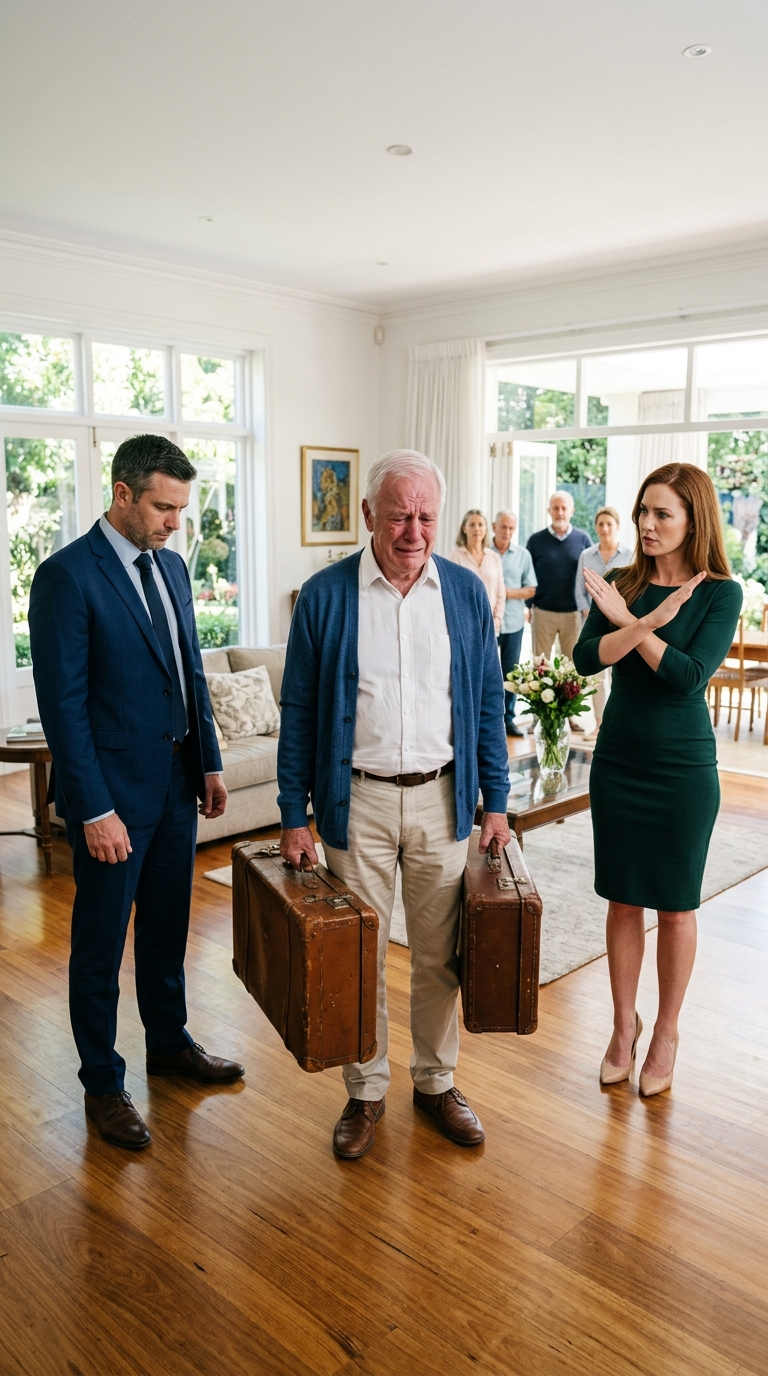
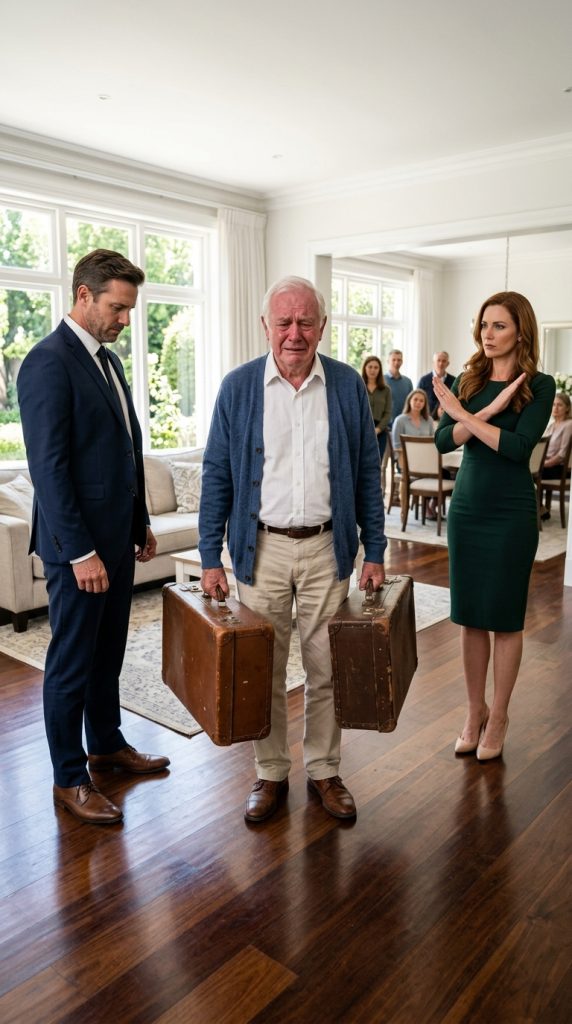
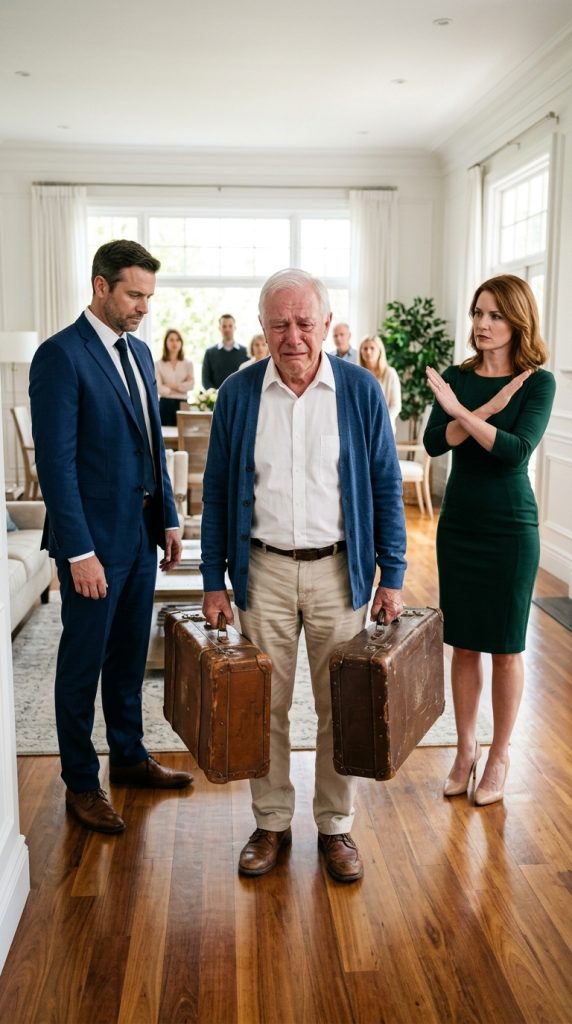
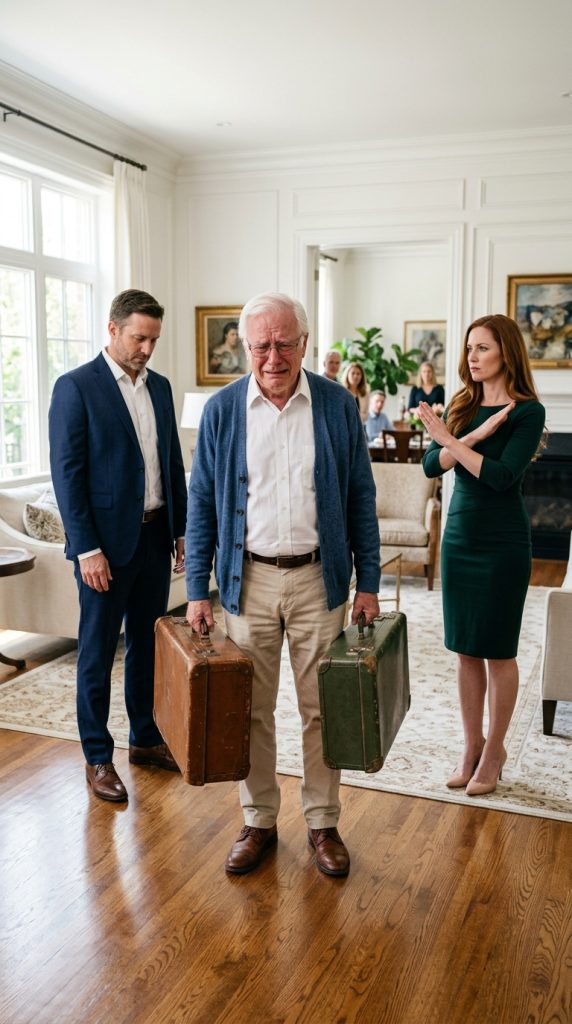
Don Roberto looked at his son. Mauricio did not defend him. He only gripped his wine glass tighter and murmured: —“Dad… give us some space, okay?”
Then Fernanda delivered the sentence that finally broke him: —“No, Mauricio. Not ‘space’. He needs to leave this house.”
Don Roberto didn’t shout. He didn’t complain. He simply smiled with such a calm sadness that it angered Fernanda.
That early morning, while the house slept, he packed two suitcases with his documents, some photos of Clara, his laptop, and a blue sweater that still smelled like home.
He left the key on the kitchen counter.
Before leaving, he opened a box in the garage with his name written on it in black marker. Inside were all the papers that Mauricio and Fernanda had never properly read.
Guarantees. Contracts. Receipts. Signatures. Notarized agreements.
Don Roberto hadn’t kept them for revenge. He kept them because an accountant knows that reality always needs proof.
Three weeks later, at 8:30 in the morning, a courier left three white envelopes at Mauricio and Fernanda’s door.
Fernanda opened the first one while drinking coffee. Then she turned pale. She opened the second with trembling hands. And when she read the third, she let out a scream so loud that the neighbors came out to see what was happening.
PART 2
The first envelope was from the bank. It informed them that Don Roberto Aguilar had officially withdrawn his name as financial support for the account linked to the house mortgage. He wasn’t the full owner, but he had been the backing that for years had prevented the bank from foreclosing whenever Mauricio fell behind on payments.
The second envelope came from the truck financing company. The white truck that Fernanda showed off at gatherings and called “my big truck” had Don Roberto listed as jointly liable. He had signed because Mauricio swore it would only be “a formality.” Now Don Roberto was legally notifying his withdrawal from the agreement, backed by a clause that allowed separation in cases of mistreatment, abandonment, or financial abuse.
The third envelope was the worst. It was a notification from Attorney Valeria Cárdenas, a civil lawyer in Querétaro. In ten pages, it detailed that Don Roberto had paid various amounts over four years to support the house: monthly payments, insurance, property taxes, interest, repairs, and even part of the truck’s down payment.
The total came to a figure that Fernanda read three times because she couldn’t believe it. $1,870,000 pesos.
It wasn’t a gift. It wasn’t unproven family support. There were bank transfers, receipts, messages from Mauricio asking for help, and a document signed by him years earlier acknowledging that his father had been covering payments “as a recoverable family loan.”
Mauricio came running downstairs when he heard the scream. —“What happened?”
Fernanda threw the papers at his chest. —“Your dad is suing us!”
Mauricio stood frozen. He read one line. Then another. His face crumbled. —“This can’t be… he never said anything.”
—“Of course he didn’t say anything, you idiot!” Fernanda shouted. “Because he was waiting to screw us over!”
But that wasn’t true. Don Roberto hadn’t been waiting for revenge. He had been waiting for respect. And when it never came, he decided to leave cleanly.
That same day the calls began. First Mauricio. Then Fernanda. Then one of Mauricio’s cousins. Then Fernanda’s mother, Doña Lorena, a woman who had always seen Don Roberto as “the old freeloader.”
Don Roberto didn’t answer. He was living in a small apartment near the Historic Center of Querétaro. He had a single bed, a wooden table, an old coffee maker, and a window overlooking a jacaranda tree. He didn’t need more.
Attorney Valeria had advised him not to speak without witnesses. —“You’re not punishing anyone, Don Roberto. You’re closing accounts,” she told him.
And that phrase gave him peace.
A week later, Mauricio showed up at the building unannounced. He waited downstairs, disheveled, with dark circles under his eyes and his shirt poorly tucked in. —“Dad, please. We need to talk.”
Don Roberto came down but didn’t invite him inside. —“Speak.”
Mauricio swallowed hard. —“Fernanda is desperate. The bank gave us 30 days. The truck… the finance company wants to renegotiate everything. We can’t handle it.”
—“I know.”
—“You know?”
—“Of course. I paid when you couldn’t.”
Mauricio looked down. For the first time he didn’t look like the busy man who was always in a hurry. He looked like a child discovering he had broken something that couldn’t be bought.
—“Dad, I didn’t know it was that much.”
—“You didn’t want to know.”
The sentence landed like a stone.
Mauricio tried to defend himself but couldn’t. He remembered the times his father ate alone. The times Fernanda made him use the back entrance. The night of the dinner. The sentence. “He needs to leave this house.” And his silence.
—“I was embarrassed,” Mauricio murmured. “I didn’t want to fight with Fernanda in front of everyone.”
Don Roberto looked at him with a hard calm. —“You were more embarrassed to defend your father than to see him humiliated.”
Mauricio cried. Not the pretty movie kind of crying. He cried ugly, with a red face, like someone who understands too late.
—“Forgive me.”
Don Roberto didn’t respond immediately. He had waited six years for those words. But when they finally came, they no longer fixed everything.
—“I forgive you, Mauricio. But forgiving doesn’t mean I’ll let you use me again.”
Meanwhile, Fernanda didn’t stay idle. She posted on Facebook that Don Roberto was “a manipulative elderly man” who wanted to take their house out of spite. The post filled with comments. Some believed her. Others wondered why a 68-year-old man had left with two suitcases and no one had looked for him earlier.
That was her first mistake.
The second was worse. At a family gathering, Fernanda claimed that Don Roberto “lived off Mauricio’s pension.”
Attorney Valeria saw the video because a cousin sent it to her. Two days later, she filed a lawsuit for moral damages and financial abuse, attaching bank statements, transfers, and screenshots of messages.
But the twist came when the lawyer reviewed an old folder that Don Roberto had almost forgotten about. It was from the purchase of the house. There appeared a document that changed everything.
When Mauricio and Fernanda bought the property, they didn’t have enough for the down payment. Don Roberto had contributed a large amount but requested that it be recorded as a recoverable contribution in case of sale, refinancing, or default. Mauricio signed it. Fernanda signed it too. She just never read the entire page.
—“Does this mean they could lose the house?” Don Roberto asked.
Valeria adjusted her glasses. —“Not exactly. It means that if they don’t pay, you have priority in the recovery line. Before their whims.”
The conciliation hearing was tense. Fernanda arrived heavily made up, with a designer bag and a victim’s expression. Mauricio arrived quietly. Don Roberto arrived in his blue shirt, with his neatly organized papers and a small photo of Clara in his wallet.
—“My client is not trying to keep the house,” Valeria said. “He is seeking recognition of what he contributed and the elimination of any future obligations.”
Fernanda let out a laugh. —“Oh please. He lived with us for free for six years.”
Don Roberto looked up. He didn’t get upset. He simply opened a folder. —“Here are the payments for electricity, water, property taxes, repairs, insurance, and 27 transfers in Mauricio’s name. There are also the messages where they asked me not to tell anyone because ‘Fernanda was going to get intense’.”
The room fell silent. Mauricio closed his eyes. Fernanda turned red.
Then Valeria presented the final document: a legally recorded audio from a call in which Fernanda said: —“As long as the old man keeps signing, he can stay. When he’s no longer useful, we’ll kick him out.”
Mauricio turned to look at her as if he had just met her. —“You said that?”
Fernanda didn’t answer. She didn’t need to.
The conciliator suspended the session for ten minutes. Mauricio went out to the hallway and sat on a bench. Don Roberto walked past him, but Mauricio took his hand. —“Dad… I really was a coward.”
This time Don Roberto didn’t pull his hand away. But he didn’t hug him either. —“Yes, son. And being a coward also hurts.”
The final agreement was clear. Mauricio and Fernanda had to refinance the debt without Don Roberto. The truck was returned. The house was put up for voluntary sale to cover the debts and pay Don Roberto the recognized amount.
Fernanda had to delete the post and issue a public apology. She didn’t do it with humility. She did it because the judge ordered her to.
Shortly afterward, Fernanda left with her mother for Celaya, saying that Mauricio had allowed “a resentful old man” to destroy their marriage.
But the truth was simpler. It wasn’t Don Roberto who destroyed that home. It was the arrogance of those who confused help with obligation.
Mauricio took months before visiting his father again. The first time he arrived without flowers, without gifts, without speeches. He only brought a bag with sweet bread and two cups of coffee.
—“I’m not here to ask for money,” he said.
Don Roberto opened the door and looked at him for a long time. —“Then come in.”
They sat by the window. They talked little. But that time, Mauricio washed the cups, swept the floor, and fixed a loose hinge on the kitchen cabinet.
Don Roberto watched him in silence. Not because he needed the help. But because, for the first time in years, his son was doing something for him without expecting anything in return.
Months later, Don Roberto updated his will. He didn’t leave everything to Mauricio as he had once planned. He created a fund to support elderly people who were victims of financial abuse by their own families.
He left Mauricio a portion, with one simple condition: he had to attend family therapy for one year and volunteer two weekends a month at a community kitchen.
When Mauricio read the condition, he cried again. But this time not because of losing money. He cried because he understood that his father was still giving him a chance to become a better person.
Don Roberto continued living in his small apartment. With his plants. His coffee. His accounts in order. And a peace that was worth more than any big house where they made him enter through the back door.
Because sometimes a family doesn’t break when someone leaves. Sometimes it breaks much earlier, when everyone sees the humiliation and no one says anything.
