


The baby’s screams tore through the marble hallways of the Caldwell mansion at three in the morning, the same hour they had torn through them the night before, and the night before that. They did not sound like hunger. They did not sound like gas or startle or the ordinary misery of a three-week-old child. They were raw, desperate, almost animal—the kind of sound that made the crystal on the sideboard tremble and turned the vast house, for a few terrible minutes, into something smaller and meaner than its price suggested.
Emily Carter stood outside the nursery with her palm flat against the door. Her black-and-white maid’s uniform was still crisp despite the hour; the white apron was tied tight at her waist, as if neatness could hold the night together. She was twenty-nine. She had worked in this house for six months. She had cleaned its guest suites and polished its silver and carried trays up staircases designed to impress people who already had everything. She had never heard crying like this.
“Emily.”
The voice cut the hallway in half.
Margaret Caldwell stood behind her in a silk robe, diamond earrings catching the chandelier’s leftover light. Her face was drawn tight—not only with exhaustion, but with irritation, and under the irritation something sharper, something that looked a great deal like fear.
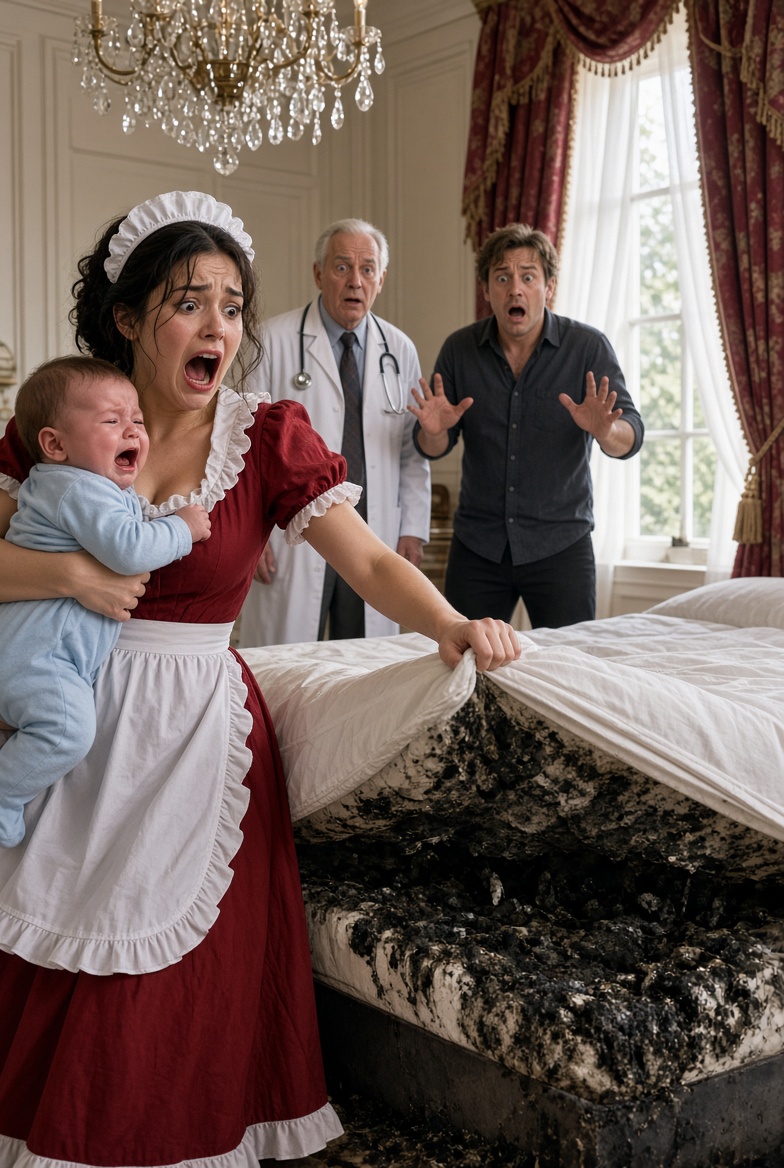
“Why is he still crying?” Margaret snapped. “You’re supposed to handle this.”
“I’ve tried everything, Mrs. Caldwell,” Emily said carefully.
Margaret’s lips pressed thin. “I don’t pay you to try. I pay you to succeed. My husband has an important meeting in four hours. Make it stop.”
Emily opened the door.
The nursery was a magazine page come to life. Organic sheets. A gold-framed crib. A temperature-controlled hush. A state-of-the-art monitor blinking its small green reassurance on the dresser. Little Oliver Caldwell lay in the center of all that perfection, his tiny body thrashing against pristine white, his face purple with distress. When Emily lifted him, her breath caught.
Red marks ran along his back.
Small, angry welts.
She held him against her chest. “Shh. I’m here. I’ve got you.”
Oliver screamed harder.
Emily had been a nanny before she became a maid. She knew the vocabulary of infant sound—the rhythmic complaint of hunger, the sharp burst of gas, the thin wail of overstimulation, the frightened cry that softened when a familiar heartbeat arrived. This was none of those. This was agony. It lived in the body. It did not negotiate.
She remembered the night the Caldwells brought Oliver home from the hospital, the way the staff had gathered in the kitchen afterward and spoken in the careful voices people use when they are not allowed to say what they think. In two weeks, three nannies had quit. One said the baby was impossible. One said he was colicky beyond help. The third left without a letter, only a folded uniform on the laundry table and a look in her eyes Emily still could not forget. That was when the housekeeper had asked Emily to add childcare to her duties—for a small raise she desperately needed to send home to her mother in Ohio, where the winter heating bill had become a kind of second rent.
The pediatrician had visited twice. He was a pleasant man with expensive shoes and a manner that suggested he had never been kept awake by anything he could not bill for.
“Some babies just cry more,” he had said, with a shrug that belonged to a different kind of house. “Colic. He’ll grow out of it.”
Emily did not believe that anymore.
She paced the nursery, bouncing Oliver gently, scanning every inch of the room as if the walls themselves might confess. Everything was perfect. That was the problem. Perfection, in her experience, was often a kind of cover. Oliver would calm in her arms—his small fists uncurling, his breath hitching down toward something almost like sleep—and then scream the moment she laid him down, as if the crib were not a bed but a sentence.
“Not fussy,” Emily whispered through tears. “You’re terrified.”
She laid him on the changing table and examined him more closely under the lamp. The red marks were worse now. They were not the faint blotches of heat rash. They clustered along the places a baby’s skin pressed longest against a mattress: the shoulder blades, the small of the back, the tender strip above the diaper line. They looked like bites.
Her stomach twisted.
She turned back to the crib and pressed her hand into the mattress.
It was damp.
Soft.
Wrong.
She glanced toward the door. The hallway was silent. Margaret had returned to the master suite, or at least she wanted Emily to believe she had. The house had a way of listening even when it pretended not to.
Emily lifted the corner of the fitted sheet.
At first she thought it was shadow—the kind of gray that collects in expensive fabric when the light is low. Then her eyes adjusted, and reality hit her like a physical blow.
The mattress was alive.
It was rotting, and it was crawling.
Thousands of maggots writhed across the surface, burrowing into black, decomposing patches of padding. The interior had collapsed into something dark and wet, filled with mold, dead insects, and a decay so advanced it looked as if it had been pulled from a flooded basement and dressed in organic cotton for the sake of a receipt. The smell rose then, late and unmistakable: sweet rot, sour damp, the particular wrongness of organic matter left too long in a closed, warm room.
Emily clapped a hand over her mouth.
She staggered backward, heart pounding so hard she felt it in her teeth.
Oliver had been sleeping on this.
Every night.
She ripped the sheet back farther. The infestation was not a corner problem, not a single unfortunate stain. It covered the mattress from seam to seam, a hidden geography of ruin beneath a surface that still looked, if you did not lift it, like care.
“How?” she whispered.
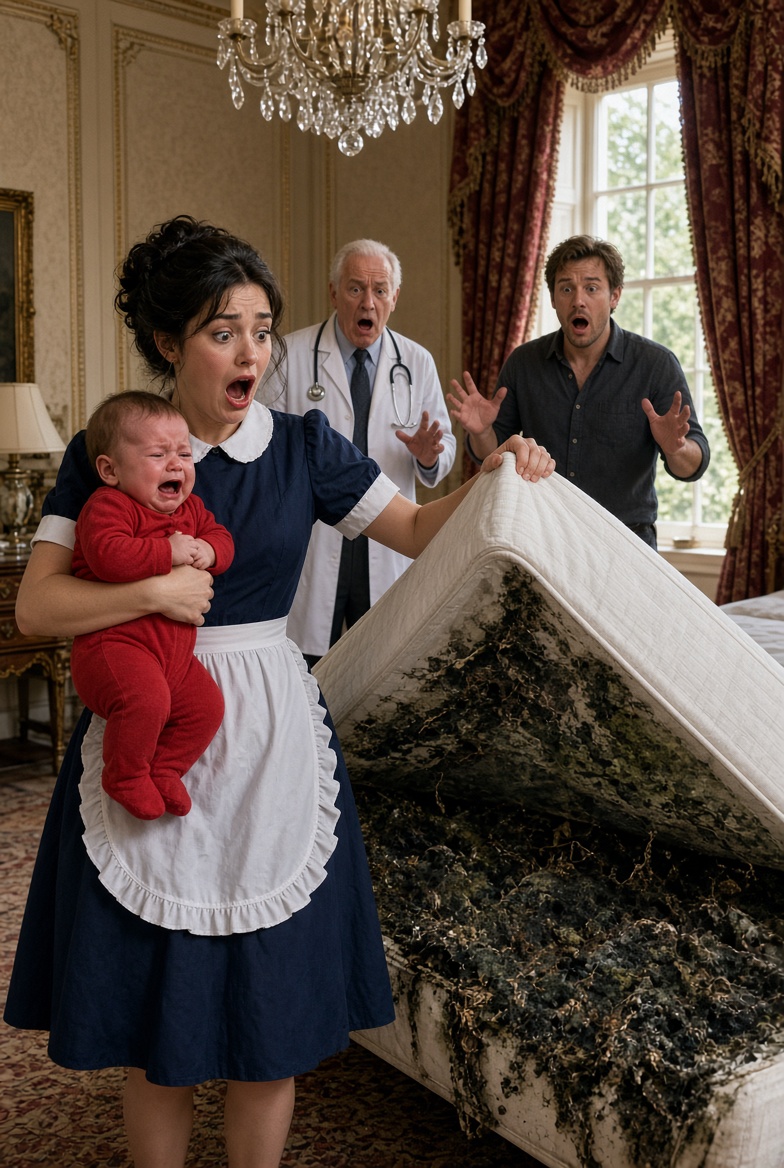
This was a twelve-million-dollar mansion. There were orchids in the foyer that were misted on a schedule. There was a wine cellar with a lock and a climate system. There were sheets with thread counts people mentioned at dinner as if thread count were a moral quality. And a newborn baby had been laid down, night after night, on rot.
She looked at Oliver’s back again.
Those welts were not rashes.
They were bites—from whatever had been crawling beneath him while he slept, while the monitor blinked its green lie, while the pediatrician said colic, while nannies packed their bags and left because they could not bear a sound they did not know how to name.
Emily’s hands shook as she pulled her phone from her apron. She took photographs because photographs were the only language this house was likely to respect. The mattress. The maggots. The black collapse of the padding. Oliver’s injuries, gentle and clinical and damning. Then she lifted him again and held him tightly against her chest, turning her body so that his skin would not touch that bed even by accident.
“No more,” she sobbed. “No more.”
She turned toward the door—
And froze.
Margaret stood there, pale in the dim light, the silk robe cinched as if composure were a garment you could tie shut. And in that instant Emily understood something that made her blood run cold.
Margaret knew.
Not the whole taxonomy of the horror, perhaps. Not the exact science of larvae and moisture and time. But she knew enough. She knew the mattress was not what it pretended to be. She knew the crying was not a mystery so much as a cost she had decided, night after night, not to look at directly.
“Put my son down,” Margaret said, her voice flat.
“This mattress is full of maggots,” Emily cried. “It’s rotting. He’s been in pain this whole time.”
“I said put him down.”
“He’s covered in bites.”
“That’s a fifteen-hundred-dollar organic mattress,” Margaret snapped, and the number arrived like a shield. “We bought it new.”
“When?” Emily demanded.
Silence opened in the room, wide enough to fall through.
“You didn’t,” Emily said slowly. “You bought it used.”
Richard Caldwell stepped into the doorway then, tall in the half-light, the man for whom the meeting in four hours apparently mattered more than the sound that had been breaking the house for weeks. He looked at the crib, then at Emily, then at his wife, and the expression that crossed his face was not surprise so much as the irritation of a man who has been caught in a smallness he preferred to keep private.
“It was a good deal,” he said. “A friend—”
“A baby slept on this,” Emily shouted, and the shout felt like the first honest noise the nursery had held all night. “Because you wanted to save money?”
The irony would have been funny if it had not been cruel. They spent without blinking on the visible world—the yacht photographs in the study, the art that needed insurance, the dinners where people admired the chandelier. The crib was gold-framed. The monitor was state of the art. The mattress, the one thing the child’s body had to trust, had been a bargain passed along like a secret, and the secret had grown teeth.
“You’re the maid,” Margaret hissed. “Watch your tone.”
“No,” Emily said, and she was steady now, because the baby in her arms had finally, against her shoulder, begun to shudder down from screaming into exhausted hiccups. “I’m the only one protecting this child.”
She walked past them. The hallway stretched out in marble and shadow. She did not run. Running would have made her look like a thief, and she was not stealing the child. She was removing him from harm, which was a different act, even if the house would try to confuse the two.
“If you stop me,” she said quietly, without turning around, “these photos go to CPS tonight.”
No one stopped her.
Emily took Oliver to her tiny staff room at the back of the house, where the carpet was thin and the window looked onto the service driveway and the walls did not pretend to be anything other than walls. It was not fancy. It was clean. She laid him on her bed and built a nest from towels and extra pillows, checking twice that nothing damp or hidden lay beneath. She washed the welts with warm water and the gentlest soap she had, murmuring the way she had murmured to other children in other rooms, in years when the work had been called nannying and the pay had still not been enough.
For the first time since she had known him, Oliver slept.
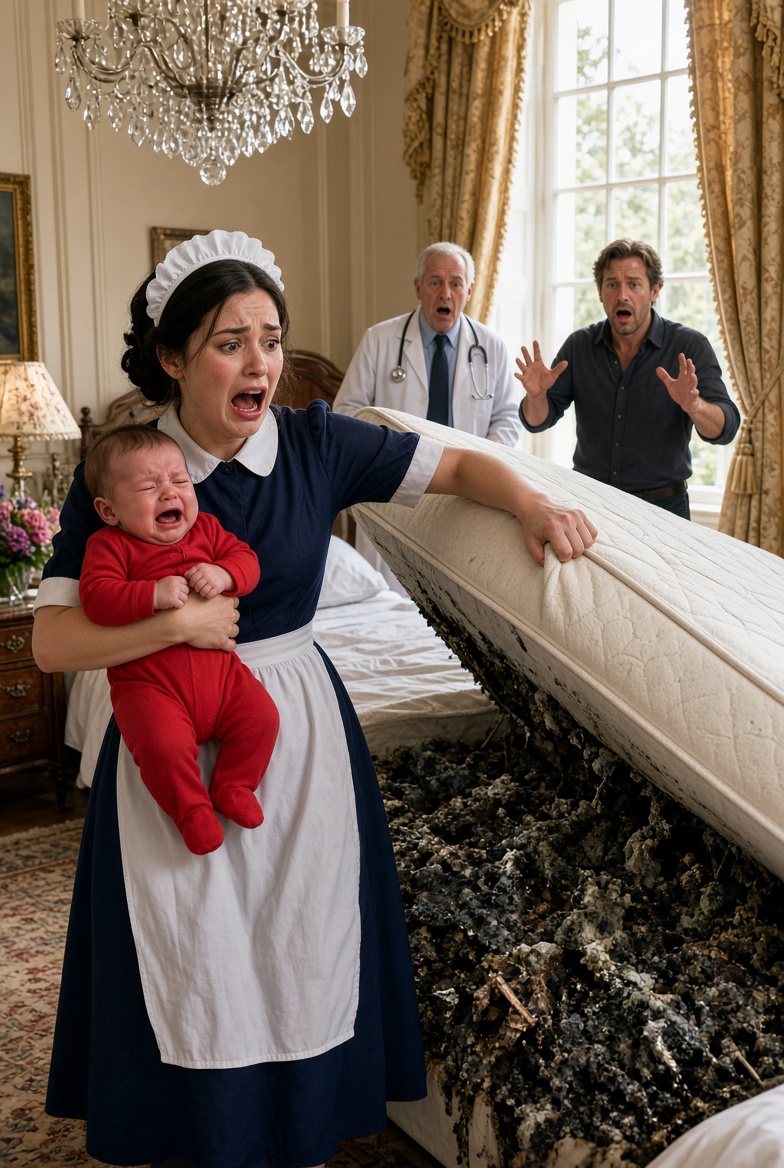
He slept as if sleep were a country he had been exiled from and had finally been allowed to reenter. His mouth went slack. The purple faded from his face. The small body, which had spent its short life thrashing against a secret, folded into ordinary infant heaviness. Emily sat on the edge of the mattress that was only a mattress and watched him, afraid to look away, afraid that if she blinked the screaming would start again and prove that mercy had been a trick.
At six in the morning, Richard burst in without knocking. Fury was easier for him than shame; it gave him a script.
“You’re fired,” he yelled.
Emily did not stand. She held up her phone. The photographs were still there, bright and ugly and undeniable. The rotting interior. The movement that should never have existed under a newborn. The map of bites on a back too small to have enemies.
The room went silent.
Margaret appeared in the doorway behind her husband, and for a moment the three adults looked like people who had survived a fire and were only now taking inventory of what the fire had been.
Finally Margaret whispered, “What do we do?”
The question was late. It was also the first honest thing she had said since three o’clock.
“You burn that mattress,” Emily said. “You do not donate it. You do not store it. You do not pretend a friend can take it off your hands. You get real doctors—not the kind who shrug, the kind who look. You tell them the truth, because if you don’t, I will. And you decide whether you deserve to be parents.”
Richard’s jaw worked. Money had always been his language for solving rooms. This room did not take that currency.
“I’ll stay,” Emily added, looking at Oliver, whose sleep had not broken even for the shouting. “But I’m not just the maid anymore. I’m his advocate.”
She said it without theater. She said it the way you state a fact that has already happened.
And this time, no one argued.
By midmorning the crib had been stripped to its frame. The mattress left the house the way shame leaves a house when it is finally forced into daylight—covered, hurried, not through the foyer. A different pediatrician came, one who did not mention colic first. He looked at the photographs in silence, then at the baby, then at the parents, and the silence did the work a lecture could not. Cream was prescribed. Follow-up was scheduled. Words like neglect and environment and documentation entered the air and did not leave it.
Emily kept the staff room as Oliver’s daytime nest until a new mattress arrived—new in the only sense that mattered, still wrapped, still innocent of anyone else’s disaster. She slept in pieces. She sent her mother the raise and a little more, and did not explain the whole story because some stories, even when they end in sleep, are too heavy to mail.
The mansion did not become kind overnight. Marble is marble. People who buy used suffering and call it a deal do not become different people because a maid found the proof. But the screaming stopped. The monitor blinked over a bed that was only a bed. And when Oliver woke now, he woke like a baby—hungry, fussing, human—not like a creature trying to climb out of its own skin.
Emily still wore the black-and-white uniform. The apron was still tied. The house still called her by her first name in the tone reserved for people who open doors. None of that was the point. The point was the child, and the lifted sheet, and the moment a poor woman in a crisp uniform decided that a twelve-million-dollar secret was not worth a newborn’s night.
Some houses are built to impress the living.
This one, for a few weeks, had been failing the smallest person in it.
Emily made sure that particular failure could not hide under organic cotton again.
