

PART 1
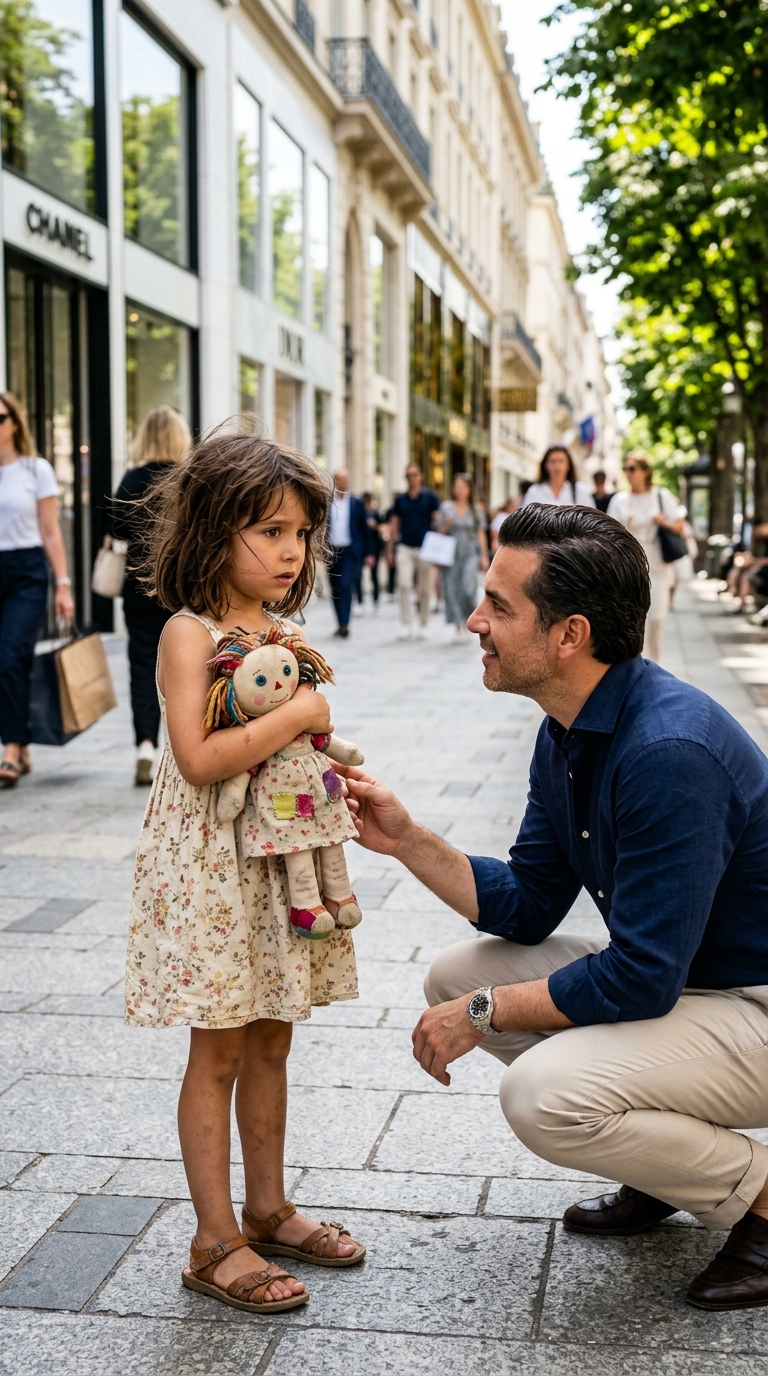
The little girl appeared among the cars in Polanco as if the city had spat her out and no one wanted to see her.
She was 6 years old, wearing a yellow dress that was too clean to be new, a poorly made braid, and a sandal tied with a piece of yarn. She clutched an old cloth doll to her chest—one of those dolls no one buys anymore because they don’t shine or talk.
But to her, that doll seemed worth more than all of Masaryk.
In front of an elegant café, where a coffee cost the same as a day’s food in a humble home, Damián Arriaga stepped out with his phone glued to his ear.
He owned hotels, office towers, and a children’s foundation that appeared in every news broadcast. Businessmen greeted him with respect. Politicians sought him out in private. Magazines called him “the king of Reforma.”
Damián walked quickly, wearing a gray suit, an expensive watch, and the face of a man accustomed to the world stepping aside when he passed.
The girl planted herself in front of him.
“Sir… will you buy my doll?”
Damián didn’t even look down.
“No, little girl. I don’t have cash.”
The small girl walked behind him.
“It’s because my mom hasn’t eaten in 3 days.”
He stopped.
Not because he was kind. He stopped because that phrase sounded completely out of place among luxury vans, bodyguards, and shop windows where a handbag cost more than rent.
The girl wasn’t crying. That was the strange part.
She wasn’t making a scene. She wasn’t stretching out her hand. She wasn’t saying “give it to me.” She was selling the only thing she held hugged like family.
Damián looked at her with annoyance, but also with an discomfort he couldn’t hide.
“What’s your name?”
“Mariana.”
“And where is your mom?”
The girl pointed toward a distant street, as if afraid to say too much.
“In a little room near Guerrero. She says not to bother anyone. But she can’t get up well anymore. And yesterday she started saying things I didn’t understand.”
Damián clenched his jaw.
“And your dad?”
Mariana looked down.
“My mom says not to ask about that.”
Then she lifted the doll.
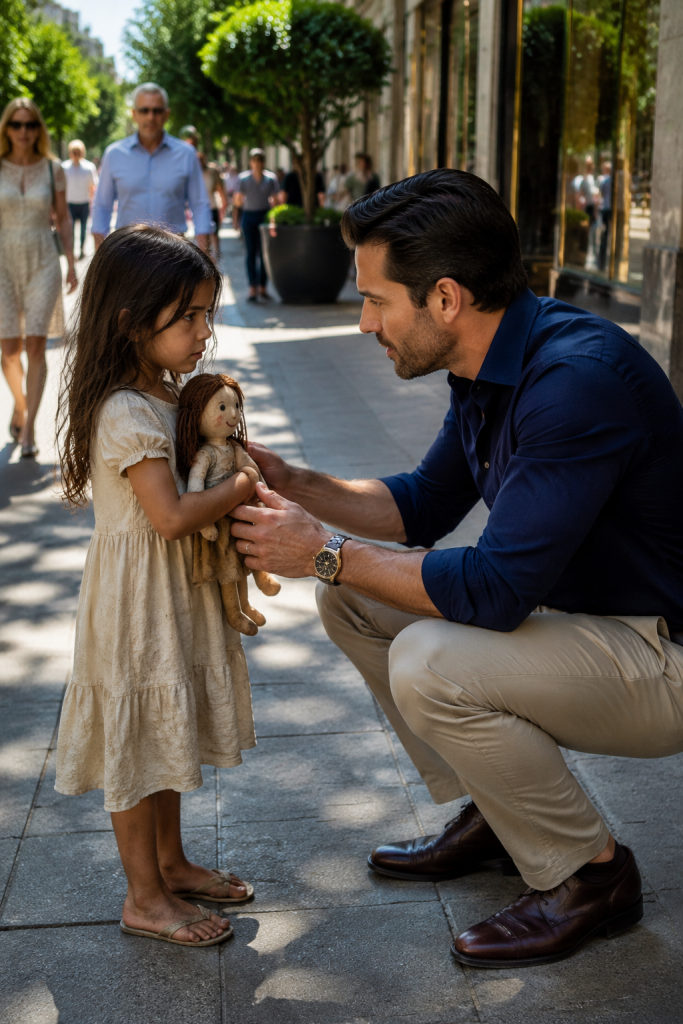
It was small, hand-sewn, with a brown button eye and black yarn hair. It wore a patched blue dress and a crooked smile.
“Her name is Rosita. My mom made her for me when I was a baby. If you give me 90 pesos, I can buy soup, tortillas, and some medicine.”
Damián reached into his wallet. He didn’t have coins or small bills. He only pulled out a 1000-peso note.
The girl’s eyes widened.
“I don’t have change, sir.”
“I don’t want change.”
Mariana hesitated.
She looked at the doll.
Then at the man.
“Will you really take care of her? Because Rosita gets scared when she’s left alone.”
Damián felt an absurd pang in his chest.
He had bought entire buildings without feeling anything. He had signed dismissals without blinking. He had ignored calls from mothers begging for help for hospitals run by his own foundation.
But this girl was asking him if he would take care of a doll.
“Yes,” he said curtly. “I’ll take care of her.”
Mariana handed over Rosita as if she were tearing out a piece of her soul.
Then she ran through the crowd with the folded bill in her hand.
Damián stood there staring at the doll.
A bodyguard approached.
“Do you want me to throw it away, sir?”
Damián shot him a withering look.
“Don’t even think about it.”
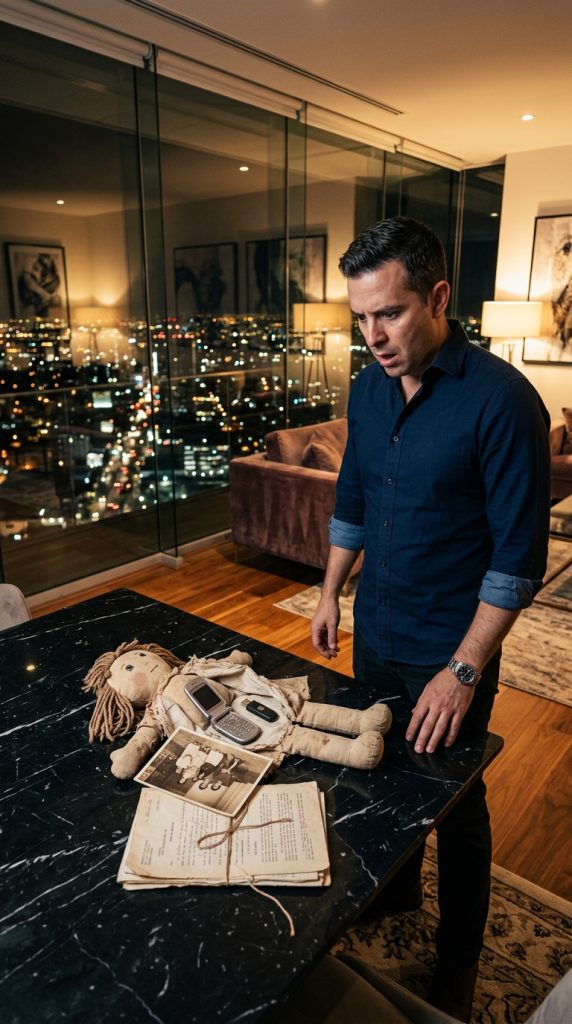
That night, in his penthouse on Reforma, he left the doll on a black marble table.
The city sparkled below, huge, arrogant, indifferent. Damián poured himself a whisky and tried to forget Mariana, her serious eyes, and her words: “my mom hasn’t eaten in 3 days.”
But at 11:47, when he turned off the living room light, he heard something.
A soft thump.
Then another.
Thud.
Thud.
It was coming from the doll.
Damián approached slowly.
The cloth belly of Rosita seemed to move slightly, as if hiding something alive.
He took some scissors, carefully opened the seam, and what he found inside froze his blood.
It wasn’t cotton.
It was an old cell phone, a USB drive, and a photograph folded into four parts.
And on the cracked screen of the phone, still lit, a message appeared that read:
“If this reaches Damián Arriaga, tell him that Mariana is his daughter.”
PART 2
Damián dropped the scissors.
The metallic clatter against the marble floor sounded like a gunshot inside the penthouse.
For several seconds he couldn’t move. He just stared at the cracked phone screen, that impossible sentence, that name that seemed written to destroy his life.
“Mariana is his daughter.”
The girl with the broken sandal.
The girl who sold him her doll to buy food.
The girl who didn’t know how to ask about her dad because someone had taught her to stay silent.
Damián picked up the photograph with trembling fingers.
In the image, a young woman held a newborn baby. She was thin, disheveled, with deep dark circles, but she smiled with a tenderness that hurt.
Behind her was an old wall, perhaps from a tenement, with damp stains and a flowered curtain.
On the back was a handwritten phrase:
“Mariana, my daughter, if one day someone tells you that your father abandoned us, remember that I fought to tell him the truth. They closed every door on me.”
Damián felt the air leave his lungs.
He knew that handwriting.
He knew that face.
The woman was Lucía Herrera.
She had worked seven years earlier as an internal auditor at Grupo Arriaga. She was brilliant, serious, incorruptible. She wasn’t impressed by expensive suits or surnames.
And she had been the only woman Damián had secretly thought of asking to stay forever.
Everything fell apart when his mother, Doña Amalia Arriaga, showed him evidence against her.
Suspicious transfers.
Emails where Lucía supposedly talked about selling information.
Messages where she said she only wanted to get pregnant by him to secure money.
Damián remembered that night as if his skin were being torn off.
Lucía had arrived crying at his office. She told him everything was false. That she was pregnant. That someone was following her. That his mother hated her because she didn’t come from a “decent family.”
Damián, full of pride and rage, hadn’t listened.
“Don’t use a child to blackmail me,” he said.
Lucía went pale.
“Then one day you’ll regret not believing me.”
It was the last time he saw her.
After that, she disappeared.
Damián had believed for years that she had left with stolen money. He became colder. Harder. More like his mother.
He plugged the USB into his computer.
There were folders with names that felt like sentences:
“Foundation.”
“Money Laundering.”
“Hospitals.”
“Mariana Birth Certificate.”
“Amalia.”
“Threats.”
He opened a video.
Lucía appeared sitting in a humble room, with the same doll on her lap. Her face was tired, but her eyes remained firm.
“My name is Lucía Herrera,” she said. “If this video reaches Damián Arriaga, it means I could no longer protect my daughter alone.”
Damián stood rigid.
“I worked at Grupo Arriaga as an auditor. I discovered that Doña Amalia was diverting donations from the children’s foundation to shell companies. She also used hospital contracts to launder money and buy land through frontmen in Puebla, Oaxaca, and Veracruz.”
Lucía swallowed.
“When I refused to sign false reports, they accused me of theft. They took my job, blocked my accounts, and threatened to take my baby away.”
Damián felt nauseous.
In the video, Lucía lifted a birth certificate.
“Damián, Mariana is your daughter. Your mother knew before she was born. She falsified messages, bought witnesses, and sent word that if I tried to find you again, my daughter would end up in an orphanage.”
Damián closed his eyes.
His mother’s voice returned like poison:
“That woman doesn’t love you, son. Poor girls are always looking to climb.”
It wasn’t advice.
It was a condemnation.
He kept opening files until dawn.
Audios.
Bank statements.
Fake invoices.
Contracts with public hospitals.
Photos of meetings with officials.
Lists of sick children who never received the support the foundation advertised on television.
And then he found the audio that finally broke him.
“Don’t touch the girl yet,” Doña Amalia said in a calm voice. “As long as Lucía is afraid, she won’t talk. And if Damián finds out, he becomes weak. I didn’t build an empire so that a starving accountant could shove a granddaughter into my living room.”
Damián slammed the table so hard that the whisky glass shattered.
His entire life disgusted him.
At 6:20 in the morning, he left without a tie, without bodyguards, and without telling anyone. He only took the doll, the USB, the phone, and the photo.
He returned to Polanco.
He asked at the café, the pharmacy, the valet, the parking attendants, and a woman selling tamales on the corner.
A waitress remembered Mariana.
“The girl ran off with a bag of instant soup and tortillas. She’s always around here, but she doesn’t beg. She sells little drawings. Poor thing, she’s very well-mannered. Honestly, it breaks your heart.”
After hours, a shoeshine boy gave him the lead.
“They live near Guerrero, boss. In an old tenement near the church. The mom is sick. But be careful—some guys came asking about them a few days ago.”
Damián felt his heart sink.
He reached the tenement almost at noon.
There was no marble or private elevators. There were damp stairs, hanging laundry, barefoot children running around, and neighbors who looked at him as if a wolf had entered the henhouse.
At the end of a hallway, he found the door ajar.
Mariana was sitting on the floor, blowing on soup in a plastic plate.
In an old bed, Lucía was breathing with difficulty.
Damián stood there, not knowing how to enter a life he himself had destroyed.
Mariana saw him first.
“Mom… the man who bought Rosita is here.”
Lucía opened her eyes.
When she recognized Damián, her face showed no joy.
It showed fear.
“No,” she whispered. “You shouldn’t have come.”
Damián entered slowly and placed the doll on the bed.
“I found everything.”
Lucía closed her eyes. A tear slid down her temple.
“Then the hell has begun.”
“Lucía, I…”
She cut him off with a weak but fiery look.
“Don’t come here saying you didn’t know. You didn’t know because you didn’t want to know.”
Damián lowered his head.
“They lied to me.”
Lucía let out a bitter laugh.
“I also told you the truth and you didn’t believe me. You preferred your mother’s evidence, because it was more comfortable than looking a poor woman in the eye.”
Mariana watched the two of them without understanding.
She had the same forehead as Damián. The same way of pressing her lips when she was scared.
His daughter.
His daughter had gone hungry while his foundation appeared in commercials handing out blankets.
Damián knelt in front of the girl.
“Mariana… I am…”
Lucía raised a hand.
“No.”

The word was low but firm.
“You’re not going to drop that word on her like it’s a prize. First you have to prove you didn’t come to buy us.”
Damián nodded.
For the first time in his life, he didn’t give orders.
He didn’t promise mansions.
He didn’t talk about lawyers as a threat.
He simply obeyed.
He took Lucía to a hospital where his family had no influence. He hired outside doctors. He sent certified copies of the USB to a notary, to journalists, and to a federal prosecutor’s office.
And then he did something no one expected.
He called an urgent meeting at the Arriaga Tower on Paseo de la Reforma.
Doña Amalia arrived impeccable, with a pearl necklace, expensive perfume, and the smile of an untouchable woman.
“Damián, I hope this isn’t another tantrum,” she said in front of the board. “I have lunch with two senators.”
Damián stood next to a giant screen.
He placed the doll on the table.
Rosita—old, patched, small.
Doña Amalia looked at it with contempt.
“What is that cheap thing?”
Damián didn’t raise his voice.
“The cheap thing that’s going to bring down your empire.”
The board members shifted uncomfortably.
Damián played the video.
Lucía appeared on the screen.
Then came the audios.
Then the bank statements.
The fake invoices.
The forged signatures.
The names of shell companies.
At first, Doña Amalia smiled.
“How ridiculous. Some kept woman making up stories.”
But when her own voice was heard talking about “the girl” and “so Damián doesn’t become weak,” the room went ice cold.
One board member stood up.
Another asked for copies.
Damián’s lawyer entered with two notaries and federal agents.
Doña Amalia slammed the table.
“Everything you are, you owe to me!”
Damián looked at her with red eyes.
“No, Mom. To you I owe shame. To Lucía I owe justice. And to Mariana I owe an entire life.”
At that moment, the door opened.
Lucía entered in a wheelchair, pale, thin, but with her head held high. Mariana walked beside her, hugging Rosita.
No one spoke.
Doña Amalia looked at the girl as if she were a stain.
“She has no business being here.”
Lucía replied without shouting:
“She has every business being here. They stole a father from her, food, a home, and even the right to know who she was.”
Mariana hid behind her mom.
Damián crouched in front of her.
“You don’t have to understand everything today. I just want you to know that your mom never lied. The one who failed was me.”
The girl clutched the doll to her chest.
“Did you make my mom cry?”
Damián felt that nothing he owned mattered anymore.
“Yes.”
Mariana looked down.
“Then you have to apologize to her many times.”
Damián nodded, broken.
“As many times as it takes.”
Doña Amalia tried to leave, but the agents were already waiting at the door.
That afternoon, all of Mexico watched the most powerful woman in Reforma fall.
She was accused of embezzlement, money laundering, forgery, threats, and using a children’s foundation to enrich herself.
Social media exploded.
Some said Damián should also pay for being blind and cowardly. Others said no one is prepared to discover that their own mother had crafted such a cruel lie.
But Lucía wasn’t looking for a spectacle.
When Damián wanted to take them to live in his penthouse, she shook her head.
“I don’t want a pretty cage. I want dignity.”
Then he understood.
He bought a simple house in Lucía and Mariana’s name as legal reparation, not as a gift. He paid for treatments, school, and protection, but let Lucía decide every step.
He learned to arrive without imposing.
He learned that being a father wasn’t about showing up with vans or expensive toys. It was waiting outside school. Carrying a backpack. Listening to the same story ten times without looking at his phone.
Twelve months passed.
Lucía recovered little by little. Mariana started smiling more, although she still slept hugging Rosita.
Damián opened a dining hall for sick mothers and girls in vulnerable situations in the same neighborhood where he had found his daughter.
He called it Casa Rosita.
At the entrance, they placed the doll inside a display case. Cleaned, sewn, and with a red ribbon.
Below it was a plaque:
“Sometimes the truth doesn’t come in elegant papers. Sometimes it comes hidden in what the powerful call trash.”
On the day of the inauguration, Mariana took the microphone with both hands.
“This house is so that no girl ever has to sell her doll because her mom is hungry.”
The crowd applauded through tears.
Damián looked at Lucía.
“I don’t know if one day you’ll be able to forgive me.”
She took a deep breath.
“I don’t know either. But Mariana asked if you can come for lunch on Sunday.”
Damián felt a knot in his throat.
“And what did you say?”
Lucía looked at him seriously.
“I said yes. But you wash the dishes.”
Sunday arrived without a driver, without bodyguards, and without a suit. He only brought sweet bread, mandarins, and a simple bouquet of flowers.
Mariana opened the door.
“Are you really going to wash the dishes?”
Damián smiled.
“Yes.”
The girl looked at him for a while. Then she took two of his fingers.
“I still don’t know if I should call you dad.”
He knelt down.
“There’s no rush.”
Mariana lowered her voice.
“Can I call you Damián-dad little by little?”
Damián couldn’t answer.
He just nodded.
And while washing dishes in a small kitchen, he understood what his family had never been able to buy:
an empire can fall because of an old doll…
but a home is only built with truth, justice, and love that doesn’t show off.
