

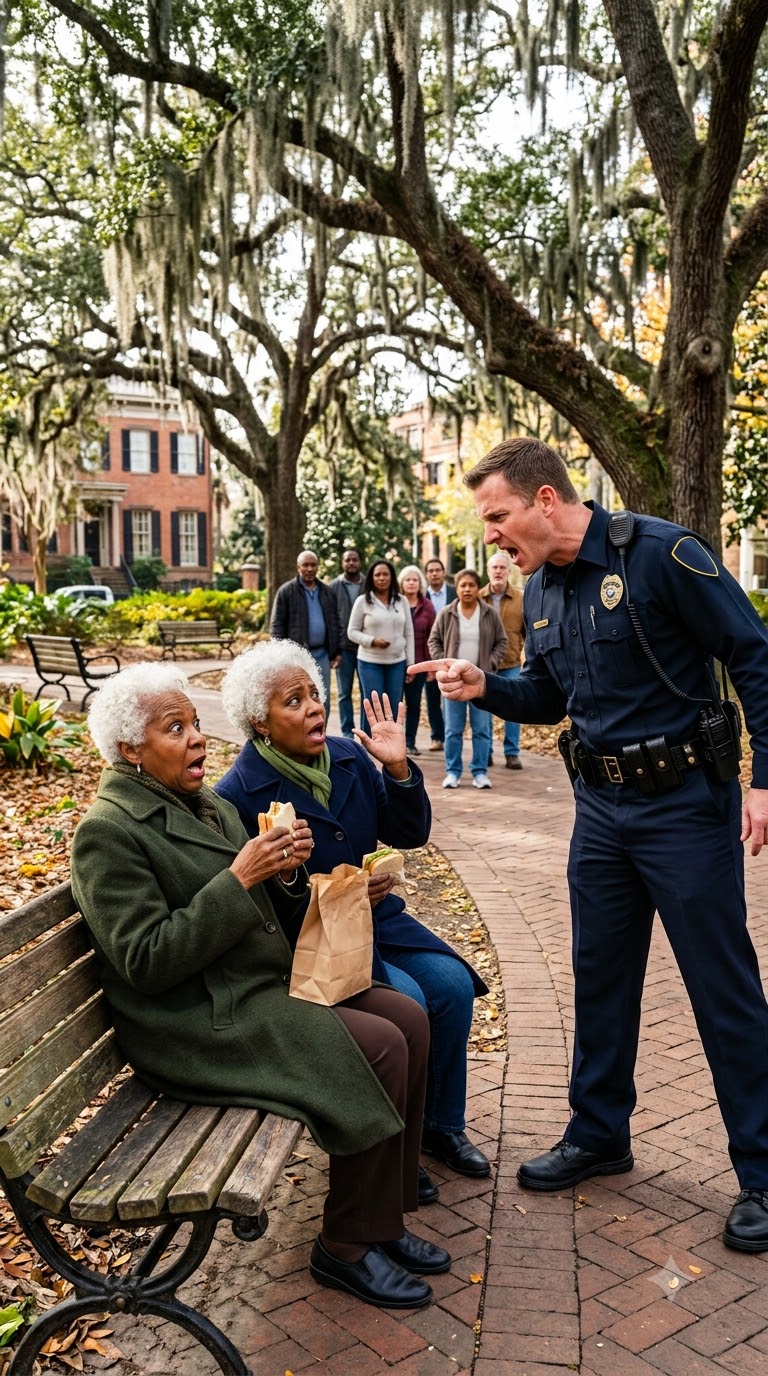
The wind arrived in Savannah before the rain did, sweeping down the avenues of Spanish moss and gathering fallen leaves into small golden storms across the historic park. It was late autumn, the kind of season where the light turned amber by 4 in the afternoon, and the air carried a chill that made people pull their coats tighter. Tourists wandered the cobblestone paths with cameras slung around their necks, pointing at the old fountains and the iron benches that had stood there for more than a century. Nobody paid much attention to the two women sitting quietly on a weathered park bench near the edge of the square, sharing a paper bag of sandwiches as though they had nowhere else to be. They looked like sisters, perhaps even twins, both with the same striking white hair that framed their dark skin, a rare condition neither of them had ever needed to explain to strangers.
To anyone passing by, they seemed like nothing more than two out-of-town visitors resting their feet after a long walk through the historic district. What none of the passersby could have known was that beneath the surface of that peaceful afternoon, something far more deliberate was unfolding. The sunglasses one of the women wore contained a nearly invisible camera lens, and a small transmitter tucked into her ear carried a constant stream of quiet chatter from a surveillance team stationed two blocks away. For nearly 6 hours, the two of them had been watching a coffee shop across the square, waiting for a man who was scheduled to meet a contact inside. They had trained themselves to look unremarkable, to blend into a city full of wanderers, and it had worked perfectly until that moment.
Nyla and Nia Ashford had grown up in a small town outside Charleston. Two girls who had learned from an early age what it meant to be looked at twice, to be noticed for reasons that had nothing to do with who they actually were. Their white hair, a rare condition called poliosis that had appeared before either of them turned five, made them impossible to forget once seen, a fact that had shaped both of their lives in ways their parents had never anticipated. Nyla had built a career on discipline and patience, rising through the ranks of the bureau until she commanded a unit dedicated to rooting out corruption from within law enforcement itself. Work that demanded a stomach for betrayal and a willingness to distrust the very people sworn to uphold the law.
Nia had taken a different path. Training as a behavioral analyst before moving into undercover operations where her ability to read a room, to sense tension before it surfaced, had saved more than one operation from collapsing at the worst possible moment. The two of them rarely worked cases together. But when Savannah’s internal affairs division had quietly reached out to federal investigators months earlier, describing a pattern of vanishing evidence and buried complaints too consistent to be coincidence, the sisters had both been assigned.
Their bond and their years of unspoken communication proved invaluable to an operation that required absolute trust. A police cruiser rolled slowly along the street bordering the park, its tires crunching over scattered leaves, and the officer behind the wheel slowed to a stop as his eyes landed on the two women on the bench. There was nothing about them that suggested wrongdoing. No disturbance, no raised voices, nothing but two people quietly eating lunch in a public space. Yet the officer’s expression shifted into something colder, something that had settled into his face long before that day, and he stepped out of his vehicle with a stride that suggested he had already made up his mind about what kind of people they were.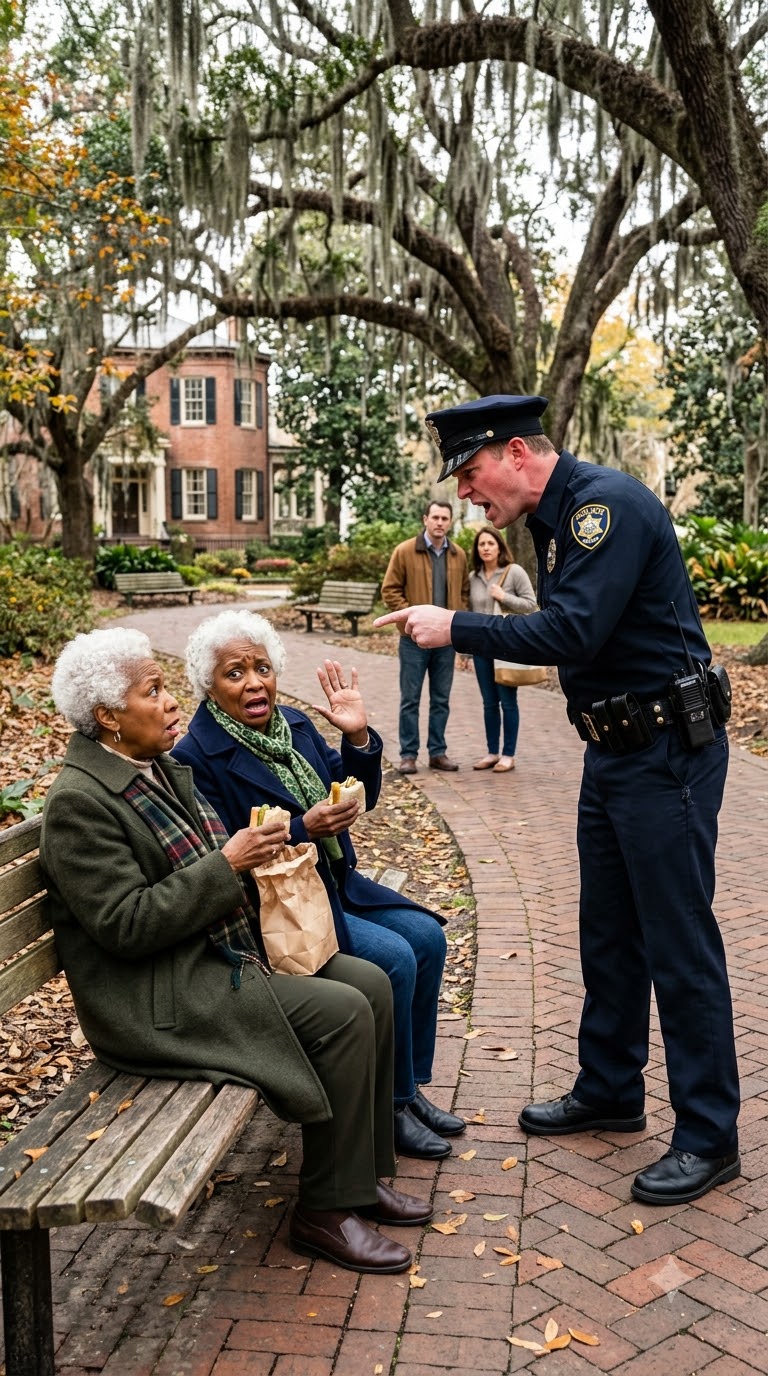
His name was Travis Boone, a veteran patrol officer who had walked these streets for over 15 years. A man who believed his badge gave him the final word on who belonged where. He approached the bench with his hand resting near his belt. His jaw set, his gaze sweeping over the two sisters as though searching for a reason that had not yet presented itself. Passersby slowed their pace, sensing the shift in the air, the way people do when confrontation announces itself before a single word is spoken.
Boone stopped a few feet from the bench, planted his boots on the pavement, and raised his voice loud enough for half the square to hear. He did not ask a question first. He did not offer a greeting. Instead, he pointed directly at the two women and barked the words that would set the rest of the day into motion. The words that would eventually reach far beyond that quiet park and into rooms neither he nor his supervisors could yet imagine.
“You two,” he said, “stand up right now.”
The sisters exchanged a brief glance, one that lasted no longer than a second, but carried an entire conversation between them. They rose slowly from the bench, unhurried, the kind of calm that unsettles people who are expecting fear. Boone demanded identification immediately, his tone sharp enough to draw more onlookers toward the edge of the square.
Nyla Ashford reached into her jacket and produced a driver’s license, her movements deliberate and unbothered, while her sister Nia did the same beside her. Boone studied the cards for a long moment, flipping them over as though searching for some flaw that would justify what he had already decided to do. He asked why they were sitting in that particular part of the park, his eyes narrowing as he waited for an answer he could pick apart. Nyla answered simply that they were resting after a long walk, her voice even, betraying nothing of the operation running silently around them. Boone was not satisfied.
He asked where they lived, though nothing about the question was relevant to any actual offense. And when Nia calmly explained they were visiting the city, his skepticism only deepened. He asked who they were waiting for, glancing toward the coffee shop across the street, as though the answer might reveal some hidden scheme. A small crowd had begun to form along the walking path, drawn by the raised voice and the unmistakable tension radiating from the scene. Boone made a remark about their hair, calling it unusual, calling them suspicious without ever articulating what crime their appearance was supposed to indicate.
The crowd around the square had grown thick enough now that a small line of tourists paused their walking tour entirely, their guide falling silent as everyone turned to watch the confrontation instead of listening to another story about the old fountains. He circled around the bench slowly, his boots crushing the fallen leaves beneath him, studying the two women as though searching for a tell that would justify his growing suspicion. He asked how long they intended to stay in the city, and Nyla answered evenly that their plans were their own business, a response that only deepened the irritation etched across his face. He asked if either of them had ever been arrested before, a question with no legal basis and no connection to anything happening in that moment. Yet he asked it anyway, watching for a flicker of hesitation that never came.
Nia remained still, her hands folded, absorbing every word with the trained patience of someone who had been assessing human behavior for most of her career, cataloging his posture, his tone, the way his hand kept drifting toward his belt as though seeking reassurance from the weapon it carried. A man walking his dog nearby slowed his steps, glancing at the growing scene with visible discomfort, though he said nothing and continued on his way, unwilling to insert himself into whatever was unfolding. Nyla, standing just behind her sister, discreetly pressed two fingers against the small device clipped inside her collar, sending a signal that reached the surveillance van parked out of sight, alerting her team that the situation on the bench had shifted into something unplanned. Boone had no idea that his every word and gesture was already being recorded by more than one source. He shifted his weight, crossed his arms, and told the two women that people like them made others in the park uncomfortable.
An accusation with no basis beyond the color of their skin and the whiteness of their hair. A murmur rippled through the gathering crowd, some shaking their heads, others lifting their phones to record the confrontation from a distance. Boone noticed the phones and barked at bystanders to keep moving. His patience thinning as more eyes turned toward him instead of away. He straightened his shoulders, stepped closer to the sisters, and delivered the demand that would push the encounter past the point of no return.
“Turn around, hands where I can see them,” he ordered. “I need to search you both.”
Nyla did not move immediately. She asked in a voice that remained calm, despite the accusation hanging in the air, what specific reason he had for wanting to search them. Boone’s face reddened at the question, as though being asked to justify himself was itself an offense. He stepped forward and reached for the strap of Nia’s shoulder bag, yanking it away before she could respond, his fingers digging through the contents with rough impatience. He found nothing but a wallet, a set of keys, a small notebook, and a folded city map.
Nothing that resembled the danger he had convinced himself was present. His frustration deepened with every item he tossed carelessly onto the bench, each one landing with a soft thud that seemed to echo louder than it should have in the tense silence of the gathering crowd. He unzipped the smaller pocket at the front of the bag and pulled out a compact makeup case, flipping it open and shaking it as though expecting something illicit to fall from inside. Nothing did. He tossed it aside with the rest, his jaw tightening further with each passing second that failed to produce the evidence he seemed determined to find.
A woman near the front of the crowd whispered to the person beside her, wondering aloud what possible justification existed for treating two calm, cooperative women this way, her words carrying just far enough for others nearby to nod in quiet agreement. Boone glanced up sharply at the murmuring, his eyes scanning the crowd as though daring anyone to speak louder, and for a moment the entire park seemed to hold its breath under his glare. An older man standing near the edge of the group finally stepped forward, his voice trembling slightly but firm, asking Boone what exactly these two women had done wrong. Boone turned on him instantly, warning him to stay out of it unless he wanted trouble of his own. The older man held his ground for a moment, glancing at the sisters with an expression of concern, but ultimately stepped back under the officer’s glare.
A young woman nearby had been recording the entire exchange on her phone, and Boone spotted the glowing screen pointed in his direction. He ordered her to turn it off immediately, his tone sharp enough that she lowered the phone without argument, though she did not fully comply. The screen simply tilted toward the ground instead of powered down. Nobody in the crowd dared to challenge him further, the collective silence settling over the park like the cold wind pressing through the trees above them. Boone straightened, satisfied that he had regained control of the scene, and reached toward his belt where a pair of handcuffs hung waiting.
His fingers closed around the cold metal, and the sound of the ratchet clicking into place cut through the quiet square. He grabbed Nia’s wrist first, twisting her arm behind her back with more force than necessary, snapping the cuffs shut around her wrists while she offered no resistance. The crowd gasped collectively, several more phones rising into the air to capture the moment. Nyla remained motionless as Boone approached her next, allowing him to cuff her without struggle, her expression unreadable, her mind clearly working through calculations that had nothing to do with fear. A teenager near the front of the crowd began narrating quietly under his breath, describing the scene aloud as though recording testimony for someone who might need it later.
His phone held steady despite the officer’s earlier warning. Boone straightened his uniform, glancing around at the stunned onlookers with something close to pride. Believing he had just handled a dangerous situation with the authority his badge afforded him, he informed the sisters that they were being taken to the station where things would be sorted out properly, his voice carrying the confidence of a man who had never once faced consequences for decisions like this. Nyla said nothing in response, her silence more unsettling to Boone than any protest could have been, and for a brief moment he seemed to falter, as though some instinct beneath his certainty recognized that her calm was not the calm of someone afraid. Nia glanced at her watch, a small, almost imperceptible motion, noting that the operation she and her sister had spent weeks building toward was now only minutes from its final stage, a stage that Boone’s interference threatened to compromise entirely.
Somewhere beyond the edge of the square, engines started quietly, and the wind carried the faint sound of tires rolling over pavement, though no one on the bench turned to look yet. The wind picked up again, scattering leaves across the cobblestones, and for a moment the park held its breath. Then, from the far end of the square, three black sport utility vehicles turned in unison and rolled toward the historic district, moving without sirens, without flashing lights, drawing no attention until they were already parked along the curb closest to the bench where the handcuffed sisters stood. Doors opened almost simultaneously, and a dozen figures in dark suits stepped out onto the pavement with the kind of synchronized purpose that immediately silenced the murmuring crowd. Boone turned toward the vehicles with visible irritation, assuming they belonged to some private security detail, or perhaps overzealous federal agents intruding on local matters.
He raised a hand and ordered them to stay back, insisting this was a police matter that did not concern outsiders. The agents fanned out along the perimeter of the square with quiet efficiency. Several of them positioning themselves near the exits of the park while others moved toward the coffee shop across the street. Their attention split between the unfolding confrontation and the mission that had brought them there in the first place. Bystanders shrank back instinctively, sensing that whatever authority had just arrived outranked anything the local police department could summon on a quiet afternoon.
One man broke from the group and walked forward with unhurried steps, his eyes moving from Boone to the two handcuffed women and back again, reading the scene with practiced precision. He stopped a few feet away, studied Boone’s badge number, and asked a single question in a voice that carried more authority than volume.
“Who gave the order to arrest these two women?” he asked.
Boone squared his shoulders, certain of himself in a way that would soon prove to be his undoing.
“I did,” he said, his chin lifted with pride, as though the answer alone should have been enough to end the conversation.
The man in the suit studied him for a long moment, something unreadable passing behind his eyes, and the atmosphere in the square shifted in a way that even the bystanders could sense, though none of them yet understood why. Whispers spread through the crowd as more agents fanned out around the perimeter of the park, some speaking quietly into concealed microphones, others simply watching the scene unfold with expressions of quiet disbelief at what they were witnessing. Boone glanced toward his own patrol car, suddenly less certain than he had been moments earlier, though his pride refused to let the uncertainty show on his face. The man in the suit reached into his jacket, slow and deliberate, and produced a small leather case that he flipped open with a practiced motion. Boone let out a short, dismissive laugh when he saw the badge inside, waving it off as some kind of prop or forgery, insisting that nobody carried real federal credentials into a city park on a random autumn afternoon.
His laughter did not last long. Behind him, Nyla shifted her cuffed hands and with a motion so smooth it seemed rehearsed, reached beneath the collar of her jacket to reveal a second badge clipped discreetly to the inside lining. One that matched exactly the credentials the man in the suit had just displayed. Nia did the same beside her sister, lifting her chin as the golden shield caught the fading afternoon light. The entire park fell into a stunned hush, the wind seeming to quiet along with the crowd, every eye fixed on the two women who moments earlier had been treated as suspects and were now revealed as something else entirely.
Boone’s confident expression drained away in an instant, replaced by a pale, frozen look of dawning horror as the weight of what he had done settled over him like a physical thing. The crowd pressed closer, straining to see, and even those who had been recording the confrontation from a distance now edged forward. Sensing that something far larger than a simple arrest was unfolding before them. A woman near the front covered her mouth with her hand, glancing between Boone and the badges, as though trying to reconcile the arrogance she had witnessed moments earlier with the reality now settling over the square. Somewhere behind the crowd, a car door slammed.
And moments later, the sound of hurried footsteps announced the arrival of someone else who had just realized the scale of what was happening. Captain Howard Briggs arrived on the scene only minutes later, having received a frantic call from a nearby unit describing a chaotic situation unfolding in the historic park. He pushed through the gathered crowd, his uniform crisp, his expression already tightening with confusion as he took in the sight of federal vehicles lining the street and his own officer standing frozen beside two women wearing FBI credentials. Briggs demanded an explanation, his voice cutting through the murmurs. But before Boone could stammer out a response, Nyla stepped forward despite the cuffs still locked around her wrists.
She addressed the captain directly, her voice steady and without a trace of anger, informing him that an ongoing federal investigation had just been compromised by his officer’s actions, though the operation itself would continue regardless of the disruption. Briggs’s face shifted through disbelief, confusion, and finally a dawning dread as he began to understand the scale of what was happening in front of him. He turned toward Boone, opening his mouth to demand answers. But the moment was interrupted by a sudden movement near the coffee shop across the square where a man in a gray coat had just stepped outside and begun walking briskly away from the scene. The interruption was not incidental.
It was in fact the entire reason Nyla and Nia had been sitting on that bench in the first place long before Boone had ever noticed them. For weeks, the Ashford sisters had been embedded in a quiet, methodical investigation into corruption running through the local police department. A case that had begun with a whistleblower’s tip and grown into something far larger than anyone outside their unit realized. It had started nearly 4 months earlier when a young records clerk inside the department noticed discrepancies between evidence logs and the actual contents of storage lockers, discrepancies too consistent and too deliberate to be simple clerical error. She had reached out through a confidential channel, and within weeks a small task force had been assembled, one that deliberately excluded most of the local department to avoid tipping off whoever was involved.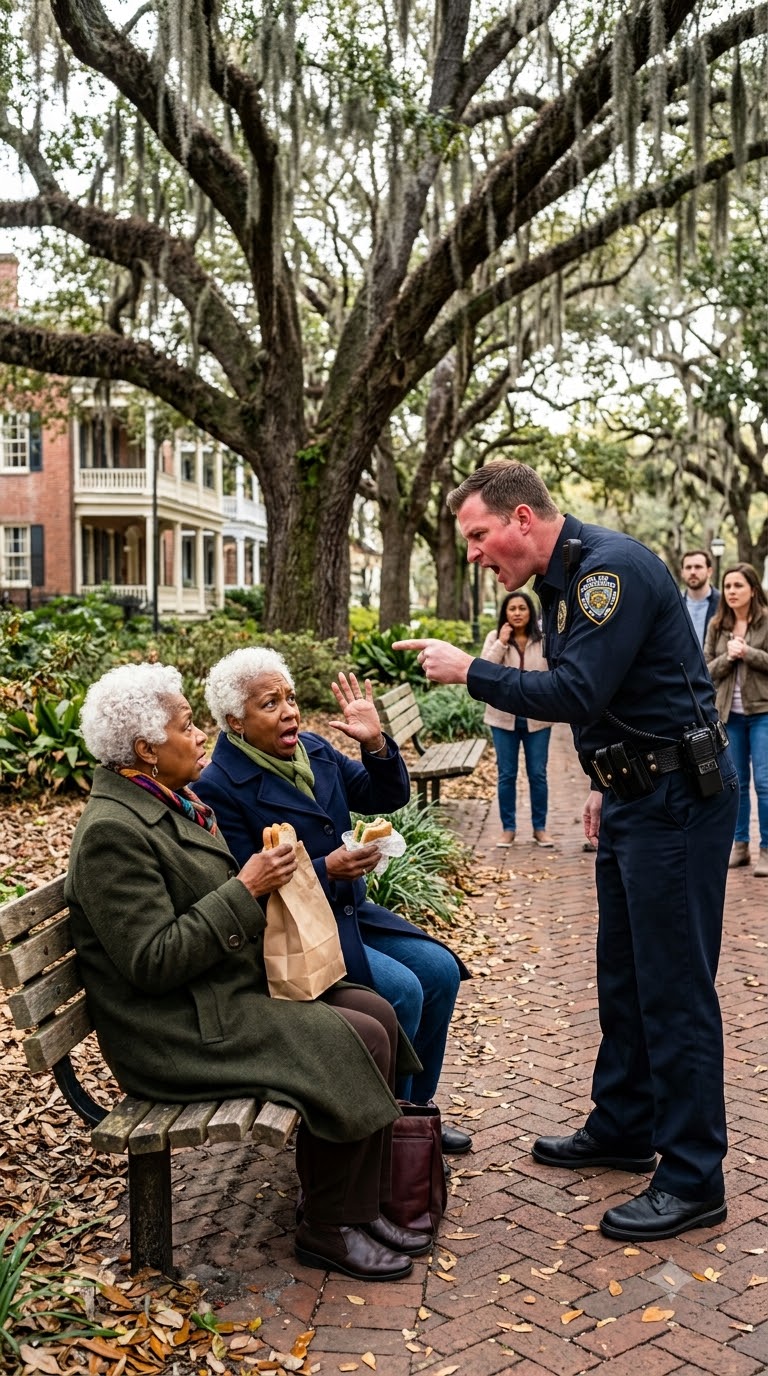
The man in the gray coat, a mid-level figure connected to a network trading in stolen evidence and falsified reports, had been the final piece needed to expose a chain of officers accepting payments to bury cases and protect certain criminal operations from prosecution. His meetings at the coffee shop followed a regular but detectable pattern, occurring only when a shipment of compromised evidence needed to change hands before a scheduled court date, and the sisters had spent the better part of 6 weeks learning that pattern well enough to predict it. Nia’s expertise in behavioral analysis had allowed the team to predict almost exactly when and how the man would make his exit, and the entire afternoon’s surveillance had been built around that single narrow window of opportunity. Boone’s interference had nearly cost them that window entirely, but the arrival of the support team meant the operation could still proceed without collapsing. Agents peeled away from the group around the bench and moved swiftly across the square, closing in on the man in the gray coat before he could reach the parking garage at the corner.
He attempted to quicken his pace once he noticed the movement behind him, but two agents intercepted him near the corner newsstand, identifying themselves calmly before he had a chance to react. Nyla watched the pursuit unfold with the same calm she had maintained throughout the confrontation. Her cuffed hands finally being released by one of her colleagues as the captain looked on speechless. The crowd, still trying to process what they had just witnessed, watched in stunned silence as federal agents converged on their target only a block away from where the sisters had eaten their sandwiches hours earlier. As the arrest of the man in the gray coat unfolded quietly at the edge of the square, another figure inside the police department realized the walls were closing in far faster than he had anticipated.
Sergeant Colin Marks, watching the scene from a distance through the window of a nearby administrative building, felt his stomach drop as he recognized the federal badges glinting in the afternoon light. Marks had spent years covering for Boone’s misconduct, filing reports that softened complaints, burying citizen grievances in drawers that never saw daylight, and accepting quiet favors from men he now understood had been under surveillance the entire time. He thought of the ledger locked in his desk drawer, the one he had always assumed was safe behind a combination only he knew. And for the first time in years, he felt something close to genuine fear settle into his chest. He backed away from the window, grabbed his jacket, and moved quickly toward the rear exit of the building.
His mind racing through options that were already narrowing by the second. He considered calling ahead to warn two other officers whose names appeared in his private records, but his hands shook too badly to hold the phone steady. And by the time he reached the stairwell, he had abandoned the idea altogether. Agents positioned near the perimeter had anticipated exactly this kind of reaction, having mapped every possible route out of the building during the weeks of preparation leading up to that day. Marks made it only as far as the parking lot before two agents stepped into his path, their expressions calm, almost bored, as though they had expected him to appear at precisely that moment.
He hesitated, glancing over his shoulder toward the street, calculating whether running was still a viable option. But the sight of a third agent closing in from behind extinguished whatever hope remained. Within minutes, Marks stood with his hands cuffed behind his back, positioned only a short distance from the very park bench where the entire day had begun. His career and everything he had built on quiet complicity collapsing in the space of a single autumn afternoon. The investigation moved with remarkable speed once the arrests began, each piece falling into place as though the entire structure had been waiting years to collapse under its own weight.
Federal agents seized computer servers from the precinct’s records office along with boxes of physical files that had never been properly logged into any official system. Digital forensics teams began extracting years of encrypted messages between Boone, Marks, and several other officers. Conversations that detailed bribes accepted, evidence tampered with, and reports altered to protect certain individuals from prosecution while ensuring others faced charges they did not deserve. Analysts working through the night cross-referenced dates from the messages against actual court records, discovering that at least 11 cases over the previous 5 years had been quietly weakened through missing evidence or conveniently forgotten testimony. Financial records revealed a pattern of deposits traced back to a shell account linked to the same network the man in the gray coat had been servicing for years.
Deposits carefully structured to avoid triggering routine bank reporting requirements. Video footage recovered from a hidden camera inside an evidence room showed Boone removing items from sealed bags on more than one occasion. Moments that had gone unnoticed by his superiors for longer than anyone wanted to admit. One piece of footage, timestamped nearly two years earlier, showed him replacing a bag of confiscated narcotics with a substance investigators later confirmed was nothing more than powdered sugar, a substitution that had allowed a significant quantity of the original evidence to disappear entirely. A handwritten ledger discovered inside a locked drawer in Marks’s office listed names, dates, and amounts that painted a clear and damning picture of systemic corruption stretching back nearly a decade.
Cross-referencing cleanly with the digital records the forensics team had already extracted. Investigators noted with a kind of grim irony that the very care Marks had taken to keep his records organized, presumably to protect himself from being cheated by his own network, was the same care that ultimately made the case against him airtight. Boone, standing off to the side as agents carried box after box out of the precinct, began to understand with sickening clarity that his own reckless decision to arrest two women on a park bench had accelerated the exposure of a scheme he had spent years believing was untouchable. Captain Briggs approached him near the end of that long afternoon, his expression a mixture of exhaustion and quiet fury, the weight of discovering corruption within his own department settling heavily across his shoulders. He asked Boone to hand over his service weapon, his voice flat, stripped of the respect that had once existed between them as colleagues.
Boone hesitated for a long moment, his hand trembling slightly as he unclipped the holster and placed the weapon into the captain’s outstretched palm. He tried weakly to offer an explanation, insisting that he had only been doing his job, that anyone in his position would have reacted the same way to two unfamiliar women sitting where they did not belong. Briggs cut him off before he could finish, reminding him coldly that two federal agents sitting quietly on a bench had never posed any threat at all, and that the only danger in that park had been standing in a police uniform. Around them, officers who had once shared coffee and conversation with Boone now averted their eyes, unwilling to meet his gaze as the reality of his exposure settled over the precinct like a heavy fog. Boone was placed under arrest before the sun fully set, the same handcuffs he had used on Nia only hours earlier now closing around his own wrists as two federal agents escorted him toward a waiting vehicle.
The video captured earlier in the park had already begun circulating far beyond the boundaries of Savannah, drawing attention from cities across the country as people watched the footage of an officer detaining two innocent women who turned out to be federal agents working an active corruption case. Commentators across the country debated the footage at length. Some focused on the obvious prejudice behind the stop, others on the sheer improbability of the outcome, but nearly all of them agreed that the composure the two sisters had shown throughout the entire ordeal was remarkable to witness. Reporters gathered outside the precinct within hours, cameras flashing, as Briggs stepped forward to deliver a brief statement, acknowledging the seriousness of what had occurred and promising full cooperation with federal investigators. He fielded a barrage of questions about how long the misconduct had gone unnoticed, offering only that a full internal review would follow and that no officer, regardless of rank or tenure, would be shielded from accountability.
Somewhere inside a quiet holding room, Nyla and Nia sat together, reviewing the day’s events with their supervisor, their expressions calm despite the chaos still unfolding outside the building, already turning their attention to the paperwork and interviews that would carry the investigation into its next phase. In the days that followed, additional victims came forward, encouraged by the footage and the growing public attention surrounding the case. A young man described being pulled over without cause on three separate occasions. Each stop escalating into searches that turned up nothing, yet left him shaken and humiliated in front of his neighbors. A mother recounted an incident from years earlier when Boone had detained her teenage son outside a convenience store.
An encounter that had never been properly documented despite her repeated attempts to file a complaint. A local business owner came forward with security footage from his shop, showing Boone confronting two customers years earlier under circumstances eerily similar to what had happened in the park. Footage he had kept for reasons he could not fully articulate at the time, but had never deleted. An attorney who had once represented a client wrongfully detained by Boone contacted investigators with a stack of old case files, evidence she had preserved for years without ever finding an avenue to pursue justice. Each new account added weight to the growing case against Boone, painting a portrait of a man who had used his badge as a shield for behavior that should have ended his career long before that autumn afternoon in the park.
Federal investigators expanded their inquiry, examining years of complaint records that had mysteriously vanished or been dismissed without proper review, uncovering a pattern of institutional neglect that extended beyond any single officer. Internal memos surfaced showing that at least two previous captains had been aware of recurring complaints against Boone, yet had chosen to quietly transfer him between assignments rather than confront the pattern directly. The scope of the investigation grew wide enough that federal prosecutors began coordinating with the state attorney general’s office. Recognizing that the misconduct extended into territory beyond the reach of a single jurisdiction, Nyla, though frequently approached by journalists eager for a quote or a dramatic soundbite, consistently declined to comment on the specifics of the case. Maintaining the same quiet professionalism that had defined her throughout the investigation, Nia, when finally pressed by a reporter outside the federal building one afternoon, offered only a brief response before continuing on her way.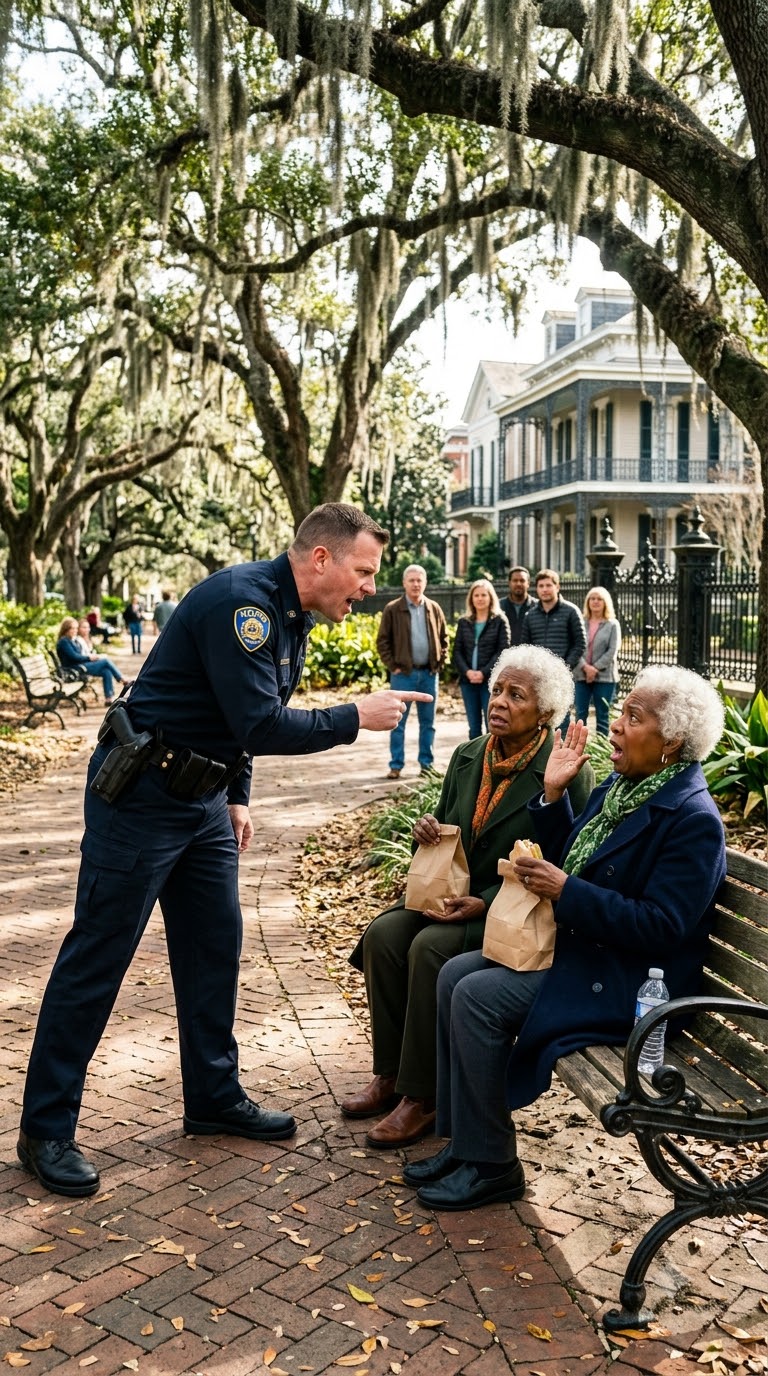
Her words carrying more weight for their restraint than any lengthy statement could have provided.
“Justice does not need to raise its voice to be heard,” she said.
And then she was gone, disappearing into the flow of pedestrians without another word. Weeks later, the director of the Federal Bureau of Investigation stood before a room full of reporters in Washington, delivering a formal statement on the outcome of what had become one of the most closely watched corruption cases in recent memory. The operation, he explained, had successfully dismantled a network responsible for years of evidence tampering, bribery, and abuse of power within the Savannah Police Department.
More than 20 officers had come under investigation as a direct result of the case, with several already facing formal charges ranging from obstruction of justice to accepting bribes in exchange for protecting criminal enterprises. He described the case as a reminder that accountability often arrives from the most unexpected direction, noting that the investigation had nearly been compromised by a single reckless decision made in broad daylight, only to have that same decision inadvertently expose the very corruption it had grown from. Reporters pressed for details about the two undercover agents whose composure during the confrontation had become the defining image of the entire case. But the director offered only a measured smile, declining to elaborate beyond confirming that both women remained active members of the bureau. The director praised the work of the undercover agents involved, though he stopped short of naming them publicly, respecting the nature of their continued work in similarly sensitive investigations across the country.
Captain Briggs, standing near the back of the room, later held his own press conference in which he pledged sweeping reforms within the department, promising independent oversight of complaint records, mandatory training on the abuse of authority, and stricter accountability measures for officers found to have violated the public’s trust. He acknowledged with visible difficulty that the department had failed the community long before that autumn afternoon and that restoring trust would take years of consistent, verifiable change rather than a single public apology. Boone meanwhile sat in a federal courtroom awaiting formal charges that would include false arrest, evidence tampering, and conspiracy, the same charges that would eventually see Marks and several other officers face similar consequences for their years of complicity. The courtroom gallery filled with faces of people whose lives had intersected with his abuse of power over the better part of two decades. On a quiet afternoon several weeks after the arrests, the wind moved gently through the same historic park where everything had begun, though the season had shifted slightly, the leaves thinning further on the branches overhead.
Nyla and Nia walked slowly along the familiar path, their steps unhurried, their conversation light after months of intense work that had finally reached its conclusion. Their unit supervisor had granted them a rare stretch of leave before the next assignment began, and both sisters had chosen, without needing to discuss it, to spend part of that quiet time back in the city where the case had reached its turning point. They passed the coffee shop where the surveillance had once centered, now simply another storefront filled with ordinary customers unaware of what had once unfolded across the street. They approached the same weathered bench where they had once sat eating sandwiches while secretly watching a man across the square.
And without discussing it, both women lowered themselves onto the worn wood exactly as they had done that day. The park around them looked much the same as it had weeks earlier, filled with tourists and locals moving through their afternoons, none of them aware of the history that particular bench now carried. There were no suspicious glances this time, no officer approaching with unfounded accusations, only the ordinary rhythm of a city continuing its life around two women who had quietly helped restore a measure of integrity to it. Nia mentioned almost in passing that Captain Briggs had personally written to their supervisor commending their conduct throughout the operation, a gesture neither sister had expected, but both quietly appreciated. Nyla replied that commendations mattered less to her than the fact that the department’s new complaint review system, now overseen by an independent board, had already reopened dozens of cases that had been buried for years.
An elderly man walking along the path slowed his steps as he passed, recognition dawning slowly across his weathered face as he studied the two sisters seated together. He had been among the crowd that gathered weeks earlier. One of the many who had watched in stunned silence as the scene unfolded before them, and something in his expression suggested he had carried the memory of that day with him ever since. He approached the bench carefully, his hands clasped in front of him, and offered a small, genuine smile before speaking.
“That day, I only saw two ordinary women,” he said, his voice gentle, carrying the weight of quiet reflection. “Today, I understand that what I actually witnessed was courage.”
Nyla looked up at him, something soft passing across her expression, a rare crack in the composed exterior she had maintained throughout the entire ordeal. She told him that most people who had stood in that crowd would never know how close the entire investigation had come to falling apart in a single afternoon, and that his willingness, however brief, to speak up on their behalf had mattered more than he likely realized. Nia offered the man a nod of gratitude, understanding better than most how much it meant for an ordinary bystander to have truly seen them, not as suspects, not as anomalies, but as people doing difficult and necessary work in the shadows of a city that rarely noticed. The man nodded slowly, his eyes glistening slightly as he glanced once more toward the square, as though comparing the peaceful scene before him to the chaos he remembered from weeks earlier.
He mentioned that his granddaughter had asked him about the video that had circulated afterward, and that he had struggled to explain to her why a person’s appearance had ever been treated as evidence of wrongdoing in the first place. Nyla considered this for a moment before answering that the answer was rarely simple, but that conversations like the one he was having with his granddaughter were exactly how change eventually took root in places that had resisted it for too long. The man walked on after a moment, continuing his afternoon stroll, leaving the two sisters alone once more on the bench where their story had both begun and in some quiet way come full circle. They sat together for a while longer, watching the leaves drift across the cobblestones, saying little, needing to say little, the silence between them carrying the same understanding it always had.
Nia finally broke the quiet, mentioning that their supervisor had already flagged a new case in another city, one that would likely take them away from Savannah within the week. Nyla nodded, unsurprised, already turning her thoughts toward whatever awaited them next, though she allowed herself one more moment to simply sit in the autumn light without the weight of surveillance equipment or suspicion pressing down on her shoulders. Then, almost in unison, they rose from the bench, straightened their coats against the autumn wind, and walked together toward whatever came next, their footsteps steady, their purpose unwavering.
Two women who had proven once again that dignity and justice, however quietly pursued, always found their way.
