

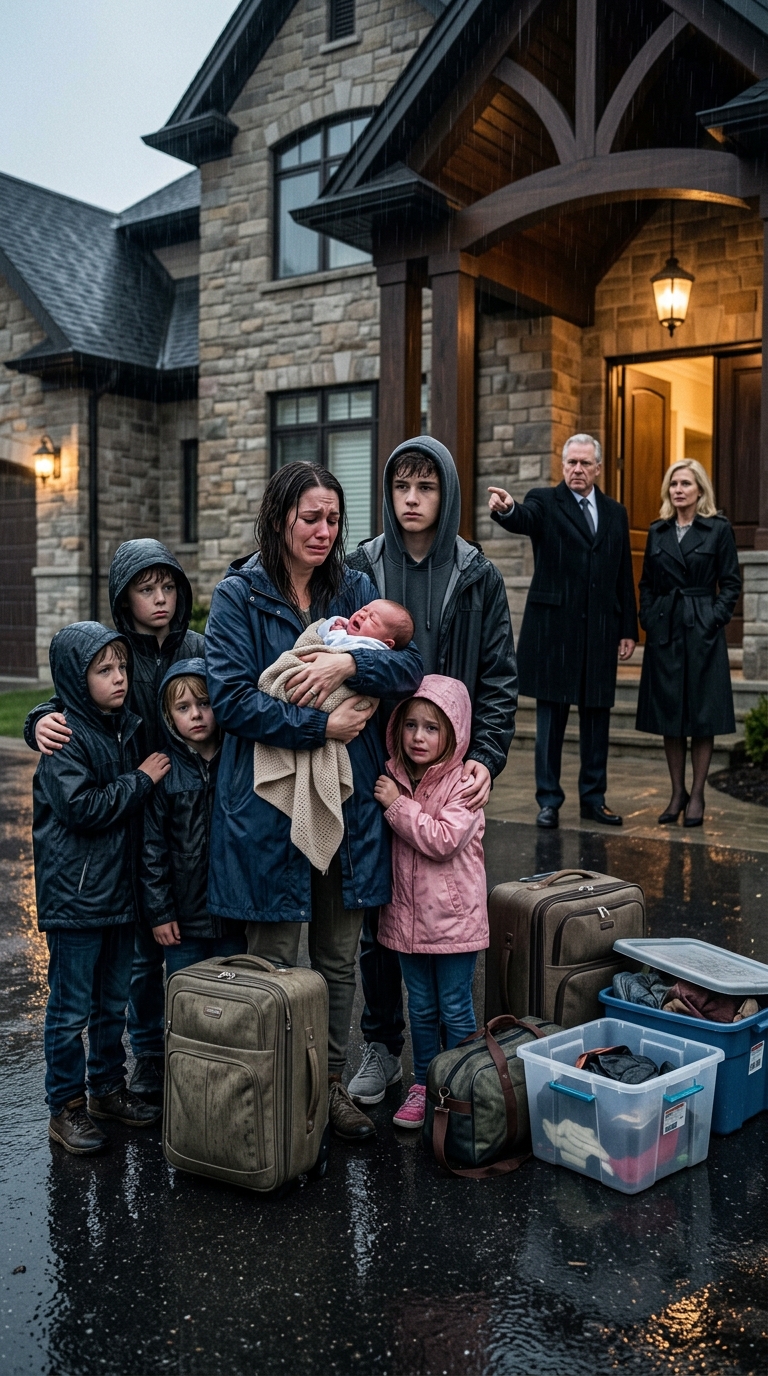
The rain had already soaked through the thin fabric of my sweater by the time my father-in-law pointed toward the front gate as if I were something that didn’t belong in his carefully curated world. My six children stood behind me, clutching plastic bags stuffed with whatever they had managed to save, and I forced my voice to stay steady because I refused to let them see me fall apart in front of people who had already decided I was disposable.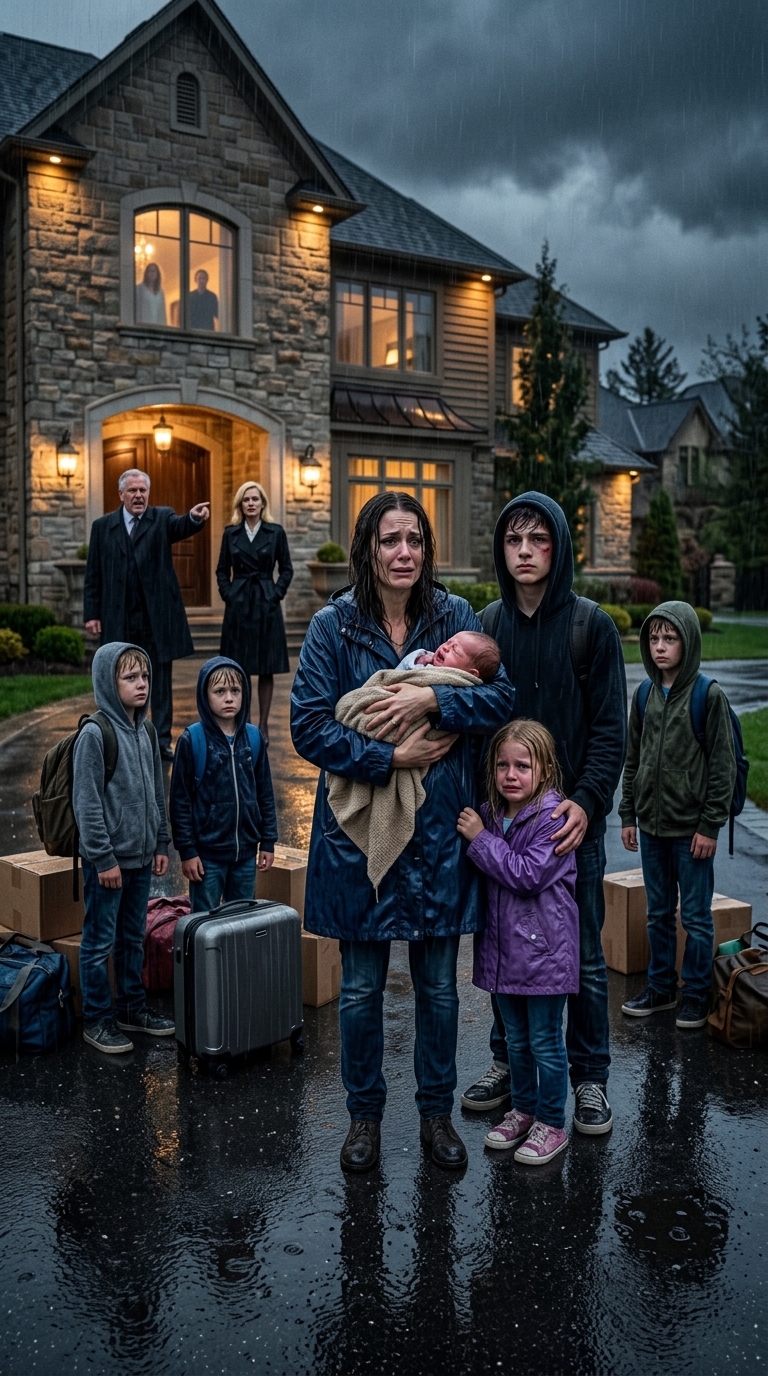
“Your husband is gone,” Richard’s father, Thomas Whitmore, said with a cold finality that sounded less like grief and more like a completed transaction. “This house belongs to blood.”
I looked down at the smallest of my children, little Sophie, her warm forehead resting against my shoulder, her breath uneven with exhaustion, and I answered him without raising my voice.
“Blood?” I asked quietly, making sure he heard every word. “I gave your son six children.”
Behind him, my mother-in-law, Eleanor, let out a small laugh that carried just enough cruelty to make the neighbors hesitate behind their curtains.
“Six mouths,” she said lightly. “Six burdens. You should be grateful we didn’t send you away sooner.”
Thomas dragged two suitcases across the porch and kicked them into the mud. The sound felt louder than it should have been, like the house itself was memorizing the moment.
“These are your things.”
“My things?” I repeated slowly, almost disbelieving how easily they had rewritten my life.
“Be thankful we packed anything at all.”
Before I could respond, my oldest son, Ethan, stepped forward.
“Grandpa, please,” he said, voice shaking but firm. “Dad told us—”
The slap cut through the rain.
Thomas struck Ethan hard enough to snap his head sideways, and for a second, everything froze.
I moved before thought, catching Ethan before he fell. My fingers pressed against his cheek, already burning with heat.
“Don’t you ever touch my son again,” I said.
Thomas smiled like he had been waiting for that.
“Or what?” he asked. “You’ll cry?”
Eleanor stepped closer, her voice lowered into something almost conversational.
“Richard married beneath him,” she said. “We tolerated you because he insisted. Now he’s gone, and so is your protection.”
I looked toward the house—the place where I had raised children, stayed up through illness, and believed, foolishly, that I belonged.
But something inside me settled.
I had never truly been welcome.
I bent down, picked up the soaked suitcases, and turned to my children.
“Kids,” I said softly, “we’re leaving.”
Thomas gave a satisfied nod.
“Good. And don’t come back.”
We walked away together, seven figures moving through the rain as one. Only when we reached the street did I turn back.
They were already laughing.
Eleanor was holding her phone up, likely rewriting the story into something that made her feel righteous.
I smiled.
Not because I was defeated—but because I remembered the folder.
Three months before Richard died, he had pressed it into my hands.
“If they ever try to erase you,” he had whispered, “take this to Daniel Harper.”
I hadn’t opened it yet.
That night, in a roadside motel with flickering lights and peeling wallpaper, I finally did.
THE SECRET HE LEFT BEHIND
By morning, the locks had already been changed. By midday, Eleanor posted the house online with a caption about “new beginnings.” I saw it while pouring cereal into paper cups for my children.
At three, a legal notice arrived.
At four, Eleanor called.
“You should sign the waiver,” she said smoothly. “Ten thousand dollars. Enough to start over somewhere smaller.”
I leaned against the wall, watching my children share a blanket.
“What waiver?” I asked.
“The one giving up your claim,” she replied. “Don’t pretend you understand these things.”
“I understand more than you think,” I said quietly.
“You have no income, no home, and six children,” she continued. “If you fight, we’ll make sure everyone sees you as unstable.”
I ended the call.
Then I called Daniel Harper.
His office smelled like old leather and patience. When I placed the folder on his desk, he studied it like a storm he had expected but hoped wouldn’t arrive.
Inside were documents, records, and proof.
When he finally spoke, his voice was controlled.
“Your husband transferred the house into a family trust four months ago,” he said. “You are the trustee.”
I stared at him.
“And them?”
“No ownership,” he said.
I exhaled.
But he wasn’t finished.
“There’s more,” he added. “He documented financial misconduct.”
A video played.
Richard’s face appeared.
“If you’re watching this,” he said, “then they did exactly what I feared.”
My hand covered my mouth.
“They’ll say you’re weak,” he continued. “That’s their mistake.”
Daniel looked at me.
“You worked in finance?”
“Twelve years,” I said softly.
He nodded.
“Then you know what this means.”
I did.
They hadn’t thrown out someone powerless.
They had thrown out the one person who knew where everything was buried.
THE MOMENT EVERYTHING TURNED
The courtroom felt still, almost suspended.
Thomas entered confidently.
I sat with my children behind me.
Their lawyer spoke first, painting me as desperate. But Daniel responded with documents—clean, precise, undeniable.
Then the video played.
Richard’s voice filled the room.
“My parents confuse kindness with weakness. My wife is kind. She is not weak.”
Eleanor’s expression shifted.
Then came the records.
The signatures.
The financial trails.
The messages.
And finally, Ethan’s photo.
Thomas tried to speak, but the judge stopped him.
Then I stood.
“My husband asked me to protect our children,” I said. “I gave his parents every chance to step back.”
A pause.
“They refused.”
I looked at them.
“And that choice ends today.”
The ruling came quickly.
Control returned.
The sale stopped.
An investigation began.
Eleanor reached for my necklace, but the judge’s voice cut through.
“Remove it.”
Outside, Thomas tried once more.
“You think this is over?”
I looked at him.
“It was never yours.”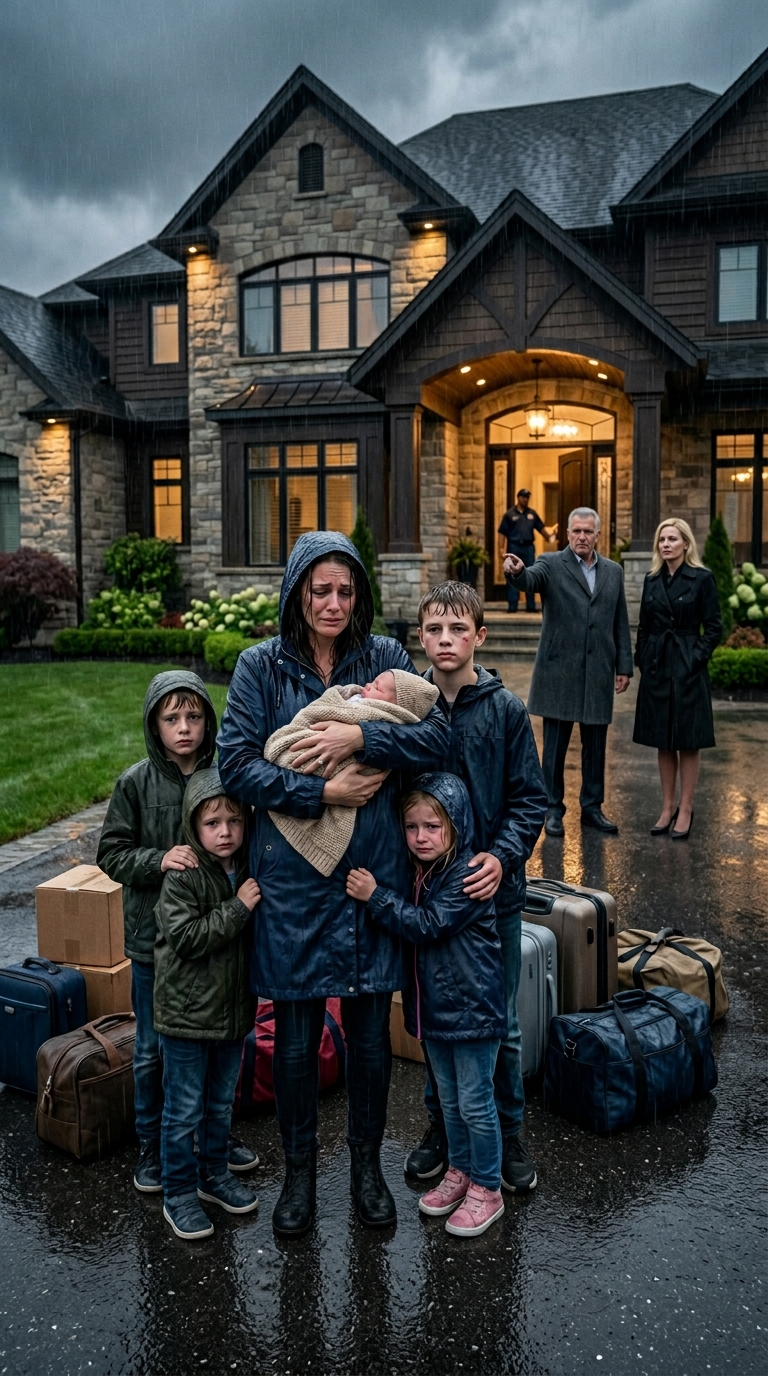
WHAT CAME AFTER
The house felt different when we returned—not changed, but reclaimed.
Ethan planted roses in the place where we had once stood in the rain.
The twins rode bikes again.
Sophie laughed freely.
One evening, Ethan asked, “Mom… are we safe now?”
I looked at my children, then at the home that had tried to reject us.
“Yes,” I said.
And for the first time, it truly was.
