

The sky above Brighton Harbor carried a dull silver haze that morning, the kind that made the entire city feel weighed down.
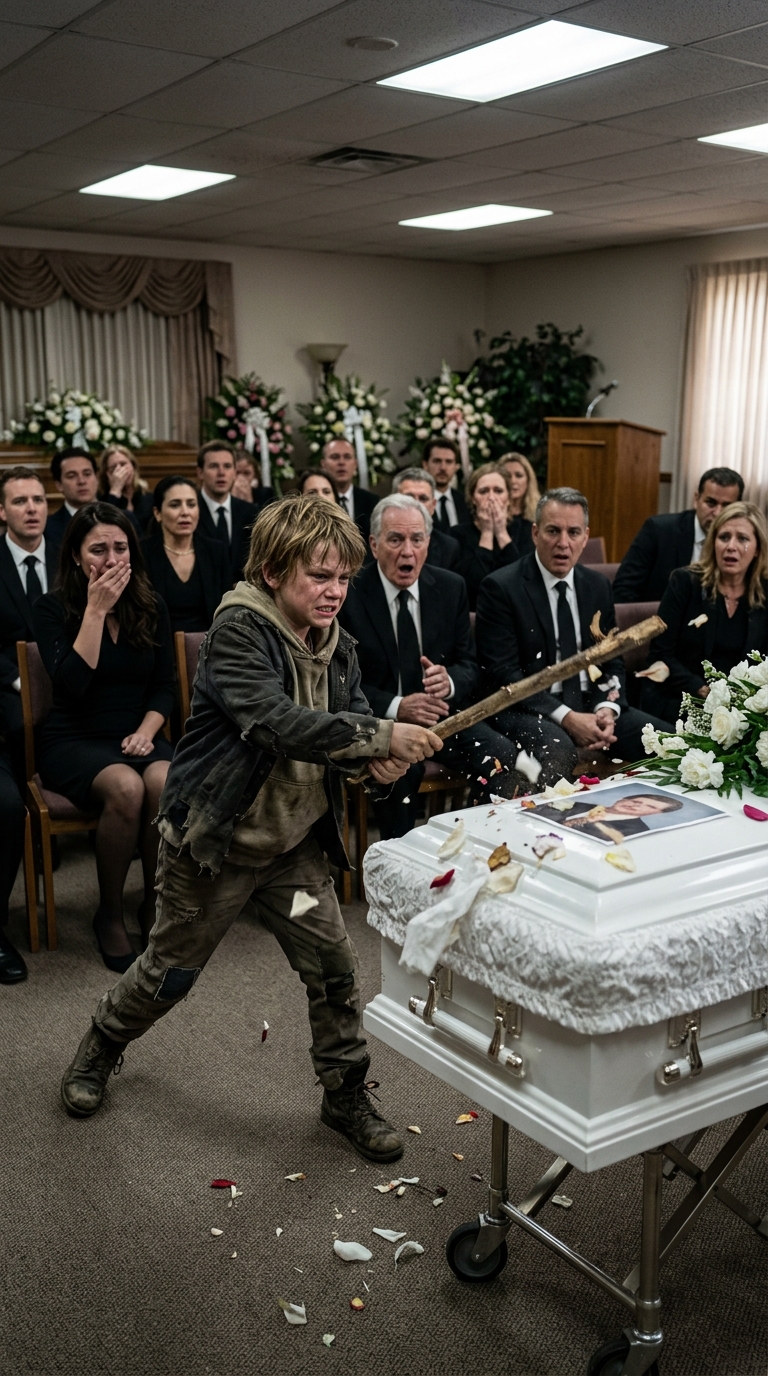
On Bayview Street, the white chapel stood with its doors wide open, welcoming guests dressed in black as quiet whispers of sympathy drifted through the air. At the front of the chapel rested a polished oak coffin surrounded by roses whose overpowering sweetness almost seemed capable of masking grief itself.
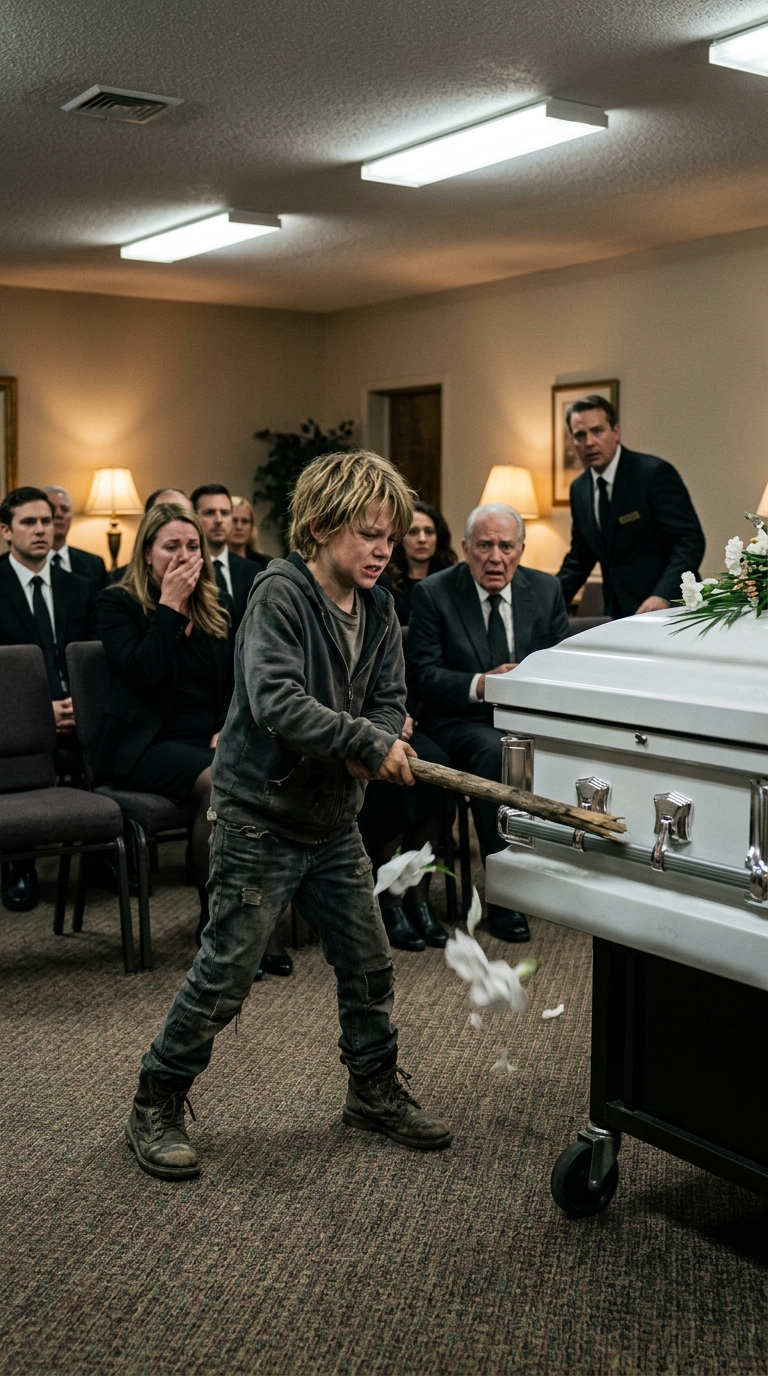
Inside that coffin, everyone believed, was sixteen-year-old Lillian Prescott, daughter of wealthy real estate magnate Gregory Prescott. The city knew her face from charity events and glossy magazine pages, always smiling beside her influential father. Now those same people had gathered to mourn her. The priest spoke gently of short lives and God’s mysteries while the organ released low mournful notes that echoed across the marble floor. Everything appeared exactly as it should for the funeral of a powerful family.
Then the boy arrived.
He wore no shoes. His shirt was far too thin for the cold morning air, his knees scraped raw, dark hair hanging into his eyes. At first nobody noticed him slipping through the rear entrance, weaving quietly among guests too polite to stare at a child who clearly did not belong there. His attention never wandered from the coffin, as though something unseen was pulling him toward it.
The moment he reached the front, he slammed both hands onto the polished wood and shouted with startling force for someone so small.
“She is not dead. You cannot bury her.”
Shock rippled through the chapel. A woman dropped her purse. The priest stopped mid prayer. Two security guards rushed forward immediately, seizing the boy by both arms, but he struggled fiercely, breathing hard, nails scraping as he fought against them.
“She is alive,” he shouted again. “I saw her today. She gave me this.”
From his pocket, he pulled out a silver charm shaped like a tiny moon with the letter L engraved into it. The charm swung beneath the chapel lights. Gregory Prescott, standing rigid near the front pew, stared at it in disbelief. He recognized it instantly. It was the gift he had given his daughter for her sixteenth birthday, selected by an assistant while he sat in meetings overseas.
His mind refused to accept what his eyes were seeing. Lillian was dead. The hospital had confirmed it. Doctors had signed the paperwork. Every detail had been official and orderly. Gregory himself had approved the embalming from a luxury hotel abroad, speaking calmly while burying his grief beneath schedules and business calls.
“Open the coffin,” the boy shouted. “If you do not believe me then look.”
Gregory slowly lifted one hand. The guards stopped. The priest swallowed nervously before giving a hesitant nod to the funeral staff. Trembling fingers released the latches. The lid opened slowly, hinges creaking softly like a held breath escaping.
Inside rested a young woman. Her hair had been styled perfectly. Makeup covered her face flawlessly. Her skin was motionless and pale. But something was wrong. The features were close enough to deceive from a distance, yet it was not Lillian. Not his daughter.
Whispers swept through the chapel. Gregory felt the world shift beneath him. He gripped the edge of the coffin as though the polished wood itself might explain the impossible.
“Where is my daughter,” he whispered.
The boy had stopped fighting now, standing still, chest rising with controlled urgency.
“My name is Jonah,” the boy said. “She is in an old boarding house near the rail bridge. A man with a chain tattoo on his neck is guarding her. She told me to find you. She said you would believe proof, not words.”
Gregory’s thoughts spiraled. Someone had replaced the body. Someone had manipulated hospital records. Someone had fooled him completely while he trusted documents more than instinct.
He chose not to call the police. Not yet. If someone connected to his own circle was involved, he could trust no one until Lillian was safe. He walked past the stunned mourners, past the priest, past the coffin that no longer mattered. Jonah followed him into a black town car. The driver silently started the engine without asking questions.
Rain began falling as they crossed the bridge into the city’s older district, where worn brick buildings leaned tiredly and windows were patched with cardboard. They stopped outside a peeling three-story house protected by rusted bars across the lower windows. The porch light flickered weakly. Jonah climbed out first.
“She is on the second floor,” Jonah said. “The door at the end of the hallway. Do not be afraid. She is waiting.”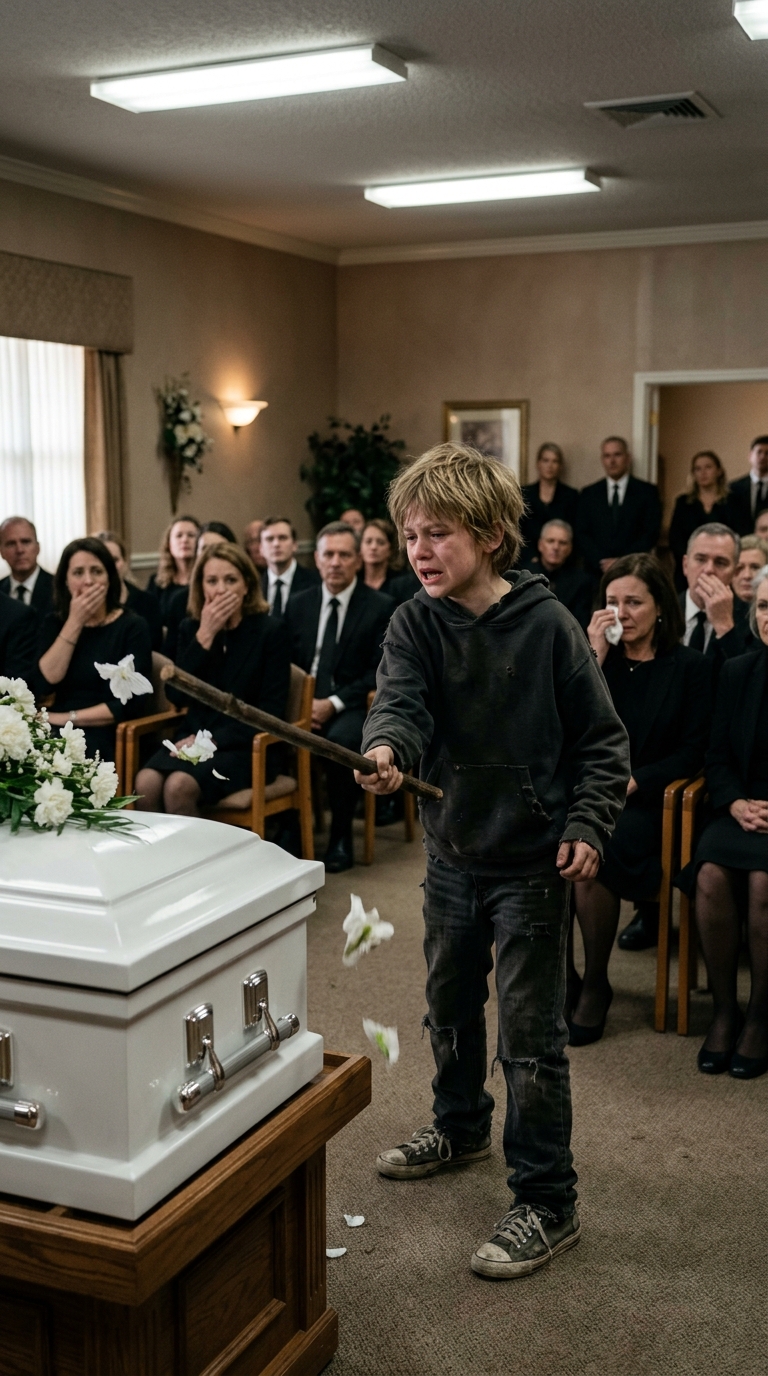
Gregory’s hand trembled while climbing the stairs. The inside smelled of damp wood and stale cooking oil. From behind a closed door came a faint voice.
“Dad,” the voice whispered. “Do not leave again.”
Gregory pushed the door open.
Lillian sat tied to a chair, wrists marked red from the ropes, hair tangled, eyes filled with tears she refused to shed. Behind her stood a tall man wearing a heavy coat, a chain tattoo curling along his neck toward his jaw.
“So the king finally arrives,” the man said. “I wanted you to feel what it is like to lose something you love without warning.”
Gregory stepped forward carefully.
“Untie her,” he said. “Whatever you want, we can talk.”
The man laughed bitterly, though there was more pain than madness in it.
“My name is Victor Hale,” he said. “My sister died outside one of your closed clinics. She needed help, and your redevelopment project turned that building into luxury condos. She bled in an alley while you celebrated profits.”
Lillian looked directly at her father, her voice calm and painfully mature for sixteen.
“I called you so many times that week,” she said. “You said you were busy. I thought you would never hear me.”
Gregory’s throat tightened. In her eyes, he saw a reflection of himself he could no longer ignore.
Suddenly sirens shattered the night. Blue and red lights flashed against the walls. Jonah had slipped away unnoticed earlier and now stood outside beside rushing police officers. Victor cursed, cutting the ropes from Lillian’s wrists before pushing her toward Gregory.
“This is not over,” Victor said. “Remember what neglect costs.”
He escaped through the back window, disappearing into the darkness and rain.
Gregory pulled Lillian into his arms. For the first time in years, he held her without glancing at a watch or checking a phone. Her heartbeat pressed against his chest, undeniable and real.
At Harborview Medical Center, doctors confirmed bruises, dehydration, and exhaustion, but no life-threatening injuries. Lillian remained under observation while Gregory stayed beside her hospital bed all night, ignoring every incoming call.
Jonah sat outside in the hallway, his feet dangling from the chair, exhaustion finally overtaking him.
When dawn light filtered through the hospital window, Lillian reached for her father’s hand.
“If you want a new beginning,” she whispered, “start by seeing the people who are still alive around you.”
Gregory nodded as tears finally escaped.
One week later, the city awoke to unexpected news. The Prescott Foundation announced plans to build a free emergency clinic in the same neighborhood where Victor’s sister had died. Construction began immediately. Gregory stood before reporters with Lillian at his side, her silver moon charm once again around her neck, while Jonah lingered shyly nearby.
Jonah was given a room inside the Prescott guest house, enrolled in school, provided clean clothes, and fed three meals a day. Sometimes he still chose to walk barefoot, but now it was beside a quiet garden pond instead of freezing pavement.
One peaceful afternoon, Lillian sat beneath a tree with Jonah.
“You broke a coffin to save me,” she said. “That was brave.”
Jonah shrugged with a small smile. “I just did not want you to disappear.”
Lillian looked toward the new clinic rising in the distance, construction sounds filling the air.
“Sometimes,” she said, “to save the living, you have to disturb the silence of the dead.”
And in Brighton Harbor, people never forgot the day a barefoot boy refused to let a lie become a burial, and a father finally learned to recognize what truly mattered before losing it forever.
