

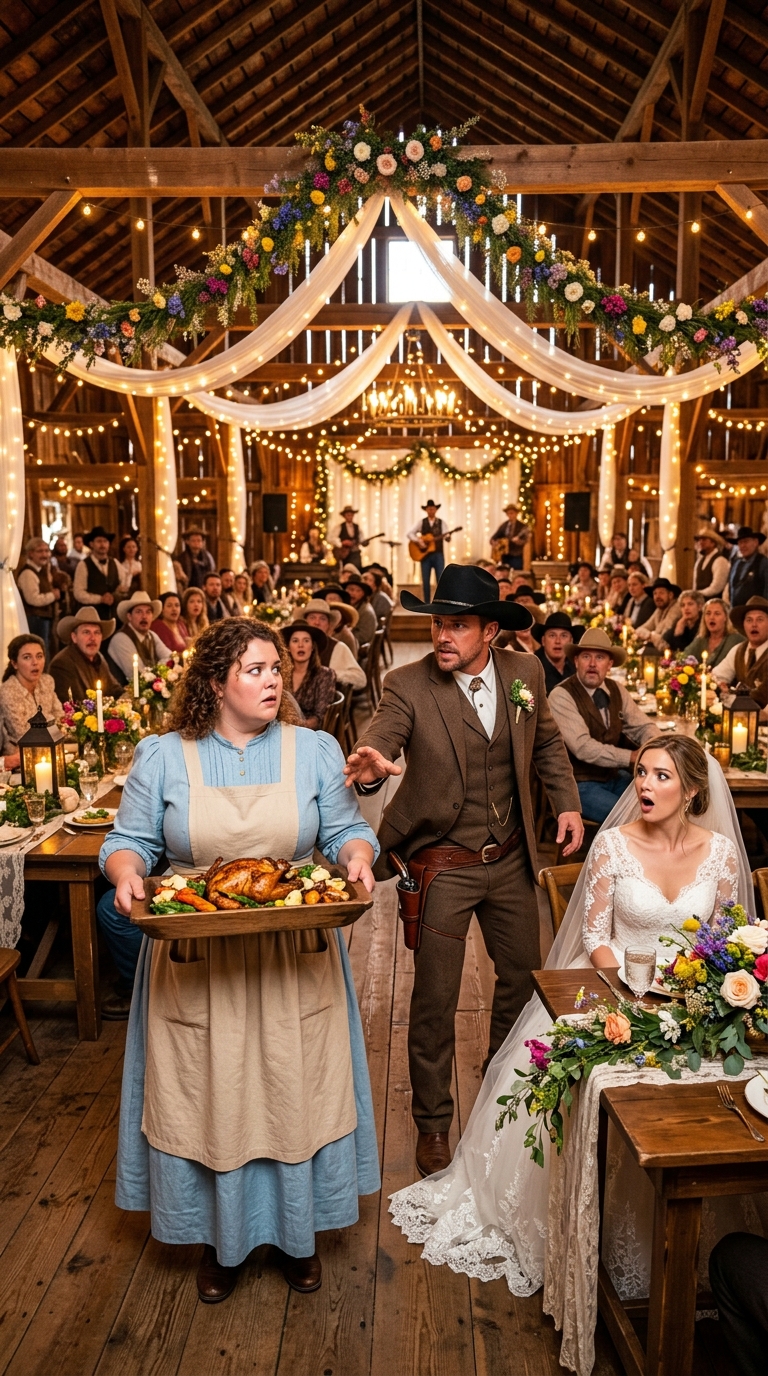
Beatriz Cárdenas did not cry when Carlota Valdivia called her “the fat widow from the kitchen” in front of more than 200 guests.
She remained behind the door of the main dining room at Hacienda Los Álamos, with her hands pressed against the wood, while the laughter swept through the hall like a gust of icy wind.
On those tables were the hams she had cured for weeks, the bread she had kneaded before dawn, the meat empanadas, the vegetables glazed with honey, and the 16 fruit cakes resting beside the windows.
In the center of the hall stood a four-tier cake decorated with sugar roses and orange blossoms, each petal shaped by her fingers.
Everything they ate had come from her hands.
Yet no one was supposed to know her name.
The story had begun six weeks earlier, during a rainy May dawn in 1892.
Beatriz lived alone on a small property on the outskirts of Santa Rosalía, in the state of Durango. Her husband, Julián, had died five years earlier, crushed by a cart loaded with minerals. Since then, she had worked the 40 hectares he left her, raised chickens, planted corn, and prepared food for the families in the town.
That morning, water was leaking through the roof of her bedroom and falling into a tin bucket.
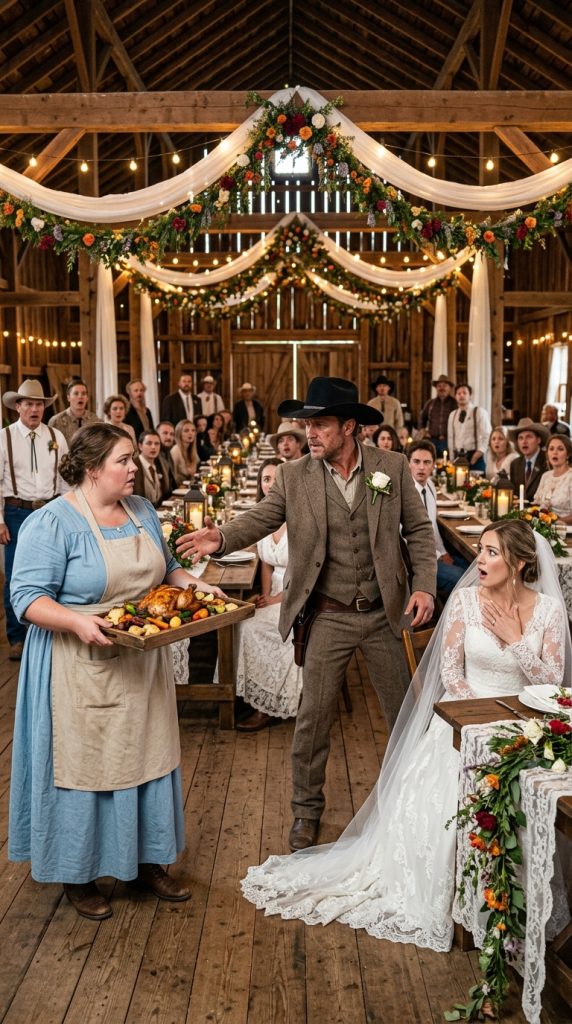
Beatriz was sitting at the table with a cup of cold coffee, calculating for the umpteenth time how much she still needed to pay the mortgage. If she did not gather 40 pesos before September, Banco de San Marcos would take her land.
It was then that the letter from Hacienda Los Álamos arrived.
Mateo Salcedo, owner of one of the most important cattle ranches in the region, was to marry Carlota Valdivia, daughter of a powerful railroad entrepreneur.
The family needed an experienced cook to prepare a banquet for more than 200 people. The job would last six weeks and the payment would be exactly 40 pesos.
Beatriz accepted that same afternoon.
She arrived at Los Álamos with her knives wrapped in cloth, an iron skillet that had belonged to her mother, and a notebook full of recipes.
The kitchen at the hacienda was larger than her entire house. It had two wood stoves, a brick oven, an underground pantry, and a long oak work table.
For a few minutes, Beatriz forgot her debts.
In that kitchen, she felt like herself again.
The door opened.
Carlota Valdivia entered wearing an ivory-colored suit that had surely been made in the capital. She was tall, slender, and beautiful. She moved as if every place belonged to her before she even stepped into it.
She looked Beatriz up and down.
“You are the cook.”
“Beatriz Cárdenas, miss. I received your letter.”
“I know who you are.”
Carlota ran a gloved finger across the table.
“I’ve been told you cook acceptably.”
“I will make sure it is better than acceptable.”
Carlota turned.
“There is one condition. You must not appear before the guests. You will remain in the kitchen throughout the celebration. You will not enter the hall or speak with anyone in the house unless spoken to.”
Her gaze deliberately traveled down Beatriz’s robust body.
“This wedding will bring together important people. I do not want anything inappropriate to distract their attention.”
Beatriz recognized that look.
She had seen it since she was a child: the expression of those who considered the size of her body to be a lack of refinement.
She felt heat in her cheeks but held the gaze.
“I understand.”
“Good. I expect a four-tier cake. Something our guests from the capital have never seen.”
Carlota left without saying goodbye.
Beatriz took a deep breath, tied on her apron, and began to work.
During the first two weeks, almost no one entered the kitchen. She rose before four o’clock, lit the stoves, and worked until nightfall. She prepared preserves, smoked meats, tested recipes, and drew designs for the cake.
One early morning, while kneading bread, the back door opened.
A man of about 38 entered, tall, with dark hair and some gray strands at the temples. He wore work clothes and boots covered in dust.
“Good morning,” he said.
“Good morning. Can I help you?”
“I’m just looking for coffee.”
He poured himself a cup like someone accustomed to doing so and sat at the end of the table.
“I am Mateo Salcedo.”
Beatriz stopped kneading for a moment.
“The groom.”
“So they say.”
There was no enthusiasm in his voice.
“The kitchen is yours, Mr. Salcedo.”
“The hacienda is mine. The kitchen, for these weeks, is yours. I wouldn’t want to get in the way.”
Mateo drank in silence. He did not watch her with curiosity or contempt. His presence did not feel like an inspection, but like company.
He returned the next morning.
And the one after that.
Over time, he began asking her questions.
“Why do you put vinegar in the dough?”
“It prevents it from hardening. The crust stays light.”
“How do you know when the bread is ready?”
“By the sound.”
Beatriz took a loaf and gently tapped the bottom.
“If it sounds hollow, it’s done. If it sounds heavy, it needs more time.”
“Did your mother teach you?”
“My mother and my grandmother. She used to say that food reveals the intention of the person who prepares it.”
“My mother used to say something similar.”
Mateo lowered his gaze to his cup.
“She died twelve years ago.”
“I’m sorry.”
“She would have liked to meet you.”
He said it naturally, but Beatriz stood motionless.
Mateo left without noticing what that phrase had stirred in her.
From then on, Beatriz began to fear the early mornings. Not because she didn’t want to see him, but because she wanted him to come too much.
He was a landowner about to marry the daughter of a powerful man. She was a widow in debt, with flour under her nails and a house whose roof was falling in.
There was no path that could join those two lives.
One morning, Carlota entered with a drawing sent from Mexico City.
“This will be the design for the cake.”
Beatriz examined the sugar columns and the decorations that were supposed to support the tiers.
“It’s beautiful, but it won’t withstand the July heat.”
“That is your problem.”
“If I build it like this, it will collapse before it is served.”
Carlota’s eyes hardened.
“I’m not paying you to tell me what you cannot do.”
“I’m not saying I cannot do it. I’m explaining what will happen so it doesn’t happen during your wedding.”
“Do you know what your place is in this house?”
Beatriz placed the drawing on the table.
“I am the woman responsible for making your banquet remembered for many years. That is my place.”
Carlota took a step forward.
“Do not speak to me that way again.”
“I will adapt the design and make something better. I give you my word.”
When Carlota left, a voice was heard from the back door.
“You handled that well.”
Mateo was there.
“How much did you hear?”
“Enough.”
His face was tense.
“She had no right to speak to you like that.”
“I need to keep this job. If you confront her for me, it will be me who suffers.”
Mateo understood.
“I won’t say anything. But I want you to know something.”
He stepped a little closer.
“You are not invisible in this house. Not to me.”
Beatriz could not respond.
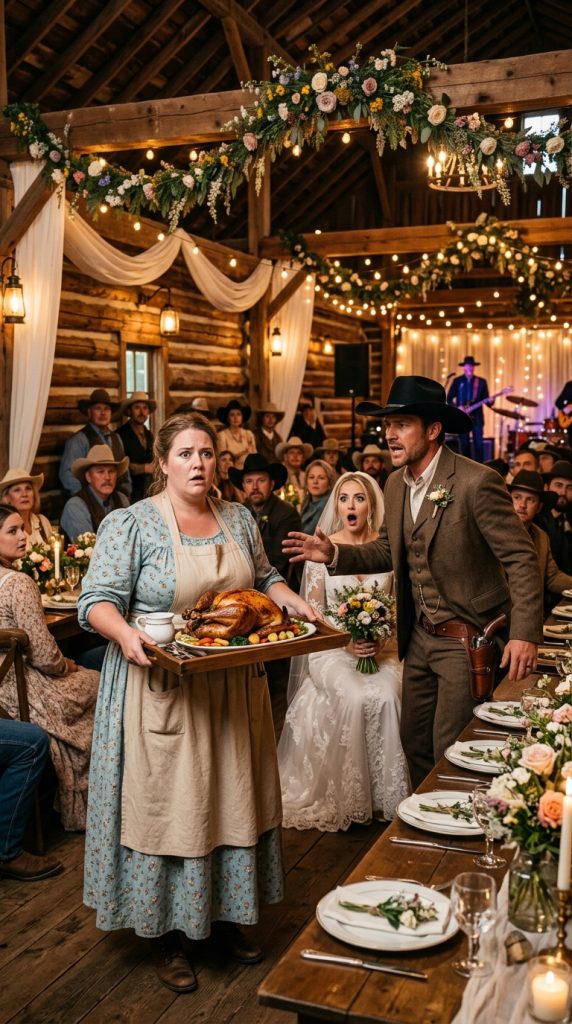
Mateo looked at the sketches on the table.
“The cake with roses and orange blossoms is perfect. Do not change that design.”
He left before she could reply.
That afternoon, Beatriz understood that she was in danger.
Not because of the wedding or the cake.
Because a man had looked at her work, had remembered which design was hers, and had said it was perfect without demanding that she transform into someone else.
Days later, Beatriz overheard an argument through the wall.
“You spend more time in the kitchen than with me,” Carlota accused.
“I’ve been having coffee there long before I met you.”
“You have coffee with her.”
“She works. I sit far from her table.”
“I’m not a fool, Mateo. I see how you look at her.”
There was silence.
“She’s a fat widow from a miserable farm,” Carlota continued. “She’s here to cook and disappear. That’s all she is.”
Mateo’s voice became dangerously calm.
“Never speak about her that way again.”
Beatriz closed her eyes.
The next morning, Mateo arrived as usual.
“You heard the argument,” he said.
“It wasn’t my intention.”
“I know.”
“I need this to remain simple, Mr. Salcedo.”
He contemplated her for a few seconds.
“Simple,” he finally repeated.
But nothing was simple again.
Inés, the hacienda administrator, revealed to Beatriz that the wedding was part of a business agreement. Don Ramiro Valdivia, Carlota’s father, intended to build a railway line and needed the eastern pastures of Los Álamos.
Those lands were the best on the hacienda.
“Mateo doesn’t want to sell them,” Inés explained. “His father is buried there.”
“And Carlota?”
“She says land is just land.”
Beatriz remembered her own plot, the house built by Julián, and her mother’s grave beside a mesquite tree.
Land was never just land.
That same week, a box of wines sent by Don Ramiro arrived in the kitchen. Inside, among the bottles, Beatriz accidentally found a folder that should not have been there.
It contained maps and contracts.
One of them bore her name.
Don Ramiro had bought Beatriz’s debt from Banco de San Marcos. He planned to seize her 40 hectares because a secondary branch of the railway would pass through them.
The document included an order to triple the interest and force her foreclosure before the end of the year.
Beatriz felt the ground disappear beneath her feet.
Carlota not only wanted Mateo’s lands. Her family also intended to steal hers.
Beatriz hid the documents under a board in the pantry and continued working. She needed to finish the banquet and get paid. Then she would go to a judge.
The morning of the wedding began at two o’clock.
By noon, the cake was finished: four tiers of ivory cream, pale roses, and white orange blossoms.
It was the most beautiful creation Beatriz had ever made.
Carlota appeared in her silk dress.
For a moment, as she contemplated the cake, her expression lost all cruelty.
“It’s beautiful.”
“Thank you, miss.”
Carlota recovered her coldness.
“Make sure you do not leave the kitchen.”
For hours, Beatriz coordinated every dish. The guests praised the ham, the bread, the stews, and the cakes. Yet when they asked who had cooked, no one spoke her name.
At the end of the banquet, Carlota raised a glass.
“Many have asked who prepared this food. We hired a widow from the area, a simple and hardworking woman. But I must clarify that every dish was conceived under my direction. She merely followed instructions.”
Some people laughed.
“She is a robust woman, without education or worldliness, whose ambitions do not go beyond a kitchen. That is why I considered it prudent to keep her out of sight. After all, no one wants to look at the fat widow from the kitchen while they eat.”
Laughter filled the hall.
Beatriz remained behind the door, motionless.
She had been prepared not to receive recognition.
She had not been prepared to become a joke.
She took off her apron, wrapped her knives, and picked up her mother’s skillet.
When she opened the back door, Mateo entered dressed for the ceremony.
“You’re leaving.”
“My work is finished.”
“What Carlota said…”
“It’s not my concern.”
“She took everything you built and claimed it as her own.”
Beatriz looked at him.
“They hired me to be invisible. She simply reminded everyone what the agreement was.”
“That is not who you are.”
“It doesn’t matter who I am. I need to go home.”
Mateo clenched his fists.
“I am not going to marry her.”
Beatriz stood paralyzed.
“There are 200 people waiting.”
“I know.”
“You cannot hide in this kitchen.”
“What if the hardest thing is not in that hall?”
They looked at each other.
Beatriz then understood that she was not the only one who had been fighting her feelings for weeks.
“You must face the truth,” she said. “Not for me. For yourself.”
Mateo returned to the dining room.
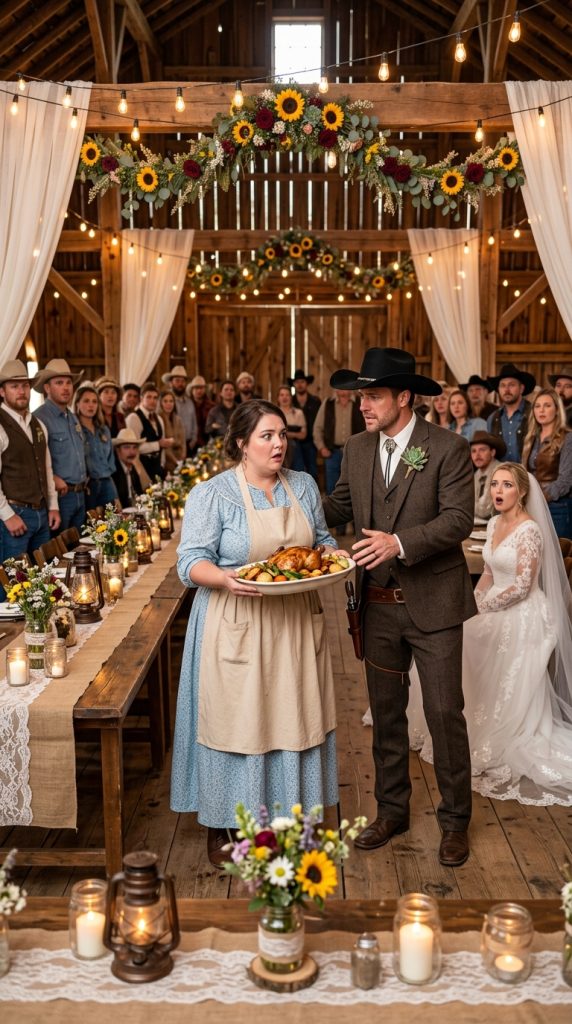
Beatriz left by the back path, but she had not reached the gate when she heard his voice rising above the guests.
“Carlota!”
Everything fell silent.
Inés came running.
“He has stopped the wedding.”
“What?”
“He said he will not spend his life with a woman who judges the value of others by their body or their money. He also refused to hand over the pastures.”
Then the shouting began.
Beatriz returned to the kitchen. Mateo was there, without his jacket and with his sleeves rolled up.
“Are you all right?” he asked.
“No.”
It was the first time Beatriz allowed the truth to come out without disguising it.
“I worked for six weeks. I made the best I have ever made in my life and that woman turned me into a joke in front of 200 people.”
Mateo approached.
“I should not have allowed them to hide you.”
Before Beatriz could respond, Carlota burst into the kitchen accompanied by her father.
“So all this is because of her!” she shouted.
Don Ramiro pointed at Beatriz.
“A cook will not destroy the most important deal in this region.”
“The wedding ended before it began,” Mateo replied. “I was just too cowardly to admit it.”
Beatriz walked to the pantry and took out the documents.
“Has this agreement ended too?”
Don Ramiro turned pale.
Mateo read the papers.
“You bought Beatriz’s debt?”
“It’s business.”
“You illegally tripled her interest.”
“Give me those documents!”
Don Ramiro tried to snatch them, but Mateo stepped between them. The businessman called his men.
The vaqueros of Los Álamos entered through the back door and surrounded the guards.
“No one will touch Mrs. Cárdenas,” Mateo ordered.
Several guests gathered in the corridor. Among them was the district judge.
Upon reviewing the documents, he discovered forged signatures and contracts related to other properties taken from widows and peasants.
Don Ramiro was arrested that same afternoon.
Carlota remained alone beside the cake.
For the first time she did not look haughty, but defeated.
“I knew about the lands,” she confessed. “I didn’t know about your farm.”
She looked at Beatriz.
“What you cooked was extraordinary. I knew it when I humiliated you.”
“Then why did you do it?”
Carlota looked at Mateo.
“Because he looked at you the way he never looked at me. And because I thought that if everyone laughed at you, maybe he would stop seeing you.”
Her eyes filled with tears.
“It didn’t work.”
Carlota left the hacienda that night.
Beatriz received her 40 pesos and returned home. She repaired the roof, paid what she legally owed, and put away the tin bucket.
The investigation against Don Ramiro annulled dozens of fraudulent contracts. Beatriz fully recovered her land.
Moreover, the guests began asking about the cook of the banquet. A rancher offered her 120 pesos to prepare a dinner. Then another proposal came, and another.
In less than a year, Beatriz opened a small professional kitchen called La Mesa de las Cárdenas. She hired four widows from the town and taught each one what she had learned from her mother and grandmother.
Mateo did not come looking for her immediately.
He sent her a single letter:
“I do not want to turn a painful day into an obligation. When you are ready, I will have coffee wherever you decide.”
Beatriz took three weeks to reply.
She invited him to her house at five in the morning.
Mateo arrived with freshly ground coffee and a box of nails to repair the corral gate.
“I don’t need you to fix my gate,” she said.
“I know.”
That answer made her smile.
They talked for hours. Not about the canceled wedding, but about work, the land, memories, and fear.
“I am not a woman that men choose,” Beatriz confessed. “I have always been the one who cooks, serves, and picks up what is left.”
Mateo took her hand.
“I am not choosing you in spite of who you are. I am choosing you for everything you are.”
Beatriz did not answer right away.
“I am demanding.”
“I know.”
“I have strong opinions.”
“I know that too.”
“And I will never again allow myself to be hidden.”
“Then I will make sure everyone knows your name.”
They married months later on Beatriz’s small property. There were no 200 guests, no railroad deals, and no dresses brought from the capital.
The workers, the widows from her kitchen, and Inés attended. Inés cried throughout the entire ceremony.
Under her best dress, Beatriz wore her mother’s old apron. Not because she was still the widow from the kitchen, but because she was no longer ashamed of any part of her story.
When the priest finished, Mateo whispered to her:
“My mother would have loved you very much.”
Beatriz finally cried.
Not because of the humiliation, the years of loneliness, or the times they made her feel invisible.
She cried because, after feeding everyone without ever receiving more than the leftovers, she had found someone who invited her to sit beside him.
The woman whom 200 people had laughed at became the most respected cook in northern Mexico, owner of her lands, and owner of her own name.
And the kitchen where she had once been ordered to remain hidden ended up being the place from which Beatriz taught an entire region that the true value of a person never depends on the body others judge, but on the dignity with which she rises when they try to turn her into a shame.
