

Part 1: The Dinner Bill That Changed Everything
My daughter-in-law told me to pay the $250 steakhouse bill and leave, right after her mother called me selfish for keeping my own home. My son sat motionless, his eyes fixed on his plate. I didn’t argue. I paid, drove home, and opened my laptop. By the next morning, the two of them were starting to learn exactly what my generosity had been covering all along.
My name is Georgia Owens. I am sixty-four years old, and I have been a widow for ten years. In that time I have learned how to fill a quiet house, how to cook for one, and how to make decisions without anyone beside me to talk them over. I am not saying this to complain. I am telling you who was sitting at that table because it matters.
For the past five years, I had quietly helped support my son David and his wife, Sarah. It never began as anything formal. A bill here, a subscription there, always offered with a smile and the reassurance that I was happy to help. I never imagined that they would eventually treat that help as something I owed them, like a debt I had signed for long ago and forgotten about.
Everything came to a head on a Friday evening at an expensive downtown steakhouse, the kind of place with dark wood paneling, heavy white tablecloths and waiters who glide between the tables as though afraid to disturb the air. I remember noticing the candles flickering on every table and thinking how peaceful it all looked from the outside.
David had called earlier in the week and invited me to what he described as a family dinner. I dressed carefully, pleased that my son wanted to spend an evening with me, and I arrived a few minutes early. But when the hostess led me to the table, I discovered that Sarah’s mother, Brenda, was already sitting there, visiting from Chicago. Nobody had mentioned her. I told myself it was an oversight and took my seat with a smile.
Brenda spent most of the evening complaining. First, the restaurant was too cold, and she pulled her shawl tight around her shoulders with a dramatic shiver. Then the service wasn’t fast enough, and she sighed loudly each time a waiter passed without glancing in our direction. Sarah nodded along with every grievance, while David kept his head down, cutting his bread into smaller and smaller pieces. By the time our main courses arrived, Brenda had found something else to criticize, and from the way she looked at me, I could tell this one had been waiting all evening.
My home. She set down her wine glass and turned toward me with a sweetness that never reached her eyes. “Georgia, David tells me you’re still living in that big four-bedroom house.” “Yes, I am.” She smiled, the way a person smiles when she believes the conversation is already going her way.
“Don’t you think that’s selfish? Sarah and David are struggling in a townhouse while you’re sitting on all that space. You could give them the house and move into a small apartment.” I felt something tighten in my chest, but I kept my voice level. I set down my fork. “My husband and I paid off that house years ago. I enjoy living there.”
Sarah rolled her eyes. “Mom’s only being practical, Georgia. You don’t have to get defensive.” “I’m not being defensive. I’m explaining that I intend to stay in my own home.” Brenda laughed, a light, careless sound that made my cheeks burn. “People your age can be terribly stubborn. David should be building his future, but his mother is holding on to the family assets.”
I looked across the table at my son. David was thirty-two years old. He knew how hard his father and I had worked to afford that house, every overtime shift, every year of careful saving. He had helped us paint the porch when he was a boy, and he had planted the maple tree beside the driveway with his own hands. Yet he wouldn’t even look at me. His silence hurt more than anything Brenda had said. “My home isn’t an inheritance waiting to be handed out,” I said. “It’s where I live.” Sarah leaned back in her chair and crossed her arms. “If you dislike my mother’s jokes so much, pay the bill and leave.”

For a moment, nobody spoke. The clink of silverware and the murmur of other diners seemed to come from very far away. I realized that Sarah expected me to apologize, to sit quietly and go on tolerating their disrespect as I had so many times before. I could almost see the satisfaction already forming on her face.
Instead, I folded my napkin and laid it beside my plate, smoothing it once with my hand. “All right.” That was all I said. Brenda’s eyebrows rose. Sarah blinked, as if she hadn’t expected me to answer at all, and David’s gaze stayed locked on his dinner.
I stood, walked to the front of the restaurant, and asked for the manager. Quietly and politely, I paid the entire $250 bill, including the tip. My hands were steady, which surprised me. Then I took my coat and left. I did not return to the table.
The night air was cool against my face as I drove home. The streetlights slid past the windshield, and my thoughts drifted over everything I had done for David and Sarah since my husband died. I had paid for their cell phone lines. I had paid for their home internet. I had paid for the premium warehouse-club membership that Sarah used every weekend, filling her cart without ever asking what it cost.
None of it had started as a permanent arrangement. What began as temporary assistance during a hard season had slowly hardened into expectation. Somewhere along the way, my help had stopped being a gift and become a line item in their budget, and I had been too soft, too eager to be a good mother, to notice.
When I reached my house, the porch light was glowing in the dark. I stepped inside, hung up my coat, and walked straight to my office without even turning on the other lamps. The house was quiet in the way it always is at night. I sat down at the desk and opened my laptop.
First, I scheduled David’s and Sarah’s phone lines for suspension at 11:59 that night. I read the confirmation screen twice, not out of doubt, but because I wanted to be certain I understood what I was doing.
Then I canceled the internet service registered under my account at their townhouse. A few clicks, and five years of quiet monthly payments were over.
Finally, I removed Sarah from my warehouse-club membership. I thought of her cart, always full, and of the receipt I had never once seen her glance at.
I sat quietly for a moment, looking at the confirmation messages lined up on the screen. The cursor blinked. There was no thunder, no dramatic music, only a calm that settled over me like a warm blanket.
I wasn’t taking anything that belonged to them. I was simply ending the financial arrangements I had been maintaining for years, arrangements that nobody had ever thanked me for and that tonight, I had been told to pay for and leave.
For the first time in a long while, I felt that my money, and my future, belonged to me again. I closed the laptop, turned off the lamp, and went upstairs to bed. At 11:59, two phones in a townhouse across town went silent. I had no idea yet how quickly the knocking would begin.
Part 2: They Came to My Door Furious, and I Had Already Made My Next Decision
By Saturday morning, David and Sarah had discovered that their cell phones were no longer working. Each of them had probably picked up a device first thing, expecting the usual glow of messages and notifications, and found only a blank, useless screen.
Their home internet had been disconnected as well. I knew they would be angry. But I had spent years paying those bills without receiving so much as a thank-you, and the thought of apologizing for stopping never crossed my mind.
After the humiliation at the steakhouse, I was finished pretending that their comfort was my responsibility. I made coffee, sat by the window with my cup, and waited, not nervously, but with the strange stillness of someone who has already decided.
Around nine o’clock, I heard a car pull into my driveway. Through the living room window, I saw David climb out, looking drawn and sleepless, followed by Sarah. A third door opened. Brenda was with them, looking even more irritated than she had at dinner. Her lips were pressed into a thin line.
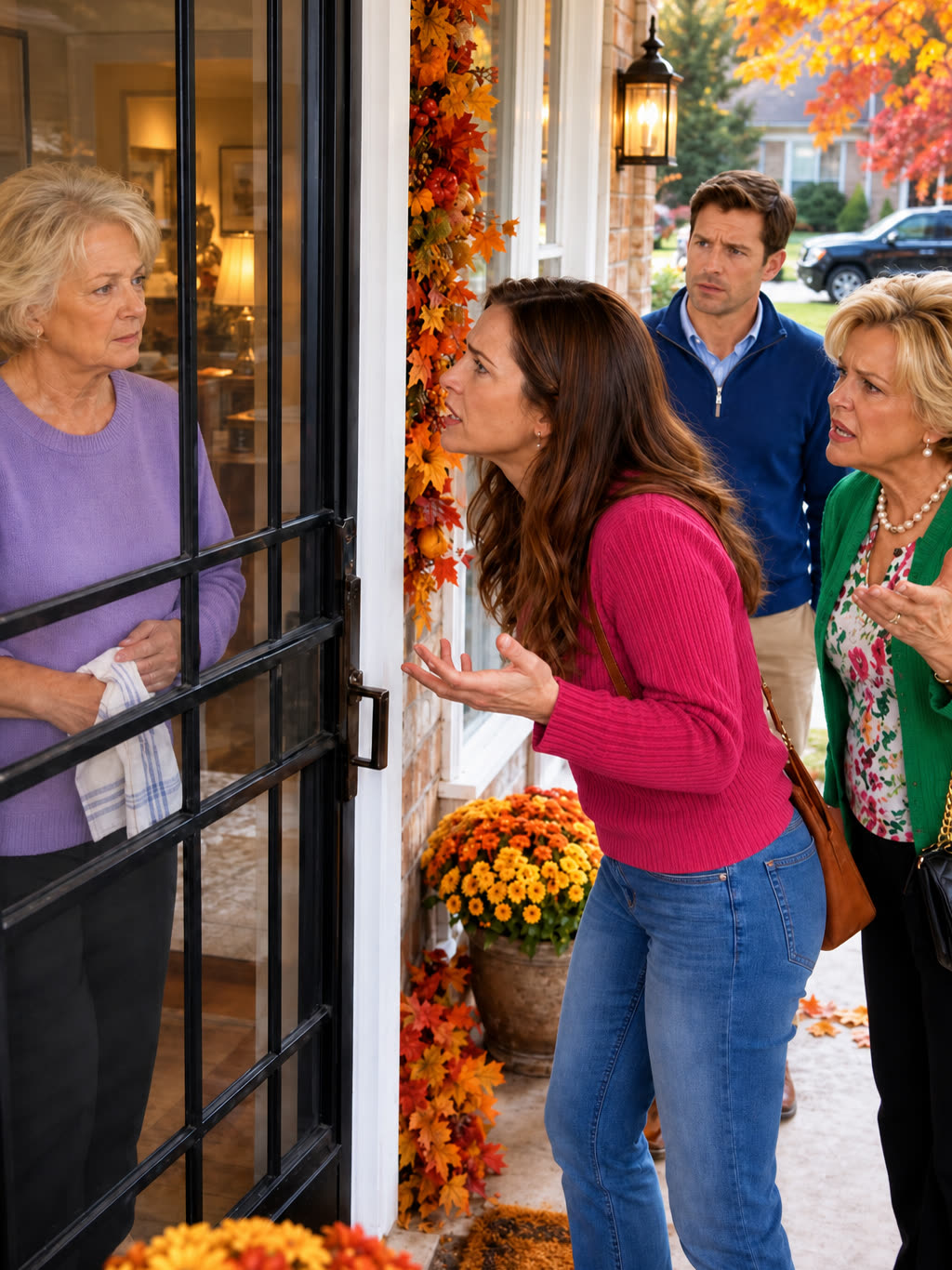
Sarah marched toward my porch and knocked hard, with the flat of her fist rather than her knuckles. “Georgia! Open the door!” Her voice carried across the lawn, and I wondered whether any of my neighbors had heard.
I walked into the hallway but left the steel security door locked. The sunlight coming through the glass threw long shapes across the floor. I stopped a few feet back and kept my hands folded in front of me. “What do you need, Sarah?”
She stared at me through the screen, her cheeks flushed. “Our phones don’t work! And David can’t get online for his job!” “I know.” I said it gently, without any triumph, simply because it was the truth.
Her expression changed, the anger giving way for a moment to something like disbelief. “You did this?” “I canceled the services I was paying for.” I did not raise my voice. I did not need to.
Brenda stepped forward, her pearl necklace swinging. “That’s a cruel thing to do to your own family.” I looked at her calmly. “Yesterday, you suggested I should give away my home. Today, you’re upset because I won’t pay another household’s bills.”
Sarah folded her arms and lifted her chin. “You’re punishing us because Mom made a joke?” “It wasn’t a joke, Sarah. And you told me to pay for everyone’s dinner and leave.” The words hung in the air between us, and for once nobody rushed to fill the silence.
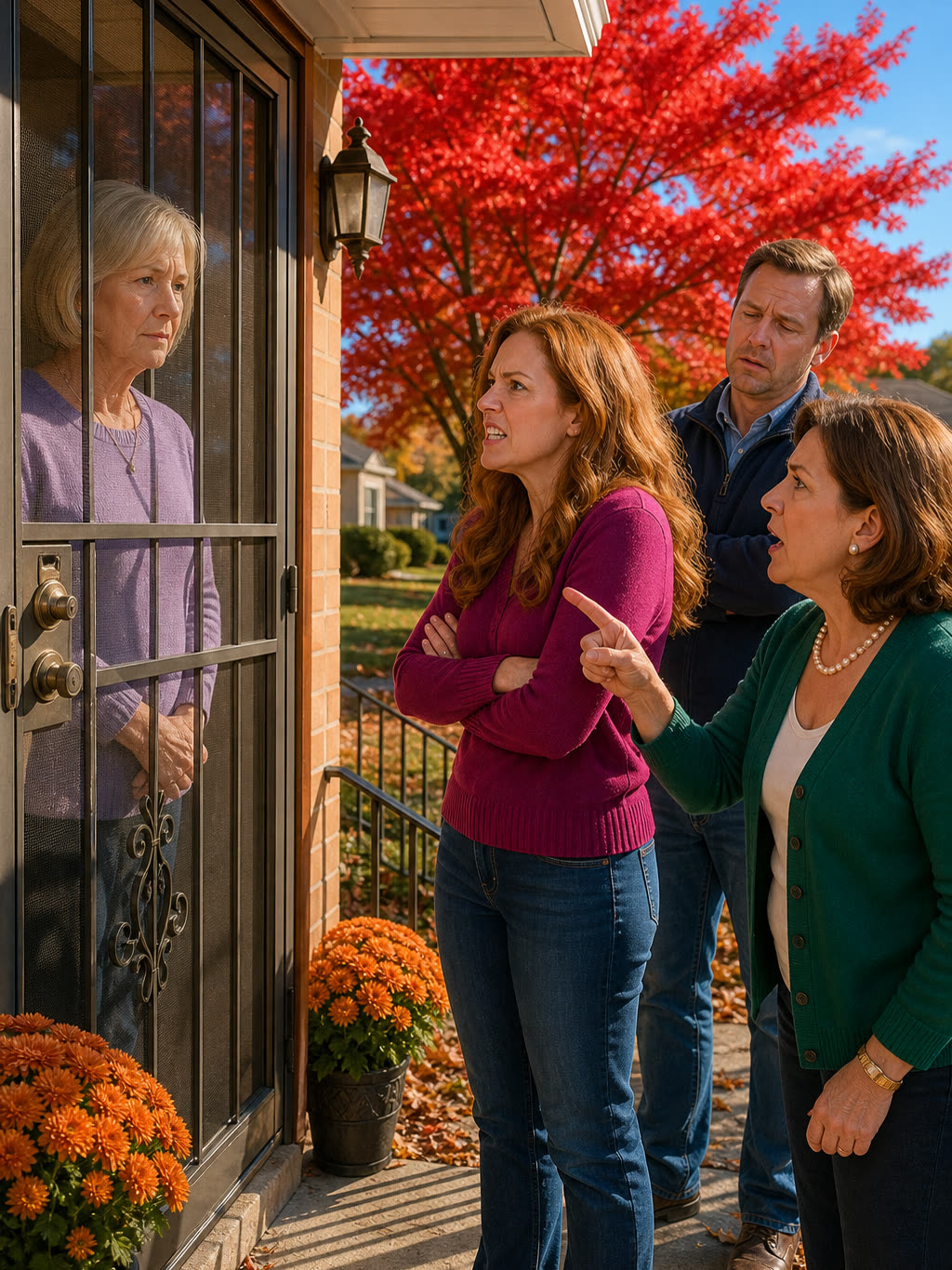
David finally spoke. His voice was low and rough, as if he hadn’t slept. “Mom, can we just talk about this?” “We are talking.” He glanced at his wife before lowering his voice further. “I need internet for work.” “Then you’ll need to arrange service in your own name.”
Sarah shook her head, her hair swinging. “Do you realize how inconvenient this is?” “I do. That’s why I paid for it for so long.” I saw the words land, though she tried to hide it.
Nobody answered. For several seconds, the only sound was the wind moving through the maple tree beside my driveway, rustling leaves that were just beginning to turn.
Then Brenda looked past me into the hallway, scanning the rooms behind me as if measuring them. “You have all this space, and you’re standing there refusing to help your son.” “My son is an adult with a job. Helping him doesn’t mean financing his household forever.”
Sarah opened her mouth to argue again, but David touched her arm. “Let’s go.” She pulled away from him, her eyes wide. “You’re seriously letting her do this?” He looked exhausted, like a man who had been carrying something heavy for a very long time. “We can figure out the bills ourselves.”
They returned to their car, doors slamming one after another, and I watched them back out of the driveway without once opening the door. I wasn’t celebrating their frustration. My hands were trembling slightly, and I pressed them together. I simply wasn’t going to reverse my decision because they disliked it.
Later that afternoon, I began sorting through the closets in my house. The work felt good, practical and clarifying. For years, David and Sarah had used my spare rooms to store boxes they didn’t want crowding their townhouse. Sarah had once tried selling clothing and accessories through a small online boutique, but most of the inventory remained untouched, still sealed in its original packaging.
I had repeatedly asked them to collect it. They never did. Each time, there was another excuse, another promise. So I called David and told him the boxes needed to be removed. He protested that they didn’t have room. “Then you’ll have to decide what to keep,” I replied. I arranged for the boxes to be collected and returned to their address rather than leaving them in my home indefinitely.
That evening, I walked slowly through the newly cleared rooms, my footsteps echoing a little. For the first time in years, I could see the floors and windows without stacks of someone else’s belongings blocking them. Light poured across the wood, and I stood there longer than I needed to.
Then I went into my office and opened a folder I had been considering for months. Inside were photographs and notes about smaller homes near the lake, pages I had collected quietly and tucked away, never quite admitting to myself why.
I loved the house my husband and I had built our life in. Every room held a memory. But I was beginning to realize that keeping it simply because everyone expected me to wasn’t the same as choosing to stay.
On Monday morning, I called a real estate agent. My voice was steadier than I expected as I gave my name and my address and asked whether she could come by.
By Tuesday morning, I had made a decision that would change the rest of my life. I was selling my house. It wasn’t because Brenda had suggested I should give it to David and Sarah. Quite the opposite. For the first time in years, I was thinking about what I wanted rather than what my family expected.
I had spent thirty years in that four-bedroom home. My husband and I had raised our son there, celebrated birthdays at the dining table, and planted a garden that grew more beautiful every spring. But I was sixty-four now, and maintaining such a large property had become increasingly exhausting. A smaller home near the lake sounded wonderful.
Meanwhile, David and Sarah were discovering how expensive their lifestyle had become without my assistance. On Saturday afternoon, Sarah had visited an upscale hair salon with Brenda. After receiving a haircut and color treatment, she approached the counter to pay the $180 bill. Her card was declined. She tried again. Declined. Eventually, she had to ask Brenda to cover the expense.
According to David, who told me about the incident later, Brenda was furious. She couldn’t understand how her daughter could afford expensive appointments while struggling to pay ordinary household expenses. Sarah attempted to call me repeatedly that afternoon. I didn’t answer. I was busy measuring my living room and preparing for the real estate agent’s visit.
When Helen arrived on Tuesday, she walked carefully through the house, admiring the hardwood floors, the sunny kitchen and the well-maintained garden. “Georgia, this place is beautiful,” she said. “I believe we could have several interested buyers within days.” I smiled. “Then let’s put it on the market.”
We reviewed the paperwork at my kitchen island, and I signed the listing agreement, my pen steady across the page. When Helen left, the house felt different, as though it was already holding its breath.
That afternoon, David appeared in my driveway. He came alone. I watched him through the window for a long moment as he stood by his car, hands in his pockets, before he walked slowly up to the porch.
I invited him inside and poured him a glass of water. He sat at the kitchen island where I had signed the listing only hours before. The For Sale sign was leaning against the hallway wall, and his eyes found it almost at once. “Mom, you’re really selling the house?” “Yes.”
He stared at me. “But this is our family home.” “It has been my home for thirty years, David. Now I’m ready for something smaller.” He rubbed his forehead. “Sarah’s mother went back to Chicago early. She couldn’t stand the tension.” I said nothing.
“Sarah’s been upset since the salon incident. We had to use our grocery money to buy a mobile hotspot so I could keep working.” “Then you’ll need to adjust your spending.” He looked at me helplessly. “Mom, we’re struggling. I always thought we’d have your house if something went wrong.”
That admission hurt. It was quiet and honest, and it told me everything. I drew a slow breath before answering. “You earn seventy-five thousand dollars a year, David. Sarah also has income from her part-time job. Your problem isn’t that you have nothing. It’s that you’ve built a lifestyle around money you don’t earn.” He lowered his eyes. “And you let your wife treat me as though I existed to pay your bills.” He didn’t argue.
I softened my voice. “I’m not trying to destroy your life. I’m asking you to take responsibility for it.” After a long silence, he nodded. “Where will you go?” “I found a lovely two-bedroom condominium near the lake. It has a ground-floor entrance, a modern kitchen, and a private patio.” He looked surprised. “You’ve already found somewhere?” “I have.”
For the first time, he seemed to understand that I wasn’t making threats to get an apology. I was moving forward with my own life. “Can I help you pack?” he asked quietly. I smiled. “Of course.” Then I added, “But I’m not paying you.” David almost laughed. It was the first genuine moment we had shared since the steakhouse dinner.
He finished his water and left, and the house settled into its evening quiet. I thought the hardest part might be behind me. Four days after Helen listed the house, my phone rang while I was watering the plants in the window. It was Helen. “Georgia,” she said, and I could hear a smile in her voice, “I have news.”
Part 3: I Sold the House My Son Expected to Inherit, and Then My Daughter-in-Law Asked to See Me
We had a buyer. Helen said it twice, as though she wanted me to hear it properly. A young couple had fallen in love with the garden, the bright kitchen, and the maple tree my husband had planted beside the driveway.
Their offer was excellent, and after reviewing everything carefully, I accepted it. I signed the papers at the same kitchen island, in the same chair, and set the pen down gently.
For a moment, I wondered whether I would regret leaving the place where I had spent thirty years of my life. I walked through the rooms once more, touching door frames and window sills, listening for echoes of the past.
But watching that young couple imagine their future there helped me understand something. I had seen the woman stand by the kitchen window, pointing toward the garden, and the man laughing as he measured the porch with his arms.
I wasn’t abandoning my memories. I was allowing someone else to create new ones. That thought carried me through the weeks that followed, like a hand at my back.
Over the following weeks, I began packing. I kept family photographs, my husband’s favorite books, and the dishes we had used for every Thanksgiving dinner, each one wrapped in newspaper and set into its box with care.
I donated furniture I no longer needed and cleared out belongings that had been sitting untouched for years. Room by room, the house grew lighter, and so, strangely, did I.
David came over regularly to help. He carried boxes to the truck without being asked, taped cartons shut, and labeled them in his boyish handwriting.
At first, we barely spoke beyond discussing which boxes belonged in the moving truck. The silence between us was careful and polite. Eventually, our conversations became easier, and small stories began to slip out between the cartons.
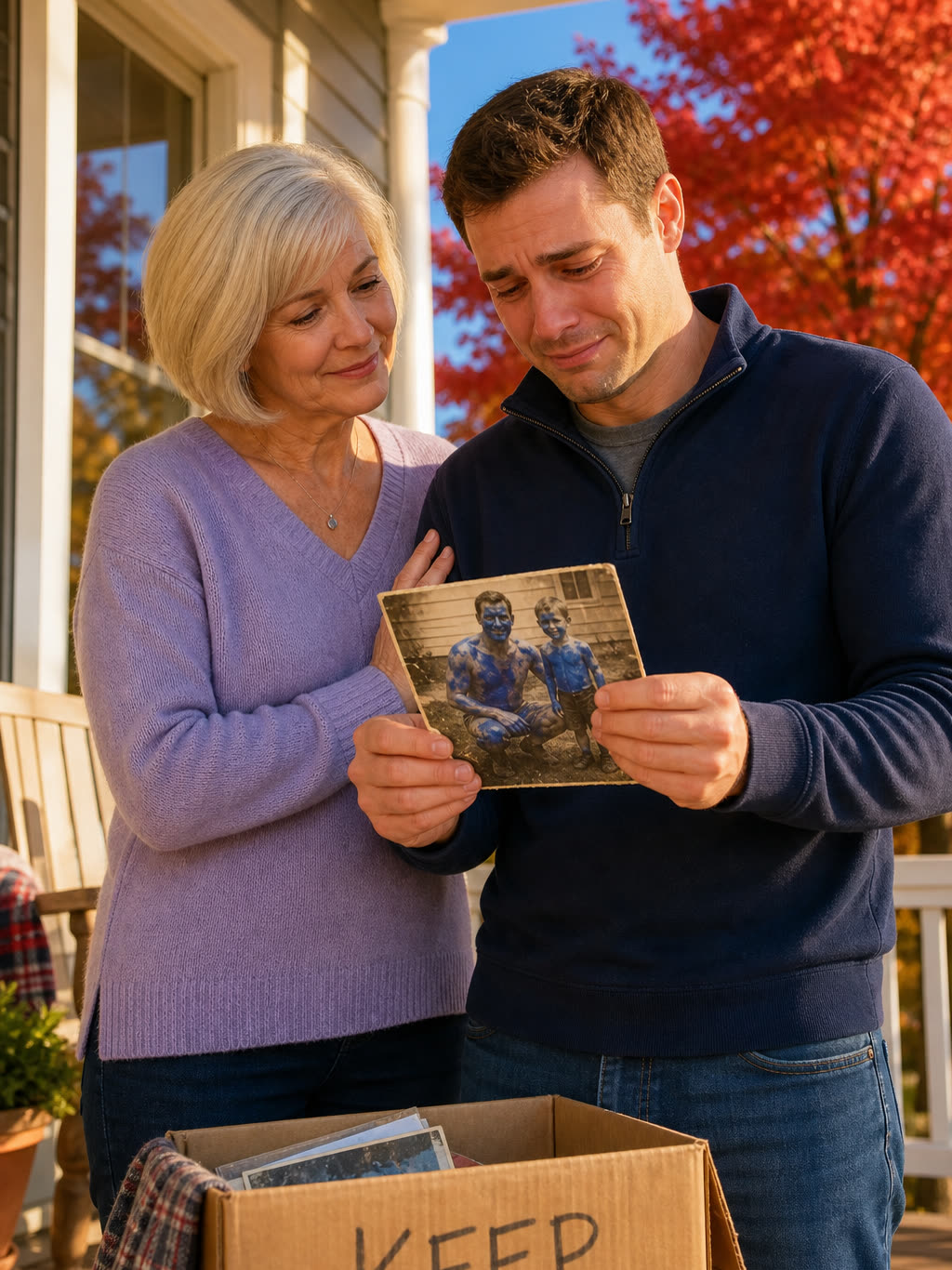
One afternoon, on the porch with the maple tree glowing red behind us, we found an old photograph of David and his father standing together, both covered in blue paint and grinning at whoever held the camera. David studied it for a long time, his thumb brushing the edge. “Dad would be disappointed in me, wouldn’t he?” I looked at the photograph, at my husband’s laughing face. “He would expect you to do better. That doesn’t mean he’d stop loving you.” David carefully placed the picture in a box marked KEEP.
A few weeks later, I moved into my condominium near the lake. It had two bedrooms, a modern kitchen, and a small patio where I arranged my favorite plants, turning each pot until the leaves caught the light.
Sunlight filled the living room every afternoon, warm and golden. There were no boxes belonging to Sarah, no bills for another household, and no expectation that I would surrender my space whenever someone needed something.
For the first time in years, my home felt entirely mine. I would stand in the kitchen in the early morning with my tea and simply listen to how quiet and gentle it was.
Two weeks after I moved, David visited to help install curtains. He stood on a stepladder, holding the rod with one hand and a screwdriver with the other, and as he worked, he told me that he and Sarah had finally created a household budget.
They had canceled unnecessary subscriptions, reduced their spending, and sold Sarah’s leftover boutique inventory at discounted prices. “It wasn’t worth nearly what we thought,” he admitted. “At least you’ve recovered some of the money.” He nodded. “We’re learning.”
Then he hesitated, and I saw him gather his courage. “Sarah wants to know whether she can come over and apologize.” I handed him the curtain rod. “An apology would be welcome if she means it.” “She says she does.”
“I don’t need her to tell me what she thinks I want to hear, David. I need her to understand why her behavior was wrong.” He looked down. “I think she finally does.”
I considered everything that had happened since the steakhouse dinner. Sarah had treated my financial help as an entitlement. Brenda had spoken about my home as though it belonged to her daughter, and David had remained silent while they humiliated me. I wasn’t willing to return to that arrangement.
“Tell Sarah she’s welcome to visit when she’s ready to speak honestly,” I said. David smiled faintly. “Does that mean things can go back to normal?” “No.” He looked surprised. “We can have a better relationship,” I explained. “But the financial arrangements are finished.” He nodded slowly. “I understand.”
After he left, I stood beside my new living-room window and looked toward the lake. I hadn’t sold my house to punish anyone. I had sold it because I wanted a different life. The water shimmered, and the evening settled over it like a promise.
A few days later, Sarah called. My phone lit up with her name, and my heart gave a small, uncertain thump. This time, I answered. “Georgia,” she said quietly, “would it be all right if I came over on Sunday?” I glanced around my peaceful new home. “Yes, Sarah. You may come.”
Sarah arrived at my condominium on Sunday afternoon, carrying a small bouquet of flowers from the grocery store. For once, she wasn’t accompanied by her mother. I opened the door and invited her inside.
She looked around my living room, noticing the sunlight, the plants beside the window, and the photographs I had arranged on a small shelf. “Your new place is beautiful,” she said. “Thank you. I’m very happy here.” She placed the flowers on the kitchen counter. Then she took a deep breath. “Georgia, I owe you an apology.” I waited.
“What I said at the restaurant was disrespectful. And the way I behaved when we came to your house the next morning was even worse.” Her voice trembled. “I got so used to your help that I started believing we were entitled to it.” I looked at her carefully. “Your mother suggested I should give you my house, Sarah. And when I defended myself, you told me to pay for dinner and leave.” “I know.” “You made me feel like I was only welcome when I was paying for something.”
Tears filled her eyes. “You’re right. I was selfish, and I’m sorry.” For the first time, she wasn’t blaming her mother or pretending the incident had been a misunderstanding. She was accepting responsibility. “I don’t expect you to pay our bills again,” she continued. “I just wanted you to know I understand why you stopped.”
I nodded toward the kitchen table. “Would you like some tea?” She looked surprised. “Yes, please.” We talked for nearly an hour. Sarah explained that she had taken additional shifts at work. She and David had begun setting aside money for emergencies instead of spending everything they earned.
She also told me Brenda had repeatedly criticized my decision to sell the house. “But I finally told her it was none of our business,” Sarah admitted. That mattered more to me than the flowers. I didn’t promise that everything was forgiven and forgotten. Trust would take time to rebuild, and I intended to keep my financial boundaries. But when Sarah left, I accepted her brief hug. It felt like a beginning.
Several months later, David and Sarah invited me to dinner at their townhouse. When I arrived, the lawn was clear. The boxes and blue tarps were gone. Sarah had prepared dinner herself, and David had set the table. Their phones and internet were now paid for through their own accounts. Nobody asked me for money.
After dinner, David showed me the small emergency fund they had started building. “It’s not much yet,” he admitted. “But it’s yours,” I replied. He smiled. Before I left, he walked me to my car. “Mom, I’m sorry I didn’t defend you at the restaurant.” I looked at him. “Your silence hurt me more than Brenda’s insults.” “I know. I should have said something.”
“You can’t change that evening, David. But you can decide what kind of man you’ll be the next time someone you love is treated unfairly.” He nodded. “I will.” Driving home, I heard an old song my husband used to love playing on the radio. For once, the memory made me smile instead of cry.
When I reached my condominium, I made a cup of tea and stepped onto my patio. The evening breeze moved gently through the trees beside the lake. My new home was smaller than the house I had sold, but my life felt larger.
I had spent years believing that being a good mother meant making everyone else’s life easier, even when it cost me my own peace. Now I understood that generosity should be appreciated, not demanded. I hadn’t stopped loving my son. I hadn’t abandoned my family. I had simply stopped paying for a lifestyle they needed to learn to support themselves.
And something unexpected had happened. Without my money standing between us, David and Sarah had begun treating me like a person again. I lifted my tea and watched the sunlight fade across the water.
The greatest thing I had gained wasn’t the money I had saved or the freedom of a smaller home. It was knowing I could love my family without surrendering my dignity. For the first time in years, that was enough, and as the last light touched the lake, I felt certain that the best chapter of my life had only just begun.
Disclaimer: This story is a work of fiction inspired by real-life themes. Names, characters, places and events are fictionalized, and any resemblance to real persons is purely coincidental. Images are for illustration purposes only.
