

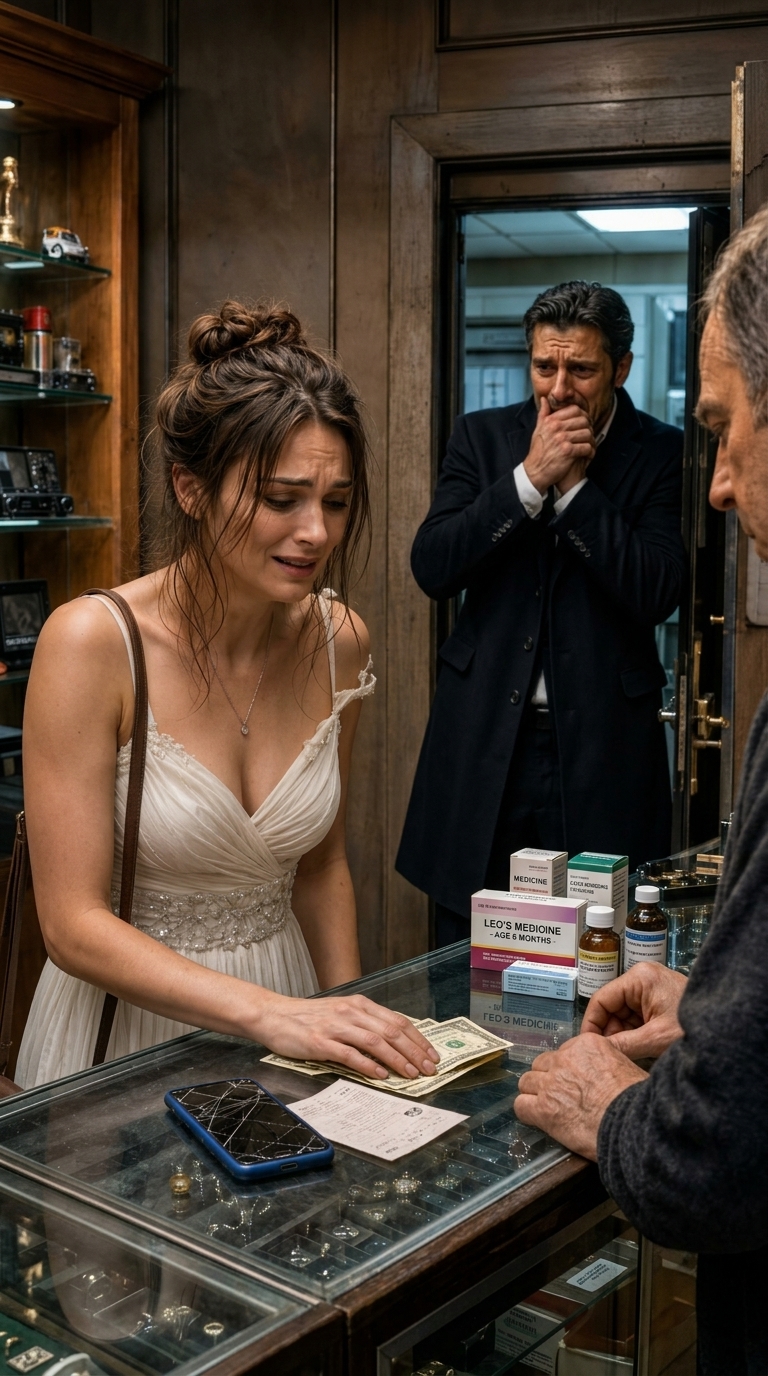
The first time Marco Vitelli saw Jenny Reeves, she was selling the last thing that connected her to the world.
Not jewelry. Not a luxury watch. Not some pretty little emergency fund tucked away in a drawer.
Her phone.
A cracked, tired iPhone with a frayed blue case, the kind a mother grabs at three in the morning when her child can’t breathe. The kind that holds school emails, doctor voicemails, grocery coupons, bus schedules, pictures of birthday candles, and every desperate note a woman writes to herself so she doesn’t fall apart.
Jenny stood at the pawn shop counter on Grover Street and counted the money twice.
“Eighty,” she said quietly. “One hundred. One-forty. One-sixty. One-eighty.”
The man behind the counter slid the bills toward her through the glass tray.
Marco watched from the half-open door of the back office.
He should not have been there. Not at that exact minute. Not in that exact building. He owned the strip, that was all. A pawn shop, a laundromat, a nail salon, a locked storage space in the back. He had come by to speak with his property manager about repairs, tax assessments, and the kind of small business headaches he normally handled with a signature and a look.
Then the bell above the front door chimed.
Jenny walked in.
She was not beautiful in the soft, polished way women became beautiful when life had been kind to them. She was beautiful like a match burning in a dark room. Sharp jaw. Tired eyes. Hair twisted into a knot because she did not have time for vanity. A navy coat buttoned wrong at the middle, as if she had dressed while thinking about something else.
She placed the phone on the counter.
“How much?” she asked.
The clerk turned it over. “Screen’s cracked.”
“I know.”
“Older model.”
“I know.”
“Hundred and eighty.”
Her jaw tightened, but she did not flinch. “Cash?”
“Cash.”
“Now?”
The clerk looked at her for a second. “Yeah. Now.”
Marco did not move.
He had seen men beg with guns pointed at them and keep his pulse steady. He had watched judges, cops, contractors, and cowards lie straight to his face and never once felt his hand tremble. For eleven years, he had trained himself not to react too quickly to human pain. Pain was everywhere. Pain was a currency. Pain was the sound underneath the city.
But this woman counted one hundred and eighty dollars like it was not enough, like she had already known it would not be enough, and somehow that small act cut deeper than any scream.
The clerk filled out the slip.
“Reason for sale?” he asked, bored.
Jenny’s eyes hardened. “Do you need that?”
“For the form.”
She looked away. “Prescription inhaler. My son.”
Marco’s chest tightened.
The clerk wrote it down.
Selling to cover cost of prescription inhaler. Son.
Jenny folded the receipt carefully, slid it into her coat pocket, and walked out.
The bell chimed again.
The shop seemed quieter after she left.
Marco stepped out of the back office.
“The receipt,” he said.
The clerk looked up. “What?”
“The receipt she just signed. Let me see it.”
“Mr. Vitelli—”
“Now.”
The clerk handed it over.
Marco read the name.
Jenny Reeves.
Then the address.
Callaway Street. Second floor.
Then the line in the description field.
Prescription inhaler. Son.
His thumb stopped on one word.
Son.
“How much is the phone worth?” Marco asked.
“Resale? Maybe two hundred and fifty if—”
“Full retail,” Marco said. “Whatever that model was new. Run my card.”
The clerk blinked. “You want to buy it?”
“I want it off your counter.”
“Sir—”
Marco placed his black card on the glass. “Run it.”
Five minutes later, he was in his car with the pawn shop receipt in his hand and Jenny Reeves’s phone sitting beside him in a paper sleeve.
He searched the medication name.
The cash price came up on his screen.
Three hundred and forty dollars.
She had walked out with one hundred and eighty.
She was one hundred and sixty short.
Marco stared through the windshield at the traffic moving along Grover Street, the city rolling on with its ordinary cruelty. People honking. A woman pushing a stroller. A delivery driver shouting into a headset. A man in a suit stepping over a homeless veteran without looking down.
One hundred and sixty dollars.
That was the gap between a child breathing and a mother failing.
Marco put the car in drive.
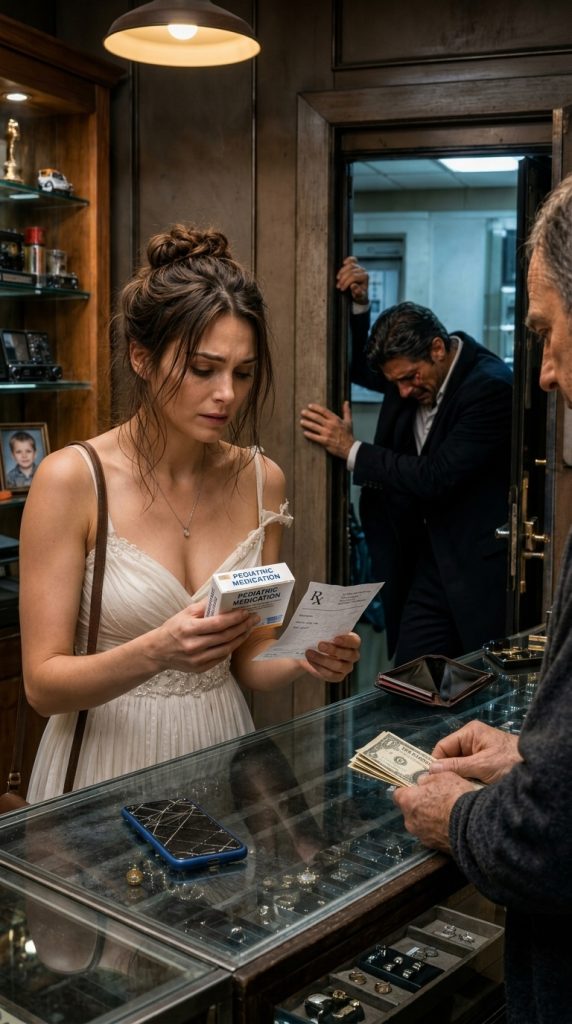
Ninth Street Pharmacy was three blocks away. He walked in, gave the pharmacist the name of the medication, and bought the maximum amount they were legally allowed to sell.
Three inhalers.
The pharmacist placed them in a brown paper bag and studied him carefully.
“Do you have the patient’s authorization?”
Marco’s expression did not change. “I have the prescription information.”
Part 2
“This is for a child?” the pharmacist asked.
Marco looked down at the brown paper bag in his hand.
The question should have been simple. Yes or no. But for one breath, the world tilted beneath him and became another room, another winter, another child gasping against a pillow while grown-ups argued over money in the hallway.
He was eight years old again.
His little sister, Lucia, was five, her lips turning pale as she clawed at the blanket. Their mother had held her upright, whispering prayers into her hair. Their father had run to three pharmacies and come back with empty hands and wet eyes. The landlord had stood in the doorway that same night, not asking if the child would live, only asking when he would get his rent.
Lucia died before sunrise.
Marco had not cried at the funeral.
He had not cried when his father disappeared two years later.
He had not cried when he became useful to dangerous men.
But standing inside Ninth Street Pharmacy, holding three inhalers bought with money that meant nothing to him, Marco Vitelli felt something inside his chest crack open like old ice.
“Yes,” he said. “It’s for a child.”
The pharmacist hesitated, then slid the bag across the counter.
Marco carried it out carefully, as if glass were inside.
Outside, the late afternoon sky had turned the color of dirty steel. He sat in his car and looked again at the address on the receipt.
Callaway Street. Second floor.
He knew the building.
Everyone knew that building, though most pretended not to. A narrow brick place with black mold on the fire escape and windows that rattled whenever trucks passed. It had once belonged to a tired old landlord named Peter Hale, a man who never fixed anything unless a city inspector stood over him with a clipboard.
Three months ago, Hale had sold it.
Marco knew the buyer too.
Elliot Granger.
A man who wore cream-colored suits in winter, smiled like a salesman, and sent notices instead of warnings. He did not break kneecaps. He broke leases. He did not carry guns. He carried folders. Marco had met killers with more mercy than Elliot Granger.
The phone on the passenger seat buzzed.
Marco looked at it, startled.
Jenny’s cracked iPhone lit up inside the paper sleeve.
One missed call.
Then another.
Then a text preview appeared across the screen.
Mom, where are you? Mr. Granger is here. He says we have to leave. I can’t find my inhaler.
Marco stopped breathing.
A second message came.
Mom please hurry.
For a moment, all the noise of the city vanished.
Marco saw only those words.
He picked up the phone, but it was locked. The child had no idea his mother no longer had it. No idea the message had gone to a stranger. No idea that stranger had spent half his life becoming the sort of man people whispered about and avoided in restaurants.
Marco started the car.
The engine roared so sharply that a man crossing in front of him jumped back and cursed.
Marco did not hear him.
He drove through two yellow lights and one that had already turned red.
Callaway Street was six blocks east, where the city forgot to pretend it cared. The sidewalks were split with weeds. The corner store had bars over the windows. A woman smoked under a leaking awning while rain began to needle down from the sky.
Marco pulled up in front of the building and saw a black sedan parked at the curb.
Elliot Granger’s driver leaned against it, scrolling on his phone.
Marco stepped out.
The driver looked up, recognized him, and straightened so fast his phone nearly slipped from his hand.
“Mr. Vitelli.”
Marco did not answer. He looked at the building entrance.
From upstairs came a crash.
A child cried out.
Marco’s face changed.
Not much. Not enough for a stranger to notice.
But the driver noticed.
He moved aside.
Marco entered the building.
The hallway smelled of old carpet, damp wood, and fear. On the wall, someone had ripped down half a notice about overdue maintenance. A bulb flickered above the stairs. Marco climbed to the second floor without hurrying, each step measured, silent, final.
Jenny’s door was open.
Inside, Elliot Granger stood in the middle of a small apartment with a leather folder tucked under one arm. Two men in gray work jackets were lifting a cheap table as if preparing to carry it out. A little boy, maybe seven years old, stood by the sofa with one hand pressed to his chest.
His breathing was wrong.
Marco heard it immediately.
Thin. Whistling. Desperate.
The boy’s eyes were wide, dark, terrified.
Jenny Reeves stood between him and Granger, soaked from the rain, one hand clenched around a paper pharmacy bag that was too small.
“I told you,” she said, voice shaking. “I have most of it. I can get the rest tomorrow.”
Granger smiled as if she had made a charming joke.
“Ms. Reeves, tomorrow is what people ask for when they have no intention of paying today.”
“My son is sick.”
“And your rent is late.”
“I had to buy his medicine.”
Granger tilted his head toward the bag in her hand. “Then you made your choice.”
The boy tried to breathe in and failed. Jenny turned, panic flashing across her face.
“Evan, baby, sit down.”
“I’m trying,” the boy whispered.
One of the men holding the table shifted uncomfortably. “Mr. Granger—”
“Keep moving,” Granger snapped.
Marco stepped into the doorway.
Nobody noticed him at first.
Jenny was tearing open the pharmacy bag. Inside was one inhaler. She must have begged, borrowed, bargained, and still come up short. Her fingers shook so badly she almost dropped it.
Then Granger saw Marco.
His smile died.
The room changed.
It was not dramatic. No thunder. No music. But the air seemed to thicken, as if everyone had suddenly remembered something dangerous could enter a room without making a sound.
“Marco,” Granger said, and his voice lost its polish. “This is a private matter.”
Marco looked at him, then at the boy.
Jenny followed Granger’s gaze and saw the man in the doorway.
She did not know him. That was clear. She only saw a tall stranger in a black coat, rain shining on his shoulders, eyes too calm for the room he had entered.
“Who are you?” she asked.
Marco held up the brown paper bag.
“I believe your son needs these.”
Jenny stared at the bag.
Then at him.
Then at the bag again.
“What?”
Marco stepped inside and placed it gently on the table before the men could carry it away.
“Three inhalers,” he said. “From Ninth Street.”
Jenny went pale.
“How did you—”
“Later.”
The boy wheezed again. Jenny moved quickly, took one inhaler from Marco’s bag, shook it, and knelt in front of her son.
“Slow breath, Evan. Like we practiced. That’s it. Again.”
The boy closed his lips around it.
One puff.
A pause.
Another.
The room waited.
The sound of his breathing did not fix itself all at once. It came back reluctantly, like a frightened animal coaxed from under a bed. But it came.
Jenny pressed her forehead to her son’s hair.
For the first time, Marco saw her almost break.
Not cry. Not yet.
Just fold inward around the boy as if she could hide him inside her bones.
Granger cleared his throat.
“I’m glad the child has his medication,” he said. “Now, as I was explaining to Ms. Reeves—”
Marco turned.
“Leave.”
One word.
The two men in gray jackets set the table down immediately.
Granger’s face tightened. “You don’t own this building, Marco.”
“No.”
“You don’t own this debt.”
“No.”
“You do not get to walk into a legal eviction and issue commands.”
Marco stepped closer.
Granger held his ground, but the effort showed in his throat.
“This is the problem with men like you,” Granger said. “You think the whole city is still run out of back rooms and butcher shops. It isn’t. There are laws now. Courts. Judges. Paperwork.”
Marco glanced at the folder under his arm.
“Show me.”
Granger blinked. “What?”
“The order.”
Granger’s fingers tightened.
Marco waited.
Jenny looked up slowly.
The two workers looked at each other.
Granger’s lips thinned. “I don’t have to show you anything.”
Marco’s voice dropped. “Yes, you do.”
For several seconds, nothing moved except the rain running down the window.
Then Granger opened the folder.
He removed a sheaf of documents and handed them over with a sharp little motion, as if the paper itself might protect him.
Marco read fast.
Late rent. Fees. Notice to quit. Court filing.
Then he stopped.
There it was.
A signature.
Not Jenny’s.
Close enough to fool a busy clerk, maybe. Not close enough to fool a man who had built his life on spotting lies before they became bullets.
Marco looked at Jenny.
“Did you sign this payment agreement?”
Jenny’s brow furrowed. “What agreement?”
Granger’s jaw flexed.
Marco turned the page toward her.
She stood, came closer, and looked.
“No,” she said. “I’ve never seen that.”
Granger laughed once. “Tenants forget what they sign all the time.”
Jenny’s eyes sharpened. “I didn’t sign that.”
“Convenient.”
Marco held the page up.
“This says she agreed to pay an extra eight hundred dollars in administrative penalties.”
“Standard fees.”
“This says she waived the repair claims.”
“She had none.”
Jenny gave a bitter laugh. “My ceiling leaks. The heater shuts off every night. There’s black mold in Evan’s closet.”
Granger looked irritated now, not frightened. “Allegations.”
Marco turned another page.
“And this says you served her notice on the fifteenth.”
“I did.”
Jenny shook her head. “No. The first notice I saw was last week.”
“I’m sure that’s what you’d prefer to remember.”
Marco’s gaze lifted.
For a moment, he did not speak.
Then he looked at the two workers.
“Go downstairs.”
They did not wait for Granger’s permission.
“Cowards,” Granger hissed as they left.
Marco handed the papers back.
“You forged her signature.”
Granger smiled again, but now it looked stretched over panic.
“Careful.”
“You falsified service.”
“Careful, Marco.”
“You added illegal fees and came here early because you thought a poor woman with a sick child wouldn’t know how to stop you.”
Granger stepped closer, anger making him reckless.
“And what are you going to do?” he whispered. “Hit me? Threaten me? Toss me down the stairs? Please. Make my case. The city is tired of your kind. Men with old names and dirty money playing king.”
Jenny took Evan’s hand and pulled him slightly behind her.
Marco noticed.
It hurt more than he expected.
Of course she was afraid of him.
She should be.
“I’m not going to hit you,” Marco said.
Granger exhaled a laugh.
Marco reached into his coat and took out his phone.
He made one call.
“Detective Marlowe,” he said when the line connected. “Callaway Street. Second floor. I have a landlord in possession of forged tenant documents. Bring someone from housing court enforcement.”
Granger’s face drained.
“You’re calling the police?”
Marco looked at him. “You like laws.”
The silence that followed was almost beautiful.
Jenny stared at Marco as if the floor had opened and revealed another floor beneath it.
Granger recovered badly. “Marlowe won’t come for you.”
“He won’t come for me,” Marco said. “He’ll come for the documents.”
“You think one detective scares me?”
“No.”
Marco stepped closer until Granger had to tilt his head back.
“I think prison scares you. I think discovery scares you. I think bank records scare you. I think the other tenants in this building scare you. I think every fake fee, every forged notice, every inspection you bribed your way around scares you.” His voice softened. “And I think the men you owe money to will be very interested to learn you’ve been hiding assets from them.”
Granger went still.
There it was.
The real wound.
Marco had guessed, but Granger’s face confirmed it.
“You don’t know anything,” Granger said.
“I know enough.”
Jenny’s voice came from behind them, small but steady.
“Who are you?”
Marco did not turn right away.
He kept his eyes on Granger.
“A man who dislikes paperwork errors.”
For one strange second, Evan let out a weak laugh.
The sound loosened something in the room.
Marco finally looked back at Jenny. Her wet hair clung to her cheek. Her coat was still buttoned wrong. Her eyes were red with exhaustion, but she held herself upright like a woman who had been knocked down so many times the ground no longer surprised her.
“I bought your phone,” he said.
Her expression changed.
The color rose to her face, fast and hot.
“You what?”
“At the pawn shop.”
“Why?”
“Because you needed more than they gave you.”
Humiliation flashed across her features so sharply that Marco almost wished he had lied.
“I didn’t ask you to do that,” she said.
“No.”
“I don’t take charity.”
“I know.”
“You don’t know anything about me.”
“I know you sold your phone to buy medicine for your son.”
Her eyes shone, furious and wounded.
“That doesn’t make me yours to rescue.”
The words struck clean.
Marco accepted them.
“No,” he said. “It doesn’t.”
Granger seized the moment like a drowning man grabbing rope.
“Listen to her, Marco. She doesn’t want your help. This isn’t one of your little neighborhood legends. You can’t just buy people and call it mercy.”
Jenny turned on him.
“And you can’t throw my child into the rain and call it business.”
Granger shut his mouth.
Marco almost smiled.
Almost.
Sirens sounded faintly in the distance.
Granger heard them too. He looked at the door, then at Marco, calculating.
“You’ve made a mistake,” he said.
“I’ve made worse.”
“This woman is not what you think.”
Jenny stiffened.
Marco noticed.
Granger smiled slowly, sensing blood.
“You didn’t know?” he asked. “Of course you didn’t. She has such a good face for tragedy, doesn’t she? All exhausted virtue and motherly sacrifice.”
Jenny’s grip tightened around Evan’s hand.
“Stop,” she said.
Granger ignored her.
“Ask her why she moved here, Marco. Ask her why no family visits. Ask her why she takes cash jobs under different names. Ask her about Boston.”
The word landed like a dropped glass.
Boston.
Marco looked at Jenny.
For the first time since he had followed her from the pawn shop, she looked truly afraid.
Not for herself.
For the past.
Evan looked between the adults, confused.
“Mom?”
Jenny swallowed.
“Mr. Granger,” she said quietly, “leave my son out of this.”
“Oh, I’d love to,” Granger said. “But secrets are expensive, Ms. Reeves. You know that better than anyone.”
Marco moved.
Not violently. Not loudly.
He simply crossed the room and took Granger by the front of his cream-colored coat. With one hand, he pushed him back against the wall hard enough to knock a framed school drawing crooked.
Jenny gasped.
Evan hid his face against her side.
Marco’s voice was low.
“You will not speak about her child again.”
Granger’s bravado cracked. Beneath it was the man he really was: soft, sweating, terrified of pain.
“You said you wouldn’t hit me,” he whispered.
“I haven’t.”
The sirens grew louder.
Marco released him and smoothed the wrinkles in Granger’s lapel with almost tender care.
“Stand up straight,” he said. “The law is coming.”
The police arrived six minutes later.
Detective Hannah Marlowe entered first, rain glittering on her leather jacket, silver hair cut blunt at her chin. She was the sort of woman who looked unimpressed by everybody, which was why Marco had always tolerated her.
She glanced at him. “Vitelli.”
“Marlowe.”
“Every time you call, my day gets worse.”
“Your day lacked purpose.”
Her eyes shifted to Jenny, then Evan, then Granger.
Granger began talking immediately.
“Detective, thank God. This man interfered with a lawful eviction, assaulted me, threatened me—”
Marlowe held up one hand.
To Marco, she said, “Documents?”
Marco handed them over.
Marlowe read. Her expression did not change, but her eyes grew colder.
“Ms. Reeves,” she said, “is this your signature?”
Jenny shook her head. “No.”
“You willing to say that formally?”
“Yes.”
Granger scoffed. “She’s lying.”
Marlowe looked at him. “I didn’t ask you.”
One of the uniformed officers stepped into the hall to speak with the two workers, who were suddenly very eager to describe how they had only been following instructions.
Marlowe kept reading.
“This service affidavit is notarized by Louis Tamm,” she said.
Marco’s mouth tightened.
Marlowe noticed. “You know him?”
“He notarized documents for my mother twenty years ago. He’s been dead since 2019.”
Granger closed his eyes.
Just once.
But Marlowe saw.
“So,” she said, “that’s unfortunate.”
Within ten minutes, Granger was no longer issuing threats. He was being advised not to leave the city. Within twenty, the eviction was stopped. Within thirty, he was escorted downstairs beneath an umbrella held by no one.
Jenny watched from the window.
When his car pulled away, she did not celebrate.
She simply stood there as though her body had forgotten what came after terror.
Evan sat on the sofa, wrapped in a blanket, breathing easier now. He watched Marco with the open curiosity of children who had not yet learned all the reasons to be suspicious.
“Are you a doctor?” Evan asked.
Marco looked at him.
“No.”
“A policeman?”
“No.”
“A superhero?”
Jenny closed her eyes. “Evan.”
Marco’s mouth twitched.
“No.”
“Then why did you help us?”
The question filled the apartment.
Jenny turned from the window.
Marco looked at the boy, and for a moment he saw Lucia again—not as she had been at the end, but laughing with a missing front tooth, chasing pigeons in a church square, calling him Marcolino because she knew he hated it.
“Because once,” Marco said, “no one came in time.”
Evan considered this with grave seriousness.
Then he nodded, as if that answer made perfect sense.
Jenny did not speak.
Marlowe returned from the hall, tucking her notebook away.
“Ms. Reeves, I’ll need you at the precinct tomorrow to make a statement. Housing advocates will contact you tonight. Until then, no one removes anything from this apartment.”
“Thank you,” Jenny said.
Marlowe nodded, then looked at Marco.
“Outside.”
Marco followed her into the hallway.
The door remained open behind them. Jenny could probably hear every word.
Marlowe kept her voice low anyway.
“What are you doing?”
“Helping.”
“That’s not an answer.”
“It’s the one I have.”
“You bought medication for a stranger, called me on a landlord, and put yourself in the middle of a housing fraud case. You don’t do random acts of kindness, Vitelli. You do strategy.”
Marco said nothing.
Marlowe studied him.
“Granger mentioned Boston.”
“I heard.”
“You know what that means?”
“No.”
“Find out before you get sentimental.”
Marco’s eyes hardened. “Is that advice or warning?”
“Both.”
Marlowe stepped closer.
“I’ve seen men like you try to clean blood with good deeds. It doesn’t work. But that woman in there? She’s carrying something. Maybe she’s a victim. Maybe she’s a witness. Maybe she’s trouble with a pulse. Don’t drag her into your world unless you know whose shadow is already standing behind her.”
Marco looked past Marlowe into the apartment.
Jenny was kneeling in front of Evan, checking his breathing again. Her hand moved softly over his hair.
“My world found her before I did,” he said.
Marlowe followed his gaze.
For once, she did not argue.
After the police left, the apartment became too quiet.
Jenny folded the blanket around Evan and told him to rest. He resisted for three seconds, then exhaustion pulled him under. His small body curled on the sofa, one hand still wrapped around the inhaler as if someone might steal the air from him again.
Marco stood near the door.
He should have left.
He had done enough.
Too much.
Jenny picked up the cracked phone from where he had placed it on the table.
“You bought this,” she said.
“Yes.”
“How much?”
“It doesn’t matter.”
“It matters to me.”
Marco gave the exact amount.
Her eyebrows lifted. “You paid full price for a cracked old phone?”
“I was in a hurry.”
“That’s a terrible business decision.”
“I’ve made worse.”
She looked at him for a long moment.
Then, unexpectedly, she laughed.
It was small, tired, almost broken. But it was a laugh.
And it did something dangerous to Marco.
It made him want another one.
She noticed the shift in his face and stopped.
“I can pay you back,” she said quickly.
“No.”
“I said I can.”
“And I said no.”
Her chin lifted. “I’m serious.”
“So am I.”
The air sharpened between them.
Jenny crossed her arms. “You don’t get to walk into my life, scare off a landlord, buy my phone and medicine, then act like I don’t owe you anything.”
“You don’t.”
“Men like you always collect.”
Marco looked at her carefully.
There it was again.
Fear, yes.
But not ignorance.
Jenny Reeves might not know him, but she knew his kind. Or thought she did.
“What kind of man am I?” he asked.
She did not back away.
“The kind people lower their voices around.”
“That’s true.”
“The kind who can make police detectives come when he calls.”
“Sometimes.”
“The kind who thinks silence is an answer.”
Marco’s expression softened by a degree.
“That’s also true.”
Jenny glanced toward Evan, then lowered her voice.
“I don’t want trouble.”
“Neither do I.”
She almost smiled at that, but didn’t.
“You expect me to believe that?”
“No.”
“Good.”
Marco reached into his coat and removed a folded card. He placed it on the table.
“My number.”
“I have a phone now,” she said bitterly. “Thanks to you.”
“If Granger comes back, call me.”
“I’ll call Detective Marlowe.”
“Call her first.”
“And you second?”
“If necessary.”
“It won’t be.”
Marco nodded once.
He moved toward the door.
Behind him, Jenny said, “Why did he say Boston?”
Marco stopped.
He did not turn.
Jenny’s voice changed. It lost its anger and became something quieter.
“Did Detective Marlowe know something?”
“Maybe.”
“And you?”
“No.”
The silence that followed had weight.
Then Jenny said, “Boston is dead.”
Marco turned then.
She stood in the middle of that poor, fragile room with water stains on the ceiling and a sleeping child behind her, but for one second he saw someone else beneath the tired mother. Someone trained by fear. Someone who had survived more than poverty.
“Dead things don’t scare men like Granger,” Marco said.
Her face closed.
“You should go.”
He should have.
Instead, he asked, “Who are you running from?”
Jenny’s eyes flashed.
“Good night, Mr. Vitelli.”
The name sounded strange in her mouth. Formal. Defensive.
Marco nodded.
“Good night, Ms. Reeves.”
He left her apartment, went down the narrow stairs, and stepped into the rain.
His driver was not there. He had driven himself.
For a few minutes, Marco stood beside his car and looked up at the second-floor window.
A shadow moved behind the curtain.
Jenny watching him.
Then the curtain fell still.
Marco got into his car.
His phone rang before he started the engine.
The caller ID was blocked.
He answered.
For three seconds, there was only breathing.
Then a man spoke.
“Stay away from Jenny Reeves.”
Marco’s grip tightened on the phone.
“Who is this?”
A soft laugh came through the line.
“You really don’t know what you picked up today, do you?”
Marco looked up again at the window.
The light in Jenny’s apartment flickered once.
Then went dark.
The voice continued.
“She sold a phone, Vitelli. Not her past.”
Marco’s blood went cold.
“Tell your men,” the caller said, “that Boston says hello.”
The line went dead.
Marco sat motionless in the rain-streaked car, the dark phone pressed to his ear, while high above him, on the second floor of a dying building, Jenny Reeves screamed.
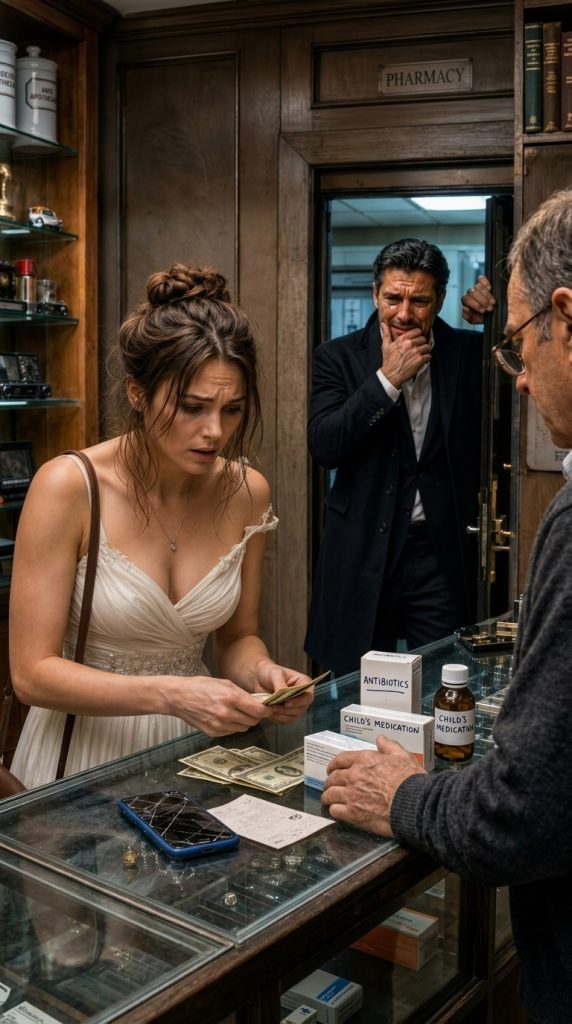
PART 3 — The Doorway Where Mercy Became a Weapon
The first thing Marco heard was the child.
Not crying.
Not screaming.
Breathing.
A thin, broken sound, like paper being torn very slowly in the dark.
Marco stood in the hallway of the Callaway Street building with rain dripping from his coat, the brown pharmacy bag clenched in one hand and Jenny Reeves’s pawned phone in the other. The building smelled of wet plaster, old heat, and fear. Somewhere below, a pipe knocked in the wall. Somewhere above, a woman laughed too loudly at a television show.
But inside apartment 2B, a little boy was fighting for air.
The door was open.
Not wide.
Just enough for Marco to see the shape of a man in a gray overcoat standing near the kitchen table, holding a folder like it was a badge.
Elliot Granger.
Marco knew him. Not personally. Men like Granger moved around the edges of Marco’s world—little vultures with paperwork, debt collectors dressed as landlords, parasites who learned just enough law to make cruelty look official.
Jenny was on her knees beside a small boy on the couch.
“Caleb, baby, look at me,” she whispered, trying to stay calm and failing with every word. “In and out. Just like we practiced. In and out.”
Caleb was seven, maybe eight. Small. Too small. Curled forward with one hand pressed to his chest, his lips pale, his eyes huge with panic. Each breath scraped through him.
Jenny had an empty inhaler in her hand.
Empty.
Marco’s jaw clenched.
Granger glanced toward the door. “Who the hell are you?”
Marco stepped inside.
The apartment changed instantly.
It was not magic. It was not volume. Marco did not shout.
He simply entered with the kind of silence that made men remember every sin they had ever hidden.
Jenny looked up, startled. Her face went white when she saw the pharmacy bag.
“You,” she breathed.
Marco walked past Granger as if he were furniture.
He knelt beside Caleb and opened the bag. “Jenny Reeves?”
She nodded, too shocked to speak.
“This is his medication.” Marco took out the inhaler, removed the cap, and placed it in her shaking hand. “Use it.”
For one second, Jenny stared at him like she had forgotten what help looked like.
Then instinct returned.
She fitted the inhaler to Caleb’s mouth. “Breathe in, honey. Now.”
Caleb inhaled weakly.
Once.
Then again.
Jenny counted softly, voice trembling. “One… two… three…”
Marco stayed kneeling, steady as stone, watching the child’s chest.
The sound did not vanish all at once. It loosened. Broke apart. Became less like tearing paper, more like a body remembering how to live.
Caleb’s fingers unclenched.
Jenny covered her mouth with her hand, and the first tear fell before she could stop it.
“Mom?” Caleb whispered.
“I’m here,” she said, pulling him against her. “I’m right here.”
Marco rose.
Only then did he turn to Granger.
The man had recovered some of his arrogance. “This is a private matter.”
Marco looked at the folder in his hand. “Eviction?”
“Legal notice,” Granger said. “She’s three months behind.”
“She told you her child was sick?”
Granger shrugged. “Everyone has a story.”
Jenny flinched at that. Marco saw it.
He also saw the table. The pile of bills. The overdue notices. The school lunch form. The cheap plastic cup with two toothbrushes in it because the bathroom sink probably leaked.
Then he saw something else.
A photograph on the refrigerator.
Jenny, younger and softer, smiling beside a man in paramedic blues. In her arms, a baby wrapped in a yellow blanket.
Marco stared.
The man in the photograph had a familiar face.
A face from one of the worst nights of Marco’s life.
His heart stopped so hard it felt like a bullet.
“Who is that?” Marco asked, his voice lower now.
Jenny followed his gaze. “My husband. Daniel.”
Marco’s throat tightened.
Daniel Reeves.
The paramedic who had dragged Marco’s younger sister from a burning car twelve years ago. The man who had stayed with her until the ambulance arrived. The man who had died two weeks later in a highway pileup while trying to save a stranger.
Marco remembered sending money anonymously to the funeral fund.
He remembered the widow had vanished before he could find her.
And now here she was.
On her knees.
With an empty inhaler.
And a landlord at her back.
For the first time in years, Marco Vitelli felt something inside him break clean in half.
Granger mistook the silence for weakness.
“Listen,” he said, stepping forward. “I don’t care what little charity performance you’re doing here, but this woman has until eight tomorrow morning to vacate. After that, I change the locks.”
Marco turned his head slowly.
“Say that again.”
Granger smiled.
He should not have.
“I said she’s out by morning.”
Marco walked toward him.
Jenny stood quickly. “Please. Don’t. Caleb is right here.”
Marco stopped.
That mattered.
The child mattered.
So Marco did not touch Elliot Granger.
He only leaned close enough for Granger to smell the rain on his coat and the danger underneath it.
“You will leave this apartment,” Marco said. “You will not come back tonight. You will not call her. You will not threaten her. And tomorrow morning, you will meet me at your office with every document you have ever put her name on.”
Granger laughed once. “And why would I do that?”
Marco smiled without warmth.
“Because by sunrise, you’ll know exactly who I am.”
PART 4 — The Widow’s Debt Was Written in Blood and Ash
Granger left with his folder pressed against his chest, but not before giving Jenny one final look of hatred.
Marco watched him disappear down the hallway.
Then he closed the door.
Jenny immediately stiffened.
“I don’t know what this is,” she said, standing between him and Caleb. “But I can’t pay you back tonight.”
Marco’s expression shifted.
Not softer exactly.
But human.
“I’m not asking you to.”
“That medicine cost—”
“Less than your son’s life.”
Her lips parted, but no sound came out.
Caleb sat on the couch, breathing easier now, watching Marco with the grave curiosity of a child who had learned too early that adults could be dangerous.
“Are you a doctor?” Caleb asked.
Marco looked at him. “No.”
“A cop?”
“No.”
“A superhero?”
Jenny gave a broken laugh and immediately wiped her face, embarrassed by it.
Marco almost smiled. “Definitely not.”
Caleb frowned. “Then why did you bring medicine?”
Marco looked at Jenny, then at the photograph on the refrigerator.
“Because your father once saved someone I loved.”
The apartment went quiet.
Jenny turned slowly. “What?”
Marco nodded toward the photograph. “Daniel Reeves. He was a paramedic.”
Jenny’s face changed at the sound of her husband’s name. Grief did that—rose without warning, filling every room it entered.
“You knew Daniel?”
“I knew what he did.”
Marco told her enough.
Not everything. Not the business he’d been in that night. Not the blood on his shirt. Not the enemies waiting in the rain while his sister’s car burned under the bridge. But he told her about Sofia. About the accident. About Daniel crawling through shattered glass when everyone else said it was too late.
Jenny listened with one hand resting on Caleb’s hair.
“He never told me that story,” she whispered.
“He probably had too many.”
“He did.” Her eyes shone. “He used to come home smelling like smoke and hospital soap, and he’d say, ‘Jenny, today was just a day.’ Even when it was awful. Even when I could see it in his face.”
Marco looked at the floor.
“I tried to find you after he died.”
Jenny’s smile was small and tired. “A lot of people did. I moved. I couldn’t stay in the house. Every corner had him in it.”
“And Granger found you instead.”
Her face hardened.
“He bought the building last year. Rent went up. Repairs stopped. Caleb got worse because of the mold.” She looked ashamed, though none of it belonged to her. “I complained. Then fees appeared. Late charges. Legal charges. Inspection penalties. I worked double shifts, but the clinic cut hours. Then the school called because Caleb had an attack, and I missed work, and…” She stopped.
Marco finished quietly, “The world kept charging interest.”
Jenny looked at him then.
Really looked.
Not at the expensive coat. Not at the watch. Not at the shadow of his reputation.
At the man.
“Yes,” she said. “That’s exactly what it did.”
Caleb leaned against her. “Mom, can Mr. Not-Superhero fix the mold?”
Jenny closed her eyes. “Caleb.”
Marco glanced at the ceiling, where a dark bloom spread near the corner.
“Yes,” he said.
Jenny opened her eyes. “No. You can’t just—”
“I own a construction company.”
“You own a pawn shop.”
“I own several things.”
That answer made her cautious again.
Marco did not blame her.
“Mr. Vitelli,” she said carefully, “what do you want?”
No one asked that question so directly anymore.
People assumed.
Feared.
Offered.
Begged.
Jenny asked.
Marco looked at Caleb, who was now fighting sleep with stubborn little blinks.
“I want your son to breathe,” he said. “I want Granger gone. And I want to repay a debt I should have repaid twelve years ago.”
Jenny’s voice dropped. “Some debts can’t be repaid.”
“I know.”
The silence after that was heavy, but not hostile.
Then Jenny’s knees buckled.
Marco caught her before she hit the floor.
She weighed almost nothing.
“Mom!” Caleb cried.
“She’s exhausted,” Marco said quickly. “Jenny? Look at me.”
Her eyes fluttered.
“I’m fine,” she whispered automatically, because mothers lied like that.
“No,” Marco said. “You’re not.”
Jenny tried to stand. “I have to get Caleb dinner.”
Marco looked toward the kitchen.
One box of crackers. Half a jar of peanut butter. A bag of rice.
That was all.
The mafia boss who had once ordered men to kneel felt his eyes burn because a mother had been starving quietly in the next neighborhood over.
He set Jenny gently on the couch.
Then he took out his phone.
“Luca,” he said when the call connected. “Send food to Callaway Street. Hot meals. Groceries. A pediatrician. A contractor for water damage. And find everything on Elliot Granger.”
A pause.
Marco’s face turned cold.
“Yes. Everything.”
Jenny stared at him.
Outside, thunder rolled over the city.
Inside, for the first time in months, someone else carried the weight for a moment.
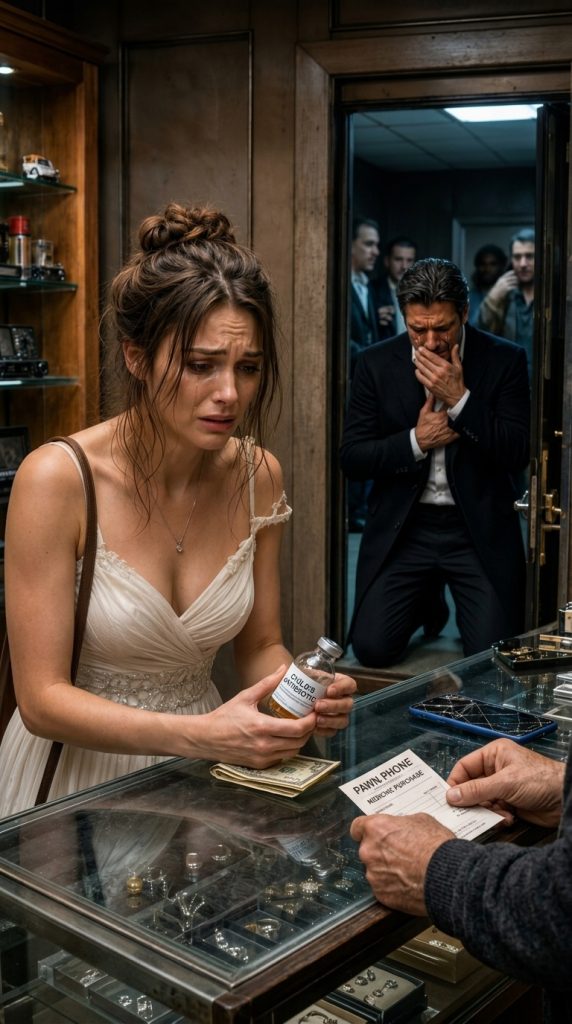
PART 5 — Elliot Granger’s Empire Began to Bleed Paper
By morning, Elliot Granger’s office looked less like a workplace and more like a crime scene made of documents.
Marco arrived at 7:58.
Jenny was with him.
She had insisted.
“I’m not hiding behind you,” she said in the car, wearing the same navy coat, now buttoned correctly.
Marco had studied her profile through the rain-streaked window.
“You don’t have to.”
“I know.”
That was the thing about Jenny Reeves.
She was afraid.
But she moved anyway.
Granger’s secretary tried to stop them. One look from Marco changed her mind.
Elliot Granger stood behind his desk, pale with fury.
“You have no right to come in here.”
Marco sat down without invitation. Jenny remained standing.
Luca entered behind them carrying a leather folder thick enough to ruin a life.
Marco placed Jenny’s pawned phone on Granger’s desk.
Granger frowned. “What is that?”
“The phone she sold to buy medicine,” Marco said. “The phone that received three messages after she left the pawn shop.”
Jenny looked at Marco.
He turned the screen toward her.
The first message was from Caleb’s school nurse.
Caleb wheezing again. Could not reach you. Sending him home with neighbor. Please call.
Jenny covered her mouth.
The second was from Mrs. Alvarez downstairs.
Jenny, Granger is here. He opened your door. I told him you weren’t home. He said he had legal right. Hurry.
Jenny’s eyes filled with rage.
The third message was from an unknown number.
Tell Reeves she has until morning. Sick kid or not. I want that unit empty. Buyer coming Friday.
Marco looked at Granger.
“Buyer?” he asked.
Granger’s face twitched.
Luca opened the leather folder.
“Elliot Granger,” Luca said, “owns no legal title to the Callaway building.”
Jenny went still.
Granger snapped, “That’s a lie.”
Luca continued, voice calm. “He manages it through a shell company pending transfer. The actual deed is tied up in probate after the original owner died. Mr. Granger has been collecting inflated rent, issuing illegal fees, ignoring medical hazard complaints, and attempting unlawful evictions to empty units before a private sale.”
Jenny whispered, “He doesn’t own it?”
Marco’s eyes remained on Granger.
“No.”
Granger reached for the phone on his desk.
Marco’s hand covered it first.
“I wouldn’t.”
“You think you can threaten me?”
Marco leaned back. “I don’t need to threaten you. Paperwork is already doing it.”
The door opened again.
This time, two city inspectors walked in.
Behind them came a woman in a charcoal suit with silver hair and eyes sharp as a blade.
“Ms. Reeves?” she asked.
Jenny nodded uncertainly.
“I’m Mara Denton. Tenant rights attorney.” She glanced at Granger. “I believe you’ve been looking for someone to listen.”
Granger exploded. “This is harassment!”
Mara smiled. “No, Mr. Granger. This is Tuesday.”
Marco looked almost amused.
For the next hour, Granger watched his world come apart one page at a time.
The mold complaints.
The forged notices.
The illegal lockout attempts.
The fake maintenance fees.
The secret buyer agreement.
And then Mara produced the final document.
A sealed letter from Daniel Reeves.
Jenny’s breath caught.
“What is that?”
Mara looked gently at her. “Your husband filed a housing complaint eight years ago, before he died. It was never processed. Attached to it was a statement naming Granger as the man pressuring low-income tenants out of paramedic housing units.”
Jenny gripped the chair.
“Daniel knew?”
“He suspected,” Mara said.
Granger laughed, desperate now. “A dead man’s complaint means nothing.”
Jenny looked up.
Something in her face changed.
The tiredness remained. The grief remained. But beneath it, steel surfaced.
“My husband saved strangers for a living,” she said. “You made money by hurting them.”
Granger sneered. “And what are you going to do about it?”
Jenny stepped closer to the desk.
“I’m going to stay alive long enough to watch you lose.”
For a moment, even Marco Vitelli looked at her as if he had just witnessed a queen put on her crown.
Then his phone rang.
He checked the screen.
His expression altered.
Jenny noticed immediately. “What?”
Marco answered.
He listened.
For the first time since she had met him, Jenny saw fear cross his face.
Not fear for himself.
For her.
He ended the call.
“Caleb’s doctor found something in the apartment,” he said.
Jenny’s blood went cold.
“What kind of something?”
Marco stood.
“The mold wasn’t just neglect.”
His voice dropped.
“It was planted.”
PART 6 — The Mold in the Walls Had a Name
Jenny did not remember leaving Granger’s office.
She remembered Marco’s hand at her elbow.
She remembered rain.
She remembered the word planted echoing so violently in her skull that everything else blurred.
By the time they reached Callaway Street, the building was surrounded by people in masks and protective suits. Tenants crowded the sidewalk, whispering, coughing, clutching children and plastic bags of belongings.
Mrs. Alvarez sat on the front steps with a blanket around her shoulders.
“Jenny!” she cried. “They found canisters in the vents.”
Jenny’s stomach turned.
Marco’s contractor, a broad man named Rafi, came toward them holding photographs in gloved hands.
“Behind the bathroom wall,” Rafi said grimly. “Cheap humidifiers rigged into the vent line. Fungal growth accelerant. Someone wanted the unit condemned.”
Jenny swayed.
Marco’s face went flat with rage.
“Caleb,” Jenny whispered.
“The pediatrician is with him,” Marco said. “He’s safe at the clinic. Luca took him.”
Jenny grabbed his sleeve. “You took my son?”
Marco did not defend himself. “Yes.”
Her eyes flashed.
Then her phone—her returned phone—rang in Marco’s hand.
He gave it to her.
The clinic number.
Jenny answered instantly. “Caleb?”
“Mom!” Caleb sounded tired but alive. “Mr. Luca has a funny voice.”
Jenny broke.
She turned away, pressing her fist to her mouth.
“I’m coming, baby.”
“The doctor said I can have pancakes after.”
She laughed through tears. “Then you better ask for extra syrup.”
When she hung up, Marco was watching her with an expression he probably did not know he had.
Tenderness, carefully restrained.
“I should have asked before moving him,” he said.
“Yes,” Jenny said.
“I’m sorry.”
She stared at him.
Men like Marco Vitelli did not look like they apologized often. Yet he said it simply, without pride fighting the words.
Jenny nodded once. “Don’t do it again.”
“I won’t.”
Then a shout rose from the corner.
Granger.
He had arrived at the building, drenched and wild-eyed, trying to push past inspectors.
“This is my property!” he shouted. “You can’t tear into walls!”
Mara Denton stepped in front of him. “It is not your property.”
Granger saw Jenny.
His face twisted.
“You,” he spat. “You should have taken the eviction.”
Marco moved.
Jenny caught his arm.
“Not here,” she said.
Marco stopped, but every muscle in him was locked.
Granger laughed, seeing the restraint. “That’s right. Let the widow hold your leash.”
The sidewalk went silent.
Marco’s eyes darkened.
But Jenny stepped forward.
Not Marco.
Jenny.
“You came into my home while my son couldn’t breathe,” she said. “You watched him suffer.”
Granger smiled thinly. “I watched you fall behind.”
“No,” Jenny said. “You made sure I would.”
Behind her, Rafi handed Mara another photograph.
Mara’s face changed.
“Mr. Granger,” she said, “do you know a company called Blackwell Urban Renewal?”
Granger went pale.
Marco turned toward Luca, who had just arrived from the clinic.
Luca nodded once.
“We traced the buyer,” Luca said. “Blackwell Urban Renewal is fronted by a nonprofit.”
Jenny frowned. “What nonprofit?”
Luca looked at her carefully.
“The Daniel Reeves Memorial Foundation.”
Jenny stopped breathing.
For a second, the entire street vanished.
The rain.
The crowd.
The inspectors.
Even Marco.
“My husband’s name?” she whispered.
Mara’s voice softened. “Someone has been using Daniel’s name to buy distressed buildings, displace tenants, and resell the land.”
Jenny looked at Granger.
He backed away.
“No,” she said, voice trembling. “No, you don’t get to wear his name.”
Granger bolted.
He made it three steps.
Then two unmarked cars pulled up at the curb.
Men in federal jackets stepped out.
Marco did not touch him.
He did not need to.
Granger was taken in the rain, shouting about lawyers and misunderstandings, while the tenants watched without pity.
Jenny stood still, soaked to the bone.
Marco came beside her.
“It’s over,” he said.
But Jenny shook her head.
“No.”
She looked at the condemned building.
At the families huddled outside.
At the name of her dead husband twisted into a weapon.
Her voice became very quiet.
“It’s not over until every person he hurt gets to go home.”
Marco looked at her for a long moment.
Then he said, “Then we build them one.”
PART 7 — The Woman Who Refused to Be Saved Quietly
Three months later, Jenny Reeves stood in a ballroom she did not belong in, wearing a borrowed black dress and shoes that pinched her toes like punishment.
Marco had rented the room under the name of one of his companies. Chandeliers glittered above city officials, lawyers, reporters, donors, contractors, and men in expensive suits who smiled at Marco with nervous respect.
At the front of the room was a banner.
THE DANIEL REEVES COMMUNITY HOUSING TRUST
Jenny stared at it until the letters blurred.
Marco appeared beside her.
“You hate the dress,” he said.
“I hate the shoes.”
“I can have someone bring—”
“No.” She lifted her chin. “Pain keeps me humble.”
His mouth twitched. “You don’t need help with humility.”
“Was that a compliment?”
“For me, yes.”
Caleb ran past them wearing a tiny suit and a crooked bow tie, carrying a plate stacked with desserts.
“Caleb,” Jenny warned.
He froze.
“How many brownies?”
He looked down.
“Emotionally or mathematically?”
Marco coughed to hide a laugh.
Jenny pointed at the table. “Put two back.”
Caleb sighed like a man ruined by injustice.
The trust had begun with Marco’s money, Mara’s legal firepower, and Jenny’s refusal to let anyone use Daniel’s name without earning it.
The seized assets from Granger’s network had gone into repairs and relocation. The Callaway tenants had temporary apartments. The old building was being gutted and rebuilt. Other buildings were under investigation.
And Jenny, who had once counted pawn shop bills with shaking hands, now signed documents that moved millions toward families who had been cornered the way she had been.
But tonight was not just a fundraiser.
Marco had kept something from her.
She could feel it.
“You’re nervous,” Jenny said.
“I’m not.”
“You are. Your left hand keeps closing.”
Marco looked down, annoyed to find she was right.
Before he could answer, Mara approached the microphone.
“Tonight,” Mara announced, “we honor the man whose life of service inspired this trust. Daniel Reeves believed that rescue did not end at the ambulance doors. It continued at home, in clean air, safe walls, and dignity.”
Applause filled the room.
Jenny’s eyes burned.
Mara continued. “But there is one person here who kept his legacy alive when the world did everything it could to bury her.”
A spotlight found Jenny.
Her stomach dropped.
“No,” she whispered to Marco.
“Yes,” he said.
“I will kill you.”
“I considered that.”
The crowd turned toward her.
Jenny walked to the stage because there was no graceful way to disappear under a table.
She stood behind the microphone.
For a moment, she saw only faces.
Then Caleb.
Then Marco.
And finally, in her mind, Daniel.
Smiling in paramedic blue.
“My husband used to say people don’t fall apart all at once,” Jenny began. “They lose one small thing at a time. A paycheck. A ride. A safe room. A working phone.”
Her voice trembled, but did not break.
“I sold my phone for my son’s medicine. I thought that was the lowest moment of my life. I thought I had failed him.”
Marco’s gaze sharpened.
Jenny looked directly at him.
“But someone saw me. And he did not look away.”
The room quieted.
“I used to think being rescued meant being carried. I was wrong. Sometimes being rescued means someone hands you back your own strength and says, ‘Use it.’”
Applause rose softly.
Then louder.
Jenny stepped back, overwhelmed.
Marco met her at the stairs.
“You ambushed me,” she whispered.
“You were magnificent.”
“I’m still mad.”
“I know.”
Then Mara returned to the microphone.
“And now, Mr. Vitelli has one final announcement.”
Jenny turned sharply. “What did you do?”
Marco walked onto the stage.
He looked uncomfortable under applause. Marco Vitelli could face armed enemies with less tension than a room full of grateful people.
“I am not a speechmaker,” he said.
A ripple of laughter moved through the room.
“So I’ll be brief. The Daniel Reeves Community Housing Trust will not be controlled by my company.”
Jenny frowned.
Marco looked at her.
“As of tonight, controlling authority transfers to a board led by Jenny Reeves.”
The room erupted.
Jenny stared at him.
Marco continued, “The trust has also acquired the entire Callaway block. Every displaced tenant has the right to return at their previous rent, locked for ten years.”
People stood.
Jenny could not move.
Then Marco said the words that made the room disappear again.
“And the first renovated unit will be named for Sofia Vitelli, who lived because Daniel Reeves refused to give up on a stranger.”
Jenny pressed both hands over her mouth.
Marco stepped down.
She hit his chest with her palm, not hard.
“You should have told me.”
“You would have said no.”
“Yes.”
“I know.”
Then Caleb appeared between them. “Does this mean we’re rich?”
Jenny laughed through tears. “No, baby.”
Marco glanced at her.
“Actually,” he said, “about that.”
Jenny went still.
“What now?”
Marco reached into his jacket.
Not for a ring.
Not for a check.
For an envelope.
Inside was a life insurance policy Jenny had never known existed.
Daniel’s.
Misfiled. Suppressed. Then uncovered in Granger’s documents.
The beneficiary line read:
Jenny Reeves and Caleb Daniel Reeves.
Amount payable:
$2,000,000.
Jenny sat down on the nearest chair before her legs vanished.
Caleb peered at the paper.
“So… mathematically rich?”
Jenny laughed and cried at the same time.
Marco crouched in front of her.
“You were never supposed to be begging,” he said quietly. “He took even that from you.”
Jenny looked at the policy.
Then at Caleb.
Then at the banner with Daniel’s name.
For the first time in years, the future did not look like a locked door.
It looked like a key.
PART 8 — The Last Thing She Sold Came Back as a Miracle
One year later, the pawn shop on Grover Street no longer existed.
In its place stood a small clinic with blue awnings, clean windows, and a sign that made Jenny cry the first time she saw it.
THE REEVES BREATHING CENTER — PEDIATRIC ASTHMA CARE AND FAMILY SUPPORT
No child would be turned away.
No parent would be asked whether they had cash before their child was allowed to breathe.
Marco had insisted on funding it.
Jenny had insisted on running it.
Their arguments had become a neighborhood legend.
“You cannot buy every broken thing in the city,” Jenny told him one afternoon while reviewing clinic applications.
Marco, seated across from her, calmly signed another check.
“No,” he said. “But I can buy this one.”
“That is not an argument.”
“It’s a result.”
“You are impossible.”
“You’re welcome.”
She threw a pen at him.
He caught it.
Caleb, now healthier and taller, looked up from his homework. “Are you two flirting or fighting?”
Jenny and Marco answered at the same time.
“Fighting.”
“Flirting.”
Caleb nodded wisely. “Gross.”
The Callaway building reopened in spring.
Fresh brick. Safe pipes. Sunlit windows. A courtyard with benches and stubborn little trees.
Mrs. Alvarez returned to apartment 1A and cried over the new stove. Rafi’s crew installed air filters in every unit. Mara framed Granger’s conviction notice and hung it in her office bathroom because, she said, justice deserved practical placement.
Granger received twelve years.
But the shocking part came later.
It came on a Sunday morning, when Jenny unlocked the clinic and found an old man waiting on the steps.
He wore a brown coat, polished shoes, and a hat held against his chest.
“Jenny Reeves?” he asked.
“Yes.”
“My name is Arthur Bell.”
She searched her memory and found nothing.
He handed her a small velvet box.
Inside was a medal.
Daniel’s paramedic service medal.
Jenny’s breath caught.
“Where did you get this?”
Arthur’s eyes filled with tears.
“Your husband saved my daughter in the highway pileup where he died. I was supposed to return this to you after the investigation. But when I came looking, you were gone. Then I got sick. Then ashamed. Then old.”
Jenny held the medal like it was alive.
Arthur swallowed.
“There’s more.”
Marco, who had been standing inside the clinic doorway, stepped closer.
Arthur removed a folded letter from his coat.
“I wasn’t only a father,” he said. “I was a judge. Retired now. Daniel told me something before they took him into surgery. He said if anything happened to him, to make sure Jenny and the baby were protected.”
Jenny’s knees weakened.
Arthur’s voice broke.
“I failed him.”
Jenny shook her head. “No—”
“I did.” He looked at Marco. “But your people reopening these cases brought everything back. I found an escrow account Daniel created with donations from paramedics after his death. It was frozen during a fraud investigation tied to Granger.”
Marco’s eyes narrowed. “How much?”
Arthur looked at Jenny.
“Enough to fund this clinic for twenty years.”
Jenny sat on the step.
The city moved around her. Buses sighed. Pigeons strutted. A child laughed somewhere down the block.
Twenty years.
Daniel had reached across death with one more rescue.
Jenny pressed the medal to her lips.
Marco sat beside her, not caring about his suit.
For a long time, neither spoke.
Then Jenny laughed softly.
“What?” Marco asked.
She wiped her cheeks. “I sold my phone for one hundred and eighty dollars.”
“I remember.”
“And somehow that terrible little phone dragged you into my life, exposed a criminal network, saved a building, started a trust, opened a clinic, found Daniel’s insurance, and now this.”
Marco looked at the clinic sign.
“Useful phone.”
She leaned her head against his shoulder.
He went very still.
Jenny felt it and smiled.
“Relax, Vitelli.”
“I am relaxed.”
“You look like someone handed you a bomb.”
“In some ways, yes.”
She took his hand.
Not dramatically.
Not for the watching street.
Just because she wanted to.
Marco looked down at their joined fingers as if he had been given something too fragile for his world.
Caleb pushed open the clinic door behind them.
“Mom? Mr. Marco? There’s a kid here who forgot his inhaler.”
Jenny stood immediately.
Marco rose with her.
Inside, a little girl sat beside her frightened father, wheezing softly. Her father kept apologizing, saying his insurance had lapsed, saying payday was Friday, saying he could leave his watch.
Jenny crossed the room and knelt in front of the child.
“No,” she said gently. “You don’t have to sell anything here.”
Marco watched from the doorway.
The father looked confused. “But I can’t pay today.”
Jenny took an inhaler from the cabinet.
Her voice was steady.
“Then today, you breathe first.”
The little girl inhaled.
Once.
Twice.
The room held its breath with her.
Then the wheezing eased.
Her father covered his face and wept.
Jenny stood, eyes shining, and looked at Marco across the clinic.
He understood without a word.
This was the ending no one had predicted.
Not revenge.
Not blood.
Not even justice.
A woman who had sold her last connection to the world had become the connection for everyone else.
And Marco Vitelli, who had spent his life being feared in doorways, finally learned what it meant to stand in one as a guardian.
Outside, the old pawn shop bell had been hung above the clinic entrance.
When the door opened, it chimed.
A clear, bright sound.
Not the sound of something being lost.
The sound of someone being saved.
The End
