

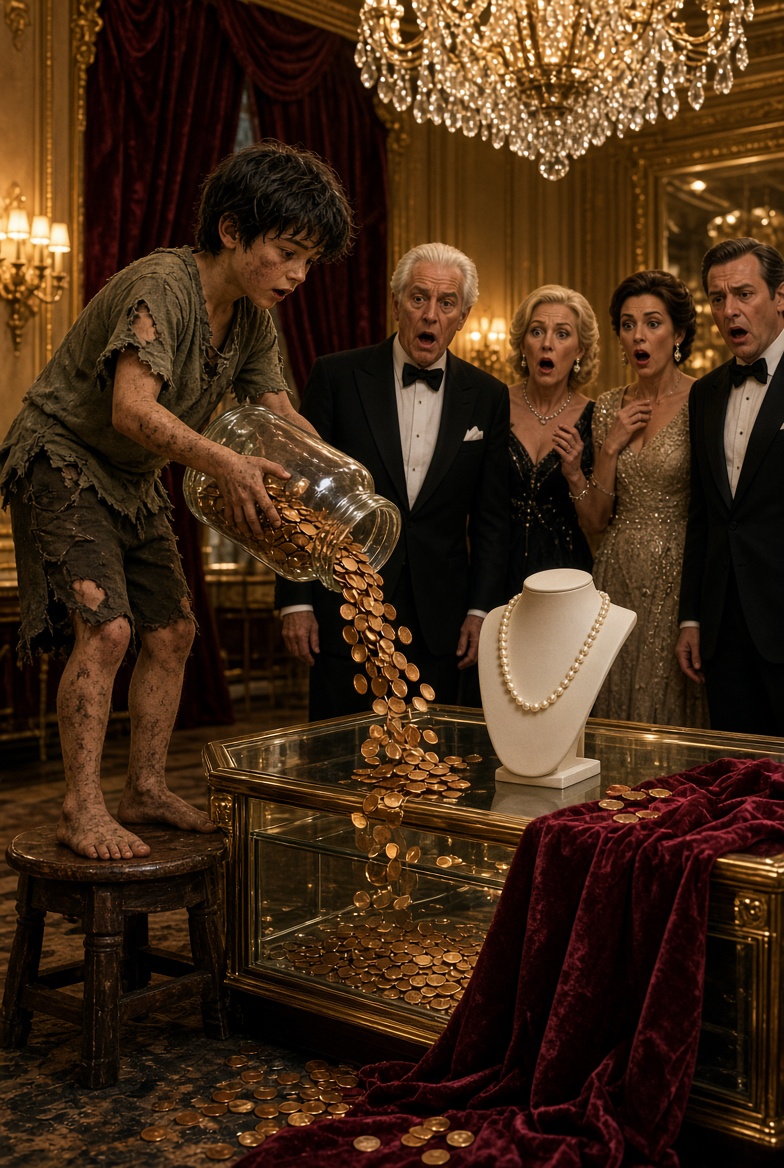
The security guard was seconds away from throwing him out. To Mr. Daniels, the dirt on the boy’s clothes looked like a stain spreading across a room that existed to stay clean—an offense against marble, against perfume, against the quiet confidence of people who never had to count change twice.
It was noon inside Royale Fine Jewelry & Pawn in downtown Houston. The air-conditioning hummed with the expensive patience of a machine that never had to rest. Light pooled on glass cases as if the diamonds themselves had hired it. Women with Chanel handbags leaned close to bracelets that threw small, cold stars onto their wrists. Near the watch counter, a businessman turned a gold Rolex under the lamps, nodding at a price he did not need to flinch from.
Then the glass door opened, and the noon changed temperature.
A twelve-year-old boy walked in.
He was barefoot. His tank top was torn at one strap. His jeans were streaked with dried mud, the kind that comes from alleys and vacant lots and the wet edges of dumpsters after rain. In both hands he carried a heavy black trash bag, the plastic stretched thin by weight. His dirty feet left faint prints across the polished marble—small, honest maps of a life the showroom had not been built to receive.
Customers frowned the way people frown when something uninvited enters a photograph they thought they were posing for.
Mr. Daniels moved fast, the way security is trained to move when a problem is still small enough to be called a problem instead of a scene.
“Hey! No panhandling in here!” he barked. “You’re messing up the floor. Out. Now.”
The boy did not answer.
He did not look at the Rolex or the bracelets or the faces already deciding what he was. He walked straight to the main counter as if the aisle had been drawn for him alone, the bag bumping softly against his knee.
“I said OUT—”
Daniels reached.
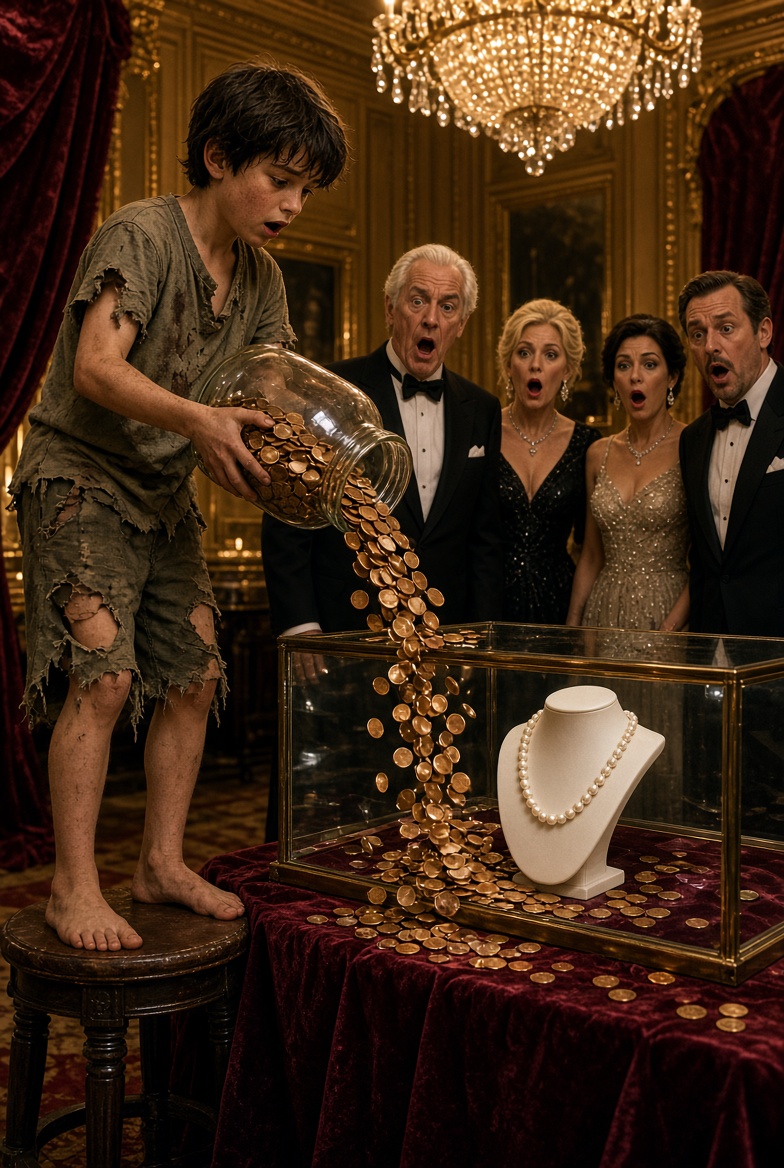
Before the guard’s hand could close on the thin shoulder, the boy flipped the bag upside down.
The sound that followed did not belong to noon, or to perfume, or to marble.
Clang.
Clink.
Clatter.
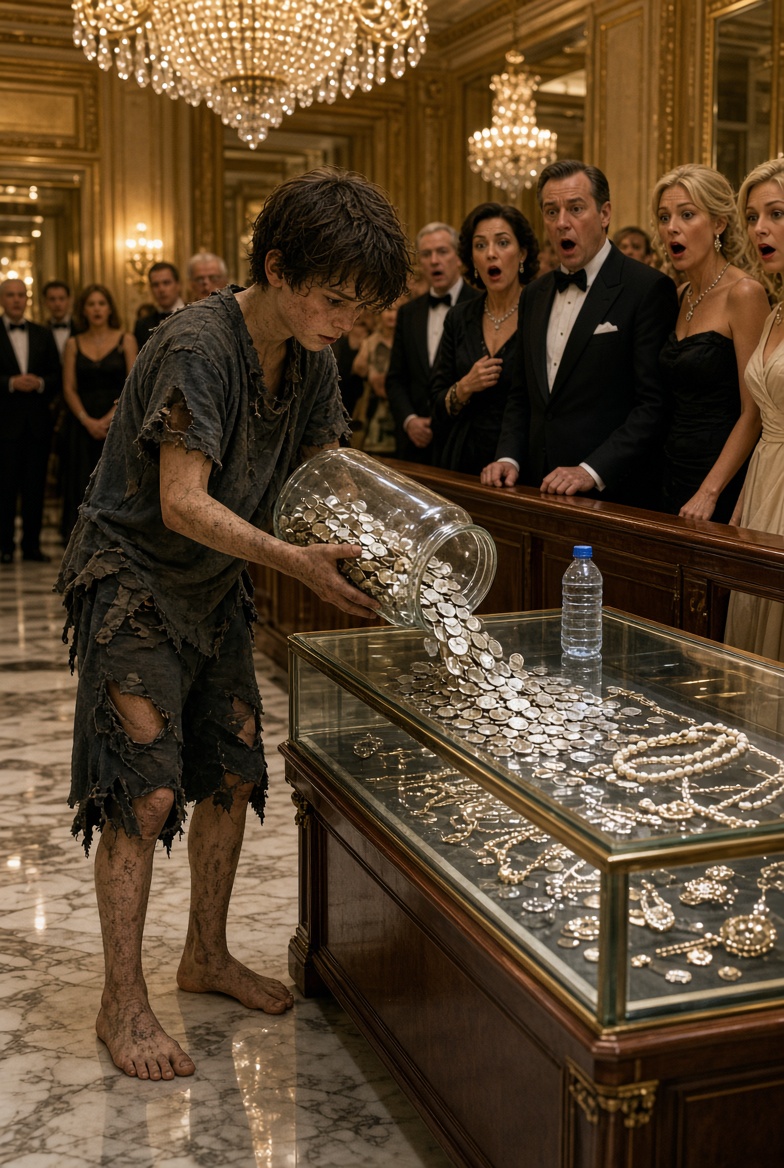
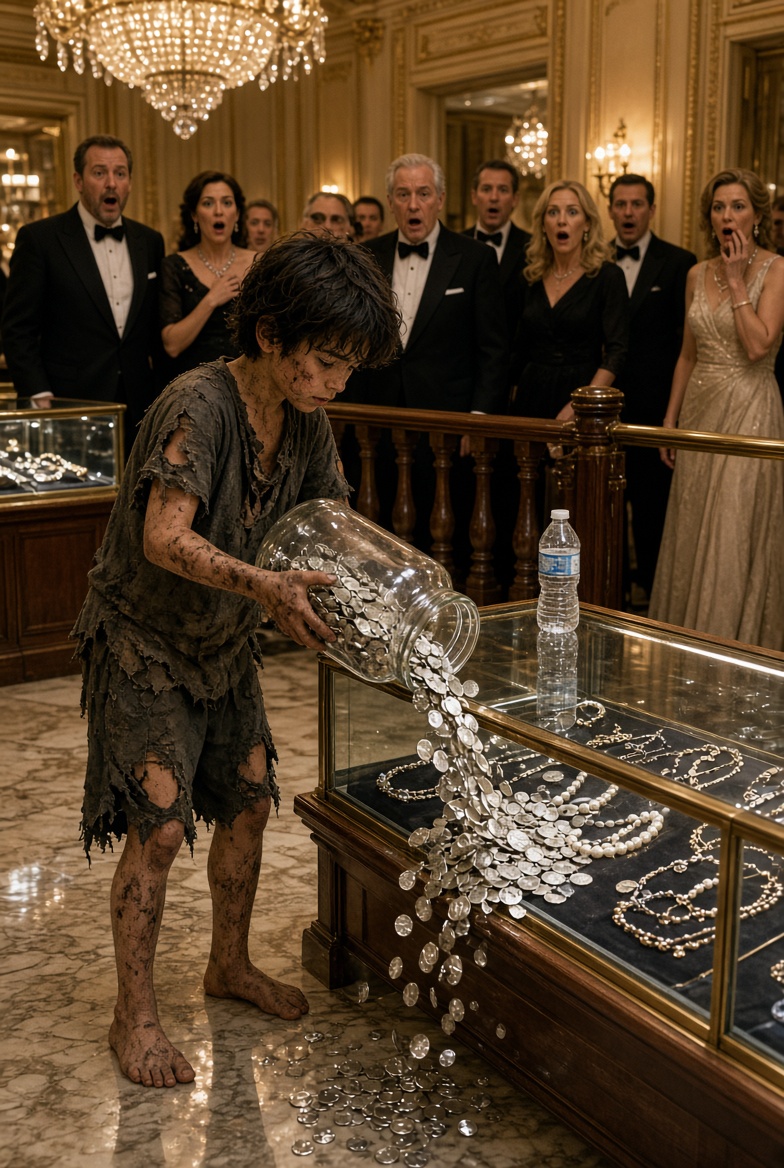
A mountain of coins spilled across the glass—pennies dark with age, nickels sticky from who knew what, dimes bent as if they had been stepped on in parking lots, quarters that rang a little cleaner than the rest. Some were filmed with dirt. Some were green at the edges. They spread in a bright, chaotic river over the display case, catching the same light that had been reserved for diamonds.
Everyone froze.
The businessman stopped turning the watch. A woman with a quilted bag put her fingers to her mouth. Even the air-conditioning seemed, for a second, to listen.
The office door opened. Mrs. Caroline Whitaker stepped out in a navy blouse that said manager without needing a name tag, her reading glasses still in her hand. She had the face of a woman who had spent years translating desire into paperwork, and who could tell, immediately, when a room had left the script.
“What is going on?”
“I was removing him,” Daniels said quickly, already defending the version of events he preferred. “He’s causing trouble.”
The boy swallowed. From the pocket of those ruined jeans he pulled a wrinkled pawn ticket, folded so many times the print had gone soft.
“I’m not causing trouble,” he said. The voice was quiet. It was also firm, which is a different kind of volume. “I’m here to get my mom’s necklace back.”
Mrs. Whitaker took the ticket. The paper looked smaller in her hands than it had in his.
Item #2045. Gold necklace with heart-shaped pendant. Pawned last year.
She knew the drawer it lived in. She knew the interest table taped inside the office cabinet. She knew, too, how often items like this never came home—how often a year became two, and two became a sale tag, and a family’s last pretty thing became someone else’s impulse.
“Sweetheart,” she said, and the word came out gentler than the room expected, “with interest, the total is twelve hundred dollars. Are you sure you have enough?”
The boy nodded and pointed at the coins, at the spilled year of his life glittering on her counter.
“It’s one thousand two hundred and sixty. I counted it three times last night.”
His hands, resting now on the glass, were covered in cuts and calluses. Not the decorative roughness of a hobby. The working kind. The kind that comes from lids that cut and metal that bites and nights spent sorting what other people throw away.
“Where did you get all this?” she asked softly.
He stared at the floor, at his own dirty footprints, as if the marble might answer for him and spare him the sentence.
“I collect cans. Bottles. Scrap metal. I’ve been saving for a year.”
His voice trembled, then steadied, because trembling was a luxury he could not afford in the middle of the story.
“My mom pawned it when I got really sick last year. We couldn’t afford the hospital bills. It was the only thing she had left from my grandma. Tomorrow’s her birthday. I want to surprise her.”
The showroom went silent in a way silence rarely does in a place that sells sparkle. It was not empty silence. It was full. It held the hospital that had not been free, the grandmother who was gone, the birthday that would arrive whether the world was kind or not. It held a child who had walked into luxury carrying the language luxury least respected: small change, honestly earned.
The same customers who had stared in disgust now found their eyes wet and their hands useless. A woman turned away and wiped her cheek as if the air-conditioning had betrayed her. The businessman set the Rolex down with a care that suddenly looked like embarrassment.
Mr. Daniels lowered his head. Shame has a posture. His found it.
Mrs. Whitaker did not make a speech. She walked to the safe.
When she came back, the necklace looked almost shy in the light. It was not flashy. It was a simple gold chain and a small heart pendant, the kind of piece that matters because of the neck it remembers, not because of the carats it announces. In that moment, against glass still littered with pennies, it looked priceless in the only way that counts.
She placed it inside a red velvet box and set the box in front of him.
“Here you go, sweetheart.”
The boy pushed the coins forward with both hands, as if the metal might try to retreat.
“This is the payment.”
She covered his rough fingers with her own.
“You can keep your money. The necklace is yours.”
His eyes widened. For the first time since he had entered, he looked like a child and not like a mission.
“F-free?”
She knelt so that the counter was no longer a wall between them.
“Some things can’t be measured in dollars.”
He shook his head so hard the torn strap of his shirt slipped farther down his shoulder.
“I promised I would pay it all. I don’t want my mom thinking I got charity.”
That sentence did more damage—and more good—than any accusation could have. This child was not only poor. He was proud. He understood, with a clarity some adults spend decades avoiding, that a gift can feel like a verdict if it arrives at the wrong angle. He had not come to be rescued in public. He had come to keep a promise in private, and the public had merely gotten in the way.
Mrs. Whitaker stood. Something in her face settled, the way a decision settles when it is finally the right shape.
“All right,” she said. “Then we’ll do this properly.”
They counted every coin.
An employee brought a tray. Another brought a machine that would have finished the job in a minute; Mrs. Whitaker waved it off. The counting was not only arithmetic. It was ceremony. Pennies clicked into stacks. Quarters rang. Sticky nickels were wiped and set aside and counted anyway, because a year of alleys does not produce mint condition. The sound moved through the store like a second kind of music, rougher than the usual hush of wealth, and no one asked them to hurry.
After several minutes that felt longer than minutes, an employee looked up.
“Exactly one thousand two hundred and sixty.”
Mrs. Whitaker nodded.
“Print a receipt for twelve hundred. Paid in full.”
The boy’s smile arrived then—relief so physical it changed the way he stood. The bag at his feet was empty. The debt on the ticket was not.
Then she wrote something extra on the receipt, her pen moving with the calm of a woman inventing a policy in real time because the policy that existed was not large enough.
Refund: $1,200 — Gold Heart Foundation
She opened the register, took out cash, and placed it back into the boy’s bag. The bills looked almost indecent next to the memory of all that copper and nickel, but she folded them in as if they belonged there.
“You paid your debt,” she explained. “Now we’re buying your coins to start a fund for other kids like you.”
It was a solution that let dignity keep its spine. He had paid. The store had not erased his work. It had converted the work into something that could travel farther than one necklace.
The store erupted into applause. It started at the watch counter and jumped to the bracelet case and then it was everywhere, awkward and sincere, the sound of people trying to clap their way back into being the kind of witnesses they wished they had been when the door first opened.
Mr. Daniels approached as the noise thinned. He looked smaller without the bark.
“I’m sorry, son.”
“It’s okay, sir,” the boy said. “I’m used to it.”
That sentence hurt more than any accusation. It meant the marble floor was not the first floor that had treated him as a stain. It meant he had practiced forgiveness because the world had given him so many occasions to need it. Several customers looked away again, newly ashamed of how quickly they had agreed with a guard’s first glance.
The boy left with the velvet box held in both hands, as if the heart inside it might start beating if he were careless. His footprints were still on the marble. No one called for them to be mopped until he was gone.
The next day, in a small house with a leaking tin roof, he stood in a kitchen that smelled like rice and rain. His mother was at the sink. Tomorrow had become today in the only way birthdays do.
He handed her the box.
When she opened it and saw the necklace—her mother’s necklace, the one she had surrendered in a fluorescent pawnshop year for a hospital that did not take promises as payment—she broke down. The sob came from a place deeper than surprise. It came from the year she had spent believing that particular gold was gone, and that she had been the one to send it away.
“How…?”
“I promised I’d get it back.”
She held him so tightly the torn shirt disappeared inside her arms.
“I’m supposed to protect you.”
“And I’m supposed to protect you,” he replied, as if the job of a family were a circle, not a ladder.
A customer had recorded the scene in the store. People record now the way they used to stare: automatically, and then with consequences they do not control. The video moved the way certain videos move when they contain both cruelty and its correction. Within days, millions knew the name the receipt had printed in small letters.
Michael Rivera.
Royale Fine Jewelry did what institutions sometimes do when a private kindness becomes public enough to require a name. It launched the Gold Heart Foundation officially. Donations arrived from people who had never set foot on that marble and from a few who had, and who wrote checks that felt like apologies. The store began to change its face—not abandoning luxury, but refusing to let luxury be the only story it told. A small café opened next door in a space that had been empty glass. The signage started saying two things at once.
Weeks later, Mrs. Whitaker visited the house with the tin roof. She sat at a table that wobbled and did not comment on the wobble.
“We want you back in school,” she told Michael. “The foundation will cover everything.”
To his mother she offered work that was not a favor dressed as employment: managing the café, learning the register, keeping the place alive for people who came in with more hunger than jewelry money. It was not charity. It was a door with a handle on both sides.
The leaking roof did not become a mansion. Life rarely pays its debts in fairy-tale architecture. But the hospital year loosened its grip. The boy went back to classrooms that had been waiting, impatiently, for a student who had been busy becoming a bank. The necklace stayed on his mother’s neck on Sundays and in a drawer on workdays, because some treasures are too heavy to wear while you fry eggs.
Ten years later, a well-dressed young man stepped onto a stage in a packed auditorium. The lights found him easily. They had been designed for people who already knew how to stand in them.
“Good evening,” he said. “My name is Michael Rivera.”
The audience stood before he asked them to. Recognition has its own manners.
“That day,” he continued, “I walked into a jewelry store to rescue a necklace. But what I really rescued was my faith in people.”
He spoke about being judged for his appearance—about mud being mistaken for character, about a trash bag being mistaken for a threat. He spoke about a woman who chose to count coins by hand when a machine would have been faster, because speed was not the point. He spoke about a guard who learned, too late for the first minute and in time for the rest of his life, that a floor can be cleaned and a child cannot be un-insulted quite so easily.
“Real gold doesn’t shine because it’s polished,” he said. “It shines because of what it survives.”
Michael Rivera was a lawyer by then. He took cases that did not photograph well: evictions, wage theft, medical debt, the quiet mathematics that still sent families to pawn counters with the last pretty thing they owned. He knew the language of those counters from both sides of the glass.
In the front row sat his mother, proud in a way that had nothing to do with the cut of her dress. Beside her sat Mrs. Caroline Whitaker, who had left the office for the evening and who wiped her eyes without pretending it was the air-conditioning.
“Don’t be ashamed of where you start,” Michael finished. “Be proud of where you choose to go.”
That evening he went back to the store.
He was no longer barefoot. He left no muddy prints. The marble accepted him now with the ease it had always reserved for people in good shoes, which was precisely why he noticed the marble at all. Over his chest, against a shirt that had never been torn, he wore the same gold heart pendant. His mother had placed it there before the speech, her hands briefly as careful as they had been the morning she opened the velvet box.
It was not the necklace that had changed his destiny. Gold is only metal until somebody walks a year through alleys for it. What changed him was the refusal to let pride and need cancel each other. What changed the room was a manager who understood that a receipt can be a kind of justice. What remained, after the video faded and the donations found their ledgers, was simpler than either viral fame or foundation letterhead.
Love.
Dignity.
Someone choosing to believe that a child with dirty feet could still be telling the most expensive truth in the building.
At the entrance of Royale Jewelry & Café, a sign still hangs where the noon light can find it:
We don’t just sell gold.
We believe in the value of people.
And it all began with a bag full of cold coins—and one extraordinarily warm heart.
