

chapter 1: The Back Door
The supervisor’s fingers went numb. He dropped the elderly woman’s wrist as if it had caught fire.
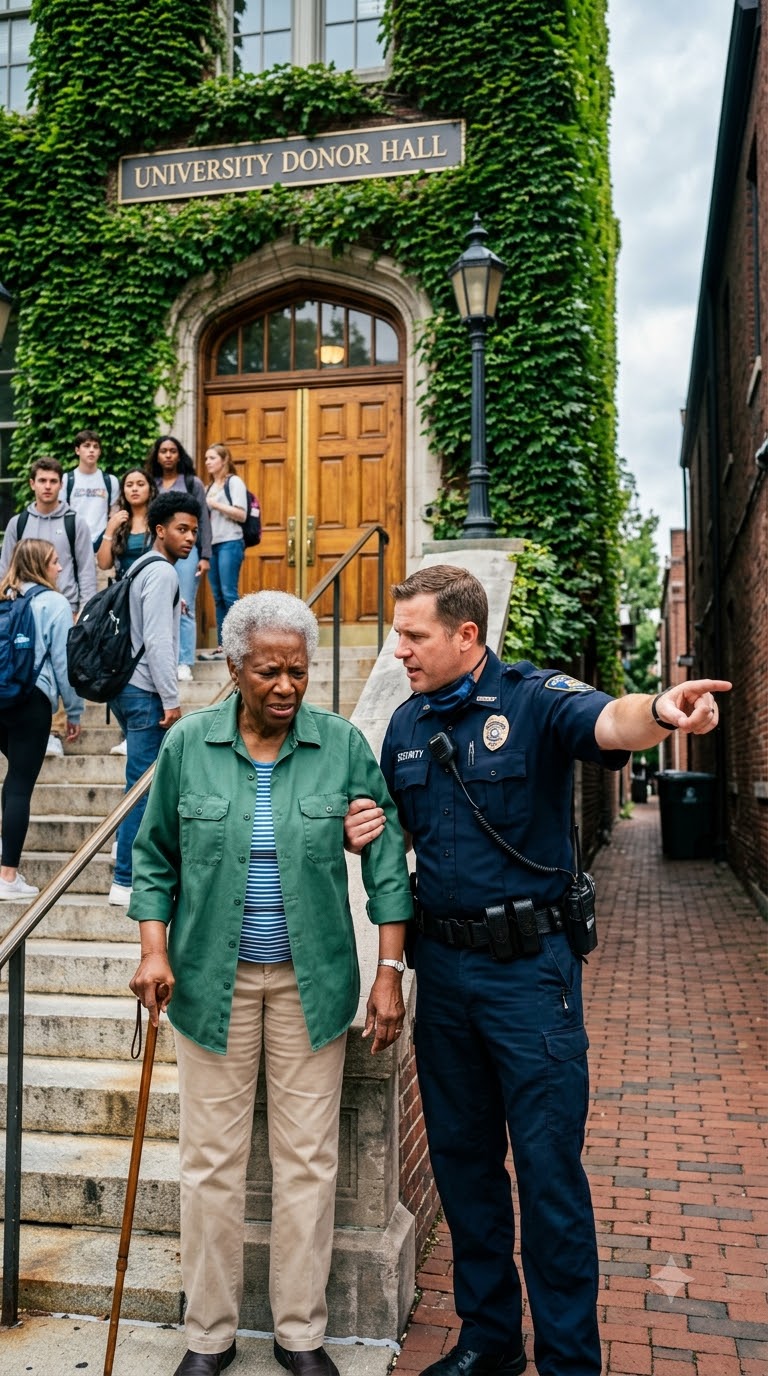
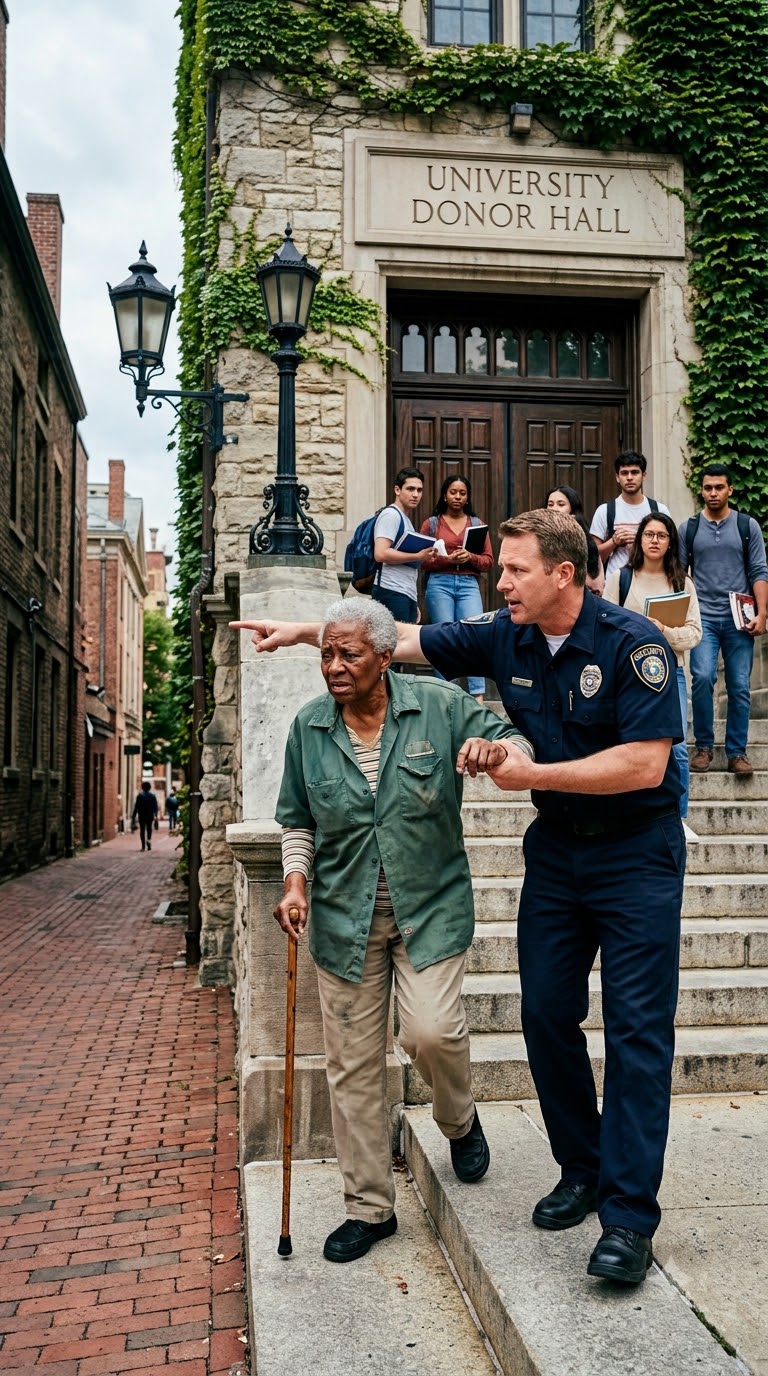
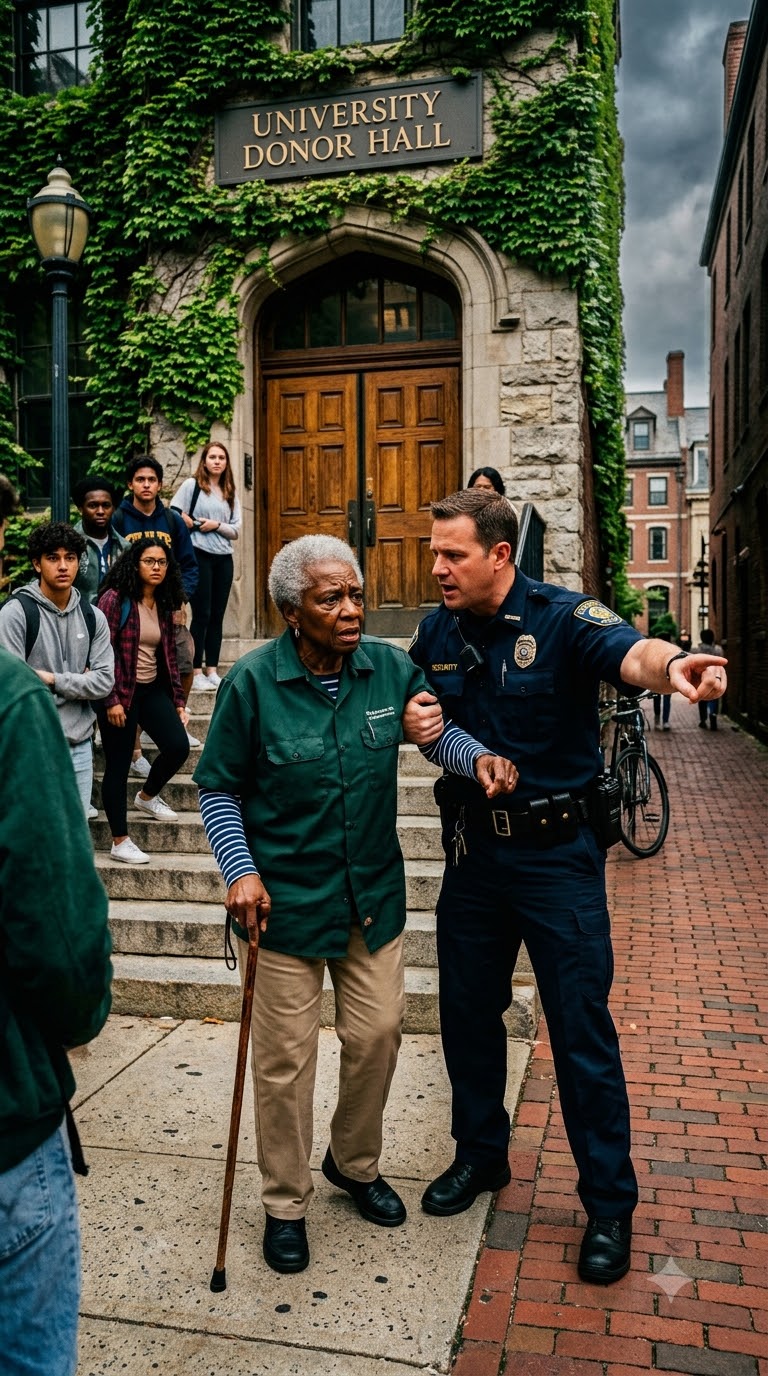
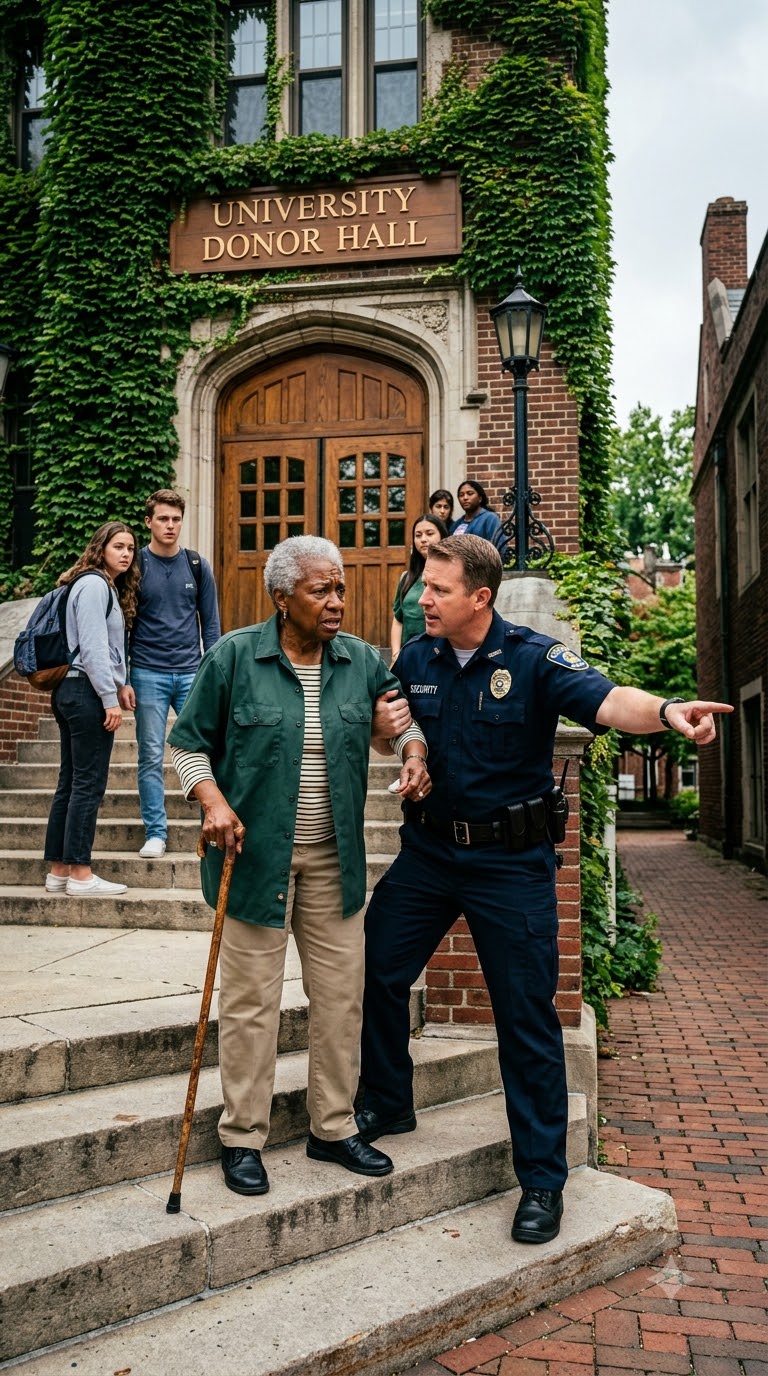
Chancellor David Sterling didn’t run. He came down the wide limestone steps with a terrifying, measured stillness, his eyes locked entirely on the older woman in the faded grey cardigan. Two campus police officers matched him step for step, their heavy boots echoing against the concrete, until David stood squarely between the security supervisor and his mother.
The supervisor, a broad-shouldered man named Marcus, took a sudden, staggering step backward. His heavy radio slapped against his tactical belt. The sheer physical presence of the chancellor—a man who usually only commanded boardrooms—forced Marcus into a hasty retreat.
“Sir, Chancellor Sterling,” Marcus stammered, his voice cracking before he quickly cleared his throat to lower the pitch. He stood up straighter, adjusting his lapel in a desperate attempt to project the authority he’d been violently throwing around seconds earlier. “I apologize for the disturbance. We had a breach at the perimeter.”
David didn’t look at him. He didn’t even acknowledge that Marcus had spoken.
Instead, the chancellor knelt on the cold concrete. He reached out with trembling, careful hands and picked up the splintered wooden cane that had clattered to the ground during the struggle. He stood, dusted the handle off with his expensive suit sleeve, and placed it gently back into the elderly woman’s shaking grip.
“Mom,” David said, his voice barely a whisper, yet it carried sharply across the dead-silent courtyard. “Are you hurt?”
Eleanor Sterling adjusted her grip on the cane, her knuckles white. She looked down at her left wrist. The thin, fragile skin was already beginning to mottle into a harsh, angry red where Marcus’s fingers had clamped down on her bones. She pulled her sweater sleeve down to cover it, a quiet gesture of preserved dignity.
“I’m alright, David,” she said softly. Her voice shook, but she kept her chin high, refusing to let the tears in her eyes spill over. “Just… startled. He moved very fast.”
David reached out, his thumbs gently grazing the fabric covering her bruised skin. The muscles in his jaw locked so tightly the skin around his cheekbones went pale.
Marcus realized the silence was working against him. The wealthy donors—the men in fitted tuxedos and women in silk evening gowns sipping champagne on the upper terrace—had completely stopped talking. Dozens of eyes were boring into him from the balcony above. The gentle string quartet playing inside the hall seemed to fade into nothing.
“Sir,” Marcus tried again, raising his hands in a placating gesture, his tone shifting into aggressive self-defense. “She was soliciting. She didn’t have clearance, and she bypassed the main checkpoint. We get drifters from downtown trying to sneak in for the free catering all the time. She was harassing the VIP guests near the fountain. I had to use standard compliance holds to prevent a security risk to the donors.”
One of the campus police officers, a tall sergeant named Miller, took a slow, deliberate step to the left, boxing Marcus in against the heavy brass railing. The second officer stepped to the right, blocking the path to the side exit.
David finally turned his head. His expression was completely blank, a terrifying void of emotion that made Marcus’s stomach pitch.
“Standard compliance hold,” David repeated, his voice dangerously flat.
“Yes, sir,” Marcus said, sweating now, aggressively adjusting his collar. He reached for the metal clipboard tucked under his arm. This was his lifeline. The master list. The absolute law of the evening. “We have strict protocols for tonight. The donor gala is a closed event. I have the master registry right here. She refused to identify herself properly and tried to force her way up the stairs. I was protecting the event.”
A murmur rippled through the crowd on the terrace. A woman in a dark green evening gown leaned over the marble balustrade, whispering furiously to her husband, her hand covering her mouth. The realization was spreading like a lit fuse through the upper echelon of the university’s elite.
The woman in the cheap cardigan wasn’t a beggar. She wasn’t a solicitor looking for a handout.
She was the guest of honor.
Marcus heard the whispers but entirely misinterpreted them. He thought the crowd was on his side, annoyed by the interruption of their exclusive evening. He held the clipboard out like a shield, tapping the metal clip with a thick finger.
“Look, I’m just doing my job,” Marcus insisted, his voice growing louder, playing to the audience above. “My team’s priority is protecting the integrity of this university. Her name isn’t on the VIP list. If she doesn’t have a credential, she doesn’t get in. That’s the rule you signed off on, Chancellor. No exceptions.”
Eleanor watched the man puff his chest out. She didn’t yell. She didn’t stoop to his level of aggression. Instead, she reached into the worn, black leather purse slung over her shoulder.
The heavy brass snap of the purse echoed sharply.
Marcus flinched, his hand dropping automatically toward the heavy flashlight on his belt, but Sergeant Miller immediately stepped forward, his hand resting casually but firmly on his duty belt. “Easy, Marcus. Keep your hands visible.”
Eleanor pulled out a thick, cream-colored envelope. It wasn’t crumpled. It was immaculate. The university’s official crest was pressed into the thick paper in shimmering gold foil. She held it out, her hand steadying as she did.
“I didn’t need to force my way in, young man,” Eleanor said, her voice finding its steel. “I was invited.”
David took the envelope from his mother. The wax seal on the back was still unbroken. He flipped it over. Written in elegant, sweeping calligraphy across the front was: Mrs. Eleanor Sterling, Honored Matriarch.
Marcus stared at the gold foil. The blood drained out of his face, pooling in his stomach like lead.
“That’s… that’s a forgery,” Marcus blurted out, the lie spilling from his mouth out of pure survival instinct. “People print fake passes all the time. I’m telling you, I checked the master list at the main gate. She isn’t on it. Someone printed that to get past security.”
David didn’t argue. He just held his hand out.
“Give me the clipboard.”
Marcus hesitated, his fingers tightening around the metal edges, pulling it an inch closer to his chest. “Sir, I really need to log the incident with dispatch first—”
“Give me the clipboard,” David repeated, taking one step forward. The air around him seemed to drop ten degrees.
Marcus handed it over, his palms slick with sweat. He swallowed hard, his mind racing to calculate his next move. He had crossed her name off himself twenty minutes ago when she first walked up to his podium looking lost. He knew she wasn’t on it anymore. The ink was barely dry.
David unclipped the thick stack of papers. He flipped past the first page, scanning the alphabetical registry. He stopped on the third page. His finger traced down the column of names under the letter ‘S’.
There it was. Sterling, Eleanor.
But a thick, jagged black line had been dragged violently through her name.
The ink was still slightly wet, catching the ambient light from the courtyard lanterns. It wasn’t a neat, administrative stroke indicating someone had already arrived. It was an angry, heavy scratch, meant to obliterate the text beneath it.
David tilted the clipboard, letting the light hit the fresh ink. He looked up, his eyes dropping to Marcus’s hands. The side of the supervisor’s right index finger had a faint, dark smear of black ink on it.
Marcus noticed where the chancellor was looking. He quickly shoved his hands into his pockets, trying to maintain a look of defensive righteousness.
“Like I said, she wasn’t on the active registry,” Marcus said, lifting his chin, a smug, desperate sort of confidence creeping back into his voice. It was his word against an old woman’s, and he was the head of security. He had the official event document. He controlled the gate. “Someone must have removed her for security reasons before the event started. I was just following protocol by turning her away. You can’t prove otherwise.”
Marcus smirked, tapping the edge of the altered clipboard David was holding. He felt secure standing in the dark blind spot of the courtyard’s old brick archway. He knew the old cameras on the south wall had been broken for months.
He was entirely unaware that just three feet above his head, bolted directly to the newly restored masonry, the university’s newest high-definition panoramic security camera was quietly sweeping the perimeter.
And the red recording light was pointing directly at the top of his head.
Chapter 2: The Guest of Honor
“She’s not on the list, sir,” the supervisor repeated, his voice gaining a false layer of confidence as he held the clipboard out. “I was just following university protocol to protect the donors.”
Marcus tilted his chin up, casting a quick, calculating glance toward the balcony overlooking the courtyard. Dozens of wealthy alumni and elite benefactors were peering over the marble balustrade, their champagne flutes temporarily forgotten. He decided to play directly to them.
“These people pay thousands of dollars a plate for a secure, exclusive evening,” Marcus said, raising his voice so the donors above could hear him clearly. “We can’t just let anyone wander in off the street because they printed a fake pass. We’ve had a lot of aggressive transients lately. I made a judgment call to secure the perimeter.”
David didn’t argue. He didn’t raise his voice. He simply handed the altered clipboard back to Marcus, letting the heavy metal edge slap against the guard’s chest.
“Sergeant Miller,” David said, his voice cutting cleanly through the damp night air.
“Yes, Chancellor,” the tall campus police officer replied, standing at rigid attention.
“Is Lieutenant Harris running the security control room tonight?”
“Yes, sir. He’s at the main dispatch desk.”
“Radio him,” David ordered, his eyes never leaving Marcus’s face. “Tell him to pull the live feed from the South Archway panoramic, Camera Four. I want the last twenty minutes downloaded to a tablet, and I want it out here in sixty seconds.”
Marcus frowned. Camera Four?
The old dome camera bolted to the brick wall behind him had been dead since November. He had personally submitted the maintenance ticket that had been ignored for months. He instinctively looked up.
There, mounted just below the center of the archway, replacing the old broken plastic dome, was a sleek, black, 360-degree high-definition lens. A tiny red indicator light pulsed like a slow, rhythmic heartbeat in the shadows.
The blood instantly drained from Marcus’s face. The clipboard in his hands suddenly felt like it weighed fifty pounds.
“Sir,” Marcus stammered, his false bravado melting into immediate, visible panic. He took a half-step backward, bumping into the brass railing. “That—that won’t be necessary. As I said, the lighting out here is poor. It was a misunderstanding. She just startled me, and I reacted with standard training—”
“Do not speak to me,” David said. It wasn’t a shout. It was a low, absolute command that carried the full, crushing weight of his office.
Marcus snapped his mouth shut. He looked around wildly. He looked to the second campus police officer for backup, but the younger cop just stared back at him with thinly veiled disgust, subtly shifting his weight to block the pathway leading back to the parking lot.
On the balcony above, the murmurs were growing louder. The donors were leaning over the edge, squinting at the small, gray-haired woman standing beside the chancellor.
Eleanor Sterling did not shrink under their gaze. She let go of her son’s arm, leaning a fraction of her weight onto her wooden cane, and turned to face the balcony. She didn’t yell. She didn’t cry. She carried herself with the quiet, unshakeable grace of a woman who knew exactly who she was.
“I am not a transient, young man,” Eleanor said, her voice steady and clear, projecting beautifully across the courtyard acoustics. “And I did not forge this invitation.”
A man in a sharp black tuxedo on the upper terrace leaned over the railing, his eyes widening. “Eleanor? Good God, is that Eleanor Sterling?”
“It is,” whispered a woman beside him, her hand flying to her pearl necklace in shock. “That guard just attacked Arthur’s widow.”
The name rippled through the crowd like an electric current. Sterling. The university’s main library bore that name. The science annex bore that name. And tonight’s gala—the single largest fundraising event of the decade—was entirely centered around the endowment her late husband had established.
“My husband, Arthur, laid the foundation for the First-Generation Scholarship fund thirty years ago,” Eleanor continued, addressing the silent, captive audience above. “We built it so that students who came from nothing, who had no legacy and no list to belong to, would find an open door here. I was invited tonight to see the first twenty students receive their full-ride tuition. I came to the side entrance because the stairs at the front gate are too steep for my knees.”
She turned back to Marcus, her pale blue eyes locking onto his panicked, sweating face.
“I presented my invitation,” she said quietly. “I spoke to you politely. And you told me that I was a nuisance, that I didn’t belong with the ‘real guests,’ and you put your hands on me.”
The donors on the balcony erupted into furious whispers. The collective mood shifted from curious annoyance to outright hostility. A prominent board member near the front slammed his champagne glass down on a patio table with a sharp crack, glaring down at the security guard.
Marcus realized he was drowning. He wasn’t just dealing with an angry boss; he had physically assaulted the literal matriarch of the university’s elite. He had tried to play the crowd against her, and now the crowd was looking at him like he was an infection.
Survival instinct kicked in. He couldn’t win this. He had to leave before the camera footage arrived.
“You know what?” Marcus said, forcing a bitter, defensive scoff. He unclipped his radio from his belt, letting it dangle by the cord. “If this is how you treat your head of security, I’m out. I don’t need this job. You want to coddle people who don’t follow protocol, fine. But I’m not going to stand here and be humiliated over a misunderstanding.”
He tossed the radio onto the concrete. It clattered loudly at David’s feet.
“I resign,” Marcus announced, trying to push past the chancellor toward the stairs. “I’m a private citizen now. Mail my final check to my apartment. I’m leaving.”
He took two steps before Sergeant Miller moved.
The tall officer didn’t reach for his taser or his baton. He simply stepped directly into Marcus’s path, squaring his shoulders, becoming an immovable brick wall of dark blue uniform.
“Move, Miller,” Marcus snapped, his voice tight with rising panic. “I just quit. You can’t hold me here. I’m leaving the property.”
Miller didn’t budge. “Pick up your radio, Marcus.”
“I said move!” Marcus shoved a hand against Miller’s chest, trying to push the officer aside.
It was the worst mistake he could have made. In a fraction of a second, Miller’s hand shot out, catching Marcus by the wrist—the exact same wrist Marcus had used to grab Eleanor. Miller twisted sharply, forcing Marcus to spin around and stumble backward against the heavy brass railing. The second officer immediately stepped in, boxing him in from the other side.
“You aren’t going anywhere,” Miller said, his voice dropping into the cold, authoritative tone used for criminals. His hand rested heavily on his duty belt, right next to his handcuffs. “You are currently a suspect in an unprovoked battery on an elderly woman. You will stand exactly where you are until the Chancellor dismisses you. Do you understand?”
Marcus pressed his back against the cold brass railing, breathing heavily. He looked completely trapped. The arrogant, chest-puffing enforcer from five minutes ago was gone, replaced by a terrified man realizing his fabricated authority had entirely evaporated.
The heavy glass doors leading to the main hall suddenly swung open.
Lieutenant Harris jogged down the limestone steps, his boots thudding loudly. He was a veteran officer, his face set in a grim, furious line. In his right hand, he carried a ruggedized, military-grade tablet.
He didn’t look at Marcus. He walked straight to the chancellor.
“Sir,” Harris said, stopping abruptly and handing the tablet over. “I pulled the feed from Camera Four. The new system captures 4K video, and it’s synced with the audio feed from the podium microphone.”
Marcus closed his eyes. The podium microphone. He had completely forgotten the podium was wired for the event organizers.
David took the tablet. He didn’t step away to watch it privately. He didn’t lower the volume. He stood exactly where he was, holding the screen so that his mother could see it, and tapped the play icon.
The audio kicked in instantly, echoing sharply in the quiet courtyard.
“Excuse me, young man,” Eleanor’s polite, slightly breathless voice came through the tablet’s speakers. “I know I’m a bit late, but could you point me to the elevator?”
The screen showed Eleanor approaching the podium, holding out the gold-embossed envelope. It showed Marcus leaning against the podium, scrolling on his cell phone, not even looking up at her.
“Main gate’s around front,” Marcus’s voice sneered through the speakers, dripping with boredom and contempt. “This is the VIP entrance. Go away.”
“I have an invitation,” Eleanor’s voice replied on the recording. “I am Eleanor Sterling.”
The footage showed Marcus finally looking up. It showed him glancing at the envelope in her hand. It showed him looking at the master list on his clipboard.
And then, in crystal clear, undeniable high-definition, it showed exactly what he did next.
The video clearly displayed Marcus picking up his black pen, finding her name on the third page, and dragging a heavy, vicious line through it. He didn’t just cross it out; he scratched over it three times, ensuring it was unreadable.
“Not on the list, lady,” Marcus’s recorded voice mocked. “And I don’t care what fake invite you printed at the public library. Now back away before I have you arrested for trespassing.”
A collective gasp swept through the balcony above. The sheer, calculated malice of the act was staggering. He hadn’t made a mistake. He hadn’t been confused. He had actively, intentionally erased her from the record purely to exert his own petty power.
On the screen, Eleanor tried to step around the podium to reach the stairs.
“I said back off!” the recorded Marcus barked.
The video showed his hand shooting out. The camera captured the brutal, unnecessary force as his thick fingers clamped down on her frail wrist. It showed her stumbling, crying out in pain as he violently yanked her backward, her wooden cane clattering onto the concrete.
David tapped the screen.
The video paused, freezing on the exact frame.
The image was damning. It captured Marcus in mid-snarl, his face twisted in ugly aggression, his large hand completely enveloping Eleanor’s small, fragile wrist, her face tight with sudden pain.
The courtyard was dead silent. The evidence was absolute. There were no more lies to spin, no more protocols to hide behind. The truth was frozen in brilliant color for everyone to see.
David slowly lowered his mother’s arm. He turned his body, holding the tablet out, pivoting so that the glowing screen was visible to the outraged donors on the balcony above, to the two disgusted police officers, and finally, to the supervisor pressed against the railing.
David looked Marcus dead in the eye, the silence stretching until it felt like the air itself was going to shatter.
Chapter 3: The Legacy
The glowing screen illuminated the supervisor’s pale face, freezing his cruelty for everyone in the courtyard to witness. There was no more room for lies, no more lists to hide behind, and nowhere left to run.
David Sterling lowered the tablet, the heavy silence of the courtyard pressing in from all sides. He didn’t turn the screen off. He let it glow, the frozen image of Marcus’s hand clamped around his mother’s wrist serving as a damning spotlight.
Above them, the balcony was in uproar.
“Get him out of here!” a man shouted from the terrace, his voice sharp with disgust. It was Richard Van Der Bilt, one of the university’s largest athletic donors. “He put his hands on Arthur Sterling’s wife! Call the actual police!”
“I’m pulling my funding if he’s still standing there in five minutes,” a woman in a silver gown added, pointing an accusatory finger downward.
Marcus pressed himself harder against the brass railing, his eyes darting frantically between the angry donors above and the cold, unyielding face of the chancellor in front of him. The false authority he had wrapped himself in all evening had completely evaporated, leaving him exposed and terrified.
He looked at Sergeant Miller, then to Lieutenant Harris, silently pleading for the thin blue line to protect him. But the campus police officers just stared back with hardened expressions, their bodies angled to ensure he couldn’t bolt.
“Chancellor,” Marcus started, his voice barely a croak, dropping the aggressive, authoritative tone entirely. He was begging now. “Look, I… I made a mistake. I was stressed. It’s a high-pressure event, and I misread the situation. I thought she was a trespasser. I’ll apologize. I’ll write a formal apology to Mrs. Sterling right now.”
David didn’t blink. “You didn’t misread anything. You looked her name up on the registry, found it, and scratched it out because you didn’t think she looked wealthy enough to belong here. You assumed she had no power, so you decided to exert yours.”
“I have a family, sir,” Marcus pleaded, his hands trembling as he held them up in a gesture of surrender. “I’ve been with campus security for five years. Please, if you fire me over this, I lose my pension. I lose my health insurance. Just let me resign quietly.”
“You don’t get to resign quietly,” David said, his voice dropping to a low, dangerous register. “You don’t get to assault an elderly woman, mock her, try to cover it up, and then quietly walk away when you get caught.”
David turned to Lieutenant Harris.
“Harris,” David said, his voice carrying clearly to the balcony above. “Strip him of his badge, his radio, and his university credentials. He is terminated immediately, effective as of the timestamp on that video.”
“Yes, sir,” Harris replied instantly.
“Sir, wait, please—” Marcus begged, but Harris was already moving.
The lieutenant stepped forward, reached out, and sharply yanked the metal security badge off Marcus’s uniform shirt. He unclipped the master keycard from Marcus’s belt and tossed it to Sergeant Miller.
“You are no longer an employee of this university,” Harris stated flatly, stepping back.
“And Harris,” David added, his eyes locked on Marcus. “Call the city police. Have a squad car sent to the south gate. I am pressing formal charges for assault and battery on behalf of my mother. Hold him here until they arrive.”
Marcus’s knees physically buckled. He grabbed the brass railing to keep from sliding down onto the concrete. The smug, confident enforcer who had demanded to see a VIP list was gone, replaced by a broken man realizing he was going to jail.
“Turn around and put your hands on the railing,” Sergeant Miller ordered, stepping in and unbuttoning the pouch that held his handcuffs.
“Miller, come on,” Marcus whispered, tears of genuine panic welling in his eyes. “We’ve worked together for three years.”
“Turn around,” Miller repeated, his voice devoid of any sympathy. “Now.”
Marcus slowly turned, placing his hands on the cold brass. The loud, metallic ratcheting sound of the handcuffs clicking closed around his wrists echoed in the quiet courtyard. It was the exact same sound of absolute finality that he had used to intimidate students for years.
David didn’t stay to watch the rest. He didn’t need to. He turned his back on the disgraced guard and walked the few short steps back to where his mother was standing.
Eleanor hadn’t moved. She stood perfectly still, her hands resting on the handle of her wooden cane. She didn’t look triumphant. She didn’t look angry. She just looked incredibly tired.
David stopped in front of her. The cold, terrifying chancellor vanished instantly, replaced by a son who had just watched someone hurt his mother. He reached out, gently taking her bruised left wrist in his hands, turning it slightly to examine the dark red marks forming on her pale skin.
“I’m so sorry, Mom,” David whispered, his voice cracking slightly. “I should have been at the gate waiting for you. I shouldn’t have let you walk up alone.”
Eleanor smiled softly, pulling her hand away and resting it against his cheek.
“It’s not your fault, David,” she said quietly. “He made a choice. And he’s answering for it.”
She looked past him, watching as two city police officers jogged down the limestone steps, led by Lieutenant Harris. They took custody of Marcus, grabbing him by the biceps and marching him toward the stairs.
As they led him up, they had to walk directly past the balcony where the donors were standing.
Marcus kept his head down, his face burning with humiliation, but he couldn’t block out the sound of the crowd. The wealthy men and women he had desperately tried to impress, the people he had claimed to be protecting, parted like the Red Sea, pulling their expensive gowns and tuxedo jackets away as if he were diseased.
“Disgusting,” a woman muttered loudly as he passed.
Marcus was shoved through the heavy glass doors and out of sight, his career, his pension, and his freedom gone in less than twenty minutes.
David took a deep breath, adjusting his suit jacket, and turned to face the balcony.
The murmurs died down immediately. The entire terrace fell completely silent, waiting for the chancellor to speak.
“Thirty years ago,” David said, his voice projecting clearly, holding the attention of every billionaire, board member, and politician in the space. “My father, Arthur Sterling, stood in this exact courtyard when it was nothing but dirt and poured the foundation for the First-Generation Scholarship. He built it because he believed that a person’s worth is not determined by the clothes they wear, the car they drive, or whether their name is on an exclusive list.”
He paused, letting the words sink in. Several of the donors looked down at their champagne flutes, visibly uncomfortable.
“Tonight,” David continued, “we saw exactly why that scholarship is still necessary. We saw how quickly someone can be dismissed, degraded, and pushed aside simply because they don’t look like they belong in a room full of wealth.”
He walked over and offered his arm to his mother. Eleanor looped her arm through his, leaning into him slightly.
“This is Eleanor Sterling,” David announced, his voice ringing with absolute pride. “She didn’t just help build this university. She helped build the legacy that paid for the food you are eating and the hall you are standing in. And tonight, we are not just handing out twenty scholarships. We are officially renaming the entire endowment in her honor.”
A stunned silence held for three seconds.
Then, Richard Van Der Bilt set his glass down and began to clap.
It started slow, but within seconds, the entire balcony erupted. The sound of applause echoed off the brick walls, deafening and genuine. The donors weren’t just clapping for the announcement; they were apologizing. They were showing respect to the woman they had ignored and whispered about only minutes before.
David smiled down at his mother. “Are you ready?”
Eleanor adjusted her grip on her cane, her chin lifting with that same quiet, unshakeable grace. “I believe I am, dear.”
Together, they walked up the limestone steps. The crowd parted completely, bowing their heads in reverence as the elderly woman in the faded cardigan walked past them. No one looked at her clothes. No one looked at her cane. They only saw the matriarch of the university.
The heavy oak doors were pulled open by two young scholarship students in formal wear, their faces glowing with respect.
Eleanor walked through the doors, stepping into the massive, brightly lit ballroom. The string quartet immediately transitioned into a triumphant, sweeping piece. Hundreds of faces turned toward her, the applause rolling through the room like thunder.
She walked to the head table, her hand resting safely on her son’s arm, her head held high, and took her rightful seat.
