

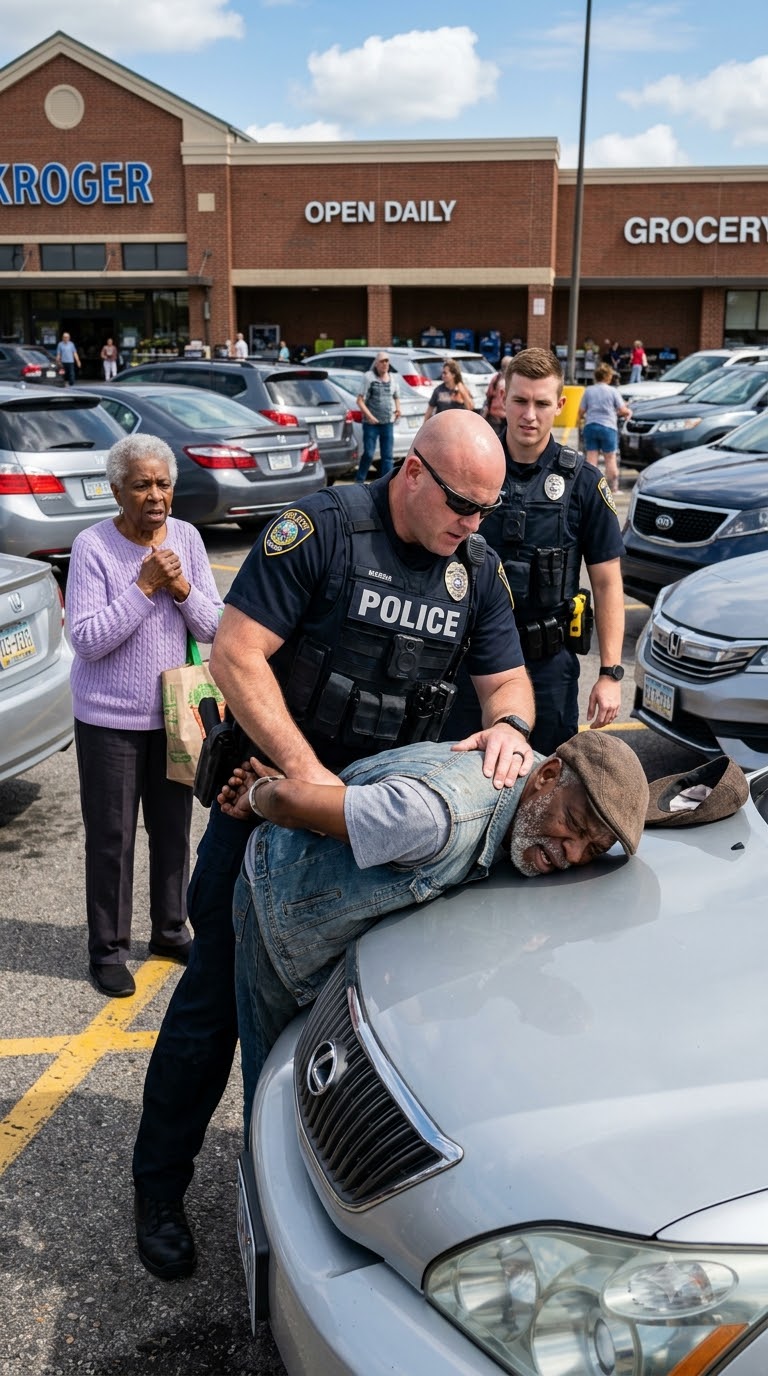
The first thing Harold Whitmore noticed was the rattle of shopping carts crossing the asphalt.
It was an ordinary Saturday afternoon outside Miller’s Fresh Market in Cedar Falls, Ohio. The sky was pale blue, the kind of late-spring blue that made people forget winter had ever existed, and the breeze carried the smell of charcoal from a barbecue stand near the entrance. Families came and went from the supermarket with paper bags under their arms, children begged for gum near the checkout lanes, and elderly men sat on the bench beside the cart return, pretending they weren’t watching the world pass.
Harold and his wife, Ruth, weren’t planning to stay long. Their son had insisted they remain in the car while he went inside to grab groceries, heart medicine, and a birthday cake for Ruth’s seventy-second birthday. Harold had objected at first because he hated feeling helpless, but his knees had bothered him all morning, and Ruth looked tired from the church rummage sale, so they agreed.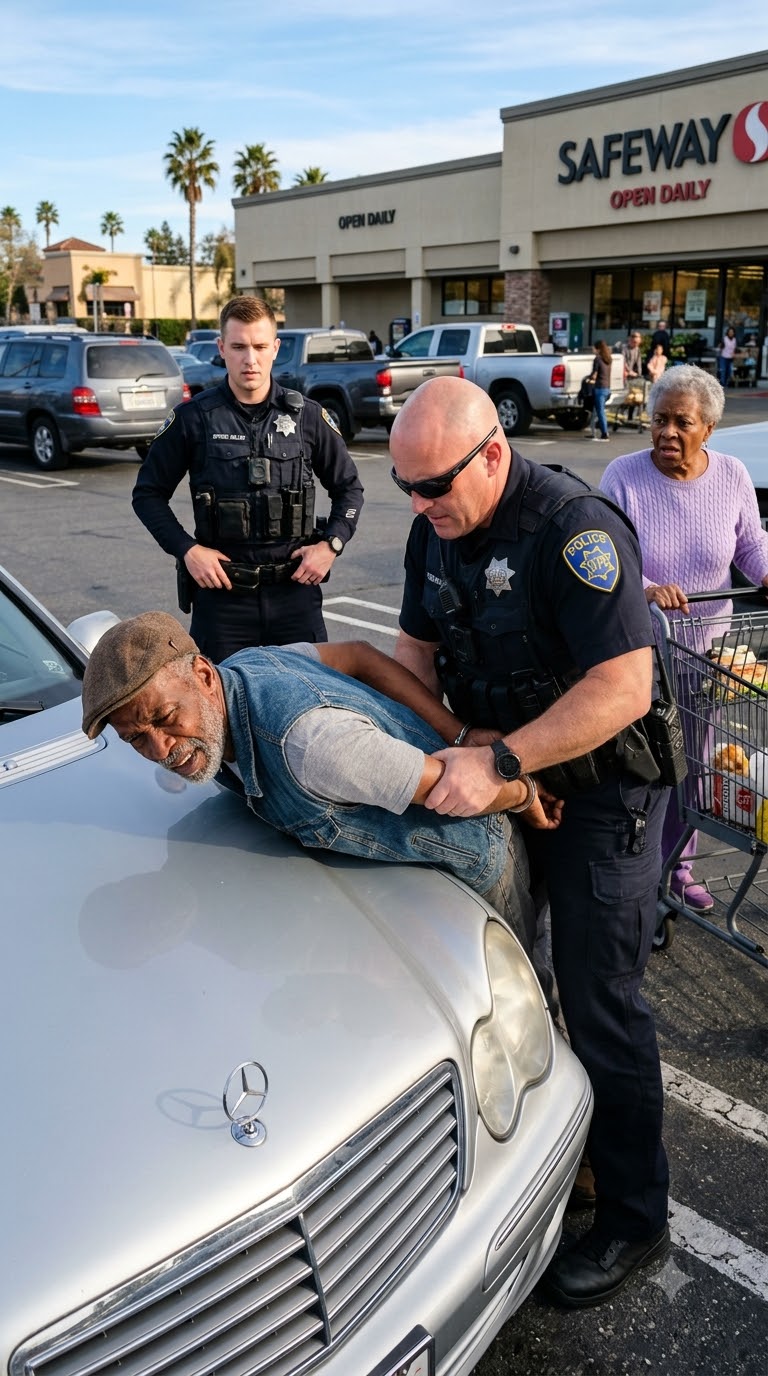
They sat together on the passenger side of an old blue Buick Park Avenue, parked two rows from the main entrance. Harold held his cane with one hand and rested the other over Ruth’s fingers. Ruth wore a soft lavender cardigan over her Sunday blouse, even though it was Saturday, because she had always believed people should look decent when going out in public. Harold wore a brown cap bearing the logo of the steel mill where he’d worked for thirty-eight years before it closed.
Their son had left the engine running to keep the air conditioning on. He had taken the keys with him, but the car remained unlocked because he only intended to be gone for ten minutes.
“He’ll forget the candles,” Ruth said.
Harold smiled. “He won’t forget the candles. He forgot them last year, and you made that face at him for a week. A man remembers a face like that.”
Ruth tried to hold back her laughter but couldn’t.
They had been married for fifty-one years. Harold could still make her laugh with almost nothing. It was one of the few things age had not taken from them.
Across the parking lot, a police cruiser slowly passed the pharmacy entrance. Harold noticed but thought nothing of it. Police cars drove through the lot regularly. Miller’s Fresh Market sat close to the interstate, and the store manager liked having patrols nearby to discourage theft.
But this cruiser didn’t continue.
It slowed.
Then it stopped at the end of their row.
Ruth noticed next. “Harold.”
“I see it.”
Two officers were inside. The driver was a broad-shouldered white man with a shaved head and mirrored sunglasses. The passenger was younger and leaner, with a nervous expression and one hand already resting on the door handle. The cruiser idled for several seconds, long enough for Harold to feel that familiar heaviness settle in his chest.
He knew that pause.
He had known it as a boy walking home from school in Alabama. He had known it as a young man driving through Indiana with Ruth sleeping beside him and two babies in the back seat. He had known it in grocery stores, banks, gas stations, and neighborhoods where his work boots cost more than the shoes worn by the men watching him.
It was the pause before someone decided he didn’t belong.
The driver’s door opened. The shaved-headed officer stepped out first. He adjusted his belt as though preparing for trouble he had already imagined. The younger officer followed, his eyes moving from Harold to Ruth and then to the Buick.
Harold squeezed Ruth’s hand once.
“Stay calm,” he whispered.
“I am calm,” she whispered back, though her fingers had turned cold.
The first officer stopped beside Harold’s window and struck the glass twice with his knuckles. Harold lowered it halfway.
“Afternoon, officer,” Harold said.
The officer didn’t return the greeting. “What are you doing in this vehicle?”
Harold blinked slowly. “Sitting. Waiting for our son.”
“Your son.” The officer glanced toward the supermarket entrance, then back at Harold. “This your car?”
“It belongs to our family.”
“That is not what I asked.”
Ruth leaned forward gently. “Officer, our son drove us here. He went inside to get our groceries. We are just waiting.”
The officer’s mouth twisted. “Ma’am, I wasn’t asking you.”
Harold felt Ruth stiffen beside him.
“No need to speak to her that way,” Harold said.
The officer lowered his sunglasses just enough to reveal pale, irritated eyes. “Excuse me?”
“I said there is no need to speak to my wife that way.”
For a moment, the sounds of the parking lot seemed to disappear. The carts rattled, the automatic doors opened and closed, and a child cried near the flower stand, but Harold heard only the officer’s breathing.
The younger officer shifted uneasily. His name tag read Bell. The older officer’s read Kersey.
Officer Kersey leaned closer to the window. “Step out of the car.”
“For what reason?”
“Because I told you to.”
Harold kept his voice steady. “Officer, I am seventy-six years old. My knees are bad. I am waiting for my son in my own family’s car. If there is a problem, please tell me what it is.”
“The problem is that this store has had a rash of vehicle break-ins, and now I find two people sitting in a running car with no keys and no driver.”
“The keys are with my son.”
“Convenient.”
Ruth’s voice trembled but remained dignified. “We have done nothing wrong.”
Kersey turned toward her. “I told you not to talk over me.”
Harold slowly opened the door, using his cane as he stepped out. Pain shot through his knee, but he refused to show it. He stood as straight as he could, one hand resting on the Buick’s roof.
“Here I am,” he said. “Now please explain what you want.”
Kersey looked him over: the mill cap, faded shirt, worn loafers, and cane. Then he looked at Ruth through the windshield as though she were evidence.
“Where is your ID?”
“In my wallet.”
“Get it. Slowly.”
Harold reached into his back pocket with two fingers. Bell took a half step forward, his hand near his taser. Harold stopped.
“I am getting my wallet because he asked for it,” Harold said.
“Just do it,” Kersey snapped.
Harold handed over his license. Kersey looked at it and smirked.
“Whitmore,” he said. “Address says Maple Hollow Drive.”
“Yes.”
“That’s across town.”
“Yes.”
“So why are you sitting in a car in this lot?”
Harold stared at him. “Because this is a supermarket. People come here to buy food.”
A woman loading groceries into a nearby minivan stopped and looked over. A man beside the cart return slowed down. Ruth noticed the attention and folded her hands in her lap, trying to disappear without lowering her head.
Kersey noticed the witnesses too, and his voice became louder.
“Don’t get smart with me. We got a call about suspicious persons checking car doors in this lot.”
“We have not checked any doors.”
“You expect me to believe that?”
“I expect you to look at the cameras. This store has cameras everywhere.”
The younger officer, Bell, glanced toward the black domes mounted on the light poles.
Kersey ignored him. “Turn around. Hands on the car.”
Ruth opened the passenger door. “No. Please. He has arthritis. He can’t stand like that for long.”
“Ma’am, get back in the vehicle.”
“He is my husband.”
“And if you interfere, you’ll be in cuffs too.”
Something changed in Harold. Not loud. Not explosive. Something quieter and older. His jaw tightened.
“You will not threaten my wife.”
Kersey stepped close enough for Harold to smell coffee and mint gum on his breath. “Old man, you are about two seconds from making this a whole lot worse.”
“It is already worse than it needs to be.”
Kersey grabbed Harold’s wrist.
Ruth cried out.
The movement was fast, unnecessary, and rough. Harold’s cane slipped and clattered onto the asphalt. His bad knee buckled. Bell reached as though to help, but Kersey shoved Harold against the Buick’s hood before he could fall.
“Hands on the car.”
“He didn’t do anything!” Ruth shouted.
Kersey twisted Harold’s arm behind his back.
Harold grunted, a sharp breath escaping his chest.
The woman by the minivan pulled out her phone.
“Officer,” Bell said quietly, “maybe we should wait for the complainant or check with store security.”
Kersey glared at him. “Maybe you should remember who your training officer is.”
Bell fell silent.
Ruth stepped toward them, tears gathering in her eyes. “Please, his shoulder. He had surgery. You’re hurting him.”
Kersey turned so quickly that Ruth flinched. “Back up.”
“Please.”
“Back up now.”
“I’m asking you to stop hurting my husband.”
Kersey grabbed Ruth by the upper arm and moved her away from Harold. It wasn’t exactly a shove, but it was hard enough to make her stumble against the open passenger door.
That was when the first voice from the crowd spoke.
“Hey, you don’t need to handle her like that.”
Kersey turned toward the man near the cart return. “Keep walking.”
The man raised both hands but didn’t move away. “They’re old. Come on.”
“I said keep walking.” Another phone appeared.
Ruth’s breathing came in quick, shallow bursts. Harold noticed and momentarily forgot the pain in his shoulder.
“Ruth,” he said. “Look at me. Breathe.”
She nodded and tried.
Kersey snapped one handcuff onto Harold’s wrist.
The cold click of metal seemed to cut through the entire parking lot.
“You have the right to remain silent,” Kersey began.
“For what?” Ruth cried. “What are you arresting him for?”
“Suspicion of attempted auto burglary, resisting investigation, and disorderly conduct.”
Harold nearly laughed, not because anything was amusing, but because the lie was so enormous it became ridiculous.
“I am standing beside my own car,” he said.
Kersey tightened the cuff. “You people always have an answer.”
The words remained hanging in the air.
They weren’t shouted or concealed. They were simply spoken aloud beneath the bright Ohio sky, outside the supermarket where Harold had bought peaches and coffee for twelve years.
Ruth froze.
Bell lowered his eyes.
The woman holding the phone whispered, “Oh my God.”
Kersey reached for Harold’s other wrist.
Then a voice came from behind them, cutting across the parking lot.
“Take your hands off my father.”
Everyone turned.
A man stood at the edge of the crosswalk, carrying two grocery bags in one hand and a white bakery box in the other. He was tall and broad-shouldered, dressed in dark jeans, a plain gray button-down shirt, and a black ball cap pulled low. His expression was so controlled that it seemed to make the air colder.
His name was Marcus Whitmore.
Officer Kersey, however, had no idea who he was.
All he saw was a large Black man approaching the police scene, jaw tight and eyes locked on the handcuffs around Harold’s wrist.
“Stop right there,” Kersey barked.
Marcus stopped. Slowly, he placed the grocery bags and cake box on the hood of a nearby car. Then he raised both hands, palms open.
“I am not armed,” he said. “I am their son.”
Kersey laughed once. “Their son?”
“Yes.”
“You think I’m stupid?”
Ruth turned toward Marcus, her voice breaking. “Baby, don’t move too fast.”
Marcus’s eyes shifted to the red mark on her arm where Kersey’s fingers had gripped her.
Something changed in his expression.
It wasn’t anger. It was something more dangerous because it remained completely controlled.
“Officer,” Marcus said, “you need to remove those cuffs and step away from my parents.”
Kersey’s hand moved toward his holster. “You don’t give orders here.”
“I’m not giving orders. I’m giving you the last chance to correct a mistake before it becomes something you can’t walk back.”
Bell looked sharply at Marcus.
Kersey sneered. “Big words. Where’d you learn those?”
“Law school,” Marcus said.
Kersey blinked, then smirked again. “Sure.”
“And after that, the United States Attorney’s Office.”
Silence fell across the parking lot.
Bell’s expression changed first. Recognition, or perhaps fear of recognition, flashed across his face. Kersey took longer.
“What did you say?”
Marcus carefully moved a hand toward his back pocket.
“Don’t,” Kersey snapped, drawing his taser halfway.
Marcus froze. “My credentials are in my wallet. I can show them if you allow me to do so safely.”
“Keep your hands where I can see them.”
“They are where you can see them.”
“Then keep your mouth shut.”
Harold raised his head from the hood. “Marcus, it’s all right.”
Marcus looked at him. “No, Dad. It is not.”
A third police cruiser entered the lot with its lights flashing. Then a fourth. Someone had called 911, or Kersey had requested backup before the situation spiraled further. Two additional officers stepped out, one carrying a notepad and another already surveying the crowd of phones.
With more officers arriving, Kersey seemed to regain his confidence.
“This man approached my scene aggressively,” he said, pointing toward Marcus. “Claims he’s related. Claims he’s some kind of federal official. Possible interference.”
Marcus remained motionless. “My name is Marcus Whitmore. I am the United States Attorney for the Northern District of Ohio. Those are my parents. You are holding my father without lawful cause. You placed your hands on my mother. Multiple civilians are recording. Miller’s Fresh Market has parking lot surveillance on at least four light poles. I strongly suggest you call your supervisor before you add another sentence to your report.”
This time, no one laughed.
Officer Bell swallowed. “Sir, do you have identification?”
“I do. May I retrieve it?”
Bell glanced at Kersey.
Kersey’s face had turned red. “No. He can say whatever he wants.”
Marcus’s voice remained even. “Officer Bell, call dispatch. Ask them to verify United States Attorney Marcus Whitmore. Then ask them whether Chief Daniel Hargrove has been trying to reach me for the past twenty minutes, because he has.”
Bell hesitated.
Kersey snapped, “Do not call anybody.”
Marcus looked directly at Bell. “Officer, this is the moment you decide whether you are a witness or a participant.”
The statement hit harder than a yell.
Bell stepped back and activated his radio.
“Dispatch, unit 318. Can you verify identity for a Marcus Whitmore, possible federal official?”
Kersey moved toward him. “Bell, I said—”
“Stop,” Marcus said.
Kersey spun around. “You shut up.”
The radio crackled.
“Unit 318, be advised, Marcus Whitmore is confirmed as United States Attorney, Northern District of Ohio. Chief Hargrove has an active callback request. Use caution and notify supervisor immediately.”
The words traveled through the parking lot like wind moving through dry grass.
Confirmed.
United States Attorney.
Supervisor immediately.
Ruth covered her mouth with one trembling hand.
Harold closed his eyes.
Kersey stood motionless, one cuff still secured around Harold’s wrist while the other dangled open from his hand.
Marcus slowly lowered his hands without reaching for anything. “Now take the cuff off my father.”
Kersey didn’t move.
One of the backup officers, a silver-haired sergeant with a tired face, stepped forward. His name tag read Calder.
“Kersey,” he said quietly, “remove the cuff.”
Kersey’s jaw tightened. “Sergeant, I had reasonable suspicion.”
“Remove the cuff.”
Kersey unlocked it with trembling fingers.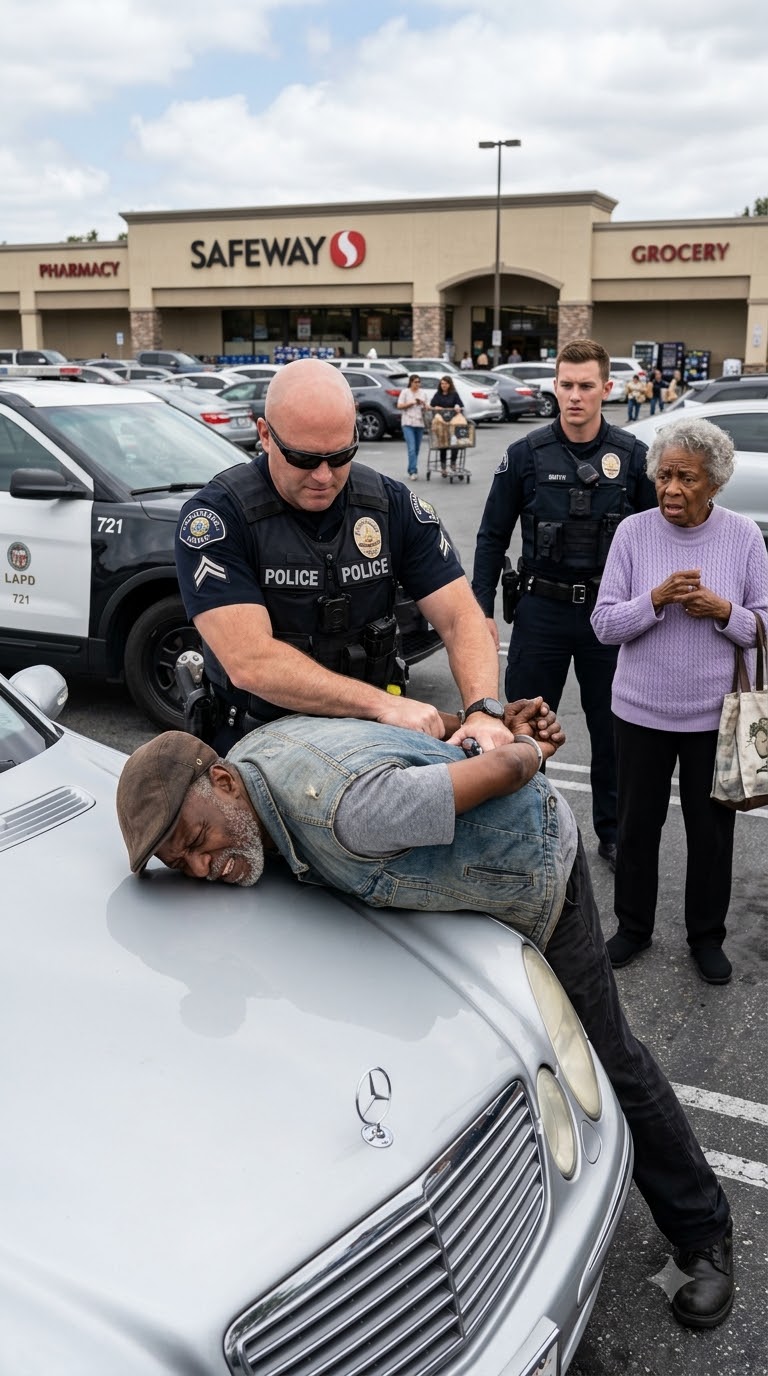
Harold pulled his arm back and rubbed his wrist. Ruth rushed to his side, and for one brief moment amid that stretch of asphalt, they were simply husband and wife again, her hands resting on his shoulder as he bowed his forehead toward hers.
Marcus moved closer. Bell and Calder allowed him through. He picked up Harold’s cane, brushed the asphalt dust from it with his sleeve, and handed it back to his father.
“You okay?”
Harold nodded once. “Your mama’s birthday cake is melting.”
Marcus almost smiled. Almost.
“We’ll get another cake.”
Ruth looked at him through her tears. “No. That one has lemon filling.”
Even Sergeant Calder looked away for a moment, ashamed.
Then the store manager hurried outside, a heavyset man named Neil Franklin, still wearing his green Miller’s apron.
“What is happening out here?” he demanded. “Mr. and Mrs. Whitmore? Are you all right?”
Kersey turned toward him. “This is police business.”
Neil looked at the scene, the phones, Harold rubbing his wrist, Ruth trembling, and Marcus standing there with federal authority written all over him.
“Police business?” Neil said. “Those two shop here every week. Their son was inside buying groceries. I watched him pay. We have cameras on the whole lot.” Marcus looked at Neil. “Can you preserve all footage from the last thirty minutes?”
“Absolutely.”
“Do not release it to anyone except through proper legal process.”
Neil nodded quickly.
Kersey made one last mistake.
“This is ridiculous,” he muttered. “If people like them didn’t look suspicious, none of this would happen.”
The words were spoken quietly.
But the phones captured them.
So did Marcus.
So did Sergeant Calder.
Marcus moved closer, lowering his voice until everyone leaned forward to hear him.
“People like them?”
Kersey realized what he had said. It was already too late.
Marcus continued. “My father worked thirty-eight years in a steel mill and paid taxes before you were old enough to spell probable cause. My mother taught second grade in this county for forty-one years. She taught children to read, including children whose parents probably voted for men who would call her suspicious in a parking lot. They raised me. They buried one daughter. They cared for my grandmother through dementia. They survived a country that kept asking them to prove they belonged. And today, while they waited for cake and heart medicine, you decided they were criminals because they were old, Black, and sitting in a car that looked too nice for your imagination.”
No one moved.
Marcus didn’t raise his voice.
That made it even more powerful.
“You did not make a mistake. You made a choice.”
Kersey looked around at the other officers, searching for someone to support him. No one did.
Sergeant Calder reached up and removed Kersey’s radio from his shoulder.
“Officer Kersey, you are relieved from field duty pending review. Hand me your badge and service weapon.”
Kersey stared at him. “In a grocery store parking lot?”
“Right now.”
“You can’t be serious.”
“I am very serious.”
The crowd watched as Kersey’s authority disappeared piece by piece. First came the radio. Then the weapon. Then the badge. Then the taser. Calder took each item from him beneath the bright white sun.
Several people whispered. One woman cried. The man near the cart return shook his head, as though he had waited years to witness something like this but still wished it had never been necessary.
Kersey was escorted toward a cruiser, not handcuffed, but not free either. Bell remained beside the Buick, pale and shaken.
Marcus turned toward him.
“Officer Bell.”
Bell swallowed. “Yes, sir.”
“You knew something was wrong.”
Bell looked down. “Yes, sir.”
“You almost spoke.”
“Yes, sir.”
“Next time, almost will not be enough.”
Bell nodded, his eyes wet. “I understand.”
Marcus didn’t comfort him. Not yet. Accountability had to come before comfort.
By sunset, the supermarket parking lot video had already spread throughout Cedar Falls. By nightfall, every local news station was carrying it. By morning, national outlets had picked it up, turning Miller’s Fresh Market into the center of a national argument.
Elderly couple handcuffed while waiting for son.
Officer suspended after confronting parents of U.S. attorney.
Parking lot arrest attempt sparks federal review.
But headlines never tell the entire story.
They didn’t show Ruth sitting at the kitchen table that night with an ice pack against her arm, staring at the untouched lemon cake as though it belonged to another life. They didn’t show Harold pretending his shoulder wasn’t hurting because he didn’t want his wife to worry. They didn’t show Marcus standing in the hallway, loosened tie in one hand, struggling with the kind of anger that had to become strategy or consume him.
“I should have come out sooner,” he said.
Ruth looked up. “You came when you came.”
“They put hands on you.”
“And now you know why we always told you to keep your license where you could reach it,” Harold said quietly.
Marcus turned toward him.
Harold’s voice wasn’t bitter. Somehow, that made it harder.
“You thought we were being careful because we were old,” Harold said. “We were being careful because we had practice.”
Marcus sat down.
Despite all his titles, courtroom victories, and federal seals on his office door, he was simply a son sitting at his parents’ table, learning again that dignity couldn’t shield people from humiliation. It could only help them endure it.
“Then we don’t just handle Kersey,” Marcus said. “We handle the practice.”
The following day, his office launched a formal civil rights inquiry into the Cedar Falls Police Department’s complaint history. Within forty-eight hours, what had begun as a parking lot incident had grown into something much larger.
The grocery store footage showed Kersey and Bell watching the Buick for nearly four minutes before approaching. It showed nobody checking door handles. There was no theft, no attempted burglary, and no threat. It showed Harold moving slowly and carefully, exactly as an elderly man with bad knees would. It showed Ruth being grabbed. It showed the precise moment Kersey’s suspicion turned into force.
Then the city records arrived.
Seventeen complaints against Officer Kersey over nine years.
Improper stops.
Aggressive detentions.
Racial language.
Searches without cause.
All cleared internally.
Marcus read the file alone in his office late that night. Every complaint had a name. Every name belonged to a life. A grandmother stopped outside a pharmacy. A college student pulled from his car after buying gas. A delivery driver detained for forty minutes because he “matched a description” nobody could later produce. An old veteran searched outside a hardware store because someone said he looked out of place.
People like them.
That phrase became the key that unlocked everything.
Within a week, Cedar Falls held a town meeting inside the high school gymnasium. Five hundred people attended. Some arrived angry. Some came embarrassed. Others came simply because news vans were outside and they wanted to be seen on the right side of history.
Harold didn’t want to speak.
Ruth did.
She walked to the microphone wearing the same lavender cardigan she had worn in the parking lot. The bruise on her arm had faded from red to yellow. Her voice trembled at first, then steadied.
“I taught children in this town for forty-one years,” she said. “Some of you learned your letters in my classroom. Some of your children did. I taught them that America is a promise, not a possession. A promise has to be kept every day. That day in the parking lot, that promise was broken. Not only for me and my husband, but for every person who watched and wondered if they would be next.”
The gym fell silent.
She looked toward Officer Bell, sitting in the second row with his hands folded and his head lowered.
“I am not asking for revenge,” Ruth said. “I am asking for memory. Remember what happened when no one was watching closely. Remember what changed when people picked up their phones. Remember that silence is not peace. Sometimes silence is just fear wearing church clothes.”
People rose before she finished.
Not everyone.
Enough.
Harold stood last, leaning on his cane, his eyes shining.
Marcus stood behind his parents, not as the man with the title, but as the boy they had raised.
Officer Kersey was terminated three weeks later. The state charged him with assault and official misconduct. The federal inquiry found enough evidence to force a consent agreement with Cedar Falls: mandatory body cameras, independent complaint review, public reporting of stops, and retraining supervised by outside monitors.
Officer Bell kept his job only after testifying fully, admitting that he had seen Kersey target people before and had remained silent. He was suspended, reassigned, and required to speak at every academy class about the cost of silence.
At first, he hated it.
Then he understood it.
Six months later, Miller’s Fresh Market installed a bench near the cart return. It wasn’t a memorial because Harold refused to call himself a victim who needed a plaque. It was simply a bench. Ruth chose the words.
For neighbors waiting, resting, and belonging.
On Ruth’s next birthday, Marcus drove his parents back to the supermarket. Harold complained about the fuss. Ruth wore blue this time. Marcus bought groceries, heart medicine, and a lemon cake with extra candles because, as he said, they had earned the extra light.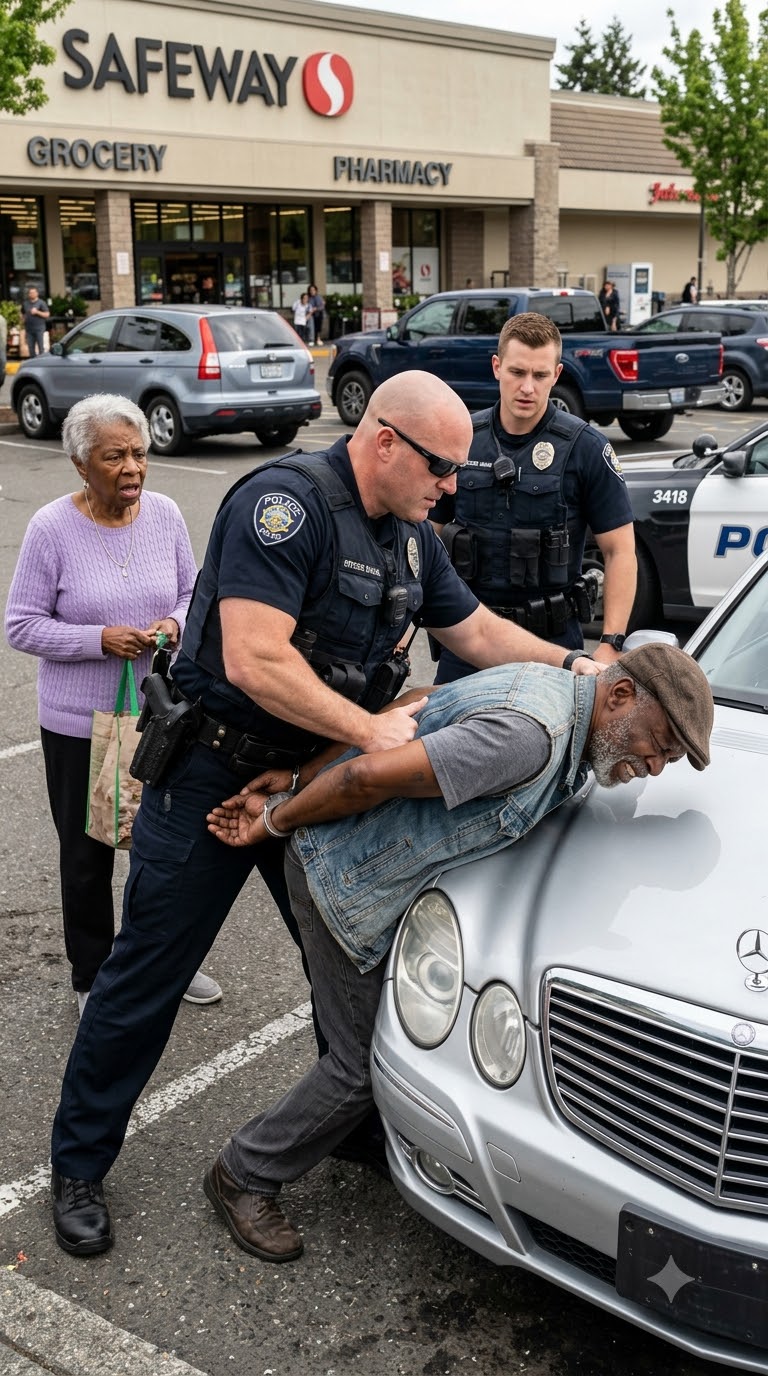
When they came outside, Harold and Ruth sat on the new bench while Marcus loaded the car. People nodded as they passed. Some recognized them. Some didn’t. A little girl dropped a box of strawberries, and Harold slowly bent down to help her gather them.
Her mother smiled. “Thank you, sir.”
Harold tipped his mill cap. “You’re welcome.”
Across the lot, a police cruiser passed.
Ruth noticed Harold noticing it.
The cruiser slowed, but only because a shopping cart had drifted into the lane. Officer Bell stepped out, moved the cart back to the return, and gave the Whitmores a quiet nod.
Harold returned it.
Not forgiveness.
Not yet.
But perhaps the beginning of a different kind of habit.
Marcus closed the trunk and turned toward his parents. “Ready?”
Ruth looked at Harold. Harold looked at the bench, the store, the parking lot, the place where humiliation had tried to make them smaller and failed.
“In a minute,” he said.
So they remained there a little longer beneath the afternoon sun, two elderly people outside a supermarket, waiting not because they were helpless, not because they were suspicious, but because they had every right to take up space in the world they had helped build.
And this time, nobody dared tell them otherwise.
