

Saturday morning at Riverside Commons was supposed to be completely ordinary. Families moved strollers beneath the tall oak trees, cyclists traveled along the river path, and children ran around the playground while their parents balanced coffee cups on picnic tables. The early-June sun had not yet become oppressive, and a light breeze drifted over the water from the Neuse River.
Nothing about that morning suggested that one section of pavement would soon become the center of a confrontation involving race, fear, medicine, and the consequences of authority deciding what it was seeing before actually taking the time to look.
Dr. Andre Lawson was halfway through his usual weekend run. Forty years old, Black, and lean from years of distance training, he worked as an emergency physician at Wakebridge Medical Center, less than twenty minutes away. For twelve years, he had treated trauma victims, heart attacks, overdoses, strokes, and countless other emergencies people brought through hospital doors during the worst moments of their lives.
That morning, however, Andre was thinking about something far less serious: whether he wanted waffles or scrambled eggs when he got home.
He wore black running shorts, a faded blue performance shirt, and a pair of running shoes his wife had been telling him to replace for months. One earbud played music quietly while the other remained loose enough for him to hear cyclists and faster runners coming from behind.
His pace was comfortable, his breathing steady, and he had just passed the river overlook when the woman ahead of him suddenly stumbled.
One second she was running normally.
The next, her legs disappeared beneath her.
Her name, Andre would later learn, was Emily Carter. She was thirty-seven, white, athletic, and wearing a bright coral running top with matching shoes that made her easy to spot along the trail. Andre had passed her earlier that morning while they were running in opposite directions, but they had never exchanged a word.
When Emily collapsed, she did not extend her hands to break the fall or attempt to protect herself. She simply dropped with the heavy, uncontrolled movement of someone whose body had abruptly stopped responding.
Andre tore the earbud from his ear and sprinted toward her.
By the time another runner yelled for someone to call 911, Andre was already on his knees beside Emily.
“Ma’am, can you hear me?”
He placed one hand against her shoulder.
There was no response.
Andre carefully rolled her onto her back, opened her airway, and checked her breathing.
Her chest was not moving.
Two fingers against the side of her neck found no meaningful pulse.
The conclusion came almost immediately.
Cardiac arrest.
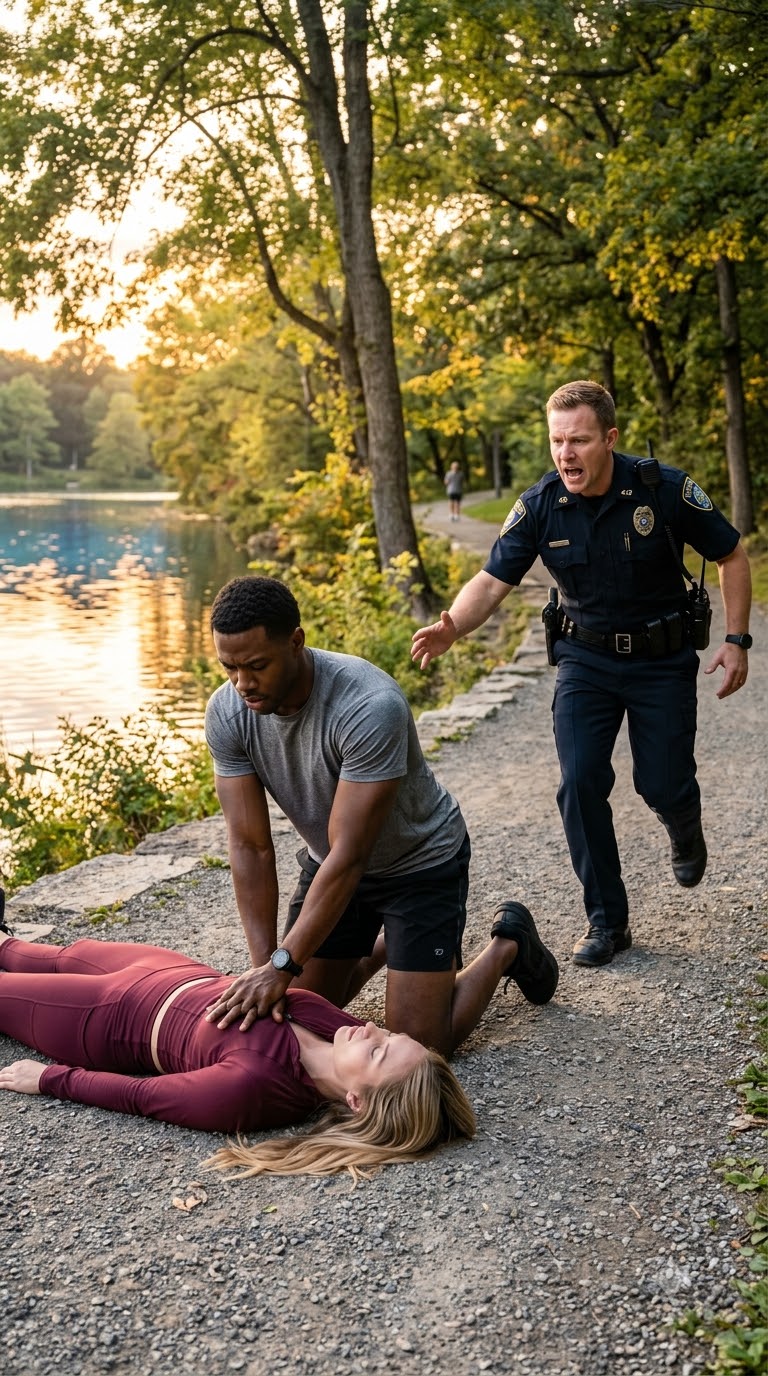
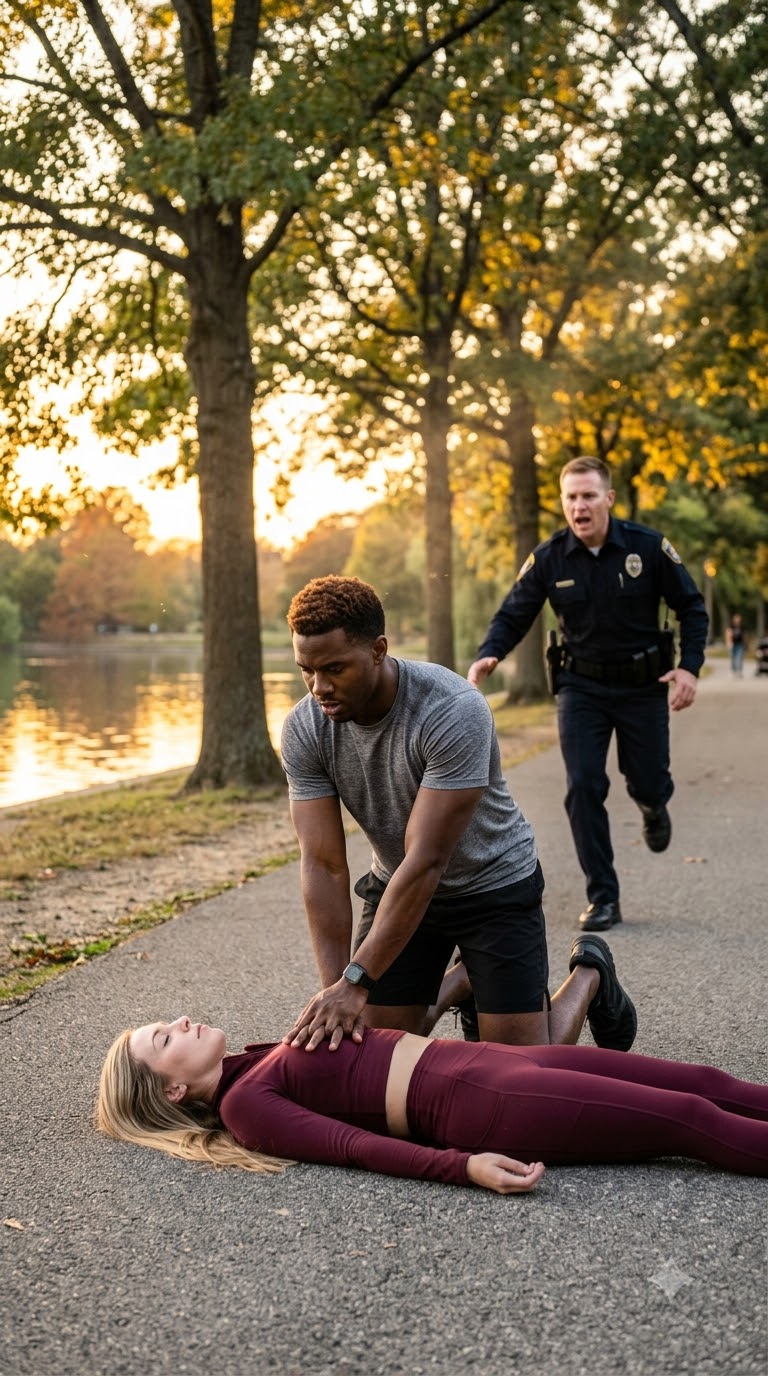
Andre positioned both hands over the center of Emily’s chest and began compressions.
“One, two, three, four,” he counted, pressing firmly and rhythmically while keeping his arms straight.
After thirty compressions, he opened her airway and delivered two rescue breaths before immediately returning to her chest.
There was no time to hesitate.
Several people had stopped along the trail. A man holding a Labrador stood frozen nearby while a young woman asked whether Andre needed assistance.
“Call 911 and tell them cardiac arrest,” Andre said without looking up. “West river loop, just south of the overlook.”
A man wearing a red baseball cap raised his phone and repeated the information to the dispatcher. Another runner said he knew basic CPR and could take over if Andre became exhausted.
Andre gave one brief nod.
“Stay close.”
Thirty compressions.
Two breaths.
Thirty more.
Sweat rolled down Andre’s temples. His shoulders began to burn, but he ignored the discomfort.
What Andre could not see was Linda Morrison, fifty-four, sitting on a bench roughly seventy yards away.
She had been drinking iced coffee and scrolling through neighborhood posts on her phone when she looked toward the trail.
From that distance, she saw a Black man kneeling over a motionless white woman.
She could not clearly see his hands.
She could not hear him counting.
She could not see the CPR.
Fear filled the gaps that observation had left behind.
Linda stood quickly and called 911.
“There’s a man attacking a woman in Riverside Commons.”
The dispatcher immediately asked what the man was doing.
Linda stared toward Andre.
“He’s over her.”
She tightened her grip on the phone.
“She’s not moving.”
“Is he hitting her?” the dispatcher asked.
Linda hesitated.
“I can’t tell exactly.”
She moved several steps closer but remained well away from the gathering crowd.
“He’s on top of her.”
The dispatcher asked whether anyone nearby appeared to be helping.
Linda looked at the runners standing around Andre.
“There are people watching.”
“Are they trying to stop him?”
Another pause.
“No.”
The dispatcher asked whether Linda could safely move closer and determine whether the man was providing medical assistance.
Linda looked again.
“I don’t think so.”
She did not approach.
She did not ask the people beside her what was happening.
She had already decided what she believed she was seeing.
The call entered the system as a possible assault in progress.
The description was simple:
Black male over unresponsive white female, possible physical attack.
Nothing in the dispatch summary mentioned CPR.
Four minutes later, two Raleigh police cruisers entered Riverside Commons with their emergency lights flashing.
Officer Grant Mercer arrived first. Thirty-eight years old, with almost thirteen years on patrol, he carried himself with the confidence of someone accustomed to acting before other people finished explaining.
Officer Evan Pike, thirty, followed him. Pike had developed a reputation for rarely challenging senior officers.
Neither officer stopped to ask Linda what she had actually seen.
Neither asked the runners surrounding Emily what had happened.
They saw Andre over Emily’s body.
They saw his arms moving.
They saw the scene described over the radio.
And they saw exactly what the dispatch description had prepared them to see.
Andre was counting compressions when Mercer came within several feet of him.
“Twenty-five, twenty-six, twenty-seven.”
Andre never heard an order to stop.
Mercer pulled pepper spray from his belt.
Evan approached from the side, one hand near his service weapon.
Neither officer took the additional second required to recognize the unmistakable rhythm of CPR.
The spray struck Andre directly across the face.
Chemical fire exploded through his eyes, nose, and throat.
His hands came away from Emily’s chest as he recoiled, choking.
For the first time since Emily’s heart stopped, nobody was compressing her chest.
That fact registered in Andre’s mind even before the pain fully did.
“She’s in cardiac arrest!” he shouted.
Evan grabbed both of Andre’s arms.
Andre could barely see.
“I’m a doctor,” he tried to say while coughing violently.
Evan forced him face-first toward the pavement.
Andre twisted enough to keep his nose from striking first, but his cheek scraped against the concrete.
“Stop resisting!”
“I’m not resisting.”
Andre’s voice cracked.
“She has no pulse.”
Mercer grabbed Andre’s other arm and pulled it behind him.
Cold handcuffs tightened around both wrists.
Andre could hear Emily’s body lying only a few feet away.
A woman near the trail screamed.
“He was doing CPR!”
Another runner shouted, “He was helping her!”
Mercer looked toward the crowd.
“Everybody stay back.”
His voice suggested that the witnesses had become another problem he needed to control.
Andre turned his head slightly. His eyes were squeezed shut against the burning spray.
“Someone needs to keep compressions going.”
“Shut up,” Mercer said.
Andre coughed.
“She’s been down maybe four minutes.”
His voice became desperate.
“Every second matters.”
Evan gave a short laugh.
“You were just attacking her.”
“No.”
Andre forced the word through the burning in his throat.
“Wakebridge Medical. Emergency department. Dr. Andre Lawson.”
Evan tightened the cuff.
“Sure you are.”
Andre had treated countless patients who lied about their identities, medications, drug use, injuries, and circumstances because fear could make people say almost anything.
He understood skepticism.
What he could not understand was skepticism so complete that new information could no longer enter.
“I am an emergency physician.”
Andre spoke slowly.
“She collapsed while running.”
Mercer leaned closer.
“Everybody suddenly has a career when the cuffs come out.”
Then he told Andre he could explain himself at the station.
Andre stopped arguing.
Not because he accepted what was happening.
Because Emily had become more important than his own humiliation.
Andre knew exactly what her brain was experiencing.
No circulation meant no meaningful oxygen delivery.
Every uninterrupted minute mattered.
He knew what prolonged cardiac arrest could do.
He knew what delay meant.
And there was nothing he could physically do.
That was the part he would remember years later.
Not the pepper spray.
Not the handcuffs.
Not the humiliation.
It was lying facedown on concrete while a woman he had been trying to save went without chest compressions.
He understood the biology of every disappearing second.
He knew exactly what they were losing.
And he could not reach her.
The ambulance entered the park less than half a minute later.
Paramedic Carlos Mendoza jumped from the passenger side before the vehicle had fully stopped, with his partner Sophie Grant immediately behind him carrying the AED.
Carlos saw Emily unattended on the pavement.
He dropped beside her and checked for a pulse.
“Weak pulse, terrible rhythm.”
He looked toward Sophie.
“Pads on.”
Sophie opened the AED.
Carlos began compressions.
The machine started analyzing.
Only then did Carlos look around.
“Who was doing CPR before us?”
Almost everyone pointed toward the Black man lying handcuffed several feet away.
Carlos followed their hands.
He saw chemical residue running down Andre’s cheeks.
Then he looked closer.
“Wait.”
He stopped for half a second.
“Andre?”
Andre turned his head toward the voice.
“Carlos.”
Carlos stared at him.
“Dr. Lawson?”
Andre nodded once.
“She collapsed in front of me. No pulse, no breathing.”
Carlos stood halfway and looked directly at Mercer.
“Why is he in handcuffs?”
Mercer said they had responded to an assault.
Carlos looked back toward Emily.
“What assault?”
“The caller said he was on top of her.”
Carlos stared at him.
“He was doing chest compressions.”
Mercer’s expression changed slightly.
Evan looked away.
Sophie attached the AED pads.
The machine announced that a shock was advised.
Carlos immediately returned his attention to Emily.
“Clear.”
The shock delivered.
They resumed compressions.
After another analysis, a second shock was advised.
Andre lay on the pavement listening to every command.
Then Carlos checked Emily’s carotid pulse.
“We’ve got something.”
Sophie leaned closer.
“Breathing’s coming back.”
Carlos nodded.
“Let’s move.”
For the first time since the pepper spray hit his face, Andre felt some of the pressure in his chest loosen.
Emily was alive.
Whatever happened afterward, she still had a chance.
The witnesses had become louder.
Thomas Greene, a retired science teacher, told Mercer he had watched Emily collapse before Andre ever reached her.
Natalie Brooks, a graduate student, said her phone recording showed Andre counting compressions.
Another runner shouted that neither officer had asked anyone what happened.
A man near the bicycle rack raised his phone.
“I have you spraying him while both his hands were on her chest.”
Mercer glanced toward the phones.
The confidence in his face began disappearing piece by piece.
Evan had gone pale.
Carlos stepped toward Andre.
“Take the cuffs off him.”
Mercer hesitated.
Carlos’s voice hardened.
“He needs his eyes flushed.”
He pointed toward Emily’s stretcher.
“And he is the reason she had any circulation when we got here.”
Mercer finally reached for the key.
The cuffs opened.
Deep red marks had already formed around Andre’s wrists.
Carlos and Sophie helped him sit.
Water from the ambulance flushed Andre’s eyes while he coughed and fought the instinct to rub them.
His first question remained the same.
“How is she?”
Carlos looked at him.
“She has a pulse.”
Andre closed his eyes for a moment.
“Good.”
“She’s going to the hospital.”
Andre nodded.
“I’ll meet you there.”
Carlos frowned.
“You’re not driving anywhere.”
Andre almost smiled despite the burning in his face.
“I wasn’t planning to.”
Carlos looked toward Mercer.
Then back at Andre.
“You need to be checked too.”
Andre shook his head.
“Emily first.”
Carlos gave him a knowing look.
“You’re still a doctor even when you’re the patient.”
Andre finally allowed the paramedic to examine him.
The scene around them had changed completely.
The people who had initially watched in uncertainty were now openly angry.
Several witnesses remained in place, holding their phones up as evidence.
Linda Morrison stood farther back, her face pale.
She had watched everything.
The scene she had reported as an assault had turned into something else entirely.
She approached slowly.
Andre looked at her.
She stopped several feet away.
“I thought…”
Her voice failed.
Andre said nothing.
Linda swallowed.
“I thought you were hurting her.”
Andre looked toward the ambulance where Emily was being loaded.
“You didn’t know.”
“I should have gotten closer.”
Andre’s expression remained exhausted.
“Yes.”
Linda lowered her eyes.
“I’m sorry.”
Andre did not answer immediately.
Then he said quietly, “I hope next time you look twice.”
The sentence stayed with Linda.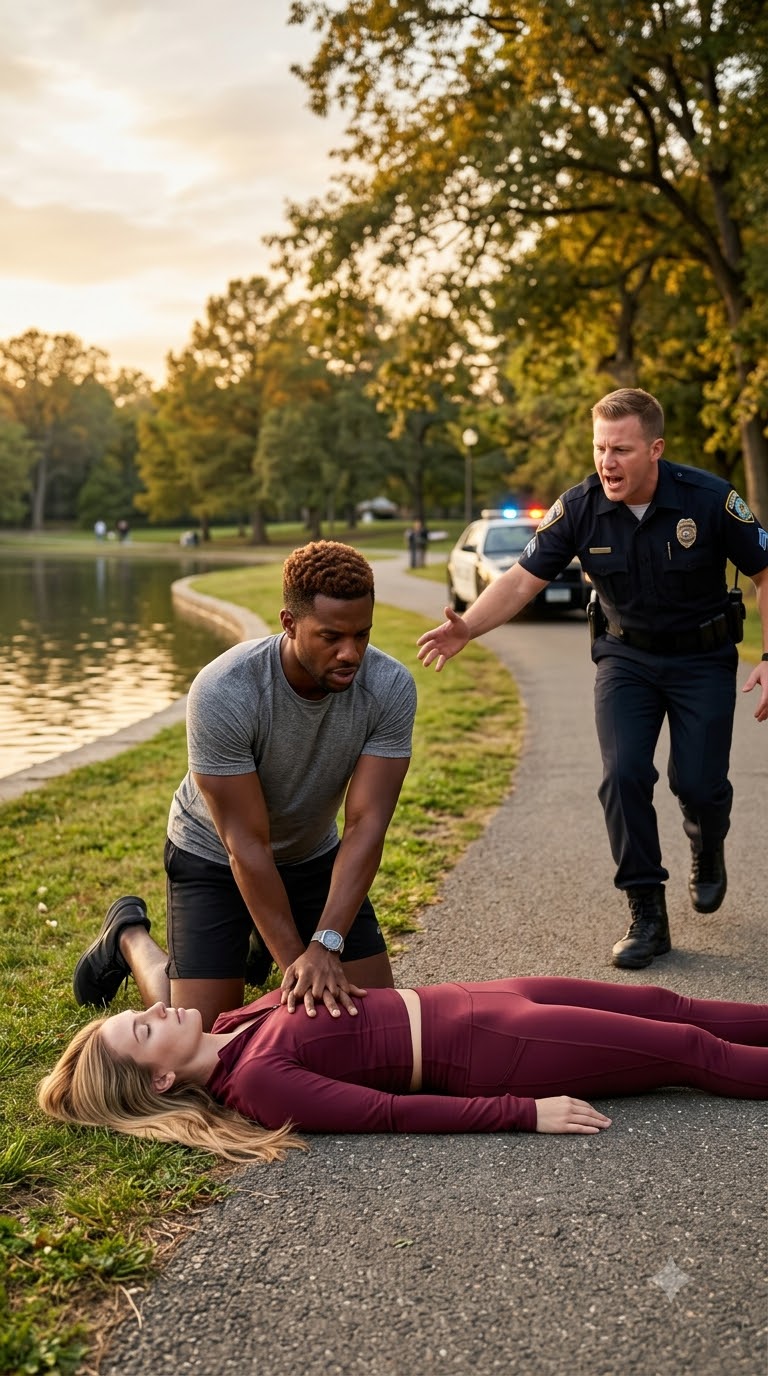
At Wakebridge Medical Center, Emily was rushed into the emergency department.
Andre arrived separately after receiving treatment for the pepper spray. He remained outside the trauma bay because hospital policy required him to step away from Emily’s care.
For nearly an hour, he waited.
His wife, Melissa, arrived after receiving his call.
When she saw the red around his eyes and the marks on his wrists, her face changed.
“What happened?”
Andre sat quietly.
“A woman collapsed during my run.”
Melissa knew him well enough to understand that the rest was difficult to say.
“You tried to save her.”
Andre nodded.
“The police thought I was attacking her.”
Melissa stared at him.
“What?”
Andre looked down.
“They sprayed me while I was doing CPR.”
Melissa’s eyes filled with disbelief.
“Did she survive?”
Andre looked toward the trauma bay.
“She has a pulse.”
That was all he could say.
Two hours later, Emily’s condition stabilized.
The attending physician came into the waiting area.
“She regained consciousness briefly.”
Andre exhaled.
“She recognized her husband.”
Melissa squeezed his hand.
“That’s good.”
“It is.”
Andre looked down at the bruises around his wrists.
“But this can’t happen again.”
The videos from Riverside Commons had already begun spreading online.
The clearest recording showed Andre performing CPR.
Another showed Mercer spraying him.
A third captured Andre lying handcuffed on the ground while repeatedly telling officers that Emily was in cardiac arrest.
The public reaction was immediate.
But Adrian Lawson’s hospital administration refused to let the incident become merely an internet controversy.
The medical center’s legal department requested the complete body-camera footage.
The hospital’s chief medical officer issued a statement confirming that Andre Lawson was an emergency physician and had been providing emergency medical care when the officers intervened.
The police department initially released a brief statement saying officers had responded to a reported assault and that the circumstances were under review.
That statement lasted less than a day.
The witness recordings contradicted the original description.
So did the ambulance crew.
So did the body-camera footage.
Most importantly, the evidence showed that officers had never attempted to establish what Andre was doing before using force.
An independent investigation was opened.
Mercer and Pike were placed on administrative leave pending review.
The department’s internal report initially described the encounter as a “miscommunication.”
Andre objected immediately.
“This was not a miscommunication.”
He sat before investigators with his wrists still bruised.
“A miscommunication is when someone hears one thing and understands another. They were given multiple opportunities to understand what was happening.”
The investigator asked him what he believed caused the mistake.
Andre paused.
“Assumption.”
“What kind?”
Andre looked directly at him.
“The kind that makes a person decide who you are before you ever speak.”
The investigator wrote the words down.
Andre continued.
“They saw a Black man over a white woman. They decided what that meant. After that, everything I said became evidence against me instead of information they needed to consider.”
The investigation eventually confirmed that multiple witnesses had told officers Andre was performing CPR.
Those statements had been ignored during the initial arrest.
The body-camera footage showed Mercer had heard at least one witness shout that Andre was helping Emily.
It also showed that Mercer did not immediately reconsider his actions.
The case became larger than one morning in a park.
A review of department training revealed that officers received instruction on responding to medical emergencies, but the material did not adequately address how to distinguish a medical intervention from an assault when the circumstances were unclear.
The police chief announced new requirements for officers responding to reported assaults involving unconscious people.
Before using force, when circumstances permitted, officers would be required to establish whether someone was providing medical assistance.
Supervisors would review any use of chemical agents during an apparent medical emergency.
And witness statements would have to be documented before an incident could be closed.
Mercer eventually faced disciplinary proceedings.
The independent review concluded that his use of pepper spray had not been justified by the circumstances captured on the available evidence.
Pike was also disciplined for failing to intervene when the situation became clear.
The consequences were not instant.
They were not dramatic.
There was no single courtroom moment where everyone suddenly admitted what had happened.
Instead, the truth emerged piece by piece.
Witnesses testified.
Recordings were reviewed.
Reports were compared against video.
And the original story fell apart.
Months later, Emily returned to Riverside Commons.
She walked slowly along the same path where she had collapsed.
Andre was there too.
She stopped when she saw him.
For a moment, neither spoke.
Then Emily smiled.
“I don’t remember falling.”
Andre nodded.
“You don’t need to.”
“I remember waking up in the hospital.”
“That’s enough.”
Emily looked at him.
“My husband told me what you did.”
Andre glanced toward the river.
“I was just doing my job.”
Emily shook her head.
“No.”
She looked directly at him.
“You were saving my life.”
Andre smiled faintly.
“That’s what doctors do.”
Emily’s eyes became wet.
“I wanted you to know that I know.”
Andre nodded.
“I’m glad you’re here.”
They stood quietly beside the river.
The same trees moved in the breeze.
The same cyclists passed along the path.
The same ordinary Saturday morning atmosphere seemed to have returned.
But for Andre, the place would never again be completely ordinary.
Neither would the lesson.
He had spent twelve years learning that emergencies demanded observation before assumption, assessment before action, and facts before conclusions.
That morning, he had watched the opposite happen.
A woman nearly died.
A doctor was treated like a criminal.
A frightened caller made an assumption.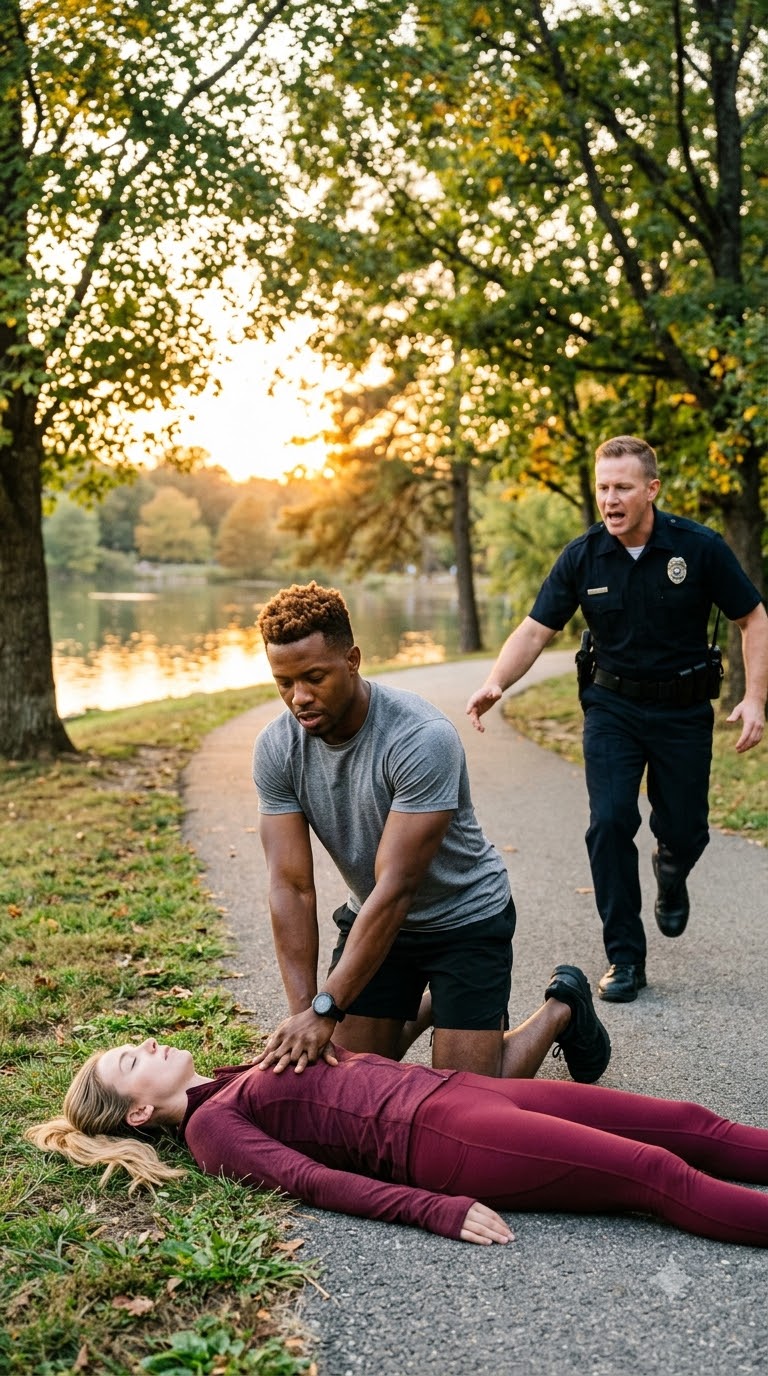
Two officers trusted that assumption more than the evidence unfolding directly in front of them.
And one paramedic recognized the truth in time to change the outcome.
Carlos later told Andre that the moment he recognized him was not what mattered most.
“What mattered,” Carlos said, “was that somebody finally looked at the scene and actually saw it.”
Andre remembered those words.
Because that was the real failure at Riverside Commons.
It was not simply that officers had made a mistake.
It was that they had stopped looking.
They saw a Black man.
They saw a white woman.
They saw a frightening possibility.
And once they had chosen their story, they stopped listening.
The evidence had been there the entire time.
Andre’s hands were positioned over Emily’s chest.
His voice was counting compressions.
Witnesses were standing nearby.
A phone was recording.
And still, they decided what they wanted to believe.
Months later, Andre returned to his weekend runs.
His wife finally convinced him to replace his worn-out shoes.
He still passed the river overlook.
He still slowed slightly when he reached the place where Emily had fallen.
But he did not stop.
He kept running.
Because the morning at Riverside Commons had taught him something he already knew as a physician but now understood in a much more personal way:
The difference between saving someone and losing them can be measured in seconds.
And sometimes, the most dangerous thing standing between a person and help is not a lack of evidence.
It is an assumption made before anyone bothers to look.
