

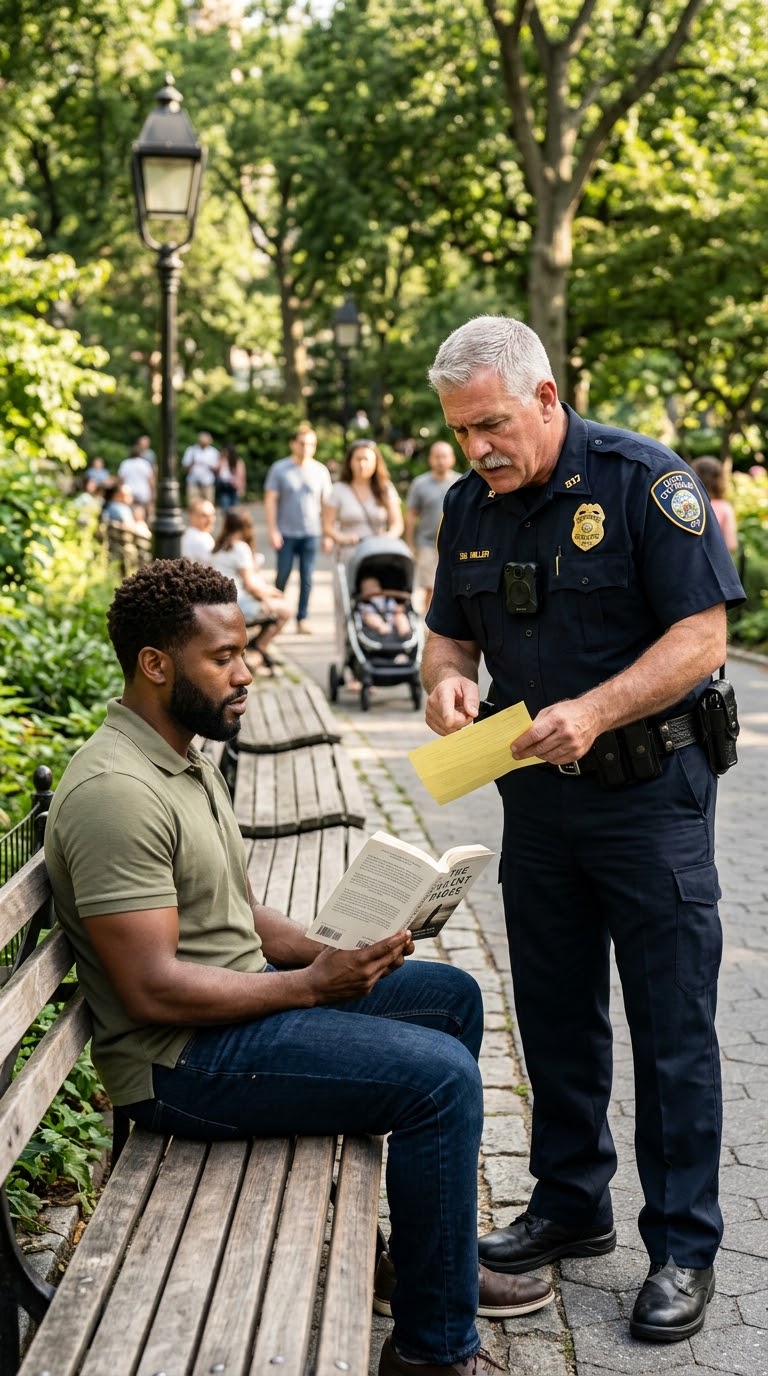
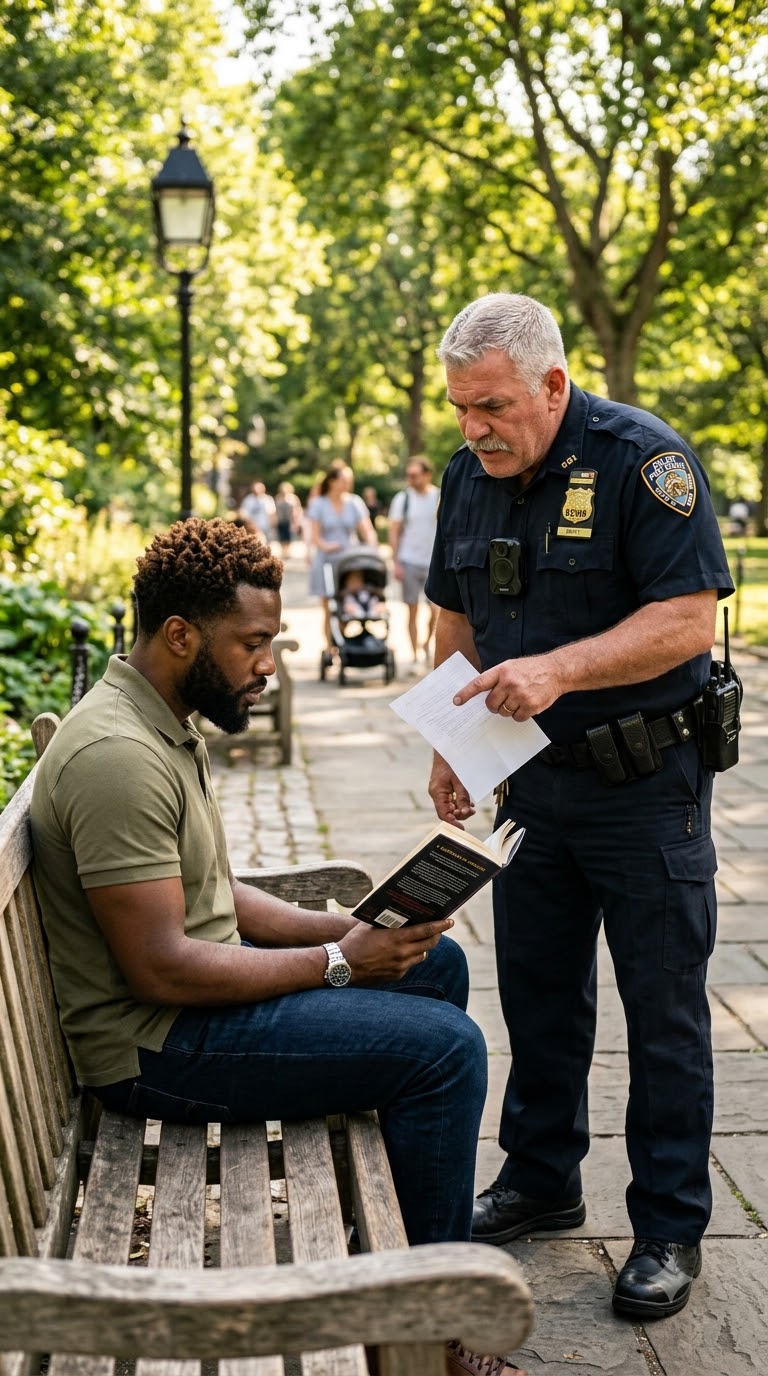
“A guy like you just sits in the park reading?”
Marcus Davis gradually closed the hardcover resting across his knees.
He lifted his eyes toward Officer Brian Harkin.
“What exactly does a guy like me look like?”
For the first time since approaching him across the grass, Harkin seemed unable to come up with an immediate answer.
Riverside Park was packed that Friday afternoon.
Children shouted around the playground.
A couple walked two dogs along the trail beside the river.
An elderly man tossed crumbs toward a cluster of pigeons.
Marcus had been sitting beneath an oak tree by himself for almost forty minutes, making the most of the first genuinely free afternoon he’d had in weeks.
At forty-three, Marcus was six feet tall, Black, and athletic without looking threatening. His hair was close-cropped, and a neatly maintained beard framed his face.
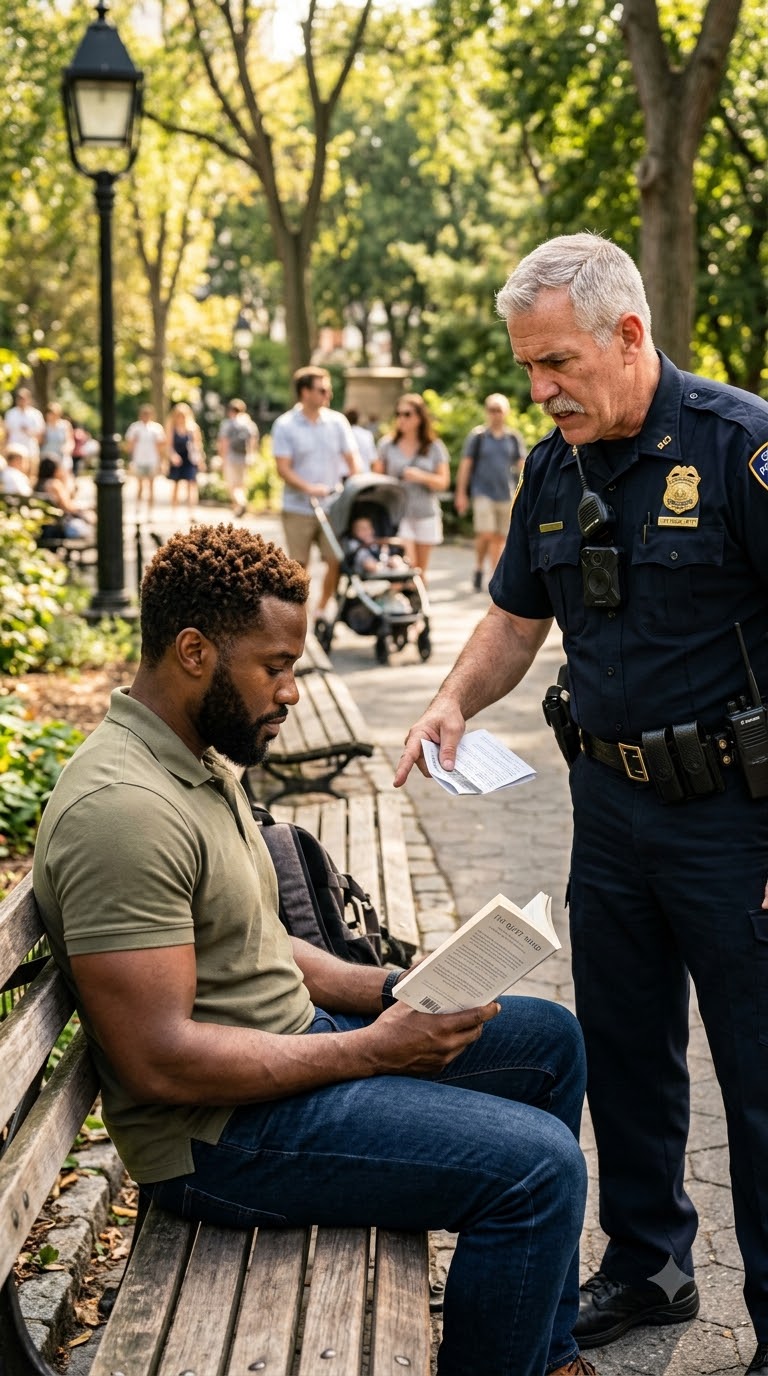
Dark jeans.
A gray pullover.
Running shoes.
Nothing unusual.
Nothing unlawful.
The biography resting on his lap was a book he’d been trying to finish for nearly a month.
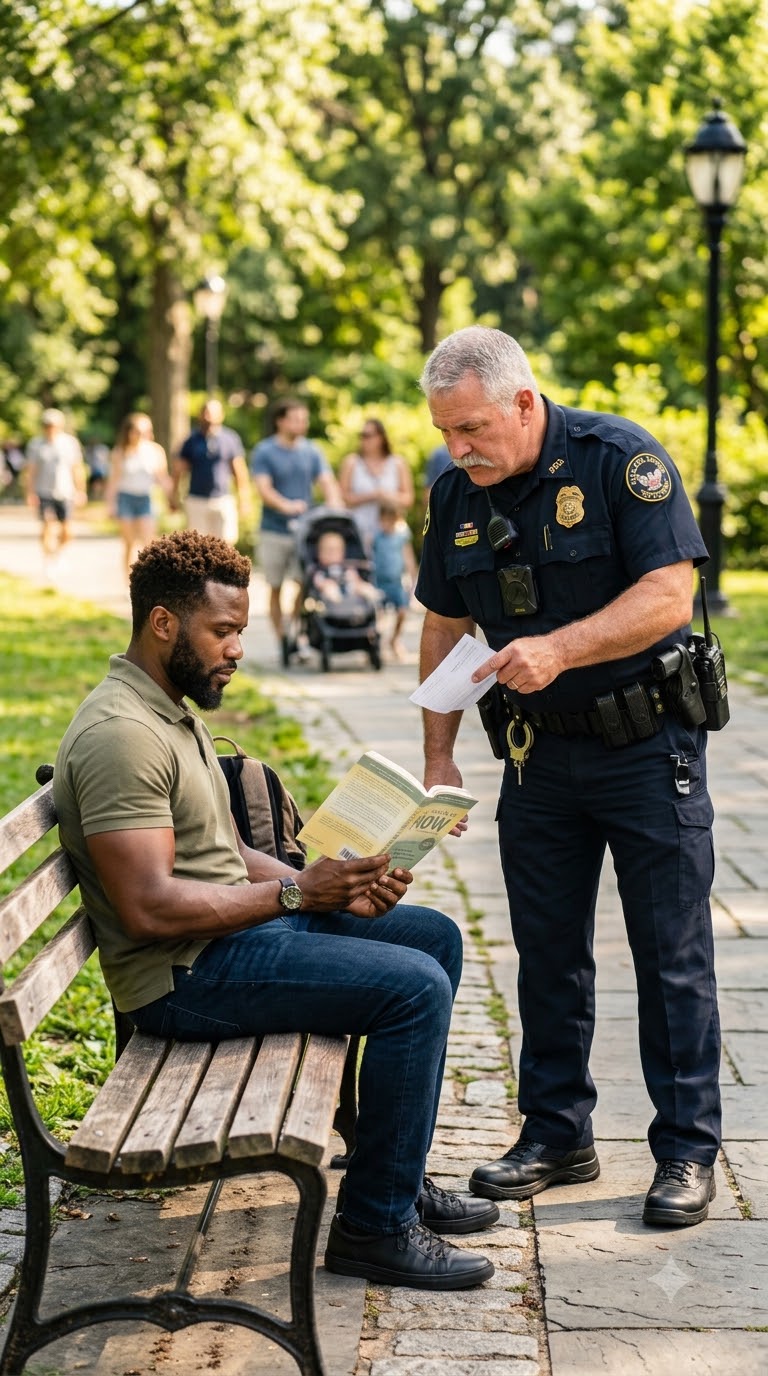
Harkin had watched him from the opposite side of the park for several minutes.
Marcus had noticed.
People in his profession became familiar with the subtle signs of surveillance.
Being watched wasn’t what bothered him.
It was the attitude behind the observation.
The officer had studied Marcus before Marcus had done anything at all.
Then he had apparently decided there must be something worth finding.
Harkin shifted his weight.
“We’ve had robberies around here.”
Marcus looked around the park.
“Alright.”
“You match the description.”
“What description?”
Harkin’s jaw tightened.
“Taller Black male. Forties. Medium build.”
Marcus waited a moment.
“That’s it?”
“Don’t get smart.”
“I’m asking what part of the description identifies me beyond race, age, and approximate height.”
Harkin moved closer.
The courteous tone he’d started with had disappeared.
“Let me see some ID.”
Marcus kept both hands resting visibly on the book.
“Am I being detained?”
“That depends on whether you cooperate.”
“That isn’t an answer.”
Harkin’s hand drifted toward his duty belt.
Marcus noticed.
So did a woman sitting on a nearby bench.
She lowered her phone from her ear and began paying closer attention.
Harkin said, “Stand up.”
Marcus drew a slow breath.
He had spent enough years in federal law enforcement to understand how rapidly a simple encounter could become dangerous once pride entered the equation.
He also knew that being legally correct didn’t make concrete any softer.
So he stood.
Slowly.
His hands remained visible.
“I am cooperating with your instructions,” Marcus said. “I want that clear.”
Harkin laughed.
“You rehearsed that somewhere?”
“No.”
“You one of those guys who watches legal videos all night?”
Marcus stared at him.
“No.”
“Then stop acting like you know my job.”
Marcus could have ended the uncertainty immediately.
His federal credentials were in his wallet.
He could have pulled them out.
SPECIAL AGENT — FEDERAL BUREAU OF INVESTIGATION.
The badge next to them would have transformed Harkin’s attitude within seconds.
Marcus knew it.
That was precisely why he didn’t do it.
A person shouldn’t need an FBI badge to be treated according to the law.
He slowly reached toward his pocket.
“My wallet is coming out.”
“Just do it.”
Marcus removed his ordinary driver’s license and passed it over.
MARCUS ELIJAH DAVIS.
Virginia.
Harkin examined it.
“You don’t live here.”
“I work here.”
“Doing what?”
Marcus studied him.
“Am I required to answer that?”
Harkin’s expression became harder.
“There you go again.”
He returned the license.
Then he pulled out his handcuffs.
“Turn around.”
Marcus didn’t immediately move.
“For what offense?”
“Suspicious behavior and failure to cooperate with an investigation.”
“I gave you identification.”
“I said turn around.”
“What crime am I suspected of committing?”
Harkin stepped forward until barely any distance remained between them.
“You want resisting added?”
Marcus looked beyond him.
A body camera was attached to Harkin’s chest.
The red light was active.
Good.
Marcus turned around.
Harkin put the cuffs on him.
They were unnecessarily tight.
Marcus felt the metal immediately pressing against his wrists.
He spoke evenly.
“The cuffs are excessively tight.”
“They’re supposed to be tight.”
“They’re restricting circulation.”
Harkin seized his arm.
“You people always have something to complain about.”
Marcus became motionless.
There it was.
A woman near the walking path quietly said, “Wow.”
Harkin turned toward her.
“Keep moving.”
She remained where she was.
Instead, she raised her phone.
Harkin guided Marcus toward the patrol vehicle.
Marcus left the book sitting on the bench.
The elderly man feeding the pigeons picked it up before it could slide onto the ground.
Marcus glanced over his shoulder.
“Could you hold onto that for me?”
The old man nodded.
“Absolutely.”
Harkin opened the rear door.
“Get in.”
Marcus lowered himself into the vehicle.
As Harkin shut the door, Marcus looked through the glass at him.
His expression remained calm.
That composure irritated Harkin more than an argument would have.
For twenty-two years, Brian Harkin had convinced himself that he possessed excellent instincts.
He believed he knew who belonged in certain places.
Who looked nervous.
Who looked suspicious.
Who was pretending too hard to appear ordinary.
He called it experience.
Sometimes it probably was.
Other times, it was something else.
That afternoon, Marcus’s calmness had become evidence against him in Harkin’s mind.
If Marcus had appeared nervous, Harkin would have considered it suspicious.
Because Marcus remained composed, Harkin considered that suspicious too.
There was no possible way for Marcus to behave correctly.
Harkin had already reached his conclusion before the investigation even began.
During the drive to the precinct, Harkin glanced repeatedly at the rearview mirror.
Marcus sat upright despite the uncomfortable position of the handcuffs.
“Tell me what you were really doing there.”
Marcus met his eyes through the mirror.
“Reading.”
“You expect me to believe you spend Friday afternoons reading alone in parks?”
Marcus almost smiled.
“Yes.”
“A guy like you?”
Marcus looked directly at him.
Harkin understood too late what he had just said.
Marcus asked quietly:
“What does someone like me do on Friday afternoons?”
Harkin turned his attention back toward the road.
“You know what I mean.”
“No. I don’t.”
Harkin tightened both hands around the steering wheel.
“Stop trying to make everything about race.”
Marcus turned his gaze toward the window.
“I haven’t mentioned race once.”
Harkin didn’t respond.
Officer Daniel Jenkins was working the booking desk when Harkin entered with Marcus.
Jenkins was thirty-one and had been assigned to the precinct less than a year.
He looked at Marcus.
Then at Harkin.
“What’ve we got?”
“Suspicious person from Riverside.”
Jenkins waited.
“And?”
“Possible robbery suspect.”
Marcus stood beside the desk with his hands still cuffed behind him.
Jenkins began entering the information from the driver’s license.
“Robbery warrant?”
“No.”
“BOLO?”
“General description.”
Jenkins continued typing.
“Which case?”
“Riverside commercial break-ins.”
Jenkins frowned.
“Did he run?”
“No.”
“Threaten anybody?”
“No.”
“Anything on him?”
“Not yet.”
Marcus finally spoke.
“Officer Jenkins?”
Jenkins looked at him.
“I requested several times to know the legal basis for my detention.”
Harkin snapped:
“Nobody asked you.”
Jenkins’s eyes briefly shifted toward Harkin’s body camera.
It was still recording.
He said nothing.
Instead, he entered Marcus’s complete information into the secure system.
A notification appeared on the screen.
Jenkins stopped typing.
His posture changed.
Harkin noticed immediately.
“What?”
Jenkins looked at Marcus.
Then back at the monitor.
A federal law-enforcement contact flag had appeared.
Federal personnel records did not display the same way ordinary criminal histories did.
But the message was enough to require verification.
Jenkins reached for the telephone.
“Who are you calling?” Harkin asked.
“Records.”
“You don’t need records.”
Jenkins looked at him.
“I think I do.”
He entered another command.
A second message appeared.
FEDERAL IDENTIFICATION — VERIFY BEFORE FURTHER ACTION.
Jenkins stared at the screen.
His face lost its casual expression.
Harkin stepped closer.
“What does it say?”
Jenkins lowered his voice.
“It says we need to verify his status.”
Harkin looked toward Marcus.
Marcus remained silent.
Jenkins picked up the phone.
The call lasted less than thirty seconds.
When he hung up, he looked directly at Harkin.
“Brian, you need to remove those cuffs.”
Harkin’s face tightened.
“Why?”
“Because he’s federal.”
Silence settled over the booking area.
Harkin looked at Marcus.
Then at Jenkins.
“What federal?”
Jenkins swallowed.
“FBI.”
Harkin stared.
Marcus finally spoke.
“Special Agent Marcus Davis.”
Harkin’s expression changed.
Marcus continued calmly.
“I was assigned to the Richmond field office eighteen months ago. I’m currently working a joint investigation that has nothing to do with the Riverside robberies.”
Harkin looked at the handcuffs.
Then at Marcus.
“You could’ve said something.”
Marcus held his gaze.
“I shouldn’t have to identify myself as a federal agent to receive basic legal treatment.”
Jenkins slowly reached for the key.
The cuffs came off.
Marcus immediately rubbed his wrists.
Jenkins noticed the red marks.
“I’m sorry.”
Marcus looked at him.
“You didn’t put them on me.”
“No. But I should have stopped this sooner.”
Harkin’s face had gone pale.
“This is a misunderstanding.”
Marcus looked at him.
“No.”
Harkin shifted.
“I was investigating a possible robbery suspect.”
“You detained someone who did not match the actual bulletin.”
“I had reasonable suspicion.”
Marcus’s voice remained controlled.
“The bulletin says twenty-five to thirty. Five-foot-eight. Thin. Neck tattoo. Red hoodie.”
Harkin didn’t answer.
Marcus continued.
“You had my identification. You knew my age. You could see my clothing. You could see there was no neck tattoo. You had no report placing me at any crime scene.”
Jenkins looked toward Harkin.
The booking area had become noticeably quieter.
Several officers had stopped what they were doing.
Marcus reached into his pocket and pulled out his credentials.
He opened the wallet.
The badge caught the fluorescent light.
FBI.
Special Agent.
Marcus closed it again.
“I didn’t show you this because I wanted to see what you would do when you believed I was simply a citizen.”
Harkin’s voice was low.
“You set me up?”
“No.”
Marcus shook his head.
“You did that yourself.”
The words landed heavily.
Harkin looked away.
At that moment, the precinct commander, Captain Elena Ruiz, emerged from her office.
She had already received a call from the records supervisor.
“What happened?”
Nobody answered immediately.
Ruiz looked at Marcus.
Then at the handcuffs on the desk.
Then at Harkin.
“Brian?”
Harkin straightened.
“Captain, there was a suspected robbery situation at Riverside.”
Ruiz looked at Marcus.
“Is he the suspect?”
“No.”
“Then why was he arrested?”
Harkin opened his mouth.
Nothing came out.
Ruiz turned toward Jenkins.
“Give me the facts.”
Jenkins hesitated.
Harkin interrupted.
“I believed he matched the description.”
Ruiz’s expression remained firm.
“Did he?”
“Broadly.”
Jenkins spoke quietly.
“No, Captain.”
Harkin glared at him.
Jenkins continued.
“The actual bulletin is substantially different.”
Ruiz looked at Marcus.
“Mr. Davis, I understand you’re an FBI agent?”
Marcus nodded.
“Yes.”
“Are you currently conducting an investigation in this jurisdiction?”
“Yes.”
“Is it connected to our precinct?”
“Not directly.”
Ruiz looked at Harkin.
“Did you know that when you detained him?”
“No.”
Marcus spoke.
“And that is the point.”
Everyone became silent again.
Marcus didn’t raise his voice.
He didn’t threaten anyone.
He simply explained what had happened.
“I was sitting in a public park reading. Officer Harkin approached me because he decided I looked suspicious. He asked me what a guy like me was doing there. He couldn’t provide a specific description beyond race, age, and height. When I asked why I was being detained, he treated the question as resistance.”
Ruiz looked at Harkin.
“Did you say that?”
Harkin said nothing.
Marcus continued.
“I gave him my driver’s license. I complied with his commands. I warned him that the cuffs were too tight. He told me they were supposed to be.”
Ruiz’s eyes moved to the red marks around Marcus’s wrists.
Then she looked at Harkin’s body camera.
“Was the camera running?”
Harkin nodded.
“Yes.”
“Good.”
Ruiz turned to Jenkins.
“Secure that footage.”
Jenkins nodded.
“Already requested.”
Marcus gave a slight nod.
“Thank you.”
Ruiz looked at him.
“I owe you an apology on behalf of this department.”
Marcus studied her for a moment.
“I appreciate that.”
Harkin finally spoke.
“Captain, I wasn’t trying to—”
Ruiz raised one hand.
“Not here.”
Harkin stopped.
Ruiz looked at Marcus.
“Do you intend to file a complaint?”
Marcus considered the question.
“I haven’t decided.”
“That is your right.”
Marcus nodded.
“But I will be documenting everything that happened.”
Ruiz’s expression remained serious.
“I would expect nothing less.”
Marcus picked up his book from the desk.
He had asked Jenkins to contact the elderly man from the park, who had eventually brought it to the precinct after learning where Marcus had been taken.
The old man appeared at the entrance holding the hardcover book.
He smiled when he saw Marcus.
“You left this behind.”
Marcus accepted it.
“Thank you.”
The man glanced at Harkin.
Then at the other officers.
“I figured somebody ought to bring it back.”
Marcus smiled.
“You did more than that.”
The elderly man shrugged.
“Seemed like the right thing.”
Before Marcus left, Captain Ruiz approached him.
“Agent Davis.”
Marcus turned.
“I want you to know we’re reviewing this internally.”
Marcus nodded.
“Good.”
Ruiz hesitated.
“Can I ask you something?”
“Sure.”
“Why didn’t you identify yourself immediately?”
Marcus looked at the book in his hand.
“Because if I need an FBI badge before an officer will treat me like a person, then the badge is doing more work than it should.”
Ruiz didn’t respond.
Marcus walked toward the doors.
Behind him, Harkin remained standing beside the booking desk.
The next morning, the body-camera footage was reviewed.
It told the story without needing anyone to embellish it.
It showed Marcus sitting quietly beneath the tree.
It showed Harkin watching him.
It showed the approach.
It showed the questions.
It showed Marcus cooperating.
It showed him asking what crime he was suspected of committing.
It showed the cuffs.
It showed the exchange about race.
And it showed something else.
Marcus never raised his voice.
Never threatened Harkin.
Never resisted.
Never attempted to leave.
The department’s internal review team compared the footage with the robbery bulletin.
The differences were unmistakable.
The review concluded that the detention had not been supported by the information available to Harkin at the time.
Harkin was placed on administrative leave while the department completed its investigation.
But the story did not end at the precinct.
Marcus’s federal supervisors had already been informed.
His identity as an FBI agent had become known because of the incident, not because Marcus had intended to reveal it.
Two days later, Marcus returned to Riverside Park.
The same oak tree stood beside the walking path.
The same benches faced the river.
Children played near the playground.
Dogs moved along the trail.
The elderly man with the pigeons was sitting on his usual bench.
He noticed Marcus immediately.
“Well, look who’s back.”
Marcus smiled.
“Looks like it.”
The old man pointed at the book.
“You finish it?”
“Not yet.”
“You’re taking your time.”
Marcus laughed softly.
“I’ve been busy.”
The old man nodded.
Then he looked toward the path.
“No police this time?”
Marcus glanced over.
“No.”
“Good.”
Marcus sat beneath the oak tree again.
He opened the biography to the page where he had stopped.
For several minutes, he simply read.
Then a young Black boy walking past with his father noticed him.
The boy stared at the book.
“What are you reading?”
Marcus looked up.
“A biography.”
“Is it good?”
“So far.”
The boy nodded thoughtfully.
“My dad says biographies are boring.”
His father immediately said, “I did not say that.”
Marcus laughed.
The boy smiled.
Then he ran ahead.
Marcus returned to his book.
He could have spent the next several weeks thinking about what happened.
He could have carried anger from the precinct into the park.
He could have let one officer’s assumptions define the way he saw every uniform.
Instead, he turned another page.
His phone vibrated.
A message from his supervisor appeared.
CHECKING IN. YOU OKAY?
Marcus typed back.
YES. HANDLING IT.
He put the phone away.
Across the park, two officers walked along the trail.
One briefly looked in Marcus’s direction.
Then kept walking.
Marcus noticed.
This time, he didn’t wonder what the officer was thinking.
He simply kept reading.
Because the lesson of that afternoon had never been about Marcus being an FBI agent.
The badge had not made him innocent.
The badge had not made him deserving of dignity.
And the badge had not made the officer’s assumptions acceptable.
Marcus had been entitled to fair treatment before anyone knew his profession.
That was the part he hoped people would remember.
Not that a Black man sitting beneath a tree turned out to be an FBI agent.
But that he shouldn’t have needed to be one.
