

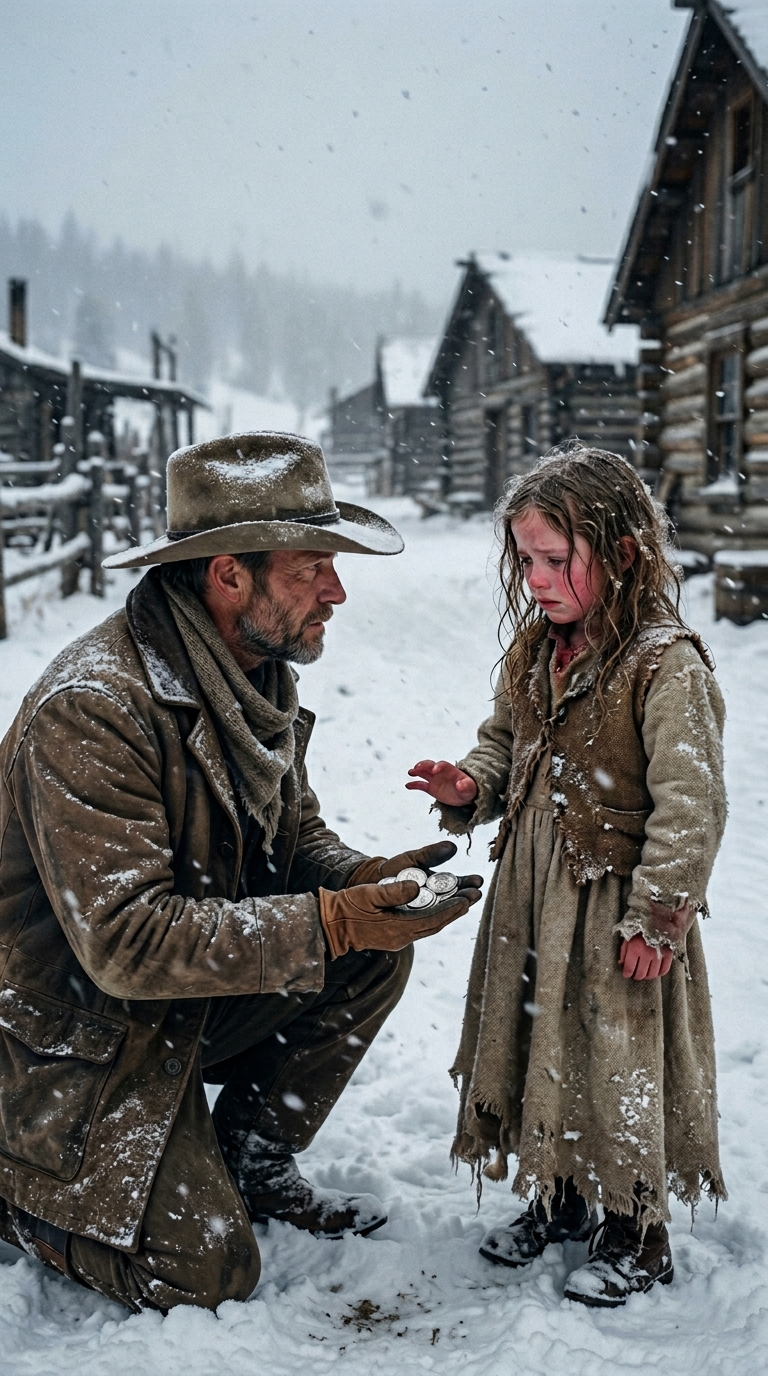
The girl who rejected charity in the snow
PART 1
The snow began before dawn.
By midday, the small town of Arroyo Seco, in the Sierra de Chihuahua, seemed swallowed by winter. The wind swept the main street with white gusts, pushing snow against the wooden facades, the windows of the saloon, and the porch of the general store. The horses snorted steam into the frozen air and stamped the ground impatiently.
Tomás Cárdenas, a fifty-eight-year-old rancher, adjusted his coat better as he got down from the cart. He had seen many winters in northern Mexico, but this one had teeth. He rubbed his hands, tied the reins to a post, and murmured to himself:
“Just buy supplies… and back to the ranch.”
Arroyo Seco had never been a place where Tomás wanted to stay. There was too much noise, too many faces, too many memories. He was heading straight to Don Melquiades’ store when something made him stop.
Beside the steps of the saloon was a girl.
She couldn’t have been more than eight years old. She wore a thin dress, patched in several places, a worn shawl that barely protected her from the wind, and boots that were too big, as if borrowed or found. Snow had accumulated in her tangled blonde hair, and one of her cheeks was red from the cold.
But what caught Tomás’s attention most was not her clothing.
It was that she wasn’t crying.
She wasn’t begging.
She wasn’t holding out her hand.
She was just standing there, watching people pass by.
Some glanced at her sideways. Most pretended not to see her.
That bothered Tomás.
A child alone in the middle of a storm should never go unnoticed.
He approached slowly. The girl barely turned her head when she heard the snow crunching under his boots.
“Where are your parents, child?” he asked.
She didn’t answer right away. She looked him up and down: the worn hat, the weathered face of a man of the land, the old but clean coat. Finally she said, in a low voice:
“I don’t have them anymore.”
The words fell heavily.
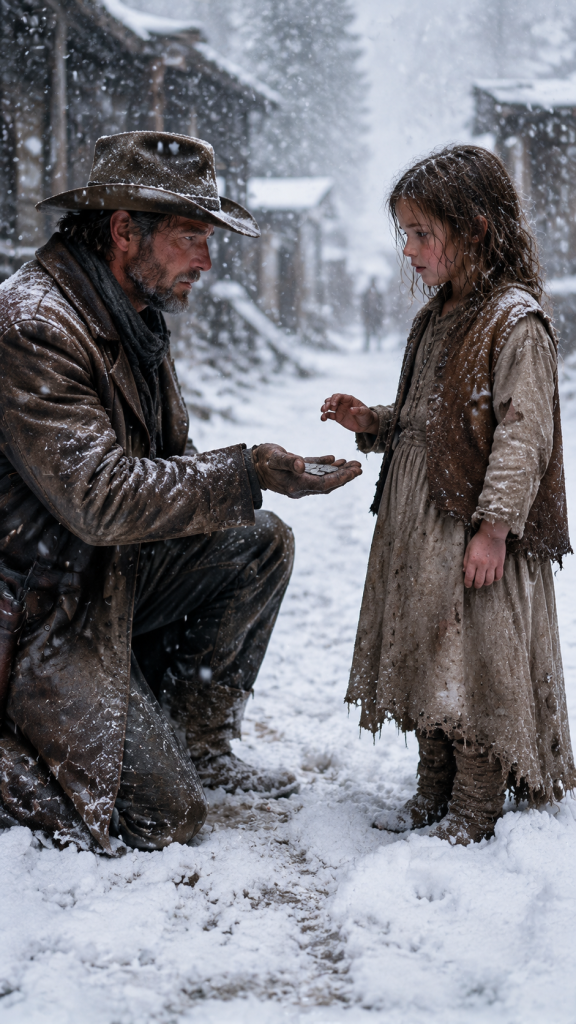
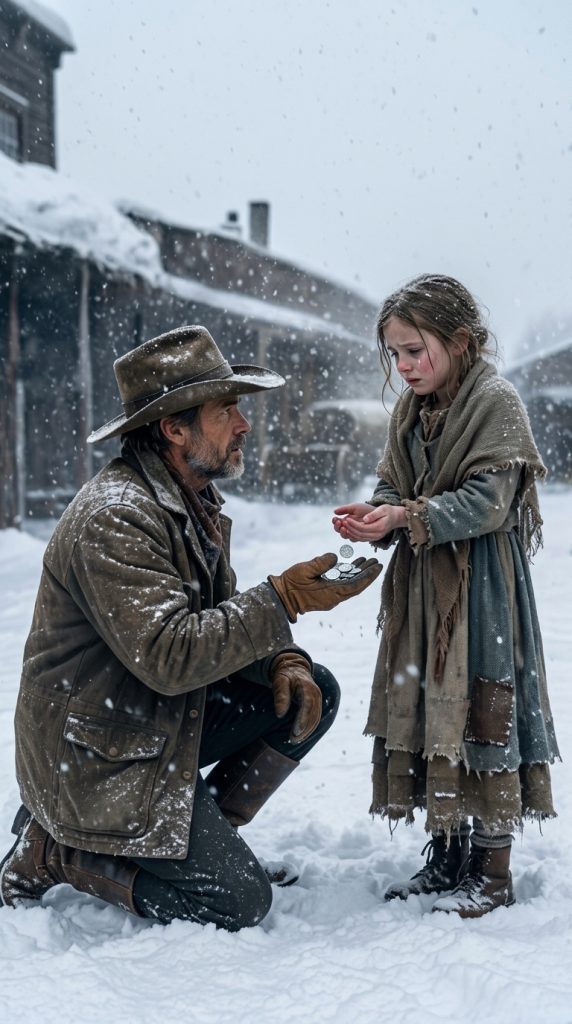
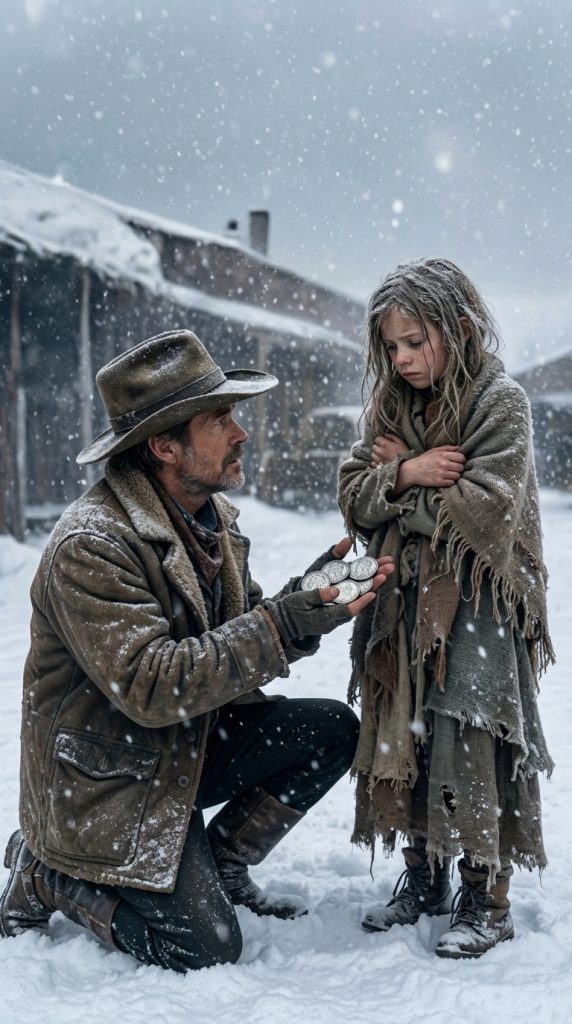
Tomás put his hand in his coat pocket and took out some silver coins. He crouched down so as not to tower over her and held out his hand.
“Here. This should be enough for something hot.”
The girl looked at the coins for a second. Snow fell on the metal. Tomás expected hesitation, relief, perhaps gratitude.
But she raised her hand and gently pushed his away.
“Keep it.”
Tomás blinked.
“Are you sure?”
The girl nodded firmly.
“I don’t need charity.”
The wind whistled between the buildings.
Tomás observed her more closely. Her hands were red from the cold, but they were not soft hands. They were small, yes, but rough, marked — the hands of someone who had already worked too much for her age.
“And what do you need?”
The girl lifted her chin a little.
“If you have work, I’ll do the work.”
Tomás exhaled through his nose, surprised.
“How old are you?”
“Eight and a half.”
For some reason, that half year spoken with such seriousness almost made him smile.
“And what kind of work do you think you can do in this weather?”
“Whatever is needed.”
Without hesitation. Without pleading.
Tomás felt something old stir in his chest. Respect. Not pity. Respect.
“What’s your name?”
She hesitated for just a moment.
“Clara. Just Clara.”
Tomás looked at the thick snow, then at the girl.
“Are you afraid of horses?”
“No.”
“Good,” he said. “Because I have a ranch about fifteen miles west of here. And I might have some work.”
Clara narrowed her eyes.
“What kind of work?”
“Feed the chickens, carry firewood, clean saddles.”
She thought for a moment.
“Does it include food?”
Tomás let out a short laugh.
“Yes.”
“And a bed?”
“Also.”
The girl remained silent for a few more seconds.
“And will you pay me?”
Tomás raised an eyebrow.
“You drive a hard bargain for someone standing in the middle of a storm.”
“I’m not asking for favors,” she replied. “I’m asking for work.”
That finally decided it for him.
Tomás put the coins away.
“All right, Clara. Let’s see if you’re as tough as you talk.”
For the first time, something like hope crossed the girl’s face.
But neither of them knew that taking her to the ranch would uncover a rotten truth in Arroyo Seco. And that the first sign of trouble would come before the storm ended.
PART 2
The journey to the ranch was silent at first.
The cart struggled through the snow while the town disappeared behind them. The lights of the saloon faded into the distance. Ahead there were only white plains, almost buried fences, and a sky as gray as lead.
“Have you been in Arroyo Seco long?” Tomás finally asked.
“Three months.”
“Did you come with your family?”
Clara nodded.
“My dad got sick first. Fever. Then my mom. She washed clothes for the people in town, but then she caught the same cough… and couldn’t work anymore.”
She said it without breaking. That hurt even more.
“And how did you survive alone?”
“Sweeping stables. Carrying water. Washing dishes behind the saloon. Sometimes they gave me food when I finished.”
Tomás gripped the reins tighter.
“And if there was no work?”
Clara looked straight ahead.
“Then I waited until there was.”
Once again, that phrase hit him inside.
When they arrived at Rancho Cárdenas, smoke was coming from the chimney and the barn creaked in the wind. Before Tomás could get down, Clara had already jumped from the cart and was looking at the corral, the stacked firewood, and the stable as if she weren’t a child entering a new place, but a worker sizing up what needed to be done.
Inside the stable, the men turned when they saw them enter. The first was Jacinto Duarte, the ranch foreman, a big, bearded man, naturally distrustful.
“Boss,” he greeted. “And who is this?”
“Her name is Clara,” Tomás replied. “She’s going to work.”
Jacinto looked at the girl, then at Tomás, then back at the girl.
“Work? Her?”
“I can,” Clara intervened before Tomás could speak. “I carry firewood, feed the chickens, clean harnesses.”
One of the ranch hands let out a short laugh.
Jacinto crossed his arms.
“Have you worked with horses?”
“Yes.”
“Has any kicked you?”
“No.”
“It will if you’re not careful.”
“I’m careful.”
That dry response drew a chuckle from one of the workers. Jacinto shook his head, half defeated, half amused.
“Well, let’s see then, Miss Eight-and-a-Half.”
He pointed to a small pile of firewood by the door.
“Take that to the kitchen.”
The load was too big for her. It showed the moment she lifted it. For a second it looked like she was going to fall. But she adjusted the way she hugged the logs, bracing with her whole body, and walked step by step without complaining all the way to the kitchen.
The men followed her with their eyes.
She returned with empty arms and asked:
“What’s next?”
That same night, with the fire already lit in the kitchen, Tomás noticed something strange: Clara carefully counted every coin he paid her, wrapped them in a piece of cloth, and hid them inside her boot.
“Are you saving for something?”
“Yes.”
“For what?”
Clara said it as if announcing something perfectly logical.
“To buy land.”
Tomás looked at her with surprise.
“Many grown men can’t buy land around here.”
“I don’t need much,” she replied. “Just enough.”
That answer kept turning in his mind.
In the following days, Clara surprised everyone. She got up before dawn, fed the chickens, cleaned the chicken coop, swept the stable, polished saddles, and never asked for rest. By the fourth day, even Jacinto had to admit it.
“She works harder than half the men I’ve hired,” he told Tomás.
But the peace didn’t last long.
One afternoon, as the sun fell behind the snow-covered hills, the ranch dogs began barking furiously. A rider appeared in the distance and approached at full speed, stopping in front of the gate.
He was a tall man with a sharp face and cold eyes. His black coat was covered in snow. As soon as he saw Clara, he smiled in a way that chilled the air more than the weather.
The bucket the girl was carrying in her hands fell to the ground.
Tomás realized it instantly.
He had only known her for a few days, but it was enough to notice that the stiffness in her shoulders was not normal. It was fear.
“Who are you?” Tomás asked, stepping in front of her.
“Baltasar Briones,” the rider replied without taking his eyes off Clara. “And that girl belongs to me.”
Jacinto muttered a curse under his breath.
“What do you mean she belongs to you?”
Baltasar smiled.
“Her father owed me money. He died without paying. Debts pass to the family.”
Clara spoke then, with contained anger.
“That’s not true.”
Baltasar took out a folded document from his coat.
“Here is the signature.”
Tomás took the paper. It was a loan contract for thirty pesos, with abusive interest added month after month. A ruin for any poor peasant.
“My dad said that man tricked him,” Clara said. “He made him sign twice.”
Tomás examined the document more carefully. Something didn’t feel right. The ink on one mark was different. Darker, more recent.
Baltasar stretched out his hand.
“I’ll give you until dawn tomorrow. Either you hand over the girl, or you pay me fifty pesos with interest. If not, I’ll go get the sheriff.”
He mounted again and left.
Clara stood still, staring at the snow.
“I told you I don’t accept charity,” she whispered.
Tomás looked down at her.
“This is no longer about charity.”
That night, the wind rose again.
PART 3
Inside the house, with the paper spread out on the table, Tomás reviewed the signature over and over. Clara was sewing a torn glove by the fire with the same calm she did everything.
“Did that man trick your father?” Tomás asked.
Clara looked up.
“He told him the second mark was from a witness. But my dad didn’t know how to read well. Then he came back asking for more money. My dad didn’t want to.”
Jacinto, who had just entered shaking snow from his shoulders, looked at the document.
“So he’s not here to collect a debt. He’s here to steal a girl.”
Tomás didn’t respond, but he knew it.
And he wasn’t going to allow it.
At midnight, the storm hit with full force. The wind struck the stable, the lamps flickered, and suddenly there was a dry crash.
Then, the sound that chilled Tomás more than the storm:
the horses screaming.
He rushed out with his coat half closed. Jacinto came out of the workers’ quarters at the same time. They fought against the wind until they reached the stable. A side door had burst open. Snow swirled in and several terrified horses kicked the boards trying to escape.
And in the middle of that chaos was Clara.
She was holding a rein with both hands while a horse reared above her.
“Clara!” Tomás shouted.
“The bar broke!” she replied. “If they run, they’ll die out there!”
Another horse hit the corral door and broke free. Then another. The two bolted into the storm.
“Everyone out!” Jacinto shouted when he noticed the roof creaking under the weight of the snow.
But Clara had already seen the horses disappear into the darkness.
“They’ll follow me!” she said.
Tomás grabbed her arm.
“You’re not going out there!”
“If they don’t come back, they’ll freeze!”
And before he could stop her, the girl broke free and ran toward the whiteness.
For a second, the snow swallowed her.
That moment broke something inside Tomás.
Because she wasn’t just a stubborn girl he had picked up from the road.
She was a presence that, in just a few days, had filled a void he had been hiding for years.
His own daughter had died of fever a long time ago. Since then, Tomás had learned to live without uttering certain absences. But seeing Clara run into the storm was like feeling that old helplessness again.
“Not again,” he murmured.
And he went after her.
The wind cut his face. He could barely see the small footprints that were half covered in the snow. He followed them to the pasture fence, beside a hollow. There he heard a whinny.
And he saw her.
Clara was between the two horses, holding one rein in each hand, dragging her boots in the snow, speaking to them in a small but firm voice.
“Easy… easy… there…”
Tomás reached them, took one of the reins, and together, step by step, they guided the animals back to the stable.
When they finally closed the doors, Jacinto looked at them as if he had seen ghosts return.
Clara was soaked, her cheeks red from the cold, but she was still standing.
“I almost had them,” she said, panting.
Tomás couldn’t hold back any longer.
He crouched in front of her and, in a voice that barely came out, said:
“You could have died.”
She shrugged.
“So could they.”
Jacinto let out an incredulous laugh.
“Boss, this little creature has more guts than half the sierra.”
Tomás didn’t laugh.
He just looked at her.
Dawn came with the world covered in new snow and an almost sacred silence over the ranch. But the problem was still there. And shortly after sunrise, Baltasar Briones returned.
He dismounted in front of the gate with the same cold smile as the day before.
“Well. Do you have my money?”
Tomás took the paper out of his coat.
“I’ve been looking at this.”
Baltasar extended his hand indifferently.
“Then you already know how much you owe me.”
Tomás pointed to the signature at the bottom.
“Curious about the ink. This part is more recent than the rest.”
Baltasar didn’t respond immediately.
Clara stepped forward.
“My dad never signed that second line.”
Jacinto positioned himself beside them.
“And the sheriff is going to be very interested in hearing about it.”
For the first time, Baltasar no longer looked completely confident.
Tomás continued speaking slowly, so that every word carried weight.
“I also think the sheriff will find it interesting that you’re trying to collect an invented debt from an eight-year-old orphan. And even more interesting that this isn’t the first time you’ve done something like this.”
Baltasar frowned.
“What are you talking about?”
Tomás raised his voice toward the fence, where several neighbors from nearby ranches had gathered after seeing the commotion. Among them was Don Eusebio, then a widow named Leonor, and then another old man who lowered his gaze as soon as he saw the paper.
“Has any of you signed anything with him?” Tomás asked.
There was an uncomfortable silence.
Then Doña Leonor spoke first.
“My late husband also had a ‘second clause’ that we never saw.”
Another man nodded.
“And he took two mules from my brother over interest that appeared out of nowhere.”
The air changed.
What until that moment had seemed like the dispute of an orphan girl became something bigger: a rot that the town had tolerated for too long.
Baltasar looked around and understood that he was no longer facing one man and a defenseless girl.
He was facing witnesses.
Facing a community beginning to lose its fear.
He crumpled the paper angrily in his hand and spat in the snow.
“She’s not worth all this trouble for a brat.”
He mounted in one leap.
“Keep her.”
He turned his horse and galloped away.
No one followed him. But that same afternoon, Tomás and Jacinto went down to the town with the neighbors to speak with the sheriff. And in less than a week, not only was Baltasar Briones under investigation for fraud: several families recovered animals, tools, and documents that he had twisted in his favor for years.
Arroyo Seco finally learned what a girl had discovered long before everyone else: that sometimes people prefer to toss a coin rather than do justice.
Days later, when the snow began to recede and the sun returned to touch the sierra with some warmth, Clara was sitting on the kitchen steps counting her coins again.
Tomás sat down beside her.
“How much do you have now for your land?”
Clara opened the cloth and showed them with complete seriousness.
“Two pesos and forty cents.”
Tomás smiled.
“That’s still a long way.”
“I have time,” she replied.
He remained silent for a moment.
Then he said:
“Maybe you won’t have to buy it alone.”
Clara looked at him, not fully understanding.
Tomás took a deep breath. There were words that cost a man more than an entire winter.
“Clara… this ranch needs someone stubborn, brave, and hardworking. But I also think you need something more than work.”
She lowered her gaze to her boots.
“What thing?”
Tomás placed a large, rough hand on her shoulder.
“A home. And a family, if you want one.”
Clara didn’t answer right away. The gentle wind barely moved the fence. The chickens pecked near the corral. In the stable, the horses snorted peacefully.
For the first time since Tomás had seen her in the storm, the girl’s hardness gave way a little.
“Does that mean I can stay?”
“It means,” he said, his voice hoarse, “that if you want, you won’t stay as a worker. You’ll stay as mine. As family.”
Clara swallowed. Her clear eyes grew moist, but she didn’t cry. She just nodded once, small and careful, like someone afraid of breaking something beautiful if they moved too much.
And inside Tomás Cárdenas settled a peace he hadn’t felt in many years.
Months later, when spring began to paint the hills green and the snow became a memory, Tomás took Clara to a small plot on the western edge of the ranch. It wasn’t big. Just a piece of good land, with a view of the stream.
“You didn’t buy this one yourself,” he told her, “but it’s going to carry your name anyway.”
Clara stood motionless.
“My land?”
Tomás nodded.
“Your land. For the day when you want to plant, build… or simply know that no one will ever take you away from where you belong.”
Then, at last, Clara cried.
Not like children cry when they’re afraid.
But like those who, after a long time, understand that they are no longer alone.
And so, in that cold corner of northern Mexico, the girl who rejected a coin in the snow found something much bigger than a wage.
She found work, yes.
She found justice.
But above all, she found a home.
