

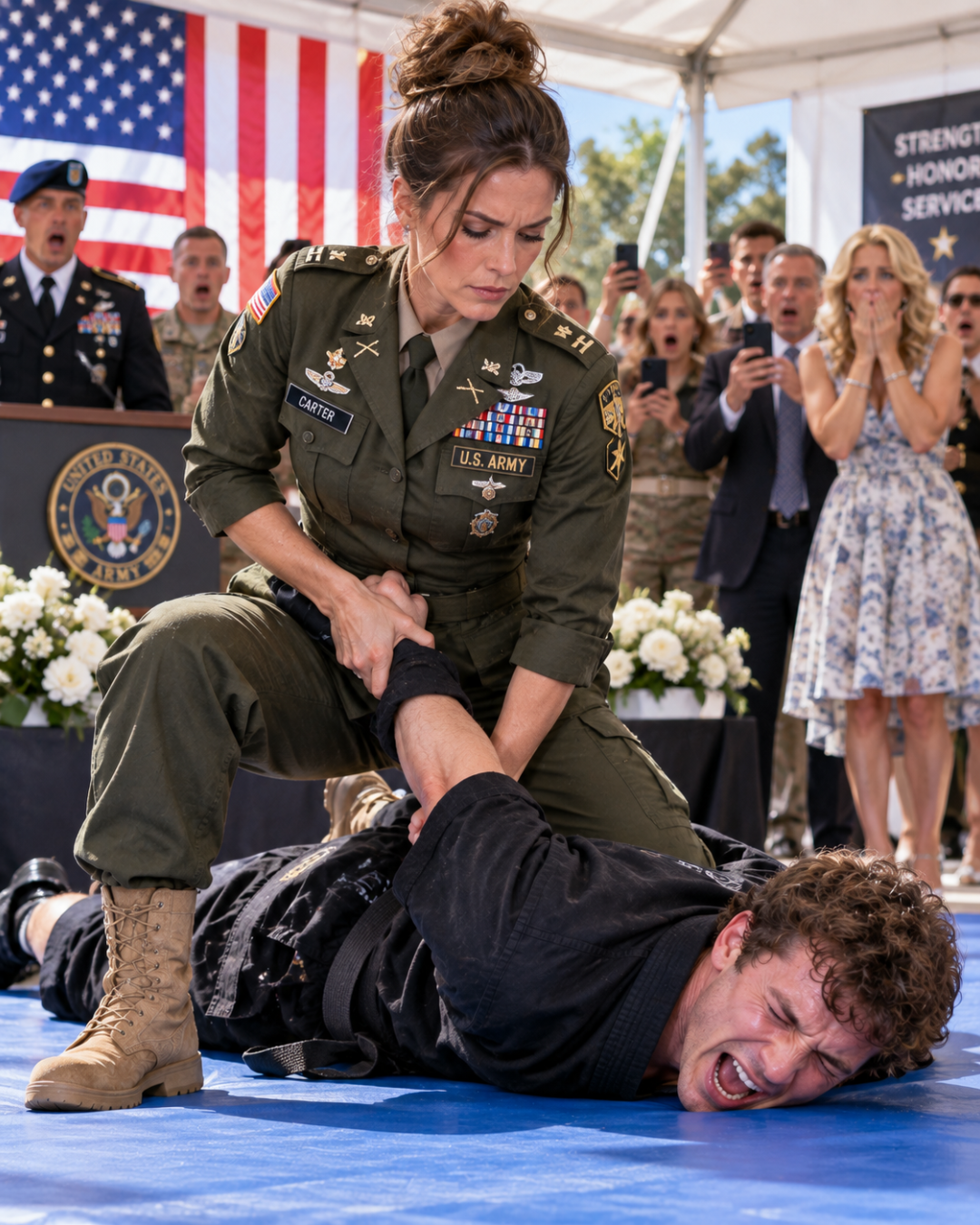
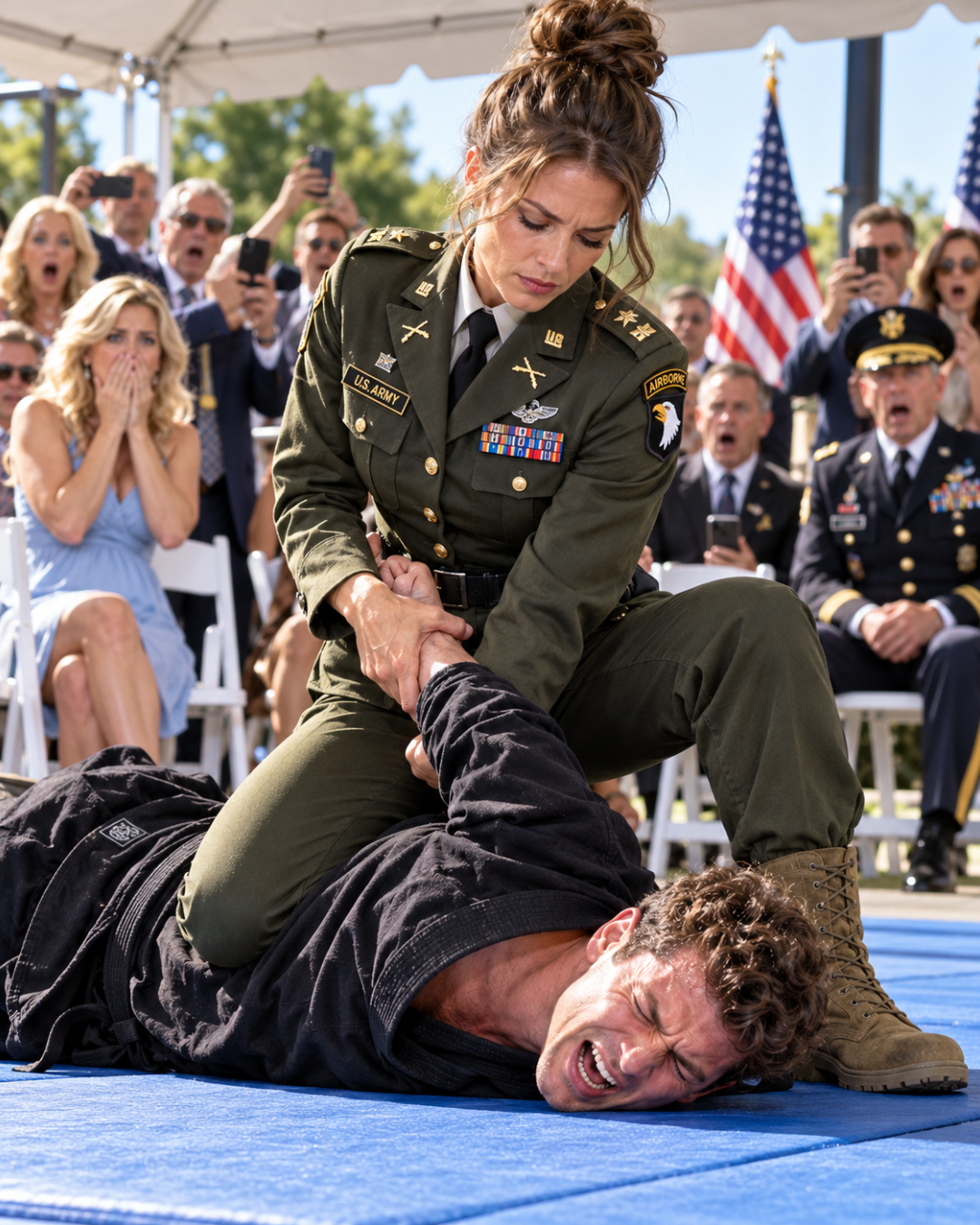
The moment my wealthy neighbor’s black-belt son slapped $10,000 onto a table and challenged me to take him down, half the neighborhood pulled out their phones. He laughed when I refused his money and called me scared, but the laughter disappeared when I removed my Army jacket and an old veteran saw the Ranger scroll on my shoulder.
“Ten thousand dollars says you can’t take me down.”
Ethan Caldwell slapped a white envelope onto the silent-auction table so hard two wineglasses rattled. At twenty-seven, he was a Brazilian jiu-jitsu black belt, the richest man’s son on our street, and he had just finished a demonstration beneath the neighborhood fundraiser tent.
“Come on, Army lady,” he called. “Show everybody what they taught you.”
My neighbor Denise grabbed my arm. “Victoria, ignore him.”
For three weeks, that was exactly what I had done. Since moving onto Larksburg Court, I’d ignored Ethan blocking my driveway, mocking my uniform, and repeatedly asking whether I had ever trained “for real.”
Eight years of Brazilian jiu-jitsu meant Ethan was genuinely skilled, and I respected that. But years in the U.S. Army had taught me something different: watch the hands, read posture, control your breathing, know your exits, and never let someone else’s ego control your decisions.
Ethan tapped the envelope. “Ten grand.”
“Keep your money.”
His grin widened. “Scared?”
“No.”
“Then get on the mat.”
“I’m not interested in proving anything to you.”
Ethan turned toward the crowd, making sure every phone was recording. “Then walk away.”
That was when I understood what he really wanted.
He didn’t care whether I could grapple. He wanted everyone there to watch the quiet Army woman back down from him.
“Fine,” I said.
Denise stared at me. “Victoria…”
I raised one finger toward Ethan. “Controlled grappling. No striking. Carlos stops it whenever he decides it’s over.”
Carlos Mendes, Ethan’s instructor, immediately became serious.
Ethan shrugged. “Whatever you need.”
“And if you lose,” I said, “your ten thousand goes to the veterans fund.”
His smile tightened.
Nearby, Ethan’s father, Richard Caldwell, straightened beneath the enormous sponsor banner bearing his family name. After a long pause, Ethan nodded.
“Deal.”
Carlos stepped between us. “First tap, verbal stop, or my call ends it immediately.”
“Understood,” I said.
He looked directly at Ethan. “Immediately.”
“I heard you.”
As people crowded around the blue mats, Denise caught my wrist. “You don’t have to do this.”
“I know.”
“Then why are you?”
I glanced at Ethan’s friends filming me. “Because walking away and being pushed away are two different things.”
I had come directly from an Army ceremony, so a lightweight jacket still covered most of my uniform blouse. As I stepped toward the mat, I slowly unzipped it.
Ethan was laughing.
His father was smiling.
Then I slipped the jacket from my shoulders.
An older man in the front row froze with his coffee halfway to his mouth. Across the tent, my seventy-eight-year-old neighbor, Walt Griffin, a Vietnam veteran, suddenly stood straighter.
Both men were staring at my left shoulder.
At the Ranger scroll.
The laughter began dying around me.
I calmly folded my jacket over one arm, but before I could step onto the mat, the older stranger moved forward. His eyes remained fixed on my insignia as if it had just told him something nobody else understood.
“Wait,” he said.
Ethan’s smile disappeared.
The veteran looked from my shoulder to my face, recognition slowly spreading across his expression.
And suddenly, I realized he knew exactly who I was.
PART 2
The veteran recognized my Ranger insignia—and the Caldwells knew more about my past than they admitted.
“Captain Mercer?”
The older stranger’s voice was quiet, but in the strange silence beneath the fundraiser tent, everyone heard him.
I looked at him more carefully.
He was somewhere in his late sixties, broad-shouldered despite his age, with silver hair clipped short and the posture of someone who had spent most of his life standing straight even when nobody was watching.
I knew the face.
It simply took me a moment to place it.
“Sergeant Major Ortega?”
His expression softened.
“Well,” he said, “I wondered if you’d remember an old man.”
“You weren’t old when I knew you.”
“That’s generous.”
A few people around us laughed, though the laughter was different now. The restless, expectant energy had disappeared.
Ethan looked from him to me.
“You two know each other?”
Samuel Ortega glanced toward Ethan, then back at me.
“I knew Captain Mercer when she was still convinced coffee counted as a food group.”
“Some things never change.”
Walt Griffin gave a delighted little snort from the first row.
But Ethan wasn’t laughing.
His eyes remained on the Ranger insignia.
“What exactly did you do?”
The question was different from the ones he had thrown at me during the previous three weeks.
There was no smirk in it.
Just curiosity.
Before I could answer, Ortega did.
“She served.”
I glanced at him.
He understood immediately.
That was enough.
I had never liked turning my military history into a résumé for strangers, especially not when half the neighborhood had their cameras raised.
Carlos Mendes stepped onto the mat and clapped his hands once.
“Are we still doing this?”
I looked at Ethan.
“That depends on him.”
Every face turned his way.
For the first time that afternoon, Ethan seemed uncertain.
His father stepped forward.
“Ethan, perhaps this has gone far enough.”
That surprised me.
Richard Caldwell had spent most of the challenge standing near the sponsor banner with the satisfied expression of a man who assumed his son controlled the room.
Now his expression had changed.
Not embarrassment.
Not exactly.
Concern.
Ethan looked at him.
“You were fine with it five minutes ago.”
Richard’s jaw tightened.
“I didn’t understand the situation.”
“The situation is exactly the same.”
“No,” Richard said quietly. “It isn’t.”
Something passed between father and son.
It lasted only a second, but I noticed it.
So did Denise.
Her fingers brushed my elbow.
“Interesting,” she whispered.
Ethan turned toward me again.
“You still want to do this?”
I stepped onto the blue mat.
“I never wanted to do it.”
That earned several surprised smiles.
“But I agreed.”
Carlos studied both of us.
“Then we keep it controlled. No audience theatrics. No proving anything. Technical grappling only.”
Ethan nodded.
I nodded.
The phones stayed raised.
I wished they wouldn’t.
Then again, asking forty people at a neighborhood fundraiser to stop recording something interesting was probably more unrealistic than anything that might happen on the mat.
Carlos brought us together.
“Ready?”
Ethan held out his hand.
That surprised me too.
I shook it.
His grip was firm.
“Ready.”
Carlos stepped back.
“Begin.”
Ethan moved immediately.
Not recklessly.
He was too experienced for that.
The joking young man vanished, replaced by someone disciplined and focused. His stance lowered slightly. His weight settled through his feet. He tested distance, reached for my wrist, withdrew, then tried again from a different angle.
For the first time since I’d met him, I respected him without qualification.
He was good.
Very good.
But he had spent three weeks assuming I was completely untrained.
That mistake lasted approximately seven seconds.
When he reached for a collar tie, I redirected his wrist, changed levels, stepped inside, and forced him to recover his balance.
His eyes widened.
“You wrestled.”
“A little.”
“That wasn’t a little.”
He circled.
I followed.
From somewhere outside the mat, Ortega laughed.
“She always says things like that.”
Ethan feinted right.
This time I didn’t move.
He changed direction quickly, caught my arm, and tried to turn the corner.
I slipped free.
He smiled.
Not mockingly.
Almost involuntarily.
The expression of someone who had finally found the contest he thought he wanted.
“Okay,” he murmured.
“Okay,” I replied.
We moved again.
For nearly a minute, nothing dramatic happened.
That was probably disappointing to everyone recording.
Real grappling often looks less impressive than people expect. Feet shift. Hands fight for position. Weight changes almost invisibly. One person tests an angle; the other closes it.
Ethan attempted a foot sweep.
I recovered.
I tried to get inside control.
He denied it.
He caught my wrist.
I broke the grip.
Then he made the first mistake.
Not a technical mistake.
An emotional one.
Someone behind him called, “Come on, Ethan!”
His attention flickered.
Barely.
But I felt the change.
He drove forward harder than necessary.
I gave him the direction.
His momentum carried him half a step farther than he expected. I turned, blocked his leg, and used the opening.
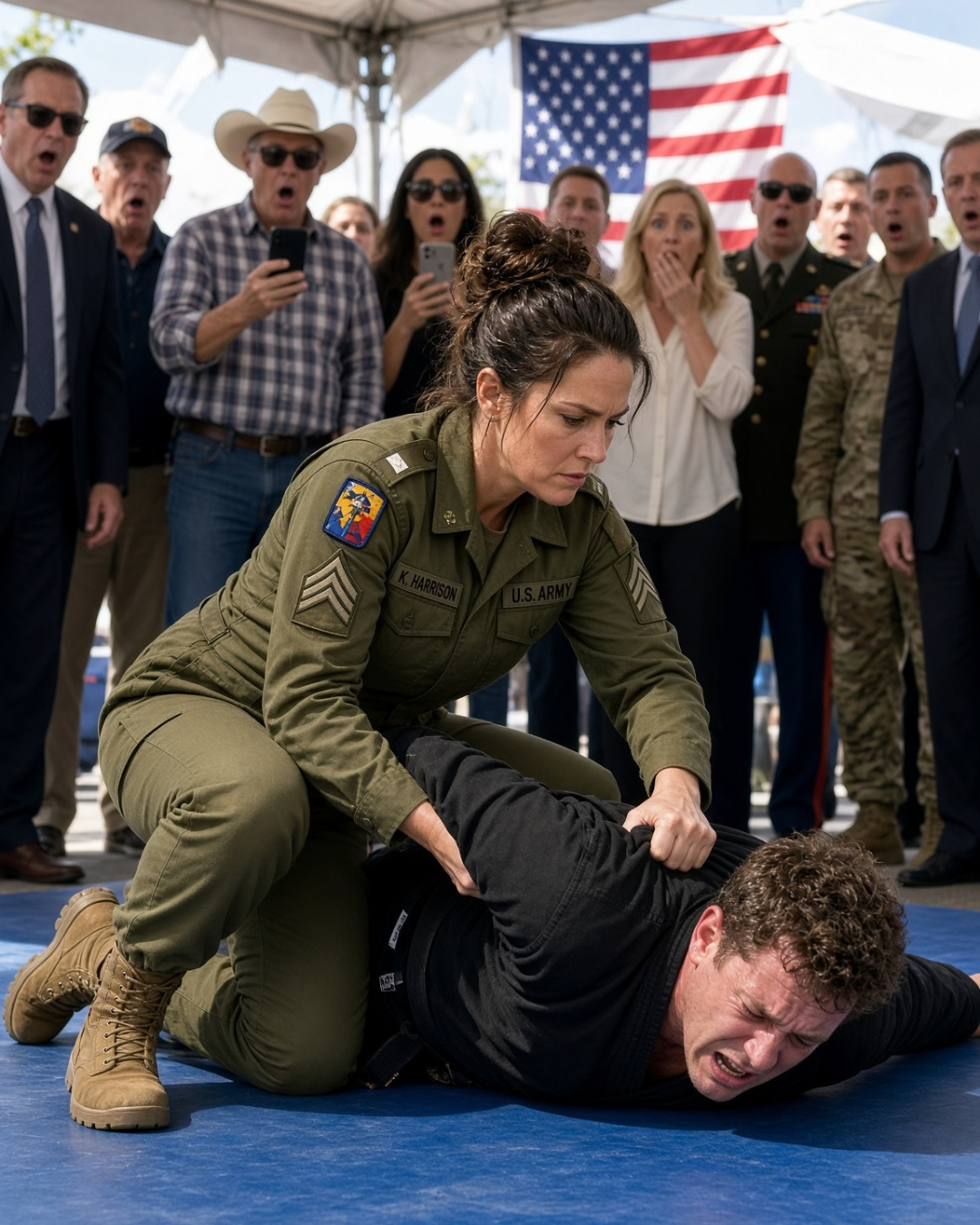
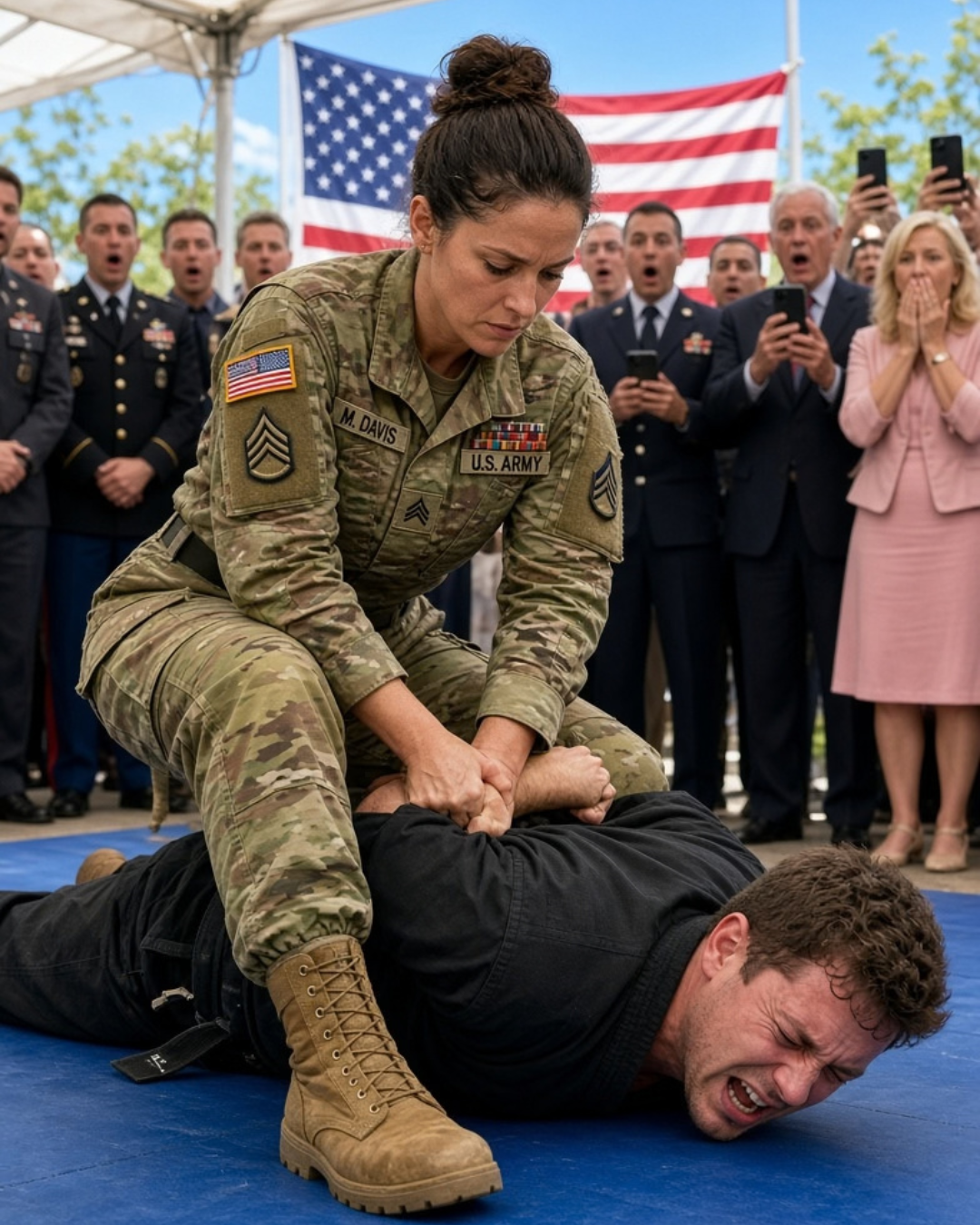
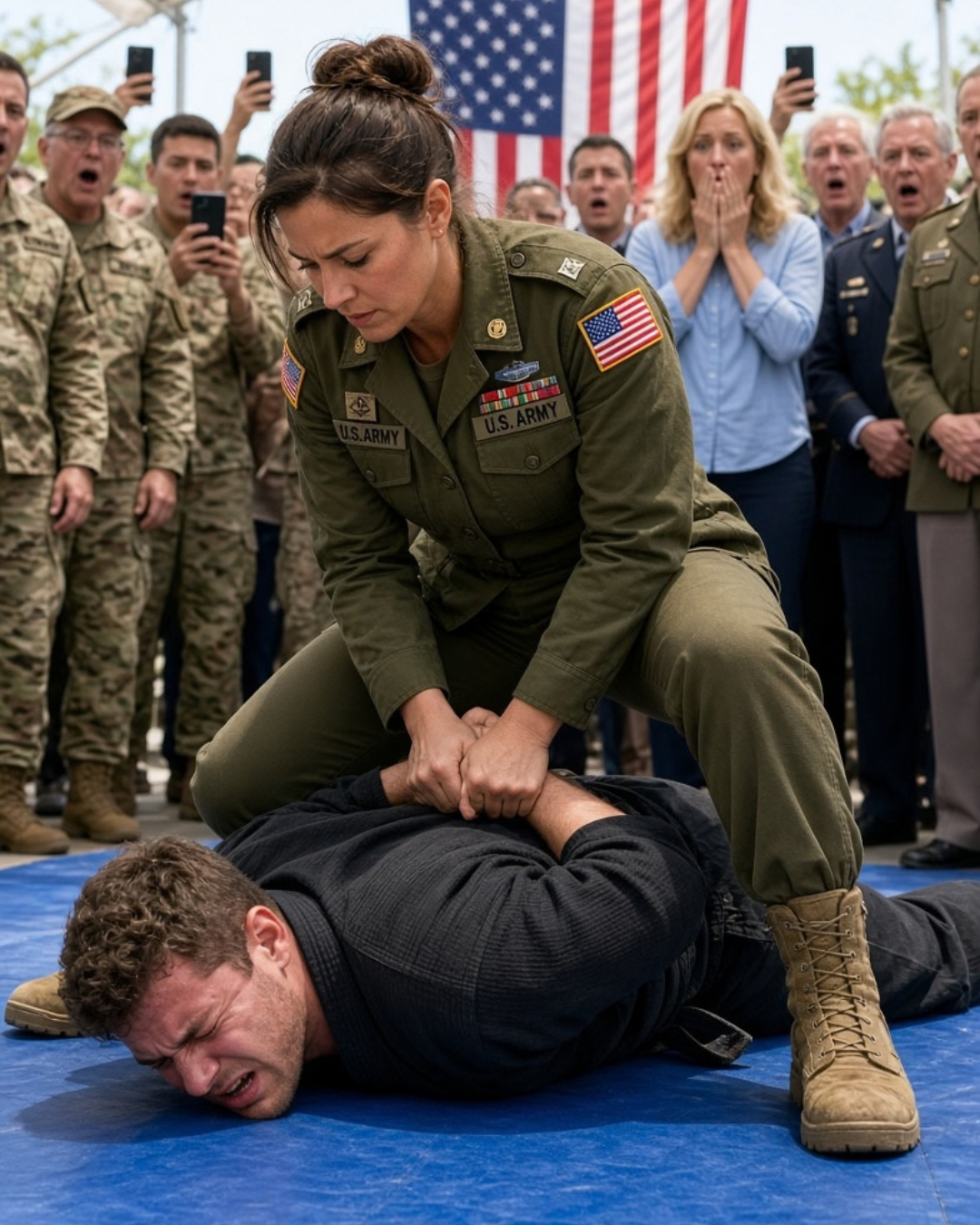
A second later, Ethan was on the mat.
Not slammed.
Not thrown dramatically.
Just taken down cleanly.
I followed him, controlled the position, and waited.
Ethan immediately started working.
His technique on the ground was better than mine, and we both knew it.
He shifted his hips, created space, and began building his base.
I let go before the exchange became a contest neither of us needed.
I stood.
Ethan remained seated for a second.
Carlos raised one hand.
“Stop.”
Ethan looked up.
“Why?”
Carlos pointed between us.
“Because your challenge was whether she could take you down.”
The crowd went completely silent.
Carlos continued.
“She did.”
Ethan glanced at me.
Then at the envelope sitting on the auction table.
I offered him my hand.
For half a second, I wondered whether pride would make him refuse it.
Instead, he took it.
I pulled him to his feet.
Someone started clapping.
I turned.
Walt.
Of course.
Then Denise joined him.
Then Ortega.
Soon the entire tent was applauding.
I hated almost every second of it.
Ethan seemed to notice.
He gave me a strange look.
“You really don’t like attention, do you?”
“No.”
“You picked the wrong neighborhood.”
That made me laugh.
It was the first time he had ever made me laugh.
He looked surprised by that too.
Carlos leaned closer to him.
“You did fine.”
“I lost.”
“You got taken down.”
“That was the bet.”
Carlos shrugged. “Then honor the bet.”
Ethan looked toward the white envelope.
His father stepped forward again.
“You don’t need to—”
“Yes,” Ethan said.
Richard stopped.
Ethan walked to the auction table, picked up the envelope, and carried it toward the woman managing the veterans fund.
“You’ll need my information, right?”
She blinked.
“I—yes. For the receipt.”
He handed her the envelope.
“Ten thousand.”
The applause started again.
Ethan immediately pointed at the crowd.
“Enough.”
That made everybody laugh.
The tension finally broke.
People began returning to their tables. Conversations restarted. The auction volunteers resumed organizing donated items.
I retrieved my jacket.
When I turned around, Richard Caldwell was standing three feet away.
Up close, I noticed something I hadn’t before.
He looked pale.
“Victoria,” he said.
Not Captain Mercer.
Not Ms. Mercer.
Victoria.
I studied him.
“I don’t remember telling you my first name.”
His eyes shifted.
For the smallest moment, he looked like a man who had stepped onto a stair that wasn’t there.
Then he recovered.
“Denise probably mentioned it.”
Behind him, Denise raised both eyebrows.
“Nope.”
Richard closed his eyes briefly.
Ethan was several yards away talking with Carlos.
He hadn’t heard.
I folded my jacket over my arm.
“How do you know my name?”
Richard looked toward the parking lot.
“Could we discuss this another time?”
“No.”
The answer came out more sharply than I intended.
I lowered my voice.
“You’ve barely spoken to me since I moved here. Your son has spent three weeks trying to provoke me. Now somebody says my last name and suddenly you know my first name.”
Richard rubbed a hand over the back of his neck.
“I know who you are.”
I waited.
When he said nothing else, I felt an old instinct return.
Silence was useful.
People often rushed to fill it.
Richard did.
“I knew your father.”
Everything around me seemed to move half a step farther away.
“My father?”
“Yes.”
Denise quietly excused herself.
I appreciated that.
My father, Daniel Mercer, had died seven years earlier.
He had been a civil engineer, a patient man who repaired clocks he never sold and kept receipts for things he bought twenty years before. He had known hundreds of people professionally.
There was no reason Richard Caldwell couldn’t have been one of them.
But Richard’s expression told me it was more complicated than that.
“How?”
“We worked together a long time ago.”
“My father never mentioned you.”
“I wouldn’t expect him to.”
That answer landed strangely.
“Why?”
Richard glanced toward Ethan again.
“Not here.”
“Then where?”
“My house. Tomorrow morning.”
I stared at him.
“No.”
He seemed startled.
“You don’t get to arrive with a mystery and then schedule the explanation.”
A reluctant smile almost appeared on his face.
“You sound exactly like Daniel.”
For reasons I couldn’t explain, that irritated me more than everything else.
“Then explain.”
Richard looked down.
“When your father and I were thirty, we started a company together.”
I said nothing.
“He left after four years.”
“My father worked for Halpern Engineering for almost three decades.”
“I know.”
“Then what company?”
Richard met my eyes.
“Caldwell Mercer Development.”
I thought I had misheard him.
“Mercer?”
“Yes.”
“My father never owned a development company.”
“He did.”
The certainty in Richard’s voice unsettled me.
“He owned half of one.”
I searched my memory.
My father had talked about college, his first engineering job, the tiny apartment where he and my mother had lived after they married.
He had told stories about impossible supervisors, badly designed bridges, frozen pipes, camping trips, tax mistakes, broken cars.
Never once had he mentioned owning a company with Richard Caldwell.
“What happened?”
Richard hesitated.
“We disagreed.”
“About what?”
“A project.”
“What project?”
His gaze moved toward the houses surrounding the fundraiser tent.
For the first time, I noticed exactly where he was looking.
Larksburg Court.
Our street.
“No,” I said.
Richard nodded once.
“This neighborhood.”
I stared at him.
“You’re telling me my father helped develop Larksburg Court?”
“He designed the original plan.”
I almost laughed.
It sounded absurd.
I had bought my house six weeks earlier because I wanted something quiet after years of moving from posting to posting. I had chosen Larksburg Court because of the mature trees, the sidewalks, the odd little central park, and the fact that every backyard had enough space to breathe.
My father had been dead seven years.
And now Richard Caldwell was telling me he had designed the place where I had somehow ended up living.
“That’s impossible.”
“No.”
“I found this house online.”
“I believe you.”
“I didn’t know anything about this neighborhood.”
“I believe that too.”
“Then why didn’t you say something when I moved in?”
Richard looked ashamed.
“Because I didn’t know what your father told you about me.”
“Apparently nothing.”
“Yes.”
The answer was almost a whisper.
Before I could ask another question, Ethan appeared beside us.
“What did Daniel tell her?”
Richard went still.
Ethan looked between us.
“Who’s Daniel?”
Neither of us answered quickly enough.
Ethan’s expression changed.
“Dad?”
Richard exhaled.
“Daniel Mercer was Victoria’s father.”
“So?”
“He and I knew each other.”
Ethan waited.
Richard seemed to age in front of us.
Finally he said, “He was my first business partner.”
Ethan stared at him.
“Your first business partner was named Mercer?”
“Yes.”
“And you never thought it was worth mentioning that our new neighbor had the same last name?”
“I wasn’t certain she was his daughter until today.”
I looked at him.
“You knew my first name.”
Richard grimaced.
“All right. I suspected.”
“How?”
“Your closing documents.”
I felt my expression harden.
He immediately lifted a hand.
“Nothing improper. The homeowners association sends ownership updates to the board. I saw your name.”
Of course.
Richard was president of the HOA.
I had forgotten.
“So you knew before I moved in.”
“I knew a Victoria Mercer had bought the house. I didn’t know for certain it was you.”
“Until today.”
“Yes.”
Ethan was still watching his father.
“What happened between you and her dad?”
Richard was quiet.
This time Ethan filled the silence.
“You always told me you built Caldwell Development by yourself.”
“I told you I built the company.”
“You said you started it in a borrowed office above a hardware store.”
“We did.”
“We?”
Richard looked tired.
“Daniel and I.”
A long moment passed.
Ethan’s face changed in a way I recognized.
It wasn’t anger exactly.
It was what happens when a piece of family history shifts under your feet.
“Why would you leave him out?”
Richard looked at me.
“Because I was ashamed of how it ended.”
The fundraiser continued around us.
Someone called Ethan’s name.
He ignored them.
I asked the question that suddenly mattered most.
“What did you do?”
Richard reached into the inside pocket of his blazer.
He removed a small brass key.
Old.
Scratched.
A paper tag hung from it.
My father’s handwriting was on the tag.
I knew it immediately.
VICTORIA.
For several seconds, I couldn’t speak.
Richard held the key in his palm.
“Your father gave this to me twenty-nine years ago.”
I stared at it.
“Why does it have my name on it?”
“He told me to keep it until you came looking for the truth.”
My throat tightened.
“I was six years old twenty-nine years ago.”
“I know.”
“What does it open?”
Richard looked toward my house across the end of the street.
Then he said something I never expected.
“Something Daniel hid before the first house on Larksburg Court was ever built.”
PART 3
I didn’t take the key.
Not immediately.
Richard Caldwell stood beneath the fundraiser tent with his palm open, my father’s handwriting hanging from a piece of yellowed paper.
VICTORIA.
The sensible part of me wanted to say no.
My father had been gone seven years. Whatever disagreement he and Richard Caldwell had experienced belonged to another lifetime.
But grief has a strange relationship with curiosity.
You can spend years convincing yourself you have accepted every unanswered question.
Then someone places a key in front of you.
“What does it open?” Ethan asked.
Richard glanced at him.
“I think Victoria should decide whether she wants you here for this.”
Ethan looked at me.
That was probably the first time since I moved to Larksburg Court that he waited for my permission instead of assuming he belonged in the middle of something.
“You can stay,” I said.
Richard handed me the key.
It was surprisingly heavy.
“What does it open?”
“The old survey office.”
I frowned.
“There’s no survey office here.”
“Not anymore.”
Richard pointed toward the small park at the center of Larksburg Court.
Behind the playground stood an old brick maintenance building that I had assumed belonged to the HOA.
“That?”
“The building predates the neighborhood.”
I looked from the building to my house.
“My father worked there?”
“For almost two years.”
Twenty minutes later, Denise had packed three leftover pieces of fundraiser cake into a cardboard container “because nobody should investigate family secrets hungry,” Walt had invited himself until his wife called him home for dinner, and Sergeant Major Ortega had wisely announced that he had already participated in enough unexpected reunions for one afternoon.
That left Richard, Ethan, and me walking toward the old brick building.
Carlos caught Ethan before we left.
I heard only part of their conversation.
“You all right?” Carlos asked.
Ethan shoved his hands into his pockets.
“Apparently I don’t know anything about my family.”
Carlos smiled faintly.
“Welcome to adulthood.”
Ethan gave him an annoyed look.
Carlos squeezed his shoulder.
“For what it’s worth, you handled the mat better after you lost than before you stepped onto it.”
Ethan looked away.
“I was acting like an idiot.”
“Sometimes that happens too.”
Their conversation stayed with me.
By the time Ethan caught up with us, he seemed quieter.
The maintenance building sat beneath two oak trees near the far edge of the park.
I had walked past it dozens of times.
Up close, I could see that one side was older than the other.
The brickwork didn’t match.
Richard unlocked the exterior door with his HOA key.
Inside were shelves of folding chairs, gardening equipment, paint cans, traffic cones, and boxes containing years of neighborhood Christmas decorations.
Ethan stared around.
“This is the big secret?”
“No.”
Richard walked toward the back wall.
Behind a stack of plastic tables was a narrow wooden door I had never noticed.
He moved the tables aside.
The brass key fit.
My pulse quickened.
The lock resisted once.
Then turned.
Richard opened the door.
The room beyond was small.
Dust floated through a shaft of evening sunlight.
An old drafting table stood against one wall.
Metal filing cabinets lined another.
Most were empty.
A faded map of Larksburg County hung crooked beside a corkboard.
Nothing dramatic.
Nothing frightening.
Just a forgotten office.
Yet I knew immediately that my father had been there.
A mechanical pencil rested in a groove along the drafting table.
Green tape was wrapped twice around its middle.
My father wrapped green tape around everything.
Flashlights.
Tools.
Extension cords.
Once, when I was ten, I asked him why.
“So I know what’s mine,” he said.
My mother had laughed.
“Nobody else wants your extension cords, Daniel.”
“You don’t know that.”
I picked up the pencil.
For a second, I was standing in our old garage again, watching my father mark measurements on scrap wood.
Ethan noticed my expression.
“His?”
I nodded.
Richard stood near the doorway.
“I haven’t moved anything in this room since the HOA acquired the building.”
“You knew this was here?”
“Yes.”
“For thirty years?”
“Not all of it.”
I turned toward him.
“Start at the beginning.”
Richard pulled one of the folding chairs from the outer room.
We sat around the drafting table.
He rubbed both hands over his face.
“When Daniel and I met, neither of us had money.”
Ethan leaned against the wall.
“That part I knew about you.”
Richard nodded.
“We met at an engineering firm. I was working on finance and project acquisition. Daniel was the best young site engineer in the company.”
I smiled despite myself.
“That sounds like him.”
“He was impossible.”
“That also sounds like him.”
Richard laughed quietly.
“He questioned everything. Drainage calculations. Road widths. Soil reports. If somebody told him something would probably be fine, Daniel would ask for evidence.”
“So how did you become partners?”
“Because I was almost as stubborn.”
Richard looked around the room.
“We believed we could build neighborhoods differently.”
“Differently how?”
“Smaller developments. More green space. Walkable streets. Houses that weren’t pushed together simply because the zoning allowed it.”
I looked through the dusty window at Larksburg Court.
The mature trees.
The sidewalks.
The central park.
All the things I had liked without knowing why.
“That was his idea.”
“Most of it.”
Richard pointed toward the old map.
“Your father designed the curved streets because he hated neighborhoods where drivers could accelerate straight through. He insisted on preserving the original oaks. He fought me for six months over the size of the park.”
“Who won?”
“Look outside.”
I smiled.
Then remembered why we were there.
“What happened?”
Richard’s smile faded.
“We got an investor.”
Ethan crossed his arms.
“Grandpa?”
“No.”
That surprised him.
“A man named Leonard Pierce. Local businessman. He offered enough funding to buy the entire parcel.”
Richard paused.
“At first, it seemed like the opportunity we had been waiting for. Then construction costs rose. Pierce wanted changes.”
“What changes?”
“More houses. Smaller lots. Less public space.”
I glanced outside again.
“My father refused.”
“Immediately.”
“And you?”
Richard stared at his hands.
“I told myself compromise was necessary.”
The room became quiet.
“I was thirty,” he continued. “I had a newborn son at home.”
Ethan straightened.
“My brother.”
“Yes.”
I knew Richard had another son.
Michael Caldwell.
I had never met him. Denise had mentioned that he lived in Oregon with his family and rarely returned east.
Richard continued.
“Your father thought accepting Pierce’s changes would destroy the point of the project. I thought losing the project would destroy the company.”
“So you voted against him.”
“We were equal partners. Neither of us could force the other.”
“What happened?”
“I found another way.”
There was no pride in his voice.
“I bought Daniel out.”
I frowned.
“He agreed?”
“Eventually.”
“Why?”
Richard looked directly at me.
“Because your mother was sick.”
My breath caught.
“My mother wasn’t sick when I was six.”
“You didn’t know.”
I shook my head.
“She had a heart condition. But that wasn’t diagnosed until later.”
Richard nodded slowly.
“It had been discovered earlier than you were told.”
I stared at him.
“My parents hid it?”
“From you. You were a child.”
That was believable.
Painfully believable.
My parents had spent most of my childhood protecting me from problems they considered adult business.
“Your father needed financial certainty,” Richard said. “I offered to buy his share.”
“And he accepted.”
“Yes.”
“How much?”
Richard named a figure.
Even adjusted for the time period, it wasn’t much.
I looked at him.
“That was half the company?”
“Yes.”
“Was that fair?”
“No.”
Ethan looked sharply at his father.
Richard didn’t defend himself.
“I told Daniel the company might fail. That Pierce could walk away. That the land deal might collapse. All technically true.”
“But you thought it would succeed.”
“I believed it would.”
The words sat heavily between us.
Ethan moved away from the wall.
“You cheated him.”
Richard flinched.
“I took advantage of his fear.”
“That’s the same thing.”
“No,” I said quietly.
Both men looked at me.
“It isn’t.”
Ethan frowned.
I continued.
“One is illegal. The other is something people can regret for the rest of their lives.”
Richard’s eyes dropped.
I wasn’t protecting him.
I simply wanted the truth to remain precise.
“What did my father say?”
“That someday I would understand what I’d traded away.”
“For money?”
Richard shook his head.
“For control.”
He looked toward Ethan.
“At thirty, I believed owning something meant you had succeeded.”
“And now?”
“Now I spend half my life wondering why everything I own requires so much effort to keep.”
Ethan stared at him.
That sentence seemed intended for more than the old company.
I sensed a conversation between father and son that had been happening silently for years.
Richard continued.
“After Daniel left, Pierce pushed the changes. I approved some. Refused others. We argued constantly. Eventually I bought him out too.”
“So the neighborhood stayed close to my father’s plan.”
“Closer than Daniel ever knew.”
I looked around.
“Did you ever tell him?”
“I tried.”
“Tried?”
Richard stood and walked toward one of the filing cabinets.
“He returned every letter.”
That sounded like my father.
When Daniel Mercer decided a relationship was finished, he rarely revisited it.
Not out of cruelty.
Finality was simply one of his weaknesses.
Richard opened the bottom drawer.
Inside was a small metal box.
No lock.
He brought it to the drafting table.
“I found this after Daniel died.”
I stared at him.
“How did you know he died?”
“The obituary.”
Richard opened the lid.
Inside were letters.
At least twenty.
Some sealed.
Some opened and refolded.
All addressed to Daniel Mercer.
“I wrote one every few years.”
“You kept copies?”
“Those are originals.”
I picked up the first envelope.
RETURN TO SENDER had been stamped across the front.
“He sent them back.”
“Yes.”
“Why keep them here?”
“Because this was the last place where we were still friends.”
That answer surprised me.
Ethan looked away.
I opened one letter.
It was dated seventeen years earlier.
Daniel,
I drove Larksburg this morning. The oaks are taller than either of us expected. You were right about the drainage basin. You were also right about the park, although I reserve the right to deny ever putting that in writing.
Michael starts high school next week. Ethan turned ten last month and has somehow inherited every stubborn quality I used to accuse you of having.
I know you do not want to hear from me.
I am writing anyway.
I read no further.
Not because I was angry.
Because I suddenly felt like I was listening through a door.
I folded the page.
“What’s in the box that’s for me?”
Richard nodded toward the drafting table.
“The key was supposed to bring you here.”
He moved the metal box aside.
Beneath it was a shallow drawer built into the table.
I pulled it open.
Empty.
At least it looked empty.
Then I noticed a second strip of green tape near the back.
I smiled before I could stop myself.
Of course.
I pressed it.
A false panel lifted.
Ethan laughed softly.
“Your dad had style.”
“No,” I said. “My dad had an unhealthy relationship with hiding compartments.”
Inside was one envelope.
VICTORIA was written across the front.
My hands stopped.
This was different.
Richard leaned back.
“I’ve never seen that.”
“You said Dad gave you the key.”
“He did. But I didn’t know what was inside.”
I lifted the envelope.
The paper was old.
The handwriting was unmistakable.
For my daughter, when she is old enough to understand that adults can love each other and still fail each other badly.
I stared at the sentence until the words blurred.
Ethan quietly walked out of the room.
Richard started to follow.
“Stay,” I said.
He hesitated.
“You’re part of this.”
I opened the envelope.
There were three pages.
The first was addressed to me.
Victoria,
If you are reading this, you found your way to Larksburg.
Perhaps Richard gave you the key. Perhaps someone else did. Perhaps you found it by accident, which would be entirely consistent with this family’s history of poor planning and good luck.
I laughed once.
My father’s voice was there.
Perfectly intact.
I kept reading.
I helped draw these streets before there were houses here. I imagined families walking them long after I was gone.
Richard imagined the same thing.
You may someday hear that Richard Caldwell betrayed me.
That is partly true.
You may also hear that I walked away because I was principled and he was greedy.
That is too simple.
Richard made a choice I could not forgive at the time.
I made pride into a home and lived inside it for years.
Your mother asked me more than once to answer his letters.
I refused.
That was my choice.
I looked up.
Richard’s face had gone very still.
I continued.
Do not inherit my grudges simply because you inherit my name.
I had to stop.
The room had become too quiet.
I took a breath.
Then turned the page.
There was more about the neighborhood.
About my mother.
About the company.
And one paragraph about me.
You were six when I left Caldwell Mercer. You asked why I no longer went to “the office with the big trees.”
I told you the project was finished.
That was not true.
I was finished with it.
There is a difference.
Someday, Victoria, you will have to decide whether leaving something behind means you lost it, escaped it, or simply completed your part.
Nobody else can decide that for you.
I lowered the letter.
For years, I had believed my father left the past cleanly.
Now I realized he had carried it quietly.
Richard wiped his eyes with his thumb and looked embarrassed by it.
“He wrote that?”
“Yes.”
“What else?”
I read the final paragraphs silently.
Then I frowned.
“What?”
Richard leaned forward.
“My father says there were two copies of the original Larksburg agreement.”
Richard nodded.
“One for each partner.”
“He says his copy stayed here.”
“That would make sense.”
I looked into the compartment.
There was nothing else.
“It’s gone.”
Richard frowned.
“What?”
“The agreement.”
I handed him the letter.
His eyes moved quickly across the page.
Then stopped.
“That document isn’t important anymore.”
“Why mention it?”
“I don’t know.”
I searched the compartment again.
Nothing.
Ethan returned carrying three bottles of water.
He took one look at our faces.
“What happened?”
“My father left another document here.”
“Something important?”
Richard answered before I could.
“Historically, maybe. Legally, probably not.”
Ethan handed me a bottle.
“What was it?”
“The original partnership agreement.”
He froze.
I noticed.
So did Richard.
“What?” I asked.
Ethan looked uncomfortable.
“I’ve seen one.”
Richard stared at him.
“Where?”
“In your study.”
“No.”
“Yes.”
“Ethan, there are hundreds of contracts in my study.”
“This one said Caldwell Mercer across the top.”
Richard stood.
“When?”
“Maybe two months ago.”
“Why were you looking at it?”
Ethan looked at the floor.
“I wasn’t.”
“Then how did you see it?”
He exhaled.
“Michael sent it to me.”
The room went silent again.
Richard stared at his son.
“My brother has it?”
“He sent me a photograph.”
“Why?”
Ethan hesitated.
Then took out his phone.
“He said I should ask you why half of everything our family built started with a man whose name nobody was allowed to mention.”
PART 4
Richard stared at Ethan’s phone without taking it.
“Michael has the agreement?”
“I don’t know if he physically has it.”
“You just said—”
“I said he sent me a photograph.”
Ethan opened the message.
The photograph showed a yellowed contract on a dark wooden table.
Across the top were the words:
CALDWELL MERCER DEVELOPMENT PARTNERSHIP AGREEMENT.
Two signatures were visible at the bottom.
Richard Caldwell.
Daniel Mercer.
I recognized my father’s signature immediately.
Richard sat down.
“When did Michael send this?”
“Eight weeks ago.”
“And you said nothing?”
Ethan gave a humorless laugh.
“You’re upset that I kept something from you?”
Richard’s expression tightened.
Ethan immediately looked regretful.
“That was cheap.”
“No,” Richard said. “It was deserved.”
I stepped between the direction the conversation was heading and the reason we were there.
“What did Michael want?”
Ethan scrolled through the messages.
“He said he found a box when Grandma moved out of the lake house.”
Richard’s mother had died several years earlier. I knew from neighborhood conversations that the family had sold her house only recently.
“What box?” Richard asked.
“One of Grandpa’s.”
Richard looked confused.
“My father wasn’t involved in Caldwell Mercer.”
“Apparently he kept some of your papers.”
Ethan handed him the phone.
Richard read silently.
Then rubbed his forehead.
“This makes no sense.”
“Call Michael,” I said.
Both of them looked at me.
Richard seemed uncertain.
“It’s late in Oregon.”
“It’s barely after four there.”
Ethan smiled.
“She has a point.”
Richard made the call.
Michael answered on the fourth ring.
“Dad?”
“Hello, Michael.”
A pause.
I couldn’t hear his words clearly, but I heard the surprise in his voice.
Richard glanced at me.
“I’m sitting with Victoria Mercer.”
Silence.
This time I heard Michael clearly.
“You found her?”
I raised my eyebrows.
Richard did too.
“What do you mean, found her?”
Another pause.
Richard put the call on speaker.
Michael’s voice filled the dusty office.
“I tried to find her months ago.”
“Why?”
“Because of Grandpa’s box.”
Richard closed his eyes.
“Start at the beginning.”
Michael sighed.
“When we cleared out the lake house, I found Dad’s old business papers.”
“You mean my papers.”
“No. I mean Grandpa’s papers. He had correspondence from Daniel Mercer.”
Richard went pale.
“That’s impossible.”
“Apparently not.”
I leaned toward the phone.
“Michael?”
“Yes?”
“This is Victoria.”
His voice softened.
“I’m sorry. This is probably strange.”
“Today has established a fairly high standard for strange.”
Ethan laughed.
Michael did too.
“I suppose Ethan told you about the agreement.”
“Yes.”
“There’s something else.”
Richard leaned closer.
“What?”
“A letter from Daniel.”
“To your grandfather?”
“Yes.”
Richard looked at me.
“Why would Daniel write my father?”
Michael shuffled papers.
“Because Grandpa tried to return something.”
“What?”
“Money.”
Nobody spoke.
Michael continued.
“Apparently after you bought Daniel out, Grandpa thought the amount was unfair.”
Richard shook his head slowly.
“My father never said anything.”
“He told Daniel he wanted to personally make up part of the difference.”
“That sounds like Grandpa,” Ethan murmured.
Richard seemed shaken.
“What did Daniel do?”
“Refused it.”
I almost smiled.
That sounded like my father too.
Michael continued.
“But he asked Grandpa to do something else.”
“What?”
“Preserve the original Larksburg plans.”
I looked around the room.
“They’re here.”
“Not all of them.”
I frowned.
“What does that mean?”
“There was a second parcel.”
Richard stood so quickly his chair scraped backward.
“No.”
Michael stopped.
“What?”
Richard walked to the faded county map.
He stared at the northwest corner of the neighborhood.
“The Miller tract.”
I joined him.
“What’s the Miller tract?”
He pointed to several acres beyond the far row of houses.
Today the land was wooded.
“There was supposed to be another phase of Larksburg.”
“What happened?”
“Daniel objected to developing it.”
“Why?”
“Wetlands. Old growth. He thought it should remain untouched.”
“And did it?”
“Yes.”
Ethan walked closer.
“So what’s the mystery?”
Michael answered through the phone.
“The land wasn’t owned by Caldwell Development.”
Richard turned.
“What?”
“According to the papers, Grandpa bought it personally after Daniel left.”
Richard stared at the map.
“I never knew that.”
“Neither did I until eight weeks ago.”
“Who owns it now?”
Michael paused.
“That’s why I tried to find Victoria.”
I knew the answer before he said it.
“Daniel Mercer.”
My stomach dropped.
“No.”
“Not exactly,” Michael said. “There was a trust.”
Richard pressed both hands against the drafting table.
“My father created a trust?”
“Yes.”
“For Daniel?”
“For the families of Larksburg.”
I sat slowly.
Michael continued.
“The property was held for conservation. Grandpa named Daniel as the original adviser because Daniel had prepared the environmental plans.”
“But my father left the company.”
“Apparently Grandpa didn’t care.”
I could imagine that.
Two stubborn older men making arrangements around Richard while never quite telling him.
“What happened when my father died?”
Michael hesitated.
“The successor adviser was supposed to be his adult child.”
Everyone looked at me.
I almost laughed.
“This is absurd.”
Ethan smiled.
“That’s exactly what I said when I learned Dad had a secret business partner.”
Richard ignored him.
“What does adviser mean?”
“Very little, financially.”
That relaxed me immediately.
Michael continued.
“The land can’t be sold for private development under the current trust. The adviser gets a vote on conservation use, public access, and whether the parcel can be transferred to the county or a nonprofit.”
“So I didn’t secretly inherit millions of dollars?”
“No.”
“Good.”
Ethan blinked.
“You sound disappointed that you’re not secretly rich.”
“I already have a mortgage. I don’t need surprise land.”
That made everyone laugh.
Even Richard.
Michael’s voice grew more serious.
“There is one issue.”
Of course there was.
“What?”
“The trust expires next year unless the current trustees renew it or transfer the land.”
Richard frowned.
“Who are the trustees?”
“Dad is one.”
Richard stared at the phone.
“I’m what?”
“Apparently Grandpa amended the documents after Daniel died.”
“And the other?”
“Me.”
Ethan threw both hands into the air.
“Does anyone in this family tell anyone anything?”
That broke whatever tension remained.
I laughed so hard I had to sit back down.
Richard began laughing too.
Even Michael, hundreds of miles away, joined us.
For a minute, the dusty little room stopped feeling like the site of some buried family dispute.
It felt like exactly what it was.
A room containing several people who had inherited unfinished conversations from men who believed writing things down was somehow the same as talking about them.
When the laughter faded, Richard looked at me.
“What do you want to do?”
“With what?”
“The land.”
“You’re asking me now?”
“Yes.”
“You didn’t know it existed ten minutes ago.”
“Neither did you.”
“Exactly.”
He nodded.
“Fair.”
I picked up my father’s letter again.
Do not inherit my grudges simply because you inherit my name.
I read the line twice.
Then looked out the window.
Children were playing in the park.
Parents folded fundraiser tables beneath the tent.
Walt Griffin was carrying two chairs at once while his wife followed behind telling him to carry one chair like a sensible human being.
Denise was waving at someone across the street.
Ordinary life.
The kind my father had once imagined filling these roads.
“Keep it green,” I said.
Richard’s expression changed.
“The land?”
“Yes.”
He nodded immediately.
“No development?”
“No.”
“Public trails?”
“Maybe.”
“A community garden?”
“Maybe.”
Ethan leaned against the drafting table.
“Dog park?”
“No.”
“Why not?”
“You have met your dog.”
“That is discrimination against Biscuit.”
I looked at him.
“Your dog ate one of my porch cushions.”
“He was expressing himself.”
Richard stared at his son.
“Your dog ate her furniture?”
“One cushion.”
“Two,” I said.
Ethan frowned.
“He returned the second.”
“He returned pieces of the second.”
Michael’s laughter came through the speaker.
“I’m beginning to understand why Victoria knows Ethan.”
“Oh, they had a wrestling match today,” Richard said.
There was a long silence.
“A what?”
“Dad.”
“What?”
“That sentence requires context.”
It was nearly an hour before we left the old office.
By then, Michael had promised to email copies of everything in the box. Richard had agreed to contact the attorney administering the trust.
And I had placed my father’s letter safely inside my jacket.
Outside, the fundraiser was almost finished.
The tent lights glowed against the early evening.
Denise spotted us.
“Well?”
She walked toward me carrying the cardboard container of cake.
“Were there government secrets? Buried gold? Long-lost royalty?”
“Wetlands.”
She stared.
“I’m sorry?”
“I apparently inherited advisory responsibility for several acres of protected wetlands.”
Denise considered that.
“I was hoping for buried gold.”
“Me too.”
“You said you didn’t want surprise money,” Ethan protested.
“I can have inconsistent feelings.”
Denise handed me the cake.
“That’s growth.”
Over the next week, something unexpected happened.
Nothing.
No scandal.
No neighborhood war.
No dramatic confrontation.
Nobody uncovered a hidden fortune.
Life continued.
But small things changed.
Ethan stopped blocking my driveway.
The first morning after the fundraiser, he actually knocked on my door.
When I answered, he stood beside a pressure washer.
“What is that?”
“A peace offering.”
“You’re giving me a pressure washer?”
“No. I’m cleaning your driveway.”
“Why?”
He looked uncomfortable.
“Because I blocked it three times.”
“Four.”
“Was it four?”
“Yes.”
He sighed.
“Then I apparently owe you one additional act of landscaping.”
I stepped onto the porch.
“You don’t have to compensate me.”
“I know.”
That mattered.
I moved aside.
“Try not to destroy the flower beds.”
“No promises.”
“Ethan.”
“Fine. Limited promises.”
He spent two hours cleaning the driveway.
Halfway through, Biscuit escaped from Richard’s yard and appeared carrying what remained of my missing porch cushion.
Ethan looked at the dog.
I looked at Ethan.
Neither of us spoke.
Finally he said, “Evidence destruction?”
“Absolutely not.”
A month passed.
Then two.
Richard and I met several times with Michael by video call and the trust attorney.
We learned the protected parcel contained nearly twelve acres, including a creek and a small grove of oaks my father had specifically marked on his original survey.
The final plan was surprisingly simple.
The land would be transferred to a local conservation nonprofit with permanent protections.
A walking trail would connect it to the neighborhood park.
No houses.
No commercial development.
No Caldwell name.
No Mercer name.
That last part had been my suggestion.
Richard agreed immediately.
“What do we call it?” Ethan asked during one meeting.
I looked at the original map.
My father had written two words beside the grove decades earlier.
KEEP OPEN.
“Open Grove,” I said.
Richard smiled.
“Daniel would like that.”
“I think so.”
My relationship with Richard changed slowly.
Forgiveness turned out not to be a dramatic moment.
There was no speech.
No instant absolution.
He told me more about my father.
I told him things about the years he had missed.
Sometimes those conversations were uncomfortable.
Sometimes they were funny.
Once, Richard admitted my father had thrown an entire sandwich at him during an argument about drainage.
“My father did not throw food.”
“It was turkey.”
“He hated turkey.”
“That may explain why he was willing to sacrifice it.”
I laughed until my sides hurt.
Ethan changed too.
Not completely.
He was still competitive.
Still loud.
Still capable of converting almost any harmless activity into a contest.
But several months after the fundraiser, I watched him teach a beginner jiu-jitsu class at Carlos’s gym.
A nervous teenager kept apologizing for making mistakes.
Ethan crouched beside him.
“You don’t have to prove anything here,” he said. “Just learn.”
I watched from the doorway.
Carlos noticed me.
“Improvement?”
“Considerable.”
“He had a good teacher.”
Carlos nodded solemnly.
“Thank you.”
“I wasn’t talking about you.”
He laughed.
Ethan looked over.
“You planning to stand there insulting me or are you training?”
“I haven’t decided.”
“Scared?”
The room went silent.
Carlos closed his eyes.
Ethan froze.
Then I smiled.
He grinned.
“Too soon?”
“Very.”
“Worth trying.”
I stepped onto the mat.
Months earlier, those words had been a challenge.
Now they were a joke between friends.
On the anniversary of the fundraiser, the neighborhood gathered to open the new trail through Open Grove.
There were no giant sponsor banners.
Richard insisted.
A small wooden sign stood beside the entrance.
OPEN GROVE
Protected for future generations.
Below it was one smaller plaque.
The design of Larksburg Court was first imagined here by two young partners who disagreed about almost everything except the belief that a neighborhood should leave room for people to breathe.
No names.
I had asked for that too.
Richard stood beside me as families began walking the trail.
“You know,” he said, “Daniel would complain about the wording.”
“Definitely.”
“He would say it was sentimental.”
“He would say the font was too large.”
Richard smiled.
Then his expression became thoughtful.
“I wish I had called him one more time.”
I looked toward the oak trees.
“He might not have answered.”
“I know.”
“But you could have called.”
“Yes.”
We stood quietly.
Finally I said, “He could have called you too.”
Richard nodded.
Something in his shoulders loosened.
Across the park, Ethan was arguing with Michael, who had flown in with his wife and children for the opening.
The argument involved a folding table and apparently very strong opinions about where lemonade should be placed.
Michael’s daughter solved the dispute by moving the table herself.
Both brothers stopped talking.
I smiled.
“Your family is exhausting.”
Richard looked at me.
“You’re part of the committee now.”
“That doesn’t make me family.”
“No.”
He glanced toward Ethan.
“But give it time.”
I shook my head.
Walt Griffin appeared beside us wearing a veterans association cap.
“Mercer.”
“Yes?”
He pointed toward Ethan.
“Kid still owes ten thousand?”
“He paid it.”
“I know. Just enjoy hearing it.”
Ethan shouted from across the lawn.
“I can hear you, Walt!”
“Good!”
Everyone laughed.
Later, after most people had gone home, I walked the trail alone.
Sunlight filtered through the oaks.
The creek moved quietly below the path.
Near the center of the grove stood one tree larger than all the others.
I stopped beneath it.
In my pocket was a copy of my father’s letter.
I had read it so many times that I knew most of it by heart.
One sentence had become my favorite.
Leaving something behind does not always mean you lost it.
For years, I had interpreted my own life through departures.
Leaving home.
Deployments.
Transfers.
Friends scattered across states and countries.
My parents gone.
The Army chapter eventually closing.
I had moved to Larksburg because I thought I wanted a place where nobody knew me.
Instead, I had found a place shaped partly by a father I thought I had already said goodbye to.
I had found unfinished history.
A difficult neighbor.
An imperfect family next door.
And the strange possibility that home wasn’t a place where nothing complicated had ever happened.
Maybe it was a place where people finally decided what to do with what had happened.
Footsteps approached behind me.
Ethan.
He carried two cups of lemonade.
“No grappling challenges,” I said.
“I retired the cash prize system.”
“Wise.”
He handed me a cup.
We walked toward the end of the trail.
After a while he said, “Can I ask you something?”
“You usually do.”
“Why did you agree that day?”
“To what?”
“The match.”
I considered the question.
At first I thought the answer was obvious.
Then I realized it had changed.
“I thought I was teaching you something.”
He laughed.
“That sounds bad.”
“It was.”
“What did you learn?”
I looked at him.
“That I was still letting strangers decide when I had something to prove.”
He nodded slowly.
“And now?”
“Now I charge twenty thousand.”
He nearly spilled his lemonade.
I laughed.
“So that’s where we’re at?”
“Inflation.”
We reached the entrance.
Richard stood there talking with Denise and Michael.
Biscuit lay beneath the new sign, exhausted from spending the afternoon greeting everyone as though he personally owned the forest.
My house was visible beyond the trees.
For the first time since arriving on Larksburg Court, I didn’t think of it as the place I had moved to.
I thought of it as home.
Richard raised a hand.
I raised mine back.
Ethan started toward his family, then stopped.
“You coming?”
For years, I had believed strength meant knowing exactly when to stand alone.
The Army had taught me how to remain steady when circumstances changed.
Life afterward had taught me something harder.
Sometimes strength meant allowing other people to stand beside you.
Even imperfect people.
Especially imperfect people.
I looked once more at the old oak grove my father had wanted protected.
Then I followed Ethan toward the others.
“Yes,” I said.
“I’m coming.”
