

PART 1
The fluorescent lights in the emergency room buzzed with an aggressive, relentless hum. The suffocating sterile whiteness made my eyes sting, though the sharp, astringent smell of rubbing alcohol and iodine might have been responsible too. I lay stiffly on the thin, crinkling paper covering the examination table. Every breath felt like a shard of glass sliding between my ribs, a brutal reminder of what tonight’s performance had cost.
On the stretcher beside me lay my twin sister, Clara. Her dark hair, normally a curtain of silk, was clotted with dried blood at her temple. Her eyes were wide and vacant, fixed on the ceiling tiles as she rocked slightly and hummed a discordant, eerie tune. It was a horrifying sight. Or it would have been, if I didn’t know it was an Oscar-worthy performance she had spent the last three months perfecting. My hand dangled over the side of my bed, my fingertips barely touching the cold railing of hers.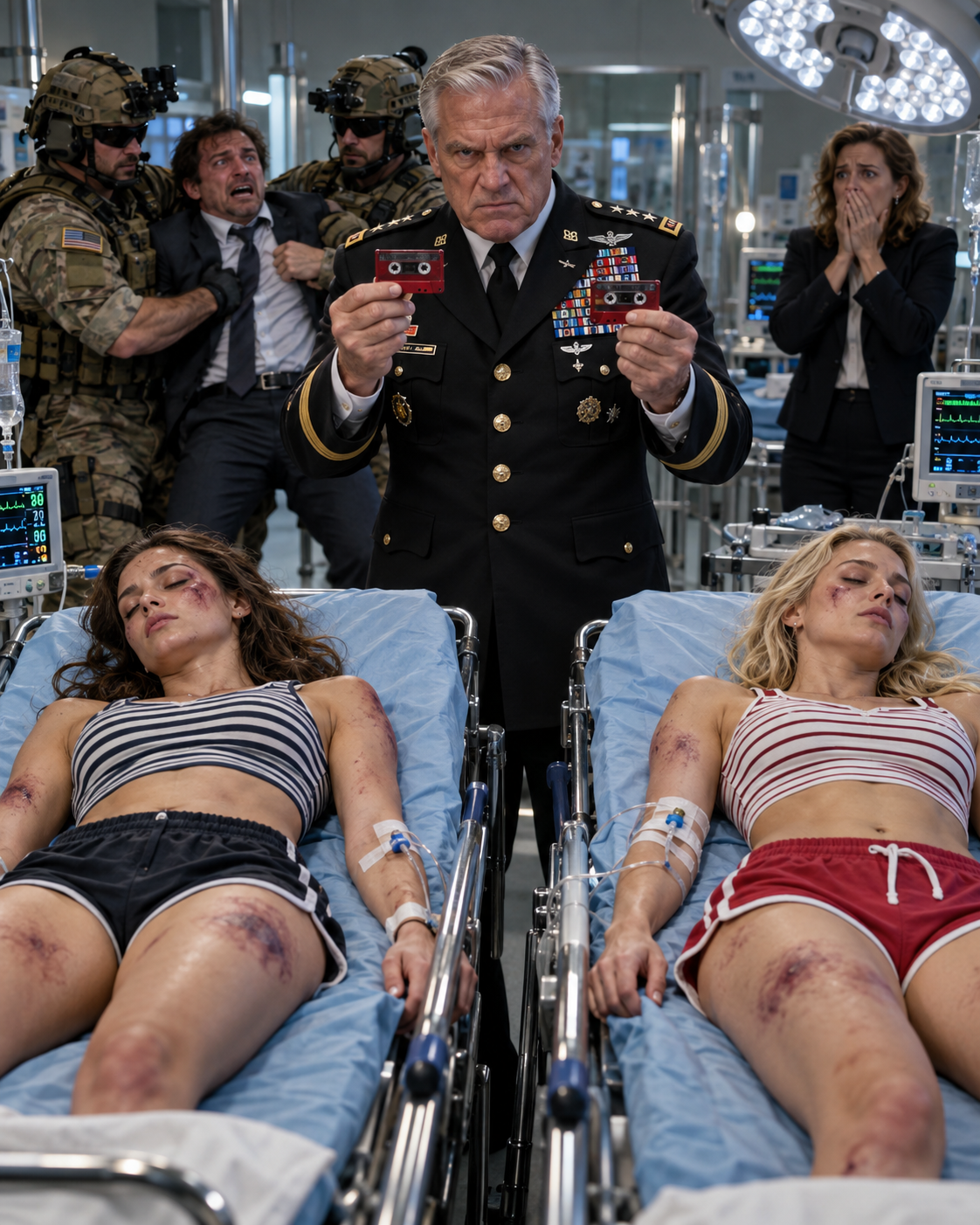
At the foot of my bed stood Dr. Sarah Miller. She was an ER veteran, a woman whose exhausted eyes had witnessed the absolute worst of human nature. Now, she was running gloved fingers across the deep, identical purple welts spreading over my forearms—textbook defensive wounds.
In the far corner of the room, as distant from us as possible, stood our captors.
My stepfather, Edward Vance, rested casually against the stainless-steel sink. He wasn’t a wild-eyed, screaming monster. He was a terrifyingly controlled, sociopathic real estate mogul. His bespoke charcoal suit probably cost more than the MRI machine down the hallway. He was washing his hands, carefully scrubbing his cuticles with soap, completely unfazed.
Beside him stood my mother, Patricia. She looked like the definition of distressed, wealthy elegance. Her hair was perfectly styled, her makeup flawless despite the hour being well past midnight. She gripped her quilted Chanel handbag so tightly that her knuckles had turned bone-white, performing the role of the devastated matriarch flawlessly.
Dr. Miller lifted her gaze from my bruised arms. “Did both girls manage to fall down the grand staircase and sustain identical defensive contusions?” she asked, her voice dangerously quiet.
Patricia responded without hesitation, giving a smooth, practiced sigh of maternal exhaustion. “They’re identical twins, Doctor. I know it sounds strange, but they even imitate each other when they’re manic. Clara had another one of her… episodes. Phoebe tried to restrain her. It was a chaotic tangle of limbs. It’s a miracle it wasn’t worse.”
Edward dried his hands before casually tossing the paper towel into the bin. “Look, Doctor, we appreciate your thoroughness. But it’s been a long night. Just patch them up, give Clara her sedatives, and let us go. They have a very important transfer tomorrow morning to a specialized care facility.”
He stepped forward, convinced that his wealth, his voice, and his sheer presence could force reality to obey him. He believed he was in control. He had no idea I had spent the last ninety days carefully engineering his complete destruction.
Dr. Miller didn’t write a prescription. She didn’t even glance at Edward. Instead, she bent toward me, adjusting the blood pressure cuff around my arm. As she leaned closer, she whispered so quietly that only I could hear, “I read the hidden text in the online triage form, Phoebe. Code Icarus.”
My breath caught.
Eight years earlier, before my biological father, Daniel Sterling, died, he had quietly paid for Dr. Miller’s entire medical school tuition when she was a brilliant, struggling student facing bankruptcy. She owed him her life. I had found her name in his old journals, and tonight, while I was in the ambulance, I had hacked into the hospital’s patient portal and embedded a specific SOS code my father used for corporate emergencies. Code Icarus.
Dr. Miller straightened, her expression becoming an unreadable mask of clinical detachment. She walked toward the heavy wooden examination-room door.
“What are you doing?” Edward snapped, his patience beginning to crack.
“Hospital policy, Mr. Vance,” Dr. Miller said coldly.
She stepped outside and pulled the heavy door shut behind her. A second later, the electronic deadbolt engaged with a deafening, echoing thud. A red light flashed above the door frame.
Lockdown.
Edward went rigid. Patricia gasped, one hand flying to her throat.
But it wasn’t that sound that made my stepfather’s blood run cold. It was the sudden, violent vibration of his cell phone inside his breast pocket. Then Patricia’s phone began ringing from inside her purse.
I looked toward the ceiling and smiled through the pain. Because they were about to understand that the sound of my ribs cracking hadn’t merely been recorded. It had been broadcast to every member of Edward’s board of directors.
Edward pulled out his phone and stared at the screen. His aristocratically pale skin suddenly turned a violent, mottled red. He rushed toward the heavy reinforced door, his composure shattering like cheap glass. He lifted his fist to pound against the reinforced window.
But before his knuckles could even touch the glass, the red light above the frame blinked green.
The lock released with a heavy clack.
Someone was opening the door from the other side.
And it wasn’t hospital security. Chapter 2: The Ghost of Desert Storm
Edward staggered backward as the heavy door swung open.
Two armed military police officers entered the stark white room, their presence so completely out of place in the sterile medical setting that the atmosphere seemed to grow heavier. They moved with lethal, synchronized precision, taking positions on either side of the doorway and clearing the way.
Patricia’s quilted Chanel bag slipped from her hand. It struck the linoleum with a heavy, careless thud, spilling a gold compact and a tube of crimson lipstick across the floor. She wasn’t watching the officers. Her eyes were fixed on the man emerging from the shadows of the hallway behind them.
He was tall and broad-shouldered, weathered by a life spent in some of the harshest conditions on Earth. He wore the standard-issue combat uniform of a commanding officer, the fabric carrying the faint, permanent dust of foreign deserts. A jagged scar ran through his left eyebrow, evidence of a past I had only ever known through redacted files. His piercing, stormy grey eyes, identical to Clara’s, swept across the room.
He ignored Edward, who was suddenly pressed smaller against the wall. He ignored Patricia, who looked as though she were staring straight into the abyss of her own personal hell.
His gaze landed on me. Then moved to Clara.
For one brief moment, the hardened military commander disappeared, replaced by an agony so deep that my own chest tightened. The ghost of Desert Storm, the man whose flag-draped casket we had supposedly mourned when I was ten, was standing inside the ER.
Daniel Sterling was alive.
“Code Icarus,” he murmured, his voice a low, gravelly rumble that seemed to vibrate through the floor. It was a voice I hadn’t heard in nearly a decade, yet hearing it anchored me instantly.
He moved slowly toward my bed, his heavy boots echoing through the terrifying silence. He extended one large, calloused hand, his fingers hovering millimeters above the purple welts on my arm, as though he feared that touching me might somehow cause more damage.
Edward finally managed to speak. His voice was thin and reedy, stripped of its usual billionaire confidence. “Who the hell are you? You can’t just barge into a private medical—”
Daniel turned his head. He didn’t raise his voice or make a show of himself. He simply regarded Edward Vance with the cold, calculating stare of a predator recognizing its prey. “Speak again,” my father said softly, “and I will have my men physically remove your jaw.”
Edward swallowed hard and pushed himself farther into the corner, suddenly and painfully aware of his own mortality.
Daniel shifted his attention to the woman trembling beside the sink. Patricia’s perfect face had twisted into an expression of absolute, paralyzing terror. She was hyperventilating, her perfectly manicured hands gripping the edge of the metal counter to keep her knees from collapsing.
My father took one measured step toward her. The temperature in the room seemed to drop.
“Patricia,” Daniel said. His voice wasn’t angry. It was worse. It was hollow.
“Daniel…” she gasped, the sound pathetic and strangled. “They… the military told me… the helicopter went down. There were no survivors. I buried an empty casket. I… I thought you were dead.”
Daniel tilted his head, his stormy eyes boring into her as though stripping away every layer of her lies with surgical precision.
“Is that so?” he asked, his voice carrying through the quiet room. He reached into the tactical pocket of his uniform and withdrew a folded sheet of paper, placing it on the metal tray table at the foot of my bed. “Because the signature on the life insurance payout, the liquidation of the girls’ trust funds, and the falsified death certificate heavily imply otherwise.”
Patricia released a weak whimper.
Daniel leaned forward, placing both hands on the metal railing of my hospital bed and creating a physical barrier between us and them. His gaze moved between Clara and me, his jaw tightening as he took in the bruised and broken condition of his daughters.
When he spoke again, the fury in his voice was so intense that it seemed to make the medical equipment hum.
“Tell me, Patricia,” he demanded softly. “Who told you I was dead? Because it certainly wasn’t the United States government.”
Patricia opened her mouth, but nothing came out. The trap she had constructed around us for eight years was closing, and every wall was lined with spikes.
Chapter 3: The Architecture of a Lie
Silence became something almost alive. In that sterile emergency room, it turned into a heavy, suffocating beast, tightening its grip around my mother’s throat.
Edward Vance, the man who had spent the past three years systematically tormenting my sister and me for sport, finally turned toward his wife. Understanding slowly appeared across his aristocratic face, twisting it into a mask of pure, ugly confusion.
“Patricia,” Edward hissed, his voice cracking. “What is he talking about? You said he was killed in action. You showed me the military documents.”
“They were highly expensive, very convincing forgeries,” Daniel answered for her without taking his eyes off my mother. “Cost her nearly a hundred thousand dollars on the black market to fabricate a Ministry of Defense seal. A small price to pay to unlock a multi-million dollar trust fund set aside for my daughters.”
I watched my mother retreat into herself. The elegant, untouchable matriarch was disappearing, leaving behind only a frightened, greedy shell.
“I was listed as MIA,” Daniel continued, his voice frighteningly even. “Missing in action behind enemy lines. It took me three years to make it to a safe zone. Three years of hell, surviving on the thought of coming home to my girls. And when I finally got to an embassy and called my own home…”
He stopped, the muscle in his jaw twitching violently.
“…the number was disconnected. The house was sold. My wife had declared me legally dead, drained the accounts, changed my daughters’ last names, and vanished into the high-society circles of a new city with a billionaire.”
Edward looked physically sick. It wasn’t because of moral outrage, of course. Edward Vance had no morals. He was sick because he realized he had married a liability. He had married a woman who had committed federal fraud against the United States military, and he, by association, was now caught in her toxic waste.
“You lied to me,” Edward sneered at her, stepping away as though she were carrying a plague.
“Oh, don’t try to play the victim, Edward,” I rasped from the bed, my voice rough from the pain in my ribs. “You knew she was draining our accounts. You just didn’t care where the money came from, as long as you could use it to leverage your hostile takeovers.”
Edward glared at me, his eyes flashing with the familiar, sadistic anger that usually came before a beating. “Shut your mouth, you ungrateful little—”
One of the military police officers shifted his rifle, the metallic click of the safety being disengaged ringing through the room. Edward immediately snapped his mouth shut.
Patricia dropped to her knees, the expensive silk of her skirt spreading across the linoleum. As expected, tears began streaming down her face. They weren’t tears of remorse. They were tears of self-pity.
“Daniel, please,” she sobbed, extending her hands toward him. “I was terrified. I was a widow. I had two little girls. I had to protect them. I had to give them a future. I thought you were gone! I thought I was doing the right thing!”
It was a flawless performance. If I hadn’t spent the last eight years living inside the nightmare she had created, I might have believed her.
A rustling came from the bed beside me.
Clara, who had remained perfectly, terrifyingly still since Daniel entered, slowly pushed herself upright. The vacant, manic expression she had shown the doctor vanished instantly, replaced by a cold, sharp lucidity that made Patricia recoil.
Clara wiped the dried fake blood from her temple. Her stormy grey eyes—identical to those of the man standing before us—locked onto our mother.
“You didn’t do it to protect us, Mother,” Clara said, her voice steady and clear. “You did it because you hated sharing the spotlight. And you certainly didn’t think he was dead.”
Patricia’s sobbing caught. “Clara, sweetie, you’re confused. You’re having an episode—”
“Stop,” Clara commanded. She reached into the front of her hospital gown. From beneath the restrictive bandages wrapped tightly around her ribs, she pulled out a thick, tightly bound bundle. It was a stack of old, worn papers secured with a frayed elastic band.
She raised it. The harsh hospital lights illuminated the top piece.
It was a postcard—a faded, generic image of a sunset over a desert mesa.
Patricia stopped crying. The color drained from her face, leaving her looking like a beautifully dressed corpse.
“You told me it was junk mail,” Clara whispered, her fingers tightening around the postcards until her knuckles turned white. “You told me it was spam. You threw them in the trash. But I remembered the way his handwriting looked. Even when he tried to disguise it.”
