

PART 3: THE FAMILY WE CHOSE TO PROTECT
One year later, sunlight poured across the green lawns of our coastal home in Montecito.
The Pacific Ocean glittered beyond the cliffs.
A warm breeze carried the scent of jasmine and eucalyptus through the garden.
And somewhere near the lawn sprinklers, my son was laughing.
“Mommy! Watch me!”
I looked up from the terrace.
Leo, now five years old, was racing barefoot across the grass.
His dark hair bounced wildly as he ran through the water.
Behind him charged Barnaby, our clumsy golden retriever puppy, barking as though the entire game had been invented for his benefit.
Water sparkled around them.
Leo shrieked with laughter.
And I found myself smiling so hard my cheeks hurt.
A year earlier, I had sat beside a hospital bed wondering whether I would ever hear that sound again.
Now it filled our home every day.
David sat beside me on a teak lounge chair.
He wore faded jeans and a white linen shirt.
His bare feet rested against the warm stone terrace.
There was a glass of lemonade in his hand.
His corporate phone lay untouched on the table.
Vanguard Alpha Capital was working on a multibillion-dollar infrastructure merger, but David hadn’t checked a single business update all afternoon.
He was too busy watching our son chase the dog.
“He’s getting faster,” David said.
I laughed.
“He’s getting harder to catch.”
“Definitely inherited your stubbornness.”
“That’s determination.”
“Of course it is.”
I leaned against his shoulder.
For the first time in years, peace didn’t feel like something I had to earn.
It simply existed.
The months following Leo’s hospitalization had not been easy.
When the investigators examined Eleanor’s financial records, they uncovered extensive evidence of unauthorized corporate transactions.
The disputed expenses totaled approximately six hundred and forty thousand dollars.
The case eventually resulted in a negotiated resolution that required Eleanor to repay the money.
To satisfy the restitution agreement, she sold much of the jewelry, designer clothing, and expensive possessions that had once defined her public image.
The glamorous life she had built around borrowed resources disappeared.
She moved into a modest apartment inland.
Without the financial support she had taken for granted, she found work at a department store, handling customer returns.
Chloe also had to make major changes.
The extravagant lifestyle she had known was no longer possible.
Many of the friends who had surrounded her at parties disappeared when the invitations and expensive gifts stopped.
She left her costly private school program and began working as a restaurant hostess.
For the first time, she had to think seriously about paying bills and managing her own life.
I heard these details through the legal proceedings and occasional updates.
I didn’t celebrate their difficulties.
But I didn’t rush to rescue them, either.
There had been a time when one tear from my mother could make me abandon my own needs.
Now I understood that boundaries were not cruelty.
And protecting my family didn’t require me to keep sacrificing myself.
David and I had also faced difficult conversations.
After that night in the ICU, I had asked him to explain everything about Vanguard Alpha Capital.
Not just the money.
The secrecy.
The years he had spent allowing me to believe he was someone different.
He listened when I told him how frightening it had been to discover that the man I trusted most had concealed such an enormous part of his life.
“I thought I was protecting us,” he admitted.
“I know,” I said. “But I need to be your partner, David. Not someone you protect by keeping her in the dark.”
He took my hand.
“You’re right.”
We spent months learning how to make decisions together with complete honesty.
I met the people who managed his investments.
I learned about the trusts, properties, and business arrangements.
We discussed our finances, our responsibilities, and what kind of life we wanted Leo to grow up knowing.
And I made one thing clear.
“I don’t want our son to believe money makes him better than anyone else.”
David smiled.
“Neither do I.”
Despite everything he owned, he still preferred fixing things himself.
He still wore his old flannel shirts.
And he still spent Saturday mornings making pancakes with Leo.
The difference was that there were no more secrets between us.
“Mommy!”
Leo’s voice brought me back to the present.
He came running up the terrace steps, dripping water everywhere.
Barnaby followed close behind.
“Look what I found!”
Leo held out his cupped hands.
Inside was a tiny red ladybug with black spots.
I leaned closer.
“She’s beautiful.”
“I found her by the roses.”
“Did you?”
He nodded enthusiastically.
“I told her she can stay in our garden forever.”
David smiled.
“That’s very generous of you, buddy.”
Leo looked serious.
“Because nobody’s allowed to be mean to her here.”
My heart tightened.
I wrapped my arms around him.
“That’s right, sweetheart. We take care of the little things that need us.”
He smiled.
Then he carefully carried the ladybug to a jasmine leaf and watched it crawl away.
A moment later, he was racing across the grass again.
Barnaby bounded after him.
I watched until they disappeared behind the sprinklers.
David squeezed my shoulder.
“He’s happy.”
I nodded.
“He really is.”
For a while, we sat quietly.
Then David reached into his pocket.
“I have something for you.”
I turned.
He was holding a thick cream-colored envelope with an embossed seal.
“What’s this?”
“An anniversary present.”
I smiled.
“David, you didn’t have to—”
“Open it.”
Inside were official property documents and an approved architectural development plan.
I read the first page.
Then the second.
My eyes widened.
The documents concerned the former Grand Ballroom and adjoining east wing of the St. Regis property.
But it was the name on the architectural plan that made me stop breathing.
The Leo Vance Pediatric Emergency and Respiratory Center.
I looked at David.
He was watching me quietly.
“What is this?”
“I arranged to acquire the space and secure the approvals for a new nonprofit medical center,” he explained. “A place dedicated to emergency and respiratory care for children.”
I stared at the drawings.
There were treatment rooms.
Specialized respiratory equipment.
Family waiting areas.
And spaces designed so parents could remain close to their children.
David pointed toward the plans.
“We’re working with medical professionals and nonprofit partners to make emergency treatment available to families who can’t afford it.”
My throat tightened.
“David…”
“That night in the hospital, I kept thinking about how frightened we were,” he said. “And we had resources most parents could only dream of.”
He paused.
“I kept thinking about the families who face the same terror while also worrying about how they’re going to pay.”
I looked down at the documents again.
The center would carry our son’s name.
Not because he was wealthy.
Not because he was important to society.
But because he had survived.
And because his survival had reminded us what truly mattered.
“Where Eleanor wanted a ballroom to impress people,” David said softly, “I want us to help build something that actually changes lives.”
Tears slipped down my cheeks.
I laughed and cried at the same time.
“You really bought the ballroom?”
He smiled.
“With the appropriate approvals, we’re turning that space into something much more useful.”
I looked toward the lawn.
Leo was crouched beside Barnaby, showing him something in the grass.
Our little boy had no idea that a building would soon carry his name.
He didn’t know about the financial accounts, the court proceedings, or the complicated history that had brought us here.
And I was grateful.
He deserved a childhood filled with ordinary things.
Puppies.
Ladybugs.
Birthday cakes.
Bedtime stories.
And parents who showed up when he needed them.
I leaned into David’s arms.
“I love you,” I whispered.
He kissed my forehead.
“I love you too.”
For twenty-nine years, I had believed that being a daughter meant enduring whatever my mother demanded.
I had mistaken obedience for love.
I had confused sacrifice with loyalty.
And I had spent far too long trying to earn affection from someone who only valued me when I was useful.
But one terrifying Saturday evening changed everything.
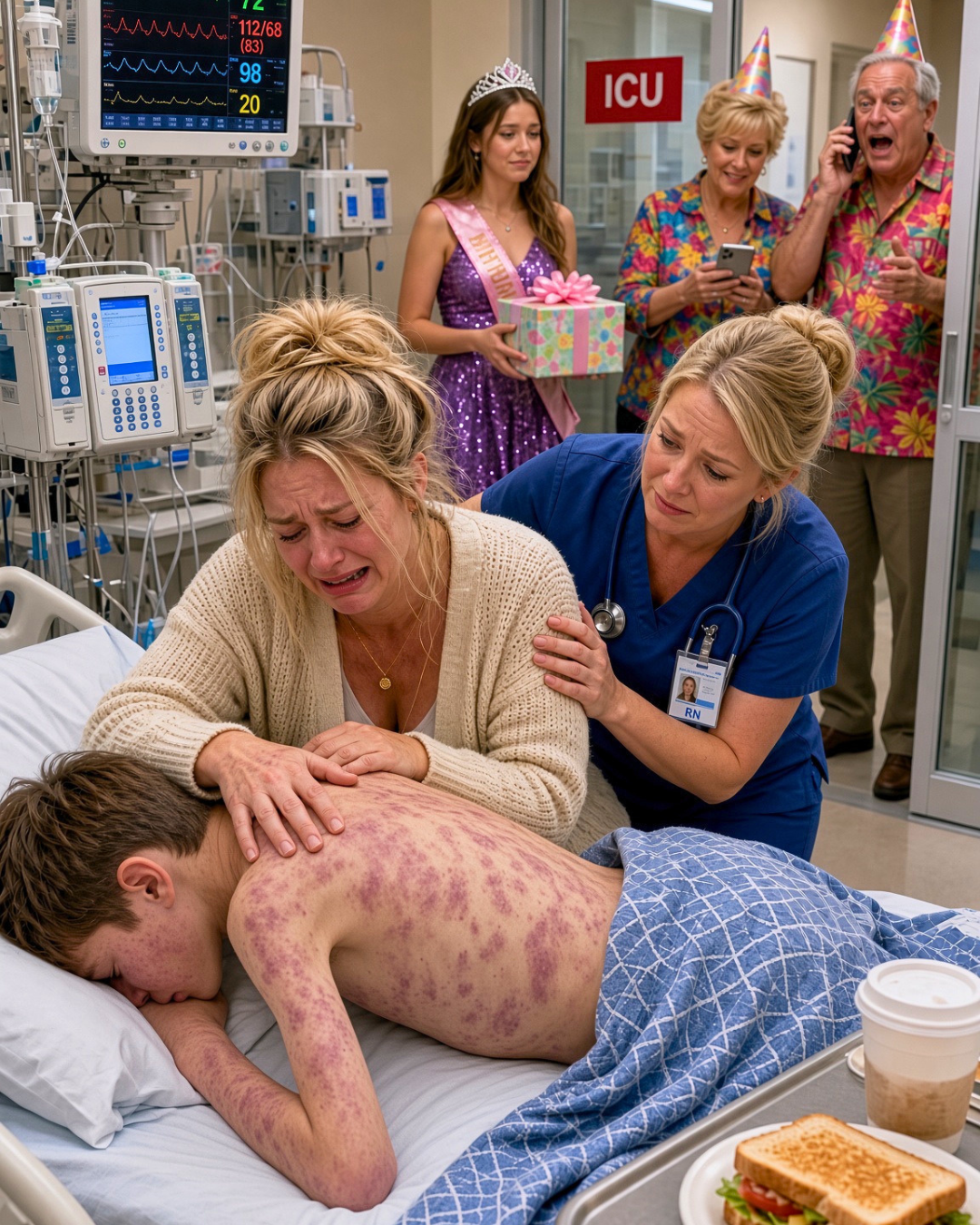
My son had been lying in an intensive care bed, fighting for every breath.
My mother had ordered me to abandon him for a birthday celebration.
And for the first time, I had said no.
I hadn’t known then that David was a billionaire.
I hadn’t known how much of my mother’s lifestyle depended on money he quietly provided.
I hadn’t known the truth about the financial records or the consequences that would follow.
All I knew was that my son needed me.
And I was not leaving him.
That decision cost me the relationship I had spent my entire life trying to preserve.
But it gave me something far more important.
Freedom.
Freedom from the endless guilt.
Freedom from the fear of disappointing my mother.
Freedom to build a family where love wasn’t measured by obedience, money, or public appearances.
Leo suddenly looked up from the lawn.
“Mommy! Daddy! Come play!”
David stood and held out his hand.
“Ready?”
I looked at him.
Then at our son, laughing beneath the sprinklers.
I took David’s hand.
“Absolutely.”
We ran across the grass together.
Barnaby barked.
Leo squealed with delight.
Cold water splashed against my clothes, and I laughed until I could barely breathe.
Above us, the afternoon sky stretched endlessly blue.
For a moment, I remembered the harsh fluorescent lights of Room 412.
The machines.
The alarms.
The terrible fear of losing my child.
Then Leo threw his arms around my waist.
“Got you, Mommy!”
I lifted him into my arms.
“Yes, baby,” I whispered, kissing his cheek. “You did.”
He laughed and hugged my neck.
And I held him close, feeling the strong, steady beat of his heart.
I had once believed that family was something you were obligated to endure, no matter how deeply it hurt.
Now I understood the truth.
Family should be the place where a frightened child finds safety.
Where a husband and wife stand together.
Where love is freely given rather than demanded.
And where nobody is ever expected to sacrifice a child’s well-being to protect someone else’s pride.
My mother had threatened to erase me from her world.
But in choosing my son, I had finally discovered the world where I belonged.
And I would never trade it for anything.
THE END.
