

PART 1
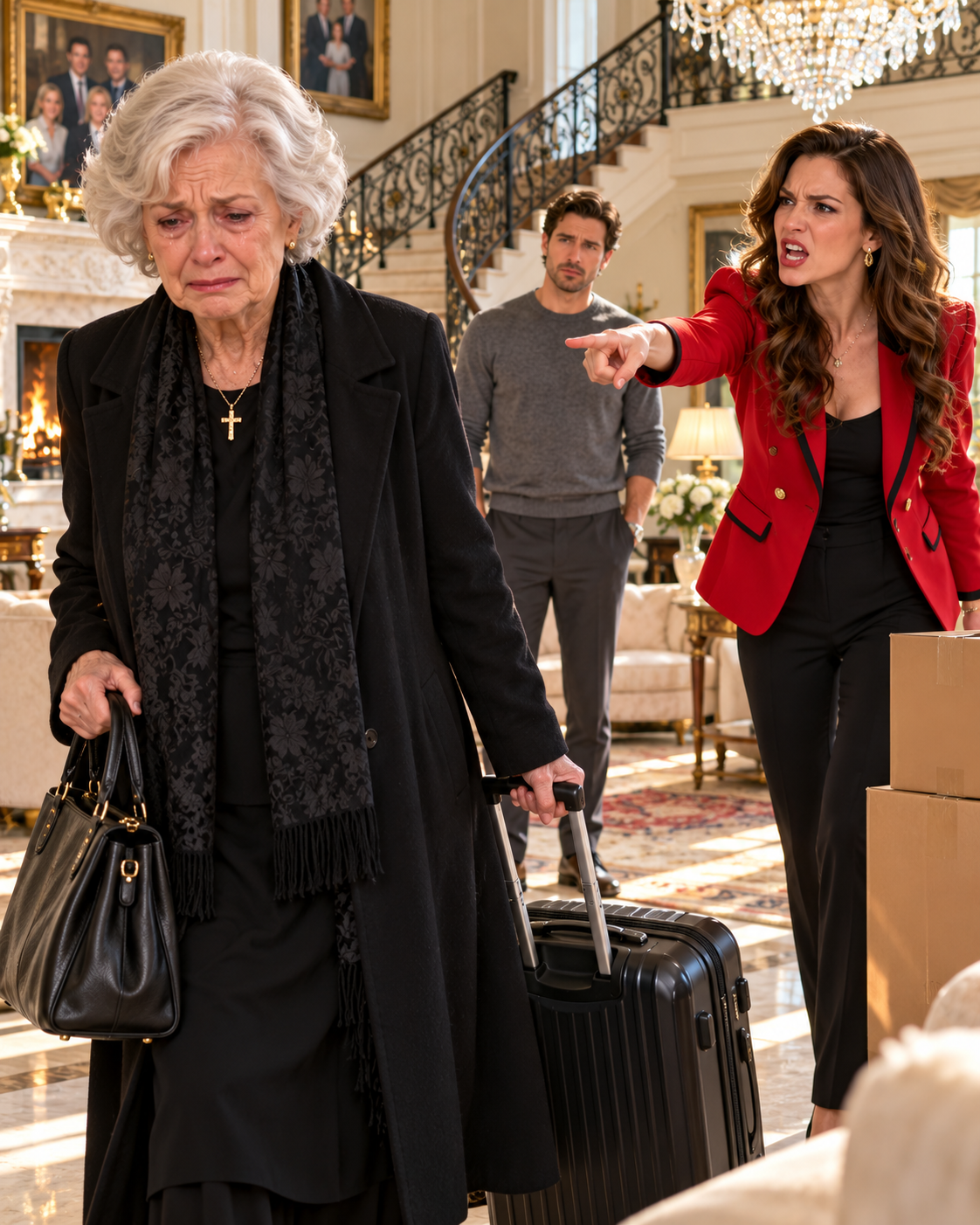
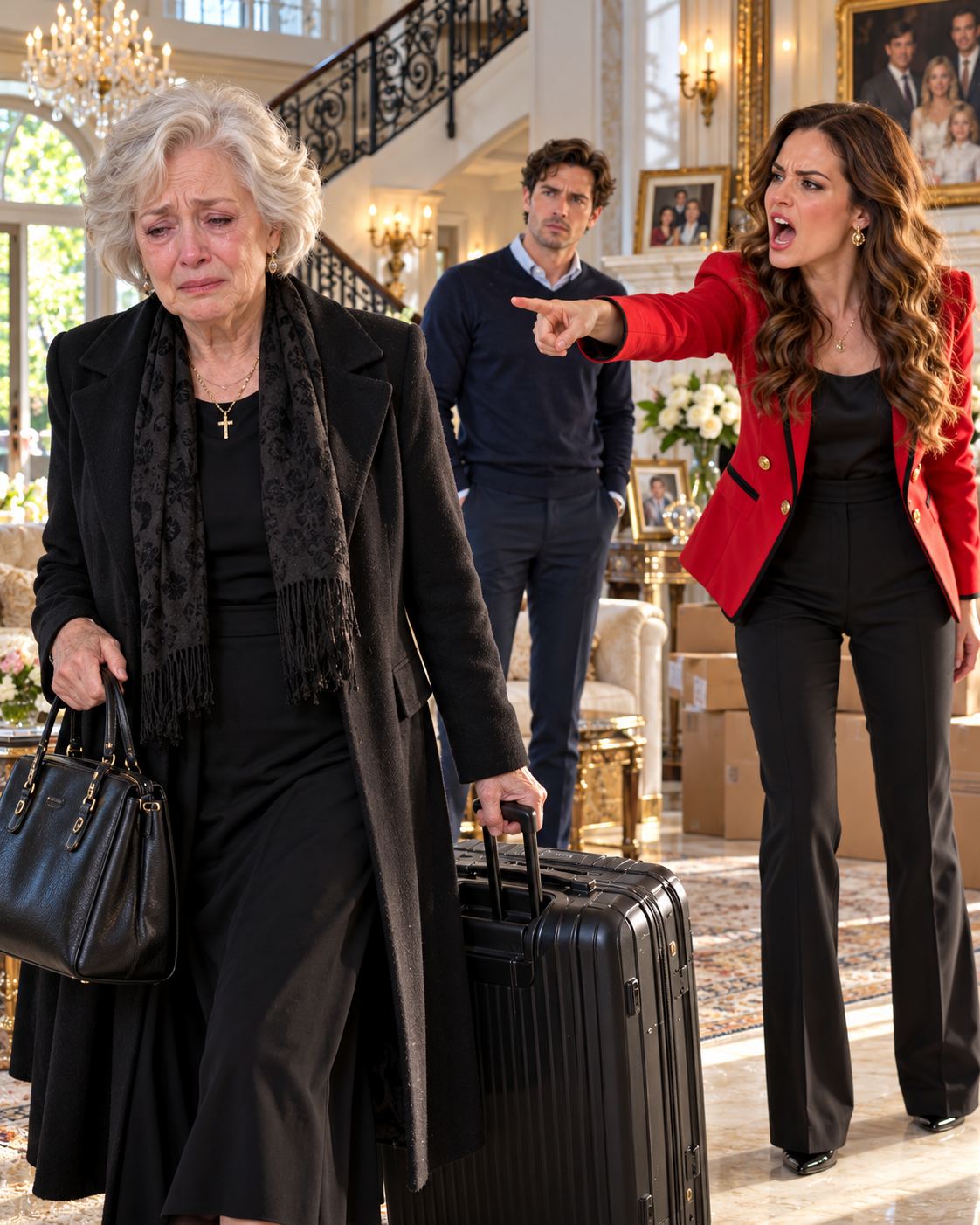
Five days after we laid my husband to rest, my daughter-in-law stood in the living room of the house where I had spent forty years of my life, pointed toward the entrance, and said, “Now that he’s dead, cry all you want, pack your things, and go live on the streets.”
My son stood only a few feet behind her.
He said nothing.
He couldn’t even bring himself to meet my eyes.
What neither of them understood was that my late husband had left behind a fortune worth more than twenty-eight million dollars, an extraordinary penthouse overlooking Central Park, and a small brass key that would eventually uncover something far more devastating than their cruelty.
I didn’t raise my voice.
I didn’t plead with them.
I simply looked at my daughter-in-law and answered, “Okay.”
Three months afterward, a courier arrived at their doorstep carrying a heavy envelope.
When my son read the opening page, his hands trembled so badly that he struggled to keep hold of it.
Yet the greatest revelation wasn’t the fortune.
It wasn’t the Manhattan apartment.
It wasn’t even the discovery that the house they believed they’d taken from me had never belonged to them.
It was the name appearing on the last document.
A name connected to the warning my husband had struggled to give me before his death.
To explain how everything unfolded, I have to return to the most painful March I had ever experienced.
My name is Margaret Hale.
I was seventy-one when I lost my husband, Arthur.
We had shared forty-three years of marriage. For forty of those years, we lived in a two-story colonial house on Maple Avenue in White Plains, New York.
Our home wasn’t particularly grand.
The staircase groaned beneath our feet. The kitchen was small. Every winter, the aging furnace demanded attention, and Arthur stubbornly insisted he could repair it himself.
Still, that house belonged to our life together.
Roses grew beneath the front windows because I had planted them there.
The curtains in the dining room were ones I’d sewn myself.
I had spent countless hours polishing the wooden floors until my knees protested.
Every imperfection reminded me of something precious.
The kitchen doorway still bore the mark left when our son, Daniel, attempted to ride his bicycle through the house at seven.
A dent in the stair railing came from the afternoon he dropped his graduation trophy.
Above the fireplace, a pale rectangle remained where our wedding portrait had hung for more than forty years.
For thirty-six years, I worked as a nurse at Saint Vincent’s Hospital.
My days often began at 4:30 in the morning. I’d prepare coffee, pack something for lunch, kiss Arthur goodbye, and head off for another demanding shift.
I never considered us rich.
Arthur worked in medical equipment manufacturing. He was modest, reserved, and happiest with secondhand books, meals cooked at home, and old watches that needed fixing.
He kept one sedan for fourteen years.
Whenever I suggested buying something newer, he would chuckle.
“Margaret, sweetheart, a car only needs to get you where you’re going.”
We lived carefully, avoided debt whenever possible, and saved what we could.
But whenever Daniel needed financial assistance, we found a way to provide it.
His college education.
The deposit on his first apartment.
Money toward buying a house.
Help when his business partnership failed.
Arthur sometimes worried aloud that Daniel had never learned to support himself.
I always argued otherwise.
“He’s our only child,” I would remind him.
“We have to help him.”
Arthur would look at me with an expression I didn’t know how to interpret.
“There’s a difference between helping someone stand,” he told me once, “and teaching them they never have to stand on their own.”
I wish those words had reached me sooner.
Because the little boy I’d taught to be courteous eventually became a man who could stand by while his own mother was driven from her home.
Arthur’s final months were filled with suffering.
He had advanced pancreatic cancer. By February, his doctors explained that there were almost no treatment options remaining.
I rarely left his side.
I cleaned his face.
Helped him sip water.
Read to him when he no longer had the strength to keep his eyes open.
During quiet nights, he sometimes held my hand and recalled memories from the beginning of our marriage.
At other times, he seemed preoccupied.
He would watch the hospital doorway with an uneasy expression, as though anticipating someone’s arrival.
Three weeks before he passed away, he asked me to shut the door.
“Margaret, there’s something I need you to keep.”
From beneath his pillow, he produced an old brass key.
A number had been stamped into its side.
He placed it in my hand.
“Keep this safe.”
I studied it.
“What does it open?”
His breathing was difficult.
“Something I should have told you about years ago.”
“Arthur, you don’t need to worry about anything right now.”
He squeezed my hand with surprising determination.
“Promise me you won’t give this key to Daniel.”
I looked at him in confusion.
“Why would I give it to Daniel?”
“Promise me.”
His expression frightened me.
It wasn’t the fear of someone facing death.
It was the fear of a man worried about what would happen to his wife after he was gone.
“I promise,” I said quietly.
He shut his eyes.
“And don’t tell anyone.”
I kissed his forehead.
I convinced myself that his medication had affected his thinking.
I couldn’t have imagined that the little key would become more valuable to me than anything else I possessed.
Arthur died on a Tuesday morning while rain tapped against the hospital windows.
I was holding his hand.
His final words came as a whisper.
“You were always the strong one, Maggie.”
Then the monitors fell silent.
The life we’d shared for forty-three years was over.
We held his funeral four days later.
Neighbors sent arrangements of flowers. Friends arrived carrying casseroles. Former colleagues embraced me and spoke warmly of Arthur.
Daniel delivered a moving tribute.
He described his father’s integrity, kindness, and dedication to the people he loved.
Vanessa stood next to him in an elegant black dress, occasionally touching a lace handkerchief to eyes that appeared completely dry.
I was grateful, at least then, that our family seemed united in grief.
That comfort didn’t survive the afternoon.
When we returned from the cemetery, Vanessa had begun attaching yellow sticky notes to furniture throughout my house.
There was one on the antique dining table.
Another on the grandfather clock.
Even my mother’s china cabinet had been marked.
I stopped in the doorway.
“Vanessa? What are you doing?”
She barely glanced at me.
“Organizing.”
“Organizing what?”
“Things, Margaret. Someone has to start making decisions.”
I turned toward the fireplace.
Our wedding photograph had disappeared.
I discovered it propped against a cardboard box on the floor.
“Why did you take that down?”
She let out an impatient sigh.
“Because this room needs updating. We can’t keep everything exactly the way it was forever.”
I turned to my son.
“Son?”
Daniel shifted his weight.
“Mom, please don’t start.”
My stomach tightened.
“Don’t start what?”
Vanessa crossed her arms.
“Margaret, your husband is gone. Daniel and I have a family to think about. We need space, and you’re not exactly getting any younger.”
I couldn’t believe what I was hearing.
“What are you saying?”
She stepped closer.
And then she spoke the words that would remain with me forever.
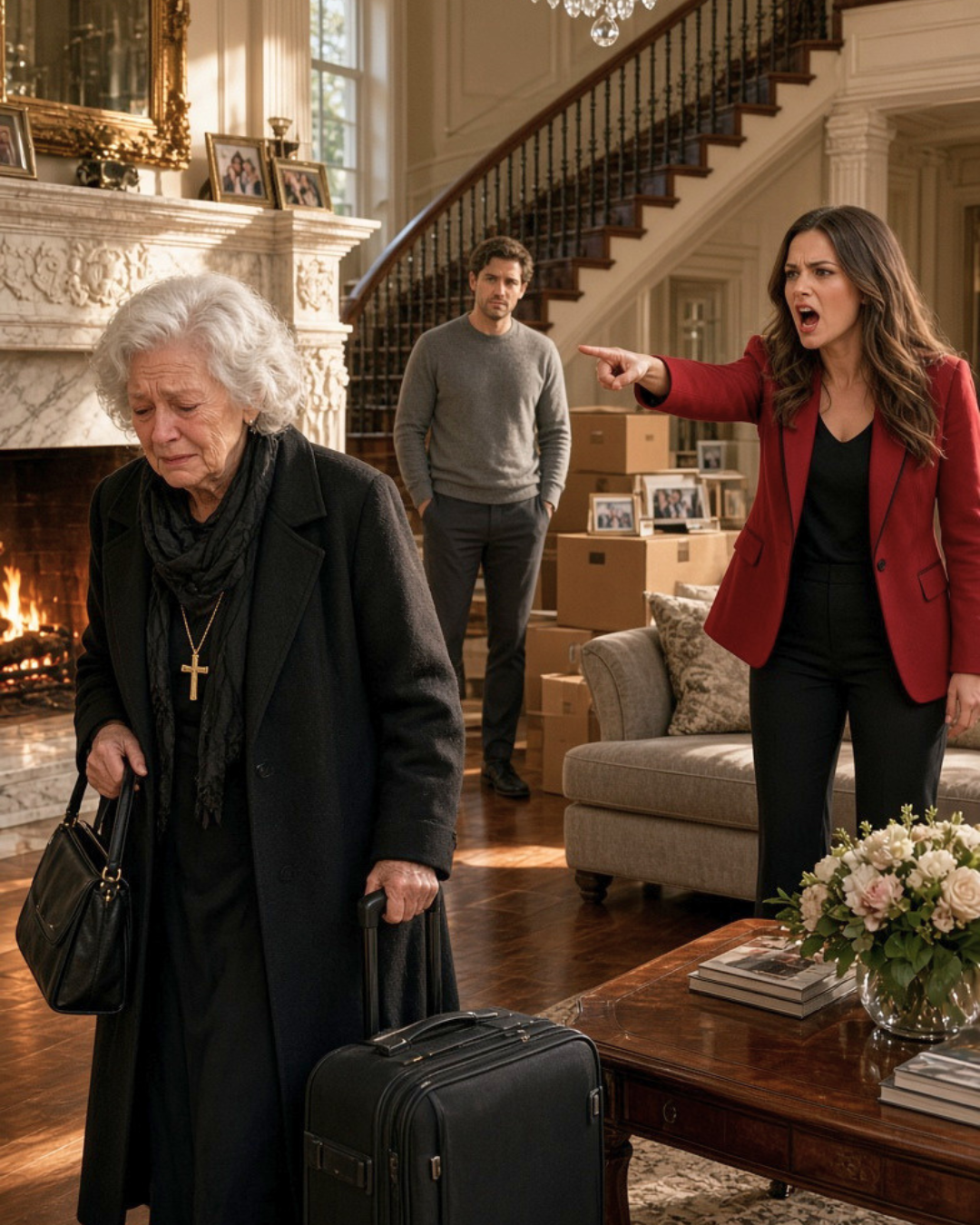
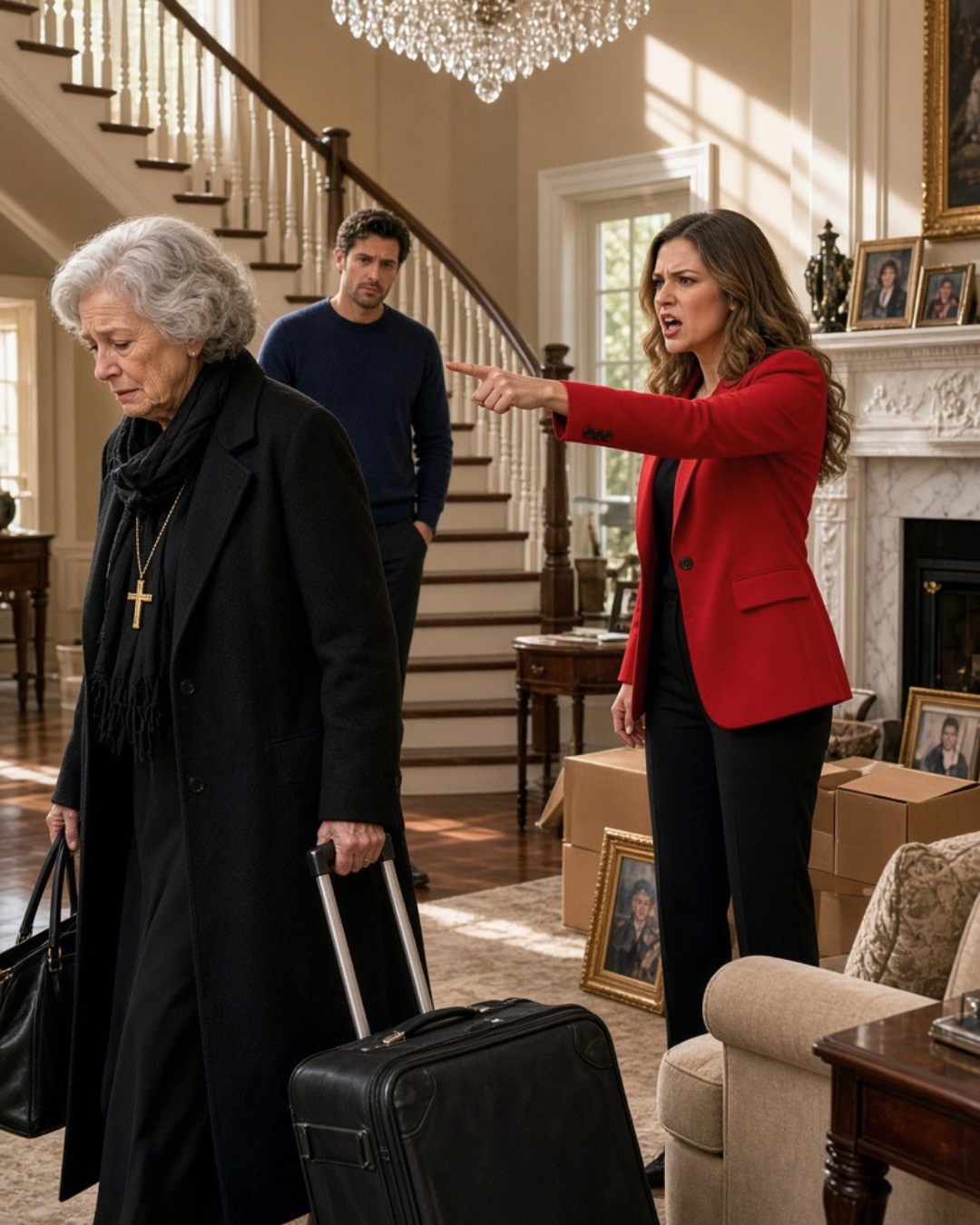
“Now that he’s gone, just cry, pack your things, and go live on the streets.”
The room seemed to move beneath me.
I looked straight at Daniel.
“Daniel,” I whispered, “did you hear what your wife just said?”
He rubbed his forehead.
“Mom, Vanessa’s just being practical.”
Practical.
That was how he described it.
Not vicious.
Not cruel.
Practical.
I remembered volunteering for Christmas Eve shifts so I could afford his presents.
I remembered sitting beside his bed whenever he was sick.
I remembered Arthur and me crying proudly at his college graduation, believing our hard work had given our child a better future.
Now he was watching his wife throw me out of the house where he’d grown up.
“Where am I supposed to go?” I asked.
Vanessa lifted her shoulders.
“You’re an adult. Figure it out.”
And something unexpected happened.
I stopped crying.
Inside my coat pocket, my fingers touched the brass key.
Arthur’s warning returned to me.
Promise me you won’t give this key to Daniel.
I looked at my son.
Then at his wife.
“Okay.”
Vanessa blinked.
“Okay?”
“Yes. I’ll leave.”
For a moment, neither spoke.
They had probably expected me to argue.
Perhaps they hoped I’d become hysterical so they could later tell everyone I was behaving irrationally.
Instead, I climbed the stairs.
In our bedroom, a stack of legal papers had been arranged neatly on the bed.
They concerned the voluntary transfer of property.
Our home.
The land beneath it.
The garage.
Everything.
A pen had been placed beside them.
I read the opening page, fighting to see through my tears.
The papers were intended to transfer my interest in the property to Daniel.
My chest tightened.
They had prepared this before Arthur was even in his grave.
I was still dressed for his funeral.
Yet they were already dividing up what they believed belonged to them.
For a long time, I sat motionless on the mattress.
Then I signed.
I didn’t fully understand the legal implications.
Grief had left me exhausted. I was frightened and unable to think clearly.
I had devoted my professional life to helping strangers survive their darkest hours, but I couldn’t find the courage to defend myself against my own family.
I filled a single suitcase.
Two sweaters.
My old nursing shoes.
My Bible.
The quilt my mother had made.
And the wedding portrait, which I wrapped carefully in a towel.
Downstairs, I left the signed papers on the kitchen table.
Vanessa came over immediately.
“Did you sign?”
“Yes.”
She examined the pages.
A pleased expression crossed her face.
“Good. That’s one less thing we have to worry about.”
Daniel remained seated on the sofa.
He didn’t rise.
He didn’t embrace me.
He didn’t even offer to carry my suitcase.
At the entrance, I turned.
“Goodbye, Daniel.”
He glanced up.
“Take care, Mom.”
Nothing more.
After forty-three years of marriage, forty years in that house, and seventy-one years of living, I walked away with everything I believed remained mine packed into one suitcase.
That night, I rented a room at an inexpensive motel near Route 119.
Disinfectant hung in the air.
The lampshade was broken.
The heater made a rattling noise that reminded me of an old truck.
I bought a sandwich from a vending machine, but managed only two bites.
Around midnight, I sat on the bed holding Arthur’s photograph.
“Why did you leave me?” I whispered.
Then I cried.
I cried until breathing hurt.
Not because I had lost a building.
Because I had finally seen that the son I’d spent my life defending was no longer the person I thought I knew.
At approximately two in the morning, I searched my purse for a tissue.
My fingers found a business card.
I took it out.
Jonathan Reed.
Estate Attorney.
47th Street, Manhattan.
Arthur had placed the card in my purse several months earlier.
When I’d found it, I’d laughed.
“Arthur, why would I ever need a Manhattan estate lawyer?”
He had smiled.
“Just keep it, Maggie.”
Now I looked from the card to the brass key.
An uneasy sensation spread through me.
I called the number.
After two rings, a man answered.
“Reed and Associates.”
“My name is Margaret Hale. My husband was Arthur Hale.”
He fell silent briefly.
Then his tone changed.
“Mrs. Hale?”
“Yes.”
“Mrs. Hale, we’ve been expecting your call.”
I froze.
“Expecting me?”
“Your husband left instructions. Do you have the brass key?”
I stared at the metal resting in my hand.
“Yes.”
“Please come to Manhattan tomorrow morning. Bring the key. And Mrs. Hale?”
“Yes?”
“Do not discuss this conversation with your son.”
I struggled to speak.
“Why?”
He answered slowly.
“Because your husband believed you might be in danger.”
The next morning, I caught the earliest bus to Manhattan.
I wore my ordinary gray coat and kept my suitcase between my knees.
Other passengers checked their phones, sipped coffee, and complained about the journey.
None of them knew the elderly woman by the window had just lost her husband, her home, and her trust in her only child.
At 9:07 a.m., I entered a private bank on 47th Street.
The interior was elegant and quiet.
Marble flooring.
Warm lighting.
Fresh flowers in crystal vases.
A receptionist in a fitted gray suit greeted me.
“Good morning, ma’am. How may I help you?”
I set the brass key on her desk.
She lifted it.
Looked at the number.
Her expression changed instantly.
She studied my face.
“May I ask your name?”
“Margaret Hale.”
She stood so abruptly that her chair rolled backward.
She picked up the telephone.
Then she whispered four words.
“She’s finally here, sir.”
An older gentleman appeared moments later, accompanied by Jonathan Reed.
“Mrs. Hale,” Jonathan said gently. “I’m so sorry about Arthur.”
I swallowed hard.
“Please tell me what’s happening.”
He noticed my suitcase.
His face grew serious.
“First, let’s get you somewhere comfortable.”
They brought me to a private conference room.
Someone offered coffee and breakfast.
I hadn’t eaten properly for two days, but I couldn’t bring myself to touch either.
Jonathan laid a leather folder on the table.
“Margaret, how much did Arthur tell you about his investments?”
I nearly laughed.
“Investments? He had a retirement account and some savings. He always said we were comfortable.”
Jonathan exchanged a glance with the bank manager.
“Your husband was a very private man.”
“Clearly.”
He opened the folder.
A financial statement lay inside.
I looked at the number.
Then read it again.
Eight digits.
$28,463,912.
I stared at him.
“What is this?”
“Your husband’s private trust.”
I shook my head.
“That isn’t possible.”
“It is.”
“No. Arthur wore the same winter coat for fifteen years.”
Jonathan gave a sad smile.
“Yes. He also held an ownership interest in a medical technology company that was acquired several years ago. His equity, patents, and subsequent investments grew considerably in value.”
My thoughts raced.
I remembered Arthur working with equipment in our garage.
Metal prototypes lay scattered across his workbench.
Years earlier, after a frightening incident involving a patient, I’d helped him think through a safety device for hospital medication systems.
Arthur developed and patented the mechanism.
I knew the invention had done well.
I had never imagined it had done that well.
“He never told me,” I whispered.
Jonathan nodded.
“He apparently intended to, several times.”
He turned the page.
“There’s also a residence in Manhattan.”
“A residence?”
“A penthouse overlooking Central Park.”
I gripped the table.
“Arthur owned an apartment in New York?”
“Yes.”
“And I knew nothing about it?”
“That’s correct.”
I felt dizzy.
For forty-three years, Arthur and I had shared a home, a bed, and an entire life.
Yet he’d kept an extraordinary fortune secret.
Part of me wanted to laugh.
Another part wanted to cry.
Most of all, I wanted to ask Arthur why.
But he was gone.
And the only thing I truly wanted was something twenty-eight million dollars could never purchase.
One more afternoon with my husband.
Jonathan waited patiently.
Then he shut the folder.
“Margaret, I’m afraid that isn’t the main reason Arthur arranged this meeting.”
I looked up.
“What do you mean?”
He turned his laptop toward me.
Our house appeared on the screen.
Maple Avenue.
The porch.
The rosebushes.
Beneath the photograph was a document bearing Daniel’s name.
“Arthur became concerned about financial activities involving your son,” Jonathan explained.
“What kind of activities?”
He opened a loan application.
Then another document.
Then a business registration.
Northline Property Holdings.
Managing members: Daniel Hale and Vanessa Hale.
Jonathan indicated the figures.
“They sought a bridge loan of approximately two point four million dollars, using your home as collateral.”
I stared.
“Our house isn’t worth two million dollars.”
“No. But the application also identified other assets they claimed would become available after Arthur died.”
My stomach twisted.
“Other assets?”
“Daniel had been attempting to learn whether Arthur controlled money he hadn’t disclosed.”
I remembered Vanessa’s sticky notes.
The papers on the bed.
The funeral.
“Daniel told me Arthur barely left enough money to cover expenses.”
Jonathan’s jaw tightened.
“He had reason to believe that wasn’t true.”
He opened another document.
“This is what worries us most.”
A medical evaluation appeared.
It bore the letterhead of Saint Vincent’s Hospital.
My former workplace.
It claimed I was experiencing serious cognitive deterioration and recommended supervised living.
I read the phrases.
Confusion.
Impaired financial judgment.
Unable to manage independent affairs.
“Jonathan, this is false.”
“We believe you.”
“I don’t have dementia.”
“I know.”
“And nobody ever performed that examination.”
“That’s what Arthur told us.”
Then I noticed the physician’s signature.
Dr. Eleanor Price.
My blood ran cold.
“That doctor is dead.”
Jonathan looked up.
“What?”
“Dr. Price died three years ago. I attended her memorial service.”
Silence settled over the table.
I pointed at the screen.
“Someone forged a medical evaluation using the name of a dead physician.”
Jonathan leaned back.
“That confirms what Arthur suspected.”
I covered my mouth.
“Why would Daniel do something like this?”
Jonathan hesitated.
“If a court accepted that you were incapable of handling your own affairs, someone might attempt to obtain authority over your finances.”
“Someone like Daniel.”
“Yes.”
Tears blurred my eyes.
“But he doesn’t know about the twenty-eight million.”
“Not the amount. Arthur went to considerable lengths to protect his privacy.”
“Then why would he do it?”
Jonathan opened an email.
Sender: Vanessa.
Recipient: Daniel.
Subject: Mother’s transition.
Once she’s out of the house, we move forward with the evaluation. Graham says the paperwork will be ready before the next payment comes due.
I stared at the name.
“Graham?”
“Graham Voss.”
I knew him.
Vanessa’s stepfather was a polished real estate investor who wore costly watches, drove luxury vehicles, and always seemed to have another lucrative opportunity underway.
He had visited us repeatedly.
During Arthur’s illness, he’d offered to reorganize our finances.
Arthur refused.
Afterward, Graham laughed and remarked, “Old-fashioned men hate letting go of control.”
Now that memory felt sinister.
Jonathan showed me more documents.
“Graham’s businesses have a troubling history. Lawsuits, unpaid obligations, and questionable property transactions.”
I shut my eyes.
“So they want to steal my home.”
“More than that, Margaret.”
He leaned forward.
“We believe they planned to use you as the legal explanation for money they were already trying to borrow.”
I felt ill.
“How?”
“An older widow supposedly experiencing memory problems. A son claiming he acted for her benefit. A voluntary property transfer. That story could have been useful if anyone investigated.”
I remembered the papers I’d signed.
“Jonathan, I signed something yesterday.”
He went completely still.
“What did you sign?”
“A property transfer. Vanessa left it on my bed.”
“Do you have a copy?”
“No.”
He glanced at the bank manager.
Then he said something astonishing.
“Margaret, fortunately, you couldn’t legally transfer that property to Daniel even if you wanted to.”
I stared at him.
“Why?”
“Because the house isn’t owned by you personally.”
Panic shot through me.
“What?”
“Arthur transferred it into a protected trust before his death. You are the lifetime beneficiary, and the bank acts as trustee.”
“The house belongs to a trust?”
“Yes.”
“And Daniel?”
“Has no ownership interest.”
I covered my face.
Then, for the first time since the funeral, I laughed.
It was a shaky, exhausted laugh, but genuine.
Vanessa had pressured me into signing over a house I had no legal power to transfer.
Jonathan smiled slightly.
“We’ll still need to examine those papers. They may be important evidence. But signing them doesn’t automatically give Daniel ownership of trust property.”
I leaned back.
“Arthur knew.”
“He suspected what might happen.”
“That’s why he gave me the key.”
“Yes.”
I looked at my trembling hands.
“What happens now?”
Jonathan softened his voice.
“First, we make sure you have somewhere safe to stay.”
He slid a set of keys across the table.
“Your penthouse is waiting.”
I began crying again.
Not because I had suddenly become wealthy.
Because Arthur had found a way to protect me even after death.
That afternoon, I entered an apartment high above Central Park.
A private elevator opened into a marble foyer.
Sunlight flooded through enormous windows.
The Manhattan skyline stretched beneath a pale spring sky.
There was a magnificent living room, a fireplace, a formal dining space, and a kitchen more luxurious than anything I’d ever owned.
From the bedroom, I could see the park.
On the bedside table stood a framed photograph of Arthur and me.
Our twenty-fifth wedding anniversary.
I lifted it.
Beside it lay an envelope.
Across the front, in handwriting I knew better than my own, was one word.
Maggie.
I sat on the bed and opened it.
My darling Margaret,
If you’re reading this, it means I ran out of time.
There are things I should have told you long ago. I believed keeping our finances private would protect you, but I realize now that protection should never require keeping the person you love unaware.
You helped create the medical safety device that changed everything for us. You recognized the problem. I only constructed the solution your remarkable mind envisioned.
Our company grew beyond anything we imagined.
Every dollar belongs to you as much as it ever belonged to me.
I should have trusted you enough to tell you.
I wiped away my tears.
Two years ago, I began worrying about Daniel.
He was borrowing from dangerous people. I discovered he had made promises involving our house.
When I confronted him, he blamed Vanessa.
But his explanation never felt right.
I hired Jonathan because I needed to know you would be protected after I was gone.
Please don’t mistake my secrecy for a lack of faith in you.
You were always the strongest person in our family.
And Maggie, there is one more thing.
I leaned closer.
If Daniel ever insists you aren’t remembering things correctly, trust yourself.
I know what I saw.
And I know what he did.
The letter ended:
Forever yours, Arthur.
I read those final words repeatedly.
I know what he did.
What had Arthur witnessed?
What had our son done?
And why had my husband been so frightened to tell me?
I didn’t yet know that the answer would force me to question nearly everything I believed about my family.
PART 2
For the next several days, I hardly ventured outside the penthouse.
I slept in a bedroom larger than the living room of my old house.
Each morning, I ate breakfast with Central Park spread beneath my windows.
I wandered through rooms filled with beautiful furnishings Arthur had apparently chosen with me in mind.
Yet happiness seemed impossibly far away.
Everywhere I went, I saw Daniel sitting silently on the sofa while Vanessa ordered me out.
Whenever my phone rang, my heart lifted.
Perhaps he’d finally called to apologize.
Perhaps he wanted to explain.
Perhaps he missed me.
But it wasn’t Daniel.
Instead, Vanessa sent a message.
Please don’t come back to the house without calling. We’re making renovations.
I stared at it.
A second text followed.
Also, Daniel says you should update your mailing address. We don’t want your bills coming here.
I kept both messages.
Jonathan had advised me not to delete anything.
A week later, Irene Alvarez came to see me.
Irene was seventy-three. We’d worked together at Saint Vincent’s for almost thirty years.
She was outspoken, loyal, and had never possessed much patience for foolishness.
When she stepped out of the elevator, she stopped.
“Margaret.”
“Hello, Irene.”
She examined the marble foyer.
Then the towering windows.
Then me.
“Either you’ve become a billionaire overnight, or I’m having a stroke.”
I laughed for the first time in days.
Then I told her everything.
Arthur’s death.
The eviction.
The key.
The trust.
The twenty-eight million dollars.
When I finished, Irene said nothing for several moments.
Then she reached across the table.
“Oh, honey.”
Those two words were enough.
I began sobbing.
Irene came around and held me.
“You deserved better than that,” she whispered.
I shook my head.
“He’s my son.”
“I know.”
“I can’t understand how he could treat me that way.”
She tightened her embrace.
“Being someone’s mother doesn’t mean you deserve to be treated like a servant.”
I cried until I was empty.
Then Irene wiped my cheeks.
“Margaret, you’ve spent your whole life looking after everyone else.”
She looked around the apartment.
“Maybe it’s time someone cared for you.”
During the following month, Irene helped me find some sense of normal life.
We walked through Central Park.
Visited museums.
Had lunch at little restaurants.
I bought a beautiful blue coat because Arthur always said that color suited my eyes.
We even attended a performance at Lincoln Center.
But while I tried to rebuild my days, Jonathan was working quietly.
He retained a forensic accountant and a private investigator named Nadia Bennett.
Nadia had previously investigated financial crimes. She had observant eyes and a way of asking questions that made dishonest people uneasy.
At our first meeting, she brought three folders.
“The good news,” she began, “is that the trust assets are secure.”
“And the bad news?”
She opened the first folder.
“Your son and his wife are facing serious financial problems.”
The documents listed credit card balances, business debts, personal guarantees, and obligations to private investors.
Together, they exceeded three million dollars.
“How?” I whispered.
Nadia showed me the records.
“Expensive purchases, unsuccessful real estate ventures, and transfers to businesses connected with Graham Voss.”
I felt numb.
Daniel had always described his consulting business as successful.
He drove a fine car.
Wore expensive clothes.
Vacationed lavishly.
Now I realized much of his lifestyle had been financed by debt.
“Why didn’t he come to us?”
Nadia looked at me carefully.
“These records suggest he did. Many times.”
I remembered every check Arthur and I had written.
She continued.
“Arthur stopped providing financial assistance around eighteen months ago.”
I remembered the argument.
Daniel came to dinner and asked for fifty thousand dollars.
Arthur refused.
Daniel accused his father of trying to control him.
Vanessa called us selfish.
They stormed out before dessert.
Later, I confronted Arthur.
“He’s our son.”
Arthur remained at the kitchen table.
“Margaret, if I give him more money, it won’t save him.”
“How do you know?”
He looked toward the doorway.
“Because he isn’t telling us the truth.”
I had thought Arthur was being unnecessarily harsh.
Now I understood his refusal had come from fear.
Nadia opened the second folder.
“There’s something else.”
She showed me photographs of an assisted-living facility in upstate New York.
White buildings stood behind well-maintained lawns and gardens.
“What’s this?”
“Oakridge Residential Care.”
“Why are you showing me a nursing home?”
Nadia paused.
“Daniel contacted them before Arthur passed away.”
My breath caught.
“He did what?”
“He requested information about placing you there permanently.”
I felt cold.
“He never discussed anything like that with me.”
“There’s an application.”
She slid it across the table.
Margaret Hale.
Age seventy-one.
Under Reason for Admission, someone had written:
Progressive dementia. Unable to live independently. Family requesting permanent supervised care.
I looked up.
“That’s a lie.”
“I know.”
“This was filled out while Arthur was still alive?”
“Yes.”
A dreadful realization settled over me.
Daniel and Vanessa hadn’t simply decided to remove me after the funeral.
They’d begun planning my removal before my husband died.
I pressed my fingers against my temples.
“How could he?”
Nadia opened the last folder.
“Mrs. Hale, I think we need to determine exactly who was directing these decisions.”
That evening, Jonathan called with additional findings.
He had examined the supposed medical evaluation and related correspondence.
The dates conflicted.
Some signatures appeared copied.
And one authorization form supposedly carried Arthur’s signature.
“That’s impossible,” I told him.
“Why?”
“Arthur was in the hospital then. He was barely conscious.”
Jonathan asked whether I remembered the date.
February seventeenth.
I remembered it vividly.
Arthur had received powerful pain medication.
I sat beside him for almost twelve hours.
“He couldn’t have signed those papers.”
Jonathan was quiet.
“Then his signature may have been forged as well.”
I turned toward Arthur’s photograph.
The brass key lay beside it.
His letter was still there.
Suddenly, the warning sounded even more frightening.
I know what he did.
Two weeks later, I received a call that nearly broke me.
It was my granddaughter, Lily.
She was ten.
Daniel and Vanessa’s only child.
Before Arthur died, Lily had spent many afternoons at our house.
We made cookies.
Worked in the garden.
Watched old films.
Arthur taught her chess, though she frequently won by inventing rules of her own.
After I was forced out, Vanessa stopped Lily from contacting me.
She claimed I needed time alone.
But that afternoon, my old flip phone rang.
“Grandma?”
I nearly dropped it.
“Lily?”
“Grandma, are you okay?”
Her voice sounded so small.
I sat down.
“I’m all right, sweetheart. How are you?”
She hesitated.
“Mom says you’re confused.”
I closed my eyes.
“Does she?”
“She says you forgot where you live.”
My throat tightened.
“Oh, Lily.”
“Grandma, I don’t think you forgot.”
“Why not?”
“Because you always remember everything.”
I laughed softly through my tears.
“Well, almost everything.”
She fell quiet.
Then whispered, “I miss you.”
I couldn’t hold back my tears.
“I miss you too, baby.”
“Are you coming home?”
I looked around the penthouse.
Home.
The word had become complicated.
“I don’t know yet, sweetheart.”
Lily lowered her voice.
“Grandma, Mom says the house is ours now.”
I swallowed.
“Does she?”
“Yes. But Grandpa always told me that the house belonged to you.”
My heart began racing.
“What did Grandpa say?”
“That if anybody ever tried to take your roses away, I should tell you.”
I sat motionless.
“He really said that?”
“Yes.”
Then she whispered something unexpected.
“Grandma, there’s a paper in Grandpa’s old workshop that Mom and Dad don’t know about.”
I leaned forward.
“What paper?”
“I don’t know. Grandpa put it in a blue envelope behind the clock.”
“Which clock?”
“The one in his workshop. The little wooden one that doesn’t work.”
I knew it.
Arthur kept a broken mantel clock above his workbench.
He refused to throw it out.
“It’s sentimental,” he always said.
“Lily, listen carefully. Don’t touch anything, okay?”
“Okay.”
“And don’t tell your parents about our conversation.”
“Why?”
“Because I want to make sure Grandpa’s things are safe.”
She paused.
“Grandma, are you going to get in trouble?”
My heart ached.
“No, sweetheart.”
I swallowed.
“I’m going to make sure you don’t.”
The next morning, I called Jonathan.
He listened and immediately warned me against returning to Maple Avenue.
“But the envelope—”
“We’ll recover it properly. If Arthur left evidence, we need to preserve it through legal channels.”
Within days, Jonathan located a maintenance worker who’d been hired to clear Arthur’s workshop.
The man remembered finding a blue envelope behind a small wooden clock.
He’d put it into a cardboard box with other belongings.
Vanessa had instructed him to discard the box.
He hadn’t done so.
Instead, he’d moved it to the garage.
The envelope remained there.
Through an agreed inventory of the property, Jonathan arranged its recovery.
Inside were three items.
A handwritten note.
A photograph.
And a small electronic storage device.
The note was from Arthur.
Maggie, if you found this, then the first part of my plan worked.
My hands trembled.
I couldn’t risk leaving these records where Daniel might discover them.
But I needed a copy nearby if something happened before I could explain.
Listen carefully.
Everything I did was meant to protect you.
Jonathan connected the device to a secure computer.
It contained more than twenty recordings.
Some were audio.
Others were video.
The oldest dated back eighteen months before Arthur died.
Our living room appeared on the screen.
Arthur sat at the dining table.
Daniel stood opposite him, visibly furious.
“I need the money, Dad.”
Arthur spoke evenly.
“I’ve already told you no.”
“You have no idea what kind of pressure I’m under.”
“Then tell me the truth.”
Daniel struck the table with his palm.
“The truth is that you’re sitting on assets you don’t even need while your own son is drowning!”
Arthur watched him.
“How much do you owe?”
Daniel said nothing.
“Daniel.”
“Enough.”
Arthur leaned forward.
“To whom?”
My son looked away.
Then he answered.
“Graham Voss.”
I felt cold.
On the screen, Arthur slowly leaned back.
“How much?”
Daniel muttered a figure.
Arthur’s face changed.
“My God, son. What have you done?”
The recording ended.
I turned to Jonathan.
“How much did he say?”
“Two million, six hundred thousand dollars.”
I pressed my hand against my chest.
The next recording was from four months later.
Arthur stood inside his workshop.
Daniel was there, accompanied by Vanessa.
She appeared anxious.
Arthur had apparently learned that creditors were investigating Graham’s business.
He confronted them about attempts to pledge our home as collateral.
Vanessa burst into tears.
“We didn’t understand what Graham was asking us to sign.”
Arthur looked directly at Daniel.
“Did you understand?”
Daniel avoided his eyes.
Arthur raised his voice.
“I’m asking you a question, son!”
Daniel finally replied, “It was supposed to be temporary.”
“Temporary?”
“We were going to repay it.”
“With what?”
No answer came.
Arthur turned to Vanessa.
“Your stepfather is using you.”
She cried harder.
Watching her, I noticed something I hadn’t understood before.
Vanessa wasn’t simply angry.
She was frightened.
Daniel, however, looked almost unnaturally calm.
His expression disturbed me.
The video ended.
Jonathan opened another.
Arthur appeared alone in the workshop, wearing his familiar brown cardigan.
He was visibly thinner.
Cancer had already begun weakening him.
He looked into the camera.
“Maggie.”
Hearing his voice again nearly shattered me.
I covered my mouth.
“If you’re watching this, I’m probably gone.”
I began crying.
“I wanted to tell you everything, sweetheart. But whenever I looked at you, I couldn’t bear adding to the pain you were already carrying.”
He paused to breathe.
“I made mistakes. I gave Daniel too much. I believed him again and again because I wanted our boy to be happy.”
He lowered his eyes.
“Then I discovered something I couldn’t ignore.”
I stopped crying long enough to listen.
Arthur held up a document.
“Daniel has been telling people I’m mentally incapable of handling our finances.”
My stomach dropped.
“He has also claimed you’re showing signs of dementia.”
“Oh, Arthur,” I whispered.
“I confronted him. He denied it.”
Arthur’s voice shook.
“But last week, I learned he’d contacted a medical records consultant about getting an evaluation prepared under your name.”
He leaned closer to the camera.
“Maggie, if anything happens to me, don’t believe Daniel when he says he was only doing what was best for you.”
He paused.
Then he spoke the words that haunted me afterward.
“Because I don’t think Vanessa is the one making these decisions.”
The screen went dark.
I couldn’t move.
For months, I had blamed Vanessa.
Her arrogance.
Her cruelty.
The words she spoke while pointing me toward the street.
But Arthur had suspected a far more painful truth.
I turned to Jonathan.
“You think Daniel planned everything?”
“We need to examine all the evidence,” he replied.
I stared at the screen.
My son.
The little boy whose fingers had once curled around mine.
Had he really tried to have me declared incompetent so he could take what belonged to his parents?
I wanted desperately to believe there was another explanation.
But the recordings continued.
One showed Daniel asking Arthur to sign a financial power of attorney.
Another captured Graham discussing a property transfer while Arthur was absent.
And an audio file recorded Daniel arguing with Vanessa.
Her voice was strained by tears.
“I don’t want to do this anymore.”
Daniel answered sharply.
“We don’t have a choice.”
“We could tell your parents the truth.”
“And destroy everything?”
“Daniel, they’re going to lose their house!”
His response was chilling.
“Then they shouldn’t have made me beg for what should have been mine.”
I stopped the recording.
My hands shook.
I felt as though my heart had been crushed.
Years of work.
Years of sacrifice.
Years of unconditional love.
Somewhere along the way, Daniel had convinced himself that everything Arthur and I had earned belonged to him.
Not in the future.
Not after we died.
Immediately.
Jonathan moved closer.
“Margaret, you don’t have to listen to the rest today.”
I looked at the screen.
“Yes, I do.”
“Why?”
I wiped my face.
“Because I spent seventy-one years believing love meant making excuses for people. I need to hear the truth, even when it hurts.”
Over the following weeks, Nadia’s investigation grew.
Graham Voss had several failing real estate businesses.
He borrowed heavily from private investors.
As investments collapsed, he took out new loans to repay older ones.
Daniel became increasingly involved.
Initially, he was an investor.
Then he guaranteed debts.
Then he became a business partner.
Eventually, he signed documents for companies whose operations he barely understood.
But Daniel and Vanessa hadn’t known the same things.
Vanessa believed her stepfather was trying to rescue their finances.
Daniel knew he was helping conceal losses.
Nadia found evidence of large transfers Daniel had made between accounts to keep the businesses functioning.
He also contacted lenders about borrowing against Arthur’s assets.
Arthur refused.
Daniel then looked for another path.
One that required portraying his aging parents as unable to manage their own affairs.
When Arthur learned what was happening, he contacted Jonathan.
Together, they established the trust.
Protected the house.
Secured the investments.
And arranged for me to have access to the assets after his death.
Arthur knew his time was short.
Yet he spent those final months trying to shield me from our own son.
That realization broke my heart.
At night, I lay awake imagining the conversations Arthur had endured.
Had Daniel threatened him?
Begged him?
Called him selfish?
Had Arthur spent his final weeks worrying more about my future than his own approaching death?
I remembered Daniel visiting the hospital alone two weeks before Arthur died.
After he left, Arthur seemed deeply upset.
“What happened?” I asked.
“Nothing, Maggie.”
“Arthur, you’re trembling.”
He gave me a tired smile.
“Just tired.”
Now I wondered what had really been said.
I also remembered defending Daniel whenever Arthur expressed doubts.
I had called my husband stubborn.
Suspicious.
Unforgiving.
I had accused him of pushing our son away.
And he had held my hand and replied, “I hope you’re right, sweetheart.”
He wanted me to be right.
He wanted our son to be innocent.
But he knew the truth was different.
By late May, almost three months after Arthur died, Jonathan told me we were ready to take action.
We met in his office.
He placed a thick stack of papers on the table.
Financial documents.
Witness statements.
Copies of the false medical evaluations.
Evidence of the attempted transfer.
A detailed legal complaint involving Daniel, Vanessa, Graham Voss, and several businesses.
“What happens now?” I asked.
“We begin the appropriate proceedings, challenge the fraudulent documents, and protect your legal interests.”
I examined the papers.
“Will they go to jail?”
Jonathan chose his words carefully.
“That will depend on the evidence reviewed by investigators and prosecutors. Our immediate priority is preventing further misuse of your assets.”
I nodded.
Then I asked what mattered most.
“What about Lily?”
Jonathan’s face softened.
“She doesn’t have to lose her grandmother.”
I looked toward the window.
“I won’t let her suffer for what her parents did.”
“We’ll keep her welfare in mind.”
I looked back at the documents.
For forty years, I believed the house on Maple Avenue was the greatest legacy Arthur and I could leave.
Now I understood that its value wasn’t in the bricks or the wood.
It was in the right to decide what happened to the life we’d worked so hard to build.
I took the pen.
And signed.
Three days later, a courier appeared at the Maple Avenue house.
It was Thursday morning, 10:17.
I learned the precise time because Vanessa later repeated it several times.
She was in the kitchen speaking with a contractor about renovations.
Daniel was upstairs handling a business call.
Lily was at school.
When the doorbell sounded, Vanessa expected an ordinary delivery.
Instead, the courier handed her a thick envelope addressed to Daniel and Vanessa Hale.
She signed for it.
Opened it.
And began reading.
At first, she assumed someone had made a mistake.
Then she saw the heading.
NOTICE OF LEGAL ACTION CONCERNING FRAUDULENT PROPERTY TRANSFERS AND MISREPRESENTATION OF OWNERSHIP.
She called Daniel downstairs.
He took the documents.
As he read, the color drained from his face.
The papers explained that the Maple Avenue property was owned by the Hale Family Trust.
Neither Daniel nor Vanessa held legal title.
The purported transfer documents were being challenged.
Legal action had begun regarding attempts to use the property as collateral.
Requests for records and notices of further claims were attached.
But the final page contained the detail that frightened them most.
The trust’s lifetime beneficiary.
Margaret Hale.
My name.
Daniel read it repeatedly.
Then he called me.
I was having tea with Irene when my phone rang.
I saw his name.
Daniel.
I watched the screen for a moment.
Then answered.
“Hello, son.”
He sounded breathless.
“Mom, what the hell is going on?”
I took a sip of tea.
“Good afternoon, Daniel.”
“Don’t play games with me! We just got some legal papers saying the house belongs to a trust!”
“That’s correct.”
“What trust?”
“The one your father created.”
He went quiet.
Then said, “Dad never told me about a trust.”
“No,” I answered. “He told me.”
Another silence.
I heard Vanessa shouting behind him.
“Ask her what she’s doing! Ask her if she’s lost her mind!”
Daniel lowered his voice.
“Mom, Vanessa says you’re trying to take our house.”
I looked at Irene.
She raised an eyebrow.
I smiled faintly.
“Daniel, I can’t take something from you that you never owned.”
He inhaled.
“Mom, be reasonable.”
There it was.
The familiar phrase he’d used for years.
Be reasonable, Mom.
Help us out, Mom.
Don’t make this difficult, Mom.
But this time, I answered differently.
“You told me to leave the house five days after I buried your father. I did exactly what you asked.”
“Mom—”
“Your wife told me to live on the streets.”
“She was upset.”
“And you stood beside her.”
“That’s not fair.”
I closed my eyes.
“No, Daniel. It wasn’t.”
He began speaking quickly.
“Look, we can work this out. You don’t understand the situation. We have debts. We have commitments.”
“I know.”
He stopped.
“What do you mean, you know?”
“I know about Northline Property Holdings.”
Silence.
“I know about the loans.”
Nothing.
“And I know about the paperwork you prepared to have me declared mentally incompetent.”
Something fell on his end of the call.
Then he whispered, “Who told you that?”
I looked toward Arthur’s photograph.
“Your father.”
The silence was complete.
Finally, Daniel spoke again.
“Mom, please.”
His voice sounded different.
For the first time, I heard fear.
“What exactly did Dad tell you?”
I answered quietly.
“Enough.”
Then I ended the call.
I thought the worst was finally over.
I was mistaken.
Because when people become desperate, they don’t always surrender.
Sometimes they become even more determined to protect themselves.
PART 3
Within forty-eight hours, Vanessa began telling relatives that grief had caused me to suffer a nervous breakdown.
According to her, I was paranoid.
Confused.
Easily manipulated.
Daniel told his uncle that an unscrupulous attorney had convinced me to sue my own family.
Graham Voss contacted Jonathan and proposed resolving everything privately.
He offered to buy the Maple Avenue property for far less than its actual value.
Jonathan declined.
Graham then proposed a cash payment if we abandoned the claims.
Nadia found that particularly revealing.
“People don’t offer settlement money this quickly unless there’s something they desperately want hidden,” she said.
A few days afterward, someone filed a petition seeking temporary control over parts of my personal and financial affairs.
The basis was my supposed incapacity.
I sat in Jonathan’s office, staring at the papers.
“They’re still claiming I have dementia.”
“Yes,” he replied.
“Even now?”
“Unfortunately.”
I felt tired beyond words.
“What do I need to do?”
“We’ll challenge the petition using your genuine medical records, independent assessments, and evidence of the false documents.”
I looked again at the signature of Dr. Eleanor Price.
The physician who had been dead for three years.
Then I stood.
“All right.”
Jonathan looked at me.
“Margaret?”
I straightened my back.
“I’ve spent my entire career advocating for patients who couldn’t defend themselves. I’m perfectly capable of defending myself.”
The legal proceedings were painful.
There were medical examinations.
Depositions.
Financial disclosures.
Witness statements.
Questions so degrading that I sometimes returned home trembling.
One attorney asked what I’d eaten for breakfast three days earlier.
Another questioned whether I understood online banking.
Someone even suggested that my decision to live alone in a luxurious penthouse demonstrated poor judgment.
I wanted to shout.
Instead, I answered.
Carefully.
Clearly.
Truthfully.
My medical records were produced.
Former colleagues testified.
Irene described our thirty-year friendship.
Jonathan submitted evidence of the forged documents.
Nadia showed how the false claims about my mental capacity were connected to attempts to obtain control of property.
As the evidence grew, the effort to portray me as incapable began collapsing.
Daniel still denied responsibility.
He blamed Graham.
Vanessa blamed Daniel.
Graham blamed his accountants.
Each pointed toward someone else.
Until Vanessa finally broke.
It happened during her deposition.
I wasn’t present, but Jonathan later shared the transcript when our legal team received it.
She had been questioned for almost four hours.
She was exhausted.
Her makeup was smudged.
When asked why she had driven me from the house, she began crying.
“Because Daniel told me she had already agreed to leave.”
The attorney paused.
“Are you saying Margaret had agreed to leave her home?”
Vanessa nodded.
“Daniel said his mother was getting confused. He said his father wanted her to move into assisted living.”
“Did you believe him?”
“Yes.”
“Did you know about the false medical assessment?”
She lowered her eyes.
“I knew there was an assessment.”
“Did you know it was forged?”
“Not at first.”
“When did you learn?”
Vanessa hesitated.
Then whispered, “After Arthur died.”
“Who told you?”
She began sobbing.
“Daniel.”
The room reportedly became silent.
The attorney asked what Daniel had said.
Vanessa covered her face.
“He told me the doctor had never examined Margaret. He said it didn’t matter because his mother would never fight us.”
When Jonathan read that passage aloud, I felt a strange stillness settle inside me.
Daniel hadn’t simply allowed Vanessa to mistreat me.
He had relied on my love to protect him from the consequences.
He believed I would never oppose him.
Never reveal what he’d done.
Never embarrass the family.
For most of my life, he’d been right.
But not anymore.
Vanessa’s testimony revealed that the scheme had begun long before Arthur’s health deteriorated.
Daniel had repeatedly asked Graham whether he could use a future inheritance to secure loans.
Graham explained that Daniel couldn’t borrow against assets he didn’t own.
So Daniel began researching guardianship.
Medical incapacity.
Financial authority.
Property transfers.
He exploited Vanessa’s fear of financial collapse to persuade her to participate.
He also lied to her.
He claimed Arthur had agreed.
He claimed I knew about the arrangements.
He claimed the house would eventually belong to them regardless.
When Vanessa expressed doubts, he reminded her that Graham’s creditors might take everything they owned.
The more evidence emerged, the clearer it became.
Vanessa had behaved cruelly.
But Daniel had acted with calculation.
That didn’t excuse her.
She humiliated me.
Forced me out.
Helped remove my possessions.
And continued participating after discovering the deception.
Yet the person who designed the scheme was the child I had raised.
That truth was almost impossible to accept.
One evening, after another exhausting meeting, I returned to the penthouse and found a package.
There was no return address.
Inside was a small wooden box.
Arthur’s watch box.
He used to keep it in his workshop.
Jonathan had arranged the return of some belongings, but this wasn’t listed among them.
I opened it.
Arthur’s wristwatch lay inside.
Beside it was his wedding ring.
And a folded note.
Lily’s handwriting.
Grandma, I found Grandpa’s box before Mom cleaned the garage. I didn’t want her to throw it away. I asked Aunt Irene to help me send it.
I smiled through my tears.
Beneath her note was another envelope.
Arthur had written across it:
For Margaret, when she finally knows the truth.
My hands began trembling.
Inside was a short letter.
Maggie,
I know you’ll want to forgive Daniel.
You’ve always had the biggest heart of anyone I’ve known.
But before you decide, you need to understand why I stopped trusting him.
Look at the final recording.
I froze.
Final recording?
I thought I’d seen everything Jonathan had shown me.
The letter continued.
Jonathan has the original. He promised not to show it unless Daniel denied everything or tried again to gain control of your affairs.
I prayed it would never become necessary.
I hoped our son would choose to become a better man.
But if he didn’t, Maggie, don’t blame yourself.
You taught him kindness.
You taught him honesty.
You taught him love.
The choices he made as an adult belong to him, not to you.
I read those words repeatedly.
Then I called Jonathan.
“There’s another recording.”
He was silent briefly.
“Yes.”
“Why didn’t you tell me?”
“Arthur asked me to wait.”
“For what?”
“Until it was absolutely necessary.”
I looked at the letter.
“I need to see it.”
Jonathan sighed.
“Margaret, this may change the way you remember Daniel’s relationship with Arthur.”
I closed my eyes.
“Everything has already changed.”
The next morning, I went to Jonathan’s office.
Nadia was there.
A laptop sat on the conference table.
Jonathan explained that the original recording and its metadata had been preserved and examined for authenticity.
I nodded.
“Play it.”
The screen came to life.
Arthur’s hospital room appeared.
February seventeenth.
The very date on which someone had supposedly obtained Arthur’s authorization for the false medical paperwork.
Arthur lay in bed, pale and struggling to breathe.
The camera seemed to have been positioned on a shelf.
Daniel entered.
He closed the door.
Pulled a chair toward the bed.
“Dad, we need to talk.”
Arthur’s voice was weak.
“About what?”
“The trust.”
My heart pounded.
Arthur opened his eyes.
“What about it?”
Daniel leaned forward.
“I know you’ve been moving money.”
Arthur remained silent.
“I talked to Graham. He said there are accounts I can’t access.”
“Those accounts don’t concern you.”
Daniel’s expression hardened.
“I’m your son.”
“I know.”
“Then why are you hiding things from me?”
Arthur watched him.
“Because you’ve been lying to me.”
Daniel rose.
“I don’t need this.”
Arthur struggled to sit up.
“Sit down.”
Something in his voice made Daniel obey.
Arthur reached into the bedside drawer and took out a folder.
“I know about the loans.”
Daniel looked away.
“I know about the forged documents.”
“Dad—”
“And I know you’ve been trying to have your mother declared incompetent.”
Daniel became motionless.
Arthur’s eyes filled.
“She’s your mother.”
Daniel clenched his jaw.
“I know who she is.”
“Then how could you?”
Neither spoke for several seconds.
Then Daniel said something that made my blood run cold.
“Because she would give everything away if someone asked nicely.”
Arthur stared.
“What?”
Daniel laughed bitterly.
“Come on, Dad. You know Mom. She spent her whole life helping people who never helped her back.”
“That doesn’t make her weak.”
“It makes her easy to manipulate.”
Arthur’s expression changed.
Even through his illness, anger burned in his eyes.
“Get out.”
Daniel remained where he was.
“Dad, listen—”
“Get out of my room.”
Daniel stood.
Then leaned toward his father one last time.
“Once you’re gone, she’ll sign whatever I put in front of her. She always has.”
Arthur stared at him.
Daniel walked toward the door.
He stopped before leaving.
“All I’m asking is that you don’t make things harder than they have to be.”
The door closed.
Arthur lay still for a long time.
Then he turned toward the camera.
Tears filled his eyes.
“I’m sorry, Maggie. I’m so sorry.”
The recording ended.
I couldn’t move.
Jonathan reached toward the laptop.
“Margaret—”
“Don’t.”
My voice sounded unfamiliar.
I stared at the dark screen.
For seventy-one years, I’d believed that enough love, sacrifice, and forgiveness could hold a family together.
But my love hadn’t transformed Daniel.
My sacrifices had become something he expected.
My generosity had become something he believed he deserved.
And my forgiveness had become a weakness he planned to exploit.
I sat quietly.
Finally, I wiped my cheeks.
“Jonathan?”
“Yes?”
“Don’t settle.”
He studied me.
“Are you certain?”
I nodded.
“I want the truth on the record. All of it.”
The investigations continued for months.
Financial authorities began reviewing Graham’s business dealings.
Creditors pursued their own claims.
The forged medical records were referred to the proper authorities.
The court rejected the effort to place my affairs under Daniel’s control.
The property dispute gradually moved toward resolution.
Faced with substantial evidence and increasing legal expenses, Daniel and Vanessa eventually acknowledged the trust’s ownership of the Maple Avenue house.
A formal arrangement required them to leave.
There were deadlines.
Inspections.
Legal protections.
They also had to return belongings they had removed.
But by then, the house itself mattered less to me than it once had.
One afternoon, Daniel asked to meet privately.
Jonathan advised me not to see him alone.
We arranged a meeting at his office.
Daniel arrived in a wrinkled suit.
He looked older.
His face was thinner.
The confident man who had stood beside Vanessa at the funeral seemed to have vanished.
He sat opposite me.
For a while, neither spoke.
Then he whispered, “Mom.”
“Daniel.”
His eyes filled.
“I’m sorry.”
I waited.
He lowered his head.
“I messed everything up.”
I said nothing.
“I was scared. Graham kept demanding money. Vanessa was panicking. We thought we were going to lose everything.”
I folded my hands.
“So you decided to take everything from me.”
He flinched.
“That’s not fair.”
I felt my resolve strengthen.
“Don’t.”
He looked up.
“Don’t what?”
“Don’t tell me what is and isn’t fair.”
I kept my voice steady.
“You had a home. A wife. A daughter. A mother who loved you. A father who spent his final months trying to save you from yourself.”
Daniel began crying.
“And you decided none of that was enough.”
He covered his face.
“I’m sorry.”
I watched him.
Part of me wanted to reach across the table.
To hold him the way I had when he was a frightened little boy.
But I remembered Arthur on the recording.
His tears.
His whispered apology.
“Daniel, do you know what hurt me most?”
He shook his head.
“It wasn’t the house.”
He looked at me.
“It wasn’t the money.”
My throat tightened.
“It was that you knew I had just buried your father, and you still believed that was the perfect moment to take advantage of me.”
Daniel sobbed.
For the first time, his tears seemed genuine.
But genuine regret couldn’t undo deliberate harm.
He extended his hand.
“Mom, please. Can you forgive me?”
I looked at him.
“I hope someday I can.”
A faint smile appeared.
Then I continued.
“Forgiveness doesn’t mean you get access to my life, my home, or my money again.”
His smile vanished.
“You can’t mean that.”
“I do.”
“I’m your son.”
“Yes.”
Tears filled my eyes.
“And I will always love you.”
I took a breath.
“But I finally understand that loving you doesn’t require letting you destroy me.”
He lowered his head.
I stood.
“You are responsible for your choices, Daniel. And I am no longer responsible for rescuing you from them.”
I left the room.
For the first time since Arthur died, breathing felt easier.
Several weeks later, Vanessa called.
I almost ignored her.
But I answered.
“Margaret?”
She sounded exhausted.
“Yes?”
“I wanted to apologize.”
I remained quiet.
“For what?”
She began crying.
“For what I said at the funeral. For throwing you out. For everything.”
I looked toward Central Park.
Summer had turned the trees a rich green.
Vanessa continued.
“I thought controlling the house might save our marriage. Daniel kept telling me his father wanted us to have it.”
I listened.
“I knew what we were doing was wrong. I just kept telling myself we’d fix it later.”
She paused.
“There was never going to be a later, was there?”
“No,” I replied softly. “There wasn’t.”
She cried harder.
Eventually, she asked, “Can Lily still see you?”
My chest tightened.
“Of course.”
“I don’t want her caught in the middle.”
“Neither do I.”
After a pause, Vanessa said, “Margaret, I think Daniel needs help.”
I closed my eyes.
“Then he needs to choose to get it.”
“I know.”
She hesitated.
“Are you ever going back to the house?”
I looked at Arthur’s photograph.
“Yes.”
“When?”
I smiled faintly.
“When I’m ready.”
The following month, I returned to Maple Avenue.
Daniel and Vanessa had left under the legal arrangement.
The rooms were empty.
Furniture had been moved.
Some walls were different colors.
The garden had grown wild.
But the roses were still blooming beneath the windows.
I stood on the porch holding Arthur’s brass key.
The key that had led me to an extraordinary fortune and a life I never knew existed.
I opened the door.
The familiar scent of wood polish greeted me.
For a moment, I imagined Arthur calling from the kitchen.
“Coffee’s ready, Maggie!”
Tears filled my eyes.
I walked through the dining room.
Past the staircase.
Into the kitchen.
Up to our bedroom.
Finally, I entered his workshop.
The workbench was bare.
The shelves had been cleared.
On the dusty wall, I could still see where the old wooden clock had once stood.
I remained there for a long time.
“You kept your promise, Arthur,” I whispered.
A breeze entered through the window.
I smiled through my tears.
“You took care of me.”
I had imagined keeping the house.
Restoring it.
Perhaps spending weekends there.
Perhaps leaving it to Lily one day.
But standing in those empty rooms, I realized I didn’t want to spend my remaining years surrounded by the memory of being discarded.
I wanted to create something different.
That evening, I called Jonathan.
“I’ve decided what to do with Maple Avenue.”
“What would you like?”
“I want to turn it into a home.”
He laughed softly.
“It already is a home, Margaret.”
“No.”
I looked at Arthur’s photograph.
“I want to make it a home for women who have nowhere else to go.”
Jonathan fell silent.
Then said, “Tell me more.”
During my years as a nurse, I’d met many older women who’d been abandoned, financially exploited, or forced out of their homes.
Some had lost husbands.
Others had exhausted their savings supporting relatives who later turned their backs on them.
Many were too ashamed or frightened to seek assistance.
I wanted Maple Avenue to become a place where vulnerable older women could find safety and professional support.
Legal guidance.
Financial counseling.
Housing assistance.
A chance to recover.
A chance to begin again.
Jonathan listened carefully.
“Arthur would have loved that.”
I smiled.
“I know.”
Over the next several months, we worked with experienced nonprofit professionals to create the Arthur and Margaret Hale Foundation.
Part of my inheritance funded the purchase and renovation of a suitable residential property nearby.
Maple Avenue became the foundation’s first small support center.
The dining room was transformed into a meeting space.
Arthur’s workshop became an office for visiting financial and legal advisers.
We restored the garden.
And the roses flourished beneath the front windows.
I insisted on one principle.
No woman should have to prove she deserved kindness.
She only needed to show that she needed help.
Irene joined the board.
Nadia helped develop protections against financial abuse.
Jonathan volunteered to coordinate legal assistance.
Lily became our unofficial supervisor of the garden.
Whenever her parents allowed, she visited.
We planted lavender and marigolds together.
One afternoon, she asked, “Grandma, why are you helping all these people?”
“Because sometimes people need somewhere safe to land.”
She considered that.
“Like you did?”
I nodded.
“Exactly like I did.”
She slipped her hand into mine.
“Grandpa would be proud.”
I kissed her head.
“I hope so, sweetheart.”
We held the foundation’s opening ceremony on a bright September afternoon.
Local officials came.
Former colleagues brought flowers.
Neighbors stopped by.
Several older women already referred for assistance stood near the entrance.
I spoke briefly about dignity.
Independence.
And protecting people who had spent their lives protecting others.
I didn’t mention Daniel.
Or Vanessa.
Or the twenty-eight million dollars.
Instead, I said:
“Getting older does not make someone disposable. Losing a spouse does not mean losing your worth. And being betrayed by family does not mean your story is over.”
The audience applauded.
I looked toward the front row.
Irene was crying.
Jonathan was smiling.
Lily clapped enthusiastically.
And for a beautiful moment, I almost felt Arthur beside me.
But later that afternoon, something extraordinary happened.
Jonathan asked me to return to the old house.
He looked unusually serious.
“Margaret, there’s something we need to discuss.”
My stomach tightened.
“Is something wrong?”
“No.”
He smiled.
“Actually, I think Arthur left you one final surprise.”
I stared.
“Another one?”
Jonathan chuckled.
“Apparently, your husband was a man of considerable planning.”
He brought me into the living room.
Irene and Nadia were waiting.
A large leather case sat on the dining table.
I recognized it.
Arthur used to carry it on business trips.
I hadn’t seen it in years.
Jonathan placed the brass key beside it.
“Do you remember the number?”
“413.”
He nodded.
“Arthur instructed us to preserve a sealed message until all legal challenges concerning your independence and the trust were resolved.”
“Why?”
“Because he wanted to ensure nobody could pressure you over what it contained.”
He opened the case.
Inside was a smaller locked compartment.
The brass key fit.
I turned it.
The lock clicked open.
Inside lay a thick envelope.
A photograph.
And a handwritten letter.
My heart raced.
The photograph showed Arthur standing beside a little girl, perhaps nine years old.
Her hair was tied with a yellow ribbon.
She was smiling.
But the building behind them caught my attention.
Saint Vincent’s Hospital.
I looked at Jonathan.
“Who is this?”
He pointed to the letter.
“Read it, Margaret.”
I unfolded the pages.
Maggie,
You probably believe the greatest secret I kept was the money.
But it wasn’t.
The money was never the most important thing.
Forty years ago, when you were working long shifts at Saint Vincent’s, you came home one evening and told me about a little girl who had been abandoned after her mother died.
I stopped breathing.
A memory surfaced.
A hospital room.
A frightened child.
A yellow ribbon.
Her name was Anna.
She was nine.
Her mother had died unexpectedly.
There was no father listed in her records.
No relatives came to collect her.
For days, she remained quiet in a hospital bed, holding a small stuffed rabbit.
I had been one of her nurses.
I brought her an extra pudding cup.
Read stories to her.
Stayed after my shift because she was afraid to sleep alone.
One evening, she asked a question that broke my heart.
“What happens to girls when nobody wants them?”
I held her hand.
“Somebody always wants you, sweetheart. Sometimes it just takes a little longer for them to find you.”
I returned to Arthur’s letter.
You never forgot that child.
For months, you asked the hospital social worker how she was doing.
You cried when you learned she’d entered foster care.
And when you received your first Christmas bonus, you insisted on buying her presents.
Tears rolled down my cheeks.
I remembered.
A warm winter coat.
Books.
A doll.
A little silver necklace.
Arthur continued.
What you never knew, Maggie, was that I stayed in contact with the agency after she left the hospital.
I wanted to know she was safe.
We were young, struggling financially, and already raising Daniel. We couldn’t adopt another child.
But I couldn’t forget the look on your face when you told me that little girl had nobody.
So I began helping quietly.
First, school supplies.
Then assistance with tuition.
Later, help with college.
I stared at the letter.
Arthur had been supporting Anna all those years?
Without telling me?
I turned the page.
Anna grew into an extraordinary woman.
She studied accounting, then finance.
Eventually, she became one of the people I trusted most.
When our medical technology business succeeded, I asked her to help manage the financial side of our investments.
My heart began pounding.
No.
It couldn’t be.
I looked at the photograph again.
The girl.
Her yellow ribbon.
Those familiar eyes.
Then I remembered the receptionist at the bank.
The tailored gray suit.
The way her expression changed when she saw the key.
Her whispered words.
She’s finally here, sir.
I turned toward Jonathan.
“The woman at the bank…”
He nodded.
“Her name is Anna Mercer.”
Tears blurred everything.
“Anna?”
“Yes.”
“The little girl?”
“The very same.”
I covered my mouth.
A child I’d cared for during a few lonely days had grown into a successful woman.
And Arthur had quietly watched over her for decades.
But the letter wasn’t finished.
Maggie, Anna knows about Daniel.
She noticed irregularities in his loan applications before I did.
She was the first person to warn me.
She helped me find Jonathan and protect the trust.
When I asked why she had worked so hard to help us, she said something I’ll never forget.
“Because your wife once made a little girl believe she wasn’t worthless.”
I began sobbing.
Arthur continued.
Anna asked me not to tell you until she could thank you properly.
She wanted to meet you as the woman she’d become, rather than the frightened child you remembered.
And Maggie, there’s something else.
I struggled to steady my breathing.
The foundation you’ve dreamed of building for older women?
Anna wants to help.
Not because of our money.
Because she understands what it means to have nowhere to go.
The final sentence was underlined.
The family you deserve may include people you once loved without expecting anything in return.
I lowered the letter.
Nobody spoke.
Then I heard footsteps.
I turned.
A woman stood in the doorway.
She wore a simple blue dress.
Her dark hair fell neatly behind her shoulders.
She was no longer the frightened child I’d cared for.
But her eyes were unmistakable.
“Hello, Margaret,” she whispered.
I stared.
“Anna?”
Tears filled her eyes.
She nodded.
“I’ve been wanting to say something to you for a very long time.”
I couldn’t move.
She approached slowly.
“When I was nine, I thought nobody in the world wanted me.”
My tears fell freely.
“Anna…”
She smiled.
“You brought me books. You stayed beside me when I was frightened. And you gave me a little silver necklace.”
She reached beneath her collar.
A delicate chain appeared.
A small silver heart hung from it.
I recognized it instantly.
I’d bought it with the money from an extra hospital shift.
Anna held the pendant.
“You told me that being abandoned didn’t mean I was unlovable.”
My knees weakened.
“I remember.”
She cried harder.
“I wore this every day. Even when I had nothing else.”
I stepped toward her.
“Oh, sweetheart.”
Then she said something that broke the last of my composure.
“Margaret, you may have lost the son you thought you knew. But you never lost the little girl who believed you were the closest thing she had to a mother.”
I wrapped my arms around her.
We cried together.
Not polite tears.
Not restrained tears.
The deep, uncontrollable kind that comes when a wounded part of your heart finally begins to heal.
For months, I’d mourned the family I thought I’d lost.
I believed Arthur’s greatest gift was security.
The twenty-eight million dollars.
The penthouse.
The protected house.
But his greatest secret was something else entirely.
He had helped a child I’d once comforted build a future.
And that child had grown into a woman who helped protect mine.
When we finally stepped apart, Anna held my hands.
“There’s something else.”
I laughed through my tears.
“Arthur certainly enjoyed surprises.”
Anna smiled.
“He did.”
She glanced toward Jonathan.
Then back at me.
“For years, I’ve helped families protect themselves against financial exploitation. When Jonathan told me about your foundation, I knew I wanted to be part of it.”
“You already have been,” I whispered.
She nodded.
“But I want to do more.”
She gave me a folder.
Inside was a professionally prepared plan to expand the foundation into a network of residential support centers for vulnerable older adults.
Housing.
Legal assistance.
Financial education.
Community support.
On the last page was a funding commitment.
Anna had pledged a substantial portion of her own wealth.
I looked at her.
“Anna, you don’t have to do this.”
“I know.”
“Then why?”
She touched the silver heart at her throat.
“Because forty years ago, you helped one abandoned girl. I want to help a thousand women who feel the same way.”
I began crying again.
Then I laughed.
Anna laughed with me.
Outside, sunlight fell across the roses.
For the first time since Arthur died, I felt something beyond relief.
Beyond victory.
Beyond satisfaction.
Hope.
During the following months, the Arthur and Margaret Hale Foundation expanded further than I could have imagined.
Anna helped establish strong financial safeguards.
Jonathan developed partnerships for legal assistance.
Irene recruited retired nurses and social workers.
Nadia created programs teaching older adults to recognize financial exploitation.
And I worked alongside them.
Not as a wealthy widow.
Not as someone seeking revenge.
But as a nurse who still believed that people deserve dignity when they are most vulnerable.
Our first resident was Clara, a seventy-eight-year-old widow.
Her nephew had persuaded her to sign away her savings.
She arrived carrying everything she owned in two shopping bags.
She stopped at the doorway.
“How much will this cost?”
I smiled.
“We’ll work that out with our team. Right now, why don’t you come inside and have some tea?”
She hesitated.
“Are you sure?”
I opened the door wider.
“Clara, you don’t have to earn the right to be treated kindly.”
She began crying.
As I held her, I remembered Anna.
The silver heart.
The hospital room.
And the promise I’d made so many years earlier.
Somebody always wants you.
Sometimes, the kindness you give returns when you need it most.
Daniel’s legal difficulties continued.
Investigators uncovered serious misconduct involving Graham’s companies.
Graham eventually faced criminal charges connected with fraudulent transactions.
Daniel had to answer for his own involvement, and the consequences changed his life.
Vanessa filed for divorce.
She moved into a small apartment and began rebuilding her life while raising Lily.
I took no pleasure in their suffering.
I didn’t need to.
Their choices had consequences without any help from me.
Daniel sent several letters.
In the first, he begged me to forgive him.
In the second, he blamed Graham.
In the third, he finally accepted responsibility.
Mom, I spent my whole life thinking love meant you would always give me whatever I wanted.
I never realized that I had turned your kindness into something I believed I owned.
I don’t deserve another chance.
But I hope someday I can become the kind of man Dad wanted me to be.
I read the letter three times.
Then placed it in a drawer.
I didn’t destroy it.
But I didn’t rush to rescue him either.
An apology can be sincere.
Healing still requires time, changed behavior, and boundaries.
I wished I’d understood that decades earlier.
On the first anniversary of Arthur’s death, I visited his grave.
It was a cold March morning.
The grass was damp.
Gray clouds covered the sky.
I carried white roses.
I knelt beside his headstone.
“Hello, sweetheart.”
For a moment, I couldn’t speak.
Then I smiled.
“You certainly left me a lot of work to do.”
The wind stirred the trees.
I set down the flowers.
“I found Anna.”
My eyes filled.
“She’s wonderful, Arthur.”
I wiped away a tear.
“You were right about so many things.”
I paused.
“And you were wrong about one.”
I could almost hear his laughter.
“You thought you had to protect me from the truth.”
I touched the marble.
“But I was stronger than either of us knew.”
I remained there for a long time.
I told him about the foundation.
About Clara.
Lily’s garden.
Anna.
The women who had found safety through the work we’d started.
Finally, I stood.
“I miss you every day,” I whispered.
“But I’m going to be all right.”
I kissed my fingertips and touched his name.
Then I walked toward the cemetery gate.
My phone rang.
Anna.
“Margaret, where are you?”
“Just visiting Arthur.”
“Are you coming to the foundation?”
“Of course.”
She laughed.
“Good. We have a surprise.”
I smiled.
“Anna, after everything Arthur put me through, I’m not sure I can survive another surprise.”
She laughed again.
“This one’s a good one.”
When I arrived at Maple Avenue, Lily stood waiting on the porch.
She wore a yellow dress and held wildflowers.
“Grandma!”
She ran into my arms.
I hugged her.
“What’s all this?”
She grinned.
“Come inside!”
I followed her into the living room.
Anna stood beside Irene and Jonathan.
Several volunteers had gathered.
Above the fireplace hung a framed photograph.
Arthur and me on our wedding day.
The very photograph Vanessa had removed before throwing me out.
Beneath it was an engraved plaque.
THE MARGARET HALE HOUSE
Dedicated to every woman who has ever been told she has nowhere left to go.
I covered my mouth.
Lily squeezed my hand.
“Grandma, we wanted you to know something.”
I looked down.
“What, sweetheart?”
She smiled.
“Nobody gets to tell you to leave this house ever again.”
I began crying.
Anna put an arm around my shoulders.
Irene handed me a tissue.
Jonathan stepped back quietly.
For a long moment, I stood surrounded by people who loved me.
A year earlier, Vanessa had ordered me out into the streets.
Daniel had remained silent.
I’d walked away with one suitcase, one photograph, and a little brass key.
I believed my life was finished.
I believed everything I’d worked for had been taken.
But I had been wrong.
Arthur’s fortune gave me financial freedom.
His penthouse offered shelter.
His trust protected the home we’d built.
And his final secret brought me back to a woman whose life had crossed mine for only a few days forty years earlier.
A woman who remembered.
As I stood beneath our wedding portrait, Anna leaned toward me.
“Margaret, do you remember what you told me in the hospital?”
I nodded through tears.
“That somebody always wants you.”
She smiled.
“Well, you were right.”
I looked around.
At Lily.
Irene.
Jonathan.
The women rebuilding their lives.
And Anna, the frightened little girl who had become family in a way neither of us could have predicted.
I smiled.
Because I finally understood what Arthur had been trying to teach me.
A house isn’t necessarily a home.
Wealth isn’t the same as security.
Being related by blood doesn’t guarantee loyalty.
And love isn’t measured by how much mistreatment you’re willing to endure.
Sometimes, the people you’ve tried hardest to please will wound you most deeply.
And sometimes, a small kindness offered to a stranger forty years earlier will return at the very moment you need it.
Daniel believed he had taken everything from me.
Vanessa thought she’d sent me into the streets.
They saw an elderly woman with nowhere to turn.
But they made one terrible mistake.
They confused my kindness with weakness.
When I stopped begging others to love me, I discovered that I had never truly been alone.
Arthur left me more than twenty-eight million dollars.
But the most valuable inheritance wasn’t held in a bank account.
It lived in the people who remembered my compassion.
The people who stood beside me without expecting anything in return.
The people who helped transform betrayal into something meaningful.
As afternoon sunlight filled the old living room, I looked once more at Arthur’s photograph.
“Thank you, sweetheart,” I whispered.
Then I turned toward the entrance.
Clara was arriving with another woman who needed our help.
I went outside to greet her.
She looked frightened.
A small suitcase rested beside her.
When she saw me, she asked the very question I’d asked after my husband’s funeral.
“Where am I supposed to go?”
I reached for her hand.
Smiled.
And offered the answer I wished someone had given me that terrible March afternoon.
“You’re safe now. Come inside.”
THE END.
