

Chapter One: The Confession
“Your daughter’s prom dress? I sold it for my Botox appointment.”
That was the digital grenade my sister, Vanessa Cole, casually lobbed into my Tuesday morning. It arrived via text, immediately followed by a high-definition selfie taken from the sun-baked asphalt of a cosmetic clinic parking lot in Columbus, Ohio. She was wearing oversized designer sunglasses, her lips pursed into a ridiculous, exaggerated kissy face.
I sat at my kitchen table, staring at the screen. I read the message twice, my brain stubbornly refusing to process the sheer audacity of the words.
The dress in question was not some off-the-rack polyester afterthought. It had cost $1,800. It was a painstaking, custom creation for my seventeen-year-old daughter, Lily. For months, Lily had hoarded saved sketches and fabric swatches on her phone, skipping mall trips and turning down a new phone upgrade just to contribute to the cost. We had finally found a master seamstress willing to bring it to life: a deep, lustrous emerald satin gown with a perfectly fitted waist and intricate, hand-sewn glass beading cascading over the shoulders.
It had been delivered only the week before. Because the interior of my house was undergoing a chaotic, fumes-heavy paint job, I had temporarily relocated the protective garment bag to my mother’s pristine cedar closet for safekeeping.
Vanessa had a spare key to Mom’s house.
Prom was exactly four days away.
My fingers felt numb as I dialed her number. She answered on the second ring, sounding entirely too cheerful.
“You sold Lily’s dress?” I demanded, my voice tight.
She laughed—a light, dismissive sound that grated against my eardrum. “Oh, calm down, Claire. Don’t be so dramatic. It’s just a dress.”
“For eighteen hundred dollars, Vanessa!”
“Look, I needed the cash,” she retorted, the cheerfulness evaporating into defensive irritation.
“For Botox?”
“So?”
Before I could tear into her, the line clicked, and my mother’s voice cut through the static. Vanessa had apparently put me on speakerphone while sitting in the clinic’s waiting room.
“Claire, honestly, Lily can just wear something cheap from the mall,” Mom sighed, her tone dripping with that familiar, exhausted appeasement she always reserved for Vanessa’s messes. “Nobody even remembers their prom dresses anyway.”
A cold, hard knot formed in my throat. I hung up the phone before I unleashed something I could never take back.
When Lily walked through the front door that afternoon, her backpack slung over one shoulder, I sat her down and told her the truth. I didn’t sugarcoat it. I couldn’t.
She stood perfectly still for a long time, the color slowly draining from her face. Her eyes, usually so bright, clouded with a profound, quiet confusion. “Why would Aunt Vanessa do that to me, Mom?”
I looked at my beautiful, hardworking daughter, and I had absolutely no answer to give her.
That night, long after the house went dark, I stood in the hallway and listened to the muffled, heartbroken sound of her crying behind her bedroom door.
By midnight, the initial shock had completely burned away, leaving behind a cold, calculating fury. Vanessa had bragged in her text, assuming she was untouchable, but arrogance breeds sloppiness. She had left a digital footprint.
Three days earlier, I remembered seeing a notification for a post she made in a local Columbus Facebook resale group. I booted up my laptop, my fingers flying across the keys.
I found the post: “Brand-new, designer-quality formal gown. Never worn. Stunning emerald green.”
It took me less than an hour to track down the buyer through the comment thread. Her name was Marissa Trent.
I sent Marissa a private message, explaining the entire humiliating situation. I attached photos of Lily glowing at her final fitting. I didn’t ask for a favor; I offered Marissa the full $1,800 to buy the dress back, double what she had paid Vanessa.
Marissa hesitated, clearly suspicious of the drama, but the cash offer ultimately won out. She agreed.
At 7:30 the next morning, running on pure adrenaline and black coffee, I drove clear across town, handed a stranger an envelope stuffed with cash, and secured the emerald dress.
I carried the garment bag into my house just as my phone chimed. It was Vanessa.
“You seriously paid double to get it back? You’re absolutely insane.”
I sat on the edge of the sofa, staring at the glowing message. The sheer lack of remorse was suffocating. I thought about Lily crying in the dark. I thought about my mother enabling this behavior for thirty years.
Then, a sudden, sharp memory pierced through my anger. Vanessa had forgotten a crucial detail about her digital life.
My sister was a high school guidance counselor at Brookfield High.
And several months ago, during a disorganized school fundraiser, Vanessa had hurriedly added me to a massive, ongoing text group chat that included nearly her entire counseling department and several senior administrators.
My pulse pounded in my ears as I opened my photo gallery. I selected the screenshot of her initial Botox text. I selected the vain parking lot selfie. And finally, I selected the message mocking me for buying back the stolen dress.
I navigated to the Brookfield High group chat.
I didn’t type a caption. I didn’t add an explanation.
I simply hit Send.
Let the professionals see exactly who is counseling their students.

Chapter Two: The Blast Radius
Three gray dots appeared at the bottom of the group chat almost immediately. Someone was typing. Then they stopped. Then someone else started.
That single, impulsive action irrevocably changed the trajectory of our family.
For almost a full, agonizing minute, nobody replied to the screenshots. The silence in the chat felt heavier than an anvil.
Then, a single message materialized from Dr. Alan Reeves, the principal of Brookfield High.
“Claire, I am going to contact you privately.”
My phone began to vibrate violently in my hand. It wasn’t Dr. Reeves. Vanessa was calling.
I watched her name flash across my screen, the phone buzzing against the wood of the coffee table. I ignored the first call. I ignored the second, letting it roll to voicemail. On the third attempt, I finally pressed accept.
“What did you do?!” she shrieked, the panic in her voice raw and jagged.
“I sent your own words,” I replied, my tone eerily calm compared to her hysteria.
“To my coworkers, Claire! To my boss!”
“Yes.”
“You’re trying to destroy my entire career over a stupid piece of fabric?!”
“No, Vanessa,” I said, leaning back against the cushions. “You stole something that did not belong to you, you spent the money on cosmetic injections, you laughed about it, and then you told me my daughter’s feelings didn’t matter. I didn’t invent any of that. I didn’t write those texts. You did.”
Her voice dropped an octave, shifting from rage to desperation. “Delete it. Right now.”
“I can’t delete screenshots from other people’s devices, Vanessa. You know that.”
“You knew exactly what you were doing,” she spat, the venom returning.
That part was undeniably true. I had been vibrating with fury when I hit send. I wanted the educators who trusted Vanessa with the emotional well-being of vulnerable teenagers to see exactly how callously she treated the humiliation of her own teenage niece. But as the initial rush of vindictive satisfaction began to fade, a cold realization settled into my gut. This was no longer just a toxic family squabble over borrowed clothes. I had just introduced a professional bomb into her life.
Ten minutes later, my phone rang again. It was Dr. Reeves.
His tone was measured, careful, and strictly professional. He stated upfront that he could not and would not discuss Vanessa’s employment status with me. However, because the screenshots had been shared in a district-related communication channel and raised serious questions regarding her professional judgment and ethics, he was legally required to forward the entire thread to Human Resources.
Then, he asked a question that caught me off guard.
“Ms. Cole, did your sister have explicit permission to sell that dress?”
“No,” I answered firmly.
“Do you have the proof of purchase and receipts?”
“Yes.”
“Do you have the original timestamped messages where she admits to the unauthorized sale?”
“Yes.”
There was a long, heavy pause on the line. I could hear the faint sound of him typing on a keyboard.
“All right,” Dr. Reeves said quietly. “Please preserve everything.”
The call ended, leaving my stomach tied in tight, anxious knots.
I hadn’t called the police. The thought hadn’t even crossed my mind. Vanessa was my sister. Until this week, the absolute worst arguments we’d ever had were over passive-aggressive holiday menus, our mother’s blatant favoritism, and Vanessa’s habit of “borrowing” my designer shoes without returning them.
But stealing an $1,800 custom gown was not borrowing. It was theft.
By lunchtime, my mother was at my front door. She didn’t knock softly; she pounded a frantic, demanding rhythm against the wood.
When I unlocked the deadbolt, she pushed past me into the foyer, her face flushed. “You need to fix this right now,” she demanded.
“Fix what, Mom?”
“Vanessa has been called into an emergency disciplinary meeting tomorrow morning!”
“That is between her and her employer.”
“You caused it, Claire!”
“No,” I fired back, standing my ground. “Her behavior caused it. Her choices caused it.”
Mom stared at me as if I were a stranger who had just committed treason. “She made one mistake.”
“She stole from your granddaughter.”
“She needed the money!”
“She spent it on Botox!” I yelled, my patience finally snapping.
“That is not the point!” Mom countered, waving her hands frantically.
“It is exactly the point!”
Mom stepped closer, lowering her voice into a harsh, conspiratorial whisper. “Do you have any idea how hard Vanessa worked to get that district job?”
I let out a short, incredulous laugh. “Do you have any idea how hard Lily worked this entire year? Do you know she skipped buying a new phone, turned down shopping trips with her friends, and worked extra shifts just to contribute to that dress?”
Mom looked away, unable to hold my gaze.
That was the exact moment Lily appeared at the top of the staircase. She was wearing an oversized hoodie, her eyes red-rimmed. She had clearly heard every word.
“Grandma,” Lily said, her voice surprisingly steady, “why is Aunt Vanessa’s job more important to you than what she did to me?”
Mom opened her mouth, but the automatic excuses died in her throat.
Lily slowly descended the stairs. “You told Mom I could just wear something cheap. You didn’t even call to ask if I was okay.”
My mother’s face shifted, a flicker of genuine guilt finally breaking through the panic. “This has just gotten too big, Lily.”
Lily shook her head, her jaw setting into a stubborn line that mirrored my own. “No. It was big the second she sold my dress.”
Mom left five minutes later, the silence in the house ringing in her wake.
That evening, my phone buzzed with a new message from Vanessa. The rage was gone, replaced by a chilling, calculated strategy.
“Please tell HR this was a huge misunderstanding. Tell them I genuinely thought Mom gave me permission to sell the dress.”
I stared at the screen. I read it twice.
Thirty seconds later, a follow-up text arrived.
“Mom will back me up.”
There it was. Not an apology. Not a shred of remorse. Just a meticulously coordinated plan to use our mother as a human shield.
I forwarded both messages to my email and saved them in a dedicated folder.
The pattern was finally breaking, and I was going to make sure the pieces couldn’t be glued back together.
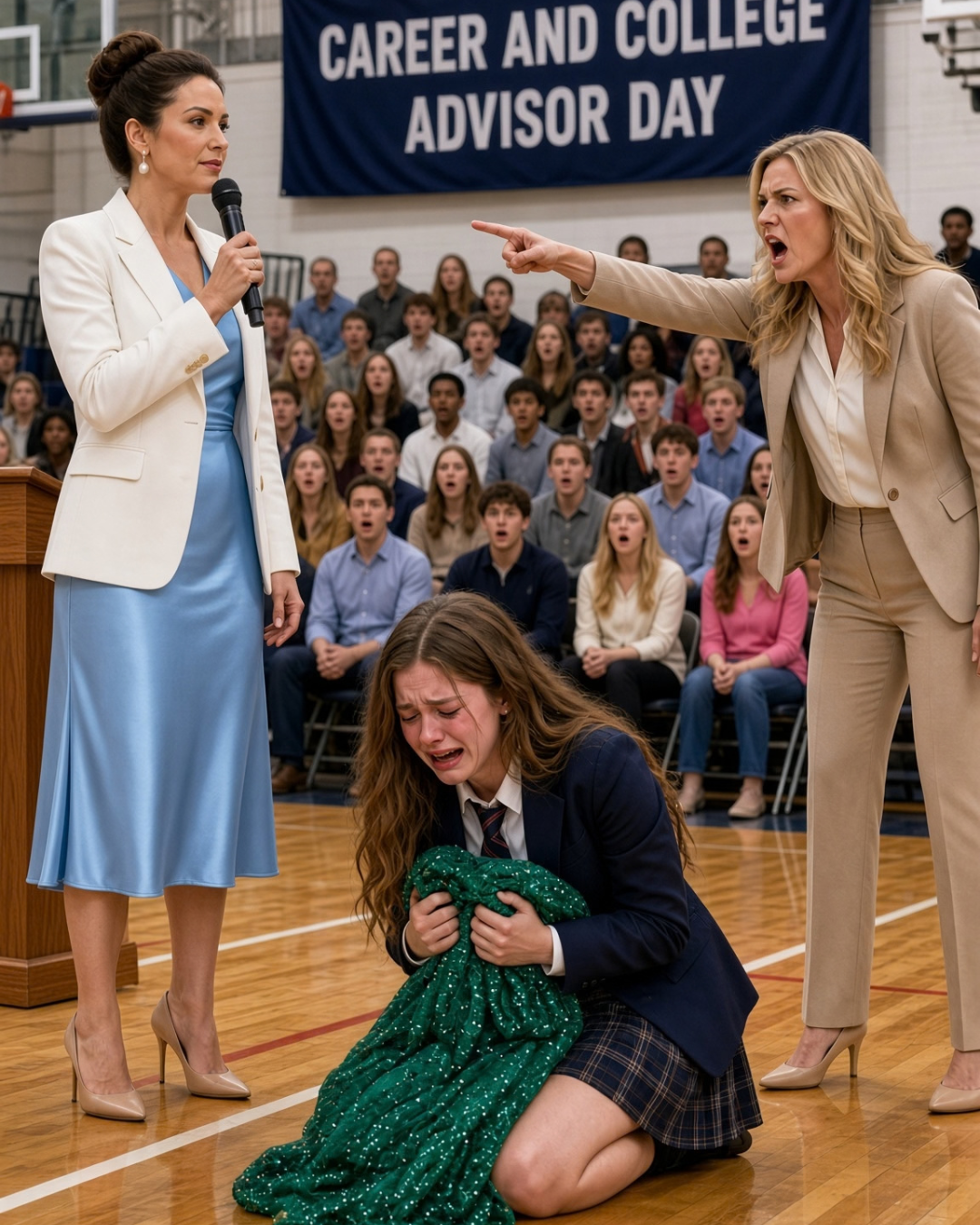
Chapter Three: The HR Interrogation
The next morning, while Vanessa was presumably sitting in a sterile administrative conference room sweating under the scrutiny of her principal and an HR representative, I was in Lily’s bedroom, carefully helping her step into the recovered emerald dress.
The heavy satin slid over her shoulders. I zipped up the back, smoothing the fabric. It still fit her perfectly. The glass beads caught the morning light, shimmering like a promise kept.
But as Lily turned to look at her reflection in the full-length mirror, her expression wasn’t one of pure joy. She reached up, tracing the beading with a quiet intensity. She said something then that fundamentally shifted my understanding of what this entire ordeal was actually about.
“Mom,” she said softly, her eyes meeting mine in the glass. “I don’t actually want Aunt Vanessa to get fired. I just want her to stop getting away with everything.”
Her words hung in the quiet room, heavy and profound.
She was only seventeen, but she had sharply identified a toxic family dynamic I had spent most of my adult life cowardly avoiding. Vanessa had always been permitted to cross a line, offer a vague, half-hearted apology—or often, no apology at all—and simply wait out the storm until someone else stepped in to smooth the dirt over her messes.
Usually, that someone was our mother.
The memories flooded back. When we were teenagers, Vanessa would “borrow” my favorite sweaters without asking, ruin them, and lie about whose turn it was to do the laundry. She would somehow miraculously turn every confrontation into a psychological debate about how “overly sensitive” I was being. As we transitioned into adulthood, the financial stakes changed, but the behavioral pattern remained identical. She borrowed money and conveniently forgot to repay it. She showed up an hour late to holiday dinners, fully expecting the entire family to delay the meal for her arrival. She canceled weekend plans with Lily at the last minute after making extravagant promises, then bought her a cheap gift weeks later, acting as if the plastic toy erased the crushing disappointment.
For decades, I had conditioned myself to believe that none of those infractions were worth igniting a full-scale family war. I swallowed the resentment to keep the peace.
But this dress was different. The dress belonged to Lily.
And Lily had finally seen the ugly, unvarnished pattern for exactly what it was.
Around noon, my phone vibrated on the kitchen counter. A text from Vanessa.
“HR wants to speak with you.”
I stared at the message, a cold knot tightening in my stomach. I did not respond.
Fifteen minutes later, a formal email arrived in my inbox from a district human resources administrator named Karen Patel. The message was incredibly professional and brief. She politely asked whether I would be willing to schedule a phone call to verify that the screenshots I had shared were authentic and to answer a few strictly factual questions regarding the incident. She also made it explicitly clear that as a private citizen, I was under no legal obligation to participate in their internal investigation.
I typed a one-word reply: Yes.
The phone call lasted exactly seventeen minutes.
Karen Patel did not ask me whether I personally believed Vanessa should be terminated. She did not pry into our childhood rivalry. She did not ask me to offer a psychological diagnosis of my sister’s narcissistic tendencies.
She asked only the cold, hard facts. Who purchased the dress? Where had the garment been stored? Did Vanessa have any form of permission, implied or explicit, to remove the item from the premises? Was the Facebook marketplace listing tied to Vanessa’s personal account? Had I successfully recovered the dress, and most importantly, had the text message screenshots been altered or doctored in any way?
I answered every single question with a simple, unwavering “yes” or “no.”
At the end of the call, Karen’s voice remained perfectly neutral. “Thank you for your time, Ms. Cole. We will handle this matter according to district ethics policy.”
That was all.
Later that afternoon, the inevitable call from Mom came through.
“Vanessa called me crying. She says you talked to the HR department,” Mom accused, her voice tight with stress.
“Yes, I did.”
“Claire, you could have stayed out of it!”
“They contacted me, Mom.”
“You could have refused to speak to them!”
“I could have,” I agreed calmly. “I chose not to.”
Mom let out a heavy, ragged sigh, the sound of a woman whose carefully constructed house of cards was finally collapsing. “She might lose everything, Claire.”
“No, Mom,” I corrected, my voice hard. “She might finally face consequences for something she actively chose to do.”
“You sound so cold.”
“I’m tired.”
That was the truest, most accurate answer I possessed.
I was bone-deep tired of being lectured that protecting Vanessa from the fallout of her own disastrous choices was somehow synonymous with loving her. I was exhausted from being expected to quietly absorb the collateral damage simply because I was labeled the “reasonable” sister.
But most of all, I was absolutely done watching that toxic expectation extend its shadow over my daughter.
Prom was Saturday. And for the first time in my life, I wasn’t going to let Vanessa ruin the weekend.

Chapter Four: The Confrontation
By Friday evening, our house was finally vibrating with the ordinary, joyful chaos that should have surrounded prom week from the very beginning. Lily’s best friend, Ava, burst through the front door hauling curling irons, massive makeup bags, and enough aerosol hair products to successfully stock a commercial salon. Two other girls arrived shortly after, balancing heavy garment bags and oversized fast-food cups.
Upstairs, upbeat pop music thumped through the floorboards. Someone laughed so loudly that the joyful sound carried all the way down to the kitchen where I was preparing snacks.
For the first time all week, the emerald fabric felt like a dress again, rather than a piece of criminal evidence.
Then, the doorbell rang.
I wiped my hands on a towel and opened the door. It was Vanessa.
I did not step aside to invite her in.
She looked vastly different from the arrogant, sunglass-wearing selfie she had sent on Tuesday. Her face was bare of makeup. She wore loose jeans, a faded gray sweatshirt, and carried the drawn, exhausted expression of someone who had spent several nights wrestling with insomnia.
“Can we talk?” she asked, her voice subdued.
“Outside,” I replied, stepping onto the porch and pulling the heavy front door shut behind me.
She glanced nervously toward the glass panels of the door. “Is Lily here?”
“Yes.”
“I want to apologize to her.”
“You can write her a letter,” I said flatly.
Vanessa’s jaw tightened, a flash of the old defiance sparking in her eyes. “I’m genuinely trying to make this right, Claire.”
“No, you aren’t,” I countered, crossing my arms against the evening chill. “You’re trying to control what happens next.”
“That’s not fair.”
I almost smiled at the bitter familiarity of the phrase. “What happened at work today?”
She folded her arms, mirroring my defensive posture. “I’ve been placed on administrative leave while they review the ethics board findings.”
I said nothing, letting the silence hang between us.
She continued, her voice rising in frustration. “They’re acting like I stole from one of my students!”
“You stole from a teenager, Vanessa.”
“She’s my niece!”
“That does not improve the situation! It makes it worse!”
“I honestly thought Mom wouldn’t care if I sold it,” she deflected, slipping back into her favorite excuse.
“The dress wasn’t Mom’s to sell,” I reminded her coldly.
“I know that now.”
“You knew it then.”
She looked past me, staring at the streetlights flickering on. “I needed cash, Claire.”
“For Botox.”
“I had already booked the appointment weeks ago!” she snapped, her frustration boiling over. “There was a massive cancellation fee. I was short on cash that month!”
“So you decided to sell Lily’s property to cover your vanity appointment.”
“I was going to replace it before Saturday!”
“With what?” I demanded, stepping closer.
Vanessa did not answer. She looked down at her shoes.
That heavy, shameful silence told me more than a thousand words ever could. There had never been a replacement plan. She didn’t have the money to buy a new dress, let alone commission a custom one in four days. She had simply assumed Lily would be crushed, Mom would immediately step in to tell us not to make a scene, and eventually, as always, everyone would just move on.
Vanessa lowered her voice, her tone turning pleading. “Claire, I could lose my counseling license over this.”
“I don’t know whether that’s true.”
“They’re reviewing whether this constitutes a violation of the district’s moral turpitude policy.”
“That is between you and the ethics board.”
“You sent the screenshots to them!” she accused, pointing a trembling finger at me.
“I sent them to a group chat you willingly added me to,” I corrected. “Your principal is the one who decided what to do next.”
“You knew he would see it.”
“Yes.” For once in my life, I did not try to soften the blow of the truth.
Her eyes narrowed, the plea vanishing into resentment. “So this was just revenge.”
“It started as anger. I won’t pretend otherwise,” I admitted freely. “But the screenshots were real, Vanessa. I didn’t invent anything. I didn’t exaggerate a single detail. If seeing your own exact words creates a professional problem for you, that problem didn’t begin with me. It began with you.”
Vanessa looked down at the wooden planks of the porch. For nearly thirty seconds, only the sound of passing cars filled the space between us.
Then, the front door clicked open.
“Mom?”
I turned. Lily was standing in the doorway. She was wearing baggy sweatpants and one of my faded college T-shirts. Her hair was a chaotic mess—half curled, half pinned up in clips. She didn’t look heartbroken anymore. She looked profoundly irritated.
When she saw Vanessa standing on the porch, she stopped cold.
Vanessa immediately took a step forward, her hands outstretched. “Lily… Lily, I am so, so sorry.”
Lily’s face became a completely unreadable mask.
Vanessa continued, speaking rapidly. “I made a terrible, stupid decision. I should never have taken your dress from Grandma’s house. I wasn’t thinking clearly.”
Lily looked at her aunt, her teenage gaze unnervingly sharp. “You were thinking clearly enough to post it for sale online.”
Vanessa flinched as if she had been slapped. “I know.”
“You were thinking clearly enough to drive across town, meet a stranger, and take her money.”
“I know.”
“And then you texted my mom like ruining my prom was a funny joke.”
“I know,” Vanessa whispered, the repetition sounding weaker and more hollow each time.
Lily walked closer, but she deliberately stayed inside the threshold of the doorway, maintaining a physical boundary. “Why did you do it?”
Vanessa opened her mouth, closed it, and finally surrendered to the ugly truth. “I needed money.”
“For Botox?”
“Yes.”
Lily stared at the grown woman standing on the porch with a kind of profound, quiet disbelief that looked far older than seventeen. “You thought your face mattered more than me having my prom dress?”
“No,” Vanessa choked out. “No, Lily, that’s not what I thought.”
“Then what did you think?”
Vanessa had no answer. She just stood there, completely stripped of her usual eloquent excuses.
Lily nodded once, a sharp, decisive movement. “Okay.”
“Okay?” Vanessa repeated, a desperate, pathetic brightness entering her voice, as if she truly believed that one word equated to absolution.
Lily quickly crushed that hope. “I heard your apology.” The brightness in Vanessa’s eyes vanished. “I’m not ready to forgive you.”
Vanessa swallowed hard, her shoulders slumping.
“But I don’t want you fired because of me,” Lily continued, her voice steady. “Whatever your school administration decides is their decision. I just don’t want anyone in this family blaming my mom for telling the truth.”
Vanessa looked at me, a flash of guilt finally penetrating her self-absorption. She looked back at Lily. “No one is blaming your mother.”
“You were screaming at her on the phone two days ago,” Lily pointed out ruthlessly.
Vanessa’s face burned a deep, shameful red.
Lily folded her arms tightly across her chest. “I heard the whole call.”
That effectively ended the conversation.
Vanessa left shortly afterward, walking back to her car with her head bowed. She did not attempt to hug Lily. And, for the first time in thirty years, she did not ask me to protect her from the consequences of her own actions.
Saturday afternoon was perfect.
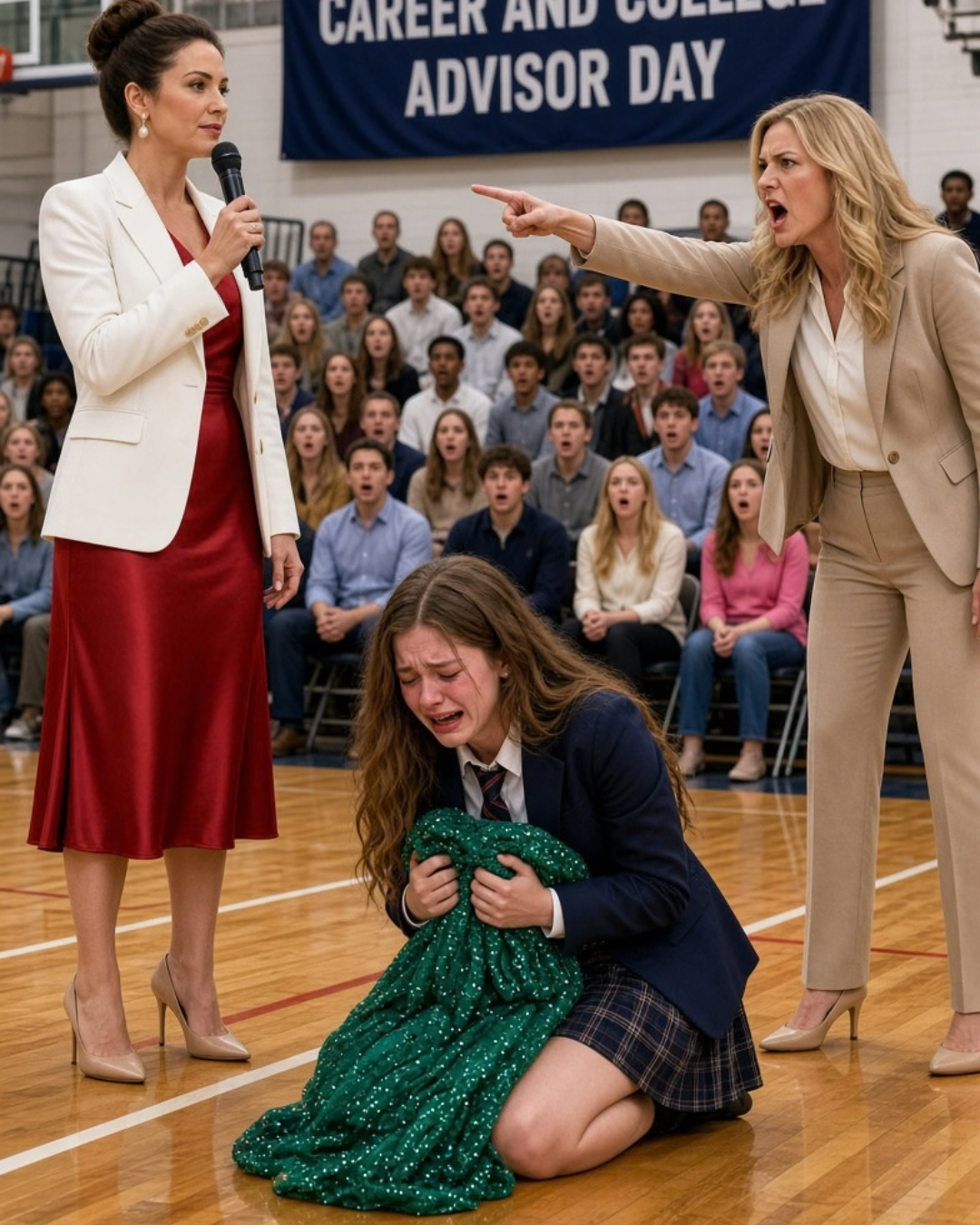
Chapter Five: The Unwritten Rule
Saturday afternoon, Lily stood bathed in the warm light of the living room window while I fastened the final, delicate clasp on the emerald dress.
The sunlight caught the intricate beading at her shoulders, making her look like royalty. She looked exactly as she had hoped she would when she first sketched the design in her notebook months earlier.
For a second, neither of us said anything, just taking in the hard-fought victory of the moment.
Then, Lily met my eyes in the mirror and smiled. “Worth buying twice?”
I laughed, the sound bubbling up from deep within my chest. “Ask me again after I pay your first semester of college tuition.”
She laughed too, the heavy tension of the week finally breaking.
When her friends arrived, the front yard filled with the chaotic, joyful noise of parents aggressively taking photos. Lily posed arm-in-arm with Ava, then smiled brightly next to her nervous date, Marcus, and finally gathered with the whole group under the shade of our old maple tree. There were pinned corsages, awkward teenage jokes, crooked bowties, and one overly enthusiastic father shouting photography instructions that nobody listened to.
It was wonderfully, brilliantly normal.
Mom did not come to take pictures.
She had texted Lily that morning, a brief message saying she hoped she had a beautiful night. Lily had replied with a simple “Thank you.” Nothing more.
The following Wednesday, my phone rang. It was Vanessa.
This time, her voice was much quieter, stripped of its usual bravado. “The district gave me a final written warning.”
I waited, letting her fill the silence.
She explained that she would be allowed to return to work the following week, but only after completing a mandatory ethics review course and serving several days of unpaid suspension. The district attorneys had ultimately concluded that because the theft happened outside of school grounds and did not involve a student currently under her professional care, they couldn’t revoke her license. However, the administrators had placed serious, documented concerns in her permanent file regarding her professional judgment, her honesty, and the deceptive way she had initially tried to frame the incident during her first HR meeting.
“What exactly did you tell them in that first meeting?” I asked, already dreading the answer.
Vanessa hesitated, the shame palpable even over the phone. “At first, I panicked. I told them Mom had explicitly told me I could sell the dress.”
There it was. The fallback plan.
“And then what happened?”
“They called Mom for verification.”
I closed my eyes, leaning my forehead against the cool glass of the kitchen window. Of course they had.
“And what did she say?”
“She told them she had given me permission to move some old things out of her closet to make room. Not to sell a custom prom dress.”
I exhaled slowly. For the first time in her life, Mom had not lied to save Vanessa’s skin.
“I changed my official statement after that,” Vanessa admitted quietly.
“You mean you were forced to tell the truth.”
“Yes.”
Neither of us spoke for a long moment.
Then, she cleared her throat. “I have to pay you back.”
“For the dress?”
“For what you paid Marissa to get it back.”
I was genuinely surprised. “I paid Marissa eighteen hundred dollars, Vanessa. You only got nine hundred when you sold it.”
“I know.”
“Where are you getting that kind of money, especially with an unpaid suspension?”
“I’m setting up a monthly payment plan.”
I turned around, leaning against the kitchen counter, my business voice taking over. “Put it in writing. Email it to me.”
Vanessa made a faint, irritated sound in the back of her throat, but she quickly stopped herself. “Fine.”
The next day, she emailed me a formal, itemized repayment schedule: $300 a month for six consecutive months.
She made the first electronic transfer exactly on time.
Then she made the second.
Mom remained angry with me for several weeks. She stubbornly maintained that my impulsive decision to send the screenshots had unnecessarily embarrassed the family in a public forum. I told her, without raising my voice, that the embarrassment belonged solely to the person who had created the situation in the first place.
We did not speak for almost a month.
Eventually, the silence became too heavy, and she texted, asking if she could take Lily to a peace-offering lunch.
I left the decision entirely up to Lily.
Lily agreed to go, but she set one ironclad condition before getting in the car. “No talking about how I need to forgive Aunt Vanessa. If you bring it up, Grandma, I’ll walk home.”
Mom accepted the terms.
That lunch did not magically fix everything. Neither did Vanessa’s meticulous repayment plan. Real families do not reset cleanly like a sitcom after one dramatic confrontation. Trust does not instantly regenerate just because everyone finally manages to say the correct sentences.
But some fundamental things did change.
Mom stopped constantly asking me to intervene and smooth things over with the school district.
Vanessa stopped dropping by my house unannounced. She quietly returned the spare key to Mom’s house. And, for the first time I could ever remember, she actually started asking for permission before borrowing even the smallest item.
Three months later, at our annual end-of-summer family barbecue, Vanessa arrived carrying a small, wrapped garment box.
She walked straight past the food table and handed it to Lily.
Lily opened it carefully. Inside, resting on white velvet, was a simple, elegant silver bracelet.

Lily stared at it, her expression guarded.
Vanessa spoke quickly, her tone entirely devoid of expectation. “It’s not meant to make up for the dress, Lily. I know it doesn’t. I just saw it in a window and thought you’d really like it. If you don’t want it, I completely understand, and that’s okay.”
Lily looked up at me, searching for a cue.
I said nothing. I just smiled softly. The decision was hers to make.
Finally, Lily closed the box, holding it gently in her hands. “Thank you.”
Vanessa nodded, looking incredibly relieved.
That was it. There was no tearful, movie-scene hug. There was no sudden, sweeping reconciliation.
Just two polite words, and a healthy boundary left firmly intact.
Later that evening, as the sun began to set, Mom and I stood side-by-side at the kitchen sink, washing dishes while everyone else lingered outside on the patio.
She handed me a wet plate. “I still wish you hadn’t posted those screenshots to her coworkers, Claire.”
“I know you do,” I replied, drying the ceramic.
“But…” She hesitated, staring down into the soapy water. “I also should have taken Lily’s side much sooner than I did.”
I stopped drying the plate and looked at her.
She kept her eyes firmly fixed on the sink, her voice barely above a whisper. “I honestly thought I was just keeping the peace all these years.”
“You weren’t keeping the peace, Mom,” I said gently. “You were just keeping Vanessa comfortable.”
Mom nodded slowly, a profound sadness settling over her features. “I think maybe I was.”
It was the closest thing to a genuine admission of guilt I had ever heard from her. I did not need to push for more.
By the end of the calendar year, Vanessa finished paying back every single dollar I had spent recovering the dress.
Lily kept the emerald gown zipped safely in a garment bag at the very back of her closet. She occasionally mentioned that she might have it shortened into a cocktail dress someday and wear it again, though I secretly suspected she never would.
The dress itself mattered far less after prom was over.
What truly mattered was everything that had happened around it.
For years, our family had operated on a toxic, unwritten rule: Vanessa was allowed to create the problem, but whoever dared to expose the problem instantly became the villain.
That rule died the morning I hit send on those screenshots.
I am not going to pretend I handled the entire situation perfectly. Sending those private messages to her professional work group was incredibly impulsive. I was blindingly angry, and a dark, vindictive part of me absolutely wanted Vanessa to feel a fraction of the public humiliation Lily had felt.
But I have never regretted fighting to recover that dress.
And I have never, not for one second, regretted refusing to lie to protect her afterward.
Months later, while we were cleaning out the garage, I asked Lily whether she still thought I had gone too far that morning.
She leaned on a broom, genuinely considering the question. “Posting it to her principal and coworkers was kind of a nuclear option, Mom.”
I laughed, tossing a trash bag into the bin. “Fair assessment.”
Then she smiled, a wise, knowing look in her eyes. “But if you hadn’t done something nuclear, Grandma would’ve just made us all pretend it wasn’t a big deal. Again.”
That was the undeniable truth.
Lily went back inside, and I stood alone in the quiet garage for a moment, pulling my phone from my pocket.
The original text from Vanessa was still saved deep in my archives.
“Your daughter’s prom dress? I sold it for my Botox appointment.”
For months, reading that single sentence had made my blood boil.
Now, looking at it in the dim light of the garage, it mostly just seemed pathetic and ridiculous.
One incredibly selfish decision had finally exposed a rotting family habit none of us had ever wanted to name out loud.
The most expensive part of this entire ordeal was never the $1,800 emerald dress.
It was the years we had all spent paying for Vanessa’s bad behavior in silence.
At least this time, she finally got the bill.
