

The steady hum of the ultra-low temperature freezer was the last sound left in existence. It was 9:00 PM in Manhattan, the city outside a chaotic artery of light and noise, but here, inside the Oncology Research Wing, time hung frozen in sterile white.
I caught my reflection in the glass of the fume hood. Dr. Caroline Wilson, lead researcher on a glioblastoma study that was consuming my life piece by piece.
I looked like a ghost haunting her own lab—black-rimmed glasses slipping down an oil-slick nose, chestnut hair pulled into a bun so tight it triggered a constant headache, and eyes that hadn’t seen eight hours of sleep since grant season began.
“Dr. Wilson? Caroline?”
I flinched, nearly dropping a pipette. Jessica, my junior researcher, lingered in the doorway with her coat already buttoned to her chin. She gave me that familiar look—the quiet pity reserved for brilliant but socially starved people.
“You should go home,” she said gently. “The cells will still be dividing tomorrow.”
“You’re right,” I sighed, snapping off my latex gloves. “I’m just… chasing a variable. Go on, Jessica. Goodnight.”
I made the tired journey home, swaying with the rhythm of the subway. The underground air smelled like ozone and stale pretzels. To distract myself from the exhaustion gnawing at my bones, I made the mistake of pulling out my phone.
My thumb hovered, guided by habit. I opened Instagram.
And there she was. Jennifer.
My sister. The Golden Child. Head Buyer for a luxury boutique on Fifth Avenue. Her life was a curated exhibit of beige filters, champagne glasses, and effortless perfection. The latest post: a selfie—blonde waves cascading, silk robe, mimosa in hand. #AnniversaryPrep #Blessed #BlueGardenTomorrow.
A dull ache throbbed in my chest. These posts were like digital shrapnel. They didn’t just show her happiness—they exposed the crater of our past.
Three years ago, when our father’s heart finally gave out, the call came at 2:00 AM. I was preparing for a career-defining symposium. I dropped everything. I didn’t even pack properly. I just ran.
For a week, I lived in a hospice chair. I fed him ice chips. I read him the sports section even when he couldn’t understand.
“Where is Jenny?” Mom asked, her voice brittle.
“She’s in Paris for Fashion Week, Mom,” I lied, stroking her hair. “She’s trying to get a flight.”
She wasn’t trying. She was posting rooftop bar stories in the Marais. She arrived two days after he died, sweeping into the funeral in oversized sunglasses, wailing loudly, throwing herself onto the casket in a performance so intense it unsettled everyone.
“Caroline was too busy with her test tubes to really care for him,” I overheard her whisper. “I’m just glad I could say goodbye properly.”
The lie spread. Then came the inheritance fight—her demanding the majority to “maintain the family image,” forcing me to concede for Mom’s care. Then came the missing invites, the silent exclusions. She painted me as the cold, childless workaholic. Herself as the loving victim.
I reached my building—a high-rise that felt more like a dorm than a home. The elevator climbed slowly. Choir practice this weekend. Visit Mom. That was my life—small, quiet duties.
I reached my door, fumbling for keys, craving a scalding shower.
Ding-dong.
The sound was sharp. Wrong. No one rang the bell at 10:00 PM.
I froze. Snow had started falling outside.
I checked the peephole. Empty hallway.
I opened my security app and rewound two minutes.
A woman appeared. Expensive coat. Struggling with something heavy. She set it down. Turned slightly—profile visible.
Jennifer.
But she wasn’t poised. She was shaking. She dropped the object and rushed to the elevator, frantically pressing the button.
I unlocked the door and swung it open.
The hallway smelled of Chanel No. 5 and winter air. On my welcome mat sat a wicker basket.
It looked like a luxury baby hamper. Draped in a cover embroidered with a Christian Dior logo.
Then it moved.
A soft, rhythmic sound came from beneath the cashmere.
My breath caught. I knelt and pulled back the blanket.
A baby girl stared up at me. Wide, dark eyes. Maybe three months old.
She wore a onesie worth hundreds. Tiny fists clutched the fabric. Jennifer’s eyes. Michael’s chin.
My brain stalled. This wasn’t a child—it felt like a prop.
Inside the basket: an Avent glass bottle, French organic formula, a leather-bound vaccination record.
And a note.
Pinned with a gold safety pin. Pink paper. Jennifer’s looping handwriting.
Caroline,
Please look after her for a while. Consider yourself the babysitter. Tomorrow is my wedding anniversary party. I forgot to send you an invitation (oops!). I can’t deal with this right now. You’re good at boring tasks. I’ll come get her… eventually.
– J
I read it three times.
“Consider yourself the babysitter.”
“Oops.”
The cruelty was staggering. She hadn’t dropped off a pet—she abandoned her child in a snowstorm because it didn’t match her aesthetic.
I replayed the footage. She never looked back.
“Wah…”
The baby’s cry started small, then broke into a desperate wail.
Something in me snapped. Shock dissolved into action.
I lifted the basket. “Okay,” I whispered. “You’re cold. Let’s go inside.”
For six hours, my apartment became a lab of survival. I changed clothes, Googled feeding schedules, sterilized bottles with surgical precision, measured water to the milliliter.
At midnight, as snow piled outside, I fed her. She drank hungrily, eyes locked on mine.
Something cracked open in my chest.
I checked Instagram again. Jennifer had posted a video from The Blue Garden—crystal, roses, candlelight. Celebrating love.
Rage blurred my vision.
I looked down at the sleeping baby. Safe. Peaceful.
“She doesn’t deserve you,” I whispered. “And she won’t get away with this.”
I didn’t sleep. I planned.
Morning came. I dressed in my sharpest black dress. Applied makeup with precision. Packed the diaper bag. Strapped the baby into the carrier.
I looked in the mirror.
The exhausted scientist was gone.
“Shall we?” I asked. “Time to crash a party.”
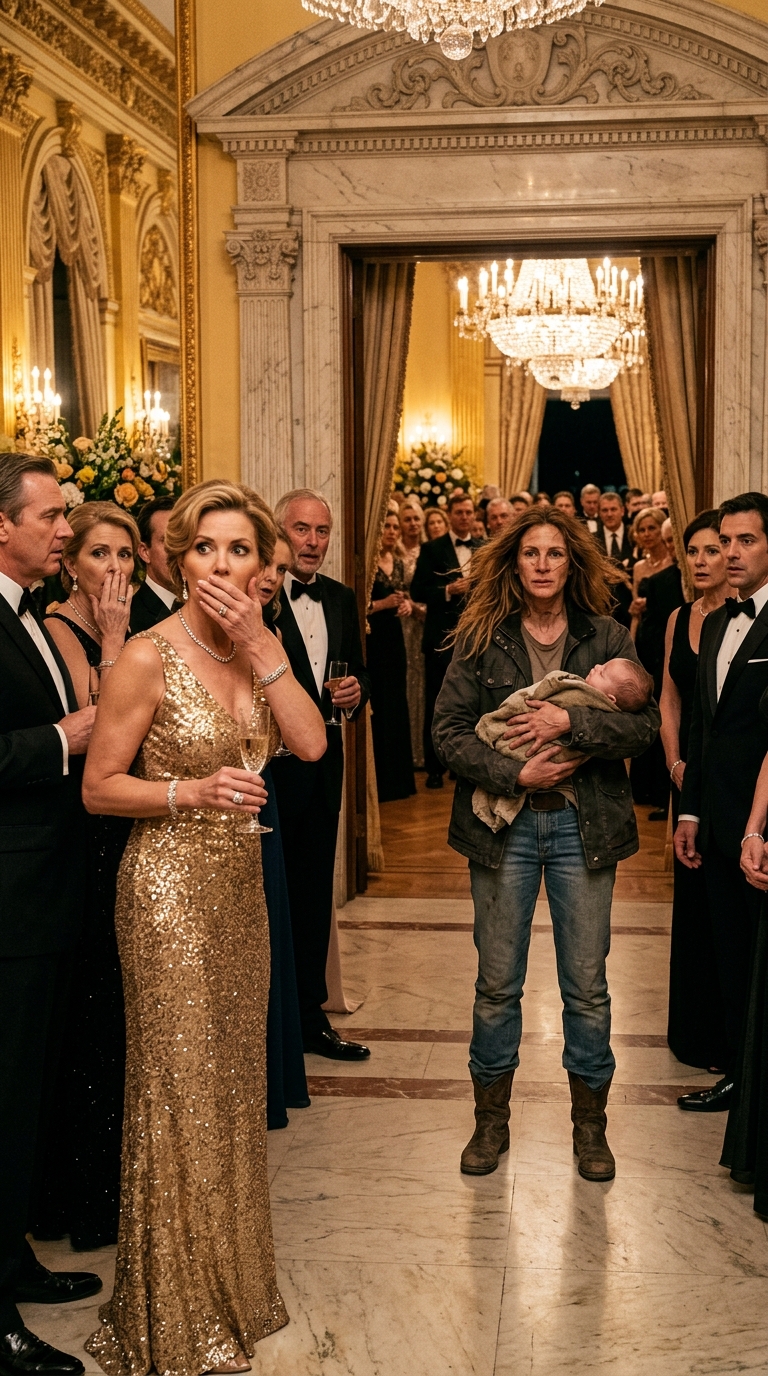
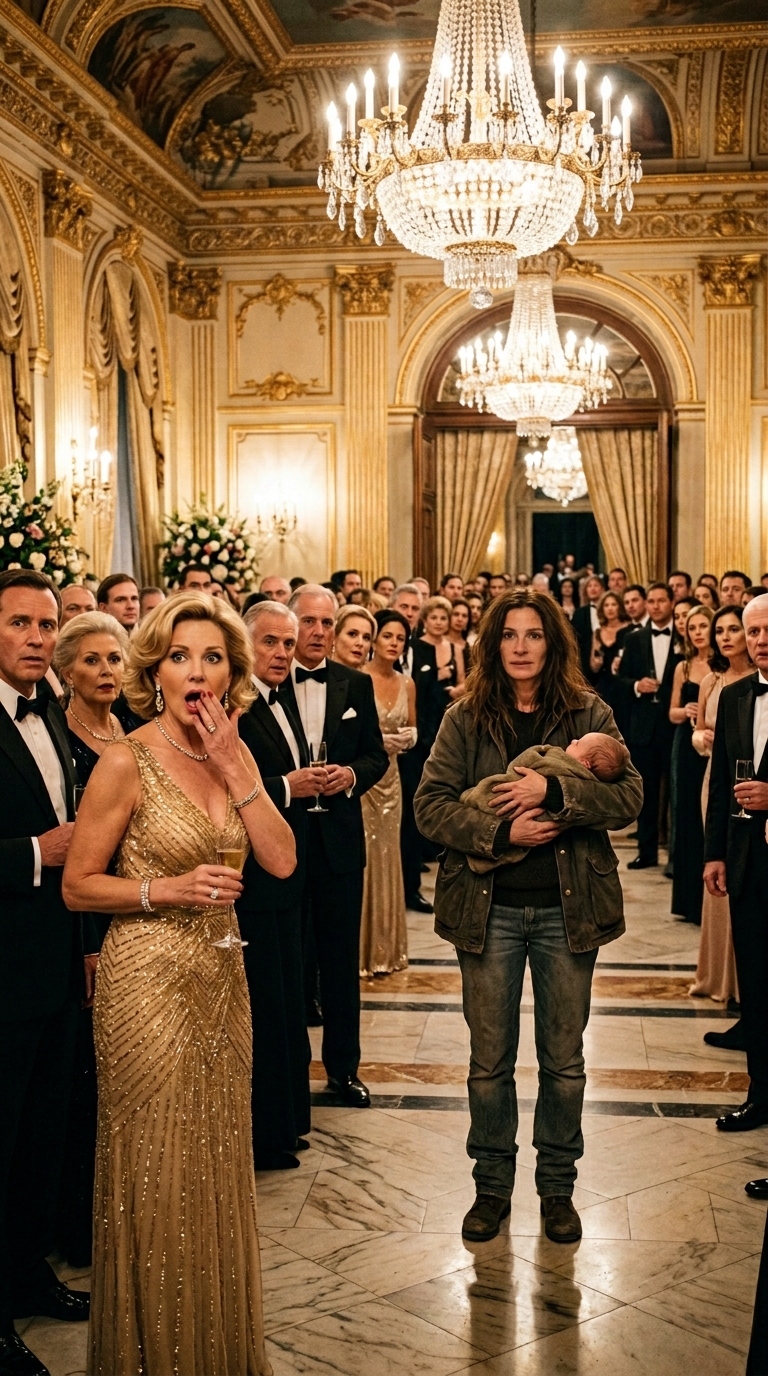
The Blue Garden was pure excess—silk curtains, marble floors, chandeliers dripping crystal.
The luncheon was underway.
I walked past the stunned maître d’.
The ballroom doors were closed. Music floated out.
I pushed them open.
Silence spread like a wave.
Two hundred heads turned.
Jennifer sat at the center, radiant in a designer gown, tiara gleaming.
“Caroline?” she squeaked.
Her smile faltered. Color drained.
I stepped forward. Heels echoing.
“Caroline, what are you doing here?” Michael asked. “Is that… a baby?”
“The babysitter has arrived,” I said calmly.
Whispers erupted.
“A joke?” Elizabeth scoffed. “Caroline always did love attention.”
“A joke?” I said. “You think this is a joke?”
I connected my phone.
The screen flickered—then showed security footage.
Jennifer. The basket. Her fleeing.
Gasps filled the room.
Next slide: the note.
Magnified. Damning.
“No!” Jennifer screamed. “Turn it off!”
“It’s fake!” she cried. “She’s jealous!”
The baby woke.
She looked at Jennifer.
Reached out.
“Mama,” she gurgled.
Silence crushed the room.
Jennifer froze.
Michael dropped his glass. It shattered.
“You told me…” he whispered. “You said you miscarried.”
Gasps.
“I wasn’t ready!” Jennifer sobbed. “It would ruin everything!”
“So you hid her?” he roared.
“At a nanny’s! I was going to bring her back!”
“So you threw her away,” I said coldly.
Michael’s face shifted—from anger to disgust.
“Don’t come near me.”
Thomas stepped forward. “You abandoned a child. You’ve disgraced this family.”
“Shall I call authorities?” the butler asked.
“I already did.”
Police entered.
Jennifer collapsed.
The arrest was chaos. Cameras flashed.
Outside, Michael sat on the curb, broken.
“I didn’t know,” he said.
“I know,” I replied.
“Can I hold her?”
I hesitated, then handed her over.
He broke down, holding his daughter.
Six months later.
I left work at 5:00 PM.
I arrived at Michael’s home—messy, alive.
“Auntie Caroline!”
He held Lily—smiling, six months old.
“She’s been waiting,” he said.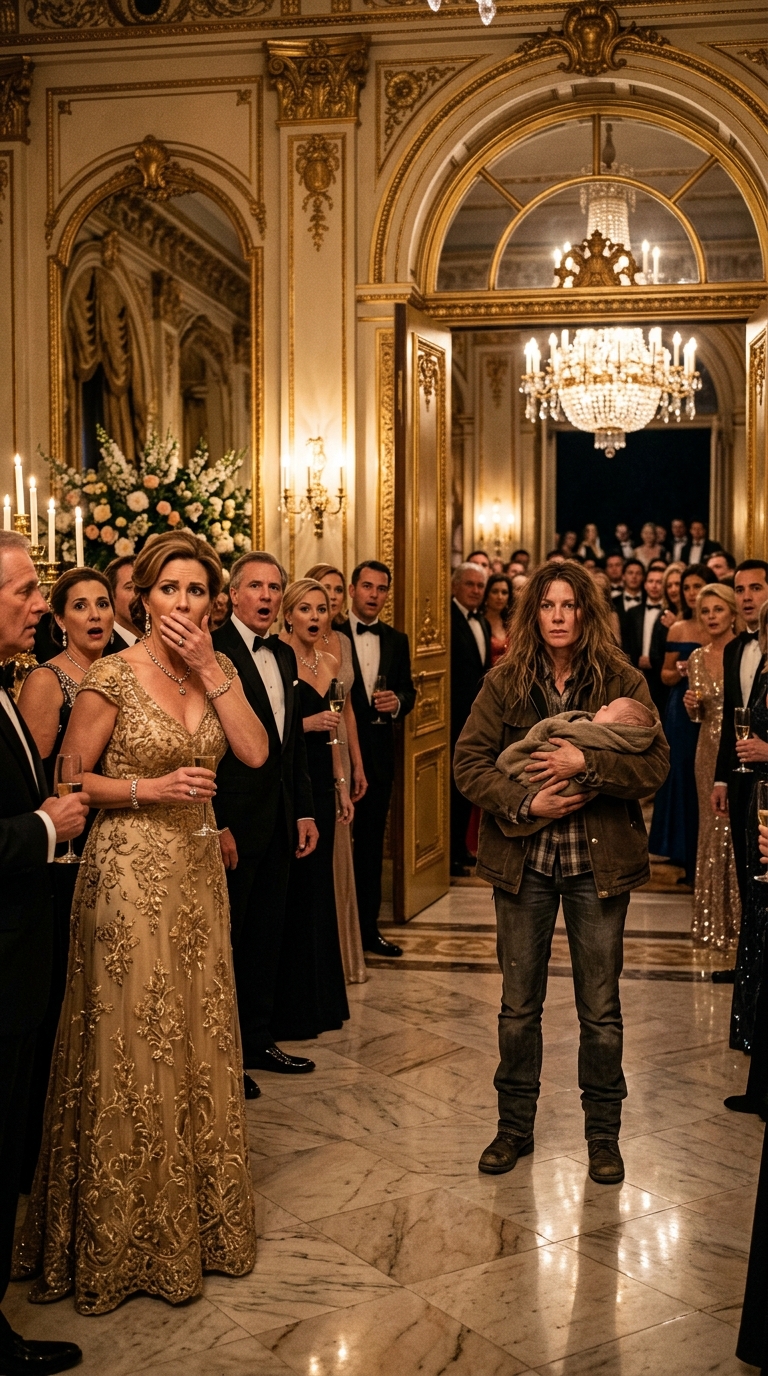
I took her. She smelled like milk and powder—better than any formula.
I thought about the life I envied.
Bonds aren’t posted.
They’re built.
I kissed her forehead.
“Ready for your story?”
She cooed.
I wasn’t just a scientist anymore.
I was family.
And for the first time, my experiment had produced a perfect result.
