

When my mother told me to keep my twelve-year-old daughter upstairs while forty guests celebrated directly beneath her bedroom, something inside me suddenly became completely calm.
“All right,” I said.
Mom heard surrender.
WHAT SHE DIDN’T REALIZE WAS THAT I PLANNED TO CLEAR THE FARMHOUSE EXACTLY AS SHE HAD INSTRUCTED.
By Friday evening, the folding tables my parents had stored inside the barn were gone.
The anniversary decorations were gone.
So were the champagne cases and every item of clothing they had left behind in the guest rooms.
I carefully packed everything and moved it into a rented storage unit under my father’s name.
Then I changed the gate code, replaced the exterior locks, and posted a signed no-trespassing notice beside the entrance.
The farmhouse belonged to me.
Not “the family.” Not my parents’ retirement retreat.
Mine.
Seven years earlier, I had purchased it from my late grandmother for its professionally appraised value.
My parents had refused to buy it because they believed the plumbing was outdated and the surrounding twenty acres had little value.
Only after I renovated everything did they begin calling it “our farmhouse.”
At nine Saturday morning, tires rolled loudly along the gravel road.
Three chartered buses followed my parents’ silver Cadillac.
Behind them came a catering van, a florist, and a string quartet.
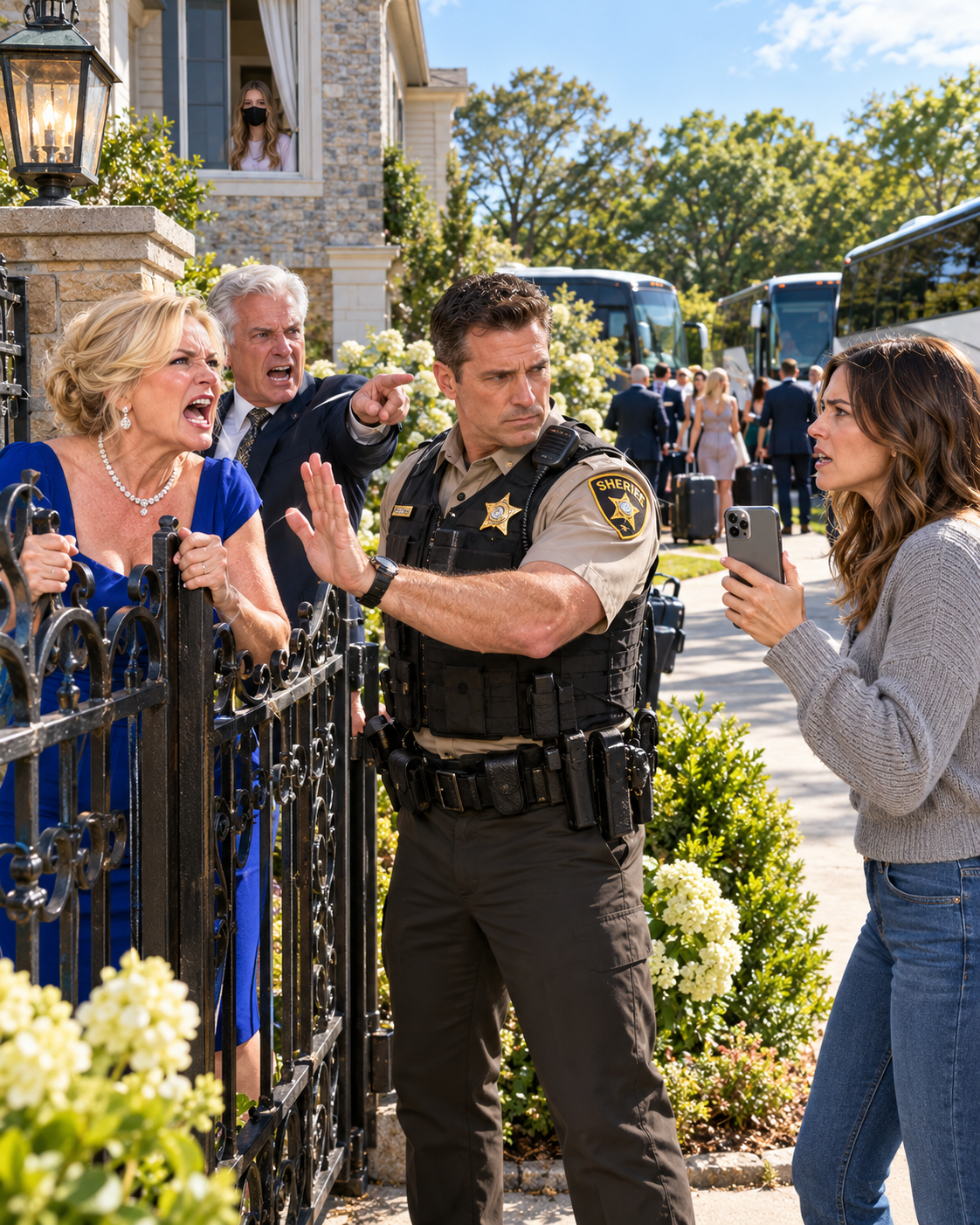
Waiting beside the locked front gate was Sheriff Daniel Brooks.
I watched through the living-room window while Lily rested in the sanitized room behind me.
She had returned home from a bone-marrow transplant just eleven days earlier.
Her doctors had warned us that even an ordinary infection could become extremely serious.
My mother stepped out of the Cadillac wearing an ivory dress and marched straight toward the gate.
“Why is the gate locked?” she demanded.
Sheriff Brooks held up the trespass notice.
“Mrs. Carter, the property owner has withdrawn permission for you and your guests to enter.”
“I am her mother.”
“That does not make you the owner.”
My father pointed toward the farmhouse.
“Emily agreed to clear the place.”
That was when I stepped onto the porch.
“I did,” I said.
“I cleared it of everything belonging to you.”
Guests were already getting off the buses.
Mom stared at me through the iron gate, and then I recognized the familiar smile I had known my entire life—the expression that always meant she believed public embarrassment would eventually make me cooperate.
“You are embarrassing yourself,” she said.
“Open the gate.”
“No.”
She gripped the iron bars and began insisting that family property could not simply be taken away by an ungrateful daughter.
Sheriff Brooks calmly told her to step back.
Instead, she reached through the gate and entered the access code she had used for years.
It didn’t work.
Then I noticed movement upstairs.
Lily stood behind the window, pale and uneasy, her medical mask covering her face.
Mom looked toward her.
“See?” she called.
“She’s already upstairs.
There’s no problem.”
Even Sheriff Brooks fell silent.
I looked at Lily, then turned back toward my mother.
I had spent eleven days carefully evaluating every possible risk around my daughter, trying to protect a body that had already endured more than any twelve-year-old should have to experience.
And my mother stood outside treating Lily’s recovery like an inconvenience interfering with her anniversary celebration.
So I took out my phone.
THERE WAS ONE THING MOM DIDN’T REALIZE I HAD SAVED: THE VOICEMAIL SHE HAD LEFT THE PREVIOUS NIGHT.
I pressed play.
“If Emily resists,” my mother’s recorded voice said, “we’ll go in through the kitchen.
She won’t make a scene in front of everyone.”
Sheriff Brooks slowly turned toward her.
Sheriff Brooks slowly turned toward her, and for a long moment nobody standing along that gravel road said a word.
Not the guests gathered beside the buses.
Not the florist, who held a bucket of white roses against her hip as though she had suddenly forgotten where to put them.
Not even the breeze moving the maple leaves along the fence throughout the morning.
There was only my mother’s recorded voice, faint and metallic through my phone speaker, hanging in the chilly air.
She won’t make a scene in front of everyone.
I didn’t stop the recording there.
I had listened to it enough times the previous night to know there was more, and I wanted everyone standing beside that gate to hear what came next.
“Richard, bring the toolbox from the trunk, just in case,” my mother’s voice continued.
“It’s my mother’s house.
Nobody is going to keep me out of my own mother’s house.”
A click.
Then silence.
I lowered my phone.
My hand remained steady.
I remember being slightly surprised by that.
“Mrs. Carter,” Sheriff Brooks said, using the same measured tone he might have used while asking for a driver’s license, “is that your voice?”
My mother lifted her chin.
“That is a private message between a mother and her daughter.
It’s being played out of context.”
“Out of context.” He nodded slowly, apparently weighing the phrase carefully.
“Ma’am, I’ve worn this badge for thirty-one years.
I can’t think of a context that turns ‘go in through the kitchen’ into anything other than what it sounds like.”
Someone beside the buses quietly cleared his throat.
A man in a gray suit suddenly became very interested in staring at his shoes.
Sheriff Brooks raised the notice again, this time so the gathered guests could clearly see it.
“Let me make this plain for everyone, so nobody is confused later.
On Thursday afternoon I went to the county recorder’s office and pulled the deed myself.
Emily Carter is the sole owner of this property.
She has been for seven years.
Hers is the only name on it.
The notice on this gate is lawful and valid.
IF ANYONE CROSSES THIS LINE WITHOUT HER PERMISSION, THAT’S CRIMINAL TRESPASS.
And if anyone were to climb in through a kitchen window—” He glanced toward the phone in my hand.
“—that becomes a good deal more serious than trespass.”
“You would not arrest a sixty-six-year-old woman in front of her friends,” my mother said.
“I’d much rather not,” he replied.
“But I would.”
She stared directly at him.
I had watched my mother challenge waiters, contractors, school principals, and once, memorably, the chairwoman overseeing a church bake sale.
I had never watched her confront someone who simply looked calmly back.
“Diane,” my father said softly.
“Let’s go.”
“Don’t you dare, Richard.”
That was how things had always worked.
My father, tall and stooped and gentle, had spent forty years believing peace and silence were essentially the same thing.
He was the kind of man who apologized to furniture whenever he accidentally bumped into it.
Throughout my entire life, he had never once directly told my mother no.
I walked down the porch steps and along the front path, stopping a full ten feet from the gate.
I was wearing a mask.
I hadn’t stood within arm’s reach of a crowd for more than two months, and I wasn’t going to start now.
In my hand was a cream-colored envelope.
I passed it to Sheriff Brooks, and he carried it through the iron bars to my father.
“Everything you left at the farmhouse is in Unit 214 at Harmon Road Self Storage,” I said.
“The unit is rented in Dad’s name and paid through next August.
The key is in there, along with a typed inventory.
Every box is labeled.
I hung Mom’s coats on a garment rack so nothing would wrinkle.
The champagne is on the north wall, in the shade, because I didn’t want it to spoil.”
My father opened the envelope.
He examined the key, then the receipt, then the inventory—three neat, single-spaced pages.
Then he looked toward me over the top of them, and something crossed his expression that I couldn’t quite identify.
“You did all of this by yourself,” he said.
“It was a long week.”
“You put our things in a storage unit,” my mother said, as though I had abandoned them somewhere outside.
“I put them in a clean, dry unit with a lock and a roof, Mom.
I’m not trying to take anything from you.
I’m trying to keep Lily safe.”
“You planned this.”
“I planned for my daughter,” I said.
“You planned for forty guests. We were always going to end up in different places.”
My mother wrapped both hands tightly around the iron bars.
Her wedding ring clicked softly against the metal.
“Open.
This.
Gate.” Throughout my life, whenever my mother used that voice, I usually gave in.
I had been doing it since I was six years old. One afternoon, I asked why my brother Mark could leave the table while I couldn’t, and she had answered, “Emily, we don’t make scenes in this family.”
It had practically become the Carter family motto, worthy of being stitched onto a decorative pillow.
Don’t make a scene. Don’t be difficult. Don’t be a burden.
Smile, pass the potatoes, and quietly swallow whatever you’re feeling until eventually it disappears.
But eleven days earlier, I had stood in a hospital corridor at three in the morning, listening to the quiet electronic chirping of a machine monitoring my child, and I had learned there were two different kinds of silence.
There’s the silence of someone who has stopped speaking up.
And there’s the silence of someone who has finally decided.
“No, Mom,” I said.
She turned toward the guests, and the smile she produced was one I had seen at countless dinner parties.
Bright, brittle, and directed like a spotlight.
“Everyone, I am so sorry for this.
Emily is under enormous stress.
She hasn’t been herself since Lily got sick.
We’ll sort this out in a moment, and in the meantime, if you’d all just wait on the buses—”
“Mrs. Carter,” Sheriff Brooks said mildly, “with respect, your daughter is the calmest person on this road.”
Nobody laughed.
But I noticed several faces in the crowd twitch, as though people were trying extremely hard not to react.
That was when my brother Mark appeared from behind the second bus, carrying a garment bag over one arm.
He had flown in from Denver the previous night.
Mom had told him to rest at a hotel and “let the women handle the setup,” meaning he had learned about the previous two weeks the same way everyone else in our family had: through my mother’s version.
He stopped when he noticed the sheriff.
Then the gate.
Then me, standing ten feet away wearing a mask.
“Em? What’s going on?”
“Ask Mom about Lily,” I said.
“Lily’s better.” He glanced from me toward her.
“Mom, you told me she was on the mend.
You said her doctors were thrilled.”
“She is on the mend,” my mother replied.
“Mark.” I kept my voice steady.
“Eleven days ago Lily came home from the transplant unit.
Right now her immune system is about as strong as a newborn’s.
The doctors say it will take a year, maybe longer, for it to rebuild.
One cold from one of your guests could put her back in intensive care.
Or worse.”
The crowd shifted uneasily.
Someone toward the back murmured, “Transplant?” as though it were a word from a language they had previously heard only on television.
A woman moved forward from the middle of the group.
She was small and square-shouldered, with cropped white hair and a purse tucked beneath one arm like a football.
Bev Lindstrom.
She had sat two pews behind my mother at church for thirty years and had brought me a casserole when Lily received her diagnosis.
“Diane,” she said.
“Tell me you didn’t.”
“I didn’t do a single thing, Bev.
Nobody was going near the child.
She would have stayed upstairs with the door shut, like anyone with a sniffle.”
“A sniffle.” Bev lowered her voice, which somehow made her words sound even stronger.
“I worked thirty-four years on a pediatric oncology floor.
Do you know what we did with visitors who had a sniffle? We turned them around at the elevator.
Every single time.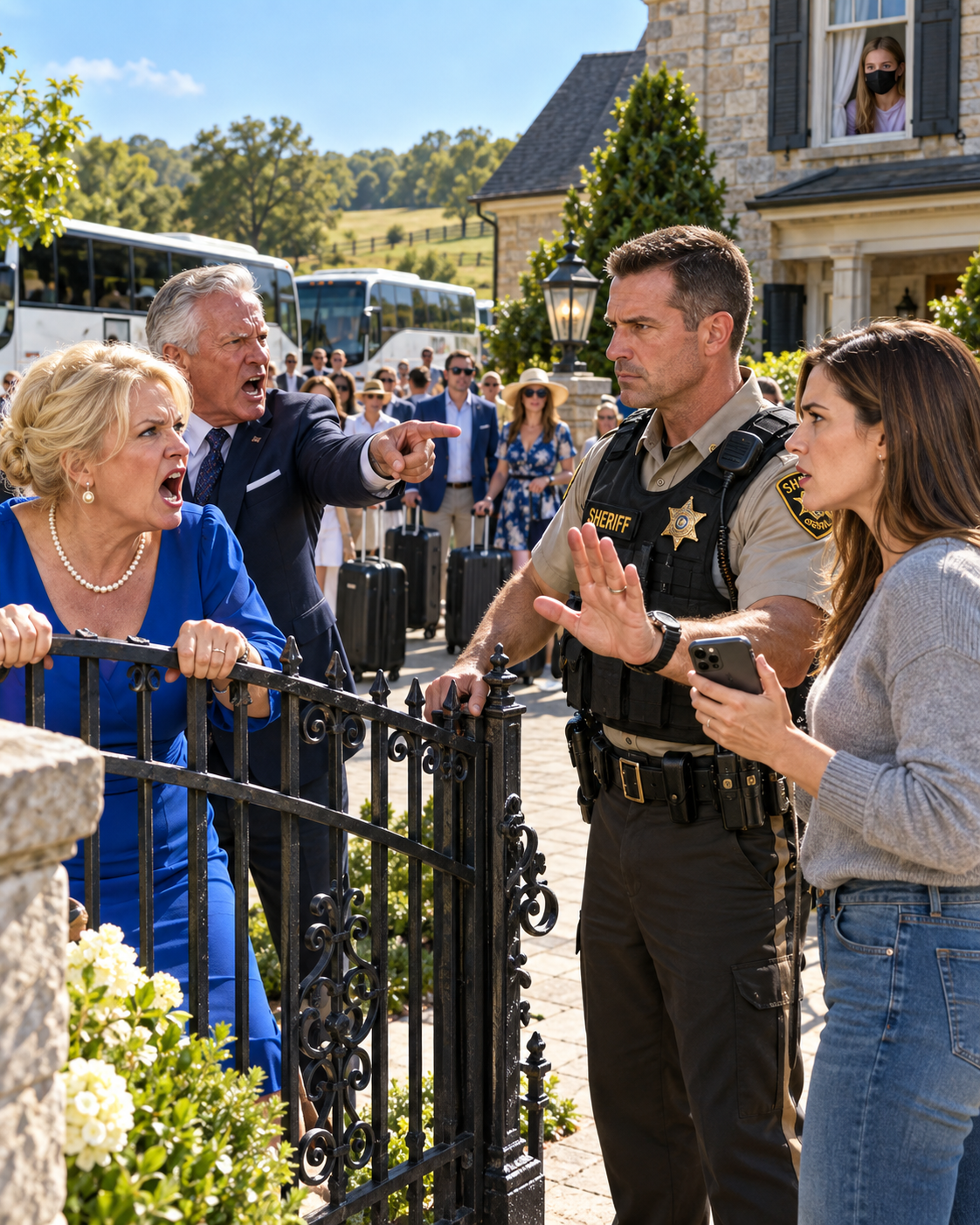
And you wanted to put forty people—half of them over sixty, several of them coughing—under a bone-marrow patient’s bedroom floor.”
“Nobody is coughing,” my mother said, at precisely the moment somebody among the guests coughed.
It was a small, dry, almost apologetic cough.
A man standing near the front, whose name I didn’t recognize, turned pink all the way to his ears.
“Sorry,” he murmured.
“I’ve had this tickle since Wednesday.”
A young mother holding a toddler against her hip quietly stepped backward twice, then twice again, settling the child’s head against her shoulder almost protectively.
The man with the tickle glanced around at all the people watching him.
“I’ll, uh.
I’ll wait on the bus.”
“Nobody needs to wait on any bus!” my mother said.
“You are all acting as though I intended harm.
I intended a celebration.
Forty years of marriage, forty years, and now I’m standing in a driveway being accused of—”
“I told her.” I spoke quietly, but the words interrupted her with surprising sharpness.
“I told you in July, Mom, when the transplant was scheduled.
I told you in August, from the hospital.
I told you eleven days ago, on the phone, when you called to say you were holding your anniversary at my house.
I texted you the discharge instructions. I emailed you the transplant team’s letter. I said the words ‘she can’t be around crowds’ so many times that eventually they barely sounded real.”
“She did,” came a quiet voice.
Everyone turned around.
It was my father.
He was still holding the envelope.
His shoulders, always slightly rounded, appeared to have dropped another inch.
“Emily did tell us, Diane,” he said.
“More than once.”
My mother stared at him as though the gate itself had suddenly spoken.
“Richard.”
“She did,” he repeated, and it was the first time in my life I had heard him finish that kind of sentence without adding but.
The silence afterward seemed to press against my ears.
And within that silence, from somewhere above us, came the small, unmistakable click of a window latch.
Everyone looked up.
Lily had apparently been at the second-floor window the entire time.
She must have awakened when the buses arrived.
Her old bedroom offered the clearest view of the driveway, and I had spent the previous eleven days helping her from bed to chair to bath without once considering that a twelve-year-old wearing a mask and carrying a curious mind might slowly make her way up the back stairs on her own unsteady legs, one hand against the wall, simply to discover what all the noise was about.
She looked incredibly small in that window.
Her skin had the faint, delicate appearance it had developed after her treatment.
Her mask rested high beneath her eyes, and the knitted cap I had bought her sat crooked over the soft peach fuzz that was slowly, stubbornly returning.
She wasn’t waving.
She was watching the crowd with an expression I recognized immediately, the cautious, observant look she had learned during her time in the hospital.
It was the expression of a child who had discovered that when adults became loud, someone usually ended up upset.
She disappeared from the window.
“Lily,” I whispered, although of course she couldn’t hear me.
“Where’d she go?” someone asked.
A long minute passed.
My heart began climbing toward my throat.
Then she appeared again, and this time she carried her sketchbook.
Lily drew constantly—mostly horses, along with the barn cats, and recently a collection of small, determined owls.
She had used her thick black marker to write across the first page.
HI GRANDMA.
HI GRANDPA.
Someone among the guests made a quiet sound.
She turned the page.
She had drawn a crooked little cake in one corner, covered with candles.
She’d apparently tried to draw forty, I think, but stopped around thirty-one and simply added a swirl of frosting instead.
HAPPY ANNIVERSARY!
Beside me, I heard Bev Lindstrom whisper, “Oh, honey,” in a voice that seemed to have almost no breath behind it.
Lily turned another page.
This one took longer.
I could see her, small and pale behind the glass, carefully moving the marker in large capital letters, and when she finally raised the page toward the window, her hands trembled slightly from the effort required to hold it there.
I’M SORRY I CAN’T COME DOWN. I WOULD IF I COULD.
I placed my hand over my mask. I want you to understand something.
Lily had never heard the words lock her upstairs. I had made absolutely certain of that.
I had taken my mother’s call inside the pantry with the door closed, and I hadn’t repeated those words to anyone, not even quietly to myself afterward.
So my daughter, who had endured needles, radiation, thirty-one nights inside an isolation room, and treatment complications that had sometimes made even swallowing difficult, had watched a caravan of buses arrive outside her home, realized on her own that there would be a celebration she couldn’t attend, and decided that the kind thing to do was apologize for it.
She turned to the final page.
There were no words on this one.
It showed a single heart, colored deeply in red, with the marker pressed so firmly that the ink had soaked through onto the next sheet.
Nobody spoke.
My father removed his hat.
He did it slowly, almost like someone entering a church.
Then he walked toward the iron bars, gently rested his forehead against them, and lifted one hand.
Upstairs, Lily raised her own hand and waved.
He waved back.
His shoulders trembled.
And my mother, who had apparently been preparing to speak, who had drawn a breath as though another sentence was coming, suddenly became completely still.
Her mouth remained slightly open.
Her ivory dress suddenly seemed too bright and too formal, almost like a costume prepared for a performance that had ended without her.
“Oh,” she said, extremely quietly.
I had never heard my mother sound so small.
“She’s twelve,” she said, seemingly to nobody.
“She’s only twelve.”
“Yes,” said someone behind her.
“She is.”
Ruth Delaney was seventy years old and had never been intimidated by her younger sister.
She stepped forward from the crowd wearing a navy dress and practical shoes, her silver hair pinned neatly back, while her husband Gene followed anxiously two steps behind.
She was my mother’s older sister, my Aunt Ruth, the woman who mailed birthday cards containing actual handwritten letters, the woman who had driven four hours to sit beside me in the hospital cafeteria during Lily’s first week there and had said almost nothing, simply holding my hand until it stopped trembling.
“Diane,” she said.
“Look at me.”
“Ruth, not now.”
“Now.” Ruth reached forward and gently but firmly guided my mother’s chin until Mom had no choice but to face her.
“Do you understand what you did this week? Do you understand what you asked of that child’s mother?”
“I asked her to make room for her family.”
“You asked her to keep a medically vulnerable twelve-year-old upstairs while forty people ate and drank and celebrated underneath her.” Ruth never raised her voice.
She didn’t need to.
“Diane.
Diane. Forty people.
This house.
A twelve-year-old girl upstairs.”
Something slowly changed across my mother’s face, as though all her certainty had drained away at once.
“That is not the same,” she whispered.
“Isn’t it?”
“Ruth, don’t.”
“I have said don’t for fifty-four years,” Ruth replied.
“I’m finished.”
I didn’t understand.
I glanced at Mark, who could only shrug helplessly.
I looked toward my father, and he had closed his eyes, almost as though preparing himself for something he had expected for many years.
Ruth turned toward the crowd, then toward me, and drew a long breath.
“Our little sister was named Annie,” she said.
“She was eight.
She had leukemia.
It was 1972, and there wasn’t much doctors could offer a child with what she had.
She passed away in a hospital in Columbus that spring.
Mama brought her home afterward, and the funeral reception was held right here, in this house, inside that front parlor.”
I felt the world shift beneath me.
“Forty people came.
Neighbors. Church folks. Cousins.
They filled the kitchen and the dining room and the porch and the yard, and there were casseroles on every surface, and everyone was trying to be kind.
And Mama, who was overwhelmed, who could barely remain standing, who had no idea how to comfort a grieving twelve-year-old when she could barely support herself, said to Diane, ‘Go upstairs, honey.
Stay in your room.
We don’t want to make a scene.’”
My mother made a small sound.
“She sat at the top of the stairs,” Ruth continued.
“For six hours.
I know because I checked on her.
I was sixteen and supposed to be helping, and I kept slipping away to look.
She sat at the top of those stairs wearing her good black dress with her knees pulled against her chest, and she listened to forty people downstairs saying her little sister’s name.
She never came down.
Nobody invited her to.
She never cried in front of anyone again.”
The entire road had fallen silent.
“I don’t think she has cried since,” Ruth said.
“Not once.
I don’t think she remembers how.
And I think that when she looked at Emily, and at Lily, and at this house, she didn’t simply see a sick child.
She saw something she herself had never been allowed to face.
And she responded in the only way she had ever been taught.”
My mother had lowered herself onto the running board of the Cadillac.
I hadn’t even noticed when it happened.
One moment she had been standing, and the next she was sitting on the chrome step, her ivory skirt spreading across the gravel, both hands pressed against her mouth.
“I was twelve,” she said through her fingers.
“Nobody asked me.
Nobody ever asked.”
I stood behind that gate with the wind against my face and a hundred different emotions pulling me in opposite directions.
I want to be clear about something.
I didn’t feel victorious.
I had spent five days imagining this moment, practicing what I would say, picturing myself standing firmly while my mother finally, finally understood what she had done.
In none of those imagined versions had she looked like this.
Small.
Gray at the temples.
Sixty-six years old, sitting beside the gravel in a beautiful dress, with the grief of a twelve-year-old girl finally surfacing fifty-four years later.
Every part of me wanted to open the gate and wrap my arms around her.
And I couldn’t.
Not because I wanted to punish her.
Because Lily was upstairs, because Lily’s blood counts remained fragile, and because what I finally understood while standing there was that someone’s old pain can help explain their choices without making those choices acceptable.
Both things can be true at once.
Both need to be true, or neither really means anything.
“Mom,” I said.
She looked up at me.
Her mascara had begun to run.
“I’m sorry,” I said.
“I’m so sorry about Annie. I’m sorry about that day. I’m sorry nobody sat on those stairs with you. If I could go back and sit beside that little girl, I would.”
She stared at me.
“But you don’t get to give Lily the same staircase,” I said.
“I love you.
And I won’t do that.
Not to protect the party, not to preserve the peace, not for anybody.
Not even you.”
The wind moved softly through the maple trees.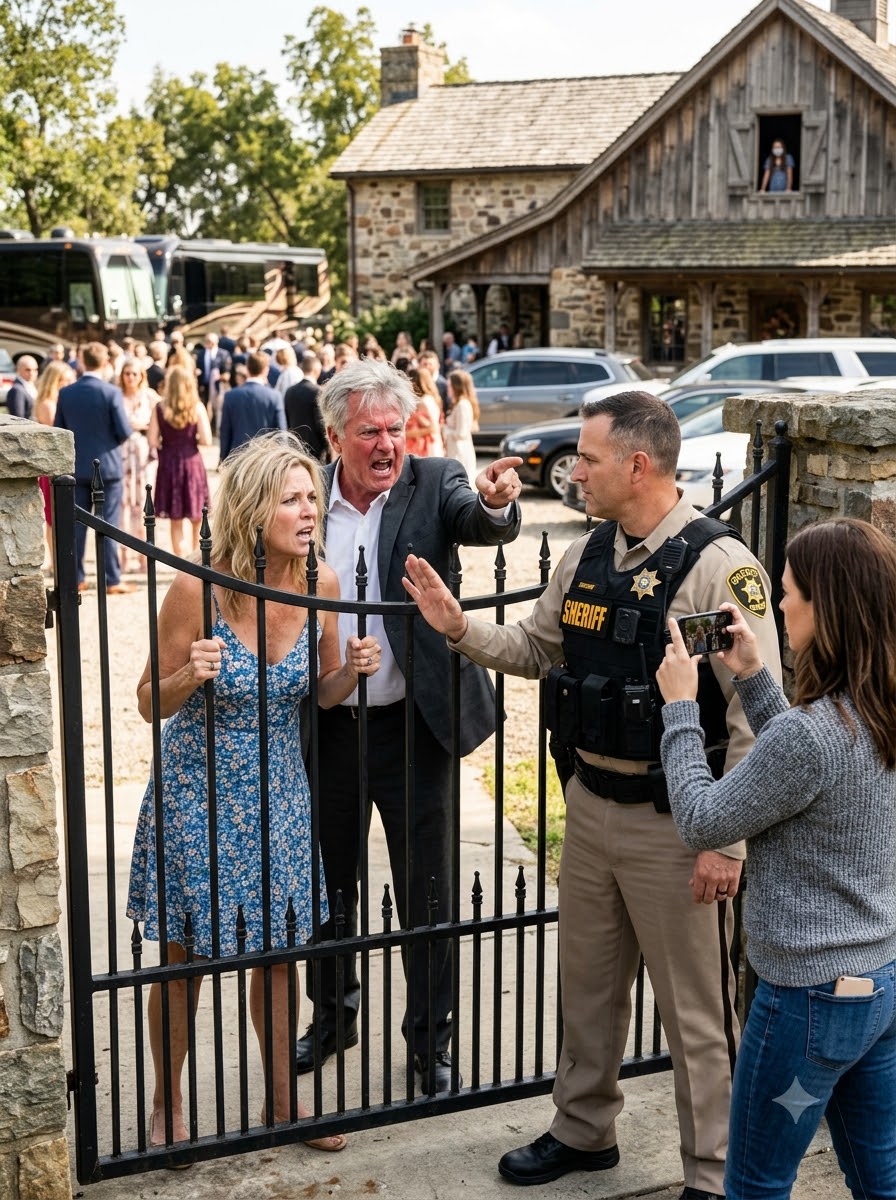
Somewhere among the guests, a woman quietly cried into a tissue.
My mother lowered her head, her shoulders beginning to tremble, and for the first time in my entire life I watched the woman who had always told me we don’t make scenes finally have one, right there before forty guests, a sheriff, and three chartered buses.
It wasn’t a graceful scene.
It was emotional and unfiltered, and it continued for quite some time.
And somehow, it was the most genuine thing I had ever watched her do.
The following hour felt like something I was observing from far away.
My father knelt beside my mother on the gravel and placed an arm around her, and she turned her face against his shoulder while he simply held her.
He didn’t say anything. He didn’t attempt to solve anything.
For a man who had spent forty years quietly leaving difficult rooms, watching him remain there was remarkable.
Sheriff Brooks discreetly stepped away and allowed them the moment.
He walked toward his cruiser, spoke briefly over the radio, then returned carrying his hat in his hands.
“Ma’am,” he said quietly to me.
“I’ll be documenting what happened this morning.
The written trespass warning will remain in my file.
It’s a formality.
I don’t expect we’ll need it.”
“I don’t want to press charges,” I said.
“I never did.
I only wanted her to stay outside.”
“I know.” He offered a small, weary smile.
“I figured.
That’s why I came personally instead of sending a deputy carrying a clipboard.”
It was Ruth who organized the guests.
I think she had been waiting fifty-four years to become useful in precisely this way.
She clapped her hands once, and the murmuring crowd became quiet like a classroom full of schoolchildren.
“All right, everyone.
Listen up.
There will be no party at this farmhouse today.
That’s settled.
But there are forty people standing on this road who traveled a long way to celebrate forty years of my sister’s marriage, and I’ll be darned if we let that go to waste.”
“Where?” somebody called.
“The Maple Ridge Grange Hall on Route 9.
It has a full kitchen and enough seating for a hundred.”
“It’s booked most weekends,” Gene said uncertainly.
Sheriff Brooks cleared his throat.
“My wife is the Grange secretary.
If it’s available, and I’d bet a week’s pay it is on a Saturday morning during the off-season, she’ll have those doors open in fifteen minutes.” He was already reaching for his phone.
The caterer had remained beside her van throughout everything, a broad-shouldered woman named Patrice with flour on her forearms and the patient expression of someone who had witnessed nearly every variety of complicated family gathering.
She lifted one hand.
“Ma’am, I’ve got enough food for sixty people in that van.
It’s prepaid.
We can serve it wherever you want.”
“Sixty,” Ruth said thoughtfully.
“And how many people are here?”
“Forty-one, including the driver.”
