

PART 1
The first warning came from my nine-year-old niece.
The second came from a title company.
By the time I understood how those two things were connected, I realized my family hadn’t simply been taking advantage of me.
**They had been planning how to get rid of me while keeping everything I paid for.**
My name is Whitney. I’m thirty-six years old, and until one New Year’s Day in Philadelphia, I believed there were two kinds of family obligations.
The ones you could afford.
And the ones you handled because you loved somebody.
I was about to learn how easily people could turn the second kind into a weapon.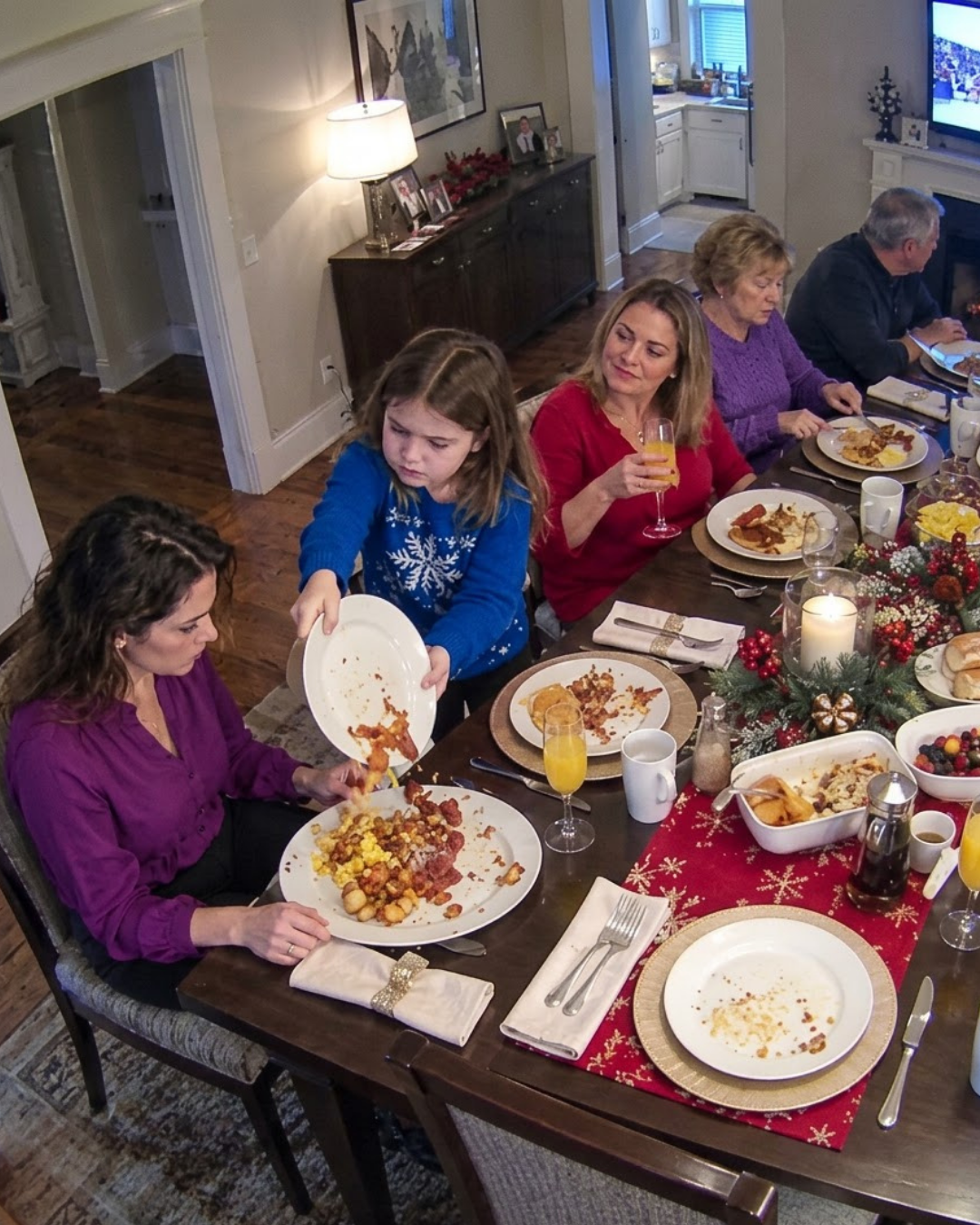
It started with a plate of leftovers.
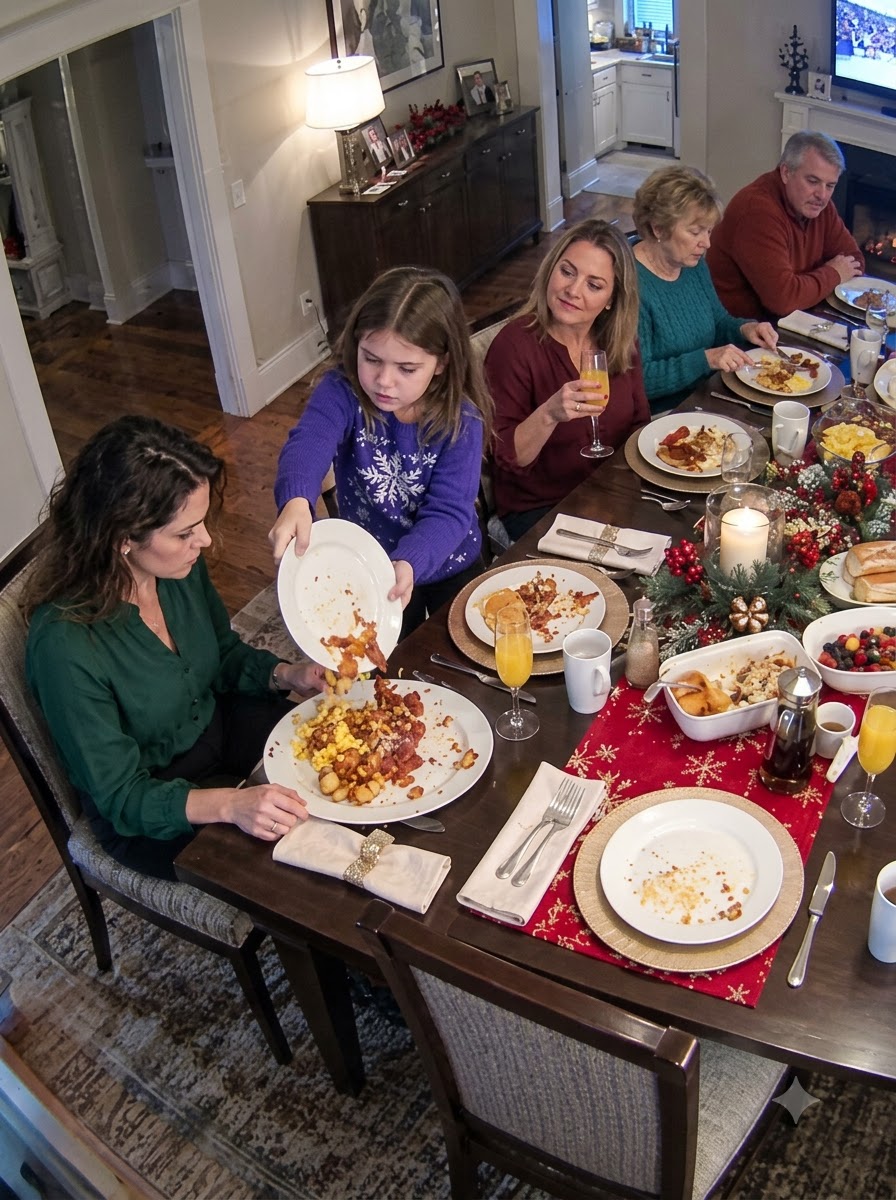
My niece, Alana, walked up beside me during our family’s New Year’s brunch, holding her breakfast plate in both hands.
She wore a red sweater with a glittering snowflake across the chest. Her hair fell around her shoulders, and she had the serious expression children sometimes wear when they’re determined to do something grown-ups have encouraged.
“What’s up, sweetheart?” I asked.
She didn’t answer.
Instead, she tipped her plate over mine.
Cold potatoes, scrambled eggs, and a strip of half-chewed bacon slid onto my breakfast.
Gravy spread across the edge of the plate and stained my mother’s white tablecloth.
I stared at the food.
Then Alana announced, clearly enough for everyone to hear:
**”Mom says you’re the family trash.”**
Nobody moved.
My sister, Desiree, lifted her mimosa.
She took a slow sip.
Then the corner of her mouth turned upward.
My mother continued cutting her French toast into careful squares.
My father watched the Philadelphia New Year’s parade on the television above the fireplace.
I waited for someone to correct Alana.
No one did.
“Come on, baby,” Desiree finally said, resting a hand on her daughter’s shoulder. “Let Aunt Whitney eat.”
I looked at my sister.
She was smiling.
Not an embarrassed smile.
Not the kind someone makes when a child has said something inappropriate.
It was a satisfied smile.
As though she’d been waiting to see whether I would finally lose control.
“You’re not going to say anything?” she asked.
I folded my napkin.
“What would you like me to say?”
“Oh, don’t start. She’s nine.”
My mother sighed.
“Whitney, children repeat things. Don’t make a scene.”
I looked at her.
“Where do you think she heard it?”
“That’s enough,” my father said without turning around. “Let’s not ruin New Year’s.”
For several seconds, I studied the people sitting around that table.
My father’s prescription bottle sat beside his coffee.
I’d paid for the refill two days earlier.
My mother’s phone rested near her elbow.
The bill came out of my account.
Desiree’s crossover was parked outside, its lease and insurance connected to my name because she couldn’t qualify for the vehicle alone.
Alana’s tablet used the family data plan I funded.
And the rowhouse itself?
Four years earlier, I’d taken out a substantial personal loan to prevent the place from being lost to back taxes and a second mortgage.
The monthly payment was larger than my rent.
I had never missed one.
Yet the child I’d been paying to send to coding club had just called me trash.
And every adult present had decided I deserved it.
I stood.
Desiree rolled her eyes.
“Here we go.”
I carried my plate into the kitchen and scraped the food into the garbage.
The room behind me remained quiet.
I rinsed the plate, set it in the drying rack, and returned for my coat.
“Leaving already?” my mother asked.
“Yes.”
“You always do this,” Desiree said.
I stopped.
“Do what?”
“Make everything uncomfortable because you don’t get enough attention.”
For the first time that morning, I felt something other than humiliation.
I felt exhausted.
Not physically exhausted.
The kind of exhaustion that comes from realizing you’ve spent years trying to earn love from people who keep moving the finish line.
“I didn’t make this uncomfortable,” I said.
Desiree opened her mouth.
Then closed it.
I walked out without slamming the door.
Outside, the January air burned against my cheeks.
A small American flag fluttered on the neighboring porch.
I sat inside my car for several minutes, staring at the steering wheel.
I didn’t cry.
That surprised me.
I’d cried plenty of times before.
When Desiree accused me of being selfish because I wouldn’t pay for a vacation.
When my mother said I cared more about money than relationships.
When my father told me keeping records of what I’d contributed was disrespectful.
But that morning, I had nothing left to explain.
I drove home.
My apartment was a modest one-bedroom walk-up in South Philadelphia.
The kitchen counters were scratched. The heating pipes clicked. My living room couch had a worn patch on one arm.
I’d lived there for seven years.
Every time I considered moving somewhere nicer, another family emergency arrived.
A medical bill.
A car repair.
A property tax notice.
Desiree needing help with a deposit.
My mother needing a new phone.
I had become so accustomed to sacrificing that I no longer noticed how little I allowed myself.
When I reached home, the family group chat was already active.
Desiree wrote:
“Alana is upset because Whitney frightened her.”
My mother followed.
“Leaving like that embarrassed everyone.”
Then Dad:
“Adults handle disagreements face-to-face.”
I placed my phone on the kitchen counter.
I made tea.
I watched the evening settle over Philadelphia.
At 9:47 p.m., my mother sent another message.
**”You’re out of our lives.”**
A thumbs-up appeared beneath it.
From my father.
Then a heart.
From Desiree.
I stared at those three little symbols.
They had made a family decision without me.
Fine.
I typed:
**”Everything in my name disappears tomorrow.”**
Then I left the group.
Eight seconds later, my phone began ringing.
Desiree.
Mom.
Dad.
Desiree again.
I turned the phone facedown.
For once, their panic didn’t make me feel responsible.
I opened my banking app.
One by one, I reviewed the recurring payments.
The house loan.
The crossover lease.
Car insurance.
The family phone plan.
Internet.
Subscriptions.
Alana’s coding club.
My father’s prescriptions.
My mother’s employer-sponsored dependent health coverage, which required additional premiums from my paycheck.
Then the smaller expenses.
Tolls.
Streaming services.
Equipment payments.
Fees nobody ever mentioned because they never had to see them.
I totaled everything.
**More than four thousand dollars a month.**
I stared at the number.
I was earning a decent salary as an operations analyst.
I wasn’t wealthy.
I’d simply learned how to budget, work overtime, and say no to myself.
My family had mistaken those habits for an unlimited supply of money.
I opened the payment settings for their home internet.
My finger hovered over the automatic payment switch.
Then I turned it off.
Automatic payment disabled.
The screen didn’t flash.
No alarm sounded.
But something enormous had shifted.
I wasn’t going to stop paying loans I’d legally signed or abandon contracts without resolving them.
I wanted my freedom, not ruined credit.
But the voluntary payments could end.
And every obligation still carrying my name could be reviewed, transferred, or closed properly.
I disabled another optional payment.
Then I opened a spreadsheet.
At 10:18 p.m., an unfamiliar number left a voicemail.
“Ms. Whitney, this is Nora with Rittenhouse Title. I’m sorry to call so late, especially on the holiday. We need to verify the release authorization associated with your parents’ property before the upcoming closing.”
I replayed it.
Closing?
My parents hadn’t told me they were selling their house.
I checked my email.
There, buried among holiday advertisements, was a message dated December 28.
The subject read:
**LIEN RELEASE AUTHORIZATION — SIGNATURE VERIFICATION REQUIRED.**
My mouth went dry.
Four years earlier, when I’d borrowed money to save the rowhouse, an attorney had made my parents sign a promissory note agreeing to repay me.
He’d also helped arrange a recorded lien securing their debt.
He explained that if the house was sold or refinanced, my claim would need to be addressed.
At the time, my father had complained.
“Why does family need paperwork?”
The attorney had answered calmly.
“Because good relationships deserve clear agreements.”
I’d been grateful for that advice.
Now I understood exactly how important it had been.
I opened the attachment.
The document claimed that I’d authorized a release of my lien.
At the bottom was my printed name.
Beneath it sat a signature.
It looked similar to mine.
But the W leaned incorrectly.
The final flourish wasn’t right.
And I had never seen the document before.
**Someone had signed my name to give up the only protection I had for the money I’d lent my parents.**
My phone buzzed.
A text from Dad.
“Whitney, whatever you’ve seen from the title company, please call me before you do anything.”
I read it twice.
Then I opened a new folder on my computer.
I saved the authorization.
The email.
The voicemail.
Every bank statement.
Every message from my family.
I named the folder:
HOUSE DOCUMENTS.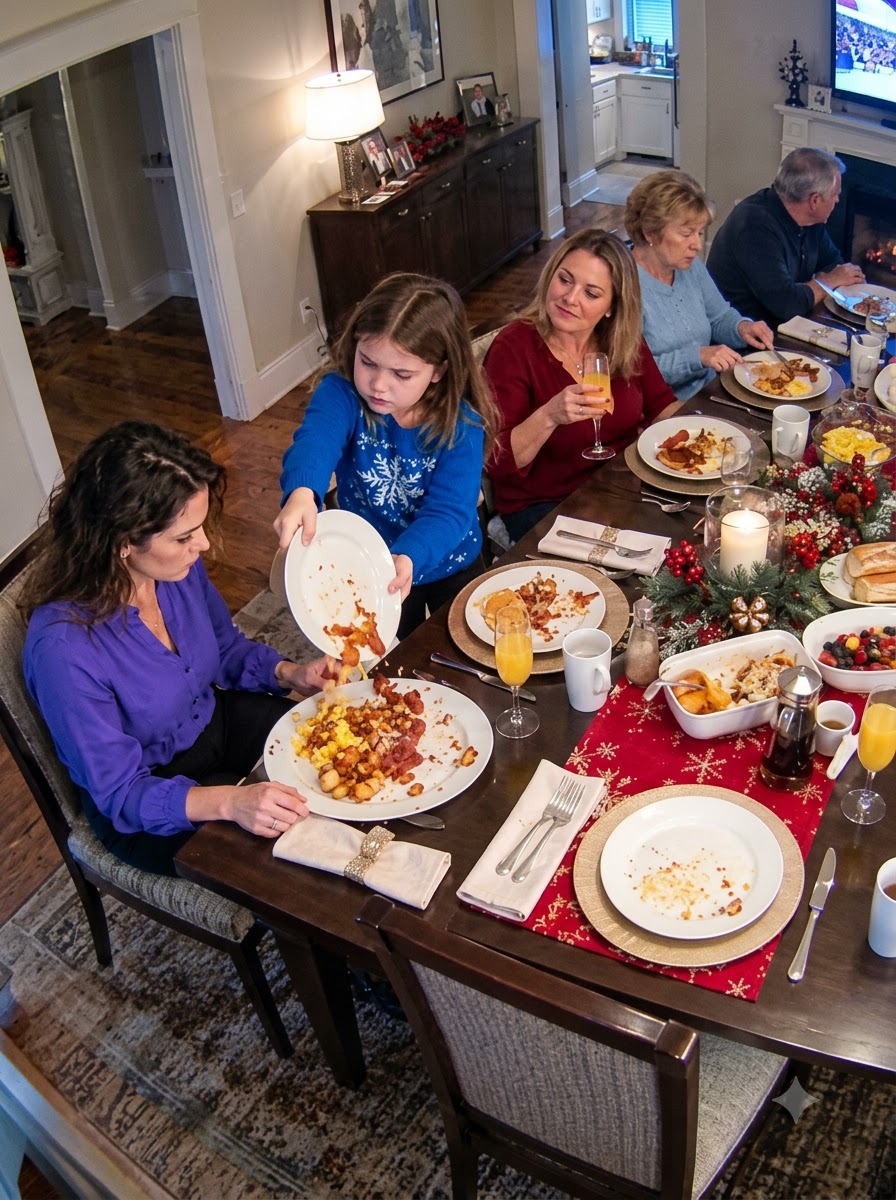
It was the first time in years that I felt grateful for my habit of keeping records.
***
The following morning, I called the title company’s publicly listed office number rather than using the number in the voicemail.
Nora answered.
“Rittenhouse Title, this is Nora.”
“My name is Whitney. You called about a lien release.”
She became serious immediately.
“Thank you for calling. I was concerned we hadn’t received independent confirmation.”
“I didn’t sign that release.”
Silence.
Then:
“Are you certain?”
“Completely.”
“All right. I need to stop this file from proceeding until our legal department reviews it.”
PART 2
My hand tightened around the phone.
“What exactly is being closed?”
Another pause.
“Have your parents explained the transaction?”
“No.”
Nora exhaled.
“I can tell you the portion that concerns your recorded lien. The property is involved in a proposed family transfer, with financing arranged for the buyer. Your lien was listed for release without payment.”
“Buyer?”
“The intended purchaser is Desiree.”
For a moment, I couldn’t speak.
My sister.
The same sister who’d smiled while her daughter dumped leftovers onto my plate.
They weren’t merely refinancing.
**My parents were preparing to transfer the rowhouse to Desiree, using a financing arrangement that depended on removing my financial claim.**
“And how much were they planning to pay me?” I asked.
Nora’s silence answered before her words did.
“The documents currently show no payoff to you.”
I sat down.
No payoff.
Four years of loan payments.
Decades of being the responsible daughter.
All of it apparently worth zero dollars.
Nora told me to contact an attorney immediately.
I did.
The lawyer’s name was Leah Porter.
She worked at a small Philadelphia firm that handled property disputes and financial fraud.
I sent her the documents before our consultation.
When we met, she had everything arranged in three neat piles.
“First,” she said, “you remain responsible for the personal loan you took out. You can’t make that obligation disappear by turning off a payment.”
“I understand.”
“Second, the lien securing your parents’ debt appears to have been properly recorded. That matters.”
“And third?”
She looked directly at me.
**”Third, somebody appears to have attempted to release your lien using an authorization you say you never signed.”**
The words sounded worse coming from a lawyer.
“Can they do that?”
“Not legally with a forged signature. We need to preserve evidence, notify the title company and appropriate parties, and determine exactly how this document was created.”
I nodded.
Leah slid another paper toward me.
“There’s something else. The proposed transaction includes a substantial gift of equity from your parents to your sister.”
“How substantial?”
She pointed to the figure.
**One hundred and forty-eight thousand dollars.**
My throat tightened.
They intended to give Desiree $148,000 in property equity.
While leaving me responsible for the debt I’d taken on to save that same property.
I thought about my apartment.
The worn couch.
The vacations I’d postponed.
The shoes I’d repaired rather than replaced.
And I almost laughed.
Because somehow, even after everything, I’d still been wondering whether I was being unfair.
Leah let me sit with the document.
Then she asked a question I hadn’t expected.
“Whitney, do you know why your parents originally had that second mortgage?”
I frowned.
“House repairs, I think. Dad’s business had problems around the same time. They were behind on taxes.”
“Do you have the original loan paperwork?”
“I might.”
“Find it.”
Something in her expression made my stomach tighten.
“Why?”
“Because before we discuss their proposed transfer, I’d like to understand the debt you helped rescue.”
***
Over the next three days, I began separating my finances from theirs.
It wasn’t the dramatic, instant collapse my family probably imagined when I threatened to remove my name.
Real financial boundaries required phone calls, notices, and signatures.
I contacted the phone provider and arranged for the family members to transfer their numbers to accounts of their own before my plan ended.
I gave them written notice of the deadline.
I reviewed my employer’s benefits rules before changing my mother’s dependent coverage and provided her with the information needed to find replacement insurance.
I wasn’t going to leave a person without medical coverage simply to prove a point.
My father’s prescriptions were different.
I called his pharmacy and confirmed that his current refill was covered.
Then I sent him information about arranging future payments through his own prescription benefits.
I canceled the subscriptions I personally owned.
The internet company confirmed the service would remain active through the current paid period.
The equipment would need to be returned afterward.
For Desiree’s crossover, I contacted the leasing company.
The contract remained my responsibility until the vehicle could be transferred with approval or returned under the lease’s termination terms.
I kept the required insurance active while the vehicle was still on the road.
Then I sent Desiree a formal request to arrange its return or qualify for a transfer by the deadline.
She called immediately.
“Are you insane?”
I held the phone away from my ear.
“Hello to you too.”
“You can’t take my car!”
“The lease is in my name.”
“It’s my car!”
“Then you can apply to take over the lease.”
“You know I won’t qualify!”
“Then we need to arrange its return.”
She became quiet.
Then her voice dropped.
“You’re really doing this because of something a child said?”
“No, Desiree.”
“Then why?”
“Because a child repeated what the adults around her believed.”
“You’re destroying this family.”
I looked at the paperwork spread across my kitchen table.
“No. I’m stopping myself from financing it.”
She hung up.
Ten minutes later, my mother called.
I let it go to voicemail.
“Whitney, sweetheart, please. We’re all upset. You know how Desiree gets. Don’t make permanent decisions over a misunderstanding.”
I listened without responding.
Then my father called.
His voicemail was shorter.
“Call me about the house. This is serious.”
He was right.
It was serious.
But not in the way he meant.
***
On Friday afternoon, I found the old loan documents.
They were tucked inside a blue folder in the back of my closet, beneath years of tax returns.
I remembered the day I’d signed them.
Four years earlier, my father had called me at work.
His voice had been shaking.
“We’re going to lose the house.”
I left the office early and drove to the rowhouse.
My mother sat at the dining room table with a stack of envelopes.
Red warnings.
Delinquent tax notices.
Mortgage statements.
They said the second mortgage had become unmanageable after my father’s income dropped.
Desiree was there, crying about how terrible it would be for Alana to lose her grandparents’ home.
“She’s just a little girl,” my sister said. “She doesn’t deserve this.”
I remembered feeling sick.
That house was where I’d spent most of my childhood.
Where my mother measured my height against a kitchen doorframe.
Where my father taught me how to ride a bicycle.
I couldn’t bear the thought of strangers walking through it after a foreclosure.
So I borrowed the money.
I signed papers that committed me to years of payments.
I told myself it was temporary.
My parents promised to repay me when their finances improved.
The attorney prepared the repayment agreement and secured it against the property.
Then life continued.
Except their finances never seemed to improve enough to repay me.
And somehow, the requests for money kept multiplying.
Now I opened the blue folder and compared it with the property records Leah had obtained.
The original second mortgage had been taken out years before I’d intervened.
The paperwork named my parents as borrowers.
The listed purpose was debt consolidation and other expenses.
There was nothing particularly unusual about that.
But tucked behind the closing statement was a bank disbursement record.
A wire transfer.
I leaned closer.
The recipient was a business account.
DESIREE LANE BEAUTY STUDIO LLC.
I stopped breathing for a moment.
Desiree had opened a beauty studio years earlier.
It lasted less than eighteen months.
My parents had always described the failure as unfortunate, but small.
They told me Desiree had lost some savings and moved on.
I hadn’t asked questions because my sister became furious whenever anyone mentioned the business.
But the wire transfer in front of me was not small.
**Seventy-six thousand dollars.**
I scanned the remaining documents.
Another payment covered business-related debt.
A third paid outstanding commercial obligations.
My hands began to shake.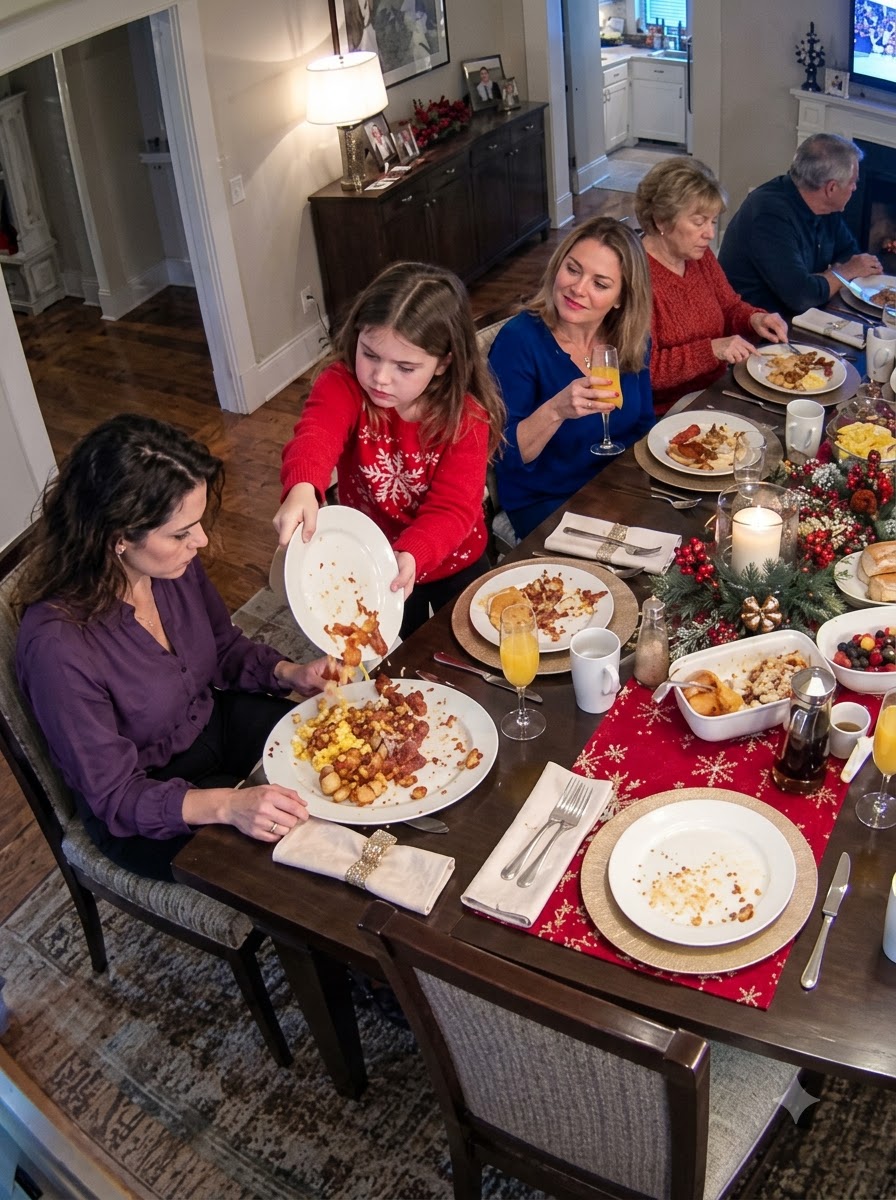
The second mortgage that nearly cost my parents their home hadn’t been taken out primarily to repair the house.
**Much of it had been used to rescue Desiree’s failing business.**
And when that debt became impossible to manage, my parents had called me.
Their responsible daughter.
The one who never said no.
I sat motionless on my bedroom floor.
Suddenly, dozens of old conversations made sense.
Desiree getting angry whenever I mentioned the house loan.
My father insisting family should never discuss money.
My mother telling me that being financially responsible was my gift.
They hadn’t merely hidden how they spent the money.
They’d hidden why they needed me to save the house in the first place.
I photographed every document.
Then I called Leah.
***
The following week, my father asked to meet.
Not at the rowhouse.
Not at my apartment.
He suggested a coffee shop near Broad Street.
I agreed only after Leah advised me to keep any discussion of the property in writing or have counsel involved. I told him I would listen, but that any proposed financial arrangement would have to go through my attorney.
He arrived twenty minutes early.
My mother sat beside him.
Desiree was already there.
Three cups of coffee rested on the table.
Mine had not been ordered.
I noticed that immediately.
For years, whenever they needed me, they made sure I felt included.
Now they didn’t even bother pretending.
My father spoke first.
“We need you to stop causing problems with the title company.”
I sat opposite him.
“You mean the company you sent a document with my forged signature?”
My mother flinched.
Desiree looked away.
Dad lowered his voice.
“Don’t use words like that in public.”
“What would you prefer?”
“A paperwork issue.”
I opened my folder.
“The signature isn’t mine.”
“We were trying to take care of the family,” my mother said.
I stared at her.
“Which family?”
“Whitney, please.”
“You disowned me on New Year’s Day.”
“I was upset.”
“You told me I was out of your life. Dad agreed. Desiree celebrated.”
My sister crossed her arms.
“You’re twisting everything.”
I turned toward her.
“Did you know about the house transfer?”
She hesitated.
Then shrugged.
“Mom and Dad wanted Alana to have some security.”
“So they were giving you the house.”
“They were helping their granddaughter.”
“With equity in a home I borrowed money to save.”
My father leaned forward.
“You were always going to get your money back eventually.”
“How?”
No answer.
“From whom?”
Still nothing.
I laid the proposed release on the table.
“This document says I give up my claim without payment.”
My mother stared at her coffee.
Finally, my father said:
“We thought you’d understand.”
Something in me hardened.
“Understand what?”
“That Desiree has a child. She needs a stable home.”
I looked at him.
“And I don’t?”
“That’s different.”
“Why?”
He rubbed his forehead.
“Because you’re established.”
There it was.
The argument I’d heard for ten years.
Desiree deserved assistance because she struggled.
I deserved obligations because I didn’t.
**My success wasn’t something they celebrated. It was something they felt entitled to spend.**
I pulled out the old mortgage disbursement records.
“Tell me about the beauty studio.”
Desiree’s expression changed.
My father’s face went pale.
My mother whispered, “Whitney—”
“Seventy-six thousand dollars,” I said. “That’s how much went directly to Desiree’s business from the second mortgage proceeds.”
Desiree sat up straight.
“That was years ago.”
“You told me you lost your own savings.”
“I did!”
“And apparently Mom and Dad’s house equity.”
My father held up his hand.
“Enough.”
“No.”
The word came out louder than I’d intended.
People at nearby tables glanced toward us.
I lowered my voice.
“No, Dad. You don’t get to end this conversation because it’s finally uncomfortable for you.”
My mother began crying.
“I never wanted any of this.”
I looked at her.
“Then why did you sign the papers?”
She glanced at my father.
That was answer enough.
But Leah had warned me not to turn the meeting into an argument about the disputed signature.
I gathered my documents.
“All further questions about the house go through my attorney. I won’t sign away my lien without a proper, documented payoff. And I won’t continue paying your household expenses.”
My father stared at me.
“You’d really let us lose the house?”
I stood.
**”I already saved it once. You were planning to give it away while making sure I never got paid back.”**
Then I walked out.
***
The next several weeks were ugly.
The title company placed the proposed closing on hold.
Leah submitted a formal notice disputing the release authorization.
I filed a report about the suspected forged signature and protected my credit by reviewing accounts and placing freezes with the credit bureaus.
The title company initiated an internal review of the document’s origin.
My father sent messages insisting it was all a misunderstanding.
Desiree accused me of punishing Alana.
My mother alternated between apologizing and telling me I was humiliating the family.
I responded only to practical matters.
Health coverage.
Payment deadlines.
The vehicle.
The outstanding debt.
When Desiree finally returned the crossover, she tossed the keys onto my kitchen counter.
“Happy now?”
I looked at them.
“No.”
“Then what do you want?”
I thought for a moment.
“To stop being responsible for your choices.”
She laughed bitterly.
“You think you’re better than me.”
“I never said that.”
“You don’t have a husband. You don’t have children. You sit in this little apartment counting money like it makes you important.”
Her words were carefully chosen.
Old wounds.
Old comparisons.
Things my mother had said behind closed doors.
But this time, they didn’t land.
I picked up the keys.
“You have a daughter who watches how you treat people,” I said. “I hope one day you understand what that means.”
For a second, her face changed.
Then she left.
I arranged the vehicle’s return through the leasing company. There were early termination costs, and I paid what I was contractually required to pay until the company confirmed the account was closed.
It wasn’t a perfect victory.
But it was an ending.
The phone accounts transferred or disconnected after the notice period.
My mother found replacement coverage.
My father arranged his own prescription payments.
The subscriptions disappeared.
No more little charges quietly accumulating in my account.
I continued covering Alana’s coding club through the semester because I had already promised her that tuition.
Afterward, I notified Desiree that future enrollment was her responsibility.
Alana wasn’t the person who had created this mess.
But she also couldn’t be used to keep me trapped inside it.
PART 3
As the weeks passed, my monthly expenses fell dramatically.
For the first time in years, I contributed to my savings without calculating whether my family would need the money first.
I bought new shoes.
I scheduled a dental appointment I’d postponed.
I visited an apartment with sunlight that reached all the way across the living room.
Small things.
Ordinary things.
They felt almost extravagant.
***
Two months after New Year’s, Leah called.
“We have a development.”
I was sitting at my desk at work.
“Good or bad?”
“Potentially useful. The title company’s investigation has identified the source of the disputed release package.”
I closed my office door.
“Who submitted it?”
“The application was coordinated through your parents’ real estate transaction. There are also questions about the supporting identity documents.”
“Do they know who signed my name?”
“Not conclusively. That’s still being investigated.”
I felt disappointed.
I’d expected a dramatic answer.
A confession.
Something that would explain how people who claimed to love me could cross such a line.
Instead, Leah continued.
“There’s another part of the transaction documents I want you to see.”
That afternoon, I sat across from her as she opened an additional financial schedule.
It concerned the proposed transfer to Desiree.
A gift of equity.
The buyer’s financing.
Proposed disbursements.
And a separate document describing what the family expected to happen after the transaction.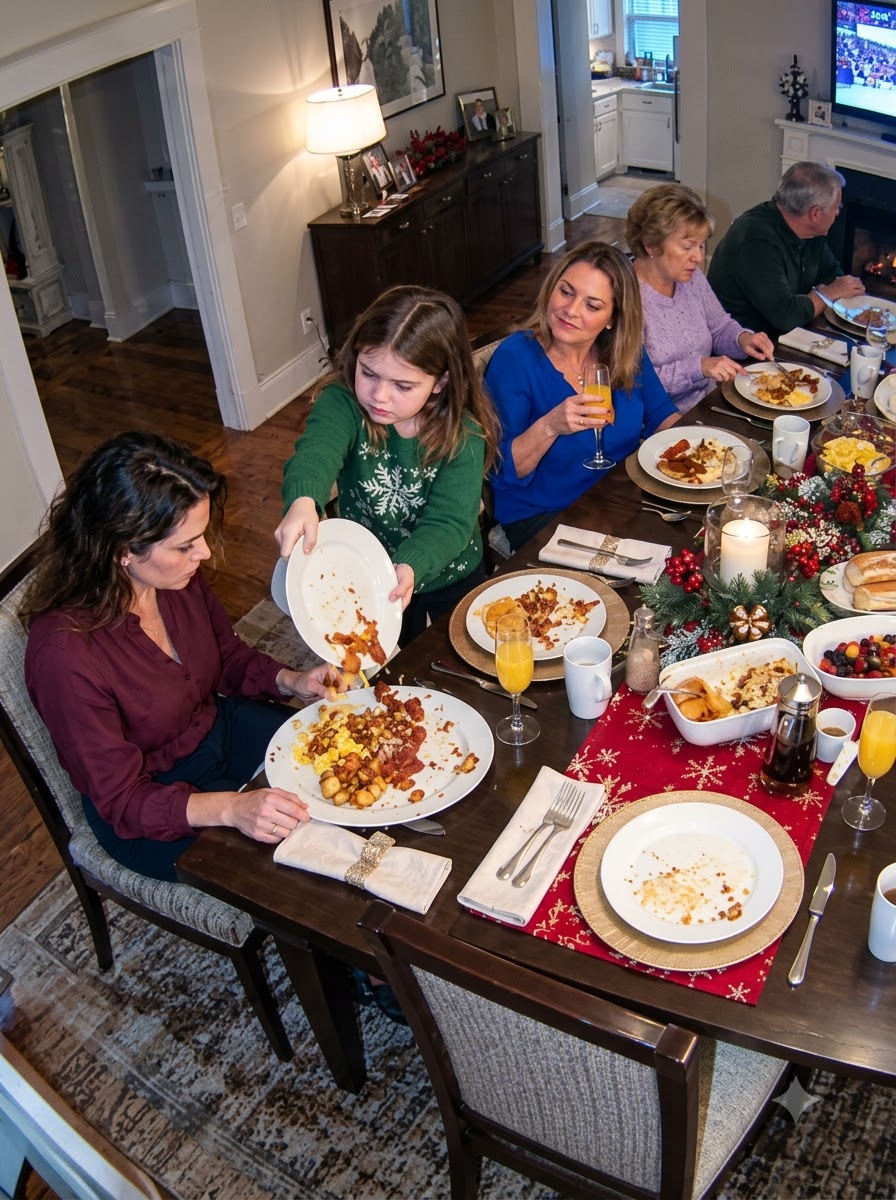
I read the first page.
Then the second.
Then I stopped.
My parents had been planning to move into a smaller rental property after transferring the house.
Desiree would own the rowhouse.
But attached to the file was correspondence from a real estate agent discussing the property’s likely resale value after cosmetic improvements.
I looked at Leah.
“Was Desiree planning to sell it?”
“That appears to have been discussed. We don’t know whether your parents understood the details.”
I read the correspondence again.
The estimated resale proceeds were substantial.
Far more than the amount needed to satisfy my remaining secured claim.
The plan wasn’t simply to provide a stable home for Alana.
**Desiree had been exploring how to turn the family house into cash.**
The house I’d helped save.
The house my father had accused me of threatening.
The house my mother said should remain in the family.
My sister might not have intended to keep it at all.
I thought about our meeting at the coffee shop.
“She needs a stable home,” Dad had said.
Now I wondered how much of the transaction my parents had actually understood.
Or whether they’d understood everything and simply hoped I would never discover it.
Leah tapped another document.
“There’s one more detail.”
It was the old second mortgage settlement statement.
This copy included supporting correspondence that hadn’t been in my blue folder.
A letter from my parents’ financial adviser, written years earlier.
It discussed using home equity to stabilize Desiree’s business debts.
And near the bottom was a sentence that made my vision blur.
**”The younger daughter, Whitney, has not been informed of the business-related purpose of these proceeds.”**
I read it again.
My parents hadn’t forgotten to tell me.
They hadn’t misunderstood where the debt came from.
They had deliberately concealed it.
Years before I was asked to rescue the house.
Years before Alana dumped food on my plate.
Years before my mother disowned me.
My parents had already decided that I didn’t deserve to know the truth.
I sat back.
For a long moment, I couldn’t say anything.
Then I asked Leah, “Can I have a copy?”
“Of course.”
I folded the paper carefully.
I had spent so many years feeling guilty for asking questions.
Now I had proof that the questions had always mattered.
***
The house eventually went on the market through a conventional sale rather than the planned family transfer.
My parents didn’t lose it overnight.
There were months of negotiations, financial disclosures, and unpleasant conversations with attorneys.
They still had options.
They could have arranged financing to repay me.
They could have proposed a credible payment plan backed by adequate security.
They could have sold the property earlier and dealt honestly with the money.
Instead, they had attempted to make my claim disappear.
Once that failed, a properly documented sale became the practical resolution.
When the transaction finally closed, the legitimate mortgage obligations were paid according to their priorities.
My secured claim was resolved from the sale proceeds under the settlement negotiated by counsel.
I used the recovered money to pay off the remaining balance of the personal loan I’d taken out to save the house.
For the first time in four years, that monthly payment was gone.
The closing paperwork was plain and unremarkable.
No dramatic courtroom speech.
No judge pounding a gavel.
Just signatures, escrow calculations, and confirmation that an obligation had finally ended.
The disputed signature remained a separate matter for the appropriate authorities and parties to examine.
I didn’t need to invent a punishment for my family.
I needed to stop living under one.
My parents moved into a smaller apartment.
Desiree had to find housing without a gifted rowhouse or a vehicle backed by my credit.
She was furious.
My mother blamed me for the move at first.
Then she blamed Desiree.
Then my father.
Eventually, she asked whether we could all get together and start over.
I didn’t answer immediately.
I had learned that some people wanted reconciliation only after the consequences became expensive.
***
One Sunday afternoon, several months after the brunch, I received a letter.
The handwriting on the envelope was uneven.
My name was written in purple marker.
Inside was a folded sheet of paper.
It was from Alana.
“Dear Aunt Whitney,
I’m sorry I put my breakfast on your plate.
Mom told me it would be funny and everybody would laugh.
But you didn’t laugh.
I didn’t know it would make you sad.
I miss coding club with you.
Love, Alana.”
I read it three times.
My throat tightened.
There was a small drawing underneath.
Two stick figures standing beside a computer.
One tall.
One small.
Above them, she’d written:
“Me and Aunt Whitney.”
I placed the letter on my kitchen table.
For the first time since New Year’s, I cried.
Not because I wanted my old life back.
Because Alana was nine.
And somehow, despite everything, she was the only person in that family who had offered an apology without attaching a demand.
I wrote back.
I told her that I loved her.
That putting food on someone else’s plate was hurtful.
That words mattered.
And that when grown-ups said cruel things, children were allowed to question them.
I told her I was proud of how much she’d learned in coding club.
I didn’t promise to pay for anything.
I didn’t promise that everything would return to normal.
I simply told her that I hoped she’d keep learning and asking questions.
A few days later, Desiree texted me.
“Alana got your letter. She cried.”
I waited.
Then another message appeared.
“Mom says you should come over sometime.”
For a moment, I considered answering.
Instead, I put the phone down.
I didn’t have to decide the entire future of my family that afternoon.
For once, I could take my time.
***
The final piece of the story arrived unexpectedly.
Leah called to discuss some remaining correspondence associated with the disputed authorization.
The title company’s records had identified an email chain about obtaining my signature.
My parents had been told that my lien needed to be paid or validly released before the proposed transaction could close.
That part wasn’t surprising anymore.
What surprised me was the date of the first message.
It had been sent weeks before New Year’s brunch.
Before my niece insulted me.
Before my mother cut me off.
Before I’d threatened to stop paying their bills.
The correspondence showed that my father had already been told I would have to agree to the release.
And in an email discussing how to approach me, he’d written:
**”Whitney always comes around when she thinks the family is falling apart. We’ll handle her.”**
I stared at those words.
Then I remembered the brunch.
My mother’s careful silence.
My father’s refusal to look at me.
Desiree’s tiny smile.
The way everyone had seemed to expect me to explode.
I couldn’t prove that every moment had been planned.
But I finally understood the pattern.
They’d spent years teaching me that I was responsible for repairing every family crisis.
If I objected, I was difficult.
If I asked questions, I was selfish.
If I left, I was abandoning them.
And whenever I returned, they wanted something.
**They hadn’t been depending on my kindness alone. They’d been depending on my guilt.**
This time, the guilt had failed.
I closed the email.
I didn’t call my father.
I didn’t send an angry message.
I didn’t ask him why he’d said it.
I already knew the answer.
He believed he understood me well enough to manage my choices.
He hadn’t expected me to change.
***
That autumn, I moved into a brighter apartment.
Two bedrooms.
A small balcony.
A kitchen with enough counter space to cook without moving everything around first.
On moving day, I carried the last box inside and stood in the middle of the living room.
Sunlight stretched across the hardwood floor.
Outside, children shouted on the sidewalk.
Somewhere below, a delivery driver leaned on his horn.
It was an ordinary Philadelphia afternoon.
I opened my banking app.
My rent.
My utilities.
My insurance.
My savings.
Every payment belonged to a life I had chosen.
There was no crossover lease.
No family phone plan.
No house loan.
No automatic draft quietly supporting a home where I’d been treated as disposable.
I thought about my mother’s message.
“You’re out of our lives.”
At the time, I’d believed it was the cruelest thing anyone had ever said to me.
Now I understood it differently.
She had intended those words to frighten me into submission.
Instead, they had given me permission to leave.
My phone buzzed.
A message from Alana.
It was a photograph of a little computer program she’d made.
Underneath, she wrote:
“I fixed the bug all by myself!”
I smiled.
“That’s awesome, sweetheart. I’m proud of you.”
Then I set the phone down and stepped onto the balcony.
For years, I’d confused being needed with being loved.
I’d believed that if I gave enough, forgave enough, and paid enough, eventually my family would treat me like I mattered.
But love that survives only while the payments continue isn’t love.
It’s an arrangement.
And I had finally ended mine.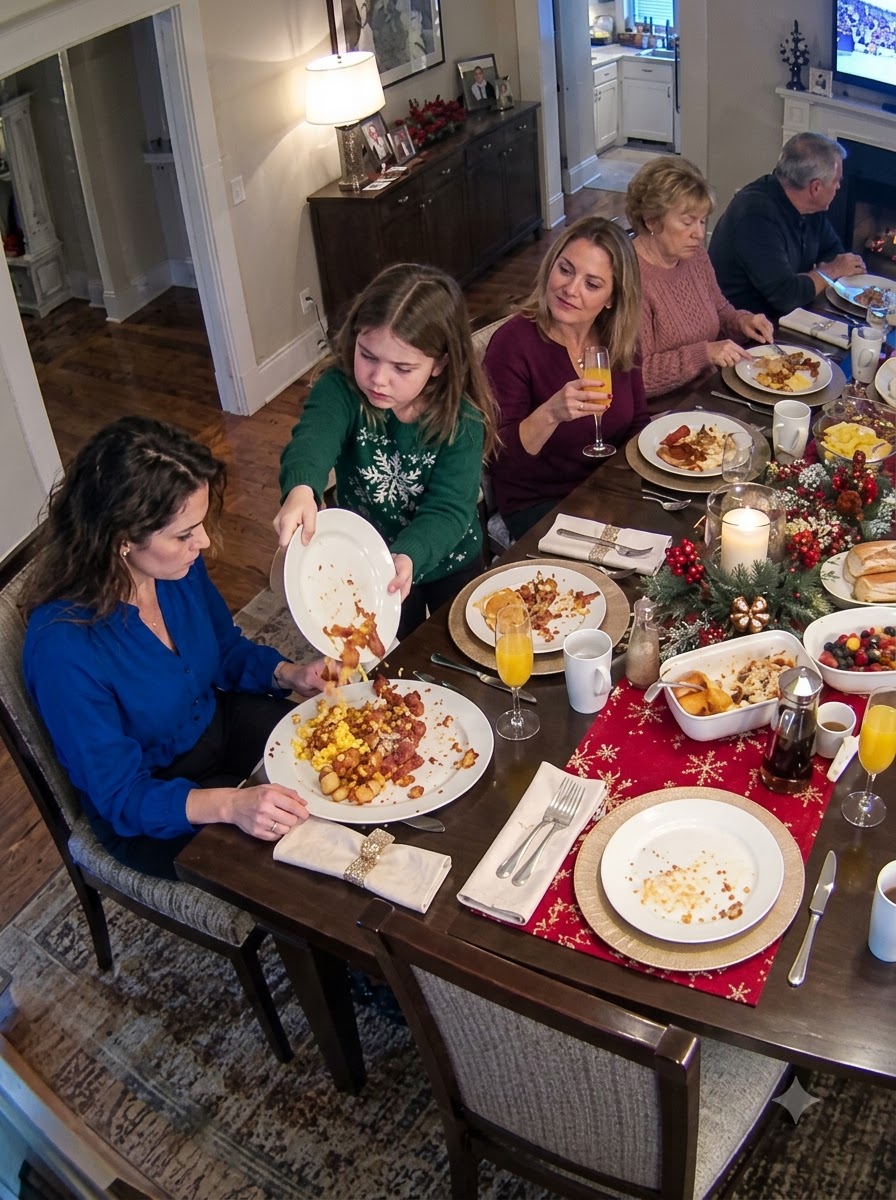
My family called me trash.
They tried to erase the debt they owed me while giving my sister the house I’d helped save.
They expected me to become angry, desperate, and apologetic.
They expected me to keep paying.
What they never expected was for me to read the documents, protect my name, and walk away.
**Because the most shocking thing I discovered wasn’t that my family had lied about needing money.**
**It was that they’d known exactly how much they were taking from me—and had planned to take even more.**
I didn’t need to bankrupt them.
I didn’t need revenge.
I needed my life back.
And in the end, the one thing I removed from that house was the one thing they had never truly appreciated.
**Me.**
