

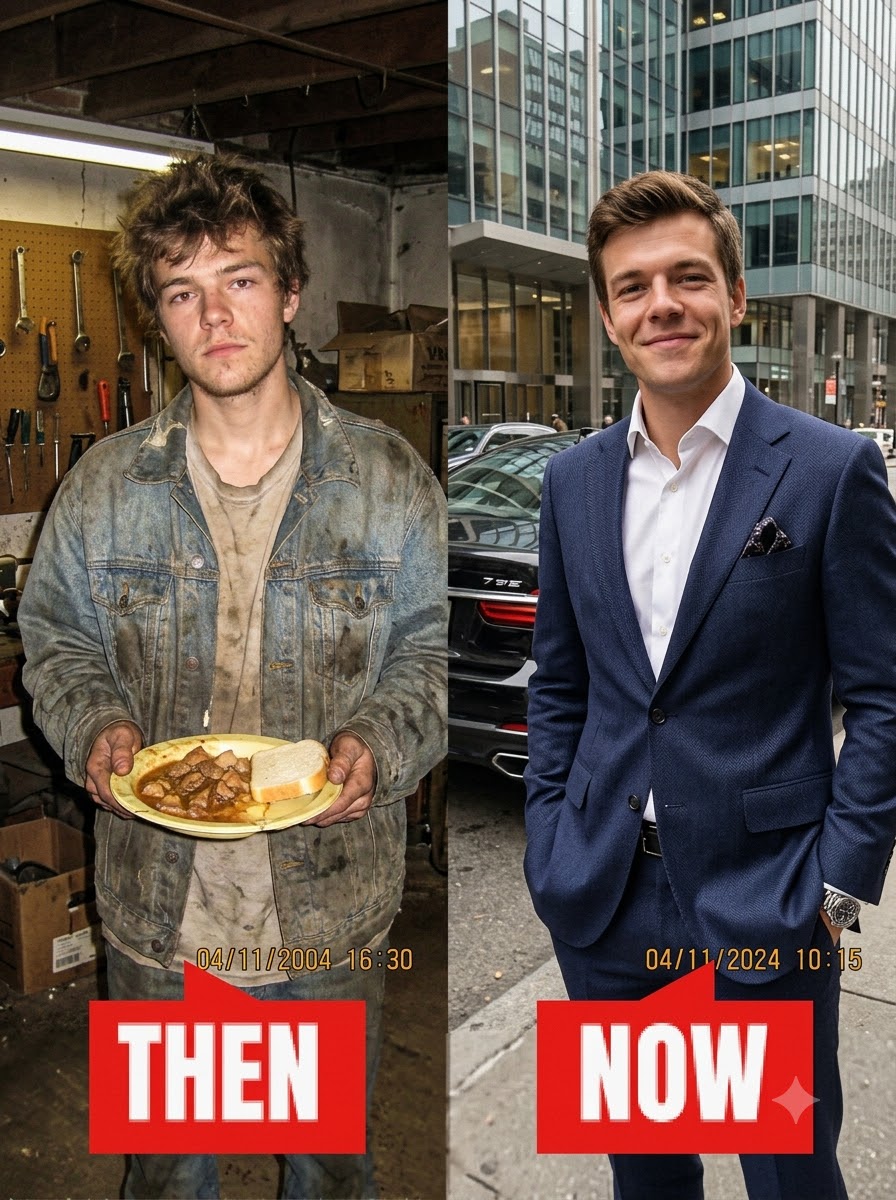
When I was eight, my mother gave our best food to a homeless teenager while my family struggled to eat. I spent years believing he had taken something from me. After her funeral, I finally went looking for him and found a man I barely recognized waiting outside our old house.
I was eight when Luke began sleeping beside the dump beyond our street, under a sheet of rusted roofing tin.
He looked eighteen, maybe younger, with hollow cheeks, dirty sleeves, and the careful eyes of someone who expected trouble from everyone.
Dad had died that spring, leaving Mom with bills, grief, and a kitchen where every meal required its own quiet arithmetic.
Still, every afternoon, Mom packed a plate, wrapped it in foil, and walked toward the dump without explaining herself.
Sometimes Luke received chicken while we ate soup. Sometimes he got bread while Mom claimed she wasn’t hungry.
I watched from the window as Luke accepted everything with both hands, always thanking her as if she had saved him.
Then one Saturday, I found Mom carrying an apple pie toward the back door, warm enough to fog its cover.
“Is that for dinner?” I asked, already smiling because apple pie was my favorite thing Mom still occasionally baked.

Mom shifted the dish against her hip and avoided my eyes.
“It’s for Luke. There’s soup waiting on the stove.”
Something inside me cracked.
“Why does he get dessert when we can’t even have decent food?!”
Mom’s face was engulfed in such a fury, I stopped crying.
“Never say that about Luke again. Never make me hear it.”
She left with the pie, and I stood alone in our kitchen, ashamed, furious, and certain Luke had replaced me.
After that, I hated him with the focus only a child can manage.
Luke tried waving whenever I passed. Once, he carved me a wooden bird. I deliberately dropped it beside his shoes.
“You don’t have to like me,” he said softly. “But your mother worries when you walk near traffic after school.”
I ignored him and kept walking, pretending his concern was another trick designed to steal even more of Mom’s attention.
As far as I knew, Luke had no parents, no home, and no job. Mom never explained why she seemed to feel responsible for him.
Years passed. Luke vanished from the dump sometime before I finished high school, and Mom refused to explain where he had gone.
The moment I graduated, I moved three hours away, accepted the cheapest apartment available, and rarely called home.
Mom and I spoke on birthdays, then holidays, then only when one of us felt guilty enough to try again.
Eleven years later, a hospital nurse called while I was at work and asked whether I was Evelyn Hart’s daughter.
“Your mother has suffered a severe stroke,” she said. “Her condition is critical. You should come as soon as possible.”
By the time I arrived, machines surrounded Mom, and she could barely speak.
I took her hand and apologized for years of distance. Her fingers tightened weakly, but her eyes remained painfully clear.
“I’m here,” I said. “You don’t have to worry about anything. I’ll handle the house, the bills—everything now, Mom.”
Her mouth moved several times before sound emerged.
“Don’t abandon Luke. Promise me.”
Those were her final words to me.
I felt anger before sorrow. Luke hadn’t even come, yet Mom was spending her last strength protecting him again.
“I promise,” I whispered, though resentment made the words taste bitter.
Mom closed her eyes and died quietly before sunset.
After the funeral, I cooked beef stew, packed bread, and drove toward our old neighborhood, carrying the weight of an unwanted duty.
I expected to search the dump or ask neighbors whether Luke still wandered nearby. I planned to leave the food, tell him Mom was gone, and consider my promise fulfilled.
Instead, a black SUV waited outside Mom’s house.
Beside it stood a clean-shaven man in an expensive coat, watching my car as tears gathered in his eyes.
“I thought you wouldn’t come,” he said when I stepped onto the curb, still holding the covered pot against my chest.
I studied his face until I recognized the younger version beneath the polished hair and tired lines.
“Luke?”
His smile looked uncertain.
“You brought dinner.”
I nodded, suddenly embarrassed by the cheap container balanced between my hands.
“But what happened to you?” I asked. “How is this possible? The way Mom spoke about you, I thought you were still living nearby and needed help.”
Luke looked toward the dark house.
“Your mother hid something from you,” he said. “Before she died, she begged me to keep her secret.”
A chill moved through me.
“What did she hide?”
Luke opened the SUV and removed a dented metal box.
“Your father’s death was not the first loss connecting my family to yours,” he said, setting the box on the hood.
His mother, Nina, had cleaned offices at Dad’s factory. When Luke was sixteen, she became seriously ill and started missing shifts.
Their landlord evicted them. Dad quietly paid for a motel room, delivered groceries, and helped Luke apply for training programs.
“Why did nobody tell me?” I asked.
“Because your father hated being praised.”
After Dad died, Nina grew worse. Luke left school to care for her full-time.
She died several months later.
By the time Luke appeared beside the dump, he was seventeen, orphaned, homeless, and unemployed. He had nowhere else to go.
A nearby recycling yard sometimes paid him cash for sorting scrap, but the work was irregular, and the local shelters were always full.
Mom fed him because she believed Dad would have done exactly the same, even when our own cupboards looked empty.
“That explains the meals,” I said. “It doesn’t explain a secret worth keeping from me for eleven years.”
Luke rested one hand on the metal box.
“Before he died, your father gave me this and one instruction.”
He unlocked it with a small key from his wallet.
Inside were dozens of cassette tapes labeled in Dad’s handwriting.
When You Think Nobody Understands You at All. Eighteenth Birthday. Graduation. Wedding Day. First Big Failure. Becoming a Parent.
My knees weakened. Luke caught my elbow, but I pulled away.
“He made these for me?”
Dad had known his health was failing. He had recorded messages for birthdays, milestones, mistakes, and difficult days he expected me to face.
Luke’s task had been simple: deliver the box when I turned eighteen.
Dad had trusted him with it because he feared Mom’s grief might make her hide the recordings. Luke had promised to follow his instructions exactly.

Instead, Mom stopped him before my birthday.
She had listened to one tape and collapsed. Hearing Dad’s voice made moving forward feel impossible for her.
She feared the recordings would trap me inside grief, keeping me tied to a father I barely remembered.
“Every year, I came back,” Luke said. “Every year, I asked whether you were ready. She always said no.”
I stared at him.
“After I turned eighteen, she didn’t have the right to decide anymore. Neither did you.”
“I know.”
His answer came immediately.
“I should have chosen differently. Loyalty does not excuse what I did.”
He said Mom had fed him, paid for night school, and treated him like family when nobody else remained.
He hadn’t stayed silent because he enjoyed having power over me.
Gratitude had slowly become obedience, and obedience had become fear of betraying her.
“And the car?” I asked bitterly. “The coat? Was Mom secretly feeding a millionaire all those years, too?”
He almost smiled.
The recycling yard had taught him about materials, pricing, logistics, and which discarded things still held value.
He finished night school, started hauling scrap with one borrowed truck, and eventually built a regional recycling and materials company.
He had moved away years earlier. He returned only after Mom’s health declined, visiting quietly because she still insisted on secrecy.
“You weren’t at the hospital,” I said.
Luke looked down.
“I was there the night before you arrived.”
When Mom learned I was coming, she ordered Luke away. She wanted one final conversation without the weight of the secret between us.
“Then why mention you?” I demanded. “Why make you her last concern after pushing you out before I arrived?”
Luke swallowed.
“She knew you would come back to settle the house after the funeral. But she was afraid you might refuse to speak to me, so she made you promise not to abandon me. It was the only way she could force us into the same room without confessing herself.”
I wanted to hate only him. It would have been easier.
Instead, anger spread evenly between the dead and the living.
I carried the box inside our old house. Dust covered the kitchen, but Mom’s apple-shaped clock still worked.
Luke set my stew on the counter and moved toward the door.
“You should hear them without me here.”
I looked at the tape marked Eighteenth Birthday.
“No. You waited eleven years. You can wait through one recording.”
We found Dad’s old cassette player in a cabinet. Luke cleaned the heads while I stood uselessly nearby, watching.
The machine clicked. Static filled the kitchen.
Then my father’s voice returned from a place beyond every unanswered question.
“Happy eighteenth birthday, peanut,” he said. “I hope you’re taller than me now, although your mother probably doubts it.”
I covered my mouth.
Luke stared at the table, giving me privacy while remaining exactly where I had asked him to stay.
Dad described my birth, his terror when he first held me, and his hope that I would travel farther than he ever had.
Then his tone softened.
“Your mother may hold on too tightly after I’m gone. Be patient, but do not disappear completely.”
I began crying before he mentioned Luke, as though some younger part of me had already recognized the warning.
“And please don’t judge your mother for feeding a boy with nowhere safe to go,” Dad continued. “Families survive hard years because people share what little they have. Sometimes the smaller portion is still enough for everyone.”
I bent over the table.
All the resentment I had protected since childhood suddenly looked painfully young and lonely.
“He knew,” I whispered.
Luke nodded.
“He knew my mother was getting worse. He worried I would end up alone—and that you might misunderstand if your mother kept helping me.”
“You both still took these from me,” I said. “His warning does not make either of you innocent.”
Luke met my eyes.
“I know. I can explain my choice forever, but no explanation can make it right.”
The tapes held no scandal, fortune, confession, or secret family waiting elsewhere for me.
They held Dad’s bad jokes, worries about money, advice about work, and affection expressed without polish or restraint.
For several evenings, Luke returned after work.
Between recordings, he described my parents before grief changed our home.
Mom sang while balancing bills. Dad burned pancakes every Sunday. They argued quietly, then apologized before bedtime.
I told Luke exactly how much I had hated him.

He listened without defending the hungry boy he remembered being.
“I thought you stole her,” I said. “Every plate she carried outside felt like proof that she preferred you.”
Luke looked down.
“I knew you hated me. I also knew you were eight, grieving, and nobody explained anything properly.”
Forgiveness did not arrive cleanly.
Some nights we laughed. Other nights I asked him to leave before another tape played.
He always left when asked. He always returned when invited.
Trust grew through repetition, not one dramatic apology.
Months later, I digitized every recording, storing copies in three places because losing Dad twice felt unthinkable.
I kept the personal messages private, but donated several broader recordings to our town’s oral-history project for preservation and study.
They covered parenting, grief, community care, and helping people without demanding gratitude or public recognition.
By then, I had begun calling my own children more often. They had grown used to the distance I had learned from Mom, and I did not want them inheriting it.
I also began recording messages for them, although nothing was wrong and I expected many ordinary years ahead of us.
I recorded birthdays, failures, questions, recipes, and stories they had heard so often that they usually rolled their eyes.
A year after Mom’s death, Luke came for dinner carrying flowers and pretending not to inspect my cooking too carefully.
I placed an apple pie on the table, then inserted the final cassette we had saved for that evening.
Dad’s voice crackled through the kitchen.
“If Luke is there, give him the larger slice. The boy never eats enough.”
Luke looked at me.
I looked at the pie, remembering the afternoon when one missing slice had felt unforgivable.
Then I cut two equal pieces and slid one toward him.
“I think we’ve both waited long enough,” I said.
