

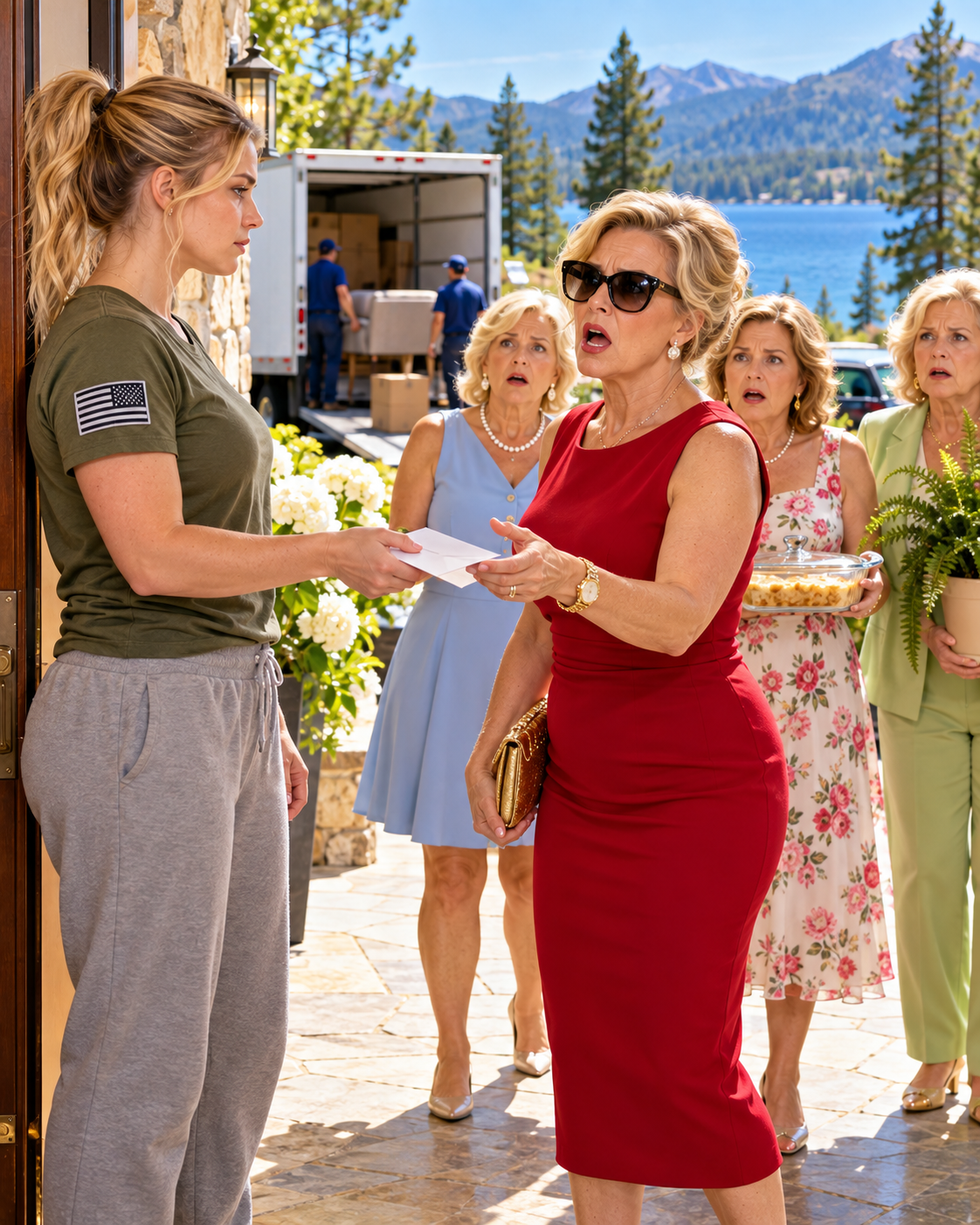
Part 7 — The Narrative Collapsed
Chelsea paced the lawn, calling me cold, heartless, and a brainwashed military robot.
I waited.
About fifteen minutes later, two familiar SUVs arrived.
Of course.
The church committee had returned.
Barbara stepped out first, followed by the same women from the moving-truck ambush.
This time they looked less confident.
Nobody brought casseroles.
Mom hurried toward them.
“She’s calling the police on us,” my mother announced dramatically.
Barbara looked between us.
“Valerie said this was becoming a family crisis.”
“It became a legal issue when they hired a locksmith,” I replied.
The women stiffened.
Apparently a homeless mother sounded sympathetic.
Forced entry tested the limits of hospitality.
Chelsea pointed at me.
“She’s lying. Mom lives here too.”
“I do not,” Valerie admitted automatically.
Then froze.
Barbara blinked.
“Wait. You don’t live here?”
Nobody answered.
Perfect timing.
A police cruiser entered the driveway.
A younger officer stepped out, followed by an older one who looked like he had no patience left for family melodrama.
The older officer approached me.
“You the homeowner?”
“Yes, sir.”
“Can you explain what’s happening?”
I handed him my ID and printed copies of the deed.
Organization becomes power.
While he reviewed them, Chelsea launched into a chaotic explanation of betrayal, trauma, housing instability, and my supposedly militant personality.
The older officer noticed the locksmith invoice.
“Did someone attempt to access the property without permission?”
“Yes,” I said calmly. “I have security footage.”
That simplified everything.
Valerie tried another emotional appeal.
“We’re family,” she said tearfully. “I raised her.”
The officer shrugged slightly.
“Ma’am, that doesn’t override property ownership.”
Simple.
Clean.
Beautiful.
Barbara stepped forward.
“Officer, surely this can be resolved privately.”
I looked at her.
“No,” I said evenly. “Private resolution is how this behavior survived for 30 years.”
Everyone went silent.
The officer asked me directly.
“Do you want them removed from the property?”
I looked at Mom, Chelsea, then the women who had originally arrived expecting me to surrender politely.
“Yes,” I answered calmly. “But before that, I think everyone here deserves accurate information.”
I lifted the folder.
Chelsea panicked.
“Oh my God, Riley, stop.”
No.
I was finished stopping.
I opened the folder and looked at Barbara.
“You were told my mother lost her housing unexpectedly. Correct?”
“Yes.”
“That’s false.”
I pulled out the foreclosure documents.
“My mother owned a condo. She refinanced it multiple times, opened a home equity line of credit, drained her retirement accounts, and eventually lost the property through foreclosure.”
The women stared.
“She did this covering legal settlements connected to Chelsea’s boutique business.”
“That’s private,” Chelsea screamed.
“No,” I replied. “Court records are public.”
I pulled out the settlement.
“$62,000.”
Barbara stared.
“Fraud-related civil claims involving customer payments and vendor contracts.”
The silence was extraordinary.
Not explosive.
Just five women mentally replaying everything Valerie had told them.
Mom finally snapped.
“You had no right digging through our finances.”
“You attempted to move into my house under false pretenses,” I replied. “That made your finances my problem.”
I handed copies to Barbara.
Mortgage filings.
Settlements.
Foreclosure notices.
Retirement withdrawals.
Everything dated.
Everything real.

And the narrative collapsed.
This wasn’t a helpless mother abandoned by a cruel daughter.
It was a financially ruined parent who sacrificed everything protecting one adult child and then planned to occupy the other child’s home permanently.
One woman looked embarrassed.
Another stepped away from Mom.
Chelsea backed toward her car.
“This is insane,” she snapped. “You’re obsessed with humiliating us.”
“No,” I said calmly. “I’m refusing to finance you.”
She practically ran to the SUV.
The older officer approached Valerie with the trespass forms.
“Ma’am,” he said to Valerie quietly. “You and your daughter are formally notified not to return to this property without permission.”
Valerie stared at the papers.
Barbara no longer looked sympathetic.
She looked disappointed.
That probably hurt Mom more than the warning.
Social approval was her oxygen.
For once, nobody was buying the performance.
The church women returned to their cars without saying goodbye.
When the last tail lights disappeared, the silence wasn’t heavy.
It felt clean.
I changed the front door code that afternoon.
Then I blocked everyone.
Mom.
Chelsea.
Aunt Linda.
Uncle Ray.
Even Barbara.
Not from anger.
Maintenance.
People call no contact revenge.
It isn’t.
It’s infrastructure repair.
You stop allowing repeated damage to systems already carrying too much weight.
Once the noise disappeared, something strange happened.
I slept.
Actually slept.
No midnight anxiety.
No guilt spirals.
No imaginary emergencies waiting in voicemail.
Just silence, lake water, and the occasional bird hitting the window because apparently nature also struggles with boundaries.
Weeks passed.
The foreclosure finished.
I heard Mom and Chelsea rented a tiny studio forty minutes away.
One bedroom.
Two adults.
A folding divider from Target trying its best.
Apparently Chelsea hated the lack of personal space, which was ironic considering she had tried to annex mine.
Mom stopped attending church.
Not because anyone was cruel.
Because people stopped trusting her version of events.
And surprisingly, I didn’t feel guilty.
I expected sadness.
Regret.
Conflict.
Instead, I felt peaceful in a way that almost seemed suspicious.
My nervous system kept waiting for the next emergency meeting.
None came.
For the first time in my adult life, nobody needed rescuing from consequences they had personally created.
My money stayed in my account.
My phone stayed quiet.
My house stayed mine.
