

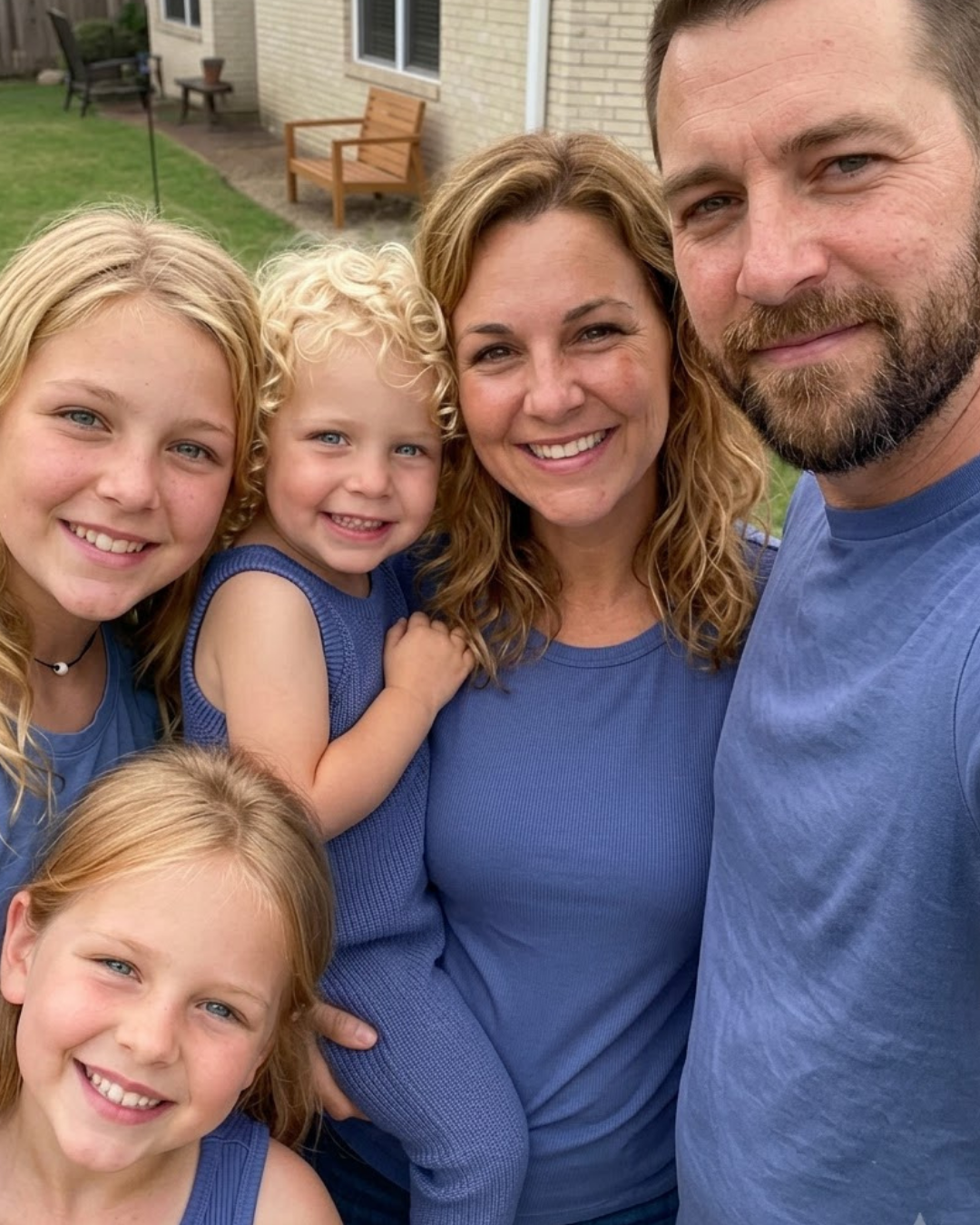
Ronan and I had been husband and wife for thirteen years.
We were raising three daughters: Brenna, twelve, Hallie, eight, and June, six.
With three girls running around the house, Ronan sometimes joked that even our dog was beginning to behave like one of them.
So when his younger brother, Vaughn, asked him to spend a weekend fishing at a cabin near Lake Mercer, I encouraged him to take the trip.
“You deserve two days without someone asking you to braid hair,” I teased.
Ronan laughed as he packed his things.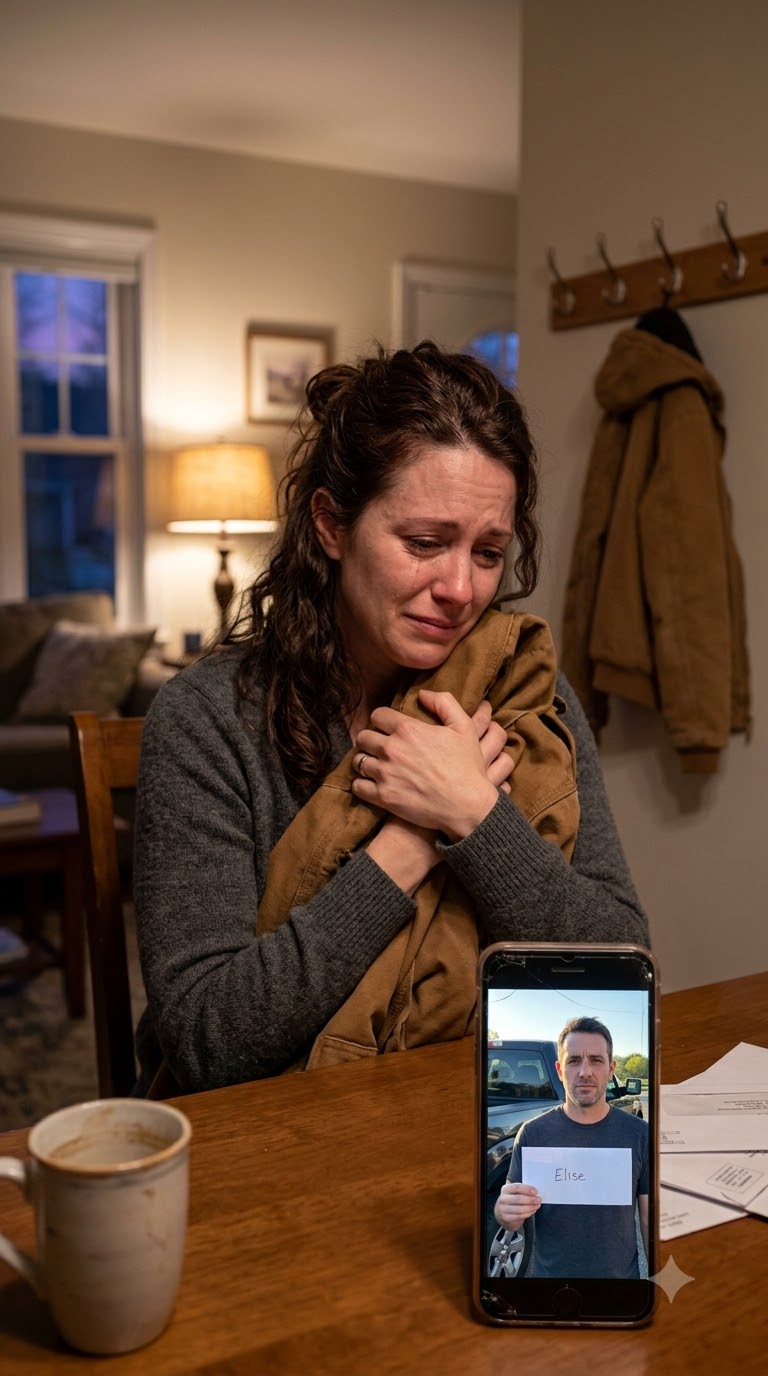
Brenna slipped a chocolate bar into his duffel bag.
Hallie added a tiny flashlight because she firmly believed every fishing trip required surviving in the wilderness.
June tucked one of her plastic horses into his boot.
Ronan found it before he left and carried it back into the kitchen.
“I assume this is essential fishing equipment?”
June nodded with complete seriousness.
“It brings luck.”
He placed it inside his coat pocket.
Then he kissed all three girls before returning to kiss me one more time.
That final kiss stayed in my mind afterward because something about him seemed distracted.
“Everything okay?” I asked.
“Yeah.”
“You sure?”
He glanced down the hallway, where the girls were arguing over who would get to wave from the window.
Then he lowered his voice.
“When I get home, we need to talk about something Vaughn asked me to do.”
“What?”
Ronan shook his head.
“Later. I don’t want to get into it before I leave.”
I should have insisted.
Over the following year, I would replay that conversation hundreds of times and wish I had pushed him for an answer.
Two days later, Vaughn returned without him.
He knocked on my door shortly after noon.
Two police officers were standing behind him.
I knew before anyone said a word.
My body knew.
Vaughn looked awful. His clothes were damp, and his face was pale.
“Elise,” he said. “Ronan’s missing.”
I grabbed the doorframe for support.
“What do you mean missing?”
“He got up early to fish. I was still asleep.”
“And?”
“A storm came in fast. Really fast. When I woke up, I couldn’t see anything past the cabin. I went outside looking for him, but he was gone.”
I stared at him in disbelief.
“His boat?”
“Gone too.”
The police took me to the lake.
Search crews were already working.
They searched the shoreline, wooded paths, small islands, drainage areas, and every trail surrounding the cabin. Divers searched beneath the water.
They eventually discovered the small aluminum fishing boat caught among fallen branches nearly two miles downstream.
But Ronan was nowhere inside.
No body.
No blood.
No shoes.
No phone.
Nothing.
The official explanation became painfully straightforward.
Ronan had gone out alone before sunrise.
A storm had moved in.
The boat had overturned.
The current had swept him away.
Eventually, everyone accepted that explanation.
Everyone except me.
Ronan was the most cautious person I had ever known.
He was the kind of man who checked the weather before taking our daughters to the park.
He kept first-aid kits inside both cars.
Once, he turned around halfway to the airport because he couldn’t remember whether he had unplugged the coffee maker.
And I was expected to believe he woke up, saw a storm approaching, and decided it was the perfect morning to take a boat onto the lake?
Whenever I said that, Vaughn gave me the exact same response.
“Grief makes you look for another explanation.”
Maybe.
But something about the way he insisted bothered me.
He never said, “I don’t understand it either.”
He said, “You have to accept it.”
Over and over.
After nearly a year, Ronan was legally declared de:ad.
Signing those documents was one of the most painful things I had ever experienced.
Brenna refused to come with me.
“I don’t care what a piece of paper says,” she told me. “Dad didn’t just disappear.”
I wanted to tell her she was right.
Instead, I wrapped my arms around her.
Then, three weeks later, she found the jacket.
I had left the girls at Vaughn’s house while I went to an appointment.
He had been helping us more since Ronan vanished, and even though I still felt uneasy around him, he was their uncle.
When I came to pick them up, Brenna got into the car with her backpack tightly zipped against her chest.
She hardly said a word on the way home.
As soon as we stepped inside, she grabbed my hand.
“Mom.”
“What?”
“You need to see something.”
She unzipped her backpack.
The brown canvas jacket landed on the kitchen table.
I recognized it immediately.
There was a small tear near the cuff from the time Ronan had caught it on our fence.
My hands started trembling.
“Where did you get this?”
“Uncle Vaughn’s garage.”
“What?”
“June wanted sidewalk chalk. Uncle Vaughn told me it was on the shelf near his fishing stuff. I moved some boxes, and this was behind them.”
I lifted the jacket from the table.
It smelled of dust and motor oil.
But there was no mistaking it. It was Ronan’s.
He had taken it with him to the lake.
The police had never recovered it.
I had always assumed he was wearing it when he disappeared.
Brenna reached inside the inner pocket.
“There was something else.”
She placed an old phone with a cracked dark-blue case into my hand.
I recognized that as well.
It belonged to Vaughn.
Years earlier, he had carried that exact phone everywhere.
Then one Christmas, he claimed he had lost it and purchased a replacement.
“Are you sure this was inside Dad’s jacket?”
Brenna nodded.
My stomach twisted.
I plugged the phone in to charge.
It took nearly forty minutes before the screen finally came on.
Almost everything had been erased.
No messages.
No contacts.
No recent calls.
But one photograph was still there.
It was dated the morning Ronan disappeared.
My breath caught in my throat.
Ronan was standing behind the cabin beside Vaughn’s truck.
He was wearing the jacket that was now spread across my kitchen table.
The lake wasn’t visible anywhere behind him.
And there was something else.
The sky was completely clear.
Not dark.
Not raining.
Clear.
Ronan was staring directly at whoever was holding the phone.
His expression looked tense.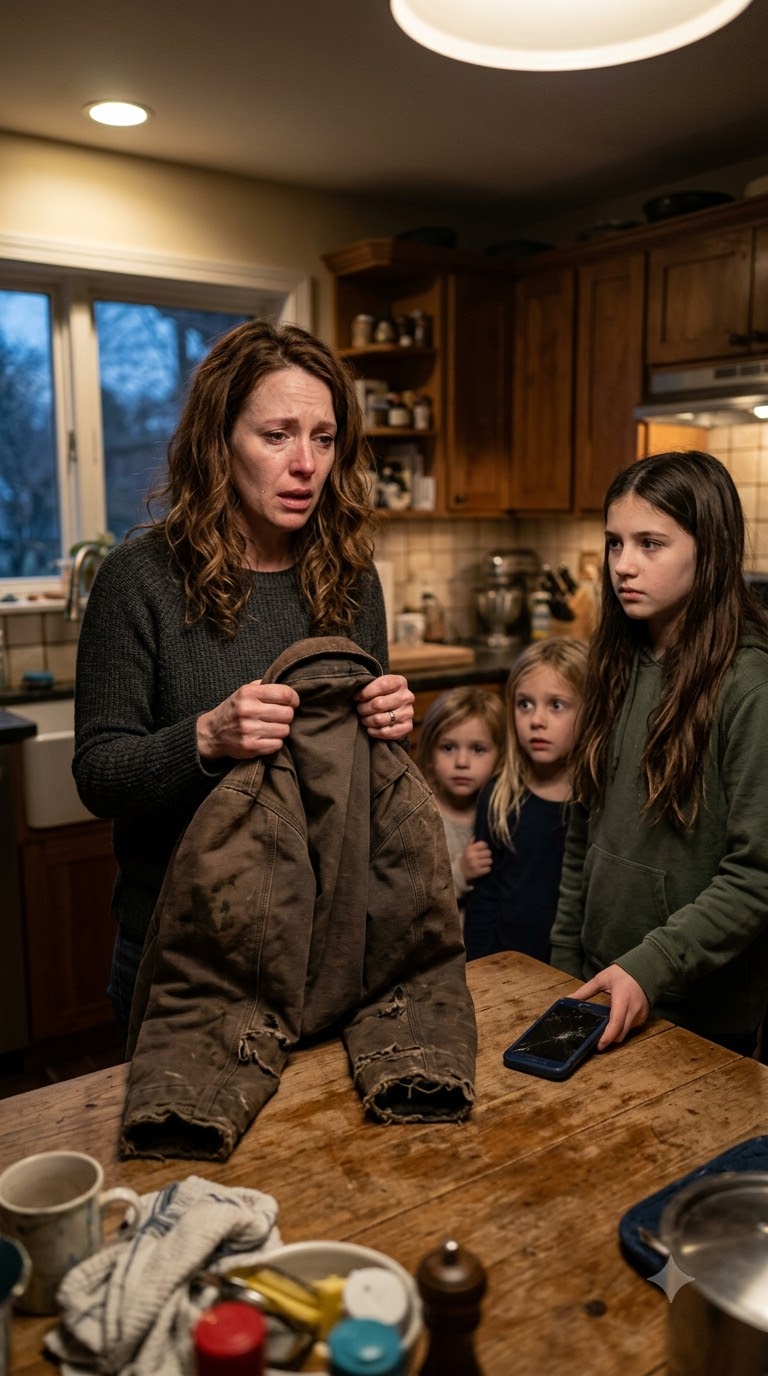
He was holding a large white envelope in both hands.
I zoomed in on the image.
My name was written across the front.
ELISE.
“No,” I whispered.
Brenna touched my arm.
“Mom?”
I could barely hear her.
“No. I knew it wasn’t an accident.”
My first thought was to drive directly to Vaughn’s house.
I wanted to throw the phone in front of him and demand that he explain everything.
Instead, I contacted the detective who had handled Ronan’s case.
Detective Marlow had always treated me with kindness, even after the search had gradually slowed.
When I placed the jacket and phone on his desk the next morning, his entire expression shifted.
“You’re certain this is Ronan’s?”
“Absolutely.”
“And your daughter found it in Vaughn’s garage?”
“Yes.”
He examined the photograph carefully.
Then he asked me something I hadn’t thought about.
“What time was this taken?”
The metadata showed 6:08 a.m.
According to Vaughn’s original statement, he had been asleep until almost seven. The storm, he claimed, had already started by the time he woke up.
Detective Marlow brought up the original case file.
Then he reviewed the archived weather reports.
The first rain around Lake Mercer hadn’t begun until after 9:30.
The severe storm didn’t arrive in the area until nearly noon.
My skin turned cold.
Vaughn had built Ronan’s disappearance around a storm that hadn’t even happened yet.
The investigation was reopened that afternoon.
Police obtained the access records from the rental cabin.
The door code had been entered at 5:41 a.m.
Again at 6:16.
Then once more at 7:03.
Vaughn had claimed he was asleep the entire time.
Someone was lying.
That night, I searched through Ronan’s desk.
I wasn’t sure what I was looking for until I remembered what he had told me before leaving.
We need to talk about something Vaughn asked me to do.
Inside an old tax folder, I discovered a notebook.
Several pages listed amounts of money beside Vaughn’s name.
$3,000.
$6,500.
$2,200.
$11,000.
Some of the entries were dated nearly five years earlier.
Then, beside the final amount, Ronan had written:
No more. He has to tell Mallory himself.
Mallory was Vaughn’s wife.
Suddenly, the fishing trip seemed completely different.
The bank records revealed the rest.
Vaughn had been borrowing money from Ronan for years.
But there was more.
He had also persuaded Ronan to co-sign a business loan that had become seriously overdue.
Vaughn had kept the debt hidden from his wife.
Ronan had finally refused to lend him anything else.
That weekend, according to messages recovered from cloud backups, Vaughn had asked Ronan to come to the cabin so they could “settle this before everyone gets dragged into it.”
Three days later, Detective Marlow called me.
“We need you to come in.”
Vaughn had been questioned again.
This time, he had no explanation for the jacket.
He claimed Ronan might have removed it before going fishing.
Then why had it ended up in his garage?
He had no answer.
He insisted he hadn’t used the old phone in years.
Then why was there a photograph on it from the morning Ronan disappeared?
Again, no answer.
And why had he lied about the storm?
That was when his entire story began to unravel.
But the police still faced one major problem.
They had no idea where Ronan was.
Then investigators examined the records from Vaughn’s truck.
His newer truck had a GPS tracking system.
Vaughn had sold it months after Ronan disappeared, but the manufacturer still had archived location data.
At 7:22 that morning, the truck had departed from the cabin.
It wasn’t heading toward the lake.
It went in the opposite direction.
It stopped for forty-three minutes near an abandoned logging road almost fourteen miles away.
Police searched the area.
Two days later, Detective Marlow came to my house.
He didn’t have to say anything.
I could read the answer on his face.
“We found Ronan.”
I sat down.
Brenna was upstairs with her sisters.
I didn’t want them to hear me.
Detective Marlow told me that Ronan’s remains had been discovered beneath a steep wooded slope, concealed by thick vegetation far from the lake.
His wallet and wedding ring were still on him.
So was June’s little plastic horse.
I covered my mouth and cried.
For an entire year, I had pictured him alone in the dark water.
The truth was somehow even worse.
But at least he wasn’t missing anymore.
Vaughn confessed the following morning.
Not right away.
Not everything.
But enough.
The brothers had argued behind the cabin before sunrise.
Ronan had brought the envelope for me.
Inside were copies of the loans, bank statements, and a letter explaining everything.
He intended to tell me and Mallory what had been happening.
Vaughn begged him not to.
Ronan refused.
The argument became louder.
Vaughn shoved him.
Ronan pushed back.
Then Vaughn struck him.
Ronan fell against the truck’s edge and collapsed.
Vaughn said he panicked when Ronan didn’t respond.
Instead of calling for help, he placed his brother in the truck.
He drove to the logging road.
He left him there.
Then he returned to the cabin and waited.
Later, when the actual storm arrived, Vaughn saw his opportunity.
He pushed the fishing boat into the current.
Then he called the police.
The jacket had remained in the truck.
So had the old phone Vaughn had secretly been using for financial accounts he didn’t want Mallory to discover.
After returning home, he shoved both items into a box in his garage.
And they remained there for an entire year.
Four feet from the sidewalk chalk my daughter eventually went searching for.
The envelope was never found.
Vaughn claimed he had burned it.
I didn’t attend every court hearing.
Some days, I simply couldn’t bring myself to go.
What mattered most was that my daughters finally knew their father hadn’t abandoned them.
He hadn’t recklessly gone out into a storm.
He had been trying to protect his family from a problem he should have told me about much earlier.
One evening after Vaughn was arrested, I placed Ronan’s jacket on the kitchen table.
The girls gathered around it.
June touched the pocket.
“Was my horse still with Daddy?”
I swallowed.
“Yes.”
Her eyes filled with tears.
“So it worked a little?”
“What did?”
“The lucky horse. It helped him come home.”
I turned away because I knew I was about to cry.
Brenna reached for my hand.
“Mom?”
“Yes?”
“Dad really was trying to come back to us, wasn’t he?”
I squeezed her fingers.
“Yes, sweetheart.”
That night, after the girls went to bed, I held Ronan’s jacket against my chest.
For an entire year, Vaughn had told me that grief was making me imagine things.
Maybe he had been right about one thing.
Grief had kept me searching.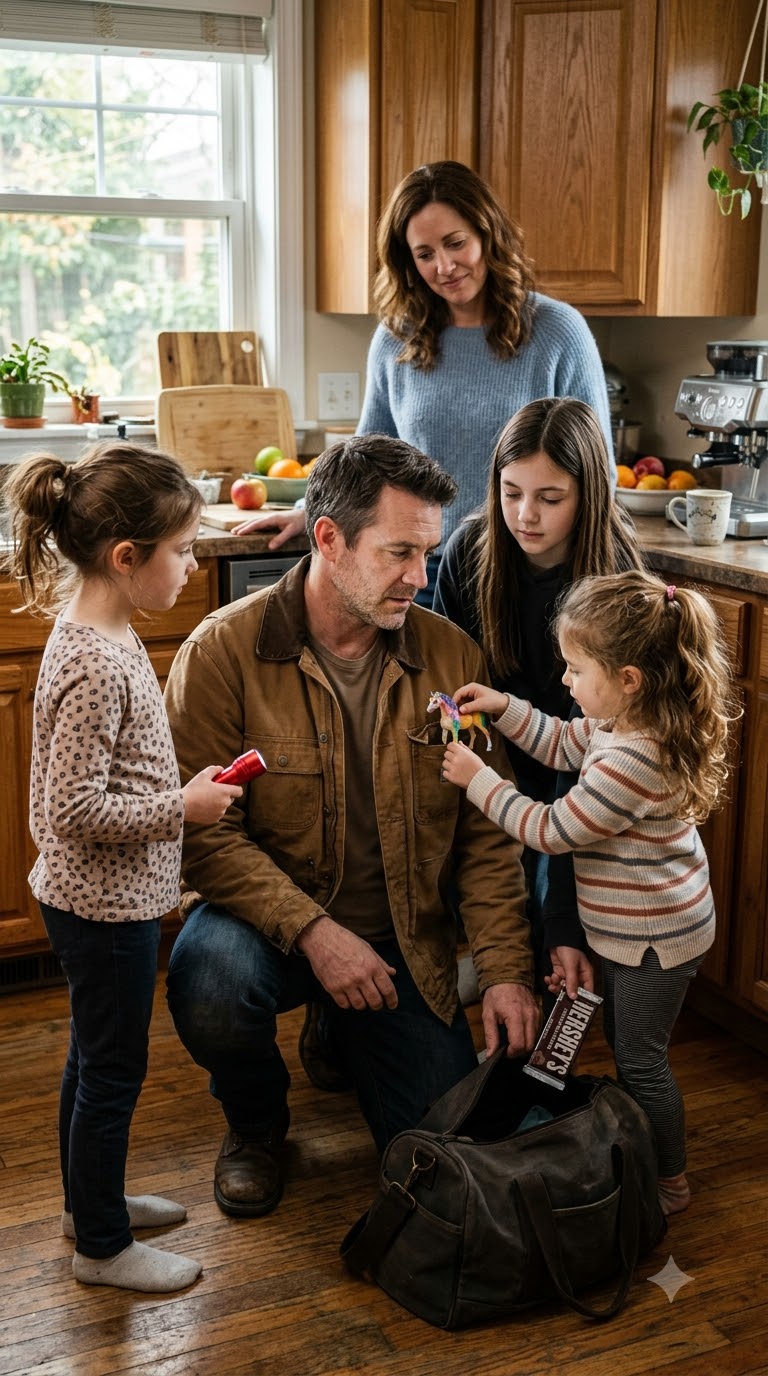
It had kept one question alive when everyone else wanted the simplest explanation.
And eventually, because my daughter reached behind the wrong box in her uncle’s garage, that question finally had an answer.
It wasn’t the answer I wanted.
Nothing could bring Ronan back to me.
But when we buried him beside the oak tree where he used to sit and watch the girls play, I no longer had to imagine him lost somewhere beneath a lake.
My daughters had somewhere to bring flowers.
I had somewhere to sit beside him.
And Ronan’s brown jacket remained hanging beside our front door for a long time afterward.
Not because I expected him to walk through the door and wear it again.
I knew better by then.
I kept it there because that jacket had done what Ronan had been trying to do on the morning he di:ed.
It had finally brought the truth home.
