

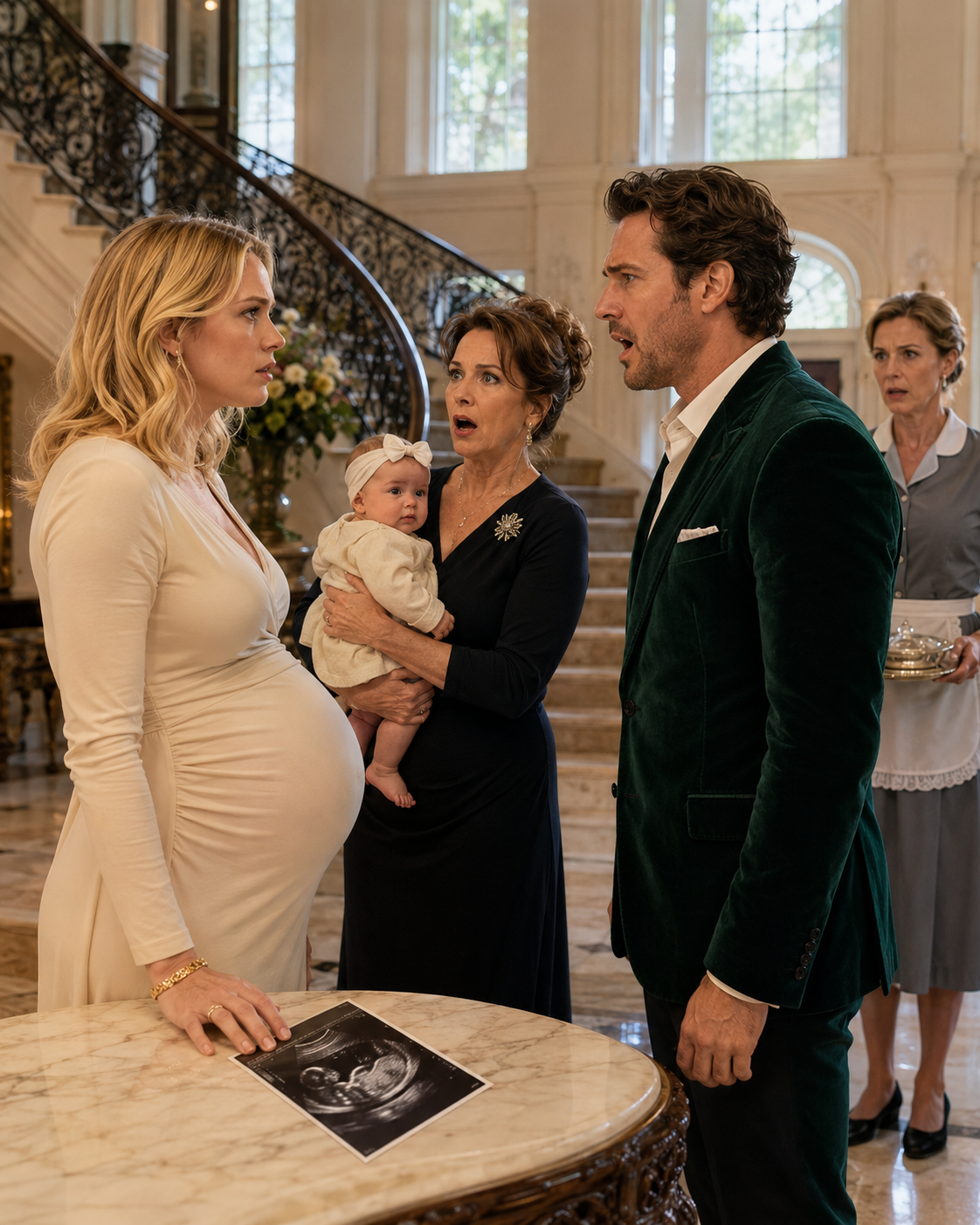
The room became completely still when I placed the ultrasound photograph on the coffee table.
My husband, Aleric, stared at the image before lifting his eyes toward me. Beside the bassinet, his mother stood with the three-month-old baby he had secretly brought into our Greenwich home only days earlier.
“I’m pregnant,” I said.
His expression didn’t change.
There was no smile. No surprise. No warmth.
He simply leaned back and said,
“We already have Julian.”
Eleanor’s hand froze above the baby’s blanket.
The housekeeper lowered her gaze.
And in that peculiar silence, I understood something that made my stomach tighten.
They were all waiting to see whether I would finally lose control.
I didn’t.
That seemed to unsettle them more than anger ever could.
A week earlier, I had returned from an appointment on the Upper East Side carrying an envelope filled with medical results I had been desperate to show my husband.
Instead of finding the quiet evening I had imagined, I walked into our living room and discovered Eleanor sitting on the sofa with a baby in her arms.
Aleric stood by the windows, speaking quietly into his phone.
“Yes,” I heard him say. “The paperwork is almost finished.”
I stopped.
“Whose baby is that?”
Eleanor looked at me as though I had interrupted a private family discussion.
“A distant relative’s,” she said. “Aleric is taking responsibility for him.”
Aleric ended his call and crossed the room.
“The mother can’t care for him,” he explained. “I’ve decided to adopt him.”
“You decided?”
“We’ll talk about the details later.”
Then Eleanor looked down at the infant with unmistakable pride.
“Look at him. That’s Sterling blood.”
Aleric immediately changed the subject.
I studied the baby again.
His eyebrows looked familiar.
So did the shape of his face.
Even the brief moment when his dark eyes opened before he drifted back to sleep felt strangely recognizable.
He looked too much like someone I knew.
Far too much.
But five years of marriage had taught me one particular skill: never react before I understood what was happening.
That was how I had survived in the Sterling household.
Before Aleric, I had been a young attorney determined to establish myself in New York.
After our wedding, he asked me to step away from my career temporarily.
“I need you here,” he told me. “We’re building a life together.”
Temporary became permanent.
One year became two.
Then five.
I managed the household, organized dinners, arranged travel, remembered birthdays, attended charity events, hosted corporate gatherings, and stood beside my husband whenever the Sterling family needed the perfect wife on display.
And throughout those years, Eleanor never missed an opportunity to remind me that I had not given the family an heir.
At Sunday brunches, she would sigh and say,
“Some women are simply more naturally suited to motherhood.”
Her gaze would then drift toward me.
Aleric never corrected her.
I kept telling myself that eventually he would.
Then Julian arrived.
That first night, I left the living room and went upstairs alone.
Near our closet, Aleric’s suit jacket was hanging on the valet stand. I picked it up because I intended to send it to the dry cleaner.
Something rigid inside the breast pocket caught against my fingers.
I pulled it out.
A folded medical folder.
For a moment, I considered putting it back.
Instead, I opened it.
Sutton Place Women’s Clinic.
Patient: Rowan Carmichael.
I sat on the edge of the bed.
I knew that name.
Rowan had attended our wedding five years earlier.
When I had asked Aleric who she was, he told me she was a cousin he had grown up with.
I remembered her champagne-colored bridesmaid dress.
I remembered the way she had watched Aleric throughout the reception.
And I remembered the message I had once seen on his phone several months after our wedding.
It came from someone saved under “Cousin.”
When I questioned him, he laughed.
“You’re reading too much into nothing.”
He even called Rowan while I sat beside him.
She apologized.
I believed both of them.
Five years later, standing in our bedroom with Rowan’s prenatal paperwork in my hands, I finally understood how convenient my trust had been for them.
I carefully refolded the document and placed it exactly where I had found it.
Downstairs, Eleanor was still admiring Julian.
The housekeeper smiled at the infant.
“He really does look familiar.”
Eleanor answered without thinking.
“He looks exactly like Aleric did at that age.”
Then she noticed me.
Her expression shifted.
“Well, obviously. They’re related.”
I nodded.
“Of course.”
That night, I heard voices from the nursery.
I didn’t enter.
I stood quietly in the hallway and listened.
Eleanor asked,
“What are you going to tell Saraphina?”
Aleric answered with unsettling confidence.
“Nothing she needs to know.”
“She may start asking questions.”
“She won’t.”
Then came the sentence that changed something inside me.
“She depends on me. She’s not going anywhere.”
I returned to our bedroom and locked the door.
For the first time in five years, I stopped thinking about how to repair my marriage.
Instead, I began thinking about what I needed to uncover before I walked away from it.
I photographed the medical folder.
Two days later, Rowan contacted me.
Her message was strangely calm.
She said she hoped Julian’s arrival wasn’t making things uncomfortable.
Then she wrote,
“Aleric and I have a history. I think you probably understand that now.”
I stared at those words for a long time.
Then I answered:
“I understand.”
Her response appeared almost immediately.
“Thank you for being reasonable.”
Reasonable.
The word stayed in my mind.
They had mistaken my silence for surrender.
So I let them.
I continued preparing breakfast.
I attended dinner.
I asked ordinary questions about Julian.
I listened while Eleanor discussed family traditions as if nothing unusual had happened.
All the while, I contacted someone I hadn’t spoken to in years.
Desmond Pierce had been one of my classmates in law school before building a successful family-law practice in Manhattan.
He answered on the third ring.
“Saraphina?”
“Hi, Desmond.”
There was a pause.
“What happened?”
“I need an attorney.”
Another silence.
“Come tomorrow.”
His office was in Hudson Yards.
I brought the medical folder, screenshots, dates, and the notes I had quietly compiled.
He read everything without interruption.
Finally, he looked at me.
“How long have you known?”
“Not long.”
“And how much does your husband think you know?”
I met his eyes.
“Almost nothing.”
Desmond slowly closed the folder.
“Keep it that way for now.”
So I did.
Then, several days later, I discovered I was pregnant.
When I told Aleric, the response in that living room confirmed more than any confession could have.
Eleanor stared at the ultrasound.
Aleric stared at me.
“This complicates everything,” he said.
I picked up my glass of water.
“For whom?”
His eyes narrowed.
“Don’t start.”
“I’m not starting anything.”
He rose from his chair.
“Then understand something. Julian is already here. Our family has made decisions.”
“Our family?”
He said nothing.
Eleanor finally intervened.
“Saraphina, this is not the time to become difficult.”
I looked directly at her.
“I’m sitting quietly on a sofa.”
No one answered.
Two nights later, I walked into Aleric’s study carrying a thick manila envelope Desmond had prepared for me.
My husband was seated behind his desk, reviewing financial reports.
He barely bothered to look up.
“What now?”
I crossed the room and placed the envelope in front of him.
For years, I had watched that same small, confident smile appear whenever he believed he controlled the situation.
It was the expression of a man who assumed every important decision in our marriage ultimately belonged to him.
“Whatever this is,” he said, “we can deal with it tomorrow.”
“No,” I said. “You should read it tonight.”
He opened the envelope.
He removed the first page.
His eyes moved across the heading.
Then he turned to the next page.
His smile vanished.
For several seconds, he didn’t speak.
Finally, he looked up.
“What is this?”
I remained standing.
“You know exactly what it is.”
His fingers tightened around the papers.
Desmond had obtained enough documentation to establish a timeline.
The prenatal records.
The dates.
The communications.
The financial transfers connected to Rowan.
And, most importantly, evidence showing that Aleric had been financially supporting Rowan for years while concealing the relationship from me.
But there was something else.
Aleric looked at the final page.
His face changed completely.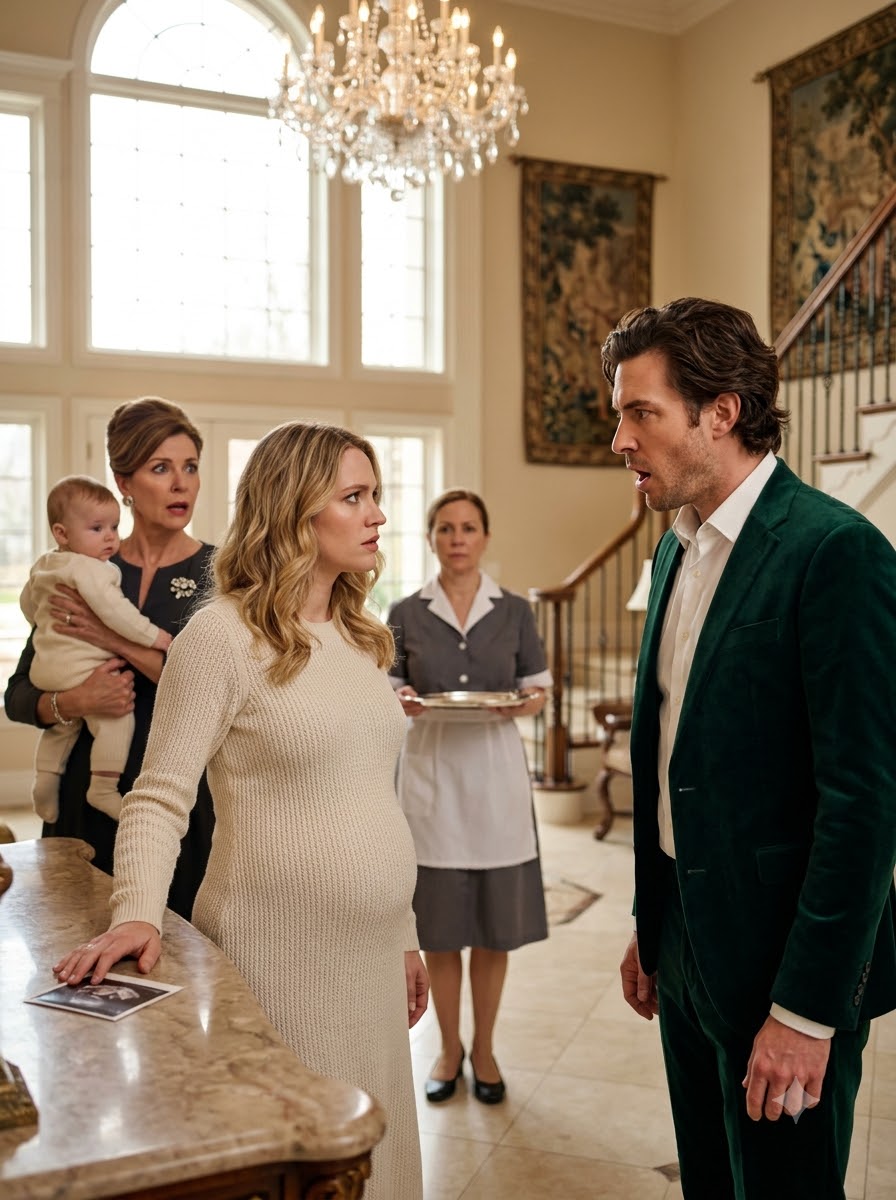
“You had a DNA test?”
“I didn’t need one from you.”
He stared at me.
“I had one performed privately on Julian.”
His chair scraped backward.
“You had no right.”
I almost laughed.
“No right?”
The anger finally surfaced in his face.
“You went behind my back.”
“You brought another woman’s baby into our home behind mine.”
Silence.
He looked down at the documents again.
“The test is conclusive?”
“Yes.”
He closed his eyes.
When he opened them, there was no longer any point in pretending.
“Julian is my son.”
I nodded.
“I know.”
Aleric stood.
“Rowan was supposed to tell me she was pregnant years ago.”
I stared at him.
“Years ago?”
He swallowed.
“She contacted me after our wedding.”
“So you knew?”
“I knew she might be pregnant.”
“Might be?”
His silence answered for him.
I felt something inside me go completely still.
For five years, Eleanor had accused me of failing her family.
For five years, Aleric had allowed me to believe my inability to conceive was the problem.
All while knowing there was a possibility that his own child existed somewhere outside our marriage.
Then he had brought that child into my home without telling me the truth.
“Why didn’t you tell me?”
Aleric lowered his gaze.
“I thought I could handle it.”
“You didn’t handle it. You hid it.”
He had no response.
I placed another document on his desk.
“This is my resignation from every Sterling family obligation.”
He looked at it.
“What does that mean?”
“It means I am no longer your hostess, your caretaker, your family’s social representative, or your convenient wife.”
His face hardened.
“You’re leaving?”
“Yes.”
“But you’re pregnant.”
“I know.”
His eyes moved toward my stomach.
For the first time, fear replaced confidence.
“What about our child?”
“Our child will have a mother who knows the truth.”
He stepped toward me.
“Saraphina, please.”
I raised one hand.
“Don’t.”
He stopped.
“I never cheated on you.”
I stared at him.
“You had a relationship with Rowan.”
“Before the wedding.”
“And after?”
He said nothing.
That was enough.
I turned toward the door.
Behind me, he spoke again.
“I love you.”
I stopped.
For a moment, I considered turning around.
Then I remembered every Sunday brunch.
Every humiliating remark.
Every time Eleanor had questioned my worth.
Every year I had sacrificed my career while Aleric quietly built a second family around a secret.
I didn’t turn around.
“Love without honesty is just another form of control.”
I left the room.
The next morning, Desmond filed the first legal documents.
I moved into a temporary apartment in Manhattan before Aleric could attempt to convince me to stay.
He called repeatedly.
I didn’t answer.
Eleanor sent messages.
I didn’t respond.
Then Rowan came to my office.
She stood outside the glass doors looking nervous.
“I wanted to explain.”
I allowed her inside.
She sat across from me.
“I didn’t know he would bring Julian into your home like this.”
“You knew he was married.”
“Yes.”
“You knew I was trying to have a child.”
Her eyes lowered.
“Yes.”
“And you still continued.”
She didn’t defend herself.
“I thought Aleric would eventually leave you.”
That sentence hurt more than I expected.
Not because I wanted him.
Because it confirmed that while I had spent years trying to save my marriage, other people had been quietly discussing when it would end.
“Does Julian know who I am?”
Rowan shook her head.
“He knows you’re Aleric’s wife.”
I nodded.
“He deserves adults who stop making decisions around him.”
Rowan looked at me.
“What are you going to do?”
I answered honestly.
“Protect my child. Protect myself. And make sure Julian is never treated as the reason for his parents’ mistakes.”
For the first time, Rowan looked ashamed.
Weeks passed.
The legal process moved forward.
Desmond discovered that Aleric had transferred significant marital funds into accounts associated with Rowan before Julian entered our home.
Those records became part of the proceedings.
The Sterling family attempted to negotiate quietly.
I refused.
I wasn’t interested in destroying Aleric.
I wanted my life back.
Eventually, Aleric agreed to mediation.
We sat across from one another in a conference room.
He looked exhausted.
I looked at the man I had married five years earlier and realized I no longer recognized him.
“I should have told you,” he said.
I remained silent.
“I should have told you about Rowan. About Julian. About everything.”
“Yes.”
“I was afraid.”
“Of what?”
“Of losing you.”
I looked at him.
“You lost me because you believed hiding the truth would keep me.”
His eyes filled with tears.
“I know.”
For a long moment, neither of us spoke.
Then he asked,
“Will you let me be involved with the baby?”
I thought about it carefully.
“Yes.”
His expression shifted with relief.
“But there will be boundaries.”
He nodded.
“And Julian?”
I looked down.
“He is innocent.”
Aleric nodded.
“He’ll always be your son.”
“No,” I corrected. “He will be your son. But he doesn’t have to be my enemy.”
Aleric looked at me for a long time.
“Thank you.”
I didn’t answer.
Because forgiveness wasn’t something I was ready to offer.
But compassion was something I could choose for myself.
The divorce was finalized several months later.
I returned to practicing law.
At first, I took small cases.
Then larger ones.
Slowly, the career I had abandoned began to feel like mine again.
I also established a separate trust for my unborn child.
No Sterling family member could control it.
No husband could access it.
And no one could ever tell me again that my value depended on producing an heir.
When my daughter was born, Aleric was present at the hospital.
So was Desmond.
Rowan remained outside.
Aleric held the baby only after I gave permission.
He cried.
I didn’t.
I simply watched.
Then he whispered,
“She’s beautiful.”
“She is.”
He looked at me.
“Thank you.”
I understood what he meant.
But I also understood something else.
My daughter wasn’t born to repair a broken marriage.
She wasn’t born to satisfy Eleanor Sterling.
She wasn’t born to become another piece on a family chessboard.
She was simply my child.
And that was enough.
Months later, I returned to Greenwich to collect the last of my belongings.
The house felt different.
Smaller.
Less powerful.
The bassinet was gone.
Julian’s toys had been moved into a separate room.
Eleanor wasn’t there.
Aleric met me near the staircase.
“I wanted you to know something.”
I waited.
“Julian knows about the baby.”
I frowned.
“He asked whether he was going to lose his sister.”
My heart tightened.
“What did you tell him?”
Aleric looked down.
“I told him family doesn’t disappear just because adults make mistakes.”
I nodded slowly.
“That was the right answer.”
He gave me a faint smile.
“I’ve learned a few things.”
“Too late.”
“Yes.”
We stood in silence.
Then I picked up the final box.
As I walked toward the front door, Aleric called after me.
“Saraphina?”
I turned.
“I really am sorry.”
This time, I believed that he meant it.
But believing his apology didn’t mean returning to him.
I walked outside.
The Greenwich air was cool and bright.
For five years, I had thought that house represented everything I had failed to become.
A wife.
A mother.
A Sterling.
Now I understood.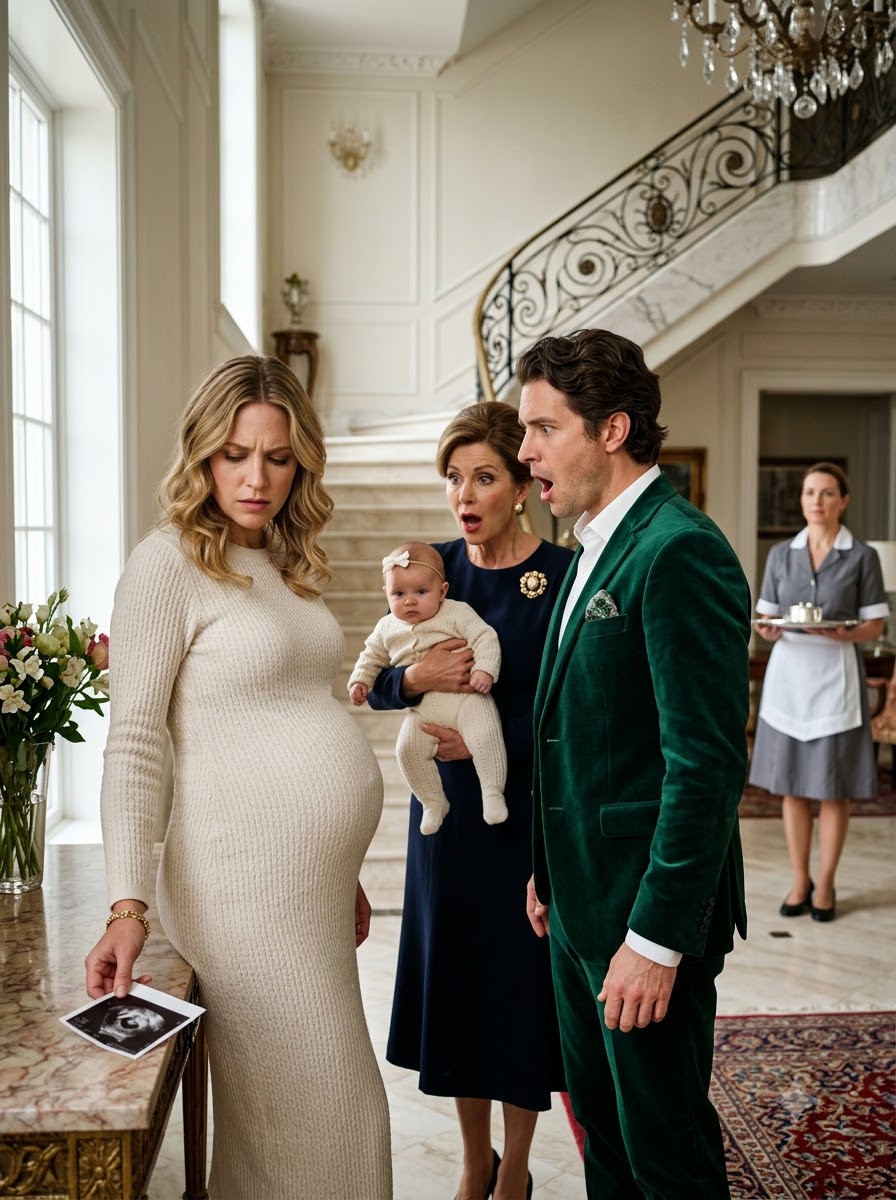
It had never been my failure.
I had simply been trying to earn a place in a family that had already decided I would never truly belong.
My daughter slept peacefully in the car seat beside me.
I looked at her tiny face.
Then I smiled.
I had spent years being told what my future should look like.
Aleric had chosen what I should know.
Eleanor had chosen what I should become.
Rowan had assumed what would happen to my marriage.
But for the first time, every decision ahead belonged to me.
I started the car and pulled away from the Sterling estate.
Behind me was the life I had spent five years protecting.
Ahead of me was something far more valuable.
A life built on truth.
A career I had chosen for myself.
A daughter who would never be taught that her worth depended on becoming someone else’s perfect heir.
And a future no one else could quietly decide for me.
For the first time in five years, I wasn’t leaving a marriage behind.
I was finally coming home to myself.
