

THE THREE LETTERS MY HUSBAND LEFT BESIDE OUR BABIES’ CHRISTENING CAKE
PART 1
The morning my husband walked away from our three babies, he had already packed a suitcase, arranged his departure, and decided exactly how he wanted our friends and neighbors to remember me, although I wouldn’t understand how carefully he had planned everything until several days later, when a woman at our credit union placed a stack of financial records in front of me.
Until that Sunday, I believed the hardest part of becoming a mother to triplets had been the weeks we spent in the hospital, watching our children grow strong enough to come home. My name is Rebecca Bennett, and I was thirty-seven when our triplets, Hannah, Caleb, and Sophie, arrived seven weeks earlier than expected. My husband, Daniel, and I had been married for eleven years, and after a long season of hoping for children, we had finally been blessed with three at once.
Our home outside Lexington, Kentucky, had become a wonderful, exhausting collection of tiny blankets, unfinished cups of coffee, and bottles waiting to be washed, and although I sometimes cried from sheer tiredness, I had never imagined that the man who once kissed each baby’s forehead before leaving for work could become a stranger.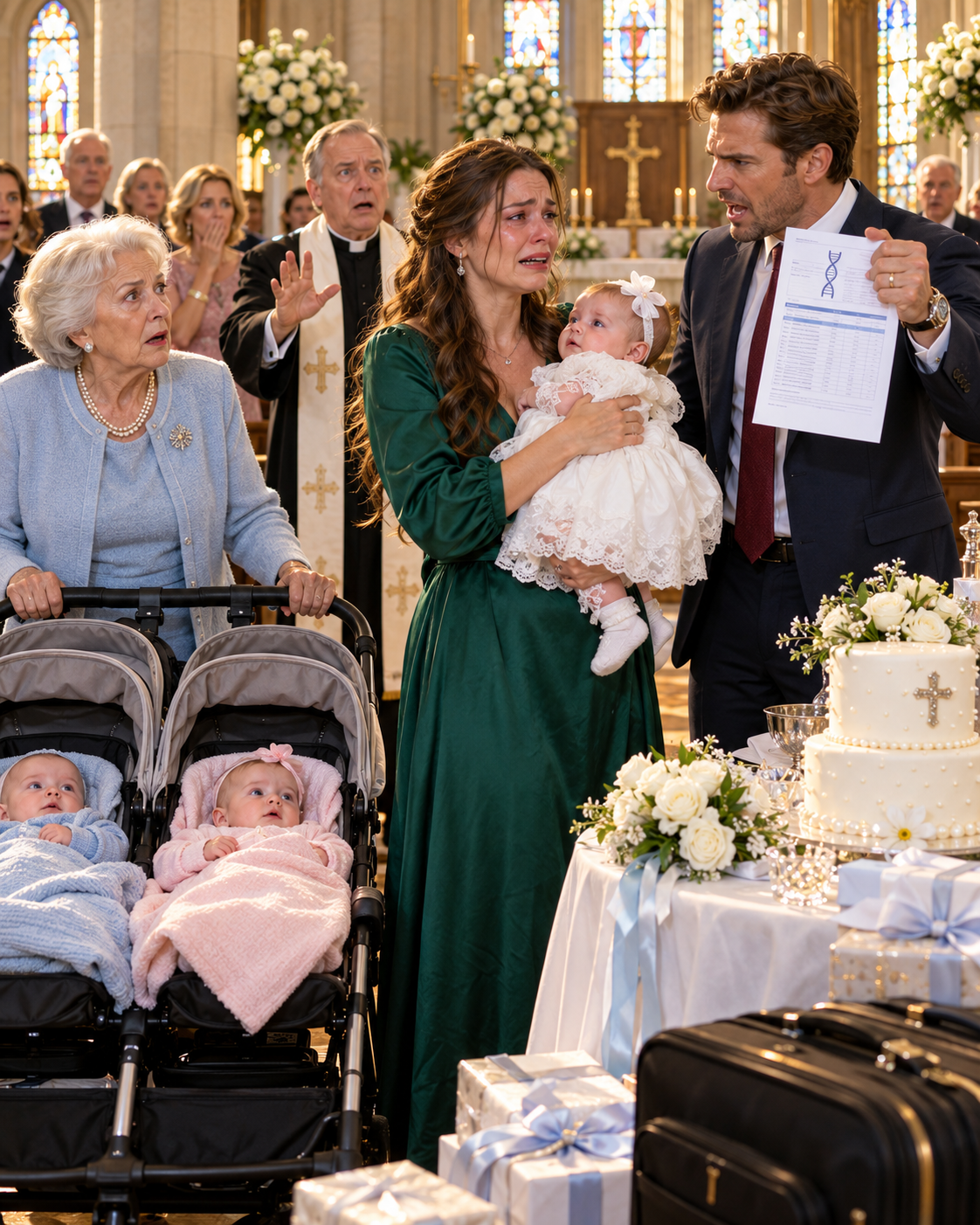
The christening was supposed to be our first celebration as a family of five.
Our small Methodist church had decorated the fellowship hall with white flowers and pale green ribbons, while nearly fifty relatives and friends gathered around a cake decorated with three little pairs of baby shoes.
I remember holding Hannah against my shoulder, feeling her warm cheek resting beneath my chin, when Daniel stepped toward the cake carrying three cream-colored envelopes.
“Before everybody leaves, there’s something I need to clear up,” he announced.
At first, I assumed he was preparing one of his awkward speeches, the kind that usually ended with him thanking everyone for helping us through the difficult first weeks.
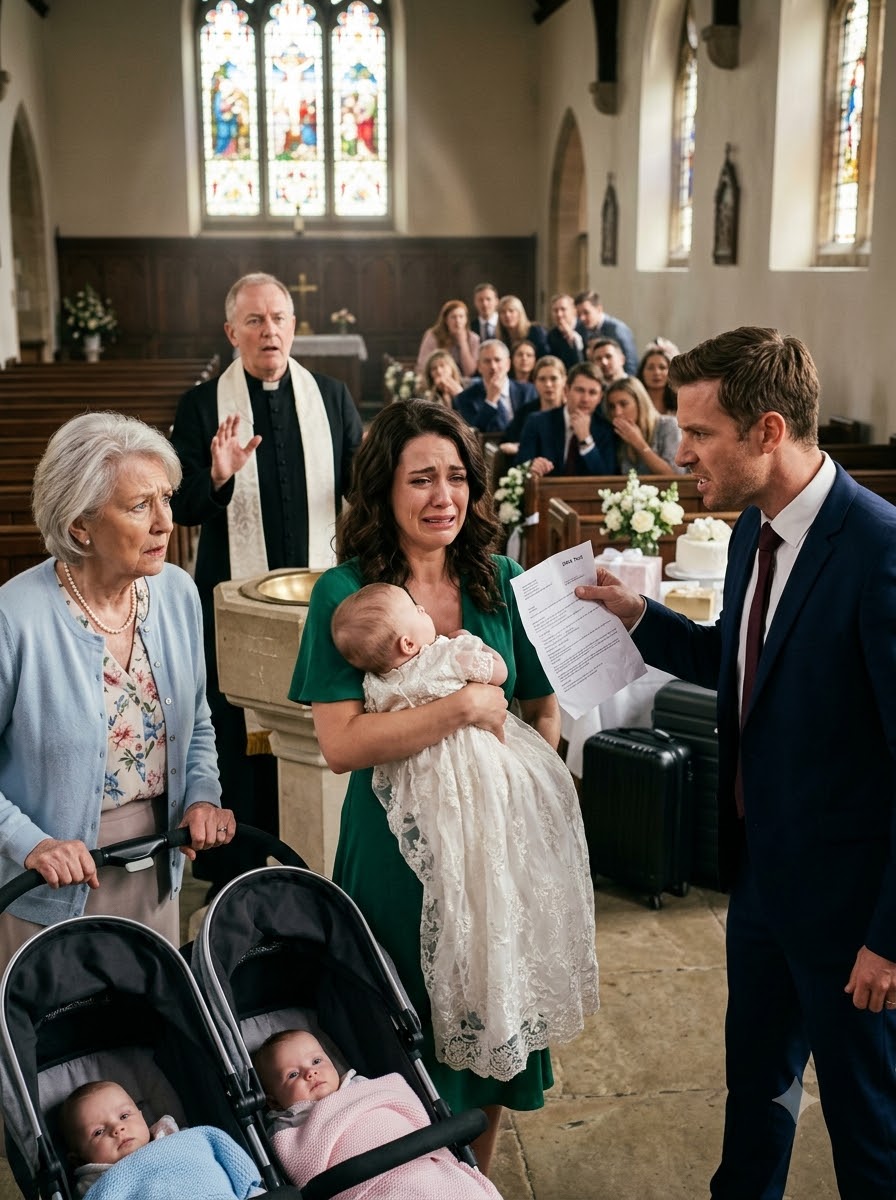
Instead, he opened an envelope and held up a document.
“These children aren’t mine.”
For several seconds, I couldn’t make sense of the words, even though I had heard every syllable.
Daniel placed the paper on the table and opened another envelope, explaining that he had arranged genetic testing and that the results proved he wasn’t the biological father of any of our children.
“I’ve spent months being made a fool of,” he continued, looking around the room rather than at me. “And I’m not going to pretend anymore.”
Our minister, Pastor Franklin, approached him and quietly suggested they speak somewhere private, but Daniel raised his voice.
“No, everybody deserves to know why I’m leaving.”
I stared at my husband, remembering the night Caleb had struggled to finish his first bottle and Daniel had sat beside his hospital crib whispering encouragement until the nurse gently told him visiting hours were over.
“Daniel, please tell me what you’re talking about,” I said, struggling to keep Hannah settled as she began to stir.
He looked at my wedding ring.
“You can start by taking that off.”
Behind him, his mother, Patricia, stood near the refreshment table, staring at the floor with an expression I couldn’t understand.
She didn’t appear confused.
She appeared ashamed.
That distinction would stay with me long after the afternoon ended.
When Daniel demanded the ring again, I removed it with trembling fingers and laid it beside the christening cake, not because I accepted his accusation, but because I could no longer bear to stand there arguing while our children grew restless.
He nodded, walked toward the coatroom, and retrieved a dark suitcase.
Only then did I understand that he had not come to the church looking for answers.
He had come prepared to leave.
Through the window, I watched him place the suitcase inside our family SUV and drive away, taking with him the vehicle that held all three infant car seats.
I was left standing in a church hall with three hungry babies, a diaper bag, and a room full of people who seemed unable to decide whether they should comfort me or believe him.
Then someone touched my elbow.
Her name was Margaret Collins, a retired elementary school librarian in her early seventies, whom I knew mostly from Sunday coffee gatherings.
“Honey, we’re going to get these babies somewhere quiet,” she said. “You don’t have to figure out anything else right now.”
She took the stroller handle, asked another woman to warm a bottle, and instructed the minister to help arrange safe transportation.
For the first time that afternoon, someone was treating my children as more important than the accusation.
Margaret stayed beside me while I opened the three envelopes in a small meeting room behind the sanctuary, where the sounds of conversation had faded and the only interruption came from Caleb’s occasional fussing.
Each report carried the name of a genetic laboratory, Daniel’s identifying information, and a conclusion excluding him as the biological father.
I read the first page twice before noticing the collection date.
April 8.
The same date appeared on all three reports.
“Something’s wrong,” I whispered.
Margaret leaned closer.
“What did you find?”
I explained that Daniel had recently told me he collected the babies’ cheek swabs at home while I was sleeping, claiming he had been quietly investigating his suspicions.
But on April 8, none of our children had been home.
All three had still been receiving specialized care in the hospital’s neonatal unit, and I had photographs, discharge papers, and daily medical updates documenting exactly where they were.
Margaret looked at the documents for a long moment.
“Then these papers need to be examined by someone who knows what they’re doing,” she said. “And until that happens, don’t let anybody convince you they prove anything.”
By early evening, her son had helped arrange three properly fitted infant car seats, and several church members had organized transportation to our house.
Margaret insisted on staying overnight, explaining that she had raised four children and could certainly manage a few bottles.
After midnight, while the babies finally slept, I sent Daniel a message asking where he had collected their samples.
His reply came almost immediately.
“At the house. You were asleep.”
I asked whether he was certain about the date.
“Of course I am.”
I sent him a photograph taken inside the neonatal unit that same afternoon, showing Hannah resting beneath a soft hospital blanket.
Several minutes passed before another message appeared.
“Maybe I mixed up the dates. It might’ve been at the hospital.”
I saved the entire exchange.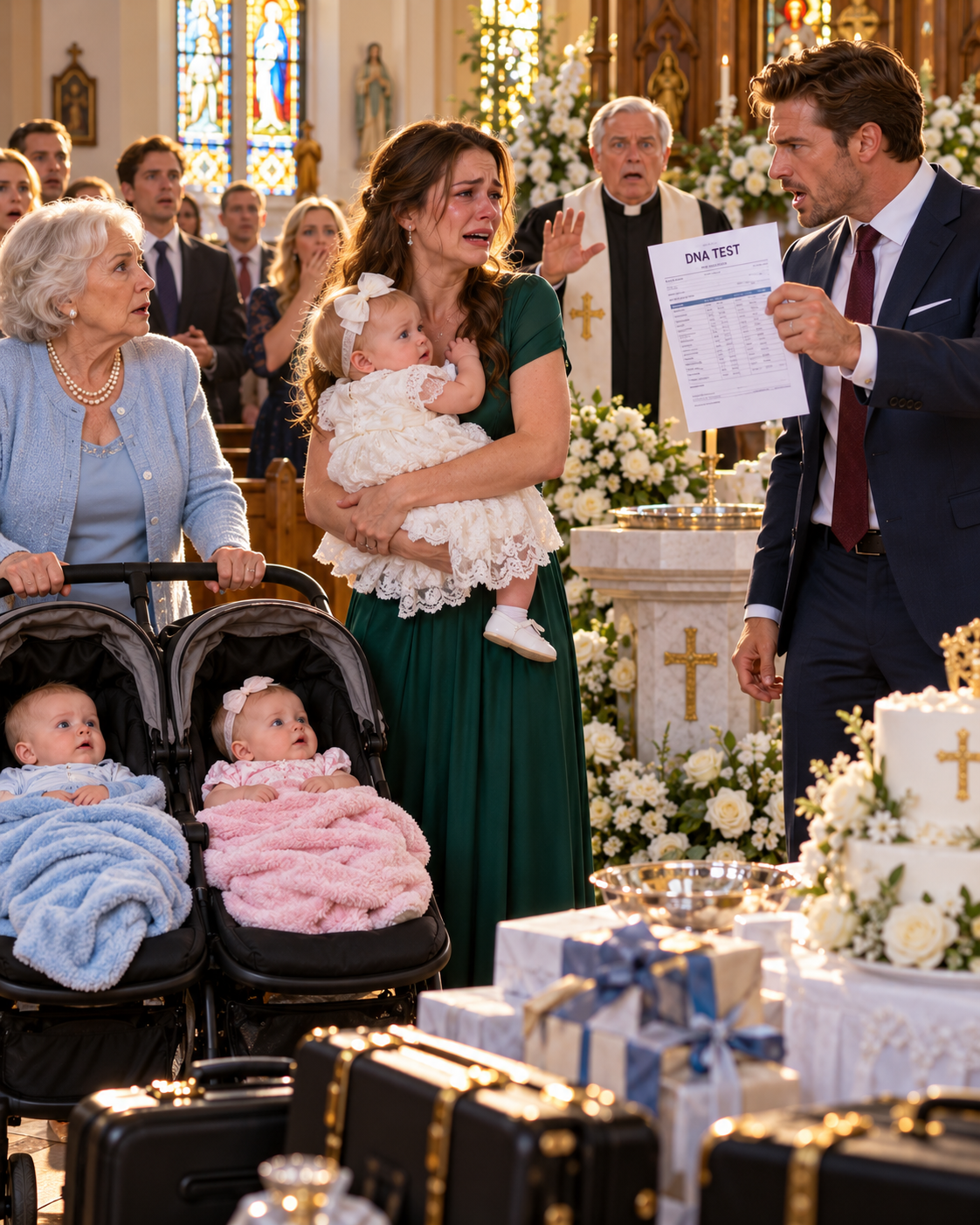
Daniel had been certain enough to humiliate me in front of our congregation, yet suddenly couldn’t remember where he had supposedly collected samples from three infants.
The following morning brought another problem.
When I attempted to check our savings account, the password no longer worked.
Daniel had managed our household finances for most of my pregnancy, telling me that my work as a county library coordinator and the demands of carrying three babies were more than enough responsibility.
I had accepted his help because marriage, as I understood it, meant trusting the person who promised to stand beside you.
Now I wondered what else I had trusted him not to tell me.
On Tuesday morning, Margaret stayed with the children while her son drove me to our credit union.
I expected to discover that Daniel had changed the password out of anger, and although I was frightened about paying our mortgage and caring for three infants, I still believed our savings would provide enough security to get us through the next several months.
A branch supervisor named Caroline Reed helped verify my identity before opening our account history.
I watched her expression become unusually serious.
“Mrs. Bennett, were you expecting a balance of approximately four thousand dollars?”
I thought I had misunderstood.
Our savings should have contained nearly ninety thousand dollars, including the money my father had left me several years earlier, which I had carefully set aside for emergencies.
“There should be much more than that,” I replied.
Caroline printed several transaction records and placed them between us.
Three transfers had been completed during March.
The first was for $26,500, the second for $31,000, and the third for $26,500.
Together, they totaled $84,000.
All three had been directed to a company called Cedar Hollow Development Partners.
I looked at the dates, feeling a growing uneasiness that had nothing to do with the amount.
Our children had been born on March 29.
Daniel had transferred the money before their arrival, weeks before the genetic tests he claimed had caused him to leave our family.
“Who approved these payments?” I asked.
Caroline explained that they had been initiated through Daniel’s authenticated online banking access, although that did not settle whether the transactions were proper or whether I had agreed to them.
She then showed me another document.
Someone had submitted a preliminary application for a substantial loan secured against our home, using financial information belonging to both of us.
My name appeared beside an electronic signature.
The accompanying email address looked almost like mine, except for two additional characters.
I had never created it.
“I didn’t authorize this,” I said.
Caroline immediately explained how to begin a formal dispute and request additional safeguards for my accounts and personal information.
Fortunately, the loan had not been completed because the lender required further verification.
I left the credit union holding a folder of documents and feeling as though I had discovered a second marriage hidden beneath the one I thought I knew.
When I returned home, Margaret was rocking Sophie near the living-room window.
“Did you get everything sorted out?” she asked.
I placed the statements on the coffee table.
“Daniel took eighty-four thousand dollars from our savings before the babies were born.”
Margaret studied the papers, then looked toward the nursery.
“Rebecca, you need a good attorney, and you need one soon.”
That evening, I searched Kentucky business records and discovered that Cedar Hollow Development Partners was connected to a real estate venture involving Daniel’s longtime business associate, Thomas Keller.
Daniel had always described Thomas as a dependable friend from his contracting days, someone who occasionally brought him opportunities through his work in commercial property inspections.
He had never told me they were involved in a struggling real estate investment.
When I called and asked about the transfers, his voice hardened.
“You had no business going through those records.”
“Daniel, that was our family savings.”
“Do you have any idea how expensive those babies have been?”
“Then show me the medical bills that explain eighty-four thousand dollars.”
He ended the call.
I sat at the kitchen table for nearly an hour afterward, listening to the baby monitor and wondering how many ordinary conversations during our marriage had concealed something important.
PART 2
By Thursday, I had met with a family-law attorney named Allison Brooks, a thoughtful woman in her forties who listened without interrupting while I described the christening, the questionable genetic reports, and the missing money.
She examined the documents carefully before explaining that Daniel’s public announcement did not, by itself, release him from his legal responsibilities toward children born during our marriage.
She also emphasized that we needed reliable testing, complete financial disclosure, and a careful review of the disputed loan application.
“We’re going to deal with the facts,” she told me. “Not with whatever story your husband wants people to believe.”
Two days later, Daniel’s attorney sent a proposed separation agreement.
I had expected him to demand another genetic test or request some arrangement involving the children.
Instead, most of the document concerned our house.
Daniel wanted me to leave within thirty days, transfer my ownership interest to him, and accept a modest payment in exchange for giving up further claims concerning our savings.
One paragraph suggested that accepting his terms would prevent additional embarrassment connected to the disputed parentage of our children.
I read that paragraph repeatedly, finally understanding why he had chosen the church rather than our kitchen to make his accusation.
He wanted witnesses.
He wanted neighbors discussing my supposed betrayal.
Most of all, he wanted me frightened enough of public judgment to surrender the home where I had planned to raise our children.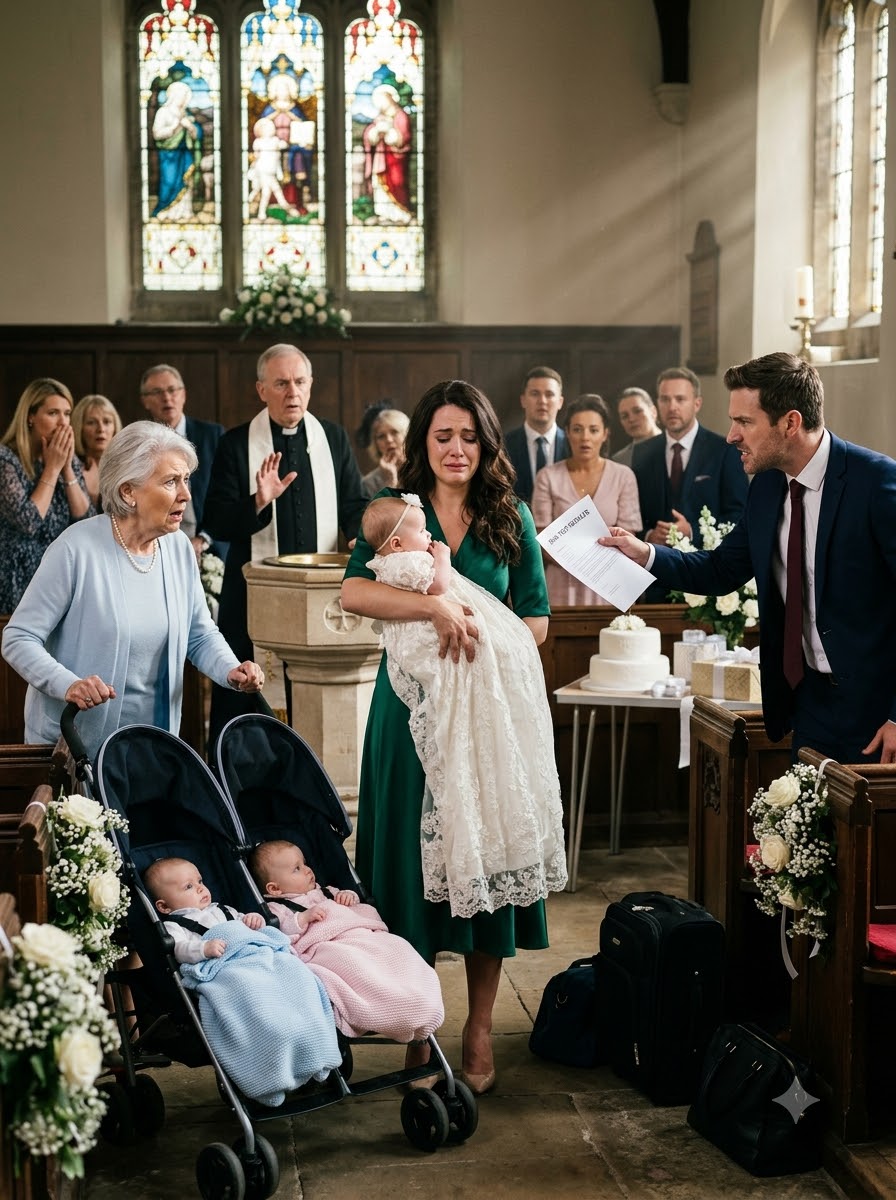
Allison advised me not to sign anything and explained that transferring property ownership would not necessarily remove my obligations under the existing mortgage.
Our house was valued at approximately $430,000, with a remaining mortgage of about $225,000.
There was substantial equity at stake, along with the savings Daniel had already transferred.
Further investigation revealed that Cedar Hollow’s property venture had encountered serious financial difficulties, including delayed payments to contractors and a financing obligation approaching $150,000.
Daniel had apparently hoped to obtain additional funds using our home as security, but the loan process had stalled.
I remembered an afternoon during my final weeks of pregnancy when he had placed a folder on the kitchen counter and asked me to sign several pages.
“It’s just paperwork for our financial planning,” he had said.
When I asked to read everything first, he became irritated.
“I wish you’d trust me for once.” I had been too tired to argue, but I had never signed.
Now that small decision seemed more important than I could have imagined.
The money he expected had not arrived, his business obligations remained, and suddenly he had produced three reports that would supposedly justify ending our marriage while pressuring me to surrender the house.
I couldn’t yet prove how all the pieces connected, but I was beginning to understand why Allison kept reminding me to preserve every document.
The following Saturday, Daniel’s mother appeared on my porch carrying a shopping bag filled with baby clothes.
Patricia had visited the hospital several times after the triplets arrived, and I remembered her holding Caleb with tears in her eyes while promising that she would always be there for her grandchildren.
Yet at the church, she had stood silently while her son denied them.
I stepped outside and closed the door behind me.
“Did you know what Daniel was planning to say at the christening?”
She adjusted the handles of the shopping bag.
“He was very upset, Rebecca.”
“That’s not what I asked.”
After a long silence, she admitted that Daniel had told her he possessed proof that the babies were not his.
“He said he needed people to understand why he couldn’t stay,” she explained.
I looked at her, remembering how carefully Daniel had positioned himself beside the cake and how quickly he had retrieved the suitcase waiting near the entrance.
“So you knew he was going to do it in front of everybody?”
Patricia lowered her eyes.
“I didn’t know about the money.”
“But you knew he was going to stand in front of our friends and say those things about three babies who couldn’t even understand what was happening.”
She began to cry, and although there had been many occasions during our marriage when I had comforted her through disagreements with her son, I could not bring myself to do it this time.
“Whatever Daniel told you about me, those children deserved better from both of you.”
I went back inside, leaving the bag on the porch.
That evening, Margaret found me sitting on the nursery floor, folding pajamas that had become too small almost overnight.
I asked her why so many people at the church had remained silent.
She thought about the question before answering.
“People sometimes convince themselves that staying out of something is the same as doing the right thing,” she said. “But there are moments when silence helps the wrong person.”
I looked at her.
“You didn’t stay silent.”
She smiled sadly.
“I was frightened too, honey. I just figured you and those babies needed somebody more than I needed to feel comfortable.”
Her words stayed with me because, during the most humiliating week of my life, a woman who had barely known me had offered more practical kindness than people I had considered family.
Several weeks passed before the questions surrounding the genetic reports began to receive clearer answers.
Through the appropriate legal process, Allison sought information about the laboratory identified on Daniel’s documents, and serious inconsistencies emerged in the report numbers and sample records.
The laboratory had not authenticated the documents he had displayed at church.
Meanwhile, a properly supervised, identity-verified genetic test was arranged as part of the family proceedings.
Daniel resisted at first, arguing that the reports he already possessed should be sufficient, but the court process continued.
When the verified results arrived, Allison invited me to her office.
I remember the rain tapping against her window and the way she placed a tissue box near my chair before opening the envelope.
“Rebecca, the results establish that Daniel is the biological father of all three children.”
I had known the truth all along, yet hearing it confirmed after weeks of whispered conversations and public judgment brought tears I had been holding back since the christening.
Allison allowed me a few moments before explaining that the financial investigation was also progressing.
Records obtained through the proceedings connected the transfers to Daniel’s property venture, and additional documentation raised questions about the source of the electronic consent attached to the proposed home loan.
The matter required further review, but the evidence no longer supported the simple story Daniel had told our congregation.
He had moved substantial money before the children were born, attempted to obtain financing connected to our house, and later used questionable genetic reports to justify leaving us.
The complete financial consequences would take time to resolve, and Allison never promised an outcome she couldn’t guarantee.
But temporary arrangements were established to address the children’s support, the disputed financial matters remained under review, and I was not required to surrender our home simply because Daniel demanded it.
Eventually, several members of our congregation learned that the verified testing contradicted his public accusation.
Some apologized for believing him.
Others admitted they had suspected something was wrong but hadn’t known what to say.
I accepted their words without pretending the afternoon had been forgotten.
Patricia wrote me a letter asking whether she might someday rebuild a relationship with her grandchildren, and I told her that any future contact would have to be guided by the children’s well-being rather than by her desire to put the past behind us.
As autumn settled over Kentucky, our house slowly began to feel like a home again.
Hannah learned to roll onto her stomach, Caleb developed a laugh that sounded almost like a hiccup, and Sophie discovered that kicking her feet against the crib mattress could produce a wonderfully satisfying noise.
Margaret continued visiting every Sunday afternoon, usually carrying something she insisted she had cooked too much of, and sometimes we sat together at the kitchen table while the babies slept, talking about ordinary things that had nothing to do with attorneys or financial statements.
One afternoon, I found the little white shoes that had decorated our christening cake tucked inside a kitchen drawer.
For a moment, I was back in that crowded fellowship hall, holding my daughter while my husband asked me to remove my wedding ring.
Then Caleb began calling from the nursery, and I placed the shoes on a shelf beside the children’s first photographs.
I no longer wanted that Sunday to be the story our family would always tell about their beginning.
There had been betrayal, certainly, and there were still difficult decisions ahead, but there had also been a retired librarian who stepped forward when everyone else hesitated, a handful of neighbors who found three safe car seats, and a mother who discovered that she could protect her children even when the person she had depended upon chose not to.
Months earlier, I had believed the most important promise in my life was the one Daniel and I had made at our wedding.
Now I understood that another promise had quietly taken its place, one I made every morning when I walked into the nursery and saw three small faces turning toward me.
Whatever happened with the house, the money, or the marriage, my children would never have to wonder whether they were wanted.
And although Daniel had stood before an entire church trying to decide what our family would be remembered for, he had overlooked something that no carefully prepared document could change.
The truth did not belong to him simply because he had spoken first.
