

PART 2
“You were more worried about what she thought of you than what I thought of you.”
He didn’t deny it.
That was the moment something inside me shifted.
Not because I suddenly stopped loving him. Feelings don’t vanish on command, even when someone gives you every reason to wish they would.
But I stopped trying to find an explanation that would make his choices hurt less.
I took a breath.
“I need you to sleep somewhere else tonight.”
His head snapped up.
“What?”
“You can stay with a friend or book a hotel. I don’t care which. But I need space.”
“You’re kicking me out over a message?”
“I’m asking you to leave because I no longer know what our marriage means to you.”
He stood abruptly.
“You can’t throw away seven years because of something that happened before we were even together.”
“I’m not throwing away seven years. I’m trying to understand whether those seven years were what I believed they were.”
“They were!”
“Then you should have trusted me enough to tell me the truth.”
He began crying again.
I had seen Daniel cry when I paid for his surgery. I had seen him cry when the splint came off and he first saw his new reflection.
Those tears had seemed like relief.
These looked like fear.
He packed a small bag and left just after sunset.
At the door, he turned toward me.
“Please don’t make a decision about us tonight.”
“I’m not making one tonight,” I replied. “I’m finally allowing myself to think about one.”
He stood there for several seconds, waiting for me to soften.
I didn’t.
When the door closed, the house fell silent.
I walked into the bedroom and found the photograph still lying on the bed.
Claire’s handwriting was small and slightly slanted.
If you ever find your way back to her, remember that she deserves someone who sees her heart before her face.
I sat down and read it again.
Then I called my sister.
She answered on the third ring.
“Hey! Everything okay?”
I tried to speak, but my throat tightened.
“Nora? What’s wrong?”
I told her about the photograph, the messages, and what Daniel had confessed.
She listened without interrupting.
When I finished, she exhaled slowly.
“Oh, sweetheart.”
That was all she said at first.
Then, after a moment, she asked, “Do you want to know what happened between us?”
“Yes.”
“I thought you might eventually ask.”
I closed my eyes.
“Why didn’t you tell me before?”
“Because I never thought it mattered. I turned him down once, years before you started dating. He was embarrassed, and I felt bad about hurting his feelings, but that was the end of it as far as I was concerned.”
“Did you know he was interested in me because of you?”
“No. I didn’t.”
She paused.
“But I remember the first time you brought him to dinner. He asked me so many questions about my life that I thought he was just nervous around your family. When he started dating you, I assumed he had genuinely fallen for you.”
“So you never suspected?”
“Not until he messaged me recently.”
I gripped the phone.
“What did you think when you read his message?”
“I thought he was trying to rewrite the past.”
Her voice grew firmer.
“Listen to me. Whatever he felt about me back then, that was his responsibility to deal with. It was never your job to make him feel better about being rejected.”
I wiped my cheeks.
“I know.”
“And paying for his surgery doesn’t mean you owe him endless patience. You did something loving for your husband. You shouldn’t have to regret being generous because he made a selfish choice.”
For the first time all evening, I began to cry.
Not the sharp, panicked crying that had come when I read Claire’s note, but the kind that follows the realization that you don’t have to keep pretending you’re fine.
My sister stayed on the phone until I calmed down.
Before we hung up, she said something I would remember for a long time.
“You cannot love someone into respecting you. They have to choose that themselves.”
That night, I barely slept.
I replayed years of memories, searching for signs I might have missed.
Had Daniel asked about Claire too often?
Had he ever seemed disappointed when she couldn’t attend a family gathering?
Had I mistaken his eagerness to please my relatives for simple affection?
I couldn’t find a clear answer.
Some memories looked different in hindsight. Others still felt genuine.
And that uncertainty was almost harder to bear than the confession itself.
The following morning, Daniel sent me a long message apologizing.
He said he understood why I was hurt. He admitted that he had been foolish, insecure, and selfish. He promised that he would never contact Claire again.
Then he asked whether we could talk.
I agreed to meet him that afternoon at a quiet café near our house.
When I arrived, he was already seated at a table by the window.
He looked tired. His eyes were swollen, and he kept turning his wedding ring around his finger.
For a moment, I remembered the man I had married.
The man who had held my hand beneath a table during my father’s funeral. The man who had driven across town in the middle of the night when I was sick at college. The man who had once spent an entire weekend assembling a bookshelf because I had mentioned wanting one.
I couldn’t simply erase those memories.
But I couldn’t allow them to erase what had happened, either.
Daniel stood when he saw me.
“Thank you for coming.”
I sat opposite him.
“Tell me what you want to say.”
He took a deep breath.
“I’ve been thinking about what you said. About how I cared more about Claire’s opinion than yours.”
I waited.
“I think you’re right.”
It was the first time he had acknowledged that without trying to defend himself.
“I spent so much of my life believing that if I could change my appearance, people would finally see me differently. I thought the surgery would fix something inside me, too.”
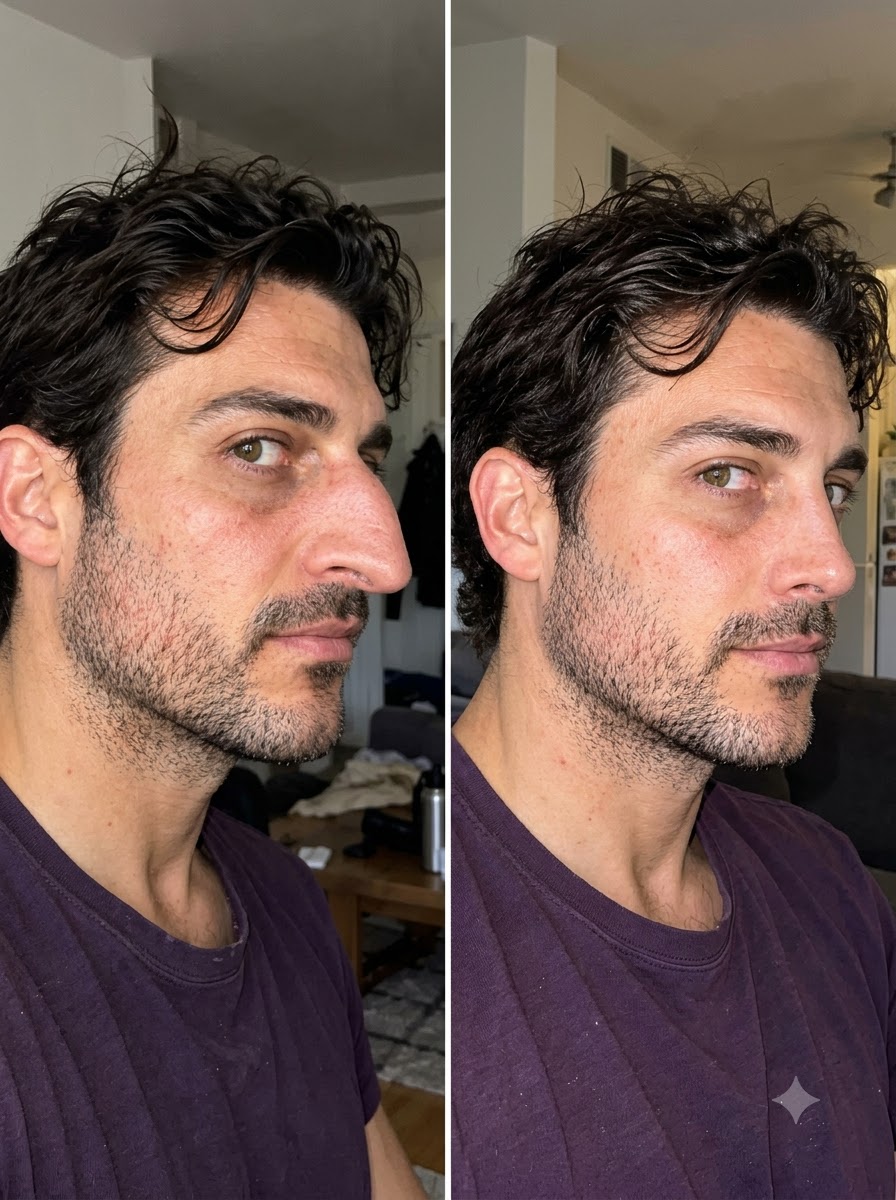
He touched the bridge of his nose, then lowered his hand.
“It didn’t. I felt better when I looked in the mirror, but I still wanted someone from my past to tell me I was good enough.”
“Why did it have to be Claire?”
“Because she was the rejection I never got over.”
He looked directly at me.
“And because I was too cowardly to admit that to myself.”
I stirred my untouched coffee.
“What do you want from me now?”
“I want another chance.”
He spoke quickly, then forced himself to slow down.
“But I know I can’t demand one. I know saying I’m sorry doesn’t undo what I did.”
For the first time since our conversation began, I believed he understood at least part of the damage.
But understanding was not the same as repairing it.
“I need you to answer one question honestly,” I said.
He nodded.
“If Claire had responded differently—if she had told you she was interested in you now—would you have pursued her?”
Daniel’s expression changed.
He looked toward the window.
I waited.
“I don’t know,” he finally admitted.
The answer hurt, but it was honest.
“That uncertainty is exactly why I can’t promise you anything.”
He lowered his head.
“I understand.”
I studied him for a moment.
“Daniel, I don’t think you’re a monster. I think you were insecure, and you made a choice that hurt the person who trusted you most. But you can’t expect me to carry the consequences of your insecurity for you.”
“I’m not asking you to.”
“You were, though. Every time you hid something because you were afraid I’d think less of you, you were asking me to live with a version of you that wasn’t real.”
His eyes filled again.
“I know.”
We sat quietly until the café’s lunchtime crowd began to grow around us.
Eventually, I stood.
“I need time. Real time. I don’t want daily messages asking if I’ve changed my mind. I don’t want you showing up at the house to convince me that you’re sorry. If we have any chance of figuring this out, you need to respect the space I’m asking for.”
He nodded.
“All right.”
“And Daniel?”
He looked up.
“Don’t contact Claire again.”
“I won’t.”
I left before either of us could say anything else.
For the next several weeks, we lived apart.
Daniel stayed with his brother while I remained in the house. We communicated only about practical matters, and for once, he respected the boundaries I had set.
I focused on work, spent more time with Claire, and began making plans that had nothing to do with my marriage.
I even started looking at cars again.
At first, I felt guilty about that.
The savings account had been nearly emptied to pay for Daniel’s surgery. Every time I thought about buying something for myself, I remembered the nights I had spent beside him, listening to him complain about the swelling and reassuring him that everything would be fine.
But eventually, I understood something important.
Helping him had been my choice.
What he did afterward had been his.
I didn’t have to punish myself for having loved someone sincerely.
About a month after Daniel moved out, he sent me an email.
He had begun seeing a therapist.
He wrote that he had spent years measuring his worth by how other people responded to him. He had convinced himself that Claire’s rejection proved something permanent about him, and he had allowed that old wound to influence his decisions long after the rejection itself should have become irrelevant.
He also admitted that he had treated the surgery as though it were a key that might unlock someone else’s approval.
I wanted to look different because I thought it would make me feel different, he wrote. But I didn’t do the work of understanding why I needed other people to validate me so badly. I let you pay for a change in my appearance while I ignored the things I needed to change about myself.
I read the email twice.
Then I closed it without replying.
His words mattered, but they didn’t obligate me to return.
Over the next few months, Daniel continued therapy. He didn’t pressure me to reconcile or ask Claire to intervene. He sent occasional updates only when necessary, and he followed through on the practical responsibilities we still shared.
I began to see that he was trying to take responsibility.
I also began to see how much of myself I had set aside while trying to make our marriage work.
I had delayed replacing my car. I had postponed a professional course because we were saving for a holiday. I had often agreed to Daniel’s plans because I believed a good marriage meant supporting each other’s dreams.
There was nothing wrong with generosity.
The problem was that I had gradually started treating his happiness as my responsibility, even when he wasn’t treating my trust with the same care.
That realization changed the way I thought about our future.
Three months after he moved out, Daniel asked if I would meet him for dinner.
I agreed.
We chose a small restaurant we had visited during our first year together. Neither of us mentioned the significance of the place, but I suspected we were both thinking about it.
Daniel looked different from the last time I had seen him.
Not physically. His nose had healed completely, and he still looked pleased with the result.
But he seemed less eager to fill every silence.
He asked about my work and listened to the answers. He told me about therapy without turning the conversation into a speech about how much he had changed.
Then, halfway through dinner, he put down his fork.
“I need to tell you something.”
I felt my shoulders tighten.
“Go ahead.”
“I’ve been thinking about the money you spent on my surgery.”
I looked at him.
“I know I can’t give you back the way you trusted me before. And I know the money wasn’t a loan. You gave it to me because you loved me.”
He paused.
“But I want to repay you anyway.”
I frowned.
“Daniel, that’s not what this is about.”
“I know. I’m not trying to buy forgiveness. I’ve set aside money from my paychecks, and I’d like to return what I can. Not because you asked me to, but because I don’t want to pretend your sacrifice didn’t matter.”
I considered his offer.
Part of me wanted to refuse immediately. Another part recognized that repaying the money would help restore something practical that had been lost, even if it couldn’t repair the emotional damage.
“All right,” I said. “We can discuss a reasonable plan. But I don’t want you using it as proof that I should take you back.”
“I won’t.”
“And if we decide not to reconcile, that agreement still stands.”
He nodded.
“Of course.”
For the first time, we had discussed something difficult without either of us trying to force the conversation toward the outcome we wanted.
It wasn’t forgiveness.
But it was progress.
After dinner, Daniel walked me to my car.
Before I got in, he said, “I know you may never want to be married to me again.”
I looked at him.
“I hope that’s not the case, but I understand why it could be.”
