

Chapter 1: The Midnight Ultimatum
At precisely 2:07 a.m., the glow of my phone cut through the suffocating darkness of our bedroom. Its vibration against the mahogany nightstand sounded strangely loud, almost like an alarm. I reached for it, the cool Virginia air raising goosebumps along my bare arm, and opened the message.
It was from my husband, Ethan Whitmore. He was asleep—or so I had believed—in the guest suite down the hall, supposedly preparing for the enormous logistical task of our son’s seventh birthday party the following day.
Instead, he was writing the death sentence of our marriage.
“Claire, please don’t come down for the party tomorrow. There will be important people there. Investors. Mom thinks the way you dress and talk will embarrass us. I’m sorry. Noah will be too busy to notice.”
I stared at the illuminated screen. I was lying inside a custom-built, ten-million-dollar estate in Great Falls, Virginia—a sprawling architectural masterpiece with towering ceilings and imported marble that I had secretly rescued from foreclosure five years earlier. Yet here, inside the heart of this fortress, my husband was asking me to disappear.
I didn’t cry. I didn’t throw the phone against the Venetian plaster walls. Twelve years in the military had trained panic out of me, replacing it with a calm, calculating stillness.
I typed a simple two-word response: “I understand.”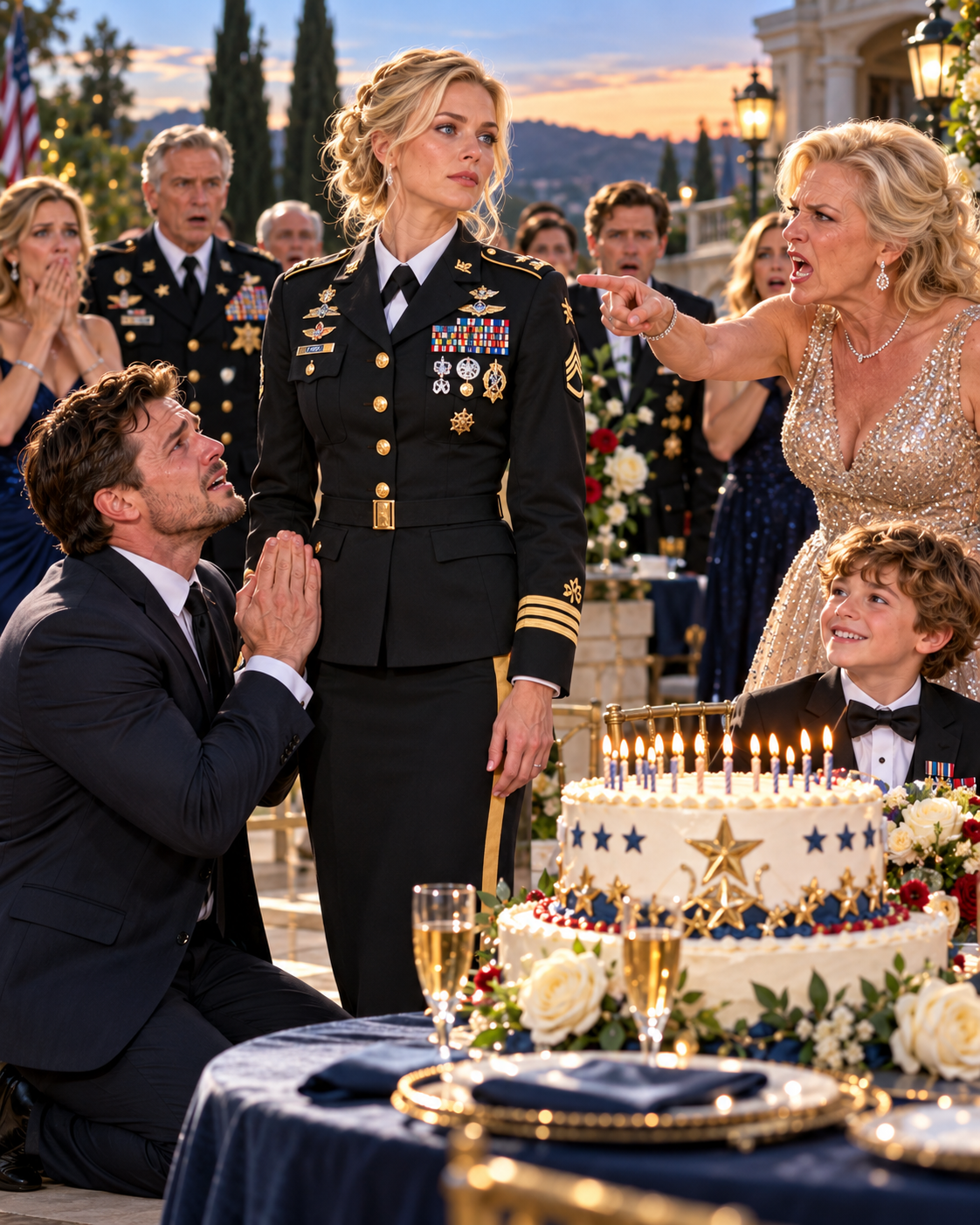
What Ethan completely failed to realize was that for more than a decade, I had allowed his blue-blood, old-money family to mistake my silence for weakness. They were people who measured value through country club memberships and inherited trusts. They ridiculed my practical wardrobe, my aging but dependable SUV, and my deliberately vague answers about my “government job.”
His mother, Margaret Whitmore, a woman whose veins seemed to carry vintage champagne and venom, had once loudly asked at a charity gala whether I had bought my evening gown from a wholesale supermarket. His father, Richard, regularly introduced me to his golf companions as Ethan’s “sweet wife who files paperwork for the state.”
I had never corrected them. I had simply allowed their misconceptions to grow.
The truth was entirely different. I had enlisted in the United States Army at eighteen and fought my way upward from the dirt into the senior officer ranks. I had commanded combat troops in hostile theaters, delivered classified briefings inside windowless Pentagon rooms, and worked within geopolitical shadows the Whitmore family lacked the security clearance to even imagine.
But sitting alone in the darkness that night, the insult wasn’t about my wounded pride. It was about the collateral damage sleeping in the room beside mine.
My son, Noah, was curled beneath his comforter, surrounded by the aerospace decorations I had spent three weeks carefully finding and assembling. Only hours earlier, while I tucked him into bed, his little hand had held tightly onto my sleeve.
“Front row, Mom?” he had asked, his eyes wide with the desperate hope of a child who could sense a tension he didn’t understand.
“Front row,” I had promised him.
My phone vibrated again. This time, the message was from Margaret.
“Thank you for being reasonable, Claire. Noah will be distracted by his little friends. He won’t even know you aren’t there.”
Something deep and structural broke inside my chest. It wasn’t a dramatic crack, but the quiet, final snap of a wire restraining an enormous weight.
I pushed back the covers and walked barefoot down the hallway to my locked study. I pressed my thumb against the biometric scanner of a wall safe Ethan had never once bothered to ask about. The thick steel door clicked open.
Inside were two separate realities. On the left lay my military identification, deployment orders, and an official photograph of me in dress uniform. On the right was a thick blue folder containing the property deed, detailed financing records, and undeniable legal proof that the holding company controlling the estate—Ashford Residential Holdings—was entirely mine.
Five years earlier, Ethan’s luxury development company had nearly collapsed. His father had coldly refused to rescue him, saying the market needed to “teach the boy a lesson.”
I had saved him. Quietly, ruthlessly, and anonymously.
At 3:41 a.m., I called my private attorney.
“Howard,” I said, my voice barely louder than a whisper, yet razor-sharp. “I need you to pull and review every single document connected to the Great Falls property. Tonight.”
Howard Vance hesitated, the sound of bedsheets shifting faintly through the receiver. “Claire? It’s the middle of the night. What exactly happened?”
“My husband just informed me that I am an embarrassment and not welcome at my son’s birthday party. In the house that I own.”
The silence on the other end was absolute. Then I heard a lamp click on. “I’ll have the portfolio ready by dawn.”
By 4:12 a.m., Howard confirmed what I already knew: legally, functionally, and undeniably, I controlled the Whitmore estate.
I made one final tactical decision. My mandatory military leave expired at midnight. A government transport was already scheduled to collect me for an emergency command briefing. Normally, I arranged these pickups at a discreet location miles away to keep Margaret’s prying eyes and Ethan’s uncomfortable questions at a distance.
I opened my encrypted messaging app and changed the extraction coordinates. I entered our exact home address.
Then I turned toward the garment bag hanging from the back of my study door.
It was time to stop being a ghost. CHAPTER 2: THE FRONT ROW
By nine the next morning, a procession of European luxury cars had begun filling our winding driveway. From the second-floor landing, hidden from view, I watched the arrival of the “important people”—venture capitalists, technology executives, and high-society followers.
At 9:16 a.m., my phone buzzed in my pocket. Ethan.
“Thanks again for understanding, Claire. Maybe just stay upstairs until the caterers clear out.”
I didn’t answer. Instead, I turned from the balcony and entered my dressing room. I pulled open the zipper of the garment bag.
Downstairs, the soft murmur of wealthy conversation suddenly faded, replaced by the chaotic, off-key chorus of thirty guests singing “Happy Birthday.” I was supposed to be standing among them.
Halfway through the song, the singing faltered and stopped. Noah’s small, frantic voice broke through the silence.
“Wait! Where’s Mom?”
Margaret’s sweet, patronizing voice floated up the staircase. “Oh, sweetie, Mommy had some very boring paperwork to do upstairs. She’s busy.”
“No!” Noah cried, his voice cracking with panic. “She promised! She said front row!”
I stepped from the shadows and began walking toward the grand staircase. The instant my foot reached the top step, the heavy brass doorbell rang.
Through the enormous floor-to-ceiling windows beside the entrance, the guests could see them. Three matte-black armored government SUVs had silently arrived in the driveway, surrounding a line of polished Mercedes and Porsches. Several uniformed personnel climbed out, their boots striking the gravel in an unnervingly synchronized rhythm.
I started down the stairs.
Margaret was the first to notice me. For twelve years, that woman had used her words like a scalpel, searching for the smallest imperfections in my posture, vocabulary, and very existence.
That morning, as she looked up at me, her mouth fell open. The scalpel was gone.
Ethan turned, a crystal champagne flute suspended halfway toward his parted lips. The color drained from his face until he looked almost like a wax figure.
“Claire?” he whispered.
I continued down the staircase with controlled, deliberate steps. The weighty fabric of my dress uniform moved around me. Ethan’s frantic gaze traveled from the gold insignia on my shoulders to the colorful rows of commendation ribbons across my heart.
“What… what rank are you?” he stammered, the realization striking him with the force of physical blows.
Before I could respond, a silver-haired technology CEO near the entrance whispered, “Oh, my God.”
The heavy oak door opened. A towering officer crossed the threshold. He surveyed the room before his eyes settled on me at the bottom of the stairs. Instantly, he brought his heels together, straightened his spine, and delivered a precise, textbook salute.
“Ma’am.”
The enormous, crowded foyer fell into a silence so complete it seemed to suck all the air from the room. Nobody moved.
And just as Ethan appeared ready to collapse, a sleek town car arrived behind the military convoy. Howard Vance stepped out, straightening his suit jacket while holding the thick blue folder tightly against his side.
Ethan knew him. He knew the folder.
“Claire,” Ethan whispered, his voice shaking, “what are you doing?”
I fixed my eyes on the man I had married, and on the family that had spent four thousand days convincing themselves I should be grateful for whatever scraps of tolerance they offered me.
“Howard,” I said quietly, my command carrying across the marble foyer. “Open it.”
Howard walked into the foyer and placed his hand on the cover of the blue folder. CHAPTER 3: THE BLUE FOLDER
For a brief moment, I almost called everything off.
Not because my determination had weakened, but because I saw Noah. He stood beside a towering pile of presents, a crooked paper crown on his head, looking between his father and me. His little face was twisted with the solemn, frightened confusion that only a seven-year-old caught in adult conflict could understand.
This was his day. Whatever damage existed at the foundation of my marriage, I refused to transform my son’s birthday into a public execution.
“Howard,” I said, my voice changing from steel to velvet.
He stopped and looked up.
“Not yet.”
Margaret, predictably, was the first to recover. Shock was temporary for a woman whose main defense was unchecked arrogance. She straightened the front of her designer blouse, her eyes moving from Howard to me and then to the heavily armed officers by the door.
Her lips compressed into a thin, colorless line. “Well,” she said, forcing out a brittle, tinkling laugh that sounded like shattered glass. “This is certainly… theatrical.”
No one laughed with her. The guests remained motionless.
The senior officer who had saluted me shifted his stance. Colonel Marcus Reed. He had served beneath my command during a brutal fourteen-month deployment in a theater Ethan probably couldn’t locate on a map. Marcus knew me. He knew how much I despised unnecessary displays.
His dark eyes moved toward Noah, taking in the collateral damage, before returning to me.
“Ma’am,” Colonel Reed said, his deep voice carrying the effortless authority of someone accustomed to issuing commands in active warzones. “The convoy can hold on your timetable.”
That one respectful sentence landed like a mortar shell in the center of Ethan’s social circle. Everyone immediately understood: the vehicles weren’t rented props. The soldiers weren’t performers. And the woman standing on those stairs wasn’t pretending.
Ethan slowly placed his champagne glass onto a passing tray. His complexion had turned gray and sickly.
“Claire,” he pleaded quietly, taking a step forward. “What exactly is going on?”
I looked at him carefully. For more than a decade, this man had learned my habits by heart. He knew I drank my coffee black. He knew I hated cilantro. He knew exactly how my sigh sounded when I was exhausted. Yet he had never been curious enough—or brave enough—to discover who the woman actually living in his home was.
“You asked me to stay upstairs,” I said, my voice calm as it carried across the room.
His jaw tightened. “I didn’t mean—”
“You sent me a message at two in the morning, Ethan. You specifically uninvited me from our son’s birthday.”
A murmur traveled through the wealthy crowd. Several guests suddenly found their shoes fascinating. Ethan sensed the atmosphere changing. His embarrassment quickly turned into defensiveness.
“Can we please not do this in front of our guests?” he whispered sharply, stepping closer as though he could contain me.
I nearly smiled. That was the Whitmore family philosophy: Cause the damage publicly, then conceal it privately.
“No,” I answered. “We are not doing anything right now.”
I turned away from him and headed toward Noah. The crowd separated around me like water.
I lowered myself to my knees, the rigid fabric of my uniform folding beneath me, until I was level with my son. His paper crown had slipped over his left ear, and a smear of chocolate frosting stained the corner of his trembling mouth.
“Hey, birthday boy,” I whispered.
He stared at the brass buttons on my chest. Slowly, cautiously, he reached out and touched the edge of one of my colorful service ribbons. “Are you going to work, Mom?”
“I am.”
His small shoulders sank. “But… you promised.”
“I know.” I reached inside my jacket and took out a small wrapped box. “I also promised I would be in the front row.”
Noah blinked, trying to make sense of the adult tension filling the room. “So?”
“So, before I deploy, you and I are going to finish this party exactly as we planned.”
He searched my eyes, looking for any sign that I wasn’t telling the truth. “Really?”
“Really.”
Noah immediately wrapped his arms around my neck and buried his face against my collar. Over his shoulder, my eyes met Ethan’s. In that brief moment, I watched understanding appear on my husband’s face. He finally realized what his mother never had: this display wasn’t about using my status to humiliate them. It was about refusing, publicly, to let their shame control my existence for another second.
I rose, keeping Noah’s hand in mine, and looked toward Colonel Reed. “Twenty minutes, Colonel.”
“Yes, ma’am.” No hesitation. No questions. Only complete and unwavering respect.
I turned toward the frozen crowd. “Please. Continue.”
Nobody moved.
Noah was the one who broke the spell. He tugged at Ethan’s slacks. “Dad, you have to light the candles again. They melted.”
The absurdity of a seven-year-old giving instructions to a room full of millionaires almost made me laugh. Ethan remained motionless, staring at me as though I were a stranger who had somehow entered his home.
“Dad!” Noah insisted.
Ethan flinched. “Right. Yes. Of course, buddy.”
His hands trembled so badly that he dropped the lighter twice before finally getting a flame.
We sang again.
This time, I stood beside my son. Front row.
For the next fifteen minutes, I stayed inside a small bubble with Noah, ignoring the horrified whispers and crushing tension surrounding us. I helped him open the motorized telescope I had bought for him. I laughed sincerely when a stray blob of frosting landed on my dress shoe. I watched Margaret standing beside the kitchen island, looking as though she were struggling to breathe.
At exactly 9:39 a.m., Colonel Reed stepped forward.
“Ma’am. Time.”
Noah’s smile disappeared. I crouched down and pulled him tightly against me.
“I have to go command my team now,” I told him.
“Will you come back?” he asked, his voice barely audible.
The question cut deeper than any insult Margaret had ever thrown at me. Children are emotional sponges; they absorb the fears their parents never say aloud.
I gave Ethan a cold look. He couldn’t meet my eyes.
“Yes, my love,” I promised Noah. “I am coming back.”
I stood and smoothed my jacket. Howard Vance caught my attention. The blue folder was still in his hands.
I pointed toward him. “Come with me, Howard.”
Ethan suddenly lunged forward, panic overcoming his paralysis. “No. Claire, wait!”
I stopped at the door.
Margaret appeared beside him and grabbed her son by the arm. “Ethan, let her leave.”
He violently pulled free of her grip. “Shut up, Mom.”
That caught me off guard.
He hurried toward me, his chest rising and falling rapidly. “What is in that folder, Claire?”
I looked at Howard, then returned my gaze to my husband. “Documents.”
“What kind of documents?”
“The kind you signed without reading when you were desperate, Ethan.”
His pupils widened. Five years earlier, when his company had reached its lowest point, Ethan had been drowning beneath debt. His father had left him to fend for himself. Margaret had blamed the economy. Ethan had signed dozens of emergency restructuring documents delivered by an anonymous angel investor, too relieved by his rescue to question where it had come from.
He knew a holding company had purchased his debt. He simply never cared enough to find out who owned it.
“Claire,” he whispered, as though the world were collapsing around him. “Who owns Ashford Residential?”
I said nothing.
Howard adjusted his glasses. “My client does.”
The collective gasp from the nearby guests was unmistakable.
Ethan staggered backward slightly. “You? You bought the mortgage?”
“Yes.”
“And the secondary liens? The Arlington guarantee?”
“Yes.”
Margaret forced her way toward the front, outrage covering her face. “Now, see here! This is ridiculous!”
Howard turned his imposing frame toward her. “Mrs. Whitmore, as legal counsel, I strongly advise you to close your mouth.”
Margaret gasped. Nobody spoke to her that way. She straightened indignantly. “This is a private family matter!”
“It became a legal matter five years ago, ma’am,” Howard answered coolly.
Ethan looked physically sick. “Why didn’t you tell me, Claire?”
“Because,” I replied without pity, “when the crisis ended, you celebrated. Your father told everyone at the country club that you had ‘weathered the storm.’ You allowed everyone to applaud your business success. You never once asked who had thrown you the life raft. And I allowed you to believe the lie.”
Margaret made a sharp, mocking sound. “This is a stunt. Ethan built this house.”
I lifted a hand, stopping Howard before he could open the folder. Then I stepped closer to Margaret until she had no choice but to look up at me.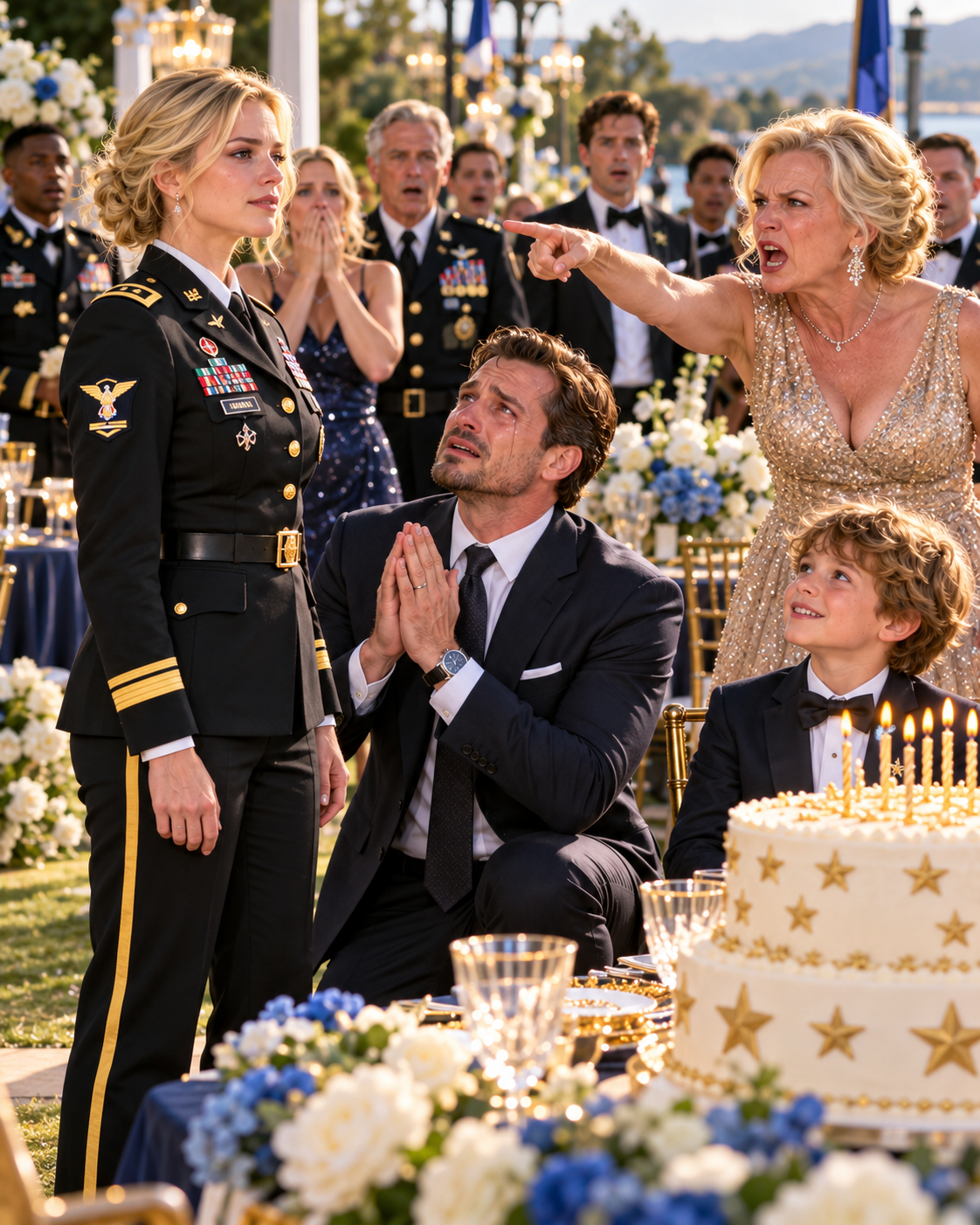
“No, Margaret. Ethan merely lived in it.”
Her nostrils flared. “You think a fancy costume and some forged papers make you our equal?”
I felt Colonel Reed tense behind me, prepared to step in. He didn’t need to.
“I have never, for one moment, believed I was your equal,” I said quietly. “I am infinitely better than you. And this is the moment I stop allowing you to treat me as inferior.”
I counted her offenses on my fingers. “You mocked my career. You insulted my wardrobe. You told your friends I came from gutter trash. Well, I did come from nothing. My father repaired HVAC units until his hands bled. I paid for my education by signing my life over to the government. I bought my first car with combat deployment pay. I am proud of every ounce of my dirt.”
I leaned closer. “The only thing I am ashamed of is that I allowed my son to watch his grandmother humiliate his mother while his father stood there and did nothing.”
Ethan covered his face with both hands.
Then a small voice broke through the crushing silence.
“Grandma doesn’t like you?”
My blood turned cold. I spun around. Noah had wandered over, clutching his new telescope.
I immediately dropped to my knees. “Noah, honey, no—”
“Does Grandma hate you?” he asked again, his bottom lip trembling.
Margaret hurried forward, her polite mask snapping back into place. “Oh, darling, of course not! Grandma loves your mommy!”
Noah looked at her with the blunt honesty only a child could possess. “Then why did you tell Dad that Mom talks wrong? Why did you say she couldn’t come to my party?”
The silence that followed was suffocating. Ethan turned sharply toward his mother, horror written across his face.
Noah had heard them.
Margaret swallowed. “You… you heard that?”
Noah looked at me, tears gathering in his eyes. “You don’t talk wrong, Mom.”
I had stood in mortar craters. I had written letters to mothers who had lost their sons. But nothing had ever hurt like that. I pulled him against my chest and buried my face in his hair.
“I know, baby,” I whispered through the emotion in my voice.
He sniffled against my medals. “I like how you talk.”
From somewhere in the back of the room, a warm, genuine chuckle broke the tension. A few guests smiled sadly.
Noah pulled away and wiped his nose. “Are you mad at Grandma?”
I took a slow breath and recalibrated. “I am very disappointed in the choices Grandma made.”
Noah nodded with complete seriousness. “Like when I lied about breaking the iPad?”
A wet laugh escaped me. “Exactly like that.”
“Is she grounded?”
Howard turned away to hide his smirk. Colonel Reed gave a distinct cough. Margaret looked as though she might explode.
“Adults don’t usually get grounded, Noah,” I said, keeping my expression straight.
“Well, they should,” he declared.
This time, half the room laughed openly.
I kissed his forehead one final time. “Go play. I’ll see you tonight.”
As Noah ran away, Ethan caught my sleeve. “Claire, we need to talk. Right now.”
“I have a national security briefing, Ethan. I am leaving.”
“You can’t drop a bomb like this and walk out!”
“I didn’t drop a bomb. I just stopped hiding the one you built.” I pointed toward the driveway. “Tomorrow morning, Howard will courier the property deeds and financial disclosures to your office. Then you and I will determine whether this marriage has a pulse.”
Margaret sneered, her confidence returning. “Don’t let her threaten you, Ethan. Throw her out.”
I stopped at the doorway, sunlight catching the gold details of my uniform. I looked toward Howard. Without hesitation, he pulled a single watermarked page from the blue folder and handed it to Ethan.
Ethan read the opening paragraph.
Once again, the blood drained from his face.
“What is it?” Margaret demanded, snatching the document from him. Her eyes moved across the text. Her lips parted in silent horror.
The title deed. The controlling interest.
Claire Elizabeth Whitmore.
“This… this is illegal,” Margaret gasped, clutching the paper against her chest.
“It is ironclad, Mrs. Whitmore,” Howard replied pleasantly.
“You would evict your own husband?” she screamed at me.
“I never said I was evicting Ethan,” I replied as I stepped into the crisp morning air. I glanced back at her over my shoulder. “But you, Margaret, were only ever invited here as a guest. And as you pointed out last night, when your presence is an embarrassment, the polite thing to do is leave.”
Margaret turned toward her son, her eyes wild. “Ethan! Are you going to let her speak to me this way? Take my side!”
Ethan looked toward the military convoy. Then at the legal document trembling in his mother’s hand. Finally, he looked at Noah, happily pointing his telescope toward the sky.
“No, Mom,” Ethan said, his voice completely hollow. “I think, for the first time in twelve years, I am taking my wife’s side.”
It was the right answer.
But twelve years late is still late.
As I climbed into the armored SUV, Noah ran onto the porch.
“Mom! Wait!”
He hurried down the steps and pushed a crumpled piece of paper through the window. It was a drawing: three stick figures standing before a large house. Above them, in shaky crayon, he had written: MY FAMILY.
“I drew you in your blue sweater,” he said, looking at my uniform. “I didn’t know you were a soldier.”
I carefully folded the drawing and placed it over my heart. “It’s perfect, Noah.”
As the convoy moved away, leaving the Great Falls estate behind, I looked into the side mirror.
Ethan stood in the driveway.
And for the first time in our entire relationship, his mother stood behind him—and he wasn’t looking back at her. CHAPTER 4: THE HOUSE OF CARDS
I arrived home at 7:46 p.m. The luxury vehicles had disappeared. Margaret’s Mercedes was noticeably missing. The house looked like a graveyard filled with deflated balloons and half-eaten cake.
I found Ethan seated at the enormous marble kitchen island. Only one pendant light cast illumination over the room. He wore sweatpants and a wrinkled T-shirt—the uniform of a defeated man.
His phone rested on the counter between his clasped hands. Beside it lay a crisp white sheet of paper with the text message he had sent me at 2:07 a.m. printed across it.
I walked past him without saying anything, went upstairs, and tucked a sleeping Noah into bed. When I came back to the kitchen, Ethan still hadn’t moved.
I pulled out a barstool across from him. The silence lingered between us, heavy and wounded.
“I’ve read this paper a hundred times today,” Ethan finally said hoarsely, staring down at the printed message. “I keep trying to hear it in a tone where I don’t sound like a spineless coward.”
“You won’t find one,” I answered simply.
He slowly nodded. “I know.”
He dragged his hands over his exhausted face. “I knew you had served, Claire. I just… I convinced myself you were a desk clerk. An administrative reserve.”
“Because admitting the truth would have meant asking questions you didn’t want answered.”
He raised his head, his eyes red from exhaustion. For the first time in our marriage, he dropped the defensive pride. “Because I needed to be the impressive one.”
I frowned, caught off guard by how honestly he said it.
“My entire life, my family measured worth through numbers,” he explained, his voice cracking. “Trust funds. Country clubs. Board seats. When I met you, none of that mattered to you. You only cared about me.”
“And I loved you for that,” I said quietly.
“I know. But instead of protecting what was genuine about that, I became insecure. I started needing you to become smaller so I could feel bigger.”
We sat in the darkness, the remains of our marriage spread out before us like an autopsy on the marble counter.
“Did you know your mother called me trash behind my back?” I asked, finally saying the question I had swallowed for ten years.
He closed his eyes tightly. “Yes.”
“And what did you do?”
“I told her to stop. Privately.”
“Public execution, private pardon,” I murmured. “Worthless.”
I rose, suddenly suffocated by the enormous kitchen. “I need space, Ethan. This house is enormous, but somehow I can’t breathe inside it.”
He stood as well, panic flashing across his face. He reached into his pocket and slid his phone across the counter toward me.
“Claire, wait. Before you make any decisions… I called my father after you left this morning.”
I stopped walking. “And?”
“He knew.”
The room seemed to shift beneath me. “Knew what?”
“He knew you owned Ashford Residential. He found out four years ago. His lawyers noticed Howard’s name on a municipal filing.”
A cold sensation tightened in my stomach. “Your father knew I rescued you, and he never told you?”
Ethan gave a bitter, humorless laugh. “He said he wanted to see how long I would parade around the country club taking credit for saving myself.”
My heartbeat pounded in my chest. “He knew I saved your legacy… and he still sat at Thanksgiving dinner while Margaret asked if I bought my clothes at thrift stores?”
“Yes.”
I turned toward the hallway, furious and ready to pack a bag.
“That is because I am a proud, foolish old man.”
The voice came from the darkness of the formal dining room. I spun around.
Standing in the archway was Richard Whitmore. He wore a perfectly tailored cashmere overcoat, looking every inch the ruthless patriarch he had always been.
Ethan stepped forward, instinctively shielding me. “Dad? How did you get in?”
“I still have the code to the service entrance,” Richard replied as he stepped into the dim kitchen light. He didn’t look at Ethan. His sharp blue eyes remained fixed entirely on me.
He approached the counter and placed a thick, sealed envelope beside Ethan’s printed message.
“Claire,” Richard said, his voice stripped of its usual commanding arrogance. “I owe you an apology.”
I folded my arms, my military composure returning immediately. “You owe me ten years of them, Richard.”
“I do,” he agreed, catching me off guard. He pulled a stool out but remained standing. “I knew about the holding company. I also knew much more about your military career than my wife did. I have friends within the Defense Department. I knew you weren’t filing tax returns.”
“Then why the charade?” I demanded, anger burning in my throat. “Why let me become the target?”
Richard lowered his eyes to his polished loafers. “Because you made me feel completely insignificant.”
Ethan stared at him. “Dad.”
Richard raised one hand, silencing his son. “When Ethan’s firm collapsed, I let him drown. I called it tough love. I told myself a true Whitmore would swim. Then… you stepped in. You mobilized capital I never knew you possessed, navigated corporate law flawlessly, and rescued my son.”
He looked up at me, his eyes glistening. “The woman I dismissed as a blue-collar nobody had more loyalty, intelligence, and sheer ruthlessness than I did. Admitting what you had done meant admitting I had failed as a father. So I allowed Margaret to tear you apart. It was easier to watch you bleed than to face myself.”
His confession remained suspended in the air, heavy and poisonous. Their cruelty hadn’t come from ignorance. It had come from deep, miserable insecurity.
Richard tapped the sealed envelope on the counter. “I resigned as Chairman of Whitmore Development at four o’clock this afternoon.”
Ethan planted both hands on the counter. “What are you talking about?”
“The board will announce it Monday,” Richard said tiredly. “I watched my grandson ask today why his grandmother hated his mother. I realized my legacy has become nothing more than teaching the people I love how to be cruel.”
He pushed the envelope toward me.
“These are my controlling voting shares in the Whitmore Trust,” Richard said quietly. “I am irrevocably transferring them.”
Ethan stopped breathing.
I stared at the thick parchment envelope. “Transferring them to Ethan?”
“No,” Richard said, his eyes meeting mine. CHAPTER 5: A NEW BLUEPRINT
“To Noah’s trust,” Richard finished. “It will be managed independently by a third-party fiduciary until he turns thirty. Neither you, nor I, nor Ethan will be able to touch it.”
“Dad, you can’t just—” Ethan began, panic rising in his voice.
“I can, and I have,” Richard snapped, a glimpse of his old fire returning. “This family needs to stop thinking a bank account makes us gods.”
For a long moment, the only sound in the kitchen was the steady hum of the ridiculously expensive smart refrigerator.
I stared at the envelope. It represented generations of wealth. Power. Complete vindication.
I reached out, placed one finger against the envelope, and pushed it back across the marble toward Richard.
“No.”
Richard blinked in disbelief. “Claire, you haven’t even seen the valuation.”
“I don’t need to.” I looked at the old man, feeling only a deep, overwhelming exhaustion. “Noah doesn’t need a financial empire to recover from what happened today, Richard. He needs adults who understand how to behave. If you want to leave your grandson a legacy, leave him an example of a good man. Not a stock portfolio.”
Richard slowly lowered his eyes toward the envelope. He looked smaller than I had ever seen him.
Then the quiet sound of bare feet against the floor came from the stairs. Noah appeared in the kitchen doorway, clutching his stuffed astronaut and rubbing sleep from his eyes.
“Why is Grandpa here in the dark?” Noah mumbled.
All three adults froze, suddenly looking extremely guilty.
Richard cleared his throat and awkwardly lowered himself to one knee, his joints popping. “Hello, buddy. Did you save me some cake?”
Noah studied his grandfather carefully. “Grandma was mean to Mom today.”
Richard’s face collapsed. The powerful industry titan suddenly looked as though he might cry.
“She was, Noah.”
“Why?”
Richard glanced at me before looking back at his grandson. “Because, Noah, sometimes adults behave very foolishly for a very long time because they are afraid.”
Noah thought about that. “You should say sorry to Mom.”
Ethan covered his face with his hands. I had to bite the inside of my cheek to keep myself from crying.
Richard slowly nodded. He stood, turned toward me, and did something I never would have imagined in a thousand lifetimes.
He lowered his head.
“Claire, I am profoundly sorry. For all of it. Without excuse.”
I held his gaze. “I hear you, Richard.”
It wasn’t forgiveness. Not even close.
But it was a truce.
And tonight, that was enough.
After Richard quietly let himself out, I turned toward Ethan.
“What happens now?” Ethan asked, his voice fragile.
I looked at the man I had loved. I still loved him; that was the tragedy. Love doesn’t simply disappear because respect has died. But love without respect becomes a hostage situation.
“I am not filing for divorce tomorrow,” I said carefully.
Hope immediately appeared in his eyes, but I quickly extinguished it.
“You are moving into the guest suite permanently until I say otherwise. Your mother is banned from this property unless I explicitly invite her. You will enter intensive therapy. And if you ever, ever ask me to make myself smaller so someone else can feel comfortable again, I will burn this house to the ground and salt the earth.”
Ethan nodded eagerly, tears finally slipping down his cheeks. “I promise, Claire. I swear to God.”
“Don’t promise,” I warned him. “Do it.”
It wasn’t a fairy-tale ending. Healing is painful, complicated work.
Margaret sent countless furious emails threatening legal action, which Howard answered with one terrifying cease-and-desist letter. Ethan spent six months sleeping in the guest suite, doing the difficult psychological work of separating his sense of worth from his mother’s approval.
Six months later, Margaret asked for a meeting. Neutral ground. A coffee shop in Georgetown.
She arrived early, wearing a modest cashmere sweater instead of her usual aggressive couture. She looked exhausted. Over cooling lattes, she admitted that her cruelty had not come from superiority, but from deep jealousy. I possessed a freedom—a complete lack of dependence on social approval—that she had spent her entire life chasing without ever attaining.
I didn’t hug her. I didn’t absolve her. But I agreed to let her see Noah during supervised Sunday dinners, as long as she never expressed judgment in front of him.
One year later, Noah turned eight.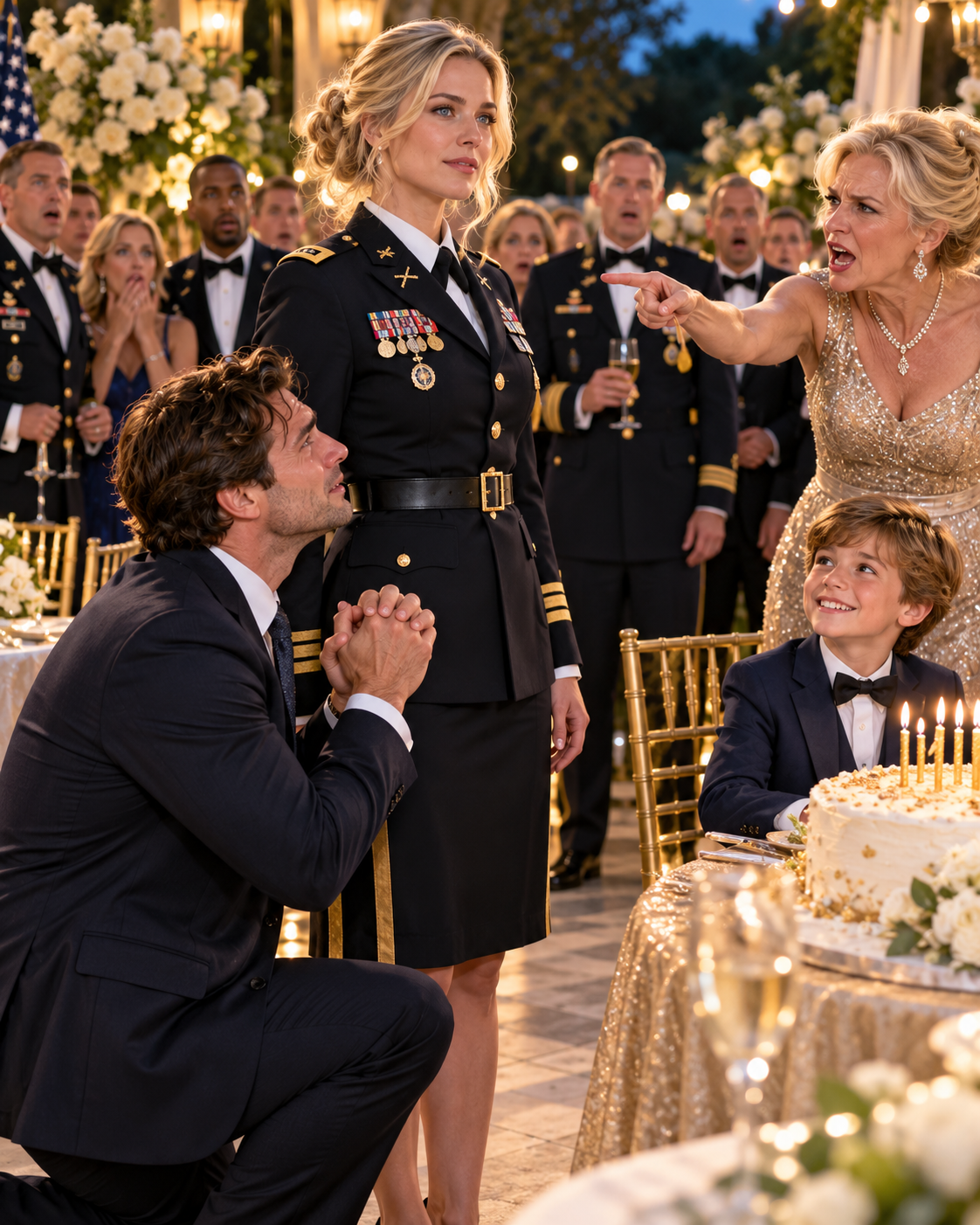
We held the party in the backyard. There were no venture capitalists. No champagne. Just twenty screaming third-graders, a slightly intoxicated magician, and a mountain of pizza.
Colonel Reed stopped by to give Noah a decommissioned altimeter gauge. Richard sat beside the pool, reading an astrophysics book he had purchased so he could talk with Noah about it.
And Margaret came.
She entered through the side gate wearing dark-wash jeans and a simple blouse.
Ethan, standing beside me at the grill, nearly dropped his tongs. “My mother is wearing jeans,” he whispered, horrified.
“I see it,” I whispered back.
Margaret noticed us staring. For a moment, her old defensiveness appeared in her eyes. Then she looked down at her legs, looked back at me, and gave me a tiny, self-mocking smile.
“Supermarket,” she mouthed.
I burst out laughing.
Against all odds, she laughed too.
Later that afternoon, Noah climbed onto a patio chair, tapping his juice box with a plastic spoon.
“Speech! I have a speech!”
The yard grew quiet.
“I want to thank everyone for coming,” Noah announced grandly. “Especially Mom. Because she promised she would always be in the front row.”
The adults smiled.
“And I want to thank Dad,” Noah continued, “for pushing the red button on his phone when Grandma is being annoying!”
The backyard exploded with laughter. Margaret let out a mortified squeak and covered her face with both hands. Ethan nearly choked on a piece of pepperoni.
I looked around my backyard.
At my son, glowing with happiness.
At my husband, finally standing beside me instead of in front of me.
At my in-laws, who had finally learned the value of respect.
For years, I believed that possessing the deed to the estate was the ultimate proof of my power.
I was wrong.
The power was never in the paperwork, the military rank, or the classified clearances.
My real strength was born the moment I finally understood that keeping the peace and remaining silent were not the same thing.
I walked toward the table as Noah prepared to blow out his candles. Ethan stepped aside, leaving a space for me right at the edge of the table.
“Front row?” Ethan asked softly.
I looked at him, feeling the warmth of the Virginia sun against my face.
“Always.”
