

PART 1: THE CHECK ON THE MARBLE TABLE
“Sign the papers and leave my life quietly, Nora. I am not going to spend the next eighteen years raising another man’s child.”
Callum Pierce tossed the divorce papers and a cashier’s check across the marble tabletop as casually as if he were settling an insignificant business transaction. Beyond the floor-to-ceiling windows of his Manhattan penthouse, a violent autumn storm swept rain across the skyline, reducing Central Park to a dark blur beneath the city lights. Inside, Nora Bellamy stood motionless, one hand resting over the sonogram hidden inside her coat pocket, feeling the memory of the two tiny heartbeats she had heard earlier that day pulse through her like a private prayer.
Twins.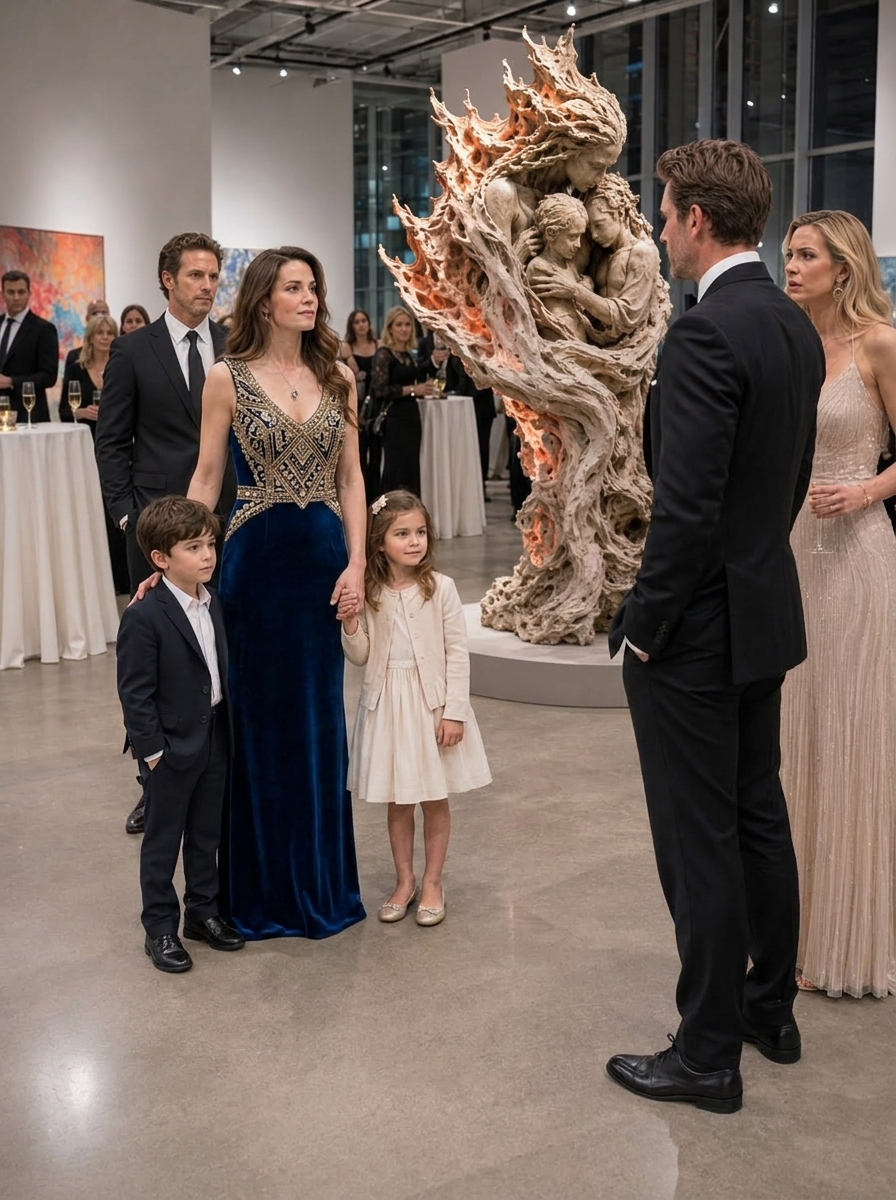
After almost four years of fertility treatments, hormone injections, failed embryo transfers, whispered conversations with specialists, and countless dinners where Callum’s mother wondered aloud whether the Pierce family name would end with her son, Nora had finally received the miracle she never believed would come. She had walked home through the rain imagining Callum’s expression softening, his hand trembling as it rested against her stomach, believing every painful month of disappointment had finally led to something sacred.
Instead, she found him waiting in the living room beside a divorce packet, a nondisclosure agreement, and Leighton Vale standing near the windows wearing Nora’s gray cashmere coat.
Leighton, Callum’s newly appointed chief strategy officer, had pale blond hair, sculpted cheekbones, and the polished smile of someone who viewed kindness as a weakness. Over the past year, she had become impossible to ignore—answering Callum’s private calls, appearing beside him at charity galas, and speaking with the easy confidence of a woman already imagining where her furniture would fit.
“Ten million dollars is generous,” Callum said, straightening the cuff of his black suit. “You can disappear somewhere peaceful, and nobody ever has to hear about this ugly situation.”
Nora looked at him in disbelief.
“What ugliness?”
A faint, dismissive laugh escaped him.
“Don’t insult my intelligence. If you’re pregnant, I know those children aren’t mine.”
The room seemed to freeze.
Nora’s fingers tightened around the sonogram.
“Callum, what are you talking about?”
He opened a leather portfolio and removed a confidential medical report from a private Connecticut clinic. Sliding it across the table, he placed it beside the check.
“I had a vasectomy fourteen months ago. I decided I didn’t want children complicating the company I spent years building. I planned to tell you when the time was right, but now you’ve saved me the conversation.”
Nora lowered her eyes to the official seal, the physician’s signature, and the date.
It matched the week Callum claimed he had been trapped in nonstop meetings with his hedge fund partners.
It matched the evenings she cried alone in the bathroom because the hormone injections left her exhausted while Callum insisted her sadness was becoming unattractive.
He had secretly made fatherhood impossible while allowing her to continue every painful fertility treatment.
Or at least, he believed he had.
“So that’s what this is,” Nora said, her voice quieter than the storm outside. “You’re trying to leave before anyone starts asking questions.”
Leighton stepped forward, her eyes shining with polished cruelty.
“Nora, you haven’t been happy for a long time. Callum deserves someone who can stand beside him publicly, not someone who turns every room into a monument to disappointment.”
Nora looked at the woman wearing her coat and wondered how much of her marriage had already been handed over.
Callum nudged the pen toward her.
“Sign it. Take the money. Keep whatever dignity you have left by not forcing me to expose what you’ve done.”
She should have shouted.
Instead, an unexpected calm settled inside her—cold, steady, and unmistakably clear.
She picked up the pen.
Then she signed.
Callum visibly relaxed.
“Good. You have thirty days to leave the penthouse.”
Nora rose to her feet, tucked the sonogram deeper into her pocket, and looked at the man she had once convinced herself was shaped by grief and ambition rather than cruelty.
“Remember this night, Callum. You are walking away from your own blood, and one day no amount of money will be enough to buy your way back.”
A faint smile crossed his face.
“That would sound much more convincing if it were true.”
Nora said nothing.
She packed a single suitcase, placed her wedding ring on the marble table, and rode the service elevator downstairs while rain hammered the building like countless tiny warnings.
In the private garage, Leighton stood beside a waiting black town car, wrapped in Nora’s coat and wearing the confidence of someone who mistook possession for victory.
“You’re making the right decision,” Leighton said. “Some women are meant for boardrooms, acquisitions, and powerful families. Others belong in smaller, quieter lives.”
Nora walked straight past her without slowing.
Inside the taxi, as Manhattan disappeared behind rain-streaked glass, she pressed both hands against her stomach.
Her old life had burned to the ground.
Yet somewhere beneath the grief, the humiliation, and the fear of an uncertain future, something else had begun to grow.
Not revenge.
Fire.
PART 2: CLAY, SMOKE, AND THE MAN WHO STAYED
By sunrise, Nora’s phone showed forty-two missed calls from her mother—and not a single one from Callum.
When she finally answered from a modest hotel room in Tribeca, her mother’s voice arrived filled not with concern, but with panic and accusation.
“Nora, how could you sign anything without talking to me first? Your brother owes money again, and the people he borrowed from aren’t willing to wait. We need at least four hundred thousand dollars by Friday.”
Still wearing yesterday’s sweater, Nora sat quietly on the edge of the bed.
“Mom, my marriage ended last night. I’m pregnant.”
There was a pause.
It wasn’t long enough to sound compassionate.
“Then use the settlement before you start talking about being exhausted. Family comes before your feelings.”
Something inside Nora quietly closed.
For years she had rescued her mother from debt, her brother from reckless decisions, and everyone else from the consequences of treating her love like an endless emergency fund.
She ended the call.
She changed her number.
Through her attorney, she delivered one final message: no further direct contact from the Bellamy family until further notice.
That afternoon, she drove north into the Berkshires to meet the attorney managing her grandmother’s estate.
Her grandmother, June Bellamy, had spent her life creating ceramic art in a converted carriage barn, selling handcrafted vessels to collectors while teaching Nora that clay remembered every hand that shaped it.
June left her the barn, an aging kiln, shelves filled with unfinished pottery, and several boxes containing handwritten glaze recipes.
The property carried unpaid taxes, a damaged roof, and an old wood-fired kiln that looked more like a sleeping creature than a machine.
But it belonged entirely to Nora.
The attorney handed her a letter written in June’s shaky handwriting.
My dearest Nora, clay does not care who abandoned you, who misunderstood you, or who insisted you were less than you truly are. It only asks what your hands are willing to become after the fire.
Nora cried.
Not gracefully.
Not quietly.
She cried because one woman who had known her long before Callum’s world had left behind a place where she no longer had to pretend strength.
When she arrived at the barn, she met Rowan Hayes, the master kiln technician who had worked beside June for twelve years.
He was tall, broad-shouldered, and quietly steady, with soot-darkened hands and a voice that felt like calm weather arriving after a storm.
When he saw Nora standing in the doorway with one suitcase and a folder filled with pregnancy records, concern crossed his face without ever becoming pity.
“Ms. Bellamy, this work is physically demanding, and the kiln reaches dangerous temperatures. You shouldn’t try to prove anything by wearing yourself out.”
Nora rested her fingertips along the edge of an unfired bowl sitting on the worktable.
“Then teach me the parts I’m able to do. I didn’t come here because I wanted someone to rescue me.”
She looked around the quiet barn.
“I came here because I needed to remember how to shape something again.” Rowan gave a single nod. “Then we start slowly.”
And that was exactly what they did.
As the cold weeks slipped by, Nora learned how to wedge clay while keeping her elbows tucked close, trim bowls from a seated position, prepare safe glazes with Rowan watching over her, and understand the language of the kiln without standing too near its heat. Rowan never pressed her to explain who had broken her heart. Instead, he quietly brought ginger tea whenever her hands trembled, lifted every heavy shelf before she could, and left warm loaves of bread outside her door when morning sickness made even a trip to the store impossible.
Little by little, peace found its way back.
Then one icy night in December, flames erupted in the storage shed behind the barn.
Nora woke to the sharp smell of smoke and an orange glow flickering beyond the kitchen window. Inside the shed were June’s notebooks, rare mineral samples, and a carved cedar box filled with three decades of glaze experiments. Barefoot in the snow, Nora ran outside and screamed as fire climbed the walls.
“The formulas are inside!”
She rushed toward the blaze, but Rowan wrapped an arm around her waist and pulled her back.
“You cannot go in there.”
“That is everything she left me!”
Without another word, Rowan threw a soaked canvas tarp over his head and disappeared into the smoke before Nora could stop him. Every minute that followed stretched longer than the entire marriage she had survived with Callum. When Rowan finally stumbled back out, coughing violently, one sleeve burned away and his arm blistered, he still held June’s cedar box tightly against his chest.
“She is still in here,” he gasped. “The fire did not get her.”
Authorities blamed faulty electrical wiring, but Nora knew the truth. Accelerant had been poured near the rear wall, and one neighbor reported seeing a dark SUV with New York plates speeding away before midnight. She did not need anyone to say Leighton’s name aloud to understand exactly what the message meant.
Leighton wanted the discarded wife erased completely.
The following morning, Nora made the first true decision of her new life. After preserving everything she could of June’s work, she sold the damaged Berkshire property, settled its debts, and invested part of the divorce settlement into a fresh beginning with Rowan in Taos, New Mexico, where generations of artists had been shaped by clay, desert sunlight, and dry mountain winds.
Together they rented a modest adobe home with a courtyard, built a new kiln, and named their studio Juniper Fire.
The final months of Nora’s pregnancy were difficult, but they were never lonely. Rowan kept the studio running, drove her to every appointment, packed her hospital bag before she admitted she was frightened, and never once treated the unborn babies like proof of another man’s betrayal.
When labor began during a late-summer kiln firing, Nora managed only one sentence before pain doubled her over.
“Rowan, please get them here safely.”
He lifted her into his truck and drove across the desert toward the hospital with steady hands gripping the wheel, though fear was written plainly across his face. The twins arrived early through emergency surgery: a son named Eli and a daughter named Willa. They were tiny, medically fragile, and fiercely determined in the way premature babies sometimes are, as though they had already decided the world would never scare them into surrender.
When Nora awoke and saw them through the neonatal nursery window, she rested her palm against the glass.
“You will never beg for love from someone who calls you inconvenient,” she whispered. “I promise you that.”
Rowan stood quietly beside her, his burned arm still wrapped in bandages. Without speaking, he placed a warm cup of tea into her hand.
That was the moment Nora realized tenderness could be almost silent and still change an entire life.
Part 3: The Fire Mother Returns To New York
Five years slipped by, and Manhattan became little more than a distant memory, no more significant than yesterday’s weather. In Taos, Juniper Fire evolved from a struggling workshop into one of the Southwest’s most celebrated ceramic studios. Nora’s work blended the disciplined forms June had taught her with red desert clay, ash glazes, and scarred textures that looked as though they had survived both ruin and rebirth.
Her most celebrated sculpture was a monumental vessel titled Mother Of Embers. It portrayed a woman curving protectively around two children, her own body fractured by flame-colored glaze while the children beneath her remained untouched. Critics described it as maternal, mythic, and fearless. Nora simply considered it the first creation her hands shaped after they finally stopped trembling.
Eli and Willa grew up beneath cottonwood trees, surrounded by drying pottery, drifting kiln smoke, and Rowan’s calm reminders about hot surfaces. At first they called him Rowan, then Uncle Ro, and eventually something gentler whenever they were sleepy. He taught them how to ride bicycles, recognize different clays by touch, apologize sincerely, and stay clear of the kiln while it burned. Nora never asked him to become anything more. He simply remained until remaining became the foundation of their home.
Meanwhile, Callum’s business empire began collapsing from within.
Only months after Nora’s departure, Leighton announced she was pregnant and produced a prenatal DNA report that confirmed exactly what Callum’s pride wanted to believe. Their son, Archer, was introduced to investors as the future heir of Pierce Global. Callum purchased Leighton a lavish Hamptons estate, promoted members of her family into executive roles, and entrusted her with accounts wiser men would have guarded far more carefully.
Archer grew into a bright, charming child who looked nothing like Callum or anyone in the Pierce family. Employees whispered quietly. Friends exchanged uneasy glances. Callum ignored every warning because admitting the truth would have meant admitting Nora had spoken it first.
Leighton and her relatives took full advantage of that blindness. Company money flowed through consulting firms, financial reports were manipulated, and investor funds disappeared into offshore accounts with polished names. Pierce Global, once one of Wall Street’s most formidable companies, became an elegant machine slowly stripped of its working parts.
Nora learned nearly all of it through headlines she never bothered to search for.
Then Juniper Fire received an invitation to headline a major contemporary craft exhibition at the Whitney Museum in New York. Nora hesitated. Returning meant walking among ghosts of the woman she used to be. But five-year-old Eli, thoughtful beyond his years, studied the invitation before saying with complete certainty,
“Great-Grandma June would want the fire lady to go to the big museum.”
So Nora accepted.
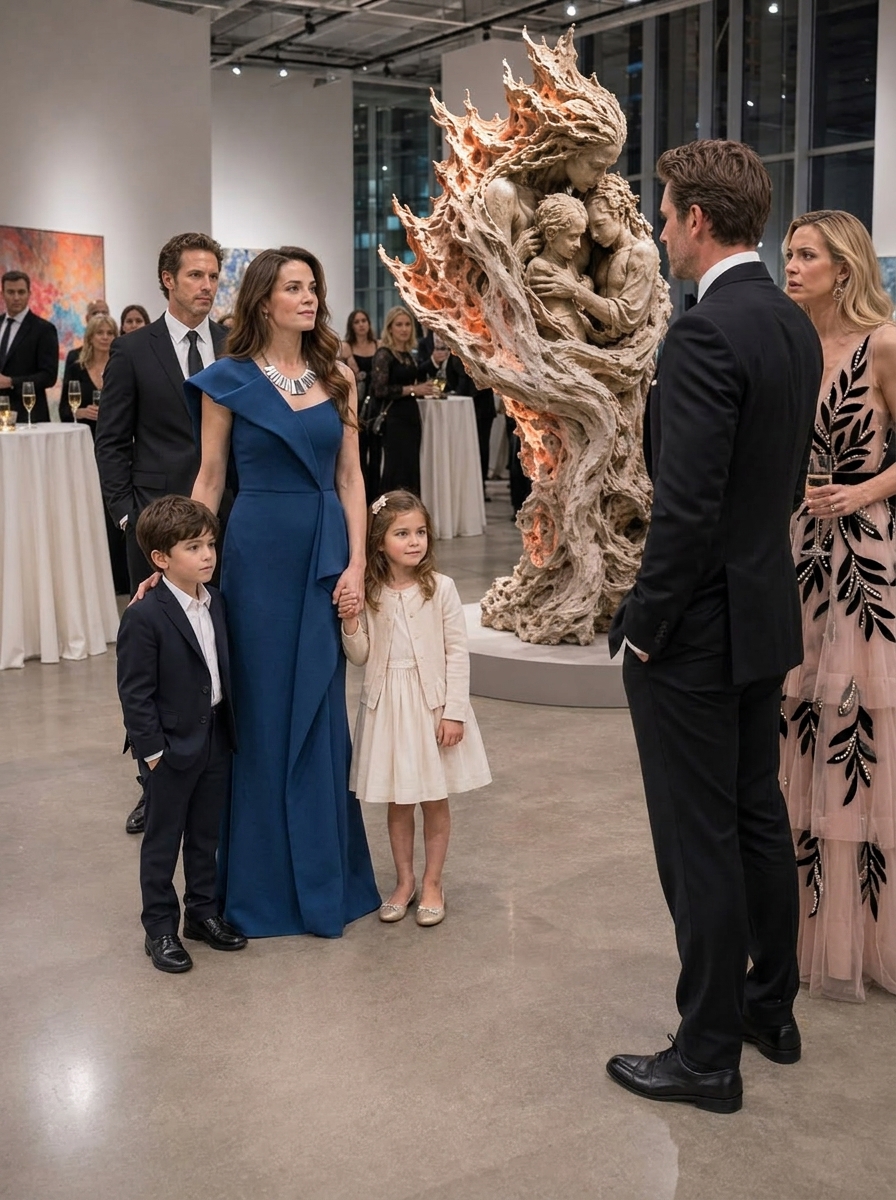
The gala shimmered beneath cameras, champagne glasses, silk gowns, museum patrons, and conversations that treated resilience as though it were another fashionable art movement. Nora wore a simple ivory dress with a small clay pendant Rowan had crafted from the first successful firing in Taos. Eli and Willa walked proudly beside her, whispering excitedly about the soaring ceilings overhead. Rowan followed a few steps behind—not as a bodyguard or an uncertain guest, but as the man whose quiet devotion had earned its place beside them.
Callum attended alongside Leighton after receiving an invitation from one of the museum’s billionaire donors. He looked older now, though still polished, still attractive in the way immense wealth often softens the harsher signs of age. Leighton wore diamonds so large they seemed almost defensive.
They paused before Mother Of Embers.
Something inside the sculpture unsettled Callum before he ever noticed Nora. His eyes lingered on the clay mother shielding two children from a wall of fire, and for one fleeting moment the certainty left his face.
Then the curator’s voice echoed through the gallery.
“It is my honor to introduce the artist behind this extraordinary work, Nora Bellamy of Juniper Fire Studio.”
Callum turned.
The champagne glass tilted in his hand.
Nora stepped toward the podium with Eli and Willa beside her. Beneath the museum lights, Eli looked unmistakably like Callum in childhood photographs—the same straight nose, the same dark eyebrows, the same tight little mouth whenever embarrassment crept in. Willa clung to Nora’s hand while facing the crowd with June’s fearless eyes.
Leighton noticed it too.
The color drained from her face.
Willa tugged gently on Nora’s sleeve.
“Mom, Eli spilled juice on his jacket.”
Nora bent, kissed Eli gently on the head, and wiped the stain away with a napkin. She never glanced toward Callum.
She did not have to.
Truth had entered the room wearing a tiny navy blazer and sticky fingers.
Within forty-eight hours, Callum ordered investigators to examine hospital records in New Mexico. Within seventy-two hours, he obtained a private DNA test through methods Nora would later challenge through legal counsel. The results confirmed Eli and Willa were his biological children.
The vasectomy had failed.
A physician carefully explained the rare phenomenon of recanalization using diagrams and measured clinical language while Callum sat in complete silence, finally realizing that the certainty he had used to condemn Nora had never been certainty at all.
It had simply been arrogance disguised as medical proof.
Then he ordered a DNA test for Archer.
Zero percent.
That single result shattered whatever remained of his pride.
The investigation that followed uncovered Leighton’s forged prenatal DNA report, her affair with a private security contractor, and the fraudulent financial transfers draining Pierce Global from within. Federal investigators eventually connected her operation to the fire at the Berkshire studio because cruelty, much like money, always leaves a trail behind it.
Leighton’s downfall was swift and painfully public. Pierce Global was forced into emergency restructuring, while Callum lost his position as chairman, the reputation he had spent decades building, and the illusion that he had always been the smartest person in every room. Nora felt no satisfaction.
She heard the news in Taos while helping Willa paint a delicate blue stripe around a small clay bowl. She switched off the television and returned to the worktable, because revenge had never been the fire that restored her life.
Part 4: The Man Waiting Beyond The Studio Gate
Late in October, Callum arrived in Taos alone. There were no bodyguards, no photographers, and none of the impeccably tailored suits that had once made him appear untouchable. He stood outside the entrance to Juniper Fire holding a paper bag filled with carefully selected children’s books, looking less like a financial empire builder than a man who had arrived far too late for something no journey could recover.
Nora found him standing there as the sun disappeared behind the mountains, her hands stained with red clay.
“I am not here to take anything from you,” he said before she had the chance to speak. “I know I have no right to ask for anything.”
Nora unlocked the gate but made no gesture inviting him inside.
“Then say what you came to say.”
Callum swallowed before speaking.
“I called you a liar. I paid you to disappear. I let another woman wear your life while you carried my children alone, and I punished you for a medical fact I never cared to question. There is no apology large enough for that.”
“No,” Nora said. “There is not.”
He lowered his head slightly, accepting the truth because even he understood that arguing would only deepen the damage.
“I would like to know them someday, if the court, the therapist, and you believe it will not harm them. I will do whatever is required, and I will not ask them to call me anything I have not earned.”
Behind Nora, Rowan stepped into the doorway of the workshop. He remained silent, yet his presence alone steadied the moment.
Nora thought about five years filled with fevers, preschool enrollment forms, sleepless nights feeding babies, tiny shoes covered in pottery dust, and Rowan patiently teaching Eli how to center clay while Willa insisted on using purple glaze. She remembered the cashier’s check lying on the marble table, Callum’s certainty, and the contempt that had ended their marriage. She also remembered that her children deserved the truth—but only one delivered without becoming another adult’s demand.
“Being a father is not a blood test,” she said. “It is staying when staying costs something. It is believing the woman carrying your children before your pride can turn her into an enemy. Rowan has been the man they ran to in storms. You are a fact they will learn carefully.”
Callum’s eyes filled with tears.
“I understand.”
“You will begin with letters reviewed by a child therapist. No gifts beyond what she approves. No private visits. No public claims. No lawyers turning my children into territory.”
“Yes.”
“And Callum?”
He lifted his eyes.
“The first time you make this about your guilt instead of their well-being, it ends.”
He closed his eyes for a moment.
“That is fair.”
Nora nearly smiled at how small the word *fair* sounded, but she let it pass. Some people reach humility with far too few words for what they have finally learned.
He placed the books beside the gate before turning back toward his car.
That evening, after Eli and Willa had fallen asleep, Nora found Rowan inside the studio trimming a bowl beneath the warm yellow work light. The burn scars along his forearm had faded into pale lines beneath a layer of clay dust. For five years, he had never once asked what place he held in her life. He had simply remained—through hospital hallways, school recitals, pottery firings, leaking roofs, childhood fevers, and every quiet season in between.
Nora walked over and stood beside him.
“You stayed.”
Rowan kept his attention on the spinning wheel, though his hands slowed.
“This place needed work.”
“I am not talking about the studio.”
The wheel continued turning softly.
Nora rested her clay-covered hand over his.
“I do not know whether the heart I carried out of Manhattan is whole in the way it once was. I only know that whatever healed inside it feels safest when you are near.”
Rowan finally looked at her, and the love he had carried for years without making it another burden finally appeared without disguise.
“I never needed you to be unbroken, Nora.”
Emotion tightened her throat.
“The children already know you as home.”
He covered her hand with his own, gentle and reverent.
“Then I will keep trying to deserve that.”
Years later, Juniper Fire became one of America’s most respected ceramic landmarks, and *Mother Of Embers* traveled through museums in New York, Chicago, and Los Angeles. Interviewers repeatedly asked Nora whether her success was the greatest revenge against the man who had abandoned her.
She always gave the same answer.
“Revenge is too small a word for rebirth. I did not become whole because someone regretted losing me. I became whole because I walked into the fire with my children, my grandmother’s clay, and the people who chose to stay, and I came out shaped by my own hands.”
For years, Callum remained on the edges of Eli and Willa’s lives, dependable enough to eventually become familiar, but never central enough to erase what his absence had cost. He watched school performances from the last rows, mailed handwritten notes instead of demands, and slowly learned that love offered too late must come without entitlement.
Leighton was sentenced to prison. Pierce Global survived only after being dismantled and sold piece by piece. Manhattan continued forward as cities always do, polishing fresh illusions before the old ones had even cooled.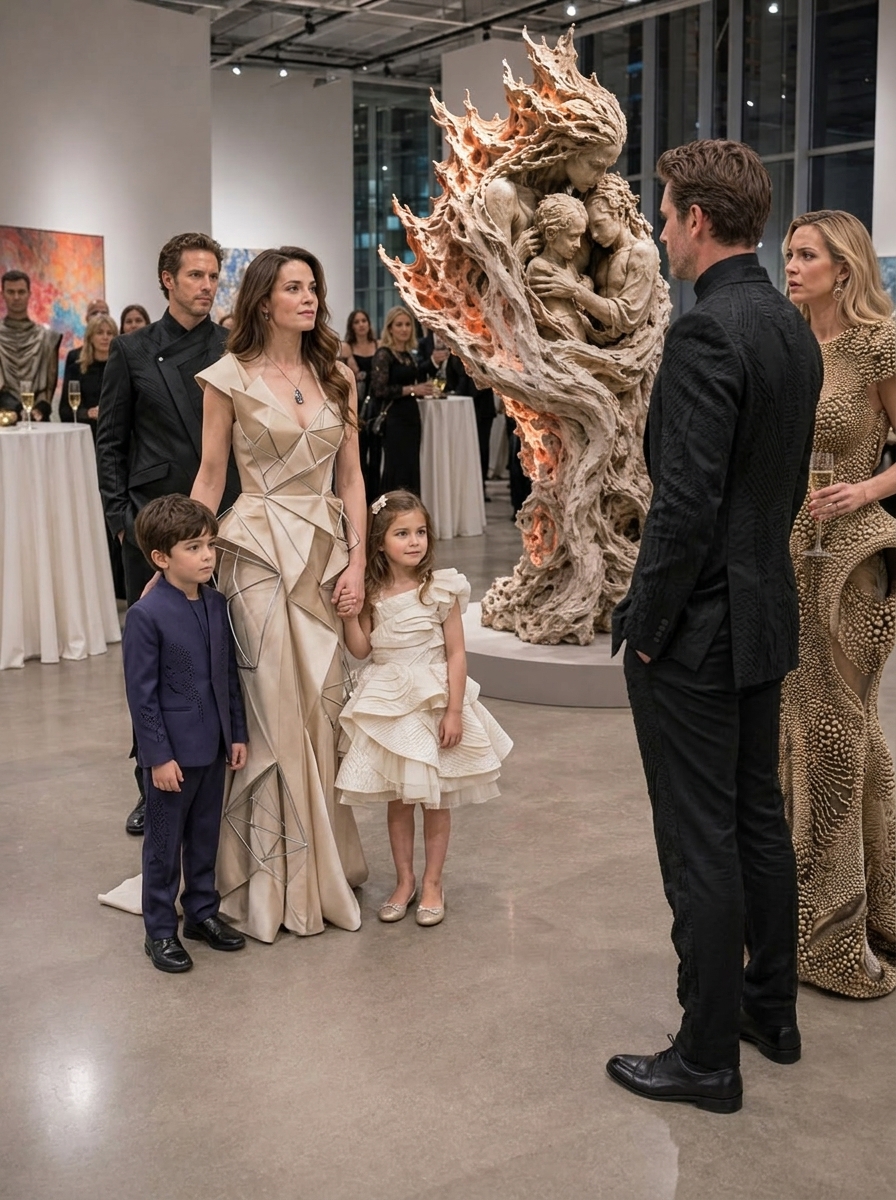
In Taos, Nora continued firing clay.
On clear evenings, when the desert glowed gold and the kiln breathed warmth into the gathering darkness, Eli and Willa chased each other through the courtyard while Rowan stacked firewood nearby. Nora would stand in the doorway of Juniper Fire with one hand resting against the adobe wall, taking in the life she had built around herself—imperfect, warm, noisy, and undeniably real.
Callum had cast her aside because he believed she was carrying another man’s children.
What he never understood was that, by doing so, he had pushed her directly toward the life that would finally teach her what family truly meant.
Not blood alone.
Not wealth.
Not promises spoken by a man who abandoned them the moment his pride was wounded.
Family was the person who ran into smoke to save your grandmother’s notebooks. It was the little boy who insisted the fire lady belonged in a museum. It was the hands that remained beside yours at the pottery wheel while the clay spun, softened, resisted, and slowly became something strong enough to survive the fire.
THE END
