

CHAPTER 1: THE TUESDAY EXTINCTION
“I’ve had my fun,” my husband announced, casually dropping his leather weekend bag onto the distressed oak floor of our foyer. “I needed to get it out of my system.”
Mark looked frustratingly refreshed. He had the sun-kissed glow of a man returning from a relaxing golf getaway in the Mediterranean. I, meanwhile, hadn’t managed more than three consecutive hours of sleep in nearly three months. He gave me a brilliant, white-toothed smile, completely lacking guilt or self-awareness.
“But I’m back now,” he declared, confidently stepping toward me. “I’m your husband again.”
I said nothing. I simply watched him, an empty shell of a woman, as his eyes moved past my shoulder toward the kitchen. That was exactly when the smug curve of his smile disappeared.
“Why is he here?” Mark stammered, the color draining from his tanned face.
I held his stare, my pulse completely steady. To understand the significance of that Sunday afternoon, and why Daniel was calmly sitting at my kitchen island, you have to go back through the previous three weeks of my life. You have to return to one particular Tuesday—the day my marriage was officially diagnosed as terminal.
Our second daughter, Emma, was barely three months old when everything began to fall apart. I was forty-three, an age when even sleeping in the wrong position could trigger a back crisis, while standing too long left aching sensations in my knees. Adding a newborn to that physical reality had done nothing to improve my resilience. Emma had apparently decided that sleep was an unnecessary luxury, best enjoyed in ninety-minute intervals. Our older daughter, Sophie, was two, and on that Tuesday, she was fighting a severe ear infection.
Sophie was burning with fever and had violently rejected her antibiotics twice. The sticky pink medicine from the first dose was splattered across her cotton pajamas. The second dose had ended up smeared down the front of my nursing tank top. By 6:30 that evening, I was stuck in the kitchen, desperately measuring a third dose while bouncing a screaming Emma against my collarbone. Sophie was sobbing uncontrollably from the living room floor. The dishwasher was packed with dirty bottles. The sink was filled with crusted plates. A laundry basket had sat on a dining chair for so long it practically belonged there.
Then I heard the heavy, steady footsteps coming down the stairs.
Mark appeared, holding a sleek black suitcase.
I remember staring at the luggage in complete confusion. My exhausted brain initially panicked, assuming I had forgotten to pack something for an important business trip.
“Where are you going?” I asked over the noise of our crying children.
He left the suitcase beside the marble kitchen island.
“I need some space.”
I kept bouncing Emma.
“Tonight? Mark, I can’t keep doing this. Doing what?”
He made a vague sweeping gesture that seemed to include the entire room.
“This. The kitchen. The crying. You. Civilization in general.”
I actually turned around, as though expecting to find some hidden disaster behind me.
“What part? You know what I mean?”
“No, Mark,” I sighed, exhaustion sinking deeper into my body. “I really don’t.”
He rubbed his temples, performing the role of an overwhelmed man.
“We’re miserable. You’re perpetually exhausted. This house is a theater of chaos. We barely even speak to each other anymore.”
From the next room, Sophie screamed, “Mommy!”
“I’m coming, sweetheart,” I called.
Mark released another long, dramatic sigh. That tiny sound sparked a deep, white-hot fury inside me. He sighed as though our feverish two-year-old had interrupted an important meeting.
“She has a fever,” I reminded him, my voice dangerously flat.
“I know.”
“Then could you take Emma and give her a bottle while I get Sophie settled?”
He didn’t move. His jaw tightened.
“This is exactly what I’m talking about. Everything is an emergency now. We have a three-month-old and a sick toddler.”
“I am acutely aware of that,” I snapped. “Are you?”
His eyes narrowed.
Then he said the sentence that would permanently brand itself into my mind:
“This whole marriage has become toxic.”
I looked down at the fragile infant trembling against my collarbone, then at the sticky medicine syringe on the counter, and finally at the grown man standing there with his suitcase already packed.
“Mark, this isn’t toxic. It’s a Tuesday.”
He didn’t smile.
Neither did I.
He coldly explained that he needed a few weeks to “clear his head,” insisting that he was suffocating inside these walls and that we had somehow become strangers. I was almost impressed by the poetic narcissism. I knew exactly who I was: the woman keeping his child alive while trying to medicate his other child.
“So, where exactly does one go to find this space?” I asked.
“I’ll stay with a friend.”
“Which friend?”
“Does it matter? Greg.”
I knew Greg. They had been fraternity brothers in college.
“For how long?”
“I don’t know. A couple of weeks. Maybe three.”
Emma started squirming and crying louder. I shifted her higher against my shoulder.
“And when, exactly, do I get my break?”
Mark looked at me—not with anger, which would have been easier to understand, but with genuine confusion.
“Laura, please don’t turn this into something it isn’t.”
I don’t even know what it is yet, I thought.
He lifted his suitcase and walked out the front door into the cool evening air.
That night became a descent into maternal purgatory.
Sophie woke at 1:40 AM, burning with fever. By 2:00 AM, I was sitting on the cold hexagonal bathroom floor because she had vomited down my side. She leaned against my left thigh wearing nothing but a diaper, shivering. Emma was strapped against my right side, screaming with colicky fury. My clothes smelled of sour milk and stomach acid. My lower back felt as though someone had repeatedly hit it with a blunt object.
Desperate, I called Mark.
The phone rang without an answer.
Ten minutes later, I tried again.
Nothing.
I texted him:
Sophie’s fever spiked again. Please call.
At exactly 4:12 AM, my screen lit up the dark bathroom.
It wasn’t a call.
It was a text.
Can we not do this right now? I need space.
I read the glowing words once.
Then again.
Sophie had mercifully fallen asleep against my leg.
For reasons I couldn’t explain, I took a screenshot of the message. I wasn’t thinking about lawyers or legal strategy yet. I simply needed proof that I wasn’t imagining things, that he had truly left us in the trenches.
I had no idea that this tiny digital breadcrumb was only the beginning of a much darker labyrinth.
CHAPTER 2: THE PARIS PARADIGM
Three days after he left, I was absentmindedly stirring warm formula in a bottle when my phone vibrated against the granite counter.
It was an automated notification from our joint credit card account.
Years earlier, I had created the account and managed the monthly payments. Mark, in his rush to secure his precious “space,” had apparently forgotten that his authorized-user card still sent every transaction directly to my phone.
The charge came from a luxury hotel.
In Paris.
I blinked repeatedly, convinced exhaustion was making me hallucinate.
A few hours later, another notification appeared: an outrageously expensive dinner at a Michelin-starred restaurant.
The next morning, there was a charge from an upscale wine bar in Montmartre.
I was fairly certain Greg did not live in France.
At first, my exhausted mind invented innocent explanations.
Maybe his card had been cloned.
But a cold, instinctive dread pushed me toward my laptop.
I searched through social media.
Mark’s profiles were completely silent.
Then I thought of Vanessa Cross.
She was a distant acquaintance, an exceptionally attractive, dark-haired executive I had met at two of Mark’s corporate galas.
She was married.
I found a mutual friend’s profile.
Buried inside a recently uploaded album were photographs from France.
My heart began pounding erratically as I clicked through them.
The third image stopped the blood in my veins.
It was a candid photograph of a candlelit bistro table.
Two crystal wine glasses.
Vanessa, glowing and laughing toward the camera.
Across from her, the photographer had accidentally captured a man’s forearm resting on the linen tablecloth.
I didn’t need to see his face.
I recognized the watch immediately.
It was a heavy stainless-steel chronograph with a distinctive midnight-blue dial.
I had bought it for Mark on our tenth wedding anniversary.
For what felt like an eternity, I sat completely frozen, the screen’s glow washing over my face.
The trance ended only when Emma suddenly spit warm milk down my collar.
I looked down at my baby daughter and reached for a dish towel to wipe away the mess. “Well, kiddo,” I whispered to the empty room. “It appears your father is currently experiencing a cliché midlife crisis in France.”
I didn’t make a furious call to Europe. I didn’t compose a hysterical message to Vanessa. Instead, I waited until the house was wrapped in the heavy silence of midnight. I made a pot of black coffee, cracked my knuckles, and opened my laptop. I ignored social media and went directly for the financial jugular. I downloaded three years of credit card statements, bank routing records, joint tax returns, 401k portfolios, and mortgage deeds. I built a digital fortress of PDFs.
I still didn’t know whether I wanted a divorce, but sitting alone in the darkness, I stopped waiting for my husband to come home. I began preparing for war.
By Thursday, the overwhelming burden of raising two sick children alone had hollowed me out. Once I finally got both girls asleep, I sat staring at Mark’s name in my contacts. All I had to do was press the green button. I wanted to call—not because I wanted forgiveness, but because the physical pain in my spine was unbearable. I wanted an adult to hold my baby for twenty minutes so I could shower without imagining phantom cries over the sound of the water.
That night, a frightening realization settled over me.
I didn’t miss him.
I simply missed having another adult between myself and the chaos.
The following morning, salvation arrived in the form of my sixty-eight-year-old mother, Diane, carrying two overflowing grocery bags. My mother believed emotional vulnerability was a weakness best treated with strong coffee and bleach.
“You look absolutely feral,” she announced as she marched into the kitchen. “Don’t glare at me. I brought soup and I gave birth to you. I have immunity.”
She methodically sent me upstairs. I collapsed into bed and slept for two hours and thirteen minutes. It felt like spending a week in the Maldives.
When I came downstairs, the laundry had somehow been folded into perfect squares, and Emma was sleeping against my mother’s chest.
Over tea, the dam finally broke.
I told her everything.
The Paris charges.
The watch.
The ghost of Vanessa Cross.
My mother listened, her expression an unreadable mask of stoicism. When I finished, she quietly asked, “Does he know that you know?”
“No.”
“Excellent,” she nodded.
Then I admitted my darkest secret.
“Mom… I almost called him to come back. Because I’m so tired.”
She adjusted the baby.
“Wanting a babysitter is not the same thing as wanting a husband.”
She paused, her expression darkening with a sadness I rarely saw.
“Your father left us once, Laura. Before you could form memories. He was gone for four months, making an absolute fool of himself.”
I stared at her in disbelief.
“And you let him return?”
“I did,” she whispered. “He came back because he knew the door was unlocked. It took me a decade to realize that letting him walk back over the threshold was the greatest failure of my life.”
With her quiet blessing, I found myself sitting across from Rebecca Sloan three days later. Rebecca was a formidable woman in her fifties, an attorney working from a sleek downtown Columbus office. She wore reading glasses hanging from a gold chain and carried the calm presence of someone who had watched countless marriages collapse and knew precisely how to search the ashes for diamonds.
I pushed the printed dossier across her mahogany desk: the Paris receipts, the photograph of the watch, and the 4:12 AM screenshot.
“What have you done thus far?” Rebecca asked, looking over her glasses.
“I secured all financial records. I haven’t confronted him.”
“Superb,” she murmured, turning a page.
“I did write a highly corrosive message to his mistress, but I haven’t hit send.”
“Delete it immediately,” she instructed. “For the foreseeable future, Laura, your primary objective is to be remarkably boring. No dramatic liquidations, no cryptic Facebook statuses, no shattered windshields. Boring women are statistically impossible to use as villains in family court.”
I accepted the boredom.
That evening, I went deeper into the financial abyss. I stopped looking at Paris and began scrolling backward.
Six months.
Eight months.
I found a series of hotel charges near Cincinnati from a weekend Mark had claimed he was attending a “logistics symposium.”
Eight months earlier.
I did the math, and the answer struck me like a blow to the sternum.
The affair hadn’t begun because of the stress of caring for a colicky newborn.
It had flourished while I was heavily pregnant.
During the exact weeks when he had been massaging my swollen ankles and enthusiastically debating whether we should name the baby Emma or Caroline, he had been paying for hotel rooms for Vanessa Cross.
Paris was a betrayal of the present.
This was a desecration of the past.
But the hotel receipts weren’t the end of it.
I noticed the bleeding.
At first, it was subtle—a three-thousand-dollar wire transfer.
Then five thousand.
Slowly and deliberately, money was draining from our joint savings into an external account I couldn’t identify.
I added up the transactions.
Just under thirty-eight thousand dollars.
I called Rebecca immediately.
“We will address it formally during discovery,” she instructed.
That evening, while I was putting Sophie into her toddler bed, my phone buzzed with a message request from an unknown account.
The name on the screen sent a surge of adrenaline straight through me.
Daniel Cross.
I opened the conversation.
My name is Daniel. I am Vanessa’s husband. I have reason to believe our spouses are currently together in Europe. And I don’t believe this started three weeks ago.
CHAPTER 3: AN ALLIANCE OF THE BETRAYED
Adultery has absolutely no respect for a toddler’s bedtime schedule.
I shoved the phone into my pocket, my thoughts racing.
Daniel Cross asked to meet in a neutral public place. We settled on an artisanal coffee shop in a quiet suburb of Dublin, Ohio.
My mother watched the girls.
I arrived early and chose a corner booth with a clear view of the entrance.
Ten minutes later, Daniel walked through the door.
He was a striking man in his early fifties, dressed impeccably in tailored charcoal trousers and a navy button-down. But his posture gave him away. He carried the hollow, haunted exhaustion of a man functioning on nothing but cortisol and black coffee.
A slim manila folder was clutched tightly beneath his left arm.
“Laura,” he said, extending his hand as he approached.
“Daniel.”
We shook hands.
There is no Hallmark greeting card for the exact moment you meet the collateral damage of your spouse’s infidelity.
We sat in heavy silence until he finally exhaled.
“Well, this is fundamentally awful.”
“Aptly summarized,” I replied, feeling the faintest hint of a smile pull at my lips.
He ordered a black espresso and placed his folder on the table, keeping one hand protectively over it.
He explained how he managed his household’s finances and had noticed obvious inconsistencies in Vanessa’s travel schedule. Then Mark’s name began appearing in shared loyalty accounts.
“How long have you known?” I asked evenly.
His eyes shifted away toward the rain-covered window.
“I’ve harbored intense suspicions for roughly two months.”
A flash of genuine anger rose inside me.
“Two months? You allowed me to endure the final stages of pregnancy, childbirth, and postpartum recovery while you silently investigated my husband?”
He winced and accepted the accusation without trying to defend himself.
“You are entirely correct to be furious. I was terrified of being right. I needed irrefutable proof.”
I studied his face.
His hesitation wasn’t motivated by cruelty, but by fragile masculine pride. He didn’t want to become the proverbial cuckold, the oblivious fool.
I understood.
But I didn’t pity him.
We opened our respective dossiers and laid our evidence across the wooden table.
It became a grim game of memories.
Mark had told Vanessa that our marriage had been a lifeless corpse for years, sustained only by our obligation to the children. According to him, we barely lived together.
“Fascinating,” I said dryly. “Because during that ‘lifeless’ period, he drove across three zip codes in a thunderstorm because I had a hormonal craving for a specific artisanal cinnamon roll. Truly the behavior of an estranged roommate.”
Then Daniel pushed a printed document across the table.
It was a commercial residential lease agreement.
“They were actively touring luxury apartments in downtown Columbus,” Daniel said quietly. “Vanessa had already started the paperwork. Your husband was supposed to be the co-signer.”
The missing thirty-eight thousand dollars suddenly made perfect, devastating sense.
This wasn’t a midlife crisis.
This wasn’t a temporary European romance.
It was a carefully planned exit strategy.
While I was painting the nursery baseboards, my husband was financing his new life.
Then Daniel showed me the final blow.
It was a printed transcript of intercepted text messages.
Vanessa: Does Laura actually believe you’re coming back to the house after the trip?
Mark: Of course.
Vanessa: And?
Mark: She always takes me back.
I read the words until they stopped looking like language.
Some insults hurt because of their venom.
This one destroyed me through its casual, clinical arrogance.
Mark didn’t see me as a serious obstacle.
He saw me as a dormant appliance, a backup generator he could leave running in the garage until he needed power.
I pushed the paper back toward Daniel.
“He truly believes I am just waiting in suspended animation.”
Daniel took a sip of espresso.
“Let’s not disappoint him prematurely.”
The following evening, I was rocking Emma in the dim nursery when my phone lit up.
It was Mark.
Landing tomorrow afternoon. Let’s put all this ugliness behind us.
I stared at the glowing message, the memory of the cold bathroom floor and the missing thirty-eight thousand dollars swirling through my mind beside the sentence:
She always takes me back.
I typed two words.
Safe flight.
CHAPTER 4: THE HOMECOMING
Sunday afternoon, at exactly 3:17 PM, the front door unlocked.
The heavy brass tumblers clicked, announcing the return of the king.
Mark walked into the foyer with the confidence of a benevolent conqueror. He carried his luggage and an offensively predictable box of artisan French truffles.
“Hey,” he called, his voice carrying the casual ease of a man returning from a quick trip to the hardware store.
I stood behind the kitchen island.
Daniel Cross sat quietly at the dining table, positioned perfectly outside the entryway’s line of sight.
“I know we need to have a serious conversation,” Mark announced as he entered the kitchen, wearing his familiar de-escalation smile. “I’ve had my fun. I needed to burn off some steam. But I’m back now, Laura. I’m your husband again.”
I didn’t move.
As Mark stepped farther into the room, his peripheral vision finally caught the figure sitting at the table.
Daniel slowly turned his chair. For the first time in ten years, I watched my husband suffer a genuine system failure. The blood drained from his face, leaving him with a sickly, translucent pallor.
“Why the hell is he in my house?”
I leaned against the marble counter.
“You know Daniel, don’t you?”
Mark’s recovery was frighteningly quick—a reflection of years spent navigating corporate battles. He straightened his back.
“Obviously. So, this is what you’ve been doing while I was away? Plotting with a stranger?”
“Careful, Mark,” Daniel warned, his voice carrying a low, dangerous rumble.
Mark turned completely, redirecting his attack toward me.
“Whatever delusional fiction he fed you about Vanessa, their marriage was essentially dead.”
“Emotionally dead, perhaps?” Daniel cut in dryly. “I must have misplaced the autopsy report.”
I lifted one hand, bringing the room to silence.
“Let’s keep this empirical, Mark. Exactly how long have you been sleeping with her?”
His jaw tightened.
“It isn’t a black-and-white situation, Laura. We were in a dark place. We disconnected. Everything was diapers and pediatricians. You haven’t been yourself since Emma was born. You were exhausted, emotional, unstable.”
He was weaponizing my postpartum depression. He was using the physical and emotional toll of carrying his children as a shield against his adultery.
It was a textbook display of gaslighting.
Daniel rose, fastening his jacket.
“I believe I’ve witnessed enough of this performance.”
He walked toward the door, stopping to look back at Mark.
“You shouldn’t be too comfortable here.”
When the door clicked shut, Mark approached me, his eyes pleading.
“Laura, you are making a catastrophic mistake.”
“We’ll see,” I whispered.
By Tuesday, the psychological warfare had begun.
Mark launched a scorched-earth public relations campaign. His mother, Diane, called under the pretense of concern.
“Laura, honey,” she cooed, the condescension practically dripping through the phone. “Mark told us how severely you’ve been struggling with your mental health since the baby. He mentioned you two agreed a temporary separation was medically necessary for your wellbeing.”
I closed my eyes, stunned by the audacity.
Not the angry wife.
The fragile, broken wife.
If I screamed, I confirmed his story about my instability. If I posted the evidence online, I looked vindictive.
He was actively rewriting our history for an audience that couldn’t see the truth.
“We deal with the PR later,” my attorney Rebecca advised calmly when I called her in a panic. “Let him spin his fables. We are going to bleed him in discovery.”
But the silence was corrosive.
A week later, Mark called me. His 47th birthday dinner had been booked months earlier at Trattoria Rossi, an upscale Italian restaurant.
“My parents expect you to be there,” he ordered.
“Then you will have to explain my absence.”
There was a long, calculating pause.
“Stay home if you must, Laura. But people will naturally draw their own conclusions about your state of mind.”
It was a veiled threat.
If I refused to appear as the dutiful, recovering wife, he would keep portraying me as the person responsible for our marriage collapsing.
I ended the call and stared at the wall for a long time.
Then I texted my mother.
Can you take the girls on Saturday night?
Her response came immediately:
Yes. Wear the sapphire blue dress.
CHAPTER 5: THE BLUE DRESS PROTOCOL
I didn’t attend Mark’s birthday dinner to create a scene. I didn’t bring manila folders or USB drives.
I went because I refused to give him the privilege of controlling the story in my absence.
Trattoria Rossi was covered in moody amber lighting designed to make everyone look wealthy and forgiving. When I arrived wearing the sapphire dress, fourteen of Mark’s closest relatives and colleagues were already gathered in the private alcove.
Mark’s eyes widened when he saw me, but the surprise quickly turned into a smug, victorious smile.
He assumed I had surrendered.
He pulled out the chair beside him.
I calmly walked past it and sat directly across from him at the opposite end of the long table.
The tension in the room immediately intensified, but upper-middle-class families are remarkably talented at pretending an explosion isn’t coming.
For thirty minutes, we performed agonizingly polite theater.
Diane asked about Sophie’s preschool.
A colleague rambled about interest rates.
Then the wine took effect, and Mark tapped his crystal glass with a silver fork.
“I’ll keep this brief,” he announced, standing upright. He gave the room a practiced, melancholy smile. “This has been a turbulent year. Laura and I have navigated some incredibly rough waters. I made some choices… choices I am not entirely proud of. But marriage is a complex ecosystem. Sometimes, in the chaos, people lose sight of each other. I just pray that we can stop punishing one another and focus on healing.”
He sat down to a scattering of sympathetic nods.
Diane lovingly reached over and patted his forearm.
I took a slow sip of my Barolo.
Then I placed the glass down.
The clink echoed through the quiet alcove.
“That was remarkably poetic, Mark,” I said, my voice slicing through the restaurant’s background noise. “But since you’ve opened the floor to our marriage, I have a point of clarification. When, precisely, did we mutually agree that you needed to leave?”
The table went completely still.
Forks froze halfway to mouths.
“Laura,” Mark whispered, a warning edge in his voice. “This is not the venue.”
“You brought it up,” I replied brightly. “I just want to make sure everyone has the correct timeline. Diane, when did he tell you we agreed to a separation?”
His mother looked frightened.
“Well… after he left for his friend Greg’s house.”
“Ah, yes. Greg.”
I held my husband’s gaze.
“Why did you tell me you were staying with Greg when you were actually in Paris?”
Mark’s father dropped his napkin.
“What is she talking about, Mark?”
Mark struggled beneath the sudden attention.
“I went away for a few weeks to clear my head. Yes, I was with someone else. It was a mistake. We were legally separated in my mind.”
“Was it a mistake?” I pressed, leaning toward him. “Who is she, Mark?”
“Her name is Vanessa,” he forced out through clenched teeth.
“And when did this ‘mistake’ begin? Because the first hotel charge I found was eight months ago. While I was pregnant with your second child.”
A collective gasp swept through his family.
His sister covered her mouth.
The story of the overwhelmed, unstable wife was collapsing in front of them.
“You hacked my finances!” Mark roared, his polished exterior finally cracking. “You want to reduce a complex emotional breakdown to credit card receipts to avoid admitting you were a terrible, absent partner!”
Before I could land the final blow, the heavy mahogany doors to the private dining room swung open.
A woman stood in the doorway.
Vanessa Cross.
Standing directly behind her was Daniel, acting like her shadow.
He had gone rogue.
He had arranged this confrontation without telling me.
Mark turned deathly pale.
He looked as though he might vomit into his truffle risotto.
“Vanessa? What are you doing here?”
Vanessa looked over the frozen family gathering. Her eyes finally settled on me before snapping back to Mark.
“You promised me that tonight was the night you were telling them everything. About us. About the apartment.”
The silence that followed was absolute.
Heavy.
Lethal.
“He told you we were separated,” I said quietly to Vanessa. “He told his family I was clinically insane. And he told me he was at a golf retreat.”
Three separate fabricated realities had just collided at the same intersection.
None of them survived the impact.
“Are you happy now?” Mark hissed at me, his eyes wild with humiliation. “You wanted to destroy me!”
I slowly stood, smoothing the blue dress.
“I didn’t invite her, Mark. I just asked where you’d been.”
I picked up my clutch and walked toward the exit, leaving my husband drowning in his own lies, surrounded by the people whose respect mattered most to him.
CHAPTER 6: GRAVITY AND CONSEQUENCES
The satisfaction of the restaurant confrontation disappeared by morning, replaced by the exhausting, drawn-out warfare of a corporate divorce.
There was no cinematic victory lap.
Only billable hours, endless discovery documents, and the grim reality of numbers.
Without Mark’s income, the mortgage on the house where I had brought both my daughters home from the hospital became a financial guillotine hanging over me.
Rebecca and I spent weeks trapped in fluorescent conference rooms, meticulously auditing the ledgers.
Eventually, I refinanced.
The monthly margins became frighteningly narrow, but I kept the sanctuary.
The phantom thirty-eight thousand dollars was formally brought into the light.
Mark’s expensive attorney tried to classify the drained funds as “pre-emptive individual investments.”
Rebecca dismantled that argument with surgical precision.
The money was recovered through the final settlement, but the cash wasn’t the real prize.
The timeline was.
The financial records proved that there wasn’t some better, more accommodating version of myself who could have prevented the affair.
Mark hadn’t simply fallen into another woman’s bed during a moment of marital weakness.
He had deliberately constructed a well-funded exit strategy while I was choosing crib sheets.
The truth freed me from the ghost of my own guilt.
We fought absurd, petty battles over household property.
The dining chairs.
The lawn equipment.
And, most strangely, a high-end Italian espresso machine I used every day.
“He’s demanding the espresso maker,” Rebecca remarked dryly during mediation preparation.
“Give it to him,” I replied, staring through the window.
“You love that machine.”
“I loved him, too, once. I clearly have a high tolerance for losing things.”
After that, I drank bitter drip coffee from a cheap machine.
It tasted unmistakably like freedom.
Through the suburban grapevine, I learned that Mark and Vanessa’s grand romance did not survive the transition from Parisian hotel suites to ordinary life.
Adultery thrives in secrecy.
It withers beneath the fluorescent lights of custody schedules, alimony payments, and legal fees.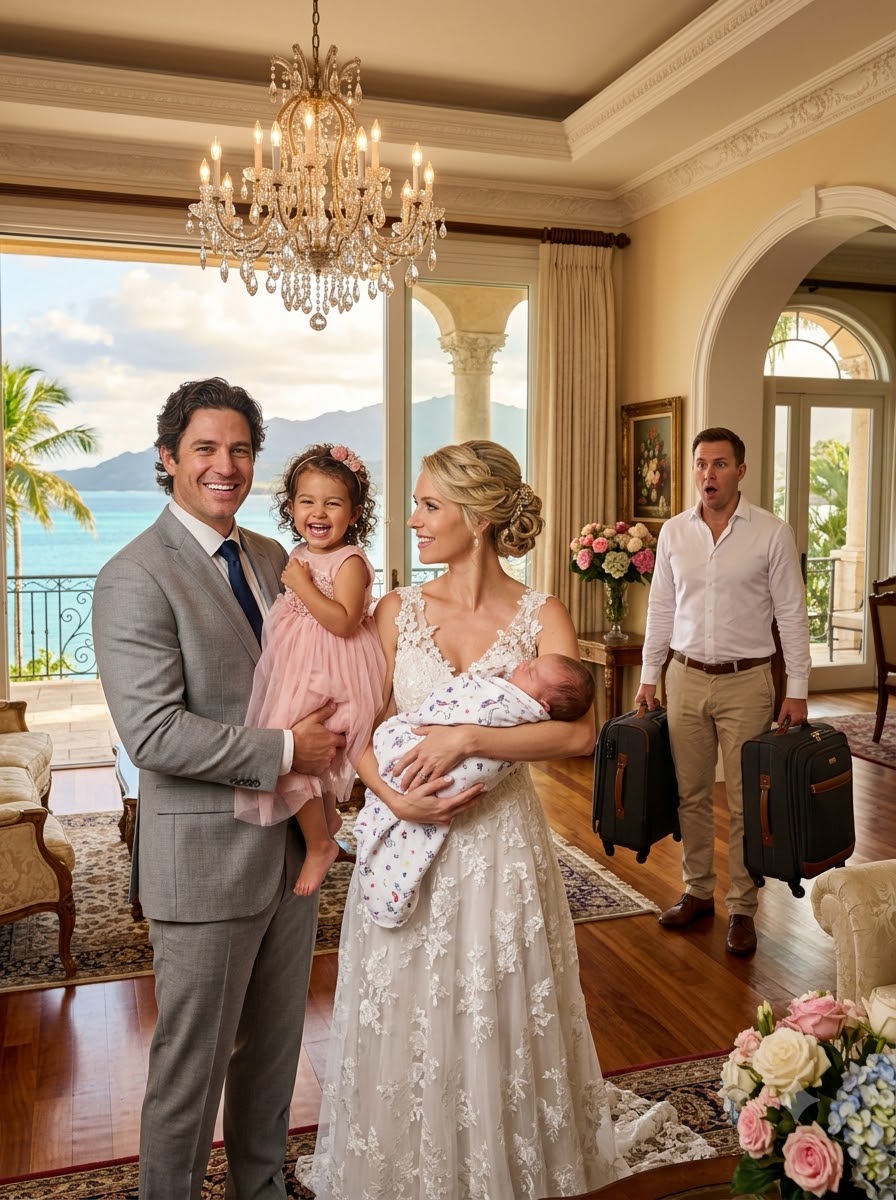
But the deepest vindication didn’t come from a courtroom result or the collapse of his new relationship.
It came in the quiet, unremarkable moments of our new reality.
Mark received standard visitation.
For the first time in his daughters’ lives, he was legally required to parent alone, without my logistical support.
One Tuesday, months after the divorce decree was finalized, my phone vibrated on the nightstand at 2:13 AM.
Mark: Emma is screaming. She won’t stop. What do I do?
I sat upright in the darkness.
In an instant, I was back on those cold bathroom tiles, covered in sour milk while he casually asked for “space.”
My thumbs hovered over the screen.
Instinct told me to drive over, rescue my baby, and fix the chaos.
It was a frighteningly persistent instinct—the urge to manage a man’s incompetence.
I deleted my first response.
Then I typed:
Check her diaper. Try a bottle. Take her temperature. You can handle it.
I placed the phone face down and pulled the duvet beneath my chin.
For the first time in his life, my ex-husband would have to live inside the reality he had created.
A year later, on a bright Saturday morning, my kitchen was filled with its familiar symphony of domestic chaos.
Emma sat in her highchair, conducting gravity experiments by dropping blueberries onto the floor one at a time.
Sophie sat at the table, carefully dissecting a stack of pancakes.
I stood at the sink washing dishes, warm morning sunlight falling across my face.
“Mommy?” Sophie called, her fork suspended in the air.
“Yes, sweetie?”
She chewed thoughtfully.
“Where is Daddy today?”
“He’s at his apartment, honey. It’s his weekend there.”
Sophie processed this with the profound logic of a toddler.
She stared at me, blinking her large eyes.
“Is Daddy having space?”
I inhaled sharply and nearly choked on my own saliva.
I coughed into my hand and turned away from the sink to look at my brilliant, observant daughter.
A genuine, carefree laugh rose from my chest and echoed through the kitchen.
“Yes, baby,” I smiled, wiping a tear of laughter from the corner of my eye. “He’s having all the space in the world.”
I once believed revenge required fire and brimstone, that it meant arranging the complete destruction of the person who had broken you.
I know better now.
The most exquisite, devastating revenge is frighteningly quiet.
It is simply stepping aside, removing your protective hands, and allowing the universe to give them exactly what they asked for.
