

PART 4
Eventually, both families agreed that the girls’ biological identities had to be respected while their immediate emotional and physical needs remained the priority.
With guidance from the professionals involved, we developed a careful transition plan rather than making an abrupt exchange.
There were more visits. More difficult conversations. More tears.
But there was also progress.
Sarah and Michael began bringing their daughter to spend time with us under the agreed arrangements. We did the same with their family.
The girls were still too young to understand what was happening, but they were surrounded by adults who were determined not to let anger or blame dictate their futures.
Daniel took responsibility for his part in what had happened between us. He apologized to Toby for dismissing his concerns and for making him feel that speaking up was wrong.
One Saturday morning, he sat beside our son on the living room floor.
“Toby, can I talk to you?”
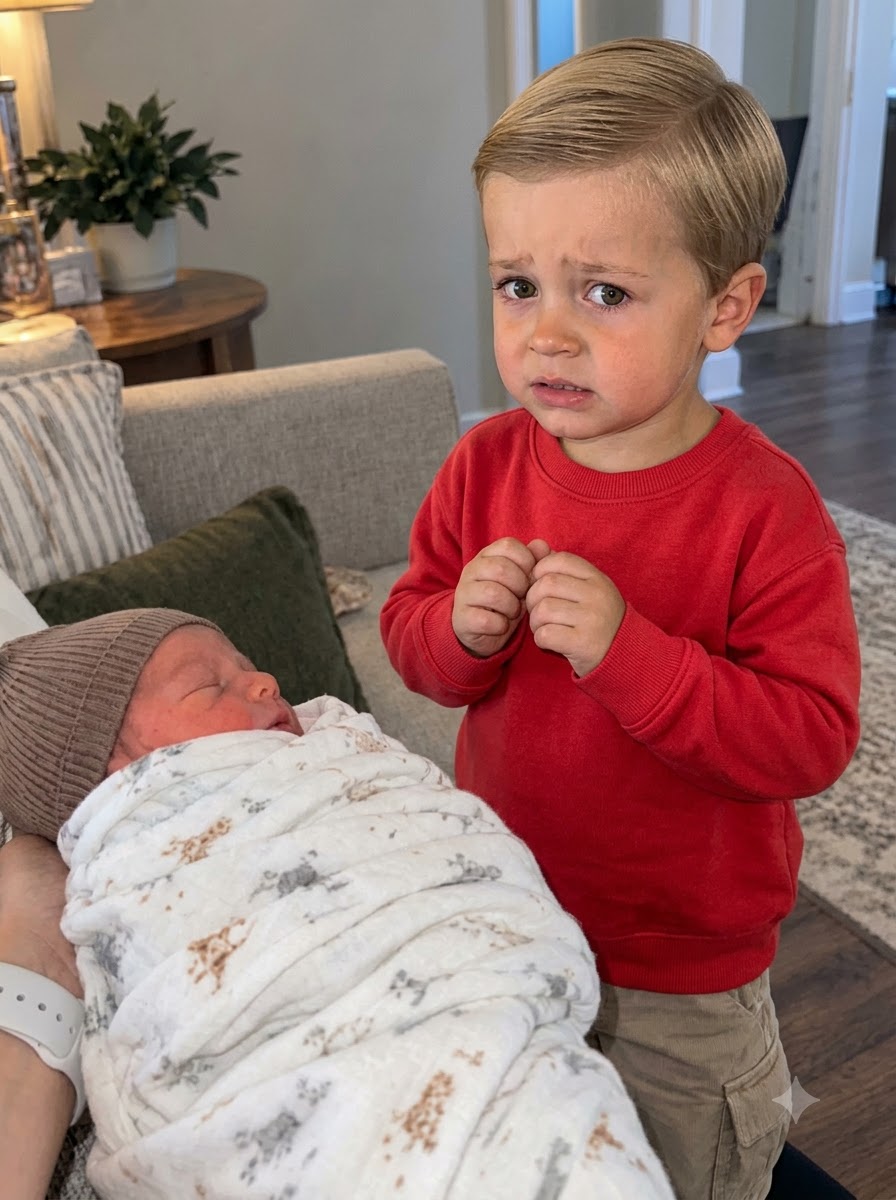
Toby looked up cautiously.
Daniel took a deep breath.
“I owe you an apology.”
Toby didn’t say anything.
“Remember when you told me what you saw at the hospital, and I said you were confused?”
Toby nodded.
“I shouldn’t have said that. I was worried, and I didn’t know how to handle it. But that wasn’t your fault.”
Daniel’s voice broke.
“You were trying to tell me something important, and I didn’t listen. I’m sorry.”
Toby studied his father for a long moment.
“Are you mad at me now?”
Daniel shook his head immediately.
“No. Never for telling the truth.”
“Even if it’s scary?”
“Especially then.”
Toby looked down at his hands.
Then he moved closer to Daniel.
“Okay.”
Daniel wrapped his arms around him.
I stood in the kitchen doorway, watching them.
Their relationship would need time to heal, just as mine and Daniel’s would.
But at least our son was finally hearing the words he should have heard from the beginning.
He had done nothing wrong.
He had been brave.
And the adults in his life needed to do better.
—
Months later, our family gathered with Sarah and Michael for a quiet afternoon at the park.
The girls were growing quickly. They had begun reaching for toys, smiling at familiar faces, and making the small sounds that made every adult nearby stop whatever they were doing.
Toby sat on a picnic blanket between the two babies.
He had brought his stuffed bunny.
He placed it in front of one girl, then moved it toward the other.
“Everybody gets a turn,” he announced solemnly.
Sarah laughed softly.
Michael handed Toby a small box of crackers.
“You’re very good at sharing.”
Toby shrugged.
“I’m the big brother.”
I looked at him.
He no longer avoided the babies. He no longer whispered that one of them wasn’t his sister.
Instead, he had begun to understand that family could be complicated, that adults could make mistakes, and that love didn’t always follow the path people expected.
Later, while the girls slept in their strollers, Sarah sat beside me on the bench.
“I think about that day at the hospital all the time,” she admitted.
“So do I.”
“Sometimes I wonder whether we will ever stop feeling sad about the years we didn’t know the truth.”
I watched Toby crouch beside Michael, examining a tiny beetle on the grass.
“I don’t think we can get those days back,” I said. “But we can decide what we do with the days ahead.”
Sarah nodded.
“Do you think the girls will understand when they’re older?”
“We’ll tell them the truth when they’re ready to understand it. We won’t make it a secret they have to discover on their own.”
She smiled sadly.
“I hope they know how loved they are.”
I looked at the two sleeping babies.
“They will.”
—
That evening, after we returned home, Toby came into my bedroom carrying his stuffed bunny.
“Mommy, can I ask you something?”
I put down my book.
“Of course.”
He climbed onto the bed and settled beside me.
“Do you remember when I said the baby wasn’t my sister?”
“Yes.”
“I was scared because I thought someone had taken my sister away.”
I stroked his hair.
“I know.”
He looked down at the bunny in his hands.
“But now I know she didn’t do anything wrong.”
“No, sweetheart. She didn’t.”
“And the other baby didn’t do anything wrong, either.”
I kissed his forehead.
“That’s right.”
He was quiet for a moment.
Then he looked at me with those serious eyes that had first frightened me in the doorway of the nursery.
“Mommy, if I see something scary again, can I always tell you?”
My throat tightened.
I cupped his face in my hands.
“Always. You can tell me anything, even when you’re frightened, even when you think I might not understand. I promise I will listen.”
He smiled.
Then he leaned against me and closed his eyes.
I held him until he fell asleep.
Afterward, I went downstairs and stood beside the nursery door.
For months, that doorway had represented fear, uncertainty, and the terrible possibility that the life I thought I understood had been built on a mistake.
Now it represented something else.
The importance of listening.
The courage it takes for a child to speak when something feels wrong.
And the responsibility adults have to take those words seriously, even when the truth is difficult to face.
I had once believed that protecting my family meant keeping frightening possibilities away from it.
I had learned that real protection sometimes meant opening the door to painful questions and refusing to look away.
Toby had seen something that the adults around him had failed to recognize.
He had tried to tell us.
And although his words had frightened me, they had also given us the chance to discover the truth.
I looked toward the hallway where his bedroom light glowed softly beneath the door.
My son had taught me something I would never forget.
Children don’t always have the words to explain what they see.
Sometimes they have only a feeling, a frightened whisper, or a sentence that makes no sense to the adults listening.
But that doesn’t mean their voices should be dismissed.
I turned off the nursery light and went upstairs.
Our family would never be exactly what it had been before.
There would be difficult conversations ahead, complicated emotions, and questions we couldn’t answer all at once.
But there would also be honesty.
There would be patience.
And there would be love for two little girls who deserved a future free from the mistakes of the adults who had brought them into the world.
As I passed Toby’s room, I heard him murmur in his sleep.
“It’s okay, baby sister.”
I paused outside his door.
Then I smiled through my tears.
He had finally found peace with the truth.
And I knew that, whatever happened next, I would never again mistake a child’s frightened voice for a problem that needed to be silenced.
Sometimes, the smallest person in the room is the one brave enough to tell everyone else that something is wrong.
Sometimes, listening to that voice is the first step toward making things right.
