

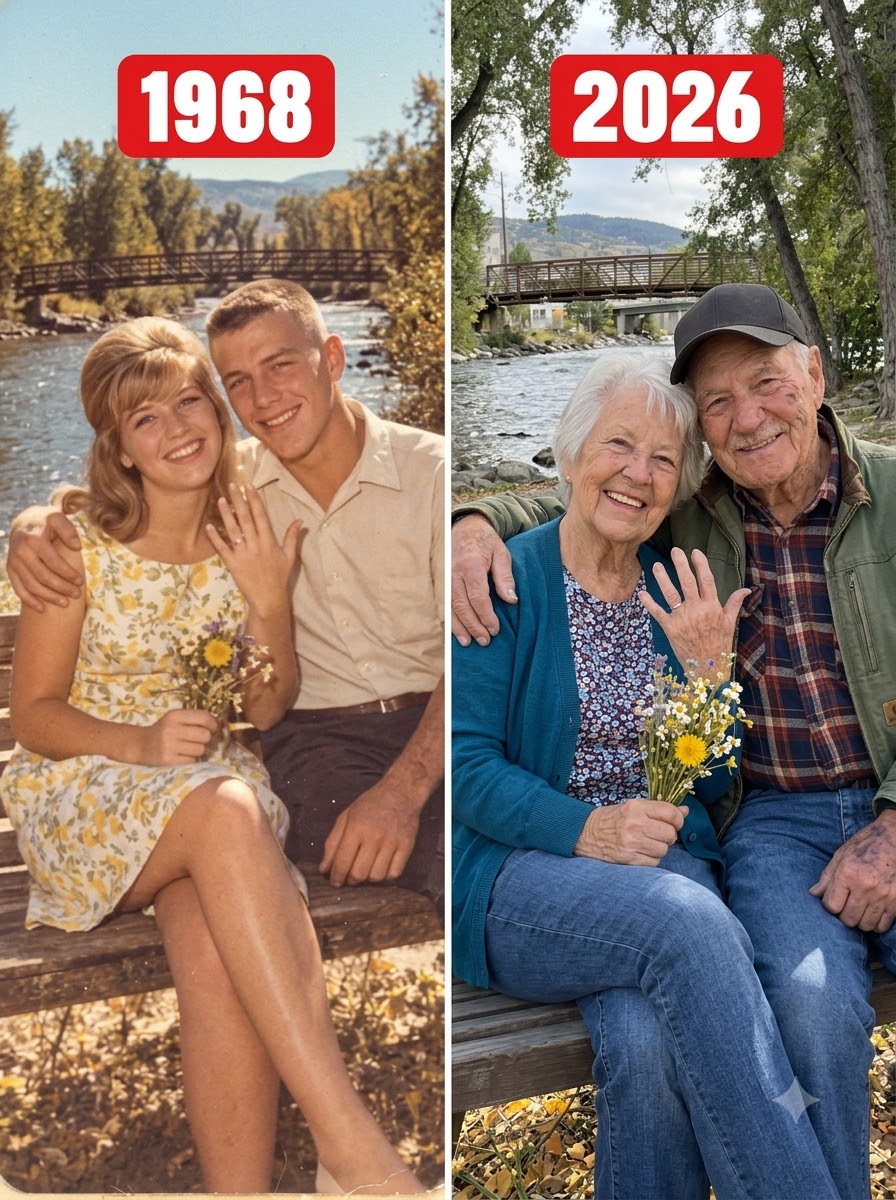
PART 1: The Boy Who Called Me Dandylion
Nine days after my fiancé slipped a diamond ring onto my finger, he boarded a bus for the Army and disappeared from my life.
Months later, his mother sent me a letter saying he had died from injuries suffered in Vietnam. I believed her. I mourned him, eventually married another man, raised children, and grew old carrying the memory of a boy I thought I would never see again.
Then, fifty-eight years later, a teenage delivery boy appeared on my doorstep holding a mason jar filled with wildflowers.
Tucked among the flowers was a small white card.
The handwriting was shaky, but I recognized it immediately.
Still my Dandylion.
The spelling was wrong.
It had always been wrong.
And there was only one person in the world who had ever called me that.
His name was Danny Wirth.
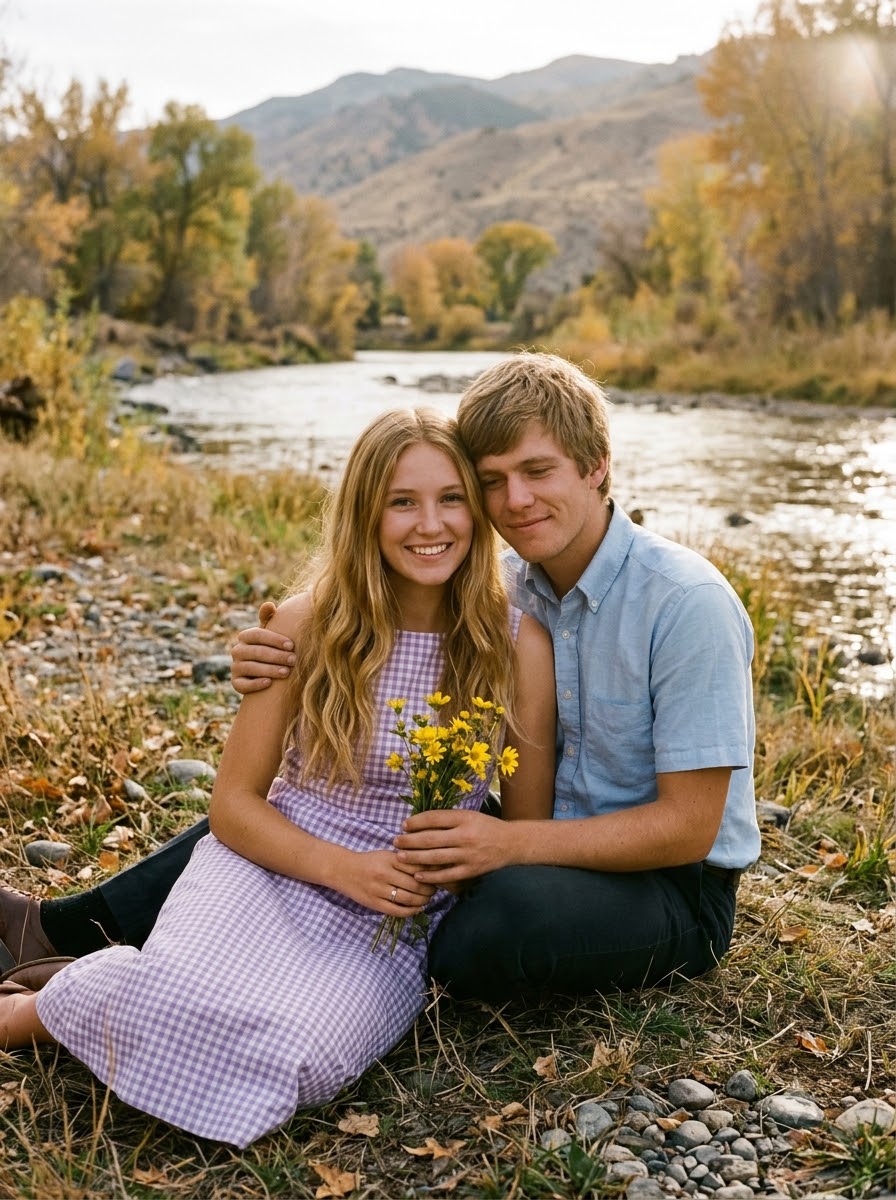
I was eighteen years old when I met him, and I was wearing a yellow dress that my mother had sewn for me.
It was the summer of 1968, back when Reno still felt small enough that everybody knew somebody who knew your family. There was a dance at the community hall, and I had gone with two girlfriends who spent most of the evening whispering about boys.
Danny approached me just as the band began playing a slow song.
He was tall and awkward, with sandy brown hair that refused to lie flat and a smile that seemed permanently caught between confidence and embarrassment.
“Would you like to dance?” he asked.
I looked behind me, certain he must be speaking to someone else.
“Me?”
“Unless there’s another pretty girl in a yellow dress standing right there.”
I laughed.
That was the beginning.
He stepped on my foot twice during our first dance and apologized both times. When the song ended, he asked if I wanted some lemonade.
We spent the rest of the evening talking beneath the yellow lights strung across the hall.
He told me he wanted to become a mechanic and someday own a garage. I told him I wanted a house with a garden and a kitchen window overlooking the backyard.
“Flowers or vegetables?” he asked.
“Both.”
“What about dandelions?”
“Those are weeds.”
He smiled.
“Not when they’re wearing a yellow dress.”
From that night forward, I was his Dandelion.
Except Danny couldn’t spell it properly.
Every note, every letter, every little message he left tucked beneath my windshield wiper addressed me as Dandylion.
I never corrected him.
Everybody else called me Sukey, a childhood nickname that had stuck so firmly most people forgot my real name was Susan.
But to Danny, I was something entirely different.
I was his Dandylion.
We spent that summer falling in love the way young people do when they believe time is something they will always have.
We drove along the river with the windows down. We shared milkshakes because neither of us had much money. We talked about houses, children, and the ridiculous names we might give a dog.
Danny wanted a big dog named General.
I wanted a little one named Biscuit.
He said we could have both.
In October 1968, he took me to a bench overlooking the Truckee River.
The air was cold enough that I had tucked my hands into the sleeves of my sweater.
Danny was unusually quiet.
Then he reached into his jacket pocket and pulled out a tiny velvet box.
“Sukey,” he began, before catching himself. “No. Dandylion.”
I started laughing because his hands were shaking so badly.
He opened the box.
Inside was the smallest diamond ring I had ever seen.
The stone was barely larger than a grain of sugar.
“I know it isn’t much,” he said. “But someday I’ll get you a better one.”
I shook my head.
“Don’t you dare.”
He looked confused.
“This is the one I want.”
He slipped it onto my finger.
Then he asked me to marry him.
I said yes before he finished the question.
Nine days later, he left for the Army.
I stood beside the bus station wearing the same yellow dress, though the weather had turned too cold for it.
Danny kissed me and promised he would come home.
“Save me a dance, Dandylion.”
“All of them,” I whispered.
He climbed onto the bus.
I watched until it disappeared around the corner.
I didn’t know that I had just watched the last ordinary moment of our lives.
For months, his letters were my whole world.
Thirty-one of them arrived altogether.
Some were cheerful. Some were frightening in the quiet ways soldiers learn to describe terrible things without naming them.
He wrote about the heat, the insects, the food, and the men he served beside.
He wrote about missing the smell of rain on Nevada pavement.
He wrote about my yellow dress.
And he always ended with some variation of the same promise.
I’ll be home before you know it.
His capital D leaned sideways, as though it was too tired to stand upright.
I kept every letter in an empty Whitman’s candy box beneath my bed.
Whenever I missed him, I opened it.
Whenever I worried, I read his words aloud.
In the spring of 1969, the letters stopped.
At first, I told myself the mail was delayed.
Then I told myself he had been moved somewhere he couldn’t write.
By May, I was frightened enough to telephone his mother.
She told me she hadn’t heard anything either.
Her voice was strangely controlled.
I remember that now.
At the time, I thought she was simply being brave.
In June, her letter arrived.
She wrote that Danny had suffered terrible burns overseas and had been transported to a military hospital in San Antonio, Texas.
She had traveled there to be near him.
But he hadn’t survived.
According to her letter, he had already been buried in her family’s plot in Ohio.
At the bottom, she had written:
“Don’t come. There’s nothing left to see. Remember him how he was.”
I read those words until the ink blurred.
Then I climbed into bed.
I stayed there for almost a week.
My mother brought me soup I couldn’t swallow. My father sat outside my bedroom door because he didn’t know what else to do.
I was nineteen.
I didn’t have enough money for a bus ticket to Ohio.
I didn’t know which town his family came from.
And I was too shattered to question the woman who had just told me her son was dead.
Eventually, life began moving again.
Not because I wanted it to.
Because life does that, whether you’re ready or not.
Two years later, I married Ted Haldane.
And before I tell you what happened next, I need to make something very clear.
Ted was a good man.
He wasn’t a replacement for Danny.
He wasn’t a consolation prize.
He was a kind, patient, dependable man who loved me without demanding that I become someone else.
He sold insurance, and eventually I joined him in the business.
We worked side by side for thirty years.
We raised two children, welcomed four grandchildren, and bought a modest house near the freeway.
In the backyard stood a lemon tree that never produced a single lemon.
Ted used to joke that it was the most expensive decorative stick in Nevada.
Every spring, he fertilized it anyway.
“One day,” he would tell me, “that stubborn thing is going to surprise us.”
Ted knew about Danny.
I told him before we married.
I even showed him the candy box.
He held one of the letters carefully and asked whether I wanted to put it away.
I said yes.
He never asked me to throw them out.
Once, after we’d been married almost twenty years, I found him repairing the broken hinge on my cedar chest.
The candy box was sitting beside him.
I froze.
Ted looked up.
“Don’t worry,” he said gently. “I didn’t read them.”
Then he added something I have never forgotten.
“Sukey, loving someone before me doesn’t mean you’ve loved me any less.”
I cried that night.
Not because I wanted Danny back.
Because I finally understood how fortunate I was to have found Ted.
We built a good life.
Not a perfect one.
We argued about money and whose turn it was to wash dishes. We worried about our children. We lost friends. We grew older.
But we laughed.
We held hands.
We stayed.
Ted died three years ago.
By then, we’d spent more than five decades together.
After his funeral, the house became painfully quiet.
I kept a pencil behind my ear out of habit from all those years filling out insurance forms.
I had Ted’s pension, a casserole in the freezer for emergencies, and a lemon tree that still refused to give me anything but leaves.
I was seventy-seven years old.
I thought the biggest surprises of my life were behind me.
Then came the flowers.
PART 2: The Man Behind the Green Door
The delivery boy couldn’t have been more than seventeen.
He stood on my porch holding a mason jar filled with black-eyed Susans, tiny blue flowers, and one bright yellow dandelion.
“Ma’am? These are for Susan.”
I almost told him he had the wrong address.
Then I saw the card.
My fingers trembled as I unfolded it.
Still my Dandylion.
For a moment, I couldn’t hear the traffic beyond the fence.
I couldn’t hear the boy asking whether I was all right.
I could only see that crooked capital D.
Fifty-eight years disappeared.
I was eighteen again, standing beside a river while a nervous boy held out a velvet ring box.
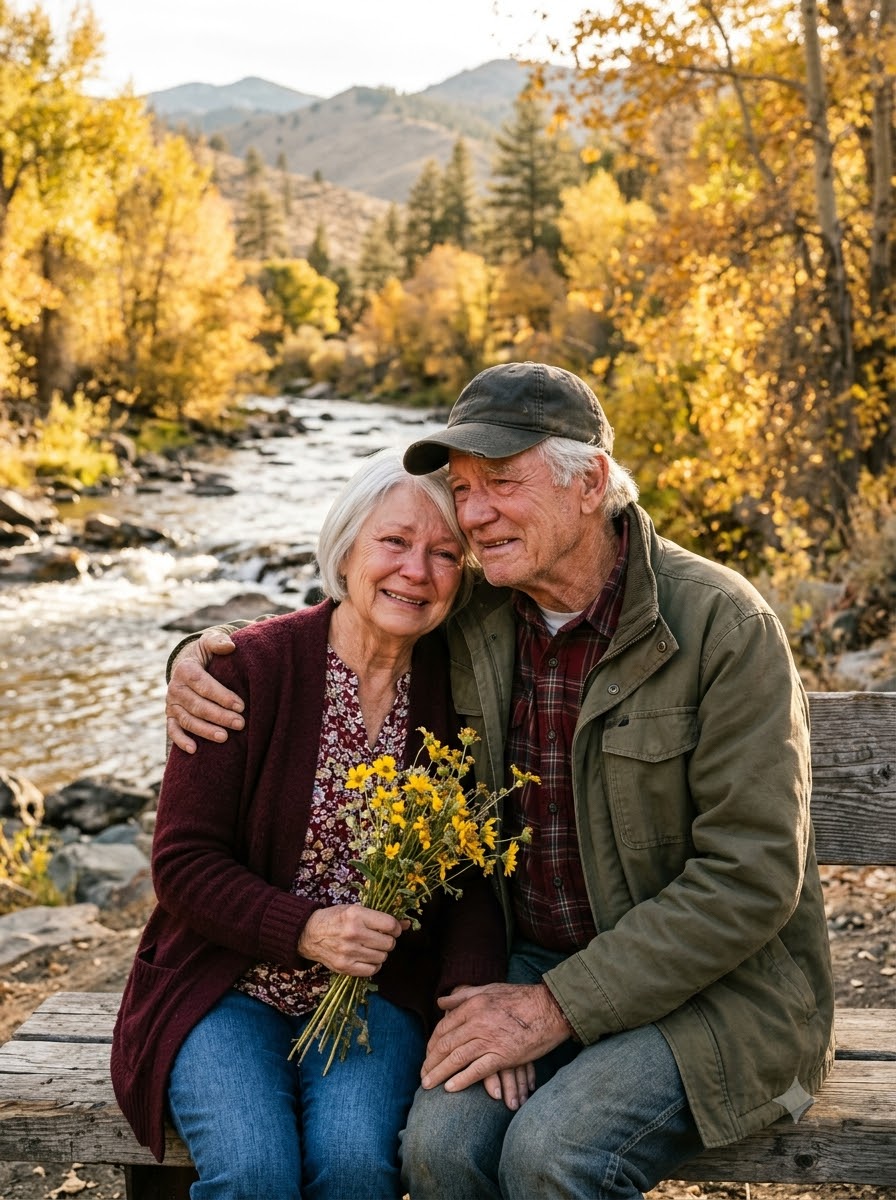
I sat down on the front step.
“Ma’am, should I call somebody?”
I shook my head.
“Who sent these?”
He checked the delivery slip.
“An older gentleman ordered them. That’s all I know.”
I thanked him and carried the flowers inside.
My first thought was that somebody was playing a cruel joke.
My second thought was worse.
What if it wasn’t a joke?
I called the florist.
Twice, I dialed the wrong number because my hands wouldn’t stop shaking.
Finally, a young woman answered.
She remembered the customer.
“An older gentleman came in Thursday,” she explained. “He paid cash and wrote the card himself. He had some trouble holding the pen.”
“Did he leave a name?”
“Just D. Wirth. And a phone number.”
My heart nearly stopped.
The number had a 530 area code.
Northern California.
I called immediately.
A woman answered.
“Hello?”
“My name is Susan Haldane,” I said. “I’m trying to find a man named Daniel Wirth.”
Silence.
Then I heard a sharp intake of breath.
“Who is this?”
“I used to know him. A long time ago.”
The line went dead.
She had hung up.
I sat at the kitchen table staring at the telephone.
That evening, my grandson came over and found the address in less than two minutes.
Susanville, California.
About two hours north.
When I told my daughter, she looked at me as though I had announced plans to climb Mount Everest.
“Mom, you’re seventy-seven.”
“I’m aware.”
“You’re going to drive two hours to chase a ghost?”
“He’s not a ghost if he can buy flowers.”
She rubbed her forehead.
“Somebody could be trying to scam you.”
“Then they’ll be disappointed. I don’t have much worth stealing.”
“Mom, please. Don’t make a fool of yourself.”
I knew she was frightened for me.
But I also knew something she didn’t.
There are questions a person can carry for so long that they become part of the bones.
And sometimes the chance to answer one is worth the risk of looking foolish.
That night, I took out the Whitman’s candy box.
The cardboard had softened at the corners. The gold lettering was faded.
I spread all thirty-one letters across my kitchen table.
I read every one.
By sunrise, I knew what I had to do.
I put the letters in my purse.
I found the little diamond ring in my jewelry box.
And I drove north.
At the Raley’s gas station on the way out of town, I sat in my car for nearly twenty minutes.
I thought about turning around.
Maybe my daughter was right.
Maybe grief had finally made me foolish.
Then I looked at the flowers resting on the passenger seat.
The dandelion had begun to wilt.
I started the engine.
The address led me to a little green house on a quiet street.
A wooden ramp stretched from the driveway to the front porch.
Beside the door stood a pair of old men’s work boots, carefully polished.
Something about those boots nearly broke me.
Danny had always taken care of his shoes.
Even as a teenager, he’d polished them every Sunday.
I knocked.
A woman of about fifty opened the door.
She had gray hair at her temples and wore medical scrubs. There were dark circles beneath her eyes, the kind that come from working too many night shifts.
The moment she saw me, her expression changed.
“You’re her,” she whispered.
I couldn’t speak.
“The Dandelion.”
My knees weakened.
“I’m Selena,” she said. “His daughter.”
I gripped the porch railing.
“Is he here?”
She looked behind her.
“Please,” I said. “Is Danny here?”
Her eyes filled with tears.
“He wanted you to have the flowers. He never meant for you to come.”
“Why?”
She swallowed.
“He’s very sick.”
“I don’t care.”
“You don’t understand. He doesn’t want you to see him like this.”
I stepped closer.
“Young lady, I’ve been looking at a grave in my mind for fifty-eight years. Whatever is inside this house, I can bear it.”
She shook her head.
“I’m sorry. Please go.”
She began closing the door.
Then a man’s voice came from somewhere inside.
“Selena. Wait.”
The voice was weak.
Rough.
Worn down by years and illness.
But I knew it.
I would have known it in a crowded room, across an ocean, or in the middle of a dream.
The door opened again.
And there he was.
Danny Wirth.
The boy I had buried in my heart was sitting in a wheelchair beside the living-room window.
His hair had turned almost completely white.
One side of his face bore the unmistakable marks of severe burns. The skin along his neck was tight and uneven, disappearing beneath the collar of his shirt.
His left hand rested awkwardly in his lap, the fingers curled and stiff.
An oxygen tube ran beneath his nose.
But his eyes were the same.
Those gentle gray-blue eyes.
For several seconds, neither of us spoke.
Then he whispered, “I’m sorry.”
I had imagined seeing Danny again a thousand times when I was young.
In every dream, I ran into his arms.
In every dream, he held me.
But standing in that little house, all I felt was a terrible, overwhelming anger.
“You’re sorry?”
He lowered his head.
“Susie—”
“Don’t.”
My voice cracked.
“Don’t call me that yet.”
Selena stood silently near the doorway.
I took another step.
“You let me think you were dead.”
Danny nodded.
“For fifty-eight years.”
“I know.”
“I cried over you. I stopped eating. I thought about you on your birthday, every Christmas, every time I saw a soldier come home.”
Tears blurred my vision.
“And you were alive?”
His face crumpled.
“Yes.”
“Then tell me why.”
He gestured toward a chair.
I refused to sit.
So he began.
He told me about the attack in Vietnam.
About the fire.
About waking in a hospital without knowing where he was.
His injuries had been severe. He’d suffered burns across his face, neck, chest, and arm, along with a head injury that left his memory fractured.
For weeks, he couldn’t remember ordinary things.
Then pieces began returning.
His childhood home.
His mother’s name.
The river in Reno.
A girl in a yellow dress.
“Your name came back before I remembered my own address,” he whispered.
I covered my mouth.
His mother had traveled to Texas to care for him.
She had seen the damage to his body and the fear in his eyes.
And she had decided that I should never know.
“She told me you were young,” Danny said. “That you deserved a husband who could work, a family, a normal life.”
He stared at his damaged hand.
“She said you would stay out of pity if you saw me.”
“That wasn’t her decision.”
“I know.”
“Was it yours?”
He shook his head.
“No.”
Then he told me the part that hurt most.
Months after his condition stabilized, he wrote me a letter.
He told me he was alive.
He told me what had happened.
He asked whether I would still want to see him.
His mother found the letter before it was mailed.
She burned it.
I felt the room tilt.
“She burned it?”
“Yes.”
“And you let her?”
His silence was answer enough.
“She said she’d already written to you,” he finally admitted. “She told me you’d accepted my death and begun moving on.”
I stared at him.
“I hadn’t.”
“I know that now.”
“You could have called.”
“Yes.”
“You could have written again.”
“Yes.”
“You could have come to Reno.”
His eyes filled.
“Yes.”
I waited for an excuse.
He didn’t give me one.
“I was ashamed,” he said. “I couldn’t look at myself in a mirror. I couldn’t imagine you looking at me. And after enough time passed, I became afraid of what I’d done.”
He wiped his face with his good hand.
“I was a coward, Sukey.”
The words struck harder than any explanation.
Because he wasn’t blaming the war.
He wasn’t blaming his mother.
He was finally taking responsibility.
“You didn’t have the right to make that choice for me,” I whispered.
“No,” he said. “I didn’t.”
Selena began crying quietly.
Danny told me he had eventually moved to California, learned to work around his injuries, and found employment repairing small engines.
He met a woman named Elaine.
She was a nurse’s aide who treated his scars as part of his body rather than the whole of his identity.
They married.
They had Selena.
For decades, he lived a life I knew nothing about.
Elaine had died several years earlier.
And now his own health was failing.
A serious heart condition, complicated by old injuries and declining strength, had left him increasingly dependent on his daughter.
He had recently found an old photograph of me in a box.
A girl in a yellow dress.
He’d kept it all those years.
“I didn’t send the flowers because I thought you would come,” he said.
“Then why?”
His voice broke.
“Because I didn’t want to die without telling you that I remembered.”
I sat down at last.
For a long time, I said nothing.
Then I opened my purse.
I took out the little velvet ring box.
Danny stared at it.
“You kept it?”
“Of course I kept it.”
I opened the lid.
The tiny diamond caught the afternoon light.
He began to cry.
And despite everything, I reached for his hand.
PART 3: The Life We Lost, and the Lives We Found
I didn’t forgive Danny that afternoon.
I want to be truthful about that.
Forgiveness isn’t a switch a person can flip because someone finally says the words they’ve been waiting to hear.
I was angry.
I was heartbroken.
And I was grieving something I hadn’t even known I’d lost.
Not just Danny.
But the possibility of a different life.
The wedding we never had.
The children we might have raised.
The years that had passed while we lived only a few hours apart.
Before I left, Selena walked me to my car.
“I’m sorry I hung up on you,” she said.
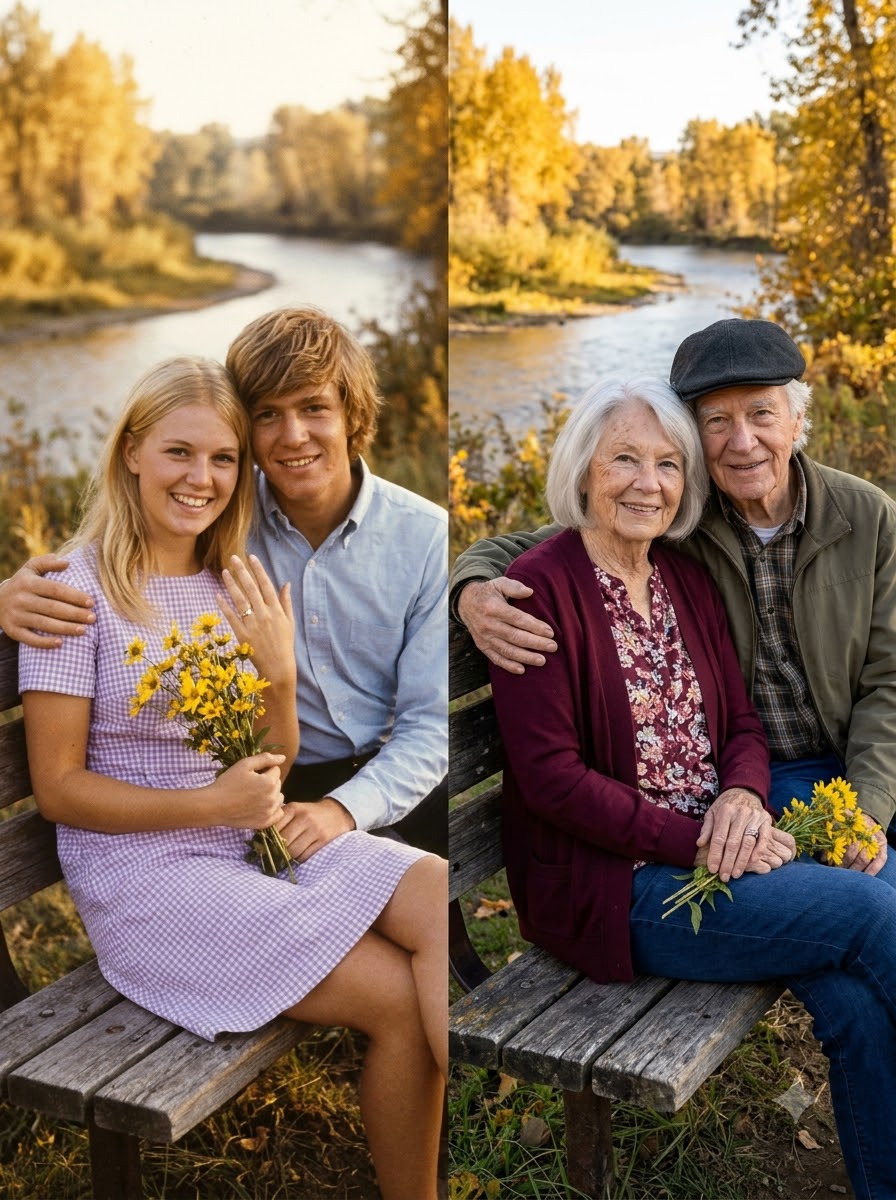
I looked at her.
“You were protecting your father.”
She nodded.
“He’s been getting weaker. When you called, I thought seeing you might be too much for him.”
“Did you know about me?”
“Not until Mom died. I found a photograph and some letters. Dad finally told me.”
She hesitated.
“Sometimes he used to say your name in his sleep.”
I looked toward the house.
Through the window, I could see Danny sitting in his wheelchair.
He raised his hand.
I raised mine.
Then I drove home.
My daughter was waiting when I arrived.
She took one look at my face and stopped asking questions.
“He’s alive?” she whispered.
I nodded.
She hugged me so tightly I could barely breathe.
That night, I told her everything.
For the first time, she understood that the story of Danny wasn’t simply an old romance her mother had never forgotten.
It was an unfinished chapter that had shaped the way I understood love, loss, and trust.
The following Sunday, I drove back to Susanville.
I brought lemon cake.
Not from my tree, of course.
That stubborn old thing still hadn’t produced a single lemon.
I bought the lemons at the grocery store and baked the cake using Ted’s favorite recipe.
Danny was waiting by the window.
When he saw me, his face brightened.
“You came back.”
“Don’t look so surprised.”
He smiled.
“Still bossy.”
“Still terrible at spelling.”
For the first time in fifty-eight years, we laughed together.
That became our routine.
Every Sunday, I drove north.
Sometimes I brought photographs.
Sometimes I brought food.
Sometimes we simply sat together and talked.
I told him about Ted.
About the insurance business.
About our children and grandchildren.
About the little house near the freeway and the lemon tree that had become a family joke.
Danny listened carefully.
One afternoon, he asked, “Was he good to you?”
I looked at him.
“Ted?”
He nodded.
“The best.”
Danny smiled, though tears shone in his eyes.
“I’m glad.”
I believed him.
Then he told me about Elaine.
She had met him when he still avoided mirrors.
She never pretended his injuries didn’t exist, but she refused to let them define him.
When he struggled to button his shirt, she helped without making him feel helpless.
When nightmares woke him, she sat beside him until morning.
When he worried that people stared at his scars, she took his hand and walked beside him anyway.
“She knew about you,” he admitted.
I was surprised.
“Everything?”
“Everything I could bear to tell her.”
“Was she angry?”
“Sometimes.”
He looked down.
“But she said something I never forgot. She said loving someone who was gone didn’t mean I wasn’t capable of loving her.”
I smiled through my tears.
“Ted said almost the same thing.”
We sat quietly after that.
Two people who had spent decades feeling guilty for carrying an old love while being loved by someone new.
And finally, we understood something.
Neither Ted nor Elaine had been second choices.
They had been real loves.
Whole loves.
The fact that Danny and I had once belonged to each other did not diminish the marriages we had built.
It simply meant our hearts had been large enough to hold more than one story.
As the weeks passed, Selena and I became friends.
She told me about Danny teaching her to ride a bicycle, attending every school concert he could manage, and fixing broken appliances for neighbors who couldn’t afford repairs.
He had been a good father.
A devoted husband.
A generous neighbor.
Knowing that comforted me.
But it also made the years of silence harder to understand.
One Sunday, I finally asked him something that had been troubling me.
“Did your mother ever regret what she did?”
Danny closed his eyes.
“Near the end of her life, she told me she’d been wrong.”
I waited.
“She said she’d been afraid of losing me after the war. Afraid that if you saw me suffering, you’d take me away and she’d be alone again.”
I shook my head.
“So she made sure we both lost each other.”
“Yes.”
“Did she ever tell anyone she’d lied about your death?”
“No. She kept that lie alive. Even after I stopped believing it was necessary.”
His voice trembled.
“She loved me, Sukey. But she let fear turn that love into something cruel.”
I thought about my own children.
About the times I’d wanted to protect them from heartbreak.
And I realized how easily protection can become control when we forget that the people we love have the right to make their own choices.
Danny’s mother had been frightened.
But fear did not excuse what she’d done.
And Danny’s shame did not excuse his silence.
We could understand those things without pretending they hadn’t caused harm.
Eventually, Selena discovered that Danny’s mother had arranged for a memorial marker in Ohio and that a false death report remained among old family records.
The official military records showed that Danny had survived, but the family’s burial and local memorial paperwork had never been corrected.
For decades, an empty grave had carried his name.
When Selena told us, Danny stared at the floor.
“I’d like to see it,” he said.
“Then we’ll go,” I answered.
He looked at me in disbelief.
“All the way to Ohio?”
“Daniel Wirth, I’ve already driven hundreds of miles because of you. What’s a few more?”
With Selena’s help, we arranged the trip.
She contacted the cemetery, gathered the necessary documents, and began correcting the surviving local records.
We traveled slowly because Danny tired easily.
At the cemetery, the sky was gray and the grass damp beneath our shoes.
Selena pushed his wheelchair along a narrow path until we reached a modest stone.
There was his name.
Daniel Wirth.
A date of birth.
And a date of death in 1969.
I stood frozen.
For fifty-eight years, I’d imagined that stone.
Now I was looking at it beside the man it claimed was buried there.
Danny reached forward.
His fingers trembled as they touched the carved letters.
For a long time, he said nothing.
Then he whispered, “I came home.”
I knelt beside him.
“Yes, Danny.”
I placed my hand over his.
“You came home.”
Selena cried behind us.
Later, we spoke with the cemetery office about correcting the marker and ensuring the records reflected the truth.
Danny asked that the old stone not simply be discarded.
He wanted it preserved as a reminder of the damage silence could cause.
“Maybe someday,” he said, “somebody will see it and decide to tell the truth before it’s too late.”
On the flight back, Danny slept most of the way.
I watched him and thought about the strange mercy of time.
It had taken nearly six decades to bring us together.
And now we had no way of knowing how many days remained.
But for the first time, I wasn’t counting the years we’d lost.
I was learning to treasure the hours we had.
PART 4: The Last Dance by the River
By spring, Danny was weaker.
Some Sundays, he couldn’t sit upright for very long.
Other days, he was lively enough to argue about baseball, complain about hospital food, and tell Selena she worried too much.
He still insisted on polishing his old work boots.
Selena told me he hadn’t worn them in years.
“Then why does he keep polishing them?” I asked.
She smiled sadly.
“He says a man ought to be ready to go somewhere.”
One afternoon, Danny asked me to take him to Reno.
I knew immediately where he wanted to go.
“The river?” I asked.
He nodded.
“The bench.”
Selena worried the trip would exhaust him, but after speaking with his doctor and arranging what he needed for the journey, she agreed.
We drove down on a bright May morning.
The city had changed.
Buildings stood where empty lots had once been.
Roads had widened.
Stores had disappeared.
But the Truckee River still moved through Reno, carrying the same restless sound I remembered from my youth.
We found a bench near the place where Danny had proposed.
Selena helped him into his wheelchair and then walked a short distance away to give us privacy.
I sat beside him.
For a while, we simply watched the water.
“Do you remember what you said here?” he asked.
“Which part?”
“When I gave you the ring.”
I smiled.
“You said you’d buy me a better one someday.”
He laughed softly.
“That sounds like me.”
“I told you not to dare.”
“You always knew what you wanted.”
“Not always.”
He looked at me.
“I wanted you,” I said. “And when I lost you, I had to learn how to want a life without you.”
His expression changed.
“I’m sorry.”
“I know.”
He reached into his coat pocket.
For a moment, I thought he was reaching for another ring.
Instead, he pulled out a folded piece of paper.
It was old and worn, but the writing was familiar.
My breath caught.
“What’s that?”
“A letter.”
“To me?”
He nodded.
“Not the one my mother burned. I wrote this years later. Never mailed it.”
He handed it over.
The words were faded, and his handwriting was uneven.
But I could still recognize that leaning capital D.
Dear Dandylion,
I don’t know whether you are happy. I hope you are. I don’t know whether you remember me. I hope you do, but I also hope remembering doesn’t hurt.
I have spent so much of my life wishing I had been braver.
If I ever see you again, I won’t ask you to pretend I did nothing wrong. I only want you to know that the boy who loved you was real.
And he never forgot the girl in the yellow dress.
I read the letter twice.
Then I folded it carefully.
“Why didn’t you send this?”
He looked toward the river.
“Because I was still afraid.”
I nodded.
At least he was telling the truth.
Then he asked the question I knew had been waiting between us since the day I arrived at his house.
“Can you forgive me, Sukey?”
I looked at the old man beside me.
At the scars.
At the tired eyes.
At the hand that had once slipped a tiny diamond onto my finger.
And I thought about the boy who had loved me.
The frightened young soldier who had come home broken.
The man who had allowed shame to become silence.
The husband Elaine had loved.
The father Selena adored.
All of those people were Danny.
And I realized I didn’t have to excuse his worst choice to recognize the good in the rest of his life.
“I forgave the boy a long time ago,” I whispered.
He closed his eyes.
“Now I’m learning to forgive the man.”
A tear slipped down his cheek.
“That’s more than I deserve.”
“Maybe,” I said. “But forgiveness isn’t always about what someone deserves.”
I took his hand.
“Sometimes it’s about deciding how much longer you want to carry the hurt.”
We stayed by the river until the afternoon light began to fade.
Before leaving, Danny asked me one final question.
“Do you ever wish we’d had our life together?”
I considered lying.
But we’d wasted too much time on things left unsaid.
“Yes,” I answered. “Sometimes.”
He nodded.
“Me too.”
Then I squeezed his hand.
“But I wouldn’t give up Ted. Or my children. Or my grandchildren.”
“Neither would I give up Elaine or Selena.”
We looked at each other.
And something peaceful settled between us.
We didn’t need to choose between the lives we’d imagined and the lives we’d lived.
We could mourn one while remaining grateful for the other.
As Selena approached, Danny smiled.
“Save me a dance, Dandylion.”
I laughed through my tears.
“All of them.”
Danny died that June.
It happened quietly, early one morning.
Selena called me the night before because his breathing had changed and he had been asking for me.
I drove to Susanville.
This time, I didn’t stop to question whether I should go.
I simply went.
He was resting in his bedroom when I arrived.
Selena sat beside him, holding his left hand.
I took his right.
His eyes opened when he heard my voice.
“Hello, Danny.”
He smiled faintly.
“Yellow dress,” he whispered.
I leaned closer.
“What?”
“You looked so pretty.”
I began crying.
“You were a terrible dancer.”
He gave the smallest laugh.
Then his fingers tightened around mine.
For a little while, we sat together in silence.
Selena played one of the old songs he loved.
I brushed his white hair away from his forehead.
And when his breathing finally slowed, I held his hand until it stopped.
There was no dramatic goodbye.
No final confession.
No miracle.
Only a man who had lived a long, imperfect life, leaving it in the company of two women who loved him.
At his funeral, Selena stood beside me.
She had placed a photograph of her parents near the flowers.
Beside it was the picture of me in my yellow dress.
I had been uncertain about including it.
But Selena insisted.
“You’re part of his story,” she said. “And Mom would have understood.”
After the service, she hugged me.
“Thank you for loving my dad.”
I shook my head.
“He was lucky to have you.”
She wiped her eyes.
“He was lucky to have both of us.”
When I returned home, the house felt different.
Not less quiet.
But less haunted.
I took the Whitman’s candy box from my cedar chest and placed Danny’s final letter beside the original thirty-one.
Then I found the little diamond ring.
I held it for a moment before putting it back in its velvet box.
I didn’t wear it.
Not because I was ashamed.
But because I no longer needed a ring to prove that our love had existed.
That evening, I walked into the backyard.
The sun was low.
A warm breeze moved through the branches of Ted’s stubborn lemon tree.
And there, tucked among the glossy leaves, were three small green lemons.
I stared at them.
Then I laughed.
I laughed so hard I had to sit down.
For more than fifty years, that ridiculous tree had refused to produce anything.
Ted had watered it, fertilized it, pruned it, and threatened to replace it.
And now, three years after his death, it had finally decided to surprise me.
I touched one of the tiny lemons.
“Well, Ted,” I whispered, “you were right.”
I thought about my husband.
About the ordinary mornings we’d shared.
About the way he’d always brought me coffee before I asked.
About his kindness when he discovered the letters.
Then I thought about Danny.
About a yellow dress.
A crooked capital D.
A tiny diamond ring.
And a mason jar filled with wildflowers.
For so many years, I had believed that loving Danny meant carrying a wound that would never close.
But I was wrong.
The wound hadn’t healed because I’d forgotten him.
It healed because I finally learned the truth, faced the pain, and understood that the life I’d lived was not less meaningful than the one I’d lost.
I had loved Danny when I was young.
I had loved Ted through a lifetime.
And in the end, I had been given the unexpected gift of saying goodbye to Danny properly.
I was seventy-seven years old, sitting beneath a lemon tree that had finally borne fruit, when I understood something I wish I’d known at nineteen.
Love doesn’t always give us the future we imagined.
Sometimes it arrives too early.
Sometimes it comes after we’ve already built another life.
Sometimes it asks us to forgive things we never should have been forced to endure.
And sometimes, after decades of silence, it returns not to begin again, but to finish what was left unfinished.
Danny didn’t come back to take Ted’s place.
He didn’t come back to give me the marriage we’d once planned.
He came back with wildflowers, a misspelled name, and the truth.
And although that truth hurt, it gave both of us something the years had never been able to provide.
Peace.
That night, before going inside, I looked up at the fading sky.
“Goodnight, Danny,” I whispered.
Then I smiled.
“Goodnight, Ted.”
And for the first time in a very long while, I didn’t feel that I was leaving anyone behind.
I was simply going home.
Because love doesn’t always return to stay. Sometimes it returns to help us find peace.
