

Part One: The Weight of Unseen Stars
My father had a laugh that did not simply fill a room; it took the room over. It was a deep baritone rumble, polished by forty years of boardroom takeovers, zoning fights, and political fundraisers, a big, theatrical sound meant to leave everyone within earshot feeling he had just done them a personal kindness.
“And this,” Roderick Dunar declared, his manicured fingers barely brushing the fabric of my shoulder before drifting away, “is my younger daughter. A bit of an odd duck, frankly. Wanders off, keeps to the margins. But she insisted on flying in for the celebration, so we made room at the table.”
A polite, syrupy titter moved through the velvet and marble of the grand parlor. It was that particular vintage of Southern country-club laughter: smooth and harmless on top, with a razor edge underneath.
I did not flinch. Decades in flight debriefing bunkers and joint command centers teach an officer to keep the blood from rising to her cheeks. So I simply studied the room with calm detachment. The Belle Meade estate smelled exactly as it had when I was a child: expensive beeswax, hothouse white lilies, and the bitter ghost of bourbon evaporating from cut crystal. Every antique credenza, every heavy silk drape, every warm recessed light had been chosen to project an effortless, inherited permanence.
Beside my father stood my older sister, Genevieve, wrapped in pale champagne satin. Jenna looked immaculate, glowing with the easy radiance our father had cultivated in her like a prized thoroughbred. Next to her stood the guest of honor, Captain Knox Sheridan of the United States Army Special Forces.
Knox was tall and carried himself with the dense, disciplined bearing of an infantryman who had spent his youth clearing compounds in the dark. His Army service greens were perfectly tailored, with the combat infantryman badge, the airborne tab, and his ribbons aligned to the millimeter. He understood decorum, but more than that, he understood that formality in uniform is never mere decoration. It is the outward ledger of sacrifice.
“Knox, my boy,” my father went on, his voice dripping with condescending warmth, “she’s quiet. Very private girl. Never could quite figure out what to do with herself in the private sector, but we love her anyway.”
The remark was delivered with a pat on the air, the way one praises a dog that has never learned a trick. I let it pass through me. I had heard versions of it at every holiday table for sixteen years.
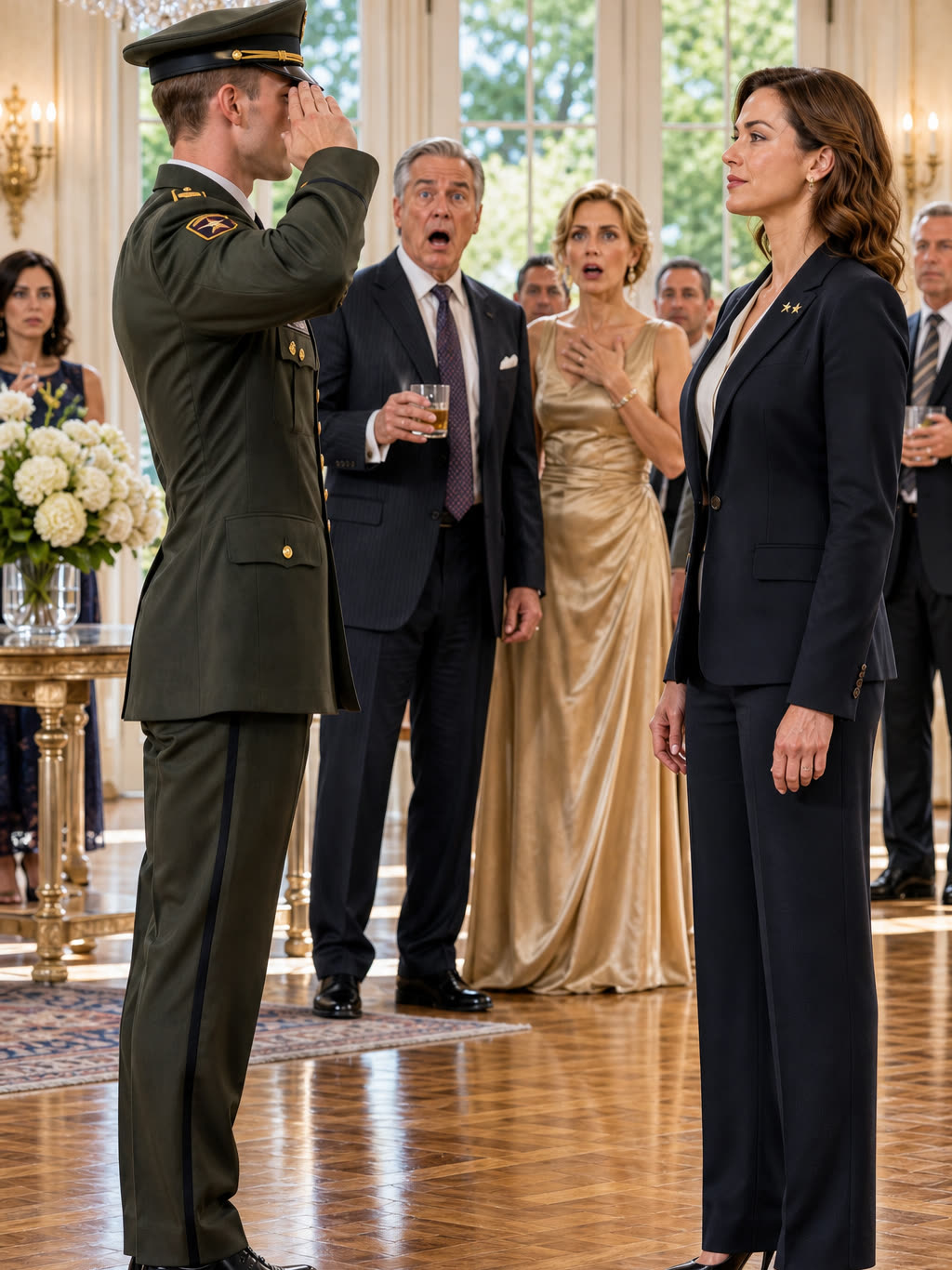
Knox stepped forward and extended his right hand for an ordinary civilian greeting. His grip was firm, professional, almost automatic. Then his eyes flickered downward. He did not look at my plain slacks, my neutral silk blouse, or the small overnight satchel resting against my ankle. His gaze locked on the left lapel of my jacket, where, pinned out of habit before I boarded my transport out of Langley Air Force Base, sat a small, understated bar bearing two polished silver stars.
I watched the machinery turn behind his eyes. It took less than a quarter of a heartbeat. To a civilian, those stars might pass for costume jewelry or an antique trinket. To an active-duty combat captain, they landed like a thunderclap. Knox’s hand broke from mine as if he had touched live ordnance. He took a crisp half-step back, his heels snapping together with a clear, ringing click on the imported parquet. His spine went rigid, his chin leveled, and his right hand cut through the perfumed air in a textbook, razor-sharp salute. “General,” Knox barked, his voice slicing through the cocktail chatter with absolute parade-ground authority. “Ma’am!”
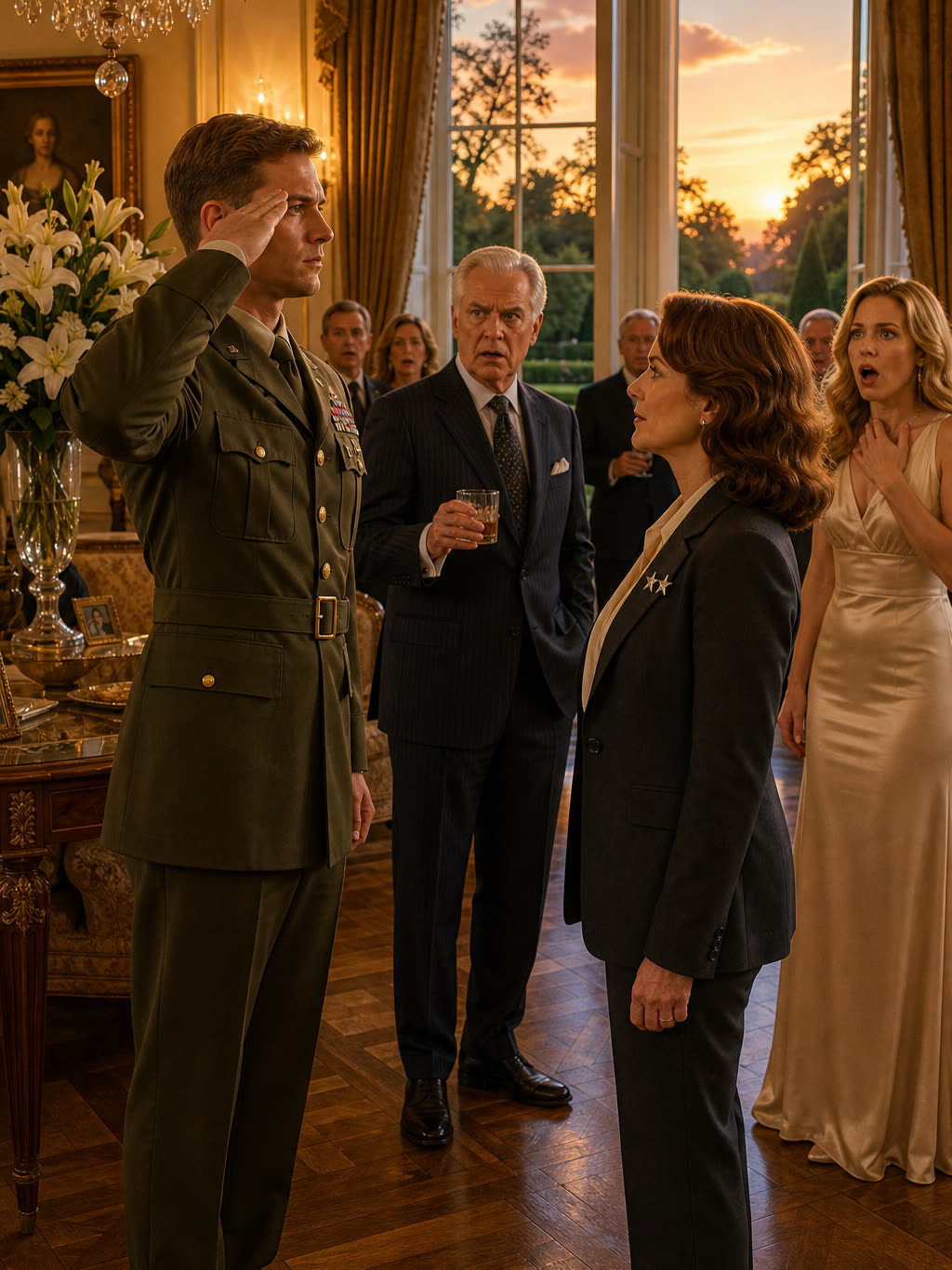
The parlor did not merely fall quiet; the air seemed to leave it. It was the kind of silence that comes just before an airframe fails, sudden, absolute, and total. Conversations died mid-sentence. Ice stopped clinking against glass.
My father’s hand froze awkwardly in the air, caught between a gesture of dismissal and plain bewilderment. His smile withered into a brittle grimace.
I held Knox’s gaze for a second, then raised my hand to the brim of an invisible cap and returned the salute with effortless, measured economy before lowering my arm.
“At ease, Captain,” I said quietly.
My father’s throat worked dryly. He cleared it twice, casting an anxious glance around the stunned circle of Nashville society. “Knox… son, there’s obviously some bizarre confusion here. My daughter isn’t—”
Knox did not turn his head. His eyes stayed fixed on mine, rigid with disciplined deference. “No confusion, sir.” Then, speaking only to me: “Forgive me, General. The civilian attire threw me off. Had I known you were in transit from command, I would have met you at the gate.”
“You weren’t expected to recognize me, Captain Sheridan,” I answered smoothly. “This is a family engagement party. Not a theater briefing.”
“Understood, ma’am,” he replied, though a faint fire of indignation flickered beneath his jaw as he glanced sideways at my father.
My father let out a dry, rattling cough that tried to pass for a laugh. “Well! Isn’t that something? Mystery solved. She… she never keeps us updated. Always so theatrical, aren’t you, darling?” He reached frantically for a fresh glass of scotch from a passing silver tray. “Shall we proceed to the terrace, everyone?”
The crowd stirred, but the pressure in the room had permanently turned over. Guests drifted away in hushed murmurs, their eyes darting back to me in frantic reassessment, as though every piece of my family’s story had to be rearranged on the spot.
I took two steps back toward the French doors that opened onto the Tennessee autumn night and slipped out into the dark. Yet as the glass shut behind me, I caught my father’s reflection in the pane. His knuckles were white around his tumbler, and his stare promised that this disruption of his kingdom would not go unpunished.
The night air carried the sharp, nostalgic scent of damp earth and burning oak leaves drifting from distant hills. Below the terrace, my mother’s old hydrangea bushes stood tall in the moonlight, the only living things on the estate that had resisted my father’s compulsive need for geometric pruning. I rested my hands on the cold stone and let my breathing slow.
The heavy brass latch clicked. Genevieve stepped onto the porch, clutching a wrap around her bare shoulders. The soft amber light from the parlor caught the turmoil moving across her delicate features.
“You should have warned me,” she said, her voice trembling slightly in the cool breeze.
“There wasn’t an appropriate moment, Jenna,” I replied, leaning against the cold stone railing. “I flew twelve hundred miles on commercial standby after a seventy-two-hour logistical cycle because you asked me to be here. I didn’t come to orchestrate a scene.”
“Six months,” she countered, stepping closer, her heels clicking softly. “We’ve had Sunday phone calls. We talked after your overseas deployment. You let Dad talk down to you every single holiday. You let him treat you like a wayward stray who couldn’t hold down a respectable corporate desk job.”
“Dad only listens to frequencies he broadcasts himself,” I said. “You know that.”
Jenna pulled her wrap tighter, looking out over the sprawling manicured lawn. “Is it true? What Knox did… what he called you?”
“Yes.”
“Major General?” Her breath plumed in the night air. “When?”
“The promotion board confirmed it thirty-six months ago. The command appointment followed shortly after.”
“Three years…” Jenna whispered, her eyes shining with unshed tears. “Three years you’ve been commanding bases, directing air operations, bearing that kind of responsibility… and when you sat at Thanksgiving dinner last November, Dad gave you a lecture on how to balance a municipal checking account.”
“Only because he wanted to believe it, Jenna. Men like Roderick Dunar don’t acknowledge mountains they didn’t personally finance.”
She swallowed hard and looked toward the glass doors, where Knox was politely extracting himself from a group of local zoning board directors. “Knox comes from five generations of West Point graduates. His grandfather was a corps commander. When he stood at attention for you… I’ve never seen him look at anyone with that kind of reverence. Not even Dad.”
“Your fiancé is a professional soldier,” I said gently. “He respects the institution, not the individual vanity.”
Jenna reached out, her fingertips resting briefly on my arm. It was a touch far more honest than the performative pat our father had given me earlier. “He’s going to be impossible now. You broke his stage.”
“I merely stood on it.”
She offered a weak, melancholy smile before turning back toward the warmth of the house. “I’m glad you came, Clara. Really.”
I stayed on the stone veranda until the house began to empty, watching luxury sedans roll down the winding gravel drive into the Nashville mist. The party’s music faded, and the laughter thinned to a few stray voices. Somewhere inside, a door closed, and then another.
It was quarter past eleven when the heavy wood of my guest bedroom door rattled with three deliberate, rhythmic knocks. Not Jenna’s hesitant tap. This was the authoritative rap of ownership.
“Enter,” I said from the wingback chair by the window. I had not bothered to undress for bed. Instincts honed over decades of deployment told me the tactical phase of the evening was far from over.
Roderick stepped across the threshold and shut the door behind him with deliberate finality. The mask of the jovial patriarch was gone, replaced by the grim, predatory focus that had crushed competitors across the regional real estate market for thirty years. Under his arm he carried a thick manila folder bound with heavy brass grommets.
“You deliberately orchestrated an embarrassment tonight,” he began without preamble, stepping toward the mahogany desk.
“I wore a clean blouse and accepted an introduction,” I replied, my voice level. “Nothing more.”
“You allowed that boy to salute you in front of the lieutenant governor’s chief of staff!” His voice rose, vibrating with suppressed fury. “You made me look completely disconnected from my own household! For thirty years, I have curated this family’s standing. Genevieve’s marriage to Sheridan secures alliances that reach into state infrastructure and federal defense contracts. And you stroll in here, smelling of aviation fuel and secrecy, turning my drawing room into a cheap military parlor trick!”
“If you didn’t know what rank I held, Roderick, it’s because you never bothered to read the official letters mother left on your desk before she died.”
His face darkened at the mention of my mother. He slapped the manila dossier onto the desk with a sharp crack that echoed off the high ceiling.
“We are not discussing Eleanor,” he snapped. “We are discussing practical reality. Look at the documents.”
I did not reach for the folder. “What is it?”
“A quitclaim and estate consolidation deed for the Duck River acreage,” he stated, leaning forward, palms on the polished mahogany. “Your mother’s will had technical ambiguities regarding that parcel. It’s messy. It creates a fractured title that complicates my current portfolio restructuring. I need the title unified under the primary family trust.”
“Mother didn’t leave that land to the family trust,” I said evenly. “She deeded those four hundred acres directly to me on her deathbed. She spent her summers there escaping this mausoleum. It remains in my name.”
“It is an unproductive strip of timberland!” he hissed, his composure unraveling. “I have a logistics consortium ready to break ground on a freight transfer terminal along that river corridor. It’s worth seven million dollars if the parcel is whole! You signing it over isn’t just sensible tax strategy—it’s an investment in your sister’s future. The Sheridans expect financial symmetry. They come from old Virginia money and generational prestige.”
“You want me to surrender mother’s sanctuary so you can pave it for industrial warehouses to impress Knox’s family.”
“I am protecting this dynasty!” Roderick leaned down, his eyes cold and unblinking. “You walked away from this family sixteen years ago to play soldier in the desert. You gave up your seat at this table. Now you want to come back with your shiny little lapel pins and disrupt Genevieve’s moment? Sign the deed, Clara.”
“No.”
The word sat between us like unexploded ordnance.
Roderick slowly straightened and pulled the folder back against his chest. His expression settled into a cruel, calculated frost. “The formal engagement dinner is Saturday night at the Cumberland Club. Every person of consequence in Middle Tennessee will be seated in that banquet hall. You will attend.”
“I received an invitation from Jenna,” I said. “I intend to be there.”
“Then let me be explicitly clear,” my father whispered, tapping the manila folder against his thigh. “You will wear civilian attire. You will sit quietly at the family table. You will not mention your rank, you will not display your credentials, and you will not contradict a single word I say from that podium. If you attempt to upstage your sister again, I will tie mother’s estate up in probate litigation until every acre of that river property is liquidated to pay legal fees. Do you understand me?”
He did not wait for an answer. He turned on his heel and strode out, leaving the door standing wide open onto the dark hallway. I sat motionless in the chair, listening to his footsteps fade, and understood that the real battle had only just been declared.
Part Two: Reconnaissance and the Cumberland Club
At six-thirty the next morning, a low autumn mist still clung to the brown water of the Cumberland River. I sat in a corner booth of a nondescript riverfront diner three miles south of the city center. It was the kind of place where nobody looked up from their grease-stained plates and the coffee arrived black and scalding in thick ceramic mugs.
I had slept little. The words Sign the deed, Clara kept replaying, each time in the same flat, final tone, the voice of a man who had never once been refused and did not believe he could be.
The bell above the door chimed. Knox Sheridan walked in wearing civilian jeans and a dark fleece jacket. His eyes swept the floor plan out of pure habit, doors, exits, blind spots, before settling on my table.
He approached, and his posture straightened the instant he reached the booth. “General.”
“Sit down, Knox,” I said, gesturing to the vinyl bench opposite me. “And drop the rank while we’re off post. We’re in flannel country.”
He slid into the booth and laid his hands flat on the laminate. “I took the liberty of looking up your deployment chronology this morning after Jenna fell asleep.”
“And?”
“Paktika Province. October 2022,” Knox said, his voice dropping into a low, steady register. “Operation Mountain Talon. Third Special Forces Group had two Operational Detachment Alpha teams pinned down in a dried riverbed near the border. Forward air control was compromised. Command was about to scrub air support due to weather minimums.”
I took a slow sip of my coffee. “A low-altitude sweep by two A-10s diverted from an alternate route cleared that ridgeline with three minutes of fuel to spare.”
“I was the ground commander in that ravine,” Knox said quietly. “We took four shrapnel casualties, but all twelve of us made it onto the extraction birds. The tactical air directive that authorized those pilots to break cloud cover below safety limits came directly from a one-star deputy director at the Combined Air Operations Center.” He locked his eyes onto mine. “That was your signature on the after-action report.”
“It was an operational necessity, Captain. The ground assets were viable; the weather models were overly conservative.”
“You saved my team’s lives,” Knox said, his jaw tightening. “And last night, your father introduced you like an unemployed black sheep he was ashamed to have in his parlor.”
The waitress topped off my mug and moved away without a word. Outside the window, a barge slid along the gray river, and I watched it for a moment before I answered.
“My father sees the world through a single lens: control,” I replied. “He spent thirty years manufacturing a narrative where he is the sole patron of this family. Jenna is his showpiece; I was the variable he couldn’t predict or purchase. When I refused his corporate trajectory, he reclassified me as a failure. It’s easier for his ego to pity me than to admit he has no leverage over me.”
“He came to your room last night,” Knox stated, not as a question but as an observation. “Jenna heard his voice down the hall.”
“He wants my mother’s river property. He plans to pave it for an industrial development to inflate his net worth before your families merge.”
Knox let out a harsh, dry breath through his nose. “My grandfather didn’t fight through the Pacific and my father didn’t serve thirty years in armored cavalry for us to care about Roderick Dunar’s commercial strip malls. Jenna is the woman I love because she is decent, kind, and real. But your father… your father is building a house of cards, General.”
“He threatened to weaponize mother’s probate against Jenna’s wedding if I disrupt his narrative on Saturday at the Cumberland Club.”
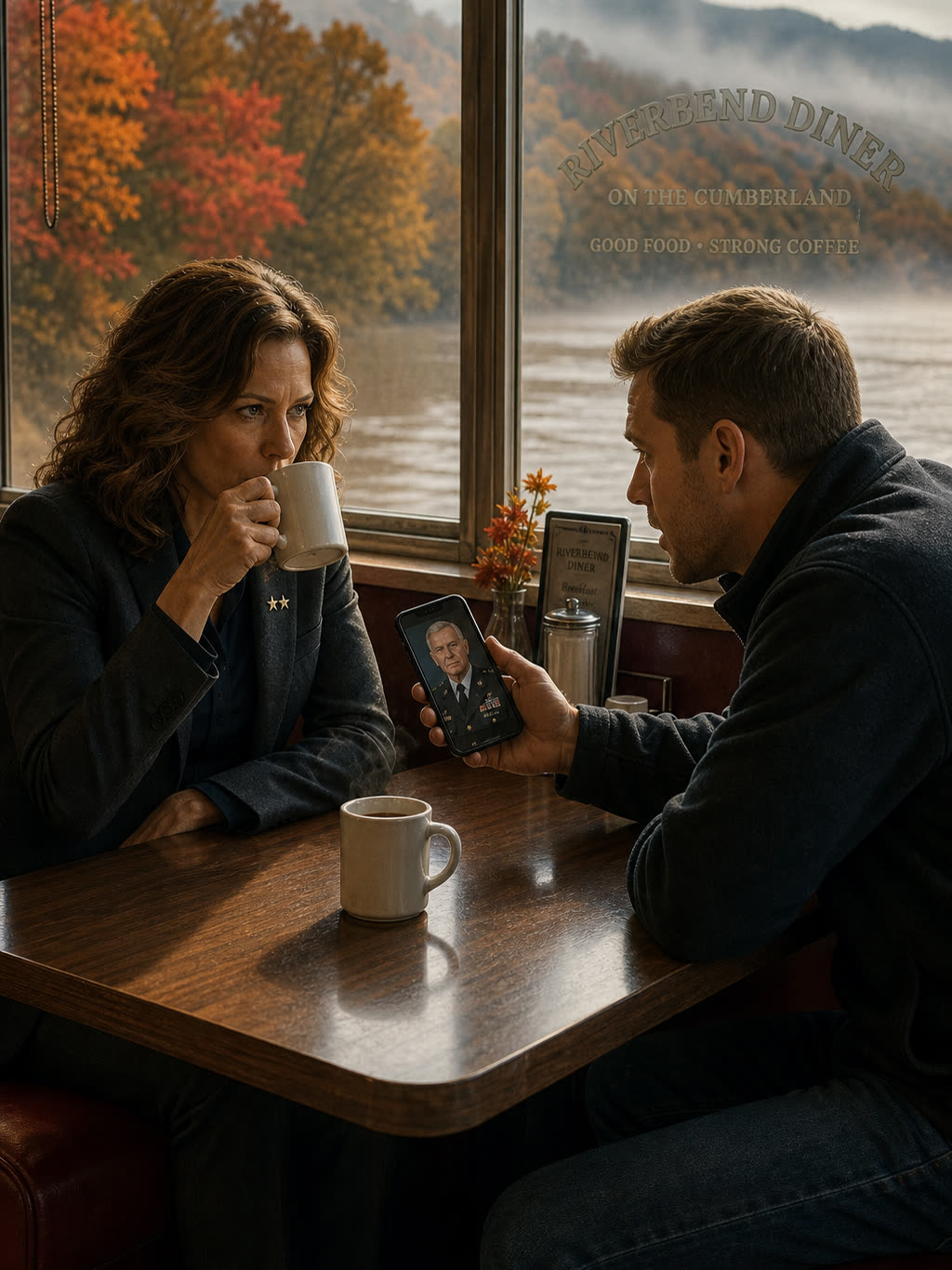
Knox leaned across the table and drew a sleek silver smartphone from his jacket pocket. He tapped the screen and slid it toward me.
On the display was an official military roster and biography. The face staring back was weathered, steely-eyed, and universally recognized within the Department of Defense: General Marcus Alfred, former Vice Chief of Staff of the Air Force, four-star general, retired.
“General Alfred sits on the regional conservation trust with your father,” Knox murmured. “Roderick considers him an ornamental prize, a four-star general to parade at his private club to prove his high-level connections. Your father invited him as the keynote guest of honor for the engagement dinner.”
I looked up from the screen. “Alfred was my senior mentor during my second tour at the Pentagon.”
“I know,” Knox replied with a ghost of a grin. “I had breakfast with him at five this morning at the military club. He remembers you, General. He remembers every briefing you ever ran for the Armed Services Committee.”
“Knox,” I warned softly. “I do not use my uniform for personal vendettas.”
“This isn’t a vendetta, ma’am,” Knox said, retrieving his phone. “This is an operational reconnaissance. Your father is preparing to mount an offensive against you using lies and public intimidation. In the military, when an adversary builds an exposed salient, you don’t retreat. You reinforce the high ground.”
“What did Alfred say?”
“He said,” Knox paused, his grin fading into absolute, professional resolve, “that it would be his distinct privilege to introduce the real General Dunar to the city of Nashville.”
I sat very still. The coffee had gone lukewarm in my hands. For sixteen years I had let silence be my answer, and now someone I barely knew was offering to help me speak.
The Cumberland Club did not permit neon, loud music, or unrestrained emotion. It stood in a century-old limestone building overlooking downtown Nashville, an enclave of dark mahogany wainscoting, heavy oil portraits of former governors, and plush green carpet that swallowed the sound of footsteps. It was the geographic heart of my father’s imagined empire.
By seven o’clock on Saturday evening, the grand banquet hall was filled to capacity with two hundred guests. State senators, banking executives, real estate developers, and their diamond-draped spouses mingled beneath crystal chandeliers, sipping vintage champagne.
I arrived at precisely seven-fifteen.
I did not wear civilian slacks. I did not slip in quietly through the kitchen corridor.
I wore the United States Air Force Service Dress uniform: dark navy wool, impeccably pressed, the trousers tailored over high-gloss low quarters. Across my left chest stretched seven rows of campaign medals, the Master Aircrew Badge, and the Defense Distinguished Service Medal. On each shoulder board sat the twin silver stars of a Major General, gleaming under the chandelier with crisp, undeniable luminescence.
As I crossed the threshold into the reception foyer, the ambient roar of laughter and conversation collapsed in stages. It died in waves, beginning at the greeting line near the door and rolling steadily toward the head table.
My father was standing by the mahogany dais, glass in hand, holding court with a state supreme court justice. When his gaze collided with mine, his face drained of every drop of color. His jaw dropped, his teeth clicking together audibly. His eyes fell to the stars on my shoulders, and for one terrifying second I thought he might choke on his olive.
Jenna, standing nearby in an exquisite ivory gown, saw me and froze. But this time there was no disappointment in her eyes. There was a sudden, breathless realization of power. Beside her, Knox caught my eye and gave an imperceptible nod.
I did not make a dramatic entrance. I walked calmly to my assigned seat at Table Twelve, tucked deliberately into the shadowy periphery near the service doors, and sat down. The waiters hovered nervously, unsure whether to pour water or snap to attention.
At eight o’clock, the chimes sounded. Roderick climbed the three polished steps to the carved wooden lectern.
He was a master of recovery. By the time his hands gripped the microphone, his theatrical smile was firmly reattached, though I could see the faint tremor in his right thumb against the wood.
“Friends, honored guests, and esteemed colleagues,” Roderick’s voice boomed over the acoustic sound system. “Tonight is a milestone not merely for the Dunar family, but for the continued legacy of our great community. When my daughter Genevieve chose to unite her future with Captain Knox Sheridan, she joined two traditions of excellence: enterprise and patriotism.”
Polite applause rippled through the room.
“Now, in any family,” Roderick continued, his eyes deliberately sweeping past my shadowed table without stopping, “there are different paths. Some children remain close to the foundation, building upon the hearth of the home, stewarding the legacy. Others… choose wandering paths, seeking their fortunes on the far margins, adrift from the central endeavor. But tonight, we welcome all our children, no matter how distant or modest their accomplishments, to share in the reflected glow of this marvelous union.”
It was a masterclass in rhetorical poison. To the uninitiated it sounded like a benevolent patriarch’s forgiveness. To everyone who had seen my uniform at the door, it was an open declaration of war.
Roderick raised his glass. “To Genevieve and Knox. May their future be as stable, as proud, and as indisputable as the ground we stand on tonight.”
Before the glasses could touch, an elderly gentleman rose from the main guest table directly in front of the dais. General Marcus Alfred did not ask permission to speak. A man who has commanded two hundred thousand airmen across four continents does not seek recognition from a real estate developer. He pushed back his chair with a soft scrape that commanded instant, absolute silence, and in his civilian tuxedo he still carried the unmistakable weight of four decades of global authority.
“Roderick,” General Alfred said, his voice deep and unhurried, with the natural resonance of an artillery battery. “Before you call that toast, you have overlooked an essential duty of protocol.”
Part Three: The River Beyond the Concrete
Roderick blinked, his smile freezing in place. “Marcus? I… protocol? I believe we have covered all the ceremonial welcomes—”
“You have not,” General Alfred interrupted smoothly, turning his back on my father to face the assembled crowd. “In our military tradition, whenever a flag officer enters an assembly of citizens and service members, custom demands they be formally acknowledged. Not merely as family, and certainly not as an afterthought.”
General Alfred turned his whole body toward Table Twelve. His posture snapped into a rigid, majestic attention, and two hundred heads turned with him, following his gaze into the shadows where I sat.
“Ladies and gentlemen,” Alfred announced, his voice reverberating off the high limestone walls, “it is my distinct privilege to introduce Major General Clara Dunar, Commander of the Air Operational Logistics Command, recipient of the Legion of Merit, and recently nominated by the President of the United States for promotion to Lieutenant General and three-star appointment to the Joint Staff.”
The entire ballroom seemed to sway on its foundations.
A state senator dropped his butter knife against his china plate with a sharp clatter. Somewhere near the back, a woman gasped, and a champagne flute came to rest very slowly on a tablecloth.
Roderick’s knuckles went pure white against the lectern. His mouth opened, but no sound came out. The room spun around him. The stage he had spent months assembling had just been requisitioned by an authority that operated entirely beyond his comprehension.
Captain Knox Sheridan stepped forward from the bridal table. In front of his aristocratic parents, in front of the city’s judiciary, in front of the cameras hired by the society gazette, Knox brought his heels together and threw the most thunderous, magnificent salute of his military career.
“General Dunar!” Knox bellowed across the silent hall. “Ma’am!”
I stood. I did not smile in triumph. I did not glare at my father. I held myself with the quiet, devastating composure that belongs only to those who have earned their ground an inch at a time. I returned Knox’s salute with crisp, immaculate precision, held it for one count, and lowered my arm.
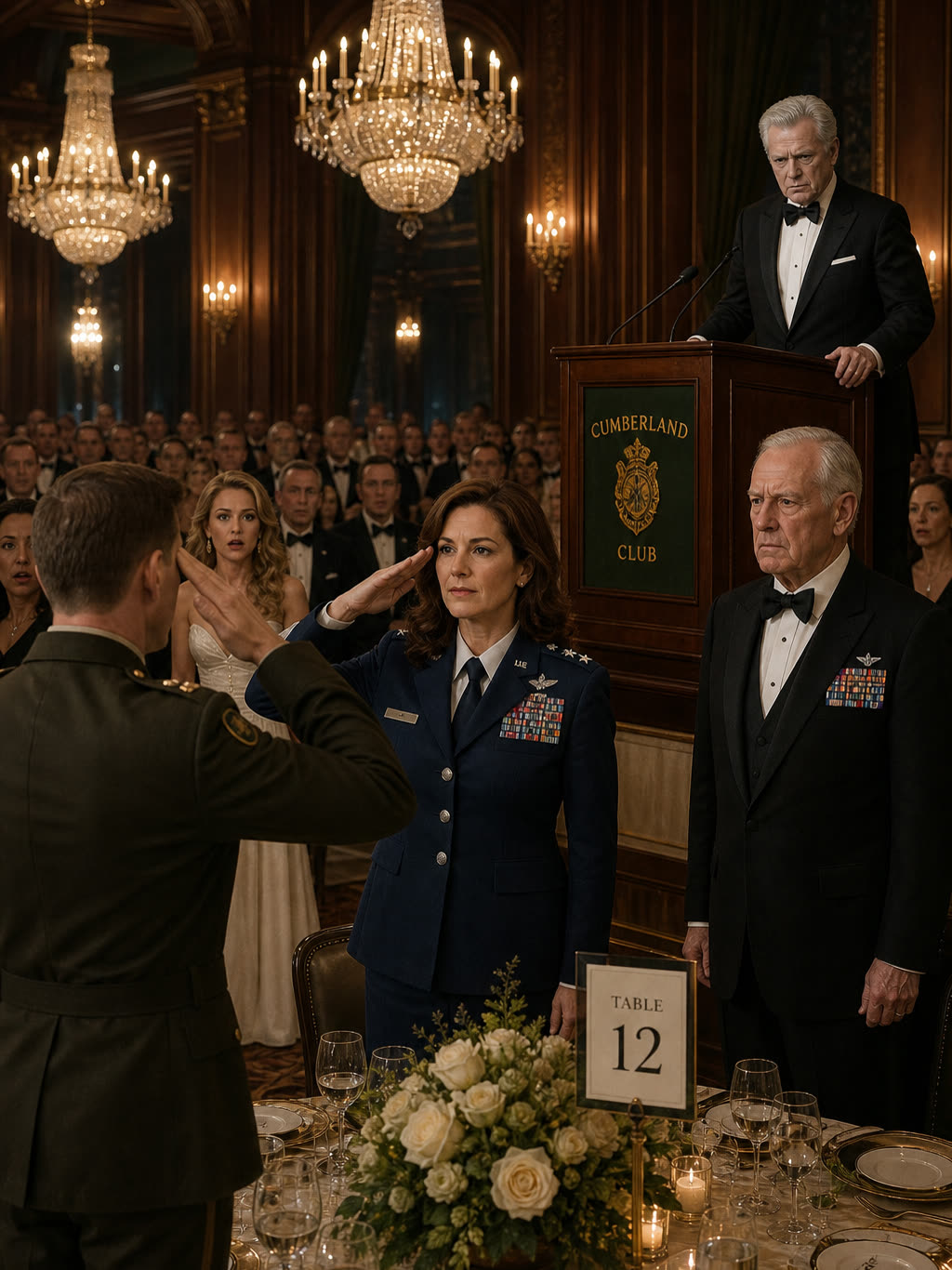
Then I looked toward the dais. My father was clutching the lectern as if it were the only piece of flotsam keeping him afloat in an ocean that had turned hostile. The silence was absolute. The entire city of Nashville was looking at him, waiting for him to account for sixteen years of dismissive lies.
“Thank you, General Alfred,” I said, my voice quiet, clear, and perfectly carried by the acoustics of the hall. “Carry on, Captain Sheridan. Father… please continue your toast.”
I sat back down.
Roderick Dunar looked down at his notes. His hands were shaking so violently that the paper rattled against the microphone, broadcasting his humiliation to every corner of the room. He managed two garbled, incoherent sentences before abandoning the podium entirely and stepping off the dais into the shadows behind the curtain.
Nobody applauded. Nobody spoke. Jenna pressed her fingertips to her lips, and Knox, still standing, turned his gaze to me as if waiting for an order. I gave him none. There was nothing left to command. What had been hidden for sixteen years was out in the open, and no one could put it back.
The morning sun broke over the Nashville skyline in bands of pale amber and cool blue. In my suite on the eighth floor of the downtown hotel, my bags were packed, my service dress hung carefully in its protective garment bag, and my travel orders lay on the glass coffee table.
A single knock sounded at the door at precisely eight-fifteen.
I opened it. Roderick stood in the corridor.
Without the velvet drapery of his home or the raised platform of the Cumberland Club, he looked shockingly vulnerable. The immaculate grooming could not hide the dark circles beneath his eyes, nor the sudden, hollow stoop in his shoulders. For the first time in my life, I saw my father not as an omnipotent tyrant but as an aging man whose every currency had suddenly been devalued.
“May I come in?” he asked, his voice stripped of all resonance.
“Five minutes,” I replied, leaving the door ajar and returning to the window.
He walked to the middle of the room and looked around at the modest hotel suite. He held an envelope in his hand, the same thick manila folder from that night.
“You took away my voice in that room last night, Clara,” he whispered.
“No,” I answered, watching the traffic cross the bridges over the river below. “You took your own voice away by lying for thirty years about who I was so you wouldn’t have to admit you didn’t control me.”
Silence settled over the room, thick and heavy. A radiator ticked somewhere beneath the window.
“Why wasn’t it enough?” I turned to face him, meeting the eyes of the man who had ignored every academic triumph, every commission ceremony, every sacrifice. “I graduated at the top of my class at the Academy. I logged two thousand hours in combat airspace. I built an honorable career while you were busy buying county commissioners. Why did you have to pretend I was nothing?”
Roderick looked down at the carpet. His jaw worked, searching for a pre-packaged corporate defense, but the machinery had broken down completely.
“Because I didn’t know how to own it,” he said, the admission tearing out of his throat like glass. “I understand bankers. I understand judges. I can write a check and make a highway bend three miles south. But you… you walked into a world where my money meant nothing. When you put on that uniform, you answered to a command structure that didn’t care who Roderick Dunar was. I couldn’t buy your promotions. I couldn’t threaten your superiors. You made me feel completely powerless.”
He paused, his voice sinking into a broken rasp. “Your mother told me. Before she went into hospice. She said, ‘Stop trying to make Clara an ornament in your garden, Roderick. She’s an oak tree. You’re going to break your teeth on her.’ I thought she was just being sentimental.”
I said nothing. I thought of my mother on the porch at the river, her hands in the dirt, laughing at something I could no longer remember. The ache of it was quiet and old.
He stepped toward the desk and set the manila folder down.
“The Duck River deed,” he said. “I tore up the transfer papers. The title is registered solely in your name at the county courthouse. No consortium, no warehouses. Keep the trees.”
“I intend to,” I said.
He lingered a moment, looking as though he wanted to reach out and touch my shoulder as he had two nights earlier. But he knew better now. That boundary had been drawn in permanent ink.
“Will you come to the wedding?” he asked softly.
“I will come for Jenna,” I replied. “Not for you.”
He nodded once, a quick, jerky motion, turned, and shuffled out, pulling the door closed behind him with none of the thunderous authority he had shown before.
My phone vibrated on the glass table. A text from Genevieve: Knox made pancakes. He insists on driving you to the air base. Can we come pick you up? I want to hear about Paktika.
I looked at the screen, and for the first time in four days the cold professional armor around my heart loosened. I typed back: Only if Knox lets you pick the radio station. See you in twenty.
I zipped my flight bag, took my garment carrier, and walked out of the room. Outside, Nashville was waking up, ordinary, noisy, and uncurated. The truth, I had realized long ago, does not need an army of publicists or an orchestra of flutes to make itself known. It simply waits. And when it finally steps into the light, even the strongest empires made of glass have no choice but to shatter.
Disclaimer: This story is a work of fiction inspired by real-life themes. Names, characters, places and events are fictionalized, and any resemblance to real persons is purely coincidental. Images are for illustration purposes only.
