

PART 1
After my divorce, I purchased a house without telling more than a few people.
Eleven days later, while I was visiting my sister four hours from home, my security system alerted me to movement in the driveway.
I assumed someone was delivering a package.
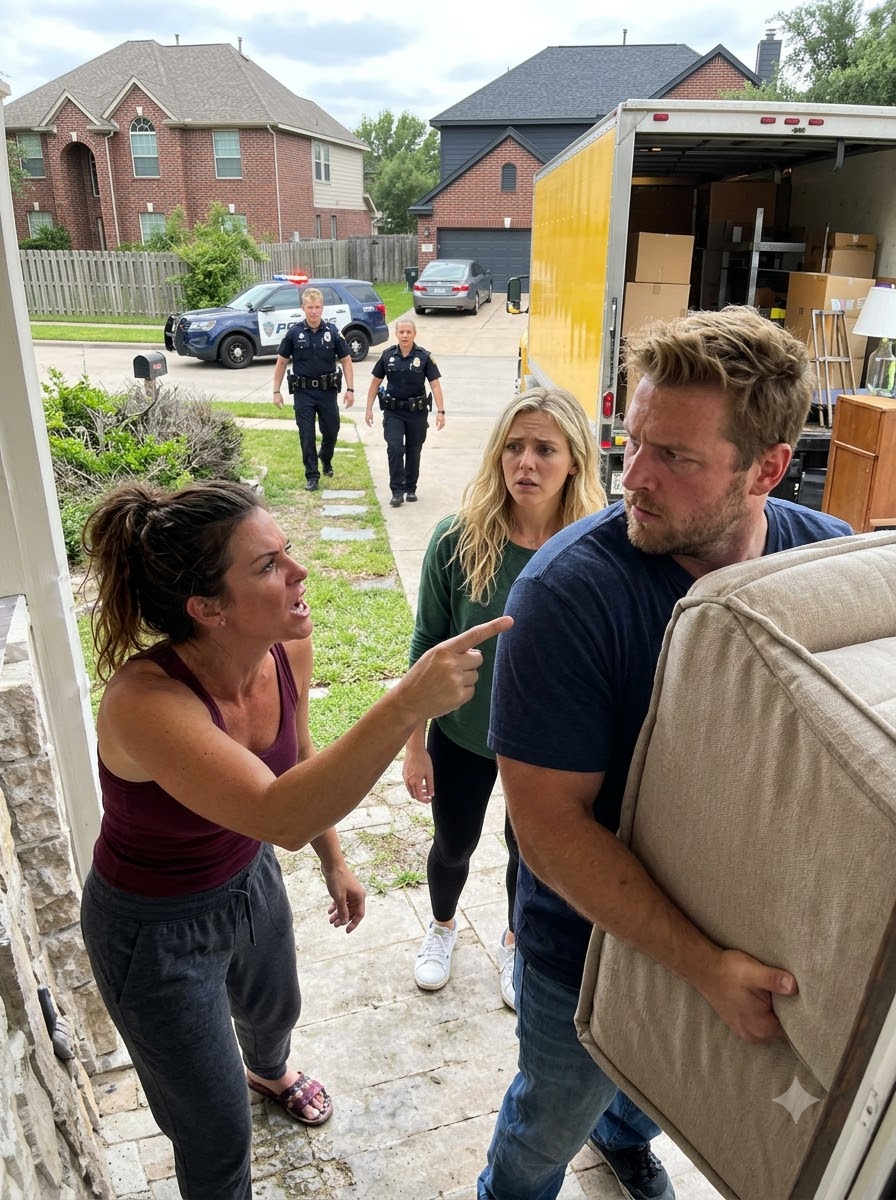
But when I opened the camera, I saw a moving truck reversing toward my garage.
My ex-husband stepped out.
Then his new wife emerged behind him.
Together, they began unloading furniture and carrying it into my house.
I didn’t phone either of them.
I called the police.
It was 10:14 on a Saturday morning.
I was in my sister Rachel’s kitchen in Louisville when my phone vibrated.
Person detected in driveway.
I tapped the notification and opened the camera feed.
Then I went completely still.
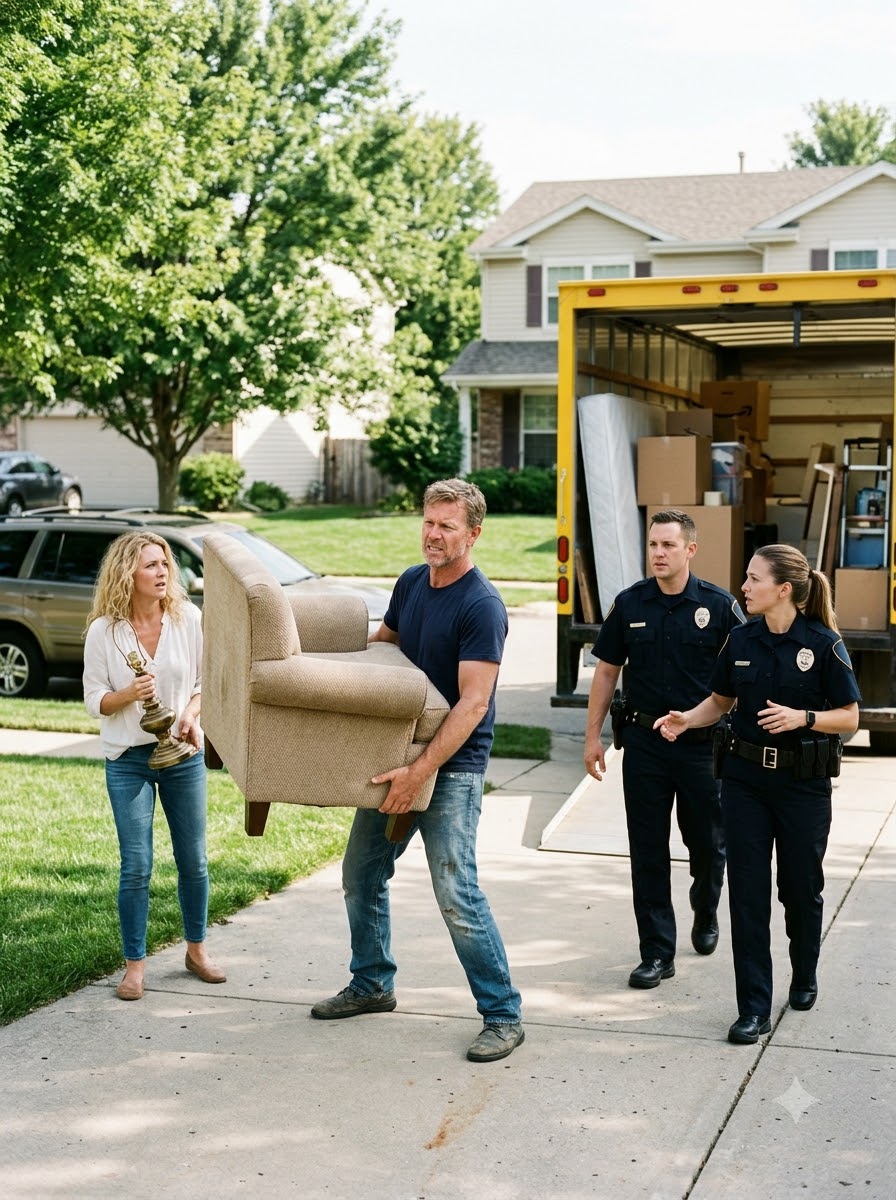
A yellow moving truck was backing into the driveway of the Ohio home I had bought only eleven days before.
Mark climbed out first.
My ex-husband.
Our marriage had lasted twenty-seven years before the divorce was finalized in January.
A few seconds later, Vanessa appeared.
His new wife.
They had married only five months after our divorce.
That house was meant to represent a new beginning for me.
I had paid $327,500.
Only my name appeared on the deed.
I was still unpacking boxes.
And Mark wasn’t even supposed to know my new address.
Then they lifted the truck’s rear door.
Out came a television.
Several boxes.
A brass lamp.
More boxes with labels.
KITCHEN.
BOOKS.
MASTER BEDROOM.
Rachel came to stand behind me.
“Are they actually moving in?”
There was no other reasonable explanation.
My former husband and his new wife were bringing their possessions into my home.
Then Mark headed directly toward the side entrance.
I had installed a smart keypad to allow contractors access when needed.
I expected him to look around for a spare key.
Instead, he pressed four numbers as though he already knew them.
Beep. Beep. Beep. Beep.
The keypad glowed green.
Click.
The door swung open.
Rachel looked at me.
“He knows your code.”
“No.”
“What do you mean, no?”
“I never gave it to him.”
On my screen, Vanessa carried the brass lamp through the doorway.
Mark followed her with the television.
Throughout our twenty-seven-year marriage, whenever Mark overstepped, my instinct had always been to call him.
He would offer explanations and arguments until I somehow ended up wondering whether I had misunderstood everything.
My finger hovered over his contact information.
Then I stopped.
I wasn’t going to ask him to explain something happening right in front of my eyes.
Instead, I opened the documents from my closing.
Sole owner.
My name alone.
Then I contacted the police.
“My ex-husband and his wife are moving furniture into a house that belongs solely to me. I’m four hours away, and neither of them has permission to be there.”
The dispatcher asked:
“Has your former husband ever lived at that address?”
“No.”
“Are you the sole owner?”
“Yes.”
“Did you give either person permission to enter?”
“No.”
Then she asked something else.
“Do you know how he got inside?”
I watched Mark standing near the keypad.
The numbers he’d entered.
The green indicator.
The door opening.
“No,” I said.
Then a more frightening realization struck me.
Mark shouldn’t have known where the house was.
I had never told him its address.
Only a very small circle of people knew I had completed the purchase.
Almost nobody.
I watched the truck on my screen.
Vanessa was carrying more belongings into my doorway.
Mark moved around the property with the confidence of someone who had already been there.
Suddenly, why they wanted to move in wasn’t even the most troubling question.
It was how they had located me.
How had Mark learned my address?
How had he obtained the keypad code?
Who had shared information I had intentionally kept private?
Because when I eventually learned the truth, I discovered that Mark and Vanessa hadn’t simply arrived hoping to take over an empty house.
Someone I loved had helped them unlock the door.
The dispatcher remained on the phone.
“Ma’am, I have officers heading to the address now. Can you stay with me?”
“Yes.”
My voice sounded unfamiliar.
Distant. Emotionless.
As though I were calmly reporting a minor traffic accident instead of watching my ex-husband move a television into the home I’d purchased to escape his influence.
On the security feed, Vanessa emerged from the side entrance again.
She stretched both arms above her head, removed the sunglasses resting in her hair, and put them on.
She looked perfectly comfortable.
Like someone settling into her own home.
“Diane,” Rachel whispered. “Breathe.”
I hadn’t noticed that I was holding my breath.
“Ma’am,” the dispatcher said, “you mentioned the door has a keypad. Do you have an app for it? Some of those systems keep a record.”
A record.
The possibility hadn’t occurred to me.
When the locksmith installed the keypad, he had explained how I could assign different codes to different people.
“That way,” he’d said, tapping his own phone screen, “you’ll always know who came in and when. Contractors get their own. Family gets their own. You can delete any of them with one tap.”
I had created three codes.
One for myself.
Another for the contractor completing my back porch.
And a third for emergencies.
I had shared that emergency code with exactly one person.
“Hold on,” I told the dispatcher.
My fingers trembled so badly that I entered the password incorrectly twice.
Rachel took my phone, typed it in, and handed it back.
The application displayed a straightforward activity log.
Side Door — Unlocked — 10:21 AM.
Directly below it, in small gray text, was the name assigned to the code.
Lauren — Emergency.
I read the words three times.
Then I placed the phone facedown on Rachel’s counter.
I couldn’t bear to keep looking.
Lauren.
My daughter.
My twenty-six-year-old daughter who called every Sunday evening while folding her laundry.
The daughter who had sat beside me on my old kitchen floor in March, eating takeout straight from the containers because the dishes were already packed.
The daughter who hugged me after closing and said, “Mom, I’m so proud of you. This is your house. Nobody gets to take it from you.”
I had trusted her with that code because I wanted someone to have access if I fell down the basement stairs and couldn’t reach my phone.
Rachel picked up my phone.
She looked at the screen.
For several moments, she said nothing.
Then, almost in a whisper, she spoke.
“Oh, Di.”
“Ma’am?” The dispatcher’s voice came from the counter. “Are you still there?”
I picked up the phone again.
“Yes,” I said. “I know which code was used.”
“Is it someone who has permission to be there?”
I considered the question.
“The person I gave the code to has permission,” I said. “The man who used it does not.”
Rachel was holding her car keys before the conversation ended.
“We’re going,” she said.
“It’s four hours.”
“Then we’d better leave now.”
She took two bottles of water from the refrigerator, grabbed pretzels from the pantry, and collected her reading glasses from the windowsill.
Rachel is three years older than I am.
She’s always handled emergencies as efficiently as someone organizing a shopping trip.
When our father suffered a stroke, Rachel called the ambulance, located his insurance card, and remembered to switch off the stove.
I stood crying in the hallway.
For most of my life, I had been the person standing helplessly in the hallway.
But not that day.
By 10:40, we were heading north on I-71.
At 10:52, my phone rang.
The caller had an unfamiliar Ohio number.
“Is this Diane Whitaker?”
“Yes.”
“This is Officer Daniel Hale with the township police. I’m standing outside your property right now. I’ve got two adults here, a man and a woman, who say they have permission to live at this address.”
“They don’t.”
“I understand that’s your position, ma’am. I want to be straight with you, because this can get complicated. The gentleman has shown me a document. It’s a residential lease agreement, and it appears to have your signature on it.”
The car seemed to fall silent.
Rachel gripped the steering wheel more tightly.
“My signature,” I repeated.
“Yes, ma’am. Month-to-month lease. Rent listed as four hundred dollars a month. Signed by a Diane Whitaker as landlord and a Mark Whitaker and Vanessa Whitaker as tenants.”
Four hundred dollars a month.
For my three-bedroom house, with its new roof and the backyard I’d dreamed of having since I was thirty.
“I never signed anything,” I said. “I haven’t spoken to Mark since the divorce hearing, except through my attorney.”
“I hear you,” Officer Hale said. His voice was careful but not unkind. “Here’s my problem. If there’s a signed lease, even a disputed one, a lot of departments will treat it as a civil matter between a landlord and tenant. That means a court process. An eviction. I’m not saying that’s where this goes. I’m telling you what I’m looking at.”
An eviction.
I had read stories about homeowners returning from trips to discover strangers living in their houses with documents claiming they had a right to be there.
Some spent months and thousands of dollars trying to reclaim their property through the courts.
And Mark knew those stories too.
Two years earlier, he had read one aloud over breakfast, shaking his head and laughing.
“Can you believe it? Possession is nine-tenths of the law, Di. Once you’re in, you’re in.”
At the time, I thought he was laughing at the people who had moved in.
Now I wondered whether he had been studying their methods.
Rachel glanced toward me.
“Ask him for the date,” she mouthed.
“Officer Hale,” I said slowly, “what date is on the lease?”
Paper rustled on his end.
“It’s dated September 14th of this year.”
I closed my eyes.
Then I opened my closing documents again.
“Officer, I didn’t own that house on September 14th.”
He said nothing.
“I closed on October 1st,” I said. “Eleven days ago. On September 14th, that house belonged to a retired couple named Bill and Sandra Okafor. They’d already moved to Arizona. I hadn’t even been given the keys. I couldn’t have leased a house I didn’t own yet.”
Another silence followed.
Then Officer Hale’s tone changed.
“Can you send me your closing documents? Right now?”
“What’s your email?”
He gave me the address.
I forwarded the settlement statement, recorded deed, and purchase agreement, highlighting the closing date in yellow.
Two minutes later, he spoke again.
“Got them.”
He paused.
“Ms. Whitaker, I’m going to ask the gentleman a few more questions. I’m also going to ask everyone to stop bringing property into the house until we sort this out. Are you coming here?”
“I’m about three and a half hours away.”
“Drive safe. Don’t speed. I’ll be here, or someone will.”
The call ended.
Rachel exhaled slowly.
“September 14th,” she said. “Diane. Your offer was accepted on September 3rd.”
“I know.”
“Which means by September 14th, he already knew which house you were buying.”
“I know.”
“Which means somebody told him almost the moment you signed.”
I stared through the windshield at the highway signs passing by.
Cincinnati 62.
Columbus 155.
“I know,” I said again.
For nearly an hour, I couldn’t bring myself to call Lauren.
Her name sat at the top of my favorites list.
I kept staring at it.
Part of me feared what she would tell me.
But an even larger part feared what I might say to her.
For twenty-seven years, I had been the person who kept peace in our family.
The one who softened disagreements.
The one who apologized first, even when I wasn’t responsible, because that was easier than enduring three days of Mark’s cold silence.
Without meaning to, I had taught my children that loving someone meant keeping everyone comfortable.
Now I wondered whether my daughter had learned that lesson so thoroughly that she had given her father access to my home simply to keep him happy.
Near Cincinnati, a message appeared on my phone.
Lauren.
Mom, are you ok? Dad just texted me that the police are at your house and that you’re “making a scene.” What is going on?? I thought you said it was ok??
I read it twice.
I thought you said it was ok.
Rachel noticed my expression.
“What?”
I handed her the phone.
She read the message and pressed her lips together.
“Call her,” she said. “Not text. Call.”
I pressed Lauren’s number.
She answered immediately.
She was crying.
“Mom—”
“Lauren. I need you to tell me everything. Slowly. And I need you to tell me the truth, even if you think I’m going to be upset.”
“You’re scaring me.”
“I’m scared too, honey. Just tell me.”
She drew an unsteady breath.
“Dad called me in August,” she said. “Like, the middle of August. He said he and Vanessa were in trouble. Their landlord was selling the condo and they had to be out by October. He said his hours got cut at the dealership and nobody would rent to them because of Vanessa’s credit. He sounded—Mom, he sounded really bad. He was crying. I’ve never heard Dad cry.”
I had heard him cry.
Whenever crying helped him get what he wanted.
“Go on.”
“He asked how you were doing. And I said you were good, you were house hunting. And he asked where. And I—” Her voice cracked. “I told him the town. I didn’t think it mattered. He said he was happy for you. He said he wanted you to have a fresh start.”
“Okay.”
“Then a few weeks later he called again and asked if you’d found anything. And I told him you had an offer accepted on the house on Linden Court. I was excited for you. I showed him the listing photos. The backyard with the maple tree.”
The maple tree.
I had fallen in love with that tree the first time I saw the property.
I shared the listing with my daughter.
She shared it with her father.
And he had looked at those same photographs and imagined something entirely different.
I saw freedom.
He saw an opportunity.
“Lauren,” I said, “did you give him the code?”
The silence lasted so long that I wondered whether we’d been disconnected.
“Last week,” she whispered. “He called me Tuesday. He said he’d talked to you.”
“I haven’t talked to your father since January.”
“I know that now.” She was sobbing. “He said you’d called him. He said you two had a long talk, that you’d been feeling bad about how the divorce went and you wanted to help. He said you offered to let them stay at your place for a few weeks while you were at Aunt Rachel’s, just until their new apartment was ready. He said you’d meant to give him the code yourself but you’d been busy and your phone was acting up and you told him to get it from me.”
I closed my eyes.
It was exactly how Mark operated.
Not with an obvious lie.
With a carefully constructed story containing just enough familiar details to sound believable.
My unreliable phone.
My visit to Rachel.
My supposed guilt about the divorce.
Everything designed to convince a daughter who loved both parents that they were finally getting along.
“Did you call me to check?” I asked. Not angrily. I just needed to know.
“I started to.” Lauren’s voice was very small. “He said not to. He said you were embarrassed about it, that you didn’t want Aunt Rachel to know you were helping him, because she’d give you a hard time. He said if I brought it up you’d feel ashamed and maybe change your mind, and then they’d have nowhere to go. He said, ‘Please, Laur. Just this once, let me and your mom handle our own business.’”
Rachel muttered something under her breath that I won’t repeat.
“So I gave it to him,” Lauren said. “I’m so sorry. Mom, I’m so, so sorry. I thought I was helping. I thought you two were finally being nice to each other.”
I stared out the window.
I remembered Lauren at eight, standing in our bedroom doorway while Mark and I argued quietly.
At twelve, bringing me tea after he slammed the front door and drove away.
At sixteen, asking me during a car ride, “Why do you always say sorry to Dad when he’s the one who was mean?”
I had pretended not to understand.
But she had understood perfectly.
Somewhere along the way, she’d learned what I had learned.
That the easiest way to deal with Mark was to give him what he wanted and hope he wouldn’t become angry.
“Lauren,” I said. “Listen to me. I’m not angry at you.”
She began crying harder.
“I’m hurt,” I said. “I’m not going to pretend I’m not. But I know who did this. And it wasn’t you. You were used. The same way I was used for twenty-seven years. He’s very, very good at it.”
“I should have called you.”
“Yes. You should have. And I should have told you a long time ago what your father is really like, instead of protecting you from it. We both have things to learn from this.”
I heard her blow her nose.
“What do you need me to do?” she asked.
I considered my answer.
“Do you still have the text messages? The ones from your dad?”
“Yes. All of them.”
“Don’t delete anything. Screenshot every message, every voicemail, everything from August until today. And send them to me.”
“Okay.”
“And Lauren?”
“Yeah?”
“Don’t answer him. Whatever he texts you next. Don’t answer.”
There was a pause.
“He’s already texted me four times while we’ve been talking,” she said.
“What does he say?”
She read them aloud.
Your mother is overreacting as usual.
Tell her to call off the police and we can talk like adults.
Laur you need to call her and calm her down.
You know how she gets.
I listened carefully.
For the first time, those words didn’t make me question my judgment.
They confirmed it.
“Send me those too,” I said.
PART 2
The screenshots began arriving before we reached Columbus.
Rachel drove while I went through them.
Everything was there.
August 11th:
Hey Laur, how’s your mom doing? Heard she’s looking at houses?
August 19th:
Did she find a place? Just curious. Happy for her.
September 4th:
Linden Court, nice. What town is that again? Is she putting down a big down payment or financing most of it?
I stopped reading.
Is she putting down a big down payment or financing most of it?
Why would someone who was supposedly pleased about his ex-wife’s new beginning care how she was paying for the property?
I continued scrolling.
September 9th:
Can you send me the listing link? Vanessa wants to see it. She loves those old maple trees.
Then, in the middle of a longer thread, I discovered something Lauren hadn’t even realized she’d saved.
It was a screenshot from a group conversation Mark had accidentally included her in during September.
He had removed her almost immediately.
But the screenshot remained.
The exchange was between Mark and Vanessa.
Mark: Closing is Oct 1. She’ll be at Rachel’s for the long weekend on the 10th. Laur says she always goes for Rachel’s birthday.
Vanessa: And you’re sure about the lease thing?
Mark: Trust me. Once we’re in with a lease and mail at the address, she’d have to go through a full eviction. That’s months. By then she’ll want to settle. She always wants to settle.
Vanessa: Settle how?
Mark: She buys us out to leave. Or she sells and we split it. Half that house should’ve been mine anyway. That down payment came out of the divorce money.
I read the final message three times.
Half that house should’ve been mine anyway.
The down payment had come from the money I received in our divorce settlement.
A settlement Mark had accepted.
Signed.
Before a judge.
It had been fair to both of us.
In fact, I had been generous because I was too exhausted to fight over the boat or his retirement savings.
He had agreed to the terms.
Then decided he deserved more.
Rachel glanced toward me.
“Diane. You’ve gone white.”
I read the exchange aloud.
She remained quiet for almost a mile.
Then she spoke.
“He planned this before you even closed.”
“Yes.”
“He planned it around my birthday.”
“Yes.”
“He knew you’d come to my house, because you always do.”
I nodded.
Rachel’s knuckles whitened around the steering wheel.
“That man sat at our Thanksgiving table for twenty-seven years.”
“I know.”
“He ate my sweet potato casserole.”
And somehow, I laughed.
It burst out of me suddenly, sharp and almost painful.
Rachel looked at me and began laughing too.
Soon we were both laughing so hard that she had to move into the right lane and slow down.
Tears streamed down our faces.
Two women in their fifties laughing uncontrollably in a Honda on the interstate.
There was nothing funny about what had happened.
Nothing at all.
But it felt as though something heavy had finally broken loose inside me.
Once we regained our composure, I forwarded the screenshots to Officer Hale.
Then I called Patricia Ng, the attorney who had represented me during my divorce.
Patricia was a calm, gray-haired woman who once told me, “Diane, the most dangerous thing you can do with a man like Mark is keep explaining yourself.”
It was Saturday.
She answered anyway.
I told her the entire story.
After I finished, she paused.
“Diane,” she said. “Do not negotiate with him. Do not agree to let them stay one night. Not one. Do you understand?”
“I understand.”
“A lease dated before you owned the property. Text messages planning to use it to force an eviction. A code obtained through deception. This isn’t a landlord-tenant dispute. Make sure the officer understands that.”
“I think he’s starting to.”
“Good. Call me when you get there. I’ll keep my phone on.”
We arrived on Linden Court at 2:31 that afternoon.
The yellow moving truck was still parked in my driveway.
Two police cruisers were there too.
Several neighbors had gathered across the street, pretending not to watch.
An older man stood with a golden retriever.
A woman held a toddler.
A teenage boy carried a basketball beneath one arm.
I’d owned the house for eleven days.
I didn’t know any of their names.
This certainly wasn’t how I’d expected to introduce myself.
Rachel pulled over to the curb.
Before I opened the door, she caught my wrist.
“Hey.”
I turned.
“Whatever he says,” she said, “you don’t owe him an answer. You don’t have to explain yourself. You don’t have to be nice. You saw what you saw.”
“I know.”
“Say it.”
“I saw what I saw.”
“Good.” She let go. “Go get your house back.”
I stepped out.
Officer Hale approached me halfway up the driveway.
He was younger than I had imagined, perhaps thirty-five, with closely cropped hair and tired eyes.
He looked like someone who had spent four hours standing in the sun.
“Ms. Whitaker?”
“Yes.”
“Thanks for the documents. And the messages.” He lowered his voice. “Those messages changed things. My sergeant’s on the way. We’ve got a detective who’ll want to look at that lease.”
“Where are they?”
“Inside. Your kitchen. I asked them to sit and wait.”
My kitchen.
I nodded.
“Do you want to go in?” he asked. “You don’t have to. You can stay out here.”
I thought about the woman I had been throughout my marriage.
She would have remained in the driveway.
She would have let everyone else handle the situation.
Then she would have apologized to Mark afterward for causing trouble.
“It’s my house,” I said. “I’m going in.”
The side door was being held open by one of their boxes.
KITCHEN was written across it in black marker.
Mark’s handwriting.
I would have recognized those blocky capital letters anywhere.
He had labeled our moving boxes the same way throughout our marriage.
I stepped over the box.
My kitchen no longer looked like mine.
Their belongings were stacked against the wall I’d planned to paint sage green.
Vanessa’s brass lamp sat on my counter beside my coffee maker.
Mark’s leather recliner, the one he’d insisted on keeping in the divorce, occupied the center of my living room.
It faced a television they’d positioned on a stand in front of the fireplace.
They had been inside for only four hours.
And they had already arranged their furniture.
Mark sat at my kitchen table.
Vanessa stood near the window, arms folded.
Another police officer, a woman with a ponytail and a notepad, waited near the hallway.
Mark looked up.
Then he smiled.
I knew that smile intimately.
The patient, slightly wounded expression he used when he wanted me to believe I was being unreasonable and he was generously tolerating it.
“Di,” he said. “Finally. Can we please talk about this like adults?”
I said nothing.
“Look,” he said, standing up. “I know this is a shock. I know you’re emotional. That’s understandable. But you’re making this a lot bigger than it needs to be. We had an agreement.”
“We didn’t.”
“Diane.” He sighed. As if I were a child who’d spilled juice. “We talked about this. You don’t remember, but we did. You were feeling guilty about how things ended, and you said—”
“I haven’t spoken to you since January.”
“You called me in September.”
“I didn’t.”
“You’re confused. You’ve been under a lot of stress, with the move and the—”
“Mark.”
He stopped.
Perhaps it was my tone.
I’d never spoken to him that way before.
I wasn’t shouting.
I wasn’t furious.
I was simply certain.
“I’m not going to argue with you,” I said. “I’m not going to explain what I remember or how I feel. The officers have the documents. They have the messages. You can explain it to them.”
For a brief instant, his expression changed.
Then his smile returned, thinner than before.
“What messages?”
Officer Hale moved forward.
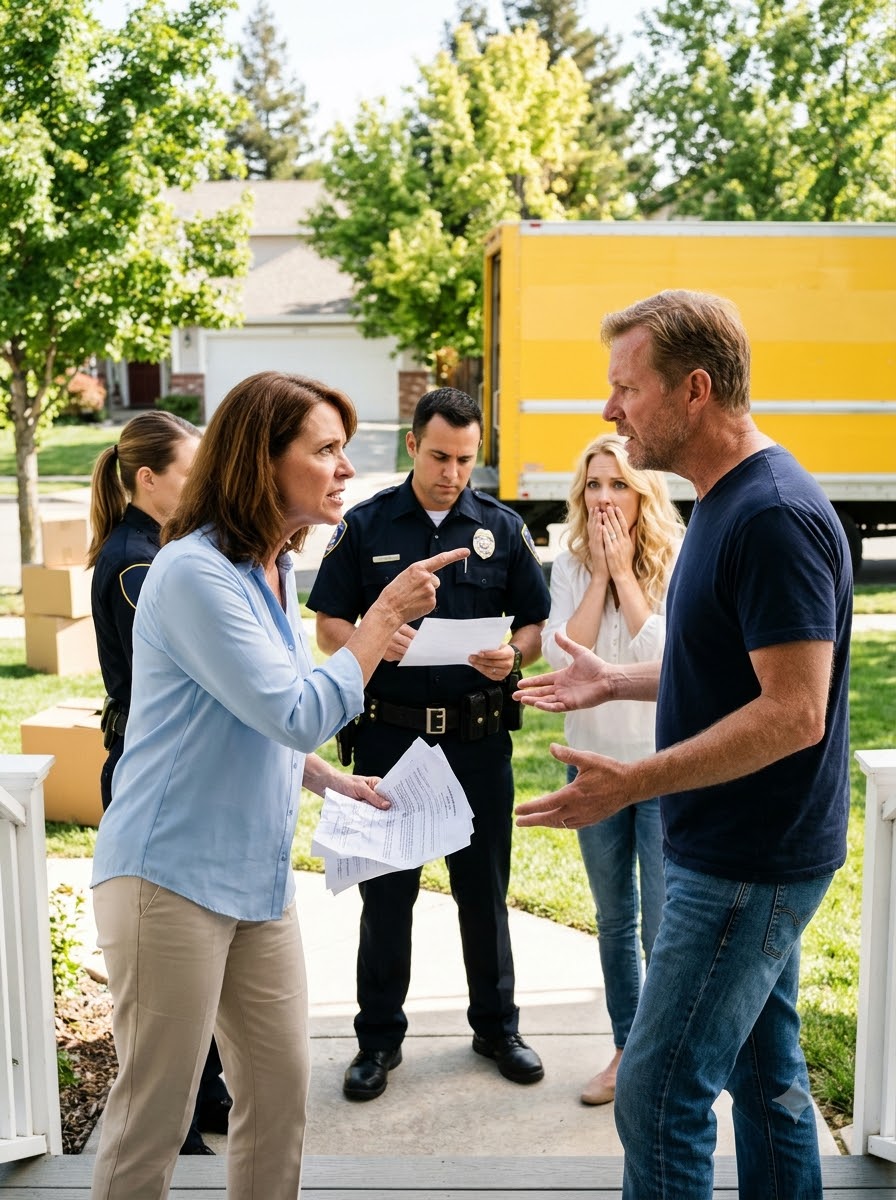
“Mr. Whitaker, we’ve been provided with text messages between you and Ms. Whitaker’s daughter, and between you and your wife, discussing this property. Including a message where you describe using a lease to force an eviction and pressure Ms. Whitaker into a settlement.”
Mark went motionless.
Vanessa turned away from the window.
“What?” she said.
Nobody responded.
“What messages?” she asked again, louder. “Mark, what is he talking about?”
“It’s nothing,” Mark said. “It’s taken out of context.”
Officer Hale raised his phone.
“Ma’am, is this your phone number?”
He read the number.
Vanessa nodded slowly.
“Did you write this? ‘And you’re sure about the lease thing?’”
Her expression shifted.
I watched confusion turn into a terrible realization.
“He told me she signed it,” she said quietly.
Mark interrupted.
“Vanessa—”
“You told me she signed it.” She turned toward him. “You said you two worked it out. You said the lease was real. When I asked about it, you told me she’d agreed and it was a formality. You said she wanted us to have the house because she felt bad about taking all the money in the divorce.”
“I didn’t take all the money,” I said.
Vanessa finally looked directly at me.
“He said you did,” she said. “He said you got the house, the savings, everything, and left him with nothing.”
“He kept the boat,” I said. “And his 401(k). And the recliner.” I nodded toward the leather chair in my living room. “We split everything down the middle. A judge approved it.”
Vanessa slowly lowered herself into one of my kitchen chairs.
“Mark,” she said. “Did she sign the lease?”
He remained silent.
“Did she sign the lease?”
“It doesn’t matter who signed it,” Mark said sharply. “Half this house is mine. That money came from our marriage. Twenty-seven years, Vanessa. I earned it.”
There it was.
No misunderstanding.
No confusion.
No emotional overreaction on my part.
Just Mark expressing what he had believed all along.
That anything belonging to me somehow belonged to him.
Officer Hale made another note.
The officer with the ponytail turned to Vanessa.
“Ma’am, did you sign this lease in the presence of Ms. Whitaker?”
Vanessa shook her head.
“Did you ever see her sign it?”
“No.” Her voice cracked. “He brought it home already signed. He said he’d met her for coffee.”
“When?”
Vanessa thought for a moment.
“In September. Middle of September.”
I almost laughed.
“On September 14th,” I said, “I was at the dentist in the morning and at my old job’s retirement party in the evening. There are about forty photographs of me there. And I didn’t own this house yet.”
Vanessa buried her face in her hands.
The sergeant arrived at 3:10.
Soon afterward, Detective Moreno joined us.
She was a soft-spoken woman who sat at my kitchen table and asked Mark the same questions in several different ways.
Each time, his explanation changed slightly.
First, he claimed I’d signed the lease in a coffee shop.
Then he said I’d mailed it to him.
When Detective Moreno asked which coffee shop and what date, he couldn’t remember.
He suggested I had signed it and later forgotten because of stress.
Detective Moreno wrote down each answer without reacting.
At one point, Vanessa walked outside to the truck.
She returned carrying a large manila envelope.
“I think you should see this,” she said, placing it in front of the detective.
Inside was a printed confirmation from the post office.
A change-of-address request.
Mark Whitaker and Vanessa Whitaker.
Moving from their condo to 14 Linden Court.
Submitted September 22nd.
Nine days before I became the owner.
“He told me to keep it for our records,” Vanessa said. “He said we’d need proof of residence for the eviction—” She stopped. Her face flushed red. “For the—if she tried to make us leave. He said if we had mail coming here, and a lease, and our furniture, the police couldn’t do anything. He said it was the law.”
“Mrs. Whitaker,” Detective Moreno said gently. “Did your husband explain why he believed that?”
Vanessa looked at Mark.
Mark stared at the floor.
“He said he’d been reading about it for a long time,” Vanessa said. “He said he had a plan. He said, ‘Diane always folds. She’ll want it to be over, and she’ll pay us to leave.’”
Nobody spoke.
Diane always folds.
Three words that summarized twenty-seven years of marriage.
I waited for the familiar embarrassment.
For the shame.
For the urge to explain that it wasn’t entirely true.
But none of those feelings came.
Instead, I felt unexpectedly calm.
Because Mark was right.
For twenty-seven years, I had given in.
When he forgot our anniversary.
When he spent our vacation savings on a boat.
When he told our children I was “too sensitive,” and I allowed them to believe him.
I had surrendered so often that he’d built an entire scheme around the certainty that I would surrender again.
But I hadn’t.
I had called the police.
“Mr. Whitaker,” the sergeant said, “I’m going to need you to stand up.”
They didn’t handcuff him in my kitchen.
Part of me had expected a dramatic arrest like something from television.
Instead, the sergeant calmly explained that Mark was being cited for criminal trespass.
The disputed lease and the circumstances surrounding it would be investigated as possible forgery.
Mark and Vanessa were required to remove their possessions immediately and stay away from my property.
“If you come back to this address,” the sergeant said, “you’ll be arrested. Do you understand?”
Mark looked at me.
Not at the sergeant.
At me.
He was waiting for something.
I knew exactly what.
For me to tell the officers it was all right.
That they could stay one more night.
That they could finish moving tomorrow.
For the old Diane to step forward and make things easier for everyone.
I stood beside my refrigerator.
And said nothing.
Something in his expression finally broke.
“You’re really doing this,” he said.
“You did this,” I said. “I’m just not stopping it.”
He opened his mouth.
Then closed it.
For the first time in twenty-seven years, Mark Whitaker had nothing left to say to me.
It took two and a half hours for them to load everything back into the truck.
Officer Hale and Officer Brandt, the woman with the ponytail, remained there the entire time.
Across the street, the neighbors eventually abandoned any attempt to pretend they weren’t watching.
The older man with the golden retriever brought two lawn chairs from his garage and placed them near the edge of my yard.
“Figured you might want to sit,” he said. “I’m Walt. I live in the gray one.”
“Diane,” I said. “Thank you.”
“Saw you move in a couple weeks back,” Walt said. “Then saw that truck this morning. Didn’t sit right with me. You’d only been here a week and a half and you were already gone again.” He nodded toward the cruisers. “I called it in too. About ten minutes after it started. Figured somebody ought to.”
I stared at him.
A complete stranger had noticed something wrong and tried to help.
“Thank you,” I repeated.
I meant it deeply.
“Welcome to the neighborhood,” Walt said, heading home.
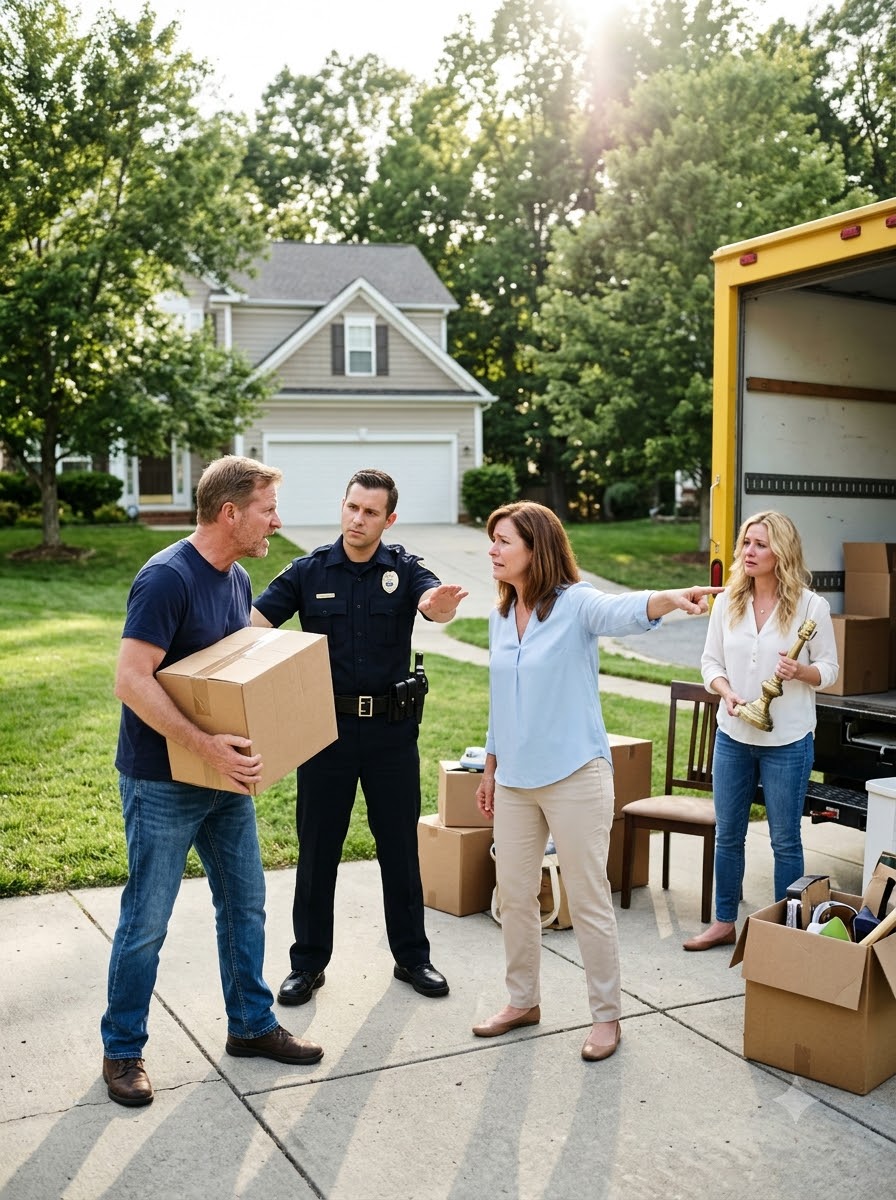
Near the end, Vanessa emerged carrying her brass lamp.
She stopped beside the lawn chairs where Rachel and I were sitting.
For a moment, she stood silently.
She was younger than I’d thought from the camera, perhaps forty-two or forty-three.
Her mascara had left faint gray streaks down her cheeks.
“I didn’t know,” she said.
I believed her.
I couldn’t fully explain why.
Perhaps because I recognized her expression.
It was the look of a woman discovering that the man she married was not the man she thought she knew.
I’d seen that same expression in my own reflection many times.
“He told you I was cold,” I said. “That I didn’t appreciate him. That nothing he did was ever good enough for me.”
Vanessa’s eyes widened.
“He told me you’d say that,” she whispered. “He said you’d try to turn me against him.”
“I’m not trying to turn you against anyone,” I said. “You saw what you saw today. You don’t need me to tell you what it means.”
She lowered her eyes to the lamp.
“He told me this house was half his,” she said. “He said we’d have a yard. A real yard. I’ve never had a yard.” She laughed, a small broken sound. “I picked out where I wanted to put a garden. By the maple tree.”
I remained silent.
There was nothing useful I could say.
After a moment, Vanessa nodded, as though she’d received an answer, and walked back to the truck.
Much later, I would learn that she filed for separation four weeks afterward.
She moved in with her sister in Dayton.
She also gave Detective Moreno a full written statement and every message on her phone.
But that afternoon, all I saw was Vanessa carrying her lamp to the truck without looking back at Mark.
At 5:46 p.m., the yellow moving truck reversed out of my driveway and turned left onto Linden Court.
I watched until it disappeared behind the trees.
Rachel reached for my hand.
“Your house,” she said.
“My house,” I answered.
Then I cried.
Not the frightened, apologetic tears I’d shed throughout my marriage.
These were different.
They came from finally setting down something so heavy that I’d forgotten how long I’d been carrying it.
Officer Hale walked through the house with me one final time.
We checked every room.
Every closet.
The basement.
The attic access in the hallway.
“Just want to make sure they didn’t leave anything,” he said. “Or take anything.”
Nothing appeared to be missing.
But on the upper shelf of the master bedroom closet, we found a forgotten box.
MASTER BEDROOM.
Mark’s familiar block lettering.
Officer Hale glanced at me.
“Want me to call him to come get it?”
I considered the question.
“No,” I said. “Put it on the porch. He can arrange a pickup through my attorney.”
For the first time that day, Officer Hale smiled.
“Yes, ma’am.”
At the doorway, he paused.
“Can I tell you something, Ms. Whitaker?”
“Of course.”
“I’ve been doing this nine years. I get a lot of calls like this one. Exes. Family members. People who think they’re owed something.” He shook his head. “You know what usually happens? The homeowner shows up, and the other person starts talking, and the homeowner starts negotiating. ‘Okay, one more night.’ ‘Okay, a week.’ And then it’s a court case and it’s a mess for months.”
He looked directly at me.
“You didn’t negotiate. You didn’t argue. You just showed us the facts and let them stand. That made my job a whole lot easier.”
“I learned that today,” I said.
“Took some people a lot longer than one day,” he said. “Lock that door behind me.”
I did.
Then I opened the keypad application and deleted every access code.
My own.
The contractor’s.
And Lauren’s.
I hesitated over her name.
Then pressed the button.
Code deleted.
It felt like something had ended.
And I hoped something better could begin.
Rachel and I ordered pizza.
We ate sitting on my living room floor, in the empty space where Mark’s recliner had stood only hours earlier.
We didn’t say much.
Rachel found a radio station playing seventies music.
We leaned against the wall, listening to Fleetwood Mac while the sunlight outside my windows changed from gold to blue.
At approximately nine that evening, someone knocked softly on the side door.
I froze.
Rachel stood immediately, phone in hand.
I opened the camera.
Lauren.
She stood on my porch wearing a gray hoodie, hugging herself against the cold.
Her car was parked behind Rachel’s.
She must have driven three hours from Pittsburgh after our conversation.
She didn’t try the keypad.
She knocked.
And waited.
I opened the door.
Neither of us spoke at first.
She looked so young.
Like the eight-year-old girl who used to stand outside my bedroom, waiting to find out whether everything was all right.
“I didn’t know if I should come,” she said. “I didn’t know if you’d want me here.”
I stepped onto the porch and embraced her.
She began sobbing.
“I’m sorry,” she said into my shoulder, over and over. “I’m sorry, I’m sorry, I’m so sorry.”
“I know,” I said. “I know, baby. Come inside. It’s cold.”
We sat at my kitchen table until nearly two in the morning.
Lauren told me everything.
Not just about that summer.
About all the months since the divorce.
Mark had called her at least twice a week.
Every conversation included questions about me.
Where I was going.
Who I was seeing.
How much money I was spending.
He repeatedly told her I’d been cold and ungrateful throughout our marriage.
That I’d “abandoned the family.”
That he had tried endlessly to make me happy, but I’d never appreciated him.
“I believed some of it,” she admitted. “Not all of it. But some. Because you never told me your side. You never said anything bad about him. Ever. So I thought maybe he was right. Maybe you just… stopped loving him, and he didn’t know why.”
That hurt more than anything else that day.
Because she was telling the truth.
I’d never explained my side.
I thought I was protecting my children.
I believed a good mother shouldn’t involve them in the problems of her marriage.
I thought that by remaining quiet, pleasant, and fair, I could spare them from having to choose between their parents.
But silence doesn’t mean neutrality.
When only one person tells the story, their version becomes the only version anyone hears.
“Lauren,” I said. “I’m going to tell you some things now. Not to make you hate your father. I don’t want that. But because you’re an adult, and you deserve the truth, and because keeping it from you is part of how we got here.”
So I told her.
Not every painful detail.
Not every argument.
But enough.
I told her about the money Mark had secretly withdrawn from our joint savings on three separate occasions.
About how he refused to speak to me for days whenever I disagreed with him, until I apologized for something I hadn’t done.
About the time he warned me, while Lauren was in college, that if I ever left him, he would make certain our children knew whose fault it was.
“He did,” Lauren said quietly. “He made sure.”
“He tried,” I said. “But you’re here. At two in the morning. In my kitchen.”
She looked at me with red, swollen eyes.
“There’s something else,” she said. “Something I didn’t tell you on the phone.”
I waited.
“Back in May, Dad asked to borrow money. He said it was for a deposit on a new apartment. Eight thousand dollars.” She twisted her hands together. “I gave it to him. It was most of my savings. He said he’d pay me back by September.”
“Did he?”
She shook her head.
“When I asked about it in August, he said things were tight. That’s when he started telling me about the condo and the landlord and Vanessa’s credit.” She swallowed hard. “Mom, I think the eight thousand was for the moving truck. And the storage unit. And—I don’t know. Whatever he was planning.”
I reached across the table and took her hands.
“Then he used you twice,” I said. “And neither time was your fault.”
“I should have known.”
“You were trying to love both your parents. That’s not a crime, sweetheart. That’s just being a good daughter to a father who didn’t deserve it.”
She cried again.
This time, more quietly.
Rachel had been sitting silently at the far end of the table.
Finally, she spoke.
“Lauren,” she said. “Can I tell you something about your mother?”
Lauren wiped her eyes.
She nodded.
“When we were girls,” Rachel said, “your mom was the bravest person I knew. When I was fourteen, a boy at school spread a nasty rumor about me. Do you know who marched up to him in front of the entire cafeteria and made him take it back? Your mother. She was eleven. She was half his size.” Rachel smiled. “Somewhere along the way, she forgot she was that girl. Today, she remembered.”
Lauren looked at me as though she were seeing me differently.
“I didn’t know that,” she said.
“There’s a lot I never told you,” I said. “But I’m going to start.”
PART 3
The following weeks were difficult.
I wish everything had ended neatly when the moving truck left my driveway.
But real life rarely resolves itself that easily.
The next Thursday, Detective Moreno called.
Investigators had compared the signature on the lease with my signatures from the closing paperwork, driver’s license, and several other documents.
She described it as “a poor imitation.”
They had also uncovered something else.
The lease came from a free online template.
Vanessa had voluntarily provided Mark’s laptop, and its download history showed he’d obtained the template on August 28th.
Six days before my offer on the house was accepted.
“He was planning this from the moment he knew you were house hunting,” Detective Moreno said. “He just needed you to pick a house.”
The prosecutor’s office took over the case.
Through his attorney, Mark tried to characterize everything as a misunderstanding.
He insisted he genuinely believed I had agreed to let him stay.
He claimed the lease was merely a “draft” he intended to have me sign.
He argued that Lauren had willingly shared the code.
But the messages told another story.
She always folds.
She’ll want to settle.
Half that house should’ve been mine anyway.
In February, Mark pleaded guilty to criminal trespass and a reduced charge connected to the forged document.
The judge sentenced him to probation, a fine, community service, and an order prohibiting him from returning to my property or contacting me except through attorneys.
He was also ordered to repay Lauren the eight thousand dollars.
Patricia Ng had made certain that was included.
“Restitution,” she’d said, with a small, satisfied smile. “It’s one of my favorite words.”
I attended the sentencing.
Mark never looked at me.
When the judge finished and the bailiff escorted him toward the side exit, I realized something.
I wasn’t waiting for Mark to turn around.
I didn’t need an apology.
I wasn’t rehearsing a response in case he tried to justify himself.
I simply picked up my purse, walked outside, and drove home.
To my own house.
Lauren returned in March for a long weekend.
She helped me paint the kitchen sage green, exactly the color I’d wanted.
We played loud music, got paint in our hair, and ate grilled cheese sandwiches standing at the counter because the table was covered with drop cloths.
On Saturday afternoon, she stepped back from the wall, paintbrush in hand.
“Mom? Can I ask you something?”
“Of course.”
“Why didn’t you call Dad that day? When you first saw the truck. You always used to call him. Every time something happened, you’d call him and try to work it out.”
I set down the roller.
“I almost did,” I said. “My thumb was right on his name.”
“What stopped you?”
I thought about the best way to explain.
“For twenty-seven years,” I said, “whenever your father did something that hurt me, I’d call him and ask him to explain. And he always had an explanation. And somehow, by the end of the conversation, I was the one apologizing. I was the one who’d overreacted. I was the one who’d misunderstood.”
Lauren nodded slowly.
“That morning,” I said, “I was looking at a camera. I could see exactly what was happening. And I realized that if I called him, he’d do what he always did. He’d talk until I didn’t trust my own eyes anymore.”
I picked up the roller.
“So I decided to trust what I saw. Instead of asking him to tell me what I was seeing.”
Lauren didn’t speak for a while.
Then she said, “I think I’ve been doing that too. With Dad. And with other people. With my boyfriend, kind of.” She made a face. “Ex-boyfriend now, actually.”
“Really?”
“Yeah. After everything with Dad, I started noticing stuff. He did the same thing. He’d say something hurtful, and then when I got upset, he’d say I was too sensitive.” She laughed a little. “That’s literally what Dad used to say to you.”
“I know.”
“I didn’t want to end up like—” She stopped herself. Her face went red. “Mom, I didn’t mean—”
“It’s okay,” I said. “You can say it. You didn’t want to end up like me.”
“Not like you,” she said quickly. “Like… the way things were. For you. Before.”
I smiled.
“Honey,” I said, “neither did I. That’s why I left.”
She put down her brush and hugged me.
We ended up with sage-green paint all over our shirts.
Neither of us cared.
On the first warm weekend of April, I finally got to know the rest of my neighbors.
Walt arrived first with Biscuit, his golden retriever, and a pie made from his late wife’s recipe.
Then came Priya, the woman with the toddler.
Marcus, the teenager I’d seen holding a basketball that Saturday, offered to mow my lawn for fifteen dollars a week.
He apologized for “being kind of nosy that day with the police.”
“Marcus,” I said, “you can be nosy anytime you want. That’s what neighbors are for.”
He grinned.
Walt stood on my back porch, looking at the maple tree.
Small red buds were appearing along its branches.
“Sandra Okafor loved that tree,” he said. “She used to sit under it every morning with her coffee. Said it was the best spot on the whole street.”
“I can see why.”
Walt glanced at me.
“You planning on putting anything under it?”
I remembered Vanessa standing in my yard, holding her brass lamp and talking about the garden she wanted to plant beside the maple.
I remembered Mark sitting in his truck, convinced that half my house should belong to him.
And I remembered all the years I’d spent arranging my life around someone else’s comfort, moods, and version of reality.
“A bench,” I said. “Just a bench. Somewhere to sit and have my coffee.”
Walt nodded.
“Good choice.”
The following Saturday, Marcus and his father helped me build it.
A simple cedar bench with a curved back.
We positioned it where the morning sunlight filtered through the branches.
On Sunday morning, I made coffee and carried it outside.
I sat down.
The air smelled of freshly cut grass and damp soil.
Somewhere down the street, Biscuit was barking.
Priya’s toddler laughed in the neighboring yard.
Above me, the maple leaves had opened into small, bright green shapes.
My phone vibrated.
For an instant, my stomach tightened.
It was the old reflex from my marriage.
Whenever my phone lit up, I never knew which version of Mark might be waiting on the other end.
But it wasn’t him.
And it would never be him again.
It was Lauren.
Morning Mom!! Are you on your bench? Send a pic!!
I laughed.
I lifted my coffee mug in front of the tree and took a photograph.
Then I replied.
On my bench. In my yard. At my house. Come visit soon. I’ll give you a new code.
She answered almost immediately.
Only if you’re sure.
I stared at the message.
Only if you’re sure.
Six months earlier, my daughter wouldn’t have asked.
She would have assumed.
Or allowed someone else to make the decision.
Now she was asking.
Not because she distrusted me.
Because she understood that the door belonged to me.
I’m sure, I wrote. I’ll tell you the code myself. In person. Just you.
Deal, she replied. Love you.
Love you more.
EPILOGUE
Thanksgiving arrived again, as it always does.
For the first time in twenty-eight years, I hosted the celebration in a home that belonged entirely to me.
Rachel drove from Louisville with her famous sweet potato casserole.
My son, Ben, flew in from Denver with his fiancée, Hannah, a lovely, quiet young woman who brought homemade rolls and immediately began alphabetizing my spice cabinet.
Lauren arrived two days early to help prepare the meal.
We stayed awake past midnight peeling potatoes and laughing over old family videos on her laptop.
Walt joined us.
So did Priya, her husband, and their toddler, who had recently learned to say “Miss Di” and repeated it approximately four hundred times throughout the afternoon.
Marcus and his parents stopped by for pie.
My dining room was so crowded that we brought in a folding table from the garage, two extra kitchen chairs, and even the cedar bench from beneath the maple tree.
Nobody complained.
Before dinner, Rachel tapped her glass with a fork.
“I want to say something,” she said.
The room became quiet.
“A year ago,” Rachel said, “my sister was in my kitchen in Louisville, watching a moving truck pull into her driveway on a security camera. And I watched her decide, right there, who she was going to be for the rest of her life.”
She turned toward me.
“Diane, I’ve loved you since the day Mom brought you home from the hospital. But I don’t think I’ve ever been prouder of you than I was that day. You didn’t fold. You didn’t apologize. You didn’t ask anybody for permission to protect what was yours.”
Her voice trembled.
“Here’s to the girl in the cafeteria,” she said. “Welcome back.”
Everyone lifted their glasses.
I couldn’t speak.
I raised mine and nodded, my eyes filling with tears.
Then Lauren stood.
“Can I add something?”
Rachel sat down.
Lauren held her glass with both hands.
“Last year, I did something that really hurt my mom,” she said. “I gave someone a key to her house because I believed what he told me instead of asking her what was true. And she could have shut me out. She had every right to.”
She looked directly at me.
“Instead, she sat with me at her kitchen table until two in the morning and told me the truth. About a lot of things. Things she’d kept from me my whole life because she thought silence was the same as protection.”
Her voice broke.
“Mom, you taught me something that day. You taught me that loving someone doesn’t mean letting them do whatever they want. And that you can forgive someone and still change the locks.”
A few guests laughed softly.
“So here’s to new codes,” Lauren said, raising her glass toward me. “And to only giving them to people who earn them.”
“To new codes,” everyone replied.
Later that night, after the dishes were washed, the guests had gone home, and Ben and Hannah had retired to the spare bedroom, I found Lauren outside.
She was sitting on the cedar bench beneath the maple tree.
One of my old quilts was wrapped around her shoulders.
She was gazing at the bare branches against the stars.
I sat beside her.
“Cold out here,” I said.
“I know. I like it, though.” She leaned her head on my shoulder. “Mom?”
“Hm?”
“Do you ever think about him?”
I considered the question carefully.
“Sometimes,” I said. “Not the way I used to. I used to think about him constantly. What he was thinking. Whether he was upset. Whether I’d done something wrong. My whole day used to revolve around predicting his mood.”
“And now?”
“Now I think about him the way you think about a storm that passed a long time ago. I remember it happened. I remember how loud it was. But I’m not standing in it anymore.”
Lauren was silent for a while.
“Vanessa sent me a message last week,” she said finally.
I looked at her, surprised.
“She said she was sorry. For her part in it. She said she’s in counseling now, and she’s figuring out a lot of things about why she believed him so easily. She said to tell you thank you.”
“Thank me for what?”
“She said that day in your yard, when you told her she didn’t need you to tell her what it meant. She said nobody had ever trusted her to figure something out for herself before. She said it was the first time she felt like she was allowed to believe her own eyes.”
I sat quietly, thinking about that.
Then I reached into my coat pocket and took out a small folded piece of paper.
I’d been carrying it all day, waiting for the right moment.
I handed it to Lauren.
She unfolded it.
Four numbers.
Written in my handwriting.
“Your new code,” I said. “Just yours. Nobody else’s.”
Lauren studied the numbers.
Then she looked at me.
“Are you sure?”
I smiled.
Because she had asked again.
And because this time, I knew my answer without needing anyone else’s approval.
“I’m sure,” I said. “This is my house. I decide who comes in.”
She carefully folded the paper and tucked it into her pocket, close to her heart.
The same way she’d once saved the little notes I slipped into her lunchbox when she was a child.
Then she rested her head against my shoulder.
We sat beneath the maple tree in the cold November darkness.
Two women who had learned the same painful lesson during one extraordinary year.
The most important door you’ll ever protect isn’t made of wood.
It’s the door inside yourself.
The one that determines whose voice you believe.
For twenty-seven years, I had allowed another person to control the code to that door.
Now it belonged to me.
And I was never handing it over again.
THE END
