

PART 3: THE DOOR THAT FINALLY BELONGED TO ME
The weeks after the moving truck left were not simple.
I wish I could say everything ended the moment Mark drove away.
But real life rarely wraps itself up so neatly.
The following Thursday, Detective Moreno called.
Investigators had compared the signature on the lease with my signature on the closing documents, driver’s license, and other records.
She described it as a poor imitation.
They had also discovered something else.
The lease had been downloaded from a free online template.
The download history from Mark’s laptop, which Vanessa voluntarily provided, showed the document had been obtained on August 28th.
Six days before my offer was accepted.
“He was planning this before you chose a house,” Detective Moreno told me. “He just needed to know which property you would buy.”
The prosecutor’s office took the case.
Mark hired an attorney.
He argued that everything had been a misunderstanding.
He claimed he genuinely believed I had agreed.
Then he said the lease was only a draft.
Then he insisted that Lauren had voluntarily given him the code.
But the messages remained.
She always folds.
She’ll want to settle.
Half that house should’ve been mine anyway.
In February, Mark pleaded guilty to criminal trespass and a reduced charge related to the forged document.
The judge sentenced him to probation, a fine, and community service.
He was also ordered to stay away from my property and communicate with me only through attorneys.
And he had to repay Lauren the eight thousand dollars.
Patricia Ng made certain the restitution was included.
“Restitution,” she told me with a small smile. “One of my favorite words.”
I attended the hearing.
When the judge read the sentence, Mark didn’t look at me.
For once, I didn’t care.
I wasn’t waiting for an apology.
I wasn’t hoping he would turn around and explain himself.
I picked up my purse.
Walked out of the courthouse.
And drove home.
To my house.
Lauren visited again in March.
This time, she stayed for a long weekend.
We painted the kitchen sage green, just as I had planned before the moving truck appeared.
We played music too loudly.
Got paint in our hair.
And ate grilled cheese sandwiches standing beside the counter because the kitchen table was covered in drop cloths.
On Saturday afternoon, Lauren stepped back from the wall.
“Mom, can I ask you something?”
“Of course.”
“Why didn’t you call Dad that morning?”
I set down my paint roller.
“What do you mean?”
“When you first saw the moving truck. You always used to call him whenever something happened. You’d try to talk things through.”
I looked at the newly painted wall.
“I almost called him,” I admitted. “My thumb was right over his name.”
“What stopped you?”
I thought for a moment.
“For twenty-seven years, whenever your father hurt me, I called him and asked for an explanation.”
Lauren listened.
“He always had one. And by the end of the conversation, I somehow believed I had misunderstood. Or overreacted. Or remembered things incorrectly.”
I paused.
“But that morning, I was watching the security camera. I could see exactly what was happening.”
I looked at her.
“And I realized that if I called him, he would keep talking until I stopped trusting what I could see with my own eyes.”
Lauren was silent.
“So I decided to trust what I saw,” I said. “Instead of asking him to tell me what I was seeing.”
She stared at the paintbrush in her hand.
“I think I’ve been doing that too.”
“With your dad?”
“With him. And with other people.”
She hesitated.
“With my boyfriend, actually.”
I raised my eyebrows.
“Boyfriend?”
“Ex-boyfriend now.”
She gave a small laugh.
“After everything that happened with Dad, I started noticing things. He’d say something hurtful, and when I got upset, he’d tell me I was too sensitive.”
I nodded.
“That sounds familiar.”
“I know.”
She looked at me.
“I didn’t want to end up like—”
She stopped.
Her face reddened.
“Mom, I didn’t mean—”
“It’s okay,” I said gently. “You didn’t want to end up like me.”
“Not like you. Like the way things were for you.”
I smiled.
“Honey, neither did I. That’s why I left.”
Lauren put down her brush.
Then she hugged me.
We got sage-green paint all over our shirts.
Neither of us cared.
By April, the maple tree in my backyard had begun to bloom.
Small green leaves unfolded along its branches.
The weather was finally warm enough to sit outside with a cup of coffee.
And I began getting to know my neighbors.
Walt came over with Biscuit, his golden retriever, and brought a pie made from his late wife’s recipe.
Priya, the woman with the toddler, introduced herself properly.
Her little boy quickly decided I was his favorite neighbor.
Marcus, the teenager with the basketball, offered to mow my lawn for fifteen dollars a week.
Then he apologized for watching the police activity that first Saturday.
“Marcus,” I told him, “you can be nosy anytime you want. That’s what neighbors are for.”
He grinned.
One afternoon, Walt stood beside me on the back porch.
He looked toward the maple tree.
“Sandra Okafor loved that tree,” he said. “She used to sit beneath it every morning with her coffee.”
I smiled.
“I can understand why.”
Walt tilted his head.
“You planning to put anything under it?”
I thought about Vanessa standing in my yard with her brass lamp.
About the garden she had imagined planting there.
About Mark believing he had a right to half my home.
And about the years I had spent arranging my life around someone else’s comfort.
“A bench,” I said.
Walt smiled.
“Good choice.”
The following Saturday, Marcus and his father helped me build one.
It was a simple cedar bench with a curved back.
We placed it beneath the maple tree, where the morning sunlight filtered through the branches.
The next Sunday, I carried my coffee outside and sat down.
The air smelled of wet earth and freshly cut grass.
Biscuit barked somewhere down the street.
Priya’s little boy laughed in the yard next door.
Above me, the maple leaves moved gently in the breeze.
Then my phone buzzed.
For one second, my stomach tightened.
The old reflex.
The feeling I’d had throughout my marriage whenever Mark called, never knowing whether he would be charming, angry, or cold.
But it wasn’t Mark.
It would never be Mark again.
It was Lauren.
Morning Mom!! Are you on your bench? Send a pic!!
I laughed.
I held up my coffee mug, framed the maple tree behind it, and took a photograph.
Then I typed:
On my bench. In my yard. At my house. Come visit soon. I’ll give you a new code.
Her reply came almost immediately.
Only if you’re sure.
I stared at those words.
Only if you’re sure.
Six months earlier, Lauren might have assumed she could share whatever information she wanted.
Now she was asking.
Not because she didn’t trust me.
But because she understood that the door belonged to me.
I’m sure, I wrote. I’ll tell you the code myself. In person. Just you.
Deal, she replied. Love you.
Love you more.
Thanksgiving arrived before I knew it.
For the first time in twenty-eight years, I hosted the holiday in my own home.
Rachel drove from Louisville with her famous sweet potato casserole.
My son, Ben, flew in from Denver with his fiancée, Hannah.
Hannah brought homemade rolls and immediately started organizing my spice cabinet alphabetically.
Lauren arrived two days early to help me prepare dinner.
We stayed awake past midnight peeling potatoes, laughing at old family videos, and remembering holidays from when the children were little.
Walt joined us.
So did Priya, her husband, and their toddler.
Marcus came with his parents for dessert.
My dining room was so crowded that we had to bring in the folding table from the garage.
We borrowed extra kitchen chairs.
And we carried the cedar bench inside from beneath the maple tree.
Nobody complained.
Before dinner, Rachel tapped her glass with a fork.
“I want to say something.”
Everyone quieted.
“A year ago, my sister was standing in my kitchen in Louisville, watching a moving truck pull into her driveway on a security camera.”
She turned toward me.
“And I watched her decide who she was going to be for the rest of her life.”
My throat tightened.
“Diane, I’ve loved you since the day Mom brought you home from the hospital. But I don’t think I’ve ever been prouder of you than I was that day.”
Her voice wavered.
“You didn’t fold. You didn’t apologize. You didn’t ask anyone’s permission to protect what was yours.”
She raised her glass.
“Here’s to the girl in the cafeteria. Welcome back.”
Everyone lifted their glasses.
I couldn’t speak.
I just nodded through my tears.
Then Lauren stood.
“Can I add something?”
Rachel smiled and sat down.
Lauren held her glass with both hands.
“Last year, I did something that really hurt my mom.”
The room grew quiet.
“I gave someone access to her house because I believed what he told me instead of asking her what was true.”
She looked at me.
“And she could have shut me out. She had every right to.”
My eyes filled again.
“But instead, she sat with me at her kitchen table until two in the morning and told me the truth.”
Lauren took a breath.
“She taught me that loving someone doesn’t mean letting them do whatever they want.”
She smiled through her tears.
“And that you can forgive someone and still change the locks.”
A few people laughed.
“So here’s to new codes,” Lauren said, lifting her glass. “And only giving them to people who earn them.”
“To new codes,” everyone repeated.
I looked around the table.
My sister.
My children.
My future daughter-in-law.
My neighbors.
People who had come because they wanted to be there.
Not because they expected something from me.
For the first time in years, Thanksgiving felt peaceful.
Later that night, after the dishes were washed and the guests had gone home, I found Lauren sitting beneath the maple tree.
She was wrapped in one of my old quilts.
The cedar bench had been returned to its place in the yard.
Bare branches stretched above her against the November stars.
I sat down beside her.
“Cold out here.”
“I know,” she said. “I like it.”
She leaned her head against my shoulder.
“Mom?”
“Hm?”
“Do you ever think about Dad?”
I considered the question.
“Sometimes.”
She waited.
“Not the way I used to,” I continued. “When we were married, I thought about him constantly. What mood he was in. Whether I’d upset him. What I needed to say to keep things peaceful.”
“And now?”
I looked toward the dark house.
“Now I think about him the way you remember a storm that passed a long time ago.”
Lauren lifted her head.
“I remember how loud it was,” I said. “I remember how frightened I felt.”
I smiled faintly.
“But I’m not standing in it anymore.”
She was quiet.
Then she said, “Vanessa messaged me last week.”
I turned toward her.
“Really?”
“She said she was sorry. For what happened. She said she’s in counseling now and trying to understand why she believed Dad so easily.”
I listened.
“She asked me to tell you thank you.”
“Thank me?”
Lauren nodded.
“She said that day in your yard, when you told her she didn’t need you to explain what she’d seen, it changed something for her.”
My chest tightened.
“She said nobody had ever trusted her to figure things out for herself before.”
I sat quietly.
I remembered Vanessa standing beside the moving truck.
Her brass lamp in her arms.
Her eyes full of confusion.
Perhaps that day had been a beginning for her too.
After a while, I reached into my coat pocket.
I had been carrying a small folded piece of paper all day.
I handed it to Lauren.
She opened it.
Four numbers.
Written in my handwriting.
“Your new code,” I said. “Just yours. Nobody else’s.”
She looked at the paper.
Then at me.
“Are you sure?”
I smiled.
Because she had asked again.
And because this time, I knew exactly what my answer was.
“I’m sure.”
I looked toward the house.
“This is my home, Lauren. I decide who comes in.”
She folded the paper carefully and tucked it into her pocket.
Then she rested her head against my shoulder.
We sat together beneath the maple tree, watching the stars through the bare branches.
Two women who had learned the same difficult lesson in the same extraordinary year.
That the most important door you’ll ever protect isn’t made of wood.
It’s the one inside you.
The door that decides whose voice you trust.
Whose version of events you believe.
And whether you are willing to stand up for what you know is true.
For twenty-seven years, I had allowed someone else to control that door.
He told me what I remembered.
What I felt.
What I deserved.
And whenever I doubted him, he convinced me to doubt myself instead.
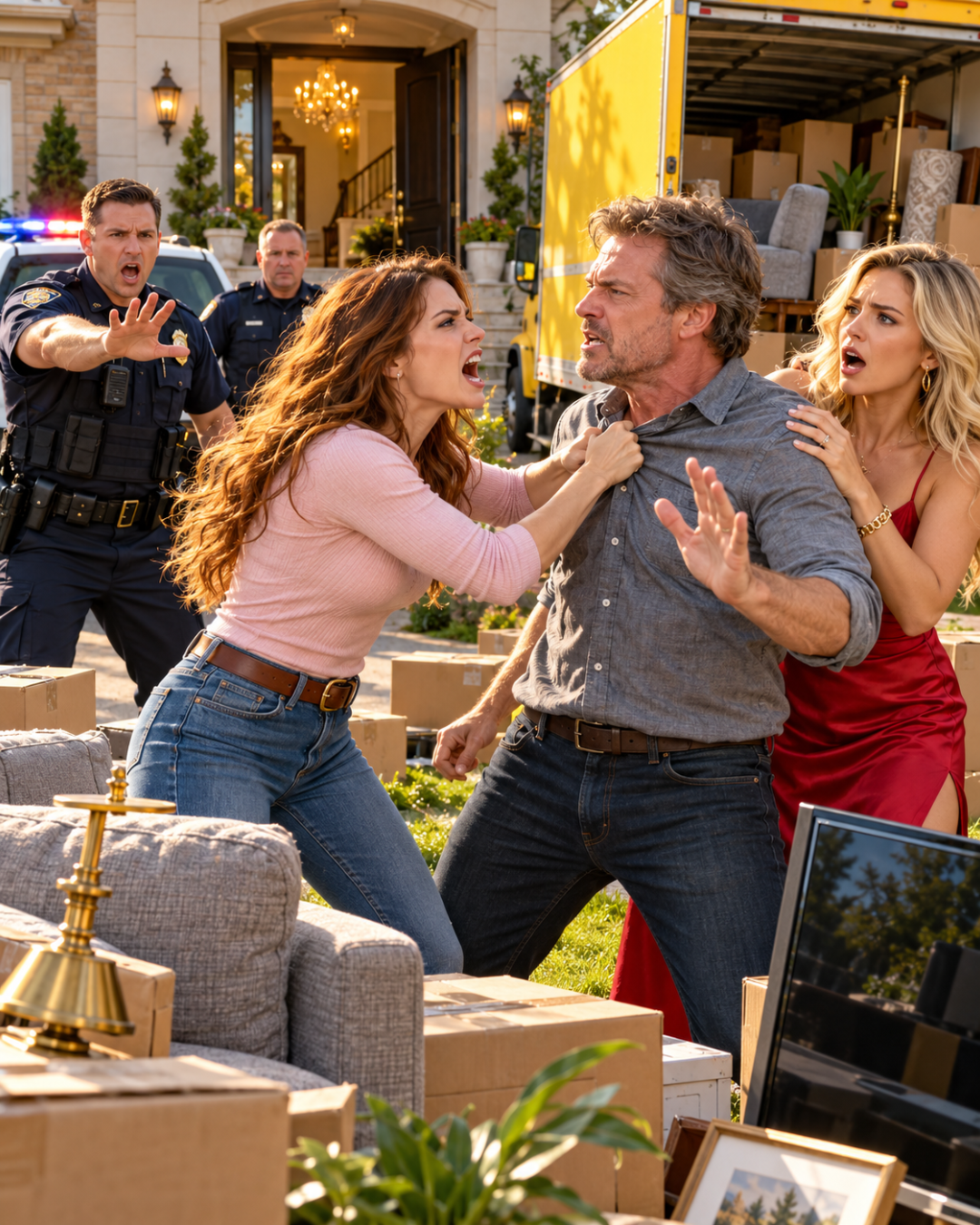
But that Saturday morning, when I watched a yellow moving truck back into my driveway, I finally stopped asking Mark to explain the truth.
I trusted my own eyes.
I called the police.
And I took back my home.
The house on Linden Court wasn’t simply a property I had purchased for $327,500.
It was proof that I could begin again.
That I could set boundaries without apologizing.
That I could love my daughter while still expecting her to respect my privacy.
And that I could leave a marriage behind without allowing my ex-husband to keep controlling my life.
The maple branches swayed softly above us.
Lauren slipped her hand into mine.
And for the first time in twenty-seven years, I wasn’t afraid of what tomorrow might bring.
Because the door was mine.
The key was mine.
The choice was mine.
And I was never giving that power away again.
THE END.
