

PART 1
When Adrián Valverde stepped inside his house in Pozuelo de Alarcón and heard his daughter laughing, he was certain his mind was playing tricks on him.
He hadn’t heard Claudia laugh that way in nearly two years.
Since her mother, Elena, had passed away following a prolonged illness, the seven-year-old had withdrawn into herself. She rarely spoke, showed little interest in playing, and could spend entire afternoons gazing silently through the window. Adrián had spent a fortune on specialists, vacations, recreational activities, and medical treatments. Nothing had managed to bring his daughter back to the cheerful little girl she had once been.
That afternoon, he arrived home exhausted after a long day at the Valverde hotel group’s offices when the sound of a guitar drifted from the living room.
He moved toward the music, careful not to make a sound.
Then he stopped in astonishment.

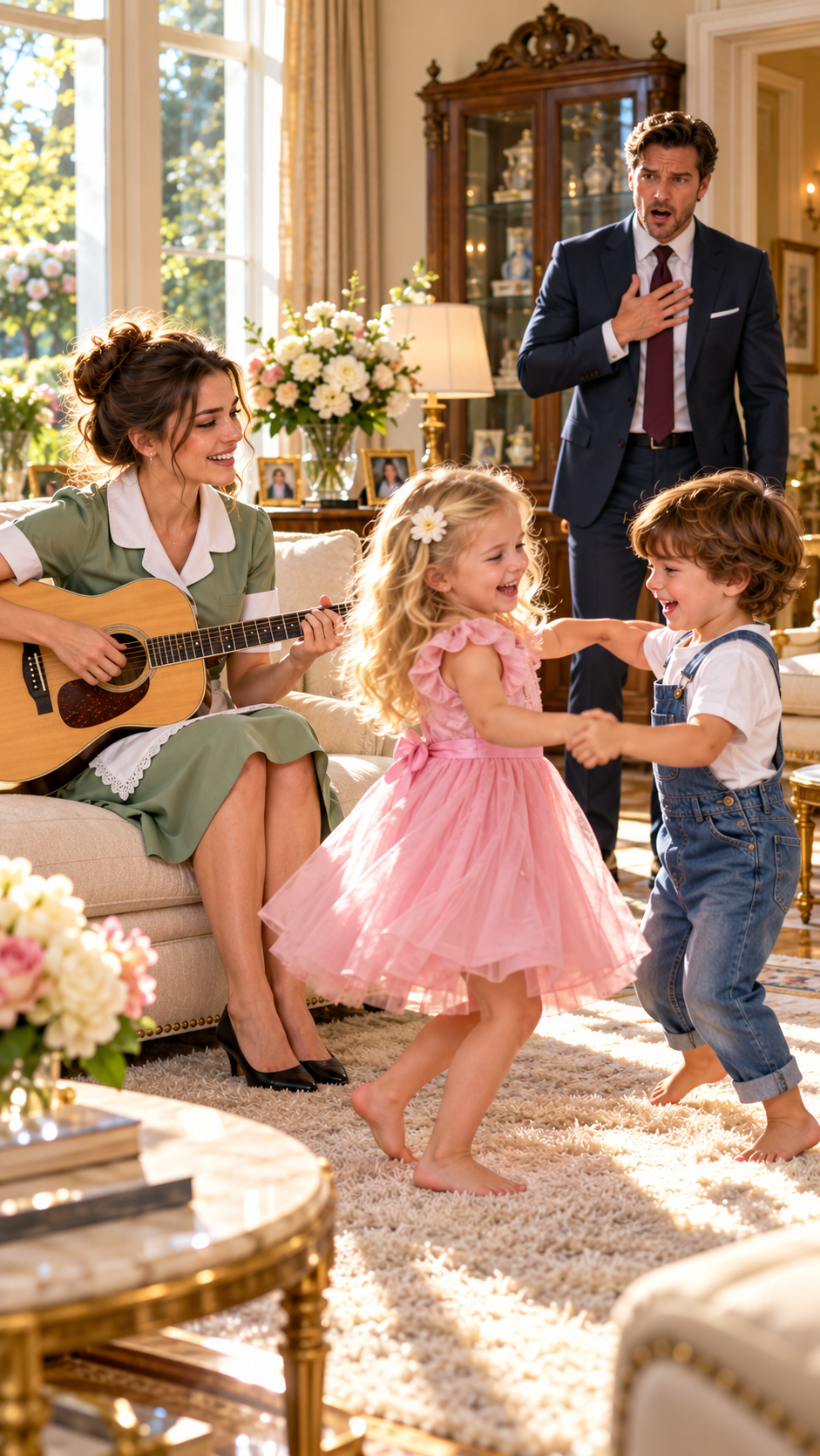
Marta Serrano, the housekeeper he had employed only a month earlier, sat at one end of the sofa. An old guitar rested across her lap, and her fingers moved over its strings with a grace and precision Adrián had never imagined belonged to the woman who cleaned his home every morning.
But what truly left him speechless was happening directly in front of her.
Claudia was dancing barefoot across the carpet, holding hands with a boy who appeared to be around eight years old.
“Again, Leo!” she shouted through her laughter.
Adrián gripped the doorframe to steady himself.
Marta noticed him and immediately stopped playing.
The boy released Claudia’s hands.
“Mr. Valverde, I can explain,” she said, turning pale. “Leo is my son. The person who was looking after him had an emergency, and I had nowhere to leave him. I know I shouldn’t have brought him here. It won’t happen again.”
But Adrián hardly registered her explanation.
His attention remained fixed on Claudia.
“Daddy,” the little girl said, “Leo is terrible at dancing.”
“You’re worse,” the boy protested.
Claudia erupted into another fit of laughter.
Adrián felt his eyes filling with tears.
Then his mother, Mercedes Valverde, entered the room.
She examined the scene with an expression of unmistakable disapproval.
“What is the son of a maid doing playing with my granddaughter?”
Claudia quickly moved behind Leo.
“He’s my friend.”
Mercedes tightened her lips.
“Marta was hired to work. Not to bring her family here or turn this house into a daycare center.”
Leo dropped his gaze toward the floor.
After a moment, he spoke quietly.
“I just wanted Claudia to feel less sad.”
Mercedes regarded him sternly.
“Tomorrow, we’ll discuss the terms of your employment, Marta.”
Adrián immediately intervened.
“You’re not going to fire her.”
“We’ll see about that.”
Mercedes turned and left the living room.
That evening, as Adrián tucked his daughter into bed, Claudia asked whether Leo could visit again the following day.
“He lost his dad too,” she whispered before falling asleep. “He says that when someone is sad, you shouldn’t ask so many questions. You should just stay with them.”
Adrián remained beside her bed long after her breathing had settled into the steady rhythm of sleep.
Later that night, he contacted Samuel Ortega, an associate whose judgment he trusted.
“I want you to find out who Marta Serrano was before she started working here.”
Samuel arrived the next morning carrying a folder.
Adrián assumed it would contain an ordinary account of a woman who had struggled to support her child.
Instead, the first page left him struggling to breathe.
Marta Serrano had not always earned her living cleaning other people’s homes.
She had once been considered among Spain’s most promising young guitarists.
And the event that had destroyed her musical career was connected directly to the Valverde family.
Samuel explained that Marta had attended the Royal Conservatory of Music in Madrid. She had earned recognition in several competitions and was preparing to begin an international career when her husband, Julián, died in the partial collapse of an aging industrial building.
At the time, the property belonged to Valverde Investments.
Earlier inspection reports had documented structural defects.
The company had disregarded multiple warnings.
Marta had attempted to pursue legal accountability, but the company’s powerful attorneys succeeded in closing the case. The resulting expenses had consumed almost everything she possessed.
“Who was running Valverde Investments at the time?” Adrián asked.
Samuel paused before replying.
“Your mother.”
A chill spread through Adrián.
But Samuel had uncovered something else.
He placed a copy of a visitor register from the clinic where Elena had spent the final weeks of her life on the table.
During those weeks, a volunteer had regularly visited the facility to play guitar for patients who had no one beside them.
Adrián examined the name written in the register.
Marta Serrano.
The woman whose future had been shattered by a company owned by his family had unknowingly offered comfort to his dying wife.
And the melody she now played for Claudia was the very song Elena had asked to hear again and again during those lonely afternoons.
Adrián slowly closed the folder.
Elsewhere in the mansion, Mercedes was speaking privately with Verónica, the house manager.
Her instruction was unmistakable.
“That woman has to leave before Adrián discovers who she is.”
Verónica responded with a knowing smile.
“Then we’ll have to give him a reason never to trust her again.”
Adrián had discovered the truth about Marta’s past.
What he didn’t yet realize was that the people closest to him were already preparing to destroy her reputation before she could expose theirs.
PART 2
Adrián found Marta in the service kitchen, where Leo sat at the table drawing a guitar.
“Can we talk?”
Marta immediately grew tense.
“Of course.”
They moved into the library.
Adrián wasn’t ready to confront her about her husband’s death or his family’s involvement. He wanted to begin with something less painful.
“Where did you learn to play like that?”
Something shifted in Marta’s expression.
“A long time ago.”
“Samuel found out a few things about your career.”
She raised her eyes toward him.
“Then he already knows quite a bit.”
“Not enough.”
Marta remained quiet for a moment before glancing toward Leo.
“His father built guitars.”
The boy’s face brightened.
“The one Mom plays was made by him.”
Marta gently traced her fingers along the guitar case.
Julián, she explained, had worked as a luthier in a modest workshop in Alcalá de Henares. They had met when he received a commission to build a guitar for one of her competitions.
They had fallen in love before he even finished making the instrument.
For several years, their lives had been filled with happiness.
She performed music.
He crafted instruments.
Then the building collapsed, and everything changed.
“When Julián was gone, I stopped playing,” Marta said. “Every time I opened this case, it felt like losing him all over again.”
Adrián looked at her.
“And how did you end up working in people’s homes?”
A sorrowful smile crossed her face.
“Because nobody cares how many competitions you’ve won when you have a child, rent, and bills to pay. But there’s always someone willing to pay you to clean.”
Adrián lowered his gaze.
For the first time, he truly understood how far apart talent and the opportunity to earn a living from that talent could be.
“I want Leo to come here after school,” he said. “Claudia is better when she’s with him.”
Marta immediately shook her head.
“His grandmother won’t allow it.”
“Claudia is my daughter.”
Before they could discuss it further, Mercedes called from the entrance hall.
“Marta, come here.”
When they arrived, Verónica stood beside Mercedes holding a document that had already been prepared.
Mercedes delivered her instructions in an even voice.
“Starting today, your son will not enter this house. You will also stop playing the guitar during your working hours. Your duties will be strictly limited to cleaning.”
Marta tightened her grip on the guitar case.
“I can accept the conditions regarding my work, but the guitar isn’t bothering anyone.”
“The guitar will disappear from this house too.”
Adrián stepped between them.
“Mother, enough,” Adrián interrupted.
Mercedes turned toward him.
“You have no idea what you’re doing.”
“I know that Claudia laughed again.”
“A vulnerable child can develop unhealthy attachments.”
“Don’t call the only thing that has restored her happiness unhealthy.”
Mercedes fell silent.
Verónica took the opportunity to intervene.
“Adrián, your mother is only trying to protect the family.”
Adrián was beginning to despise that word.
Family.
As though invoking it made every cruel decision acceptable.
“Marta keeps her job,” he declared. “Leo can come here. And that guitar stays.”
Mercedes moved closer to her son.
“When this ends badly, remember that I tried to warn you.”
Later that afternoon, Adrián contacted Dr. Ferrán Núñez, the psychologist treating Claudia.
The doctor spent nearly an hour observing the children together.
Afterward, he explained what he had seen.
“Leo isn’t trying to cure her. That’s precisely why it works. They’ve both lost someone essential to them. Claudia recognizes a pain similar to her own in him, and she no longer feels different.”
Adrián listened carefully.
“Should we let them continue spending time together?”
“As long as the relationship remains natural and healthy, I wouldn’t interfere with it.”
Relief washed over him.
When he returned to the living room, Claudia was showing Leo one of her drawings.
“This is Mommy,” she was saying. “She’s on a star.”
Leo pointed toward another star.
“Then my dad will be right next to her. That way, they can talk.”
Marta turned away, attempting to conceal her tears.
Adrián did the same.
While everyone was occupied with the children, Verónica slipped into the small room where Marta stored her personal belongings.
She reached into her pocket.
Inside was a diamond brooch that Mercedes had owned for decades.
Verónica opened the guitar case and placed the jewelry among its contents.
She did not hide it in a drawer.
She did not slip it into a handbag.
She chose the guitar case deliberately.
She wanted the discovery to appear so damning that Marta would have no believable explanation.
That evening, Mercedes announced that her diamond brooch had disappeared.
Suspicion immediately spread throughout the mansion.
Verónica took charge of the search.
Only minutes later, she returned carrying Marta’s guitar case.
Before everyone, she opened it.
The missing brooch sparkled beside the spare strings.
Marta’s face drained of color.
“That isn’t mine.”
Mercedes looked at her coldly.
“It was found among your belongings.”
“I’ve never seen it before.”
Leo stepped forward.
“My mother would never put anything like that in there.”
“Leo,” Marta whispered.
But her son refused to remain silent.
“My dad made that guitar. Mom doesn’t even let me keep toys inside it.”
Adrián studied the open case.
The situation made no sense.
Someone deliberately concealing stolen jewelry would surely select somewhere less obvious.
And Marta, who treasured the guitar above almost everything else, would never choose it as a hiding place for something she had stolen.
Mercedes watched her son carefully.
“Don’t tell me you’re going to believe her.”
Adrián hesitated.
The pause lasted less than two seconds.
But Marta noticed.
And that brief hesitation told her everything.
She shut the case.
Then she lifted the guitar and placed its strap over her shoulder.
“You can keep the brooch.”
Adrián moved toward her.
“Marta, wait.”
“No.”
Her voice remained steady.
“I’ve survived too much to stay in a house where I have to prove I’m not a thief.”
She reached for Leo’s hand.
Claudia hurried toward them.
“Are you coming back tomorrow?”
Marta couldn’t bring herself to answer.
Leo embraced his friend.
“Of course.”
But once they were leaving, he looked up at his mother.
“Are we coming back?”
Marta squeezed his hand.
She said nothing.
Over the following days, Claudia stopped dancing.
Soon afterward, she abandoned her drawings.
Eventually, she stopped even asking about Leo.
Dr. Núñez did not soften his assessment.
“She’s regressing.”
Adrián began trying to locate Marta.
Then Teresa, the household cook, requested a private conversation.
“On the night the brooch disappeared, I saw Verónica enter Marta’s room.”
Adrián looked up sharply.
“Are you sure?”
“Absolutely.”
He examined the exterior surveillance recordings and uncovered another important detail. Verónica had passed through the service corridor shortly before Mercedes reported her jewelry missing.
Adrián confronted the house manager.
Verónica denied any wrongdoing.
But when he threatened to involve the police and provide the recordings, her composure collapsed.
“Your mother wanted her gone.”
Adrián stared at her.
“Did my mother ask you to plant the brooch?”
Verónica lowered her eyes.
“She told me to solve the problem.”
Adrián entered Mercedes’s study without bothering to knock.
He dropped Samuel’s folder onto her desk.
“I know about the building.”
His mother’s face lost its color.
“Adrián…”
“I know there were reports about the structure. I know Julián Serrano died there. I know Marta filed a claim, and your legal team managed to leave her with nothing.”
Mercedes remained in her chair.
“It was a huge company. There were hundreds of cases.”
Adrián’s voice hardened.
“She wasn’t a case file.”
“I know that now.”
“No. Now you know I’ve discovered the truth.”
Mercedes closed her eyes.
But Adrián wasn’t finished.
“I also know Marta visited Elena at the clinic.”
His mother looked up abruptly.
“What?”
He placed the visitor register before her.
Mercedes began reading.
Her hands started trembling.
“Elena was very lonely some afternoons,” Adrián said. “I was trying to keep the company running. You were organizing everything. And Marta sat beside her and played a song.”
Mercedes covered her mouth.
“The same song that makes Claudia smile now.”
For the first time Adrián could remember, his mother began crying without attempting to conceal her tears.
But he couldn’t stop to comfort her.
“Claudia is shutting herself away again. I need to find Marta.”
They searched unsuccessfully for three days.
On the fourth, Adrián received a telephone call from a temporary shelter in Carabanchel.
A social worker had discovered his business card among Leo’s belongings.
“The boy talks constantly about a girl named Claudia.”
Adrián drove directly to the shelter.
He found Marta sitting in a courtyard, her guitar resting beside her.
Leo noticed him first.
“Mom.”
Marta lifted her eyes.
Her expression immediately turned guarded.
“What are you doing here?”
“I’ve come to apologize.”
“Has another piece of jewelry gone missing?”
Adrián accepted the painful remark without protest.
“Verónica planted the brooch.”
Marta remained expressionless.
“There’s a witness and there are recordings.”
“Then you know I didn’t steal it.”
“I knew.”
Marta looked straight into his eyes.
“No. You wanted to believe it. That’s not the same thing.”
Adrián remembered those two seconds of uncertainty.
“You’re right.”
“When your mother accused me, you hesitated.”
“Yes.”
“That was enough.”
Adrián drew a slow breath.
“There’s something else you need to know.”
“Is there anything worse left?”
“My wife.”
Marta looked confused.
“Elena spent her final weeks at San Gabriel Clinic.”
Recognition flashed across Marta’s face.
“Elena Valverde?”
“Yes.”
She took a step backward.
“Room 214.”
Adrián went completely still.
“You remember?”
“Of course I remember.”
Marta raised a hand to her mouth.
“She was the woman who always asked me to play the same song.”
Tears began rolling down Adrián’s cheeks.
“The song you play for Claudia.”
Marta nodded slowly.
“She used to talk to me about her daughter. She said she had a laugh that could light up an entire house. One afternoon, she asked me to make her a promise.”
Adrián could barely speak.
“What promise?”
“That if I ever met a child who seemed to have forgotten how to smile, I would play that melody.”
For several seconds, neither of them spoke.
All the suffering, deception, and losses that had brought their lives together suddenly formed a connection neither could have imagined.
Without realizing who Claudia was, Marta had fulfilled a promise made to her dying mother.
“Claudia needs Leo,” Adrián said. “And she needs that music.”
Marta studied him cautiously.
“Are you asking me to return to that house?”
“I’m asking you to come for her. Nothing more. You don’t have to work for us. You don’t have to forgive anyone.”
Leo gently pulled at his mother’s sleeve.
“Mom.”
She looked down.
“What is it?”
“Claudia needs me.”
Marta shut her eyes.
When she opened them again, her decision had been made.
“I’ll go back for Claudia.”
They reached the mansion shortly before two in the morning.
Mercedes waited in the entrance hall, with Verónica standing nearby.
As Marta entered carrying her guitar, Mercedes rose.
“Please, sit down.”
Marta did not move toward a chair.
“I’d rather stand.”
Mercedes nodded, accepting her choice.
“Verónica planted the brooch among your belongings.”
The house manager immediately tried to object.
Mercedes silenced her.
“You also intercepted a letter addressed to Marta.”
Adrián frowned.
Verónica went pale.
“Hand it over.”
At last, she retrieved an envelope from a drawer.
It bore the name of the Royal Conservatory of Music in Madrid.
Marta opened it.
She read the letter once.
Then she read it again.
“They want me to return.”
The conservatory had introduced a reinstatement program for former students forced to abandon their studies under exceptional circumstances.
And Marta had been offered a full scholarship.
She pressed the letter tightly against her chest.
Mercedes took a deep breath.
“Verónica, collect your things tomorrow.”
Verónica turned toward Adrián, hoping he would intervene.
He offered no assistance.
Once the house manager had left, Mercedes faced Marta.
“For years, I convinced myself I was protecting my family,” she said. “In reality, I had learned to look at people and see problems. Your husband became a figure in a financial report. You became a legal claim. And when you appeared in this house, I was afraid the past would come back.”
Marta listened without responding.
“I won’t ask you to forgive me tonight. That would be insulting. But Valverde Investments will reopen the case, acknowledge its responsibility, and provide compensation. It will also cover anything your scholarship doesn’t.”
Marta held her ground.
“I don’t want charity.”
“It isn’t charity.”
Mercedes swallowed.
“It’s a debt.”
Before anyone could speak again, footsteps sounded on the staircase.
Claudia appeared wearing her pajamas.
Her eyes found Leo.
She stopped in disbelief.
“You came back?”
Leo ran toward her.
“Yes.”
Claudia wrapped her arms around him so tightly that both children nearly lost their balance.
“I thought you were gone forever.”
“No.”
Leo gestured toward the guitar.
“My dad has come back too.”
Claudia looked at the instrument.
“Then Mommy can hear us again.”
Marta began to play.
Elena’s familiar melody spread through the entrance hall.
And Claudia and Leo started dancing barefoot.
Adrián wept openly.
Mercedes did too.
For the first time in years, the house felt less like a mansion and more like a home.
But for Marta, returning to that house was only the beginning of something she had believed was lost forever.
PART 3
In the weeks that followed, Marta returned to the conservatory.
She did not regain the exact future that had been taken from her when Julián died.
Instead, she began creating a different future.
One that belonged entirely to her.
Leo enrolled at the same school as Claudia, and the children continued to spend their days together. Their friendship remained as natural and uncomplicated as it had been on the afternoon Adrián first heard his daughter laughing.
Mercedes also honored the promises she had made.
Valverde Investments publicly admitted its failures concerning the old industrial building and established the Julián Serrano Foundation. Its purpose was to improve safety standards in small workshops and support families who had suffered losses through workplace accidents.

Marta, however, refused to let her husband’s memory become a public relations instrument for the Valverde family.
“If you do this to clean up your family name, I’ll withdraw my permission,” she warned.
Mercedes did not argue.
“Then we’ll do it to make amends for what we did.”
The two women did not suddenly become friends.
Reconciliation was not that simple.
But they gradually learned to occupy the same spaces without concealing the truth from one another.
Adrián, meanwhile, made certain that his gratitude toward Marta did not become another burden she was expected to carry.
He admired her.
And his admiration deepened as time passed.
Yet he recognized that a woman who had spent years watching her life fall apart needed the freedom to rebuild it on her own terms.
One afternoon, several months later, Adrián returned from work and once again heard the familiar sound of a guitar coming from the living room.
He walked toward the music.
Marta sat in the same place where he had discovered her that first afternoon.
Claudia and Leo were dancing together on the carpet.
But this time, Adrián did not remain standing in the doorway.
He entered the room.
Claudia hurried toward him.
“Daddy, you have to dance.”
Adrián smiled.
“I’m terrible at dancing.”
Leo grinned.
“That’s what makes it fun.”
Adrián agreed to join them.
Marta continued playing.
When the melody ended, Claudia walked over to the guitar and gently ran her fingers across its wooden surface.
“Can Julián hear it when you play?”
Marta smiled, though her eyes were filled with tears.
“I like to think he can.”
Claudia turned toward her father.
“And Mommy?”
Adrián knelt beside his daughter.
“Her too.”
“Then they know each other.”
“Probably.”
Claudia thought about that for a moment.
“They’re probably angry because it took us so long to find each other.”
A soft laugh escaped Marta.
Adrián looked toward Leo.
Then he turned to Claudia.
These two children had lost someone irreplaceable long before they were old enough to understand the full meaning of grief.
Yet they had managed to accomplish something the adults in that mansion had failed to do for years.
They did not conceal their sorrow.
They did not turn their pain into a weapon against others.
They simply reached for each other’s hands.
The old guitar continued filling their lives with music for many years.
Marta completed her education and eventually returned to performing onstage.
But she never permitted anyone to introduce her as “the housekeeper who became a concert guitarist.”
Whenever someone used that description, she corrected them.
“I was a musician before I cleaned houses. I just had to find my way back.”
The guitar Julián had lovingly crafted accompanied her during her first major recital in Madrid.
Leo, Claudia, and Adrián sat together in the front row.
A few seats behind them, Mercedes listened without speaking.
When Marta played the final notes of her performance, the audience rose to its feet in a standing ovation.
But Marta did not immediately lift her gaze toward the crowd.
Instead, she looked down at the worn wooden body of the guitar resting in her hands.
Then she whispered:
“We made it back.”
Years later, Claudia could still remember the afternoon her father came home exhausted and discovered her dancing with a boy she had only recently met.
For Adrián, that moment had initially seemed nothing short of miraculous.
As the years passed, however, he came to understand that it had not been a miracle.
It had required something far more difficult.
Two families carrying the weight of devastating losses had somehow found their way into each other’s lives.
One family possessed wealth, influence, and more secrets than anyone should have to carry.
The other had lost nearly everything except an old guitar, a little boy, and the dignity of a woman who refused to surrender it.
And in the end, it was the family with the least material wealth that taught everyone else what saving a family truly meant.
It was never about protecting a famous surname.
It was not about hiding the mistakes of the past.
Nor was it about preserving a fortune at any cost.
It meant finding the courage to acknowledge the harm that had been done, speak the truth, and repair whatever could still be repaired.
Some people inherited grand buildings, successful companies, and millions in wealth.
Leo inherited only a guitar.
But within that guitar remained the memory of his father’s hands, the melodies his mother had played, the final promise Elena had entrusted to her, and the first genuine laughter Claudia had found after years of sorrow.
And for as long as those strings continued to sing, none of them would ever have to feel entirely alone again.
