

PART 1: The Day My Father Finally Saw the Truth
The parking lot looked exactly the same. Nothing about it ever seemed to change.
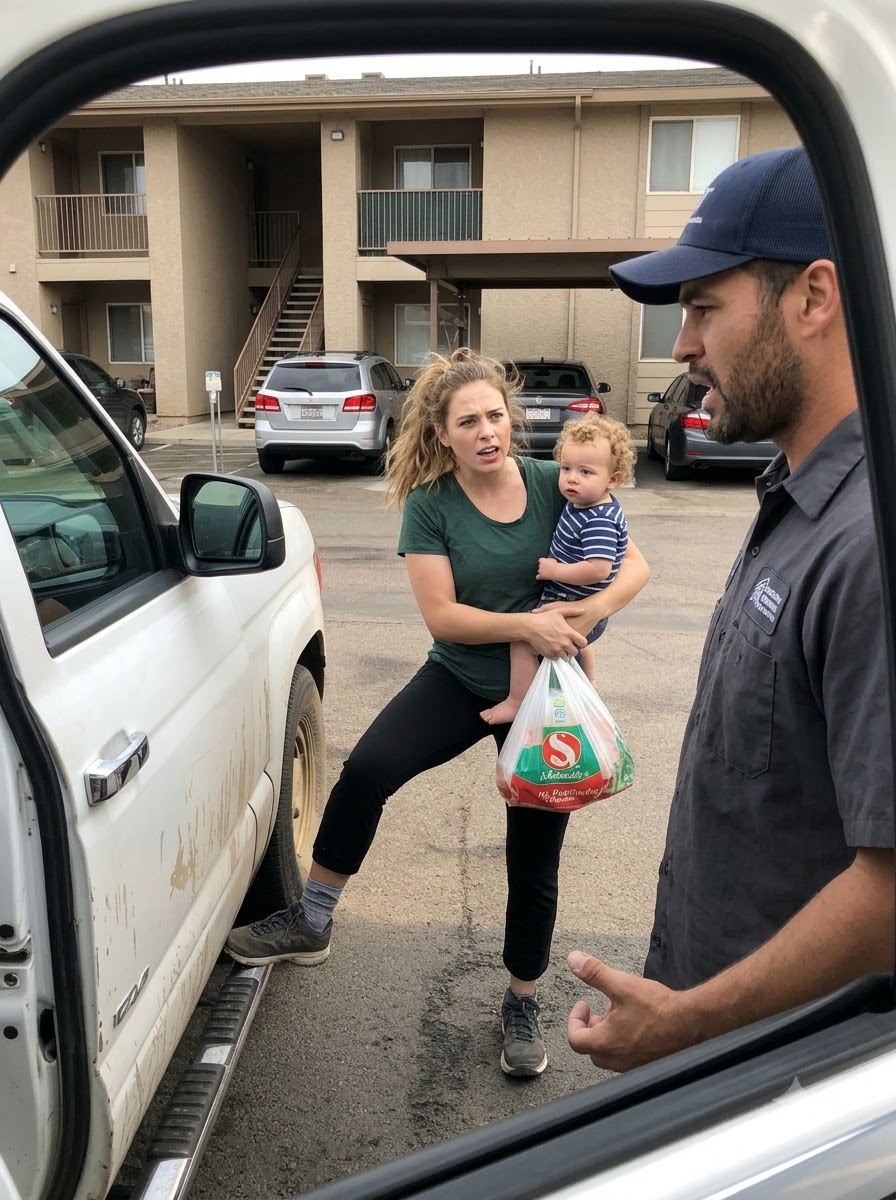
My father guided his car through the entrance of the cracked asphalt lot, driving with the same careful, unhurried precision he brought to everything. Through the windshield, I watched the familiar line of weathered stucco apartment buildings appear.
The late afternoon sun struck the complex from a low angle, bathing the faded yellow walls in amber light. In a photograph, the scene might have appeared inviting. Sitting there in person, I felt nothing remotely comforting.
Bent metal awnings cast irregular shadows over the parking spaces. Near the stairwell, several dead plants stood in terracotta pots, their curled stems rising from soil so dry it had split into pale cracks.
Nobody had bothered watering them for weeks, perhaps months.
When I first moved in, I had offered to care for them. Back then, I still believed small acts of kindness could make a difference.
Patricia had informed me that the plants were none of my concern.
Her white SUV occupied its customary space near the entrance. Derek’s truck sat two spots away.
And beside the curb, in the parking space supposedly reserved for me, stood a familiar blue sedan.
My car.
Except that description wasn’t entirely accurate.
I knew it wasn’t, and the knowledge tightened something deep inside my chest.
For twenty-two months, I had made the payments on that vehicle. Every other Friday, money disappeared from my paycheck before I could consider spending it on anything else.
Derek always promised that things would improve.
He talked about getting financially stable, about a business opportunity perpetually on the verge of becoming real, and about eventually transferring the car title into the proper name.
Patricia supported every excuse.
She frequently reminded me how fortunate I was that she had handled the original paperwork, emphasizing the inconvenience she had supposedly spared us.
I was expected to be grateful.
Meanwhile, the title remained in her name.
And the car remained in a parking space closer to the building than the one I generally used.
I stared through the windshield, feeling the familiar knot forming in my stomach.
Dad switched off the engine.
For several seconds, he simply studied me.
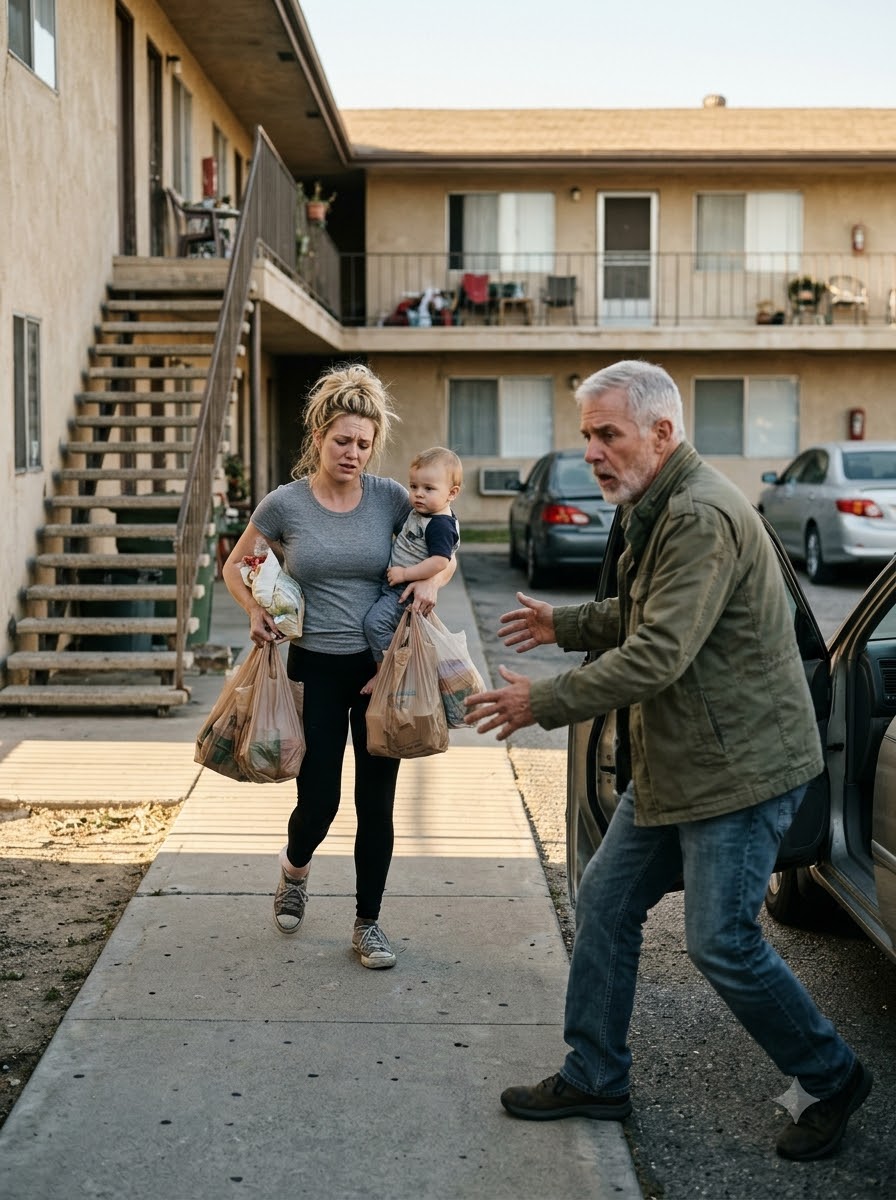
He had given me that same look earlier in the afternoon when I arrived at his house with Evan balanced on my hip, a grocery bag digging painfully into my palm, and my weight shifted awkwardly away from my injured ankle.
I hadn’t even realized how obviously I was limping.
He hadn’t immediately asked questions.
Instead, he took the groceries, placed them on the counter, lifted Evan from my arms, and looked at me.
It was the expression of a father confronting something he had feared for a long time, something he had hoped would never happen but had quietly prepared himself to face.
“Can you walk?” he asked now, looking at my ankle.
That morning, I had wrapped it with an old bandage from beneath the bathroom sink.
The makeshift support had accomplished very little. My ankle remained painfully tender, and the bandage had loosened throughout the afternoon until it slipped toward my heel.
“Yes,” I said.
Dad glanced at the slipping bandage before raising an eyebrow.
“Can you walk enough to get inside and get your things?”
I went completely still.
Get your things.
He hadn’t suggested making peace.
He hadn’t proposed a family discussion.
He wasn’t offering Derek another opportunity to explain himself with that familiar helpless shrug while Patricia supplied the words he couldn’t seem to find.
He wanted me to collect my belongings.
“My things?” I said.
“You and Evan are not staying here tonight.”
His words seemed to fill the car.
I understood what he meant, but accepting it required me to rethink everything I had spent two years convincing myself was unavoidable.
I had imagined leaving countless times.
Usually, those thoughts came late at night after Evan finally fell asleep, when I lay on the mattress on the floor of Derek’s childhood bedroom, staring at the ceiling while the white noise machine hummed beside us.
In my imagination, leaving was simple.
There were no financial calculations, no questions about childcare, no worries about where we would sleep.
I didn’t have to consider how little remained in my bank account after the car payment cleared.
I didn’t have to untangle the strange collection of legal and informal arrangements that governed everything in the apartment while somehow leaving me with almost no real ownership.
But Dad wasn’t talking about an imaginary escape.
He meant tonight.
He had even placed a duffel bag in the trunk before coming to get me. I noticed it only when I turned in my seat.
My hands began trembling against my legs.
Dad noticed immediately.
His voice softened, though his certainty never wavered.
“You don’t have to decide the next five years right now,” he said. “You only have to decide tonight.”
Behind us, Evan began fussing in his car seat, twisting impatiently after sitting still for too long.
It was such a small, ordinary sound.
But his simple need somehow settled the decision more effectively than any argument could have.
I opened the passenger door and stepped onto the asphalt.
Pain shot through my ankle.
Still, I wasn’t carrying grocery bags this time.
And I wasn’t carrying my baby.
Dad walked around the vehicle, released Evan from his car seat, and lifted him comfortably against his shoulder.
My son studied his grandfather with the serious concentration babies sometimes display when deciding whether someone can be trusted.
Apparently satisfied, he tucked his face into Dad’s neck.
Dad gestured toward the stairs.
We started climbing.
The railing on the left had been unstable since before I moved into the apartment.
I had once offered to contact the building manager about repairing it.
Patricia told me that property maintenance wasn’t my responsibility and warned me against interfering in matters that didn’t concern me.
I held the railing anyway.
It shook beneath my hand, just as it always had.
The apartment door was unlocked.
That detail told me Patricia felt entirely secure.
She rarely left the door unlocked unless she believed everything around her was under control.
Her confidence lived in small gestures: an unlocked entrance, a folded kitchen towel, perfectly applied lipstick even in the middle of the afternoon.
Every detail communicated the same message.
This was her home, her territory, and nothing happened without her approval.
Dad knocked firmly.
Patricia opened the door holding a kitchen towel, irritation already visible on her face.
Her smooth blond hair was carefully arranged. Her lipstick was flawless, and her posture carried the rigid authority of someone who had already decided that any unexpected visitor was an inconvenience.
Then she recognized my father.
Her irritation hardened into something colder.
“Can I help you?” she said, her voice tilting into a politeness that had no warmth in it whatsoever.
Dad remained composed.
“We’re here for her things,” he said, nodding toward me.
Patricia looked past him at me, then lowered her eyes toward my injured ankle.
Her expression showed the same impatient indifference I had seen that morning.
“That seems a little dramatic,” she said. “We were just working through some things earlier. You can’t run home every time things feel difficult. She needs to learn to handle discomfort without turning it into a crisis.”
Heat climbed into my chest.
My old instinct immediately surfaced.
Apologize.
Explain.
Make myself smaller before someone became angry.
For two years, I had learned to move through that apartment as though my presence were a privilege that could be withdrawn at any moment.
I kept my purse on one particular chair, stored my belongings inside bags, and avoided leaving personal things on shared surfaces.
I had trained myself to occupy as little space as possible.
But before I could apologize, Dad stepped forward.
“She’s not running anywhere,” he said. “She’s leaving.”
The word seemed to change the atmosphere in the hallway.
Patricia blinked.
Her kitchen towel stopped moving.
Then she gave a dismissive little laugh.
“Leaving? With what, exactly? Everything she has is here.”
Dad turned toward me.
“Go pack,” he said quietly.
I walked past Patricia before fear could persuade me to remain.
The hallway smelled familiar, lemon cleaning solution covering the stale, accumulated odors of too many lives occupying too little space.
It seemed narrower than I remembered.
Perhaps that was what happened after two years of making yourself smaller.
Eventually, you started believing every room belonged to someone else and that your own presence was an intrusion.
The bedroom door stood open.
Our mattress remained on the floor, its fitted sheet pulled loose at one corner.
Evan’s blanket lay crumpled where I had left it before going grocery shopping.
A water glass stood beside the mattress.
My purse hung from the back of the only chair.
Everything was exactly where I had left it.
I stood there, absorbing how little of the room reflected the fact that I had lived in it for two years.
Then I began packing.
I didn’t own a proper suitcase.
The duffel bag I had brought when I first moved in was still beneath the bed, in the only storage space I could confidently call mine.
I dragged it out, opened it, and started filling it.
My clothes.
Evan’s diapers.
The onesies I had purchased myself rather than accept Patricia’s hand-me-downs, which always arrived with remarks about how fortunate I was to receive her assistance.
His favorite stuffed rabbit, without which he had recently decided sleeping was impossible.
Then I reached into the bottom of the bag.
Beneath everything else was a folder.
I had kept it hidden there because no other place felt secure.
Not Patricia’s locked filing cabinet.
Not the kitchen, where she monitored everything.
Only the bottom of my own bag.
Inside were twenty-two months of pay stubs, bank statements showing highlighted car payments, and photographs of the vehicle’s insurance cards, registration, and title.
Patricia’s name appeared clearly on that title.
But the payments came from me.
I hadn’t gathered those records because I was plotting revenge.
I kept them because living in that apartment had taught me something important.
If I didn’t preserve the truth, someone else would rewrite it.
Patricia had the confidence.
Patricia had the loudest voice.
But I had the paperwork.
And as I held that folder, I began to understand that the evidence I had quietly protected might be the one thing she couldn’t dismiss.
PART 2: The Moment I Stopped Making Excuses
Packing revealed something I hadn’t expected.
It wasn’t simply how few belongings I possessed.
A duffel bag and a laundry basket were enough to contain nearly everything Evan and I had accumulated during two years in that apartment.
There was something painful about realizing how little physical space our lives occupied.
But what unsettled me most was the folder.
Those carefully preserved records belonged to someone who had spent years watching, documenting, and quietly preparing for the possibility that her version of events would eventually be challenged.
I hadn’t consciously planned an escape.
Yet some part of me had always understood that I needed proof.
I placed the folder carefully inside my purse.
Then I finished filling the laundry basket with a few books, Evan’s small jacket, and the baby monitor I had purchased on sale.
I had charged that monitor every night beside the mattress.
When the duffel was full, I zipped it closed.
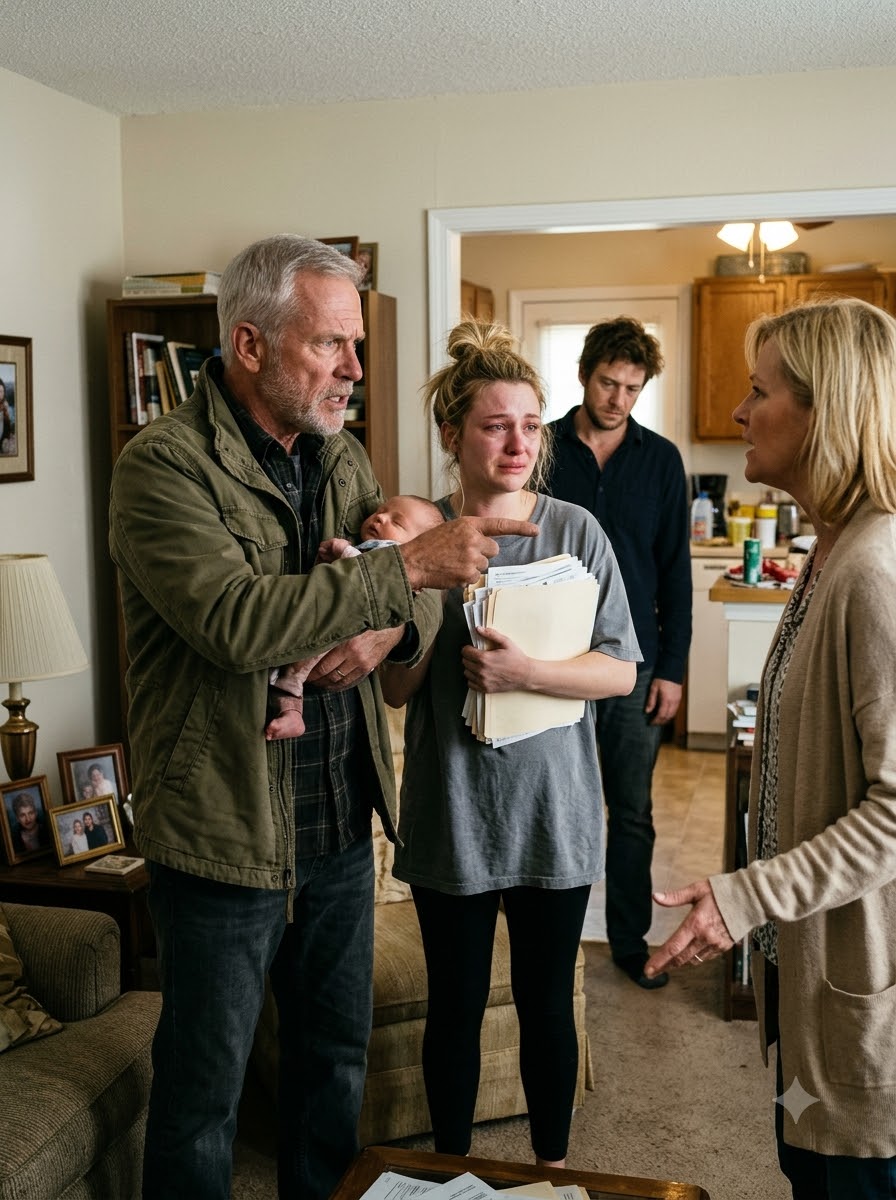
Raised voices drifted from the living room.
“You are taking a very partial view of things,” Patricia said. Her voice had taken on the particular tone she used in arguments, reasonable on the surface, with a cold current running underneath. “She agreed to contribute to this household. That is not control. That is adulthood. That is how shared living works when people are responsible.”
“Contributing isn’t the same as control,” Dad said. He did not raise his voice. He never needed to.
“She had access to everything she needed.”
“She had access to what you approved.”
Patricia responded with a short, contemptuous sound.
“I don’t know what she’s been telling you, but this household has been more than generous. We took her in. We gave her stability she did not have on her own. We helped with the car when she could not have managed it alone.”
“You put your name on the car title and kept taking her money,” Dad said.
Silence followed.
Then I heard Derek.
“It wasn’t supposed to be permanent. We were going to sort that out.”
“When?” Dad asked.
Derek offered no answer.
I carried my belongings into the living room.
Nothing there had changed.
Patricia’s furniture filled the space. Her photographs covered the walls. Every decoration reflected her preferences, her choices, and her authority.
There was almost nothing to suggest that other people lived there.
Derek stood beside the couch, his arms hanging awkwardly at his sides.
I recognized his expression immediately.
Whenever conflict emerged, he became helpless.
For a long time, I had explained that behavior as sensitivity.
Sometimes I called it avoiding confrontation.
Other times, I convinced myself he was struggling beneath the weight of Patricia’s expectations.
Perhaps those explanations contained fragments of truth.
But his refusal to act was still a decision.
And I was the person who paid for it.
He looked toward me.
His face had gone pale, his expression uncertain, as though he knew the truth had finally surfaced but hadn’t decided how to respond.
Dad noticed the folder in my hand.
“Are those your records?” he asked.
“Yes,” I said.
Patricia looked at the folder.
For the first time, I saw an expression on her face that I didn’t recognize.
It wasn’t her familiar anger.
It wasn’t the sharp irritation she used to intimidate me.
It was uncertainty.
Dad turned toward Derek.
“You let her make payments on a car for nearly two years,” he said. “The title is in your mother’s name. She has no legal claim to the vehicle she funded.”
“The insurance was complicated,” Derek started.
“Titling a car is paperwork that takes an afternoon,” Dad said. “You had almost two years of afternoons.”
Derek tightened his jaw.
Still, he said nothing.
Patricia moved forward, attempting to reclaim control of the discussion.
“A father swooping in after one phone call doesn’t have the full picture,” she said. “There are dynamics here you don’t understand. There is context.”
“I understand what I saw when my daughter walked through my front door today,” Dad said.
Patricia stopped.
“I saw a woman carrying a baby and groceries, limping on an ankle she hurt on your broken step, trying not to show the pain because she has been trained not to complain. I saw a woman who pauses before she speaks, as if she needs to check whether her words are allowed. I saw two years of someone working and paying and waiting for things to get better while the terms of the arrangement kept moving.”
I felt those words settle deep inside me.
Dad had noticed everything.
The limp.
The hesitation.
The way I instinctively measured my words before speaking.
He had seen what I had spent two years trying to explain away.
Patricia pressed her lips together.
“She’s an adult,” she said, but her voice had lost some of its sharpness. “She made choices.”
“She did,” Dad agreed. “And now she’s making another one.”
He adjusted Evan against his shoulder and looked at me.
There was no pity in his expression.
He wasn’t treating me as helpless or incapable.
He believed I could leave.
He had simply come to make sure I didn’t persuade myself to stay.
That realization nearly brought me to tears.
My father hadn’t needed an elaborate explanation of every incident from the previous two years.
He had watched me enter his home carrying my baby and groceries while struggling to hide the pain in my ankle.
That had been enough.
Sometimes a father recognizes what his daughter is enduring long before she finds the courage to describe it.
Derek finally stepped away from the couch.
For a brief moment, hope flickered inside me.
Perhaps he would acknowledge what had happened.
Perhaps he would admit that his silence had helped Patricia control our lives.
Perhaps he would finally accept responsibility for the car, the financial arrangements, and the endless promises that never became reality.
He opened his mouth.
Then closed it.
His eyes moved instinctively toward his mother.
And he remained silent.
Something inside me ended.
There was no dramatic heartbreak, no sudden explosion of rage.
It was quieter than that.
It felt like reaching the end of an exhausting journey and realizing there was no reason to continue walking.
I had loved Derek.
That mattered.
In the beginning, he had been funny, affectionate, and full of plans.
I had loved the man he seemed capable of becoming.
And long after his behavior stopped matching that version of him, I continued loving the memory.
I explained his silence in ways that allowed me to stay.
I told myself he was overwhelmed.
I told myself he was trying.
I told myself that the car title, the financial dependence, and the mattress on the floor were all temporary.
Temporary could be endured.
Temporary suggested that something better was coming.
But temporary only means something when someone is actively working to change the situation.
Derek wasn’t.
Standing there, watching him look to Patricia for permission to speak, I finally understood that he was exactly where he wanted to be.
I adjusted the duffel strap over my shoulder and lifted the laundry basket.
“I’m not coming back,” I said.
My voice was steady.
That surprised me.
For once, I wasn’t asking for understanding.
I wasn’t apologizing.
I was stating a decision.
Patricia laughed in disbelief.
“We’ll see,” she said.
Her response was almost automatic.
She had spent years relying on the belief that if she made resistance difficult enough, people would eventually surrender.
Make leaving feel impossible, and they would stop trying.
Until that afternoon, her strategy had worked.
I shook my head.
“No,” I said. “You won’t.”
Then I faced Derek.
“The car,” I said. “I paid for it. I have every payment documented.”
Patricia immediately interrupted.
“Legally, it is not in your name.”
Dad answered before I could speak.
“Legally,” he said, in a tone that made it clear this was not an empty statement, “we’ll work through that.”
Patricia went completely still.
Those words had changed the situation.
She could argue with my feelings.
She could dismiss my complaints.
But the folder contained financial records, and Dad was prepared to make sure they were taken seriously.
He nodded toward the entrance.
“Let’s go.”
I walked toward the door.
I didn’t glance at Derek.
I didn’t look at Patricia.
I refused to linger over the couch where I had spent so many evenings feeling invisible or the kitchen table where every purchase had somehow required her approval.
I didn’t look toward the window where I used to stand with Evan, watching the parking lot while wondering how much longer I could pretend this arrangement was temporary.
I simply walked out.
The air outside felt different.
It was the same late afternoon air that had always surrounded the building.
Yet breathing it now felt easier.
Dad followed and closed the apartment door behind us.
We descended the stairs carefully.
He carried Evan ahead of me while I followed with the laundry basket, protecting my injured ankle.
The railing still shook beneath my hand.
The pain was still there.
But something fundamental had changed.
For the first time, those problems existed outside a situation I had believed I couldn’t escape.
At the bottom of the stairs, Dad turned toward me.
He studied my face with the same quiet attention he had shown when I was little and had fallen or hurt myself.
He always seemed to know whether a moment required comfort or simply practical action.
Without saying anything, he took the laundry basket from my hands.
He carried it to the car while keeping Evan securely against his shoulder, then placed it in the trunk.
Next, he carefully buckled my son into his car seat, adjusting every strap with patient attention.
Only when Evan was secure did he return to me.
I stood beside the car, looking toward the blue sedan parked against the curb.
In the fading sunlight, it looked like an ordinary vehicle.
But to me, it represented twenty-two months of wages, broken promises, and financial sacrifices.
Dad followed my gaze.
“We’ll get it back,” Dad said.
He spoke without drama.
It wasn’t an attempt to make me feel better.
It was a promise he intended to pursue.
I nodded.
He squeezed my hand and walked around to the driver’s side.
I remained standing for another moment, my purse hanging from my shoulder and the folder safely inside it.
Patricia still had her name on the title.
But she no longer controlled where Evan and I would spend the night.
And for the first time in two years, that difference mattered more than the car itself.
PART 3: The Freedom I Had Almost Forgotten
I stood beside Dad’s car, looking at the blue sedan as the afternoon light slowly faded.
The folder inside my purse suddenly felt heavier than its contents should have allowed.
Twenty-two months of bank statements.
Pay stubs.
Highlighted transfers.
Photographs of the registration, insurance documents, and title.
I had preserved everything without fully understanding why.
It hadn’t been part of an elaborate plan.
It was simply the instinct of someone who had learned that her experiences could be dismissed unless she could prove them.
Patricia had always been confident.
Her voice had always dominated every disagreement.
But confidence couldn’t erase the payments recorded on those pages.
And Dad knew a lawyer whose number, I suspected, had been saved in his phone before he drove over.
That was how he handled difficult situations.
He prepared quietly.
He didn’t need to announce what he was doing.
He simply made sure he was ready when the moment arrived.
I climbed into the passenger seat.
Dad started the engine.
Behind us, Evan made a happy little sound.
He had recently discovered that he could grab his own foot, and the achievement continued to fascinate him as though he were experiencing it for the first time with every attempt.
I watched him in the mirror.
He was completely absorbed in that tiny discovery.
For a moment, the tightness in my chest eased.
As Dad reversed out of the parking space, I looked toward the apartment building.
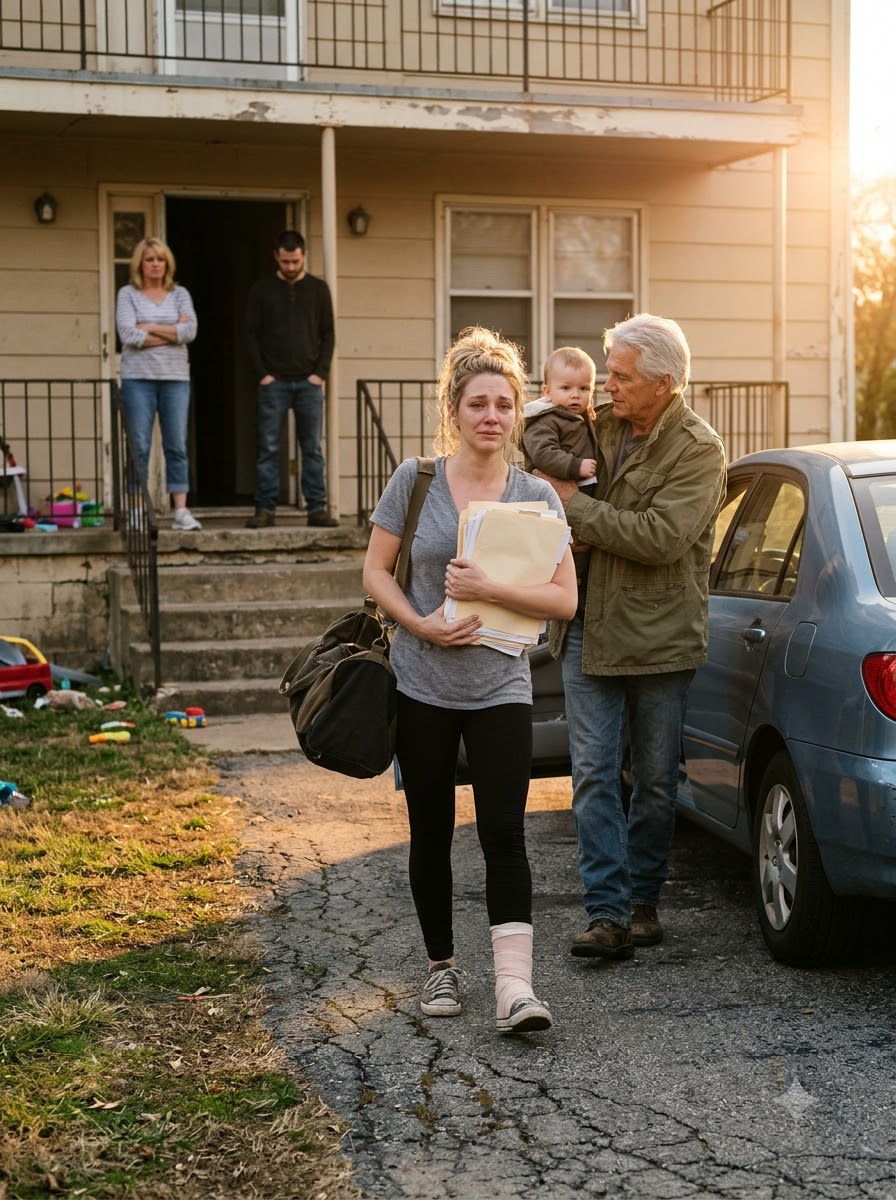
Patricia stood in the doorway.
Her arms were crossed over the kitchen towel, and her posture remained rigid, as though looking unmoved could somehow restore her authority.
Derek stood partly behind her, one hand resting against the doorframe.
Neither moved.
From a distance, they looked like two people waiting for an inconvenience to pass so their familiar routine could resume.
But there would be no return to that routine.
The blue sedan appeared in my side mirror as we approached the parking lot exit.
It was clean and well maintained.
I had always taken care of it.
Even when the people controlling the arrangement showed little consideration for me, I had protected the vehicle I was paying for.
Looking at it hurt.
I won’t pretend otherwise.
But the grief wasn’t really about Patricia.
It wasn’t about losing the apartment.
And it wasn’t even entirely about Derek.
I was grieving the time.
I remembered the future I had imagined when I first moved in.
A future where Derek established himself financially.
Where the car title was corrected.
Where we eventually had a proper home and Evan could grow up with both parents under one roof.
I remembered how sincerely I had believed those things would happen.
And I remembered the countless small adjustments I had made when they didn’t.
I lowered my expectations and called it patience.
I accepted less and called it understanding.
I tolerated uncertainty and told myself I was being mature.
I confused remaining in a difficult situation with making an effort to improve it.
That was the loss I felt most sharply.
Not the car.
Not the apartment.
The woman I had been when I still believed staying was proof of love.
I allowed myself to feel that sadness.
There was no reason to deny it.
Leaving didn’t erase the good memories, and recognizing the truth didn’t mean I had never cared about Derek.
I had loved him.
I had hoped.
I had waited.
Those feelings had been real, even if the future I imagined never became reality.
Then Dad turned out of the parking lot.
The apartment buildings disappeared behind us.
Ahead, the city stretched into the amber-gray light of early evening.
Storefronts began glowing.
Streetlights flickered on.
Cars moved through intersections, and ordinary life continued in every direction.
The world hadn’t stopped because my life had changed.
Strangely, that comforted me.
There was still a whole city beyond the apartment complex.
There were streets I could travel without Patricia’s approval.
There were places Evan and I could go.
There were possibilities I had stopped allowing myself to imagine.
I knew the next few months wouldn’t be easy.
The car dispute might require legal assistance, paperwork, and difficult conversations.
I would have to make practical decisions about housing, childcare, and money.
Starting over meant confronting dozens of ordinary problems that rarely appear in inspiring stories about leaving unhealthy situations.
There would be exhausting evenings.
There would be uncertain mornings.
There would probably be moments when I questioned myself.
I knew how easily doubt could return, especially after spending years being told that my discomfort was an overreaction.
But I also knew I couldn’t allow those doubts to rewrite what had happened that afternoon.
I had seen the apartment clearly.
I had heard Derek’s excuses.
I had watched him turn toward his mother when he should have been speaking for himself.
And I had finally stopped pretending those things meant something other than what they were.
Beside me sat a father who had driven across town, entered a home where he wasn’t welcome, and calmly said the words I had been afraid to say.
Behind me was a baby who had no understanding of the confrontation we had just left.
Evan didn’t know about car titles or bank statements.
He didn’t understand the financial arrangements that had trapped his mother.
He simply knew that he was safe in his car seat, surrounded by people who loved him.
And on my lap rested a folder filled with evidence.
Evidence that I hadn’t imagined the unfairness.
Evidence that I had contributed more than anyone acknowledged.
Evidence that some quiet part of me had continued protecting my interests even when I lacked the courage to defend them aloud.
I had been documenting my life while struggling to find a way to reclaim it.
That folder wasn’t merely a collection of financial records.
It was proof that I had never completely abandoned myself.
Dad turned on the radio.
Soft, wordless music filled the car.
The evening sunlight stretched across the dashboard, turning its edges golden.
Evan had fallen asleep.
His head rested to one side, his mouth slightly open, one small hand still loosely holding his foot.
He looked as though he had drifted off in the middle of celebrating his latest discovery.
I smiled.
Then I placed my hand on the folder.
The blue sedan remained in Patricia’s parking lot.
The title still carried her name.
The legal questions were unresolved.
Nothing about those practical facts had changed during the drive.
Yet they no longer frightened me the way they had that morning.
Because the most important thing had already changed.
I wasn’t trapped inside that apartment anymore.
I was sitting beside my father.
My son was sleeping safely behind us.
We were moving forward.
I had left with a duffel bag, a laundry basket, a folder of records, and an ankle that still throbbed with every movement.
I hadn’t brought much.
But I had brought Evan.
And I had brought myself.
For two years, I had allowed my sense of security to become tangled with a vehicle I was paying for but didn’t legally own.
I had treated that car as proof that I was building something stable.
Now I understood that possession and freedom were entirely different things.
Owning a car mattered.
Having financial security mattered.
But neither meant much if I had to surrender my voice, my dignity, and my independence to keep them.
I didn’t know exactly how we would resolve the title dispute.
Perhaps it would take a lawyer.
Perhaps it would require months of paperwork.
Perhaps the process would be frustrating and unpleasant.
But I could face those possibilities.
I no longer had to face them alone.
Dad kept driving with his familiar steady concentration.
Evan slept peacefully.
The city moved past our windows, indifferent to the fact that an ordinary afternoon had become a turning point in my life.
I looked ahead at the road.
For the first time in two years, I wasn’t wondering whether I was allowed to speak, whether I had asked for too much, or whether someone would become angry because I needed something.
I wasn’t preparing an apology.
I wasn’t rehearsing an explanation.
I was simply sitting in a car with my family, breathing without fear.
The silence around us was gentle.
It didn’t demand obedience.
It didn’t require permission.
It didn’t mean I had to make myself smaller.
It was simply quiet.
And for the first time in two years, that quiet felt like peace.
