

PART 2
I could hear her trying to steady her breathing.
“He told me he had found letters he’d never seen. He said he needed to know whether I’d really asked him to stay away.”
“And had you?”
“No, Annie.”
Her voice grew firmer.
“I never told him to abandon his daughter.”
I felt cold.
“Then who sent the letter saying you were marrying someone else?”
Malia sighed.
“My mother.”
I stared at the floor.
“Your mother?”
“She never approved of Daniel. She thought he was too young and too poor. When he left for Oregon, she believed he wouldn’t return. She wanted me to marry a man whose family owned a business on the island.”
“Did you?”
“No.”
She paused.
“I never married anyone.”
I closed my eyes.
The tragedy of it was almost unbearable.
A young father had left to earn money.
A young mother had waited for him.
And the people around them, each convinced they knew what was best, had torn their family apart.
“My mother sent him a letter pretending it was from me,” Malia continued. “She admitted it years later, when she was dying. By then, I believed Daniel had ignored every letter I sent.”
“And my mother hid them.”
“Yes.”
I pressed my forehead against my knees.
For thirty-five years, two people had lived with the same wound.
Each believed the other had chosen to leave.
“Did Dad forgive my mother?” I asked.
Malia took a long breath.
“He told me forgiveness wasn’t something he could decide in a single afternoon.”
I nodded, though she couldn’t see me.
“He said he still loved her. He said she had been a good mother to you. But he also said loving someone didn’t mean pretending they hadn’t hurt you.”
I wiped my cheeks.
“That sounds like him.”
Malia gave a sad little laugh.
“He still sounded like the boy I knew.”
For a while, neither of us spoke.
Then she asked, “Would you like to talk to Leilani?”
My heart started racing.
I looked down at the photograph in my lap.
The woman with my father’s eyes.
My sister.
“Does she know about me?”
“Yes. Daniel told her.”
“Does she want to talk to me?”
Malia’s voice softened.
“She’s been hoping you would call.”
I swallowed.
“Yes.”
There was a rustling sound.
A door opened somewhere in the background.
Then another woman came on the line.
“Hello?”
I couldn’t speak.
“Annie?”
“Yes.”
A shaky breath.
“I’m Leilani.”
I pressed my hand over my mouth.
For thirty-one years, I’d believed I was an only child.
Now my sister was speaking to me from an island I’d never visited.
“Hi,” I managed.
She laughed nervously.
“Hi.”
Neither of us seemed to know what to say.
Then she whispered, “I’m sorry about Dad.”
That was when I began to cry.
Not because she called him Dad.
But because I realized how much it must have cost her to use that word.
“He talked about you,” I said.
“He talked about you, too.”
“Really?”
“All the time.”
I wiped my face.
“What did he say?”
She laughed through her tears.
“He said you were impossible to beat at cards. That you always stole the crispy potatoes off his plate. That when you were little, you made him check under your bed for monsters even after you were old enough to know there weren’t any.”
I started laughing and crying at the same time.
“He really told you that?”
“He said you were his greatest joy.”
I closed my eyes.
Then Leilani added something that made my heart ache.
“He told me he wished he could have been the same father to me.”
I held the phone tightly.
“I wish he could have, too.”
We talked for almost an hour.
She told me about growing up in Honolulu, about the little bookstore where she worked, and about Noah, her son, who loved dinosaurs and insisted that every sunset looked different.
I told her about Oregon.
About Dad’s terrible singing.
About how he always burned pancakes but claimed the black edges made them taste better.
She laughed.
“He used to do that when he was young.”
I froze.
“What?”
“Burn pancakes. He told me he learned to cook them from his grandmother.”
I smiled through my tears.
There he was.
My father.
Not just the man who raised me, but the young man he had been before I existed.
For the first time, I understood that parents have entire lives their children never see.
And sometimes, those hidden years contain both their deepest happiness and their greatest pain.
Before we hung up, Leilani asked me a question.
“Annie, would you ever consider coming to Hawaii?”
I looked toward the kitchen.
Mom sat motionless beneath the yellow curtains.
I thought about Dad’s photograph of the beach.
The warm rain.
The smell of the ocean.
And the journey he had never completed.
“Yes,” I whispered. “I think I need to.”
PART 4: THE JOURNEY HE NEVER FINISHED
I didn’t book the flight immediately.
For three days, I barely slept.
I moved through Dad’s house, touching ordinary things as though they might disappear.
His jacket still hung beside the back door.
His reading glasses rested on the living room table.
A half-finished crossword lay beside his favorite chair.
I kept expecting to hear him calling from the garage.
Instead, the house was quiet.
Mom and I spoke only when necessary.
She tried several times to explain herself.
Each time, I told her I wasn’t ready.
On the fourth morning, I found her sitting in Dad’s study.
She was holding an old shoebox.
“I need to show you something,” she said.
I almost walked away.
But then I saw what was inside.
Airline brochures.
Travel guides.
A folded map of Oahu.
And a small notebook filled with Dad’s handwriting.
I sat beside her.
“He kept these?” I asked.
Mom nodded.
“For years.”
I opened the notebook.
The first pages contained practical notes.
Places he wanted to visit.
People he hoped to find.
Addresses that had been crossed out and rewritten.
Then, near the middle, I found a page titled:
Things I want Annie to see.
My throat tightened.
Underneath, Dad had written:
The beach where I learned to swim.
The mountain trail Grandpa used to take me on.
The house where I grew up.
The little bakery that sells the best sweet bread in the world.
And at the bottom:
I want her to understand why I loved this place. And I want her to know that loving Hawaii never meant loving her less.
I couldn’t stop the tears.
Mom watched me silently.
Then she whispered, “I was so afraid he would go back and realize he’d chosen the wrong life.”
I looked at her.
“He didn’t choose the wrong life, Mom. He loved us.”
“I know that now.”
“He always loved us.”
She nodded.
“But he loved them, too.”
Mom began to cry.
For the first time, I saw something beyond her fear.
I saw the shame she’d been carrying.
It didn’t erase what she’d done.
It didn’t restore the years Leilani had lost.
But it reminded me that people could be deeply wrong without being incapable of regret.
“Why didn’t you tell me?” I asked.
Mom stared at the notebook.
“At first, I told myself I would explain when you were older. Then every year that passed made the truth harder to say.”
She swallowed.
“Eventually, I became afraid that telling you would mean losing you.”
I looked at her for a long moment.
“You almost did.”
She nodded.
“I know.”
I closed the notebook.
“I’m going to Hawaii.”
Mom wiped her face.
“I thought you might.”
“I want to meet Leilani.”
“You should.”
“And Malia.”
Mom’s expression tightened, but she nodded again.
Then I asked the question I’d been avoiding.
“Do you want to come?”
She looked at me in disbelief.
“Annie, I don’t think they’d want me there.”
“Maybe not.”
I took a breath.
“But I think Dad would have wanted us to stop hiding.”
Mom looked toward the window.
For a long time, she said nothing.
Finally, she whispered, “If they’ll allow it, I’ll come.”
I called Malia that afternoon.
She was quiet when I explained.
Then she said, “Annie, I won’t pretend seeing your mother will be easy.”
“I understand.”
“But if she’s coming to tell the truth, I won’t turn her away.”
A week later, Mom and I boarded a plane to Honolulu.
I carried Dad’s notebook in my handbag.
Mom carried the wooden box.
Neither of us spoke much during the flight.
When the plane descended over the island, I pressed my forehead against the window.
The ocean stretched beneath us, impossibly blue.
Green mountains rose beyond the shoreline.
White waves curled against the sand.
I thought of Dad at twenty, leaving this place with a suitcase and the belief that he’d return in a few months.
I wondered whether he’d looked back at the island through an airplane window the way I was looking at it now.
When we stepped outside the airport, warm air wrapped around me.
It smelled of flowers, rain, and salt.
I stopped walking.
Mom turned.
“Annie?”
I began to cry.
Because suddenly, I understood.
“The rain is warm,” I whispered.
Dad had been right.
The ocean was somewhere beyond the buildings, but I could already smell it.
He had described this place to me so many times.
And now I was standing in the world he’d carried inside him for thirty-five years.
Leilani was waiting near the arrivals area.
I recognized her immediately.
She wore a pale blue dress and held a small flower lei in her hands.
Beside her stood Malia, her dark hair now threaded with silver.
A little boy in a green shirt clutched a handmade sign.
WELCOME, ANNIE.
I stopped.
Leilani stared at me.
Then her face crumpled.
“Oh, Annie.”
We crossed the distance between us at the same time.
When she wrapped her arms around me, I felt something I couldn’t explain.
She was a stranger.
And she was my family.
We held each other for a long time.
“I’m so glad you’re here,” she whispered.
“Me too.”
When we finally stepped apart, I looked into her eyes.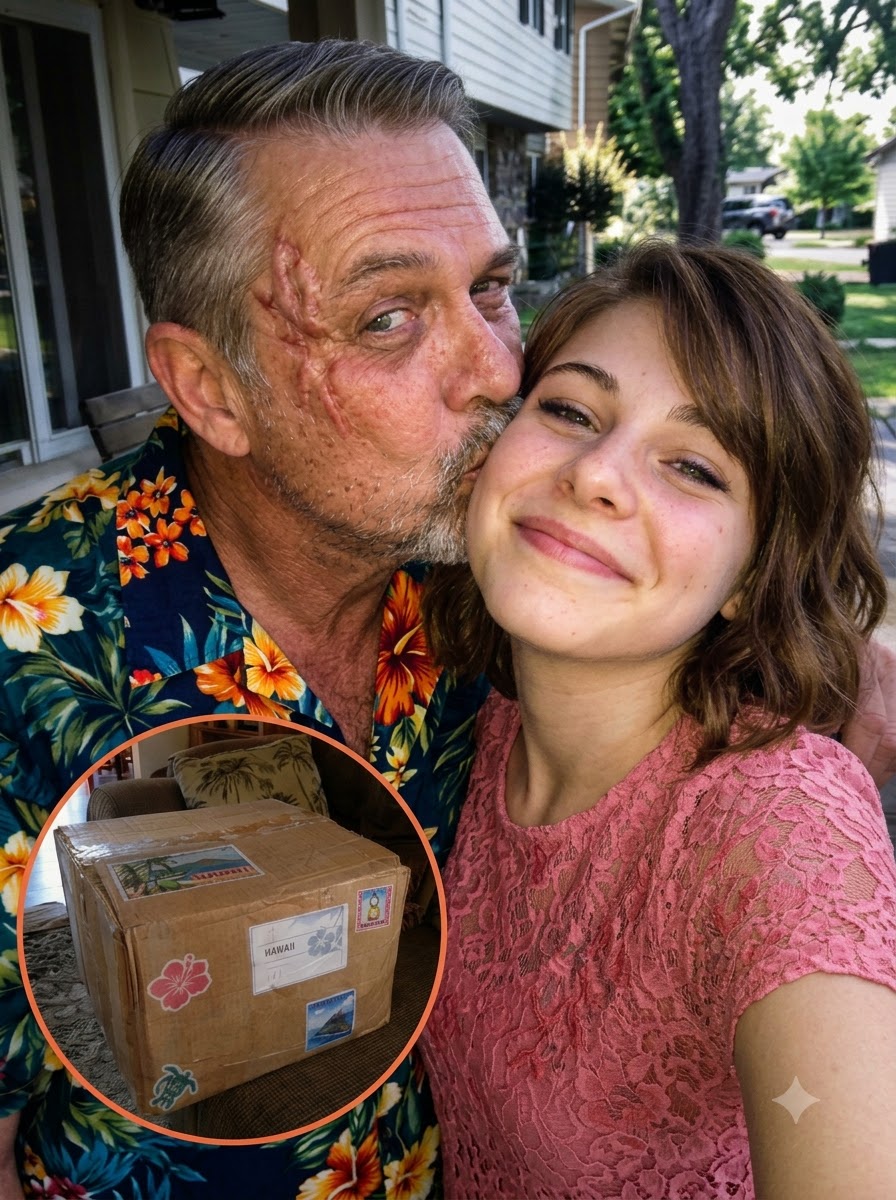
Dad’s eyes.
The same deep brown.
The same little crease at the corners when she smiled.
I began crying again.
Leilani laughed through her tears.
“I know. I saw it in the mirror this morning, too.”
Malia stepped forward.
For a moment, she simply looked at me.
Then she touched my cheek.
“You have his smile.”
I couldn’t speak.
She pulled me into a gentle embrace.
“Thank you for coming.”
Behind us, Mom stood frozen.
Malia noticed her.
The warmth in her expression faded into something more complicated.
Mom stepped forward slowly.
“Malia.”
“Claire.”
Hearing my mother’s name in Malia’s voice was strange.
It was as though two separate chapters of Dad’s life had finally been brought into the same room.
Mom’s hands trembled.
“I don’t expect you to forgive me.”
Malia said nothing.
“I took years from you. From Leilani. From Daniel.”
Her voice broke.
“I was wrong.”
Malia looked at her for a long time.
Then she said quietly, “Yes. You were.”
Mom lowered her eyes.
“I’m sorry.”
Malia’s eyes filled with tears.
“I waited for him for years, Claire. I thought every letter he didn’t answer meant he cared a little less.”
Mom covered her mouth.
“And my daughter grew up believing her father didn’t want her.”
“I know.”
“No,” Malia whispered. “You don’t.”
The words hung between them.
I wanted to intervene.
But I didn’t.
Some pain needed to be spoken aloud.
Finally, Malia took a slow breath.
“I can’t forgive you today.”
Mom nodded.
“I understand.”
“But I won’t let this become another thirty-five years of silence.”
Mom began to cry.
And Malia, despite everything, reached for her hand.
Not in forgiveness.
Not yet.
But in acknowledgment that the truth had finally arrived.
Noah tugged on my sleeve.
“Are you my aunt?”
I looked down at him.
He had Dad’s crooked smile.
“Yes,” I whispered.
He considered that for a moment.
Then he held out a small plastic dinosaur.
“Grandpa Daniel said you liked animals.”
I knelt beside him.
“He told you about me?”
Noah nodded seriously.
“He said you were really good at finding things.”
I laughed.
“Did he?”
“Yeah. He said you always found his hidden Christmas presents.”
I covered my mouth.
Dad had told this little boy about me.
A boy he’d never met.
A grandson he’d never held.
And somehow, across thousands of miles, he had already begun connecting us.
Noah placed the dinosaur in my hand.
“You can borrow this.”
I hugged him.
“Thank you.”
