

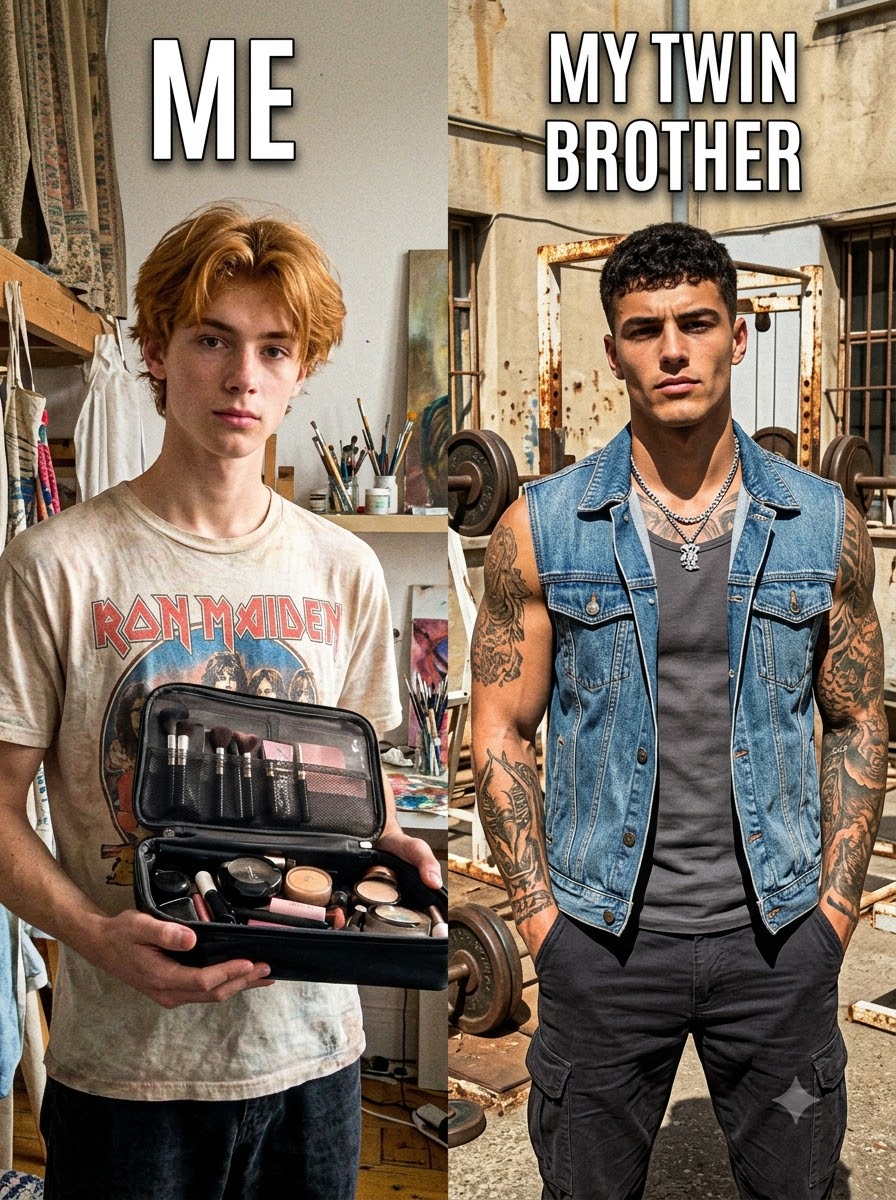
My twin brother, Jake, and I looked almost identical growing up, but by sixteen, nobody would have confused us.
Jake lived at the gym, played football, rode dirt bikes, and seemed to embody everything Dad thought a son should be. I preferred spending time with girls, but not for the reason Dad assumed. After helping a classmate cover a facial scar before prom and seeing her look in the mirror without immediately turning away, I became obsessed with makeup.
I watched hundreds of tutorials and practiced for hours, eventually learning techniques for women with scars, birthmarks, and other visible facial differences. It was never about becoming someone else. It was about giving a person back the face they recognized as their own.
Dad hated it.
“Your brother comes home smelling like a locker room,” he would say. “You come home carrying makeup brushes. Do you have any idea how embarrassing that is?”
Mom defended me whenever she could, but Dad controlled our house. His rules were not suggestions. They were the walls. On our eighteenth birthday he finally gave me an ultimatum: throw away my makeup kit or leave.
I packed.
Mom cried so hard she could barely speak. Jake stood beside Dad and said nothing. As I reached the door, Dad told me, “Maybe living in the real world will finally make a man out of you.”
I did not come back.
Over the next ten years I turned the thing Dad despised into my career. I worked with women who wanted help feeling confident after accidents, surgeries, or years of hiding from cameras. I learned the quiet language of damaged skin—how a burn pulls, how a graft shines under fluorescent light, how a birthmark sits differently after a person has spent a lifetime covering it with their hair. I rented a small studio above a florist. I kept the lights honest and the mirrors clean. Clients came because someone had told them I would not flinch.
My family became strangers. Mom sent a card the first Christmas. After that, even the cards stopped. I told myself I had built a life that did not need their permission. Most days that was true. Some nights it was only a sentence I repeated until I could sleep.
Then, three nights ago, someone knocked on my apartment door.
When I opened it, I almost did not recognize him. His clothes were wrinkled, his eyes were bloodshot, and the hands I remembered as always steady were trembling.
Neither of us spoke for several seconds.
Then he whispered, “I’ll do anything if you come home.”
I nearly laughed.
“Ten years ago, you made it pretty clear I didn’t have a home.”
His face crumpled.
“I know.”
“Then why are you here?”
Dad looked down before asking something that made my anger disappear.
“Didn’t Jake call you?”
“No. Why?”
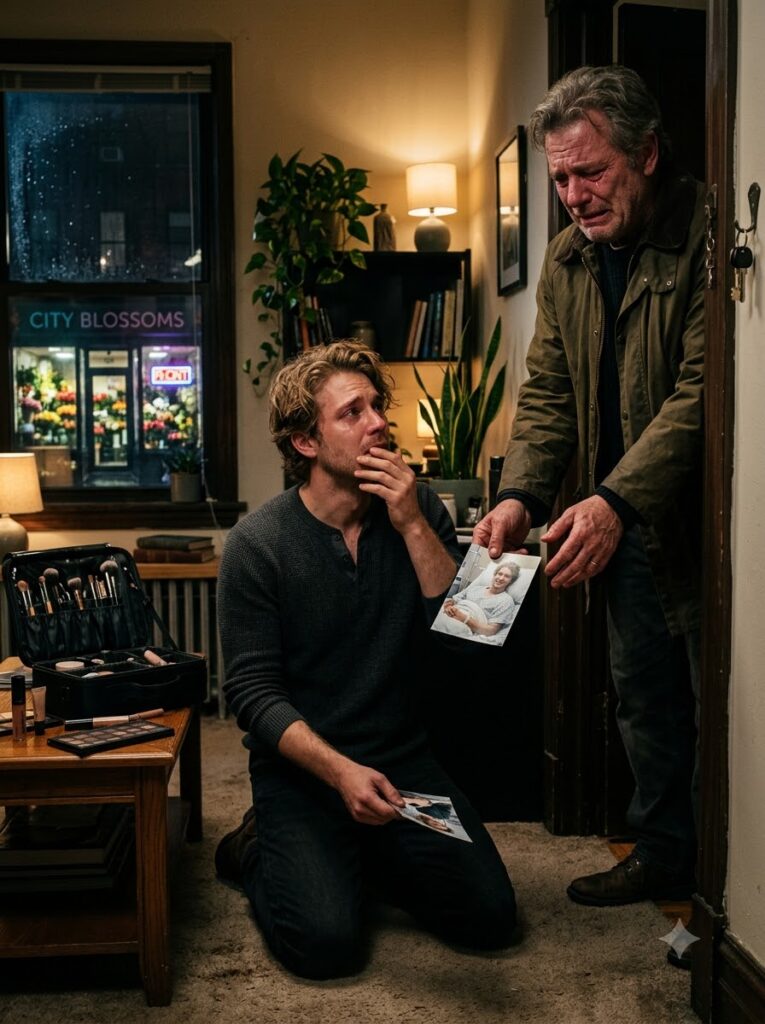
Dad slowly reached into his coat and pulled out a photograph, but he could not bring himself to hand it to me. Instead, he started crying.
“Please, son. Just look at this… and then tell me you still won’t come.”
I took the photo from his trembling hand. When I understood what I was looking at, my breath caught. The photo slipped from my fingers, and I fell to my knees.
It was Jake.
Not the boy who used to fill a doorway. Not the twin whose jersey still hung in a hallway I no longer walked. The man in the photograph was lying in a hospital bed with his head wrapped in white, one eye swollen shut, the skin of his jaw and throat a landscape I knew too well from other people’s files. Burns. Deep ones. The kind that do not end when the fire does. A chart clipped to the rail had his name printed in block letters, as if the letters needed to insist on an identity the face could no longer carry alone.
Dad did not try to lift me. He stood in my doorway with his coat still on and cried the way men cry when they have run out of sentences that used to work.
“When?” I asked, when I could make a word.
“Six weeks ago. Dirt bike. The fire road behind the old quarry. There was fuel. A tree.” He stopped, then forced the rest out. “He asked for you before they intubated him. He said your name twice. I thought he was confused. I thought he meant me.”
I picked the photograph up off the floor. My hands were not steadier than his.
“He did call,” Dad added, quieter. “From a hospital phone. Three times. He wouldn’t leave a message. He said you wouldn’t pick up a number you didn’t know, and he didn’t want the first thing you heard to be a machine. I told him to wait. I told him I would handle it.”
“Handle it,” I repeated.
He flinched as if I had struck him.
I did not invite him in at first. Then I did, because leaving a shaking man on a landing at midnight felt like a cruelty I was not interested in practicing, even toward him. He sat on the edge of my couch like a person who had forgotten how furniture worked. I poured water. He did not drink it.
He told me the rest in pieces.
Two years after I left, Mom had a stroke. Not the kind that makes a speech at a funeral. The kind that turns a house into a schedule of pills and a chair by a window. Jake moved home. He kept the lawn. He drove her to therapy. He learned to braid the thin hair on the left side of her head because her right hand would not. Dad kept going to work because work was the only room in which he still recognized himself.
“She asked for you,” Dad said. “Not every day. Enough. Jake would tell her you were busy. He said it kindly. I let him.”
Mom had died fourteen months ago. No one called. Jake had stood at the grave in a borrowed jacket and told the pastor there were two sons. Only one of them was there.
Something sharp moved under my ribs. It was not forgiveness. It was time I could not get back.
“Why now?” I asked. “Why not the funeral? Why not the first night in the ICU?”
Dad stared at his hands. “Because I still thought I could fix him without admitting I was wrong about you. Because I thought doctors and grafts and time would be enough. Because I am a proud man, and pride is a stupid god, and I served it until it had nothing left to give me.” He swallowed. “Then they took the dressings down last Thursday so he could see himself. He asked for a mirror. He looked for a long time. Then he asked for you again. Not as a brother. As the person who knows what to do when a face stops being a face a man can live behind.”
I thought of the classmate before prom—the first person who had trusted me with a scar. I thought of every client who had sat in my chair and said, before anything else, I just want to go outside without feeling like a problem. I had built a life out of that sentence. I had not built it so my father could show up at midnight and spend it like a coupon.
“I’m not coming home,” I said.
His face folded.
“I’m going to the hospital,” I said. “Those are not the same thing.”
He nodded as if I had granted him a country.
We drove in his truck because mine was in the shop and the night was already too long for taxis. He did not turn on the radio. Twenty minutes outside the city the houses thinned and the dark got honest. I watched his profile in the dashboard light and tried to find the man who had stood in a doorway at eighteen and told me the real world would make a man out of me. That man was still there. He was also smaller. Grief does that. It does not improve people. It only removes the padding.
County General smelled like every hospital: bleach, coffee, the metal of machines that do not sleep. A night nurse recognized Dad and did not smile. She looked at me the way people look at a rumor that has finally grown a body.
“He’s awake,” she said. “He asked if the knock at the door worked.”
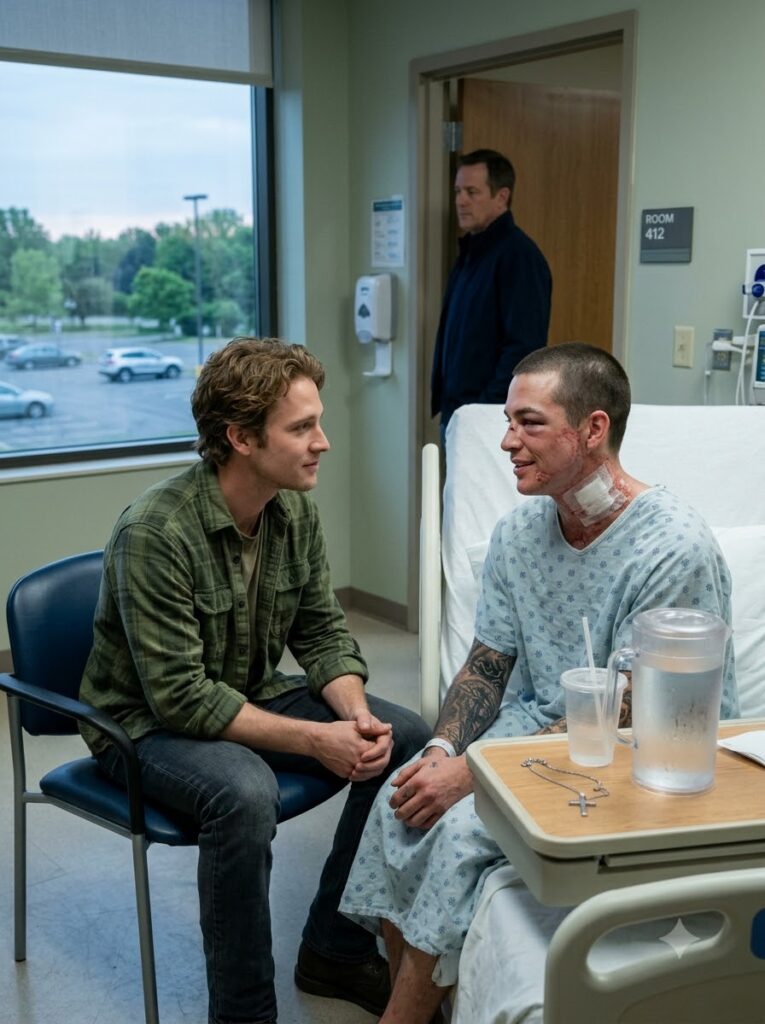
Room 412 faced the parking lot. The television was off. A plastic water pitcher sweated on the tray. Jake was sitting up against the raised bed, a gauze pad taped along the left side of his neck, the rest of him a map I had studied on strangers for a decade. The fire had taken the left cheek, the corner of the mouth, the lower lid, a stretch of throat. Grafts had already begun their slow, shining work. One eye was intact. It found me and did not look away.
For a second we were sixteen again, the same face in two bodies. Then we were not.
“You look old,” Jake said. The words dragged on the left, but the joke arrived on time.
“You look like you lost a fight with a stove,” I said.
His mouth—what was left of the old shape of it—attempted a smile. “Dirt bike. Tree. Fuel line. Very manly. Dad should put it on a plaque.”
Dad made a sound from the doorway and went to find coffee that did not exist.
We were alone.
Jake picked at the edge of the sheet. “I told him not to come to you like a beggar. I told him to tell you the truth and let you decide. He does everything the hard way. Always has.”
“You called,” I said.
“Three times. He said he’d handle it. I should have known what that meant.” He looked at the ceiling. “I didn’t want the first time you heard my voice in ten years to be me asking you for a favor. Then I saw the mirror and I stopped caring about dignity.”
“What do you want?” I asked.
He was quiet long enough that I thought he might not answer. Then he said, “I want to walk into a grocery store without a kid staring. I want to go back to the shop without the new guys doing that polite thing with their eyes. I want Mom’s neighbor to stop crossing the street. I don’t need to look like I used to. I need to look like a person who is allowed to be here.”
I had heard versions of that speech from women who had survived car fires, surgeries, years of hiding. I had never heard it in my brother’s voice.
“I can help with the surface,” I said. “I can’t give you the years. I can’t give you Mom. I can’t make him into someone he wasn’t.”
“I’m not asking for that.” Jake’s good eye was wet and angry and clear. “I’m asking you to do the thing he threw you out for. That’s the whole joke. That’s the whole rotten joke.”
I sat in the visitor chair. The vinyl stuck to the back of my legs.
“He told me you braided her hair,” I said.
Jake’s throat moved. “Somebody had to. He could lift her. He could pay the bills. He could not look at the part of her that had changed and still call it her. I learned. It wasn’t noble. It was Tuesday.”
“You should have called me then.”
“I know.” He said it without defense. “I stood next to him when you left. I said nothing. I told myself it wasn’t my fight. Then it became every fight and I still didn’t pick up the phone, because I was afraid you’d tell me to go to hell and I would have deserved it.”
I let that sit between us. I did not take it away from him. Some debts are not improved by being called something softer.
“I’ll come in the morning,” I said. “Bring a kit. We’ll see what the skin will accept. No promises about pretty. Promises about possible.”
Jake exhaled as if he had been holding a decade.
“Thank you,” he said.
“Don’t thank me yet. Thank me if you can buy milk without putting your hood up.”
Dad came back with two paper cups and nothing to say that would have helped. I took one cup because my hands wanted an object. We did not hug. We did not rewrite the doorway. I told him I would drive myself in the morning. He nodded, and for the first time in my memory he did not try to turn a nod into a rule.
I did not sleep. I sat at my studio table above the florist and laid out what I would need: silicone-based foundations that would sit on graft without sliding, pigments that understood red and brown and the yellow that burns leave behind, a stipple sponge, a palette I had mixed for a woman named Priya whose left cheek had met a motorcycle exhaust in July. I wrote notes I did not need. The work was already in my hands. What I was doing was giving the night a job so it would not invent a worse one.
At dawn I texted a client to move her appointment. She wrote back, Take care of your people. I stared at the words. I had not thought of them as mine in a long time.
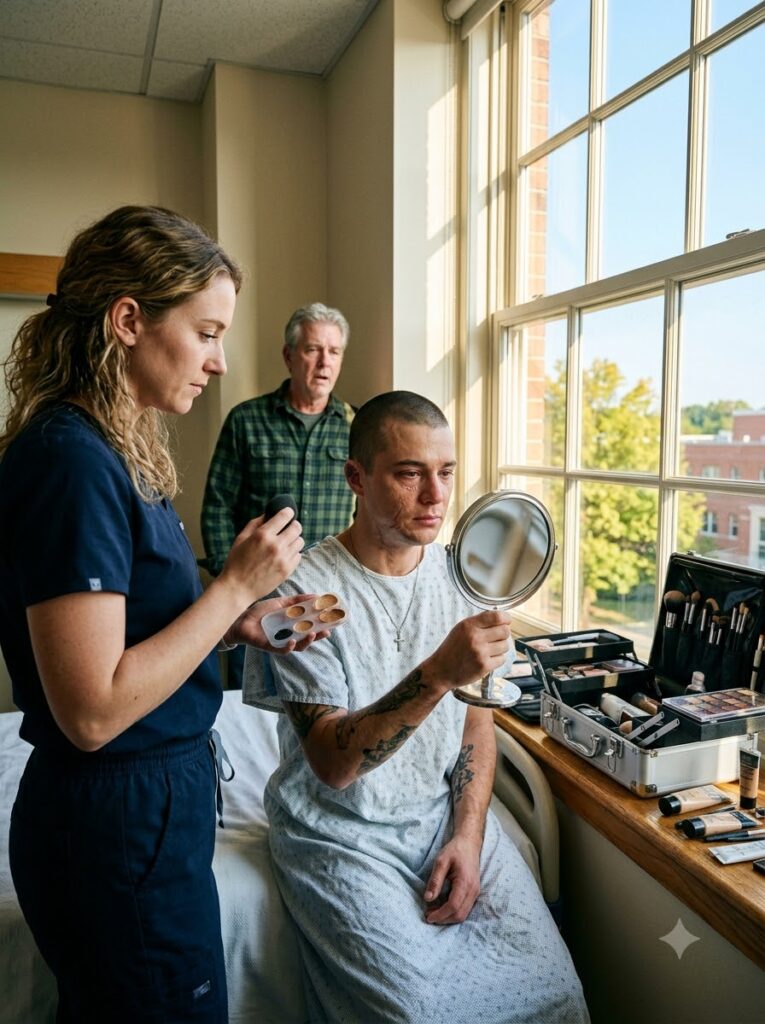
County General in daylight is a different country. Machines sound less like verdicts. Jake had been washed. The nurse had left the good side of his face uncovered, an accidental courtesy. I set up at the window where the light was honest.
“This is not magic,” I told him. “This is geometry and patience. If something pulls, you say so. If you hate it, we take it off. You are not a canvas. You are the client.”
“Yes, boss.”
I started with what the fire had not taken—the unburned brow, the living eye—and built toward the damage instead of attacking it. That is the first mistake amateurs make. They try to erase. Erasure looks like a mask. A mask looks like shame. What I do, when I do it right, is negotiation. I ask the scar what color it wants to be in this room, under this light, on this Tuesday, and I answer without flinching.
Dad stood in the corner and watched. He did not speak. Once he leaned forward when I mixed a tone that matched the skin at Jake’s temple, and I saw his mouth open around a question he did not ask. I let him keep it. Some educations have to happen in silence.
An hour in, Jake looked at the hand mirror I held up and went very still.
It was not the old face. It would never be the old face. What it was: a man who could be glanced at and then glanced away from, which is the ordinary mercy most people never know they are receiving. The graft still shone if you knew where to look. The lid still sat a fraction low. But the map had become a country a person could live in.
Jake’s good eye filled.
“Say it,” I said.
“I look like I got in a fight and won,” he said. “I can work with that.”
Dad made the sound again. This time he did not leave the room.
I packed the kit slowly so no one would have to invent the next sentence too fast.
“I’ll show you how to do the morning version yourself,” I said to Jake. “Twenty minutes. Less when you stop being precious about the sponge. Fridays I’ll come out and we can correct whatever the week does.”
“Fridays,” Jake said, as if the word were a place.
Dad cleared his throat. “I still don’t understand half of what you do with those bottles. But I understand what it is for.” He looked at the floor, then at me, then at the floor again. “If that invitation is still possible—not the house. You. If you’ll come to dinner. I’ll cook. I won’t talk unless you want me to.”
I looked at Jake. Jake shrugged one shoulder the way he used to before a game, except now the gesture cost him something and he offered it anyway.
“I’ll come to dinner,” I said. “I’m not coming home to be made into someone else. I’m coming as the man the real world actually made.”
Dad’s eyes shone in the late morning light. He did not reach for the old sentence. He had spent ten years learning, too late and still not too late, that some doors only open from the outside if the person who closed them is willing to stand there without demanding a costume.
That night I sat at a table I had not seen since I was eighteen. The plates did not match. The meat was a little dry. No one pretended the years had been a misunderstanding. On the sideboard there was a framed picture of Mom from before the stroke, and beside it a later one Jake must have taken: her in the window chair, a braid over her left shoulder, looking at something past the camera that I would never get to ask about.
We passed the salt.
Jake told a story about a nurse who had teased him for asking whether foundation came in football colors. Dad laughed once, startled by the sound of himself. I watched my brother’s profile in the kitchen light—the mapped skin, the living eye, the courage it took to be seen—and understood at last what the photograph had been asking.
It had not been a plea for me to become the son my father wanted.
It had been a plea for the son I already was to come and do the work only he knew how to do: not to hide a life, but to give a man back enough of his face that he could walk into the rest of it.
After the plates, Dad went to the sink and stayed there longer than dishes required. I found, in the drawer where Mom used to keep rubber bands, a small envelope with my name on it in her uneven post-stroke hand. Jake saw me holding it and nodded once. He had kept it. He had not opened it. He had not earned the right to, and he knew that.
I read it in the hallway, under the same bulb that had lit my leaving.
I told him not to. I told him a house is not a test. If you are reading this, I did not get to say it in a voice you would recognize. You were never the embarrassment. You were the one who looked at a hurt and did not turn away. That is a kind of man I understand. I am sorry I was not louder. I am proud in the quiet way. Come if you can. If you cannot, be kind to the boy who braids my hair. He is trying in a house that does not know how to say so.
I put the letter in my jacket. Some things do not belong on a table the first night back.
I stayed through coffee. I washed the dishes because my hands needed a simple job. When I left, Dad walked me to the car and stopped short of an embrace, which was honest. He said my name the way a person says a word they have practiced alone.
“Thank you for not throwing away the kit,” he said.
I looked at him over the roof of the car. “Thank you for finally seeing what it was.”
On the drive back to the city I passed the florist beneath my studio. The windows were dark. Upstairs, the chair would be waiting in the morning, and with it the next person who needed to look in a mirror without immediately turning away. I had built that room out of the thing I was told would unmake me. It had not unmade me. It had made a way home that did not require me to disappear.
Jake texted just after midnight, the letters careful, the humor intact.
Same face. Better lighting. See you Friday.
I turned the phone face down on the passenger seat and let the highway take me. Behind me, a father was learning how to live with the son he had, and a brother was learning how to be looked at again. Ahead of me was the work. The work had always been the point. The rest—the knocking, the photograph, the knees on my own floor—was only the long road back to a truth I had known at eighteen and carried anyway.
A man is not made by what he is told to put down. He is made by what he refuses to stop offering the world, even when the world, and his own father, call it by the wrong name.
